JEE Drop Year Decision: Should You Take a Drop After Class 12? (2027)
Taking a JEE drop year is worth it if you genuinely underperformed due to avoidable reasons — procrastination, weak mentorship, or preparation gaps — and you have the drive to fight harder for one more year. Students who scored between 94 and 99 percentile especially have a strong case: they are just 3–4 questions away from an IIT seat. The decision must come from honest self-reflection, not pressure from relatives or fear of judgment.
Table of Contents

eSaral › JEE › JEE Main ›JEE Drop Year Decision

🚀 Checkout eSaral Courses
Who Should Definitely Take a JEE Drop Year?
You Genuinely Underperformed for Fixable Reasons
If your Class 12 result was below 93 percentile and you can honestly identify why — procrastination, poor mentorship, a weak teacher in one subject, no structured guidance, or personal circumstances — a drop year is almost certainly the right call.
Why? Because none of those reasons are permanent. They are fixable.
The students who regret not taking a drop year vastly outnumber those who regret taking one. The regret of "I never gave it my real shot" tends to last a lifetime.
| Reason for Underperformance | Fixable in Drop Year? |
|---|---|
| Procrastinated consistently | Yes |
| Weak teacher in one subject | Yes — change your source |
| No mentorship or guidance | Yes — structured batch solves this |
| Did not revise basics on time | Yes |
| Personal/family crisis | Yes — with the right support system |
| Did not understand the exam pattern | Yes |
💡 Expert Tip by Saransh Gupta, IIT Bombay AIR-41: If you cannot name at least 2–3 specific mistakes you made in your preparation last year, you have not reflected honestly enough. Naming the mistake is the first step to fixing it. Do that exercise before deciding.
You Are Getting Nothing Worthwhile Right Now
If your current options are limited to private colleges with uncertain placements, inflated fees, and facilities that don't match what was promised — a drop year gives you a genuine shot at something better.
Several students take the sunk-cost route: they join an expensive private college because they already "wasted" two years. But the next three to four years in the wrong institution often cost far more than one focused drop year.
Who Should Think Twice Before Dropping?
Students Who Are Mentally Done With Preparation
A JEE drop year requires intense, sustained effort. If, after two years of preparation, you genuinely feel you cannot study at that level for another year, respect that decision. A disengaged drop year almost always produces worse results than the original attempt.
The honest question is: Do I still want to fight, or do I want it to be over? Both answers are valid. Only one of them justifies a drop year.
Students Expecting a Guaranteed IIT
No drop year comes with a guarantee. If your primary reason for dropping is "I will definitely get IIT next year," reconsider. The right reason to drop is "I want to give myself the fullest chance to improve — whatever the outcome." That mindset produces results. Entitlement does not.
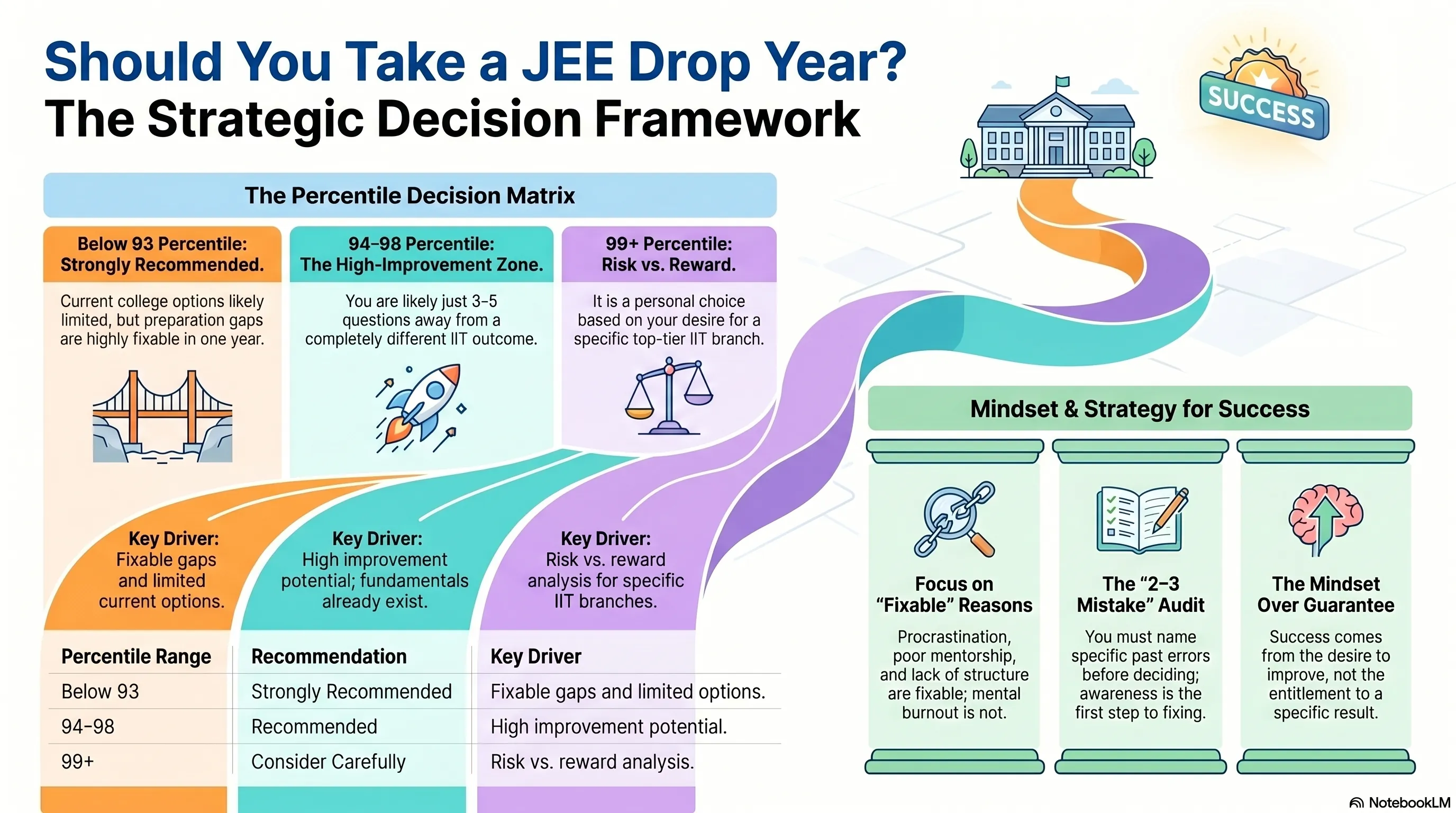
What Percentile Range Are You In? A Decision Framework
Your JEE Main percentile is a useful starting point for the drop year decision. Here is a breakdown of how to think about each range.
Below 93 Percentile — Drop Year is Strongly Recommended
At this range, the options available right now are limited. Private colleges in this bracket often have placement records and infrastructure that fall short of what students expect. The gap between your current level and IIT is real — but it is absolutely closeable in one focused year.
Students who felt they had systemic problems — wrong batch, no mentorship, weak subject teaching — belong squarely in this category. Those problems can all be fixed.
94 to 98 Percentile — Strong Case for Dropping
This is where the math is most compelling. At 94–98 percentile, you are roughly 3 to 5 questions away in JEE Advanced from a completely different outcome. You already have strong fundamentals. You know the exam. You just need a more targeted year of practice and problem-solving.
💡 Expert Tip by Prateek Gupta, eSaral Faculty: Students in this range often underestimate how close they already are. They built 90% of the engine in two years. The drop year is about tuning the last 10% — and that 10% is the difference between IIT and no IIT.
Almost every student eSaral has seen in this percentile range who took a drop year improved their JEE Main score in the next attempt. Knowledge does not disappear in a year — it compounds.
| Percentile Range | Drop Year Recommendation | Key Reason |
|---|---|---|
| Below 93 | Strongly Recommended | Limited current options; fixable gaps |
| 94–98 | Recommended | Very close to IIT; high improvement potential |
| 98–99+ | Personal Decision | Risk-taking capacity is the key variable |
| 99+ | Consider Carefully | Good NIT/IIT available; risk vs reward analysis needed |
98 to 99+ Percentile — It Depends on Your Risk Appetite
This is where the decision becomes genuinely complex. You likely have decent NIT options on the table. A drop year is not obviously necessary — but it is not obviously wrong either.
Students who have a specific IIT branch in mind — Computer Science at IIT Bombay, for example — and are willing to take the risk should consider it seriously. Several AIR Top 100 rankers in recent years were drop year students. Rank 3 in eSaral's own history was a dropper.
The question here is not "will I definitely improve?" It is "am I the kind of person who can commit fully to one more year?" If the answer is yes, the upside is substantial.
Do JEE Droppers Actually Improve? Real Data and Examples
The narrative that "droppers don't improve" does not survive contact with real data.
In eSaral's JEE batches, students who came in at 94–98 percentile and enrolled in the dropper program consistently improved their JEE Main percentile in the next attempt. Several moved from no IIT to IIT.
Some real student journeys from eSaral's dropper batches:
- A student with 1 lakh rank in JEE Main went on to crack IIT Bombay
- A student with 90,000 rank cracked IIT Roorkee after one year
- A student with 3 lakh rank reached IIT Kharagpur
- Uday Shankar — visually impaired — cracked IIT in his drop year and is currently at IIT Hyderabad
These are not outliers manufactured for brochures. These are students who identified their gaps, took a structured approach, and executed.
It is also worth noting the broader context: many students who crack JEE with Top 100 ranks today started their preparation in Class 10. They effectively had three to four years of preparation. A JEE dropper is simply giving themselves that equivalent third year — the year many top rankers used to build their edge.
How Does a Drop Year Prepare You Differently?
The Preparation Strategy Shifts Completely
A well-structured drop year is not a repeat of Class 11 and 12. For students with 94+ percentile, it is not about re-learning theory from scratch. Their conceptual foundation is already solid.
What changes in a drop year:
- Intensive problem practice — More questions, more test series, faster solving
- Targeted weak-area work — Identifying the 3–4 question types that cost marks
- Exam temperament — Managing pressure, time, and calculation errors
- Personalised mentorship — A mentor who knows your specific gaps and addresses them
Students below 94 percentile may need more foundational work — and a good dropper program accounts for that too, asking students upfront about their needs.
The Mindset is That of an Experienced Player
First-time JEE aspirants are still learning the exam. Droppers know the exam. They know which topics are high-yield, which question types trip them up, and how the pressure of the final exam feels. That experience is a genuine advantage — if channelled correctly.
Common Mistakes to Avoid in Your JEE Drop Year
Many students take a drop year with the right intention but make avoidable errors that undo the potential of that year.
1. Starting slowly because "you have a whole year" The drop year flies by. Students who coast through the first four months — thinking they can peak at the end — rarely do. Treat Month 1 with the same urgency as Month 11.
2. Repeating the same preparation style that did not work before If your Class 12 approach failed, doing the same thing in the drop year will likely produce the same result. Change your resources, batch, mentorship, or study method — at least one major variable needs to change.
3. Letting external opinions affect your focus Relatives, neighbours, and even well-meaning friends will have opinions. Some will discourage. Some will add pressure. Their opinions are not data. Your preparation is.
4. Skipping test series and mock exams Many droppers over-study theory and under-practice under exam conditions. JEE is a timed, high-pressure exam. Mock tests are the only way to prepare for that specific condition.
5. Not having a mentor to correct your approach mid-year Studying hard in the wrong direction is worse than not studying hard enough. A mentor who monitors your tests and adjusts your focus is not a luxury — it is the highest-leverage investment a dropper can make.
🚀 Checkout eSaral Courses
Frequently Asked Questions
Find answers to common questions.
Should I take a JEE drop year if I got 94 percentile in JEE Main?
Yes, a drop year is strongly worth considering at 94 percentile. You are approximately 3–4 questions away from a fundamentally different JEE Advanced outcome. Students in this range who took a structured drop year at eSaral consistently improved their percentile and many cracked IIT. Your knowledge base is solid — the gap is in practice and problem-solving depth.
Do JEE dropper students actually get better ranks?
Yes, most do — provided they follow a structured plan and address the specific gaps from their previous attempt. eSaral's dropper batches have produced students who went from 1 lakh rank to IIT Bombay and 3 lakh rank to IIT Kharagpur. The improvement is real, but it requires a different approach than the original attempt, not just more of the same.
Is a JEE drop year worth it if I can get a decent private college?
It depends on what "decent" means in your specific case. Many students who join private colleges after JEE find that the placement records, infrastructure, and peer environment did not match what was promised. A drop year at least gives you a chance to avoid that outcome. The key question: will you regret not giving IIT your full shot?
How is drop year JEE preparation different from Class 11–12 preparation?
Dropper preparation is more targeted and exam-focused. Students above 94 percentile do not repeat theory from scratch — they focus intensively on problem practice, test series, and fixing specific weak areas. Mentors calibrate the plan based on the student's existing level. Droppers are experienced players learning to perform — not beginners learning the subject.
What percentile do I need to take a JEE drop year?
There is no fixed minimum — the decision depends on your reasons for underperforming and your motivation to improve. That said, students below 93 percentile almost always have a clear case for dropping, since current options are limited. Students between 94 and 99 have a strong mathematical case. Students above 99 need to weigh their specific options and risk tolerance carefully.