JEE Dropper Batch 2027: Should You Drop, How to Prepare, and What Actually Works
JEE Dropper Batch 2027 guides aspirants on making a successful drop year through a structured 4-phase study plan, expert mentorship, multiple syllabus revisions, regular mock tests, and proven strategies that have helped thousands of students secure admission to top IITs.

Table of Contents

eSaral › JEE › JEE Main ›JEE Dropper Batch 2027

🚀 Checkout eSaral Courses
Should You Drop for JEE 2027?
JEE Advanced 2026 result did not go your way. One subject pulled you down. Negative marks added up. The rank you needed for your dream IIT branch stayed out of reach. Now the question everyone around you is asking — and the question you are asking yourself — is whether to drop.
The answer depends on one thing: how much the difference between IIT and a lower-ranked college will matter across your career.
💡 Expert Perspective by NK Gupta, IIT Kanpur PhD: "The next 80 years of your life will carry either an IIT tag or a normal college tag. That choice gets made in this one year. I have seen thousands of students take a drop and reach their dream IIT. Do not compromise."
IIT vs NIT: Why the Gap Is Real
| Parameter | IIT (Top 7) | NIT / Other Colleges |
|---|---|---|
| Research infrastructure | World-class labs | Limited |
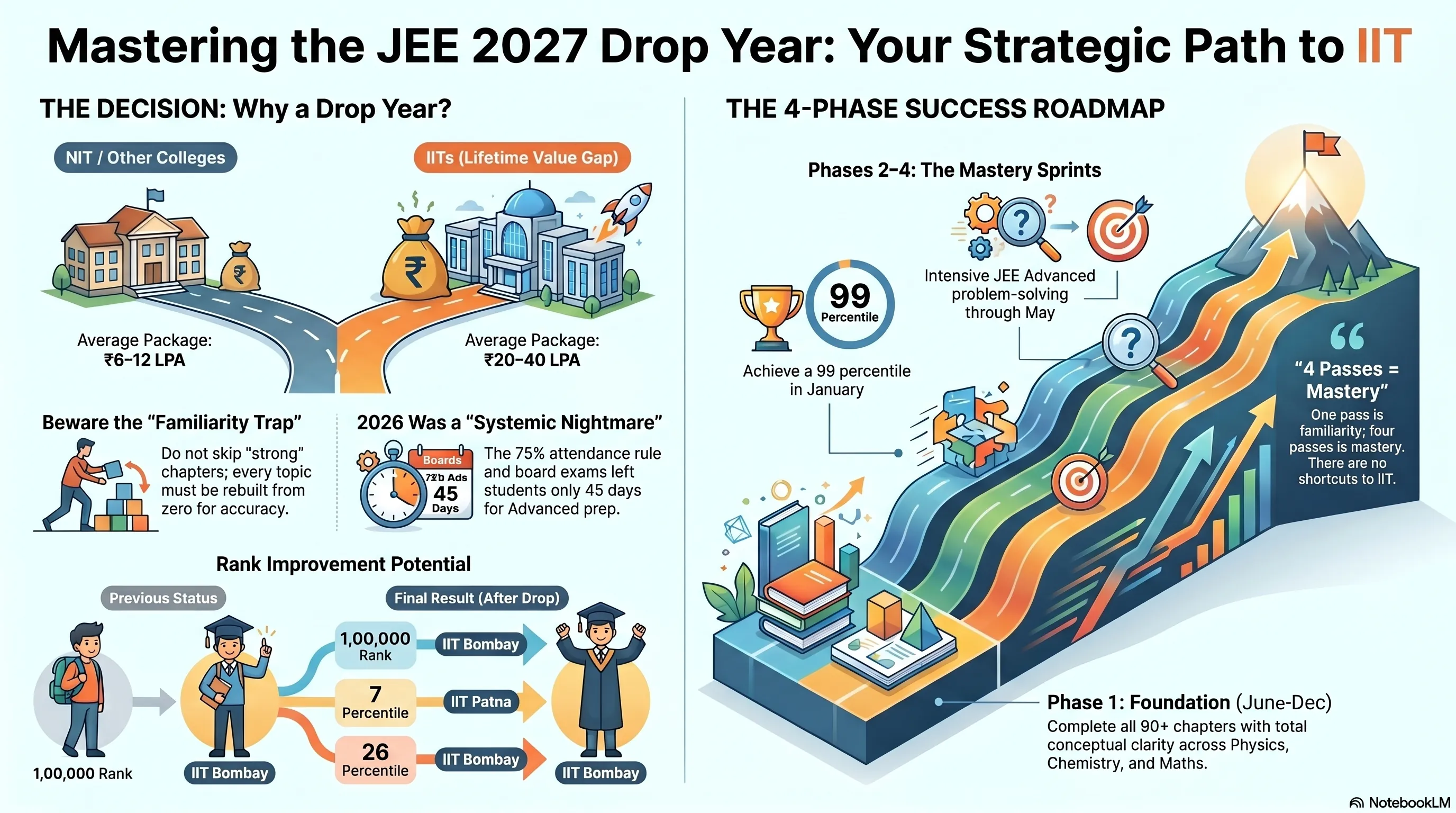
| Placement package (avg.) | ₹20–40 LPA | ₹6–12 LPA |
| Alumni network | Global, high-density | Regional |
| Startup / research access | Extensive | Limited |
| Social signal | Lifetime credential | Moderate |
| JEE rank required | Under ~5,000 | Under ~50,000 |
The decision is not about one year of your life. It is about the next 40 years of your career. If you wanted IIT Bombay Computer Science or IIT Delhi Electrical Engineering and you did not get there, a structured drop year is a legitimate path — not a failure.
That said, dropping without a plan is the only real mistake you can make. The rest of this guide is about ensuring you do not make it.
Why Your JEE 2026 Result Is Not Your Fault
Before you plan your drop year, you need to understand what actually happened — because most JEE 2026 aspirants faced a systemic disadvantage that had nothing to do with their intelligence.
The 75% Attendance Rule Created a Study Calendar Nightmare
From December onwards, you faced pressure to hit the 75% attendance mark. Pre-boards, practicals, and board exam prep pulled your focus away from JEE. Then, within days of finishing pre-boards, JEE Main Session 1 arrived in January — on top of a full Class 11 + 12 syllabus you barely had time to revise once.
Boards ran from February 15 to March 15. That wiped out another month. Then JEE Main Session 2 came in early April, giving you barely 15 days to prepare for a paper that demands months of revision.
45 Days for JEE Advanced Was Not Enough
After JEE Main qualification, you had roughly 45 days to prepare for JEE Advanced — covering 90+ chapters at the deepest conceptual level. Even students who were consistently strong found their contact with topics had broken down after months of switching between boards and JEE prep.
💡 Expert Note by NK Gupta, IIT Kanpur PhD: "In my 37 years in Kota, I have never seen students work as hard under as much pressure as this generation. You qualified for JEE Advanced under these conditions. That itself proves you have what it takes."
This is why your drop year does not start at zero. You are starting with a base, with awareness of your weak areas, and with a full calendar — no boards, no 75% pressure, no split focus.
What Dropper Students Do Wrong (And How to Avoid It)
A drop year fails not because of the student — it fails because of specific, avoidable mistakes. Here are the most common ones:
Mistake 1: Treating Strong Chapters as Done
Many droppers assume chapters they scored well in during Class 12 can be skipped or lightly revised. This is the single biggest trap.
Even if a chapter felt strong last year, a whole year of minimal contact has eroded it. JEE Advanced demands accuracy, not familiarity. Every chapter must be rebuilt from zero — conceptual level first, then JEE Main problems, then JEE Advanced problems.
Think of it this way: a batsman who scored a century last match still goes into the nets every day before the next match. The century does not exempt him from preparation.
Mistake 2: Unequal Focus Across PCM
Most droppers have one weak subject that brought down their rank. The instinct is to over-invest in that subject while neglecting the others. This creates a new imbalance.
PCM must receive equal, structured attention throughout the year — not reactive attention based on recent test scores.
Mistake 3: Not Doing Mock Tests Systematically
Reading and solving questions is not the same as exam performance. Droppers who do not take full-length mock tests under timed conditions — and analyse them rigorously after — consistently underperform relative to their preparation level.
Mistake 4: Studying Without Mentorship
A drop year without regular mentorship is just self-study with anxiety. You need someone to track your regularity, analyse your test results, identify your backlogs, and adjust your plan. Without that feedback loop, preparation drifts.
How to Structure Your Drop Year: A 4-Phase Study Plan
A successful JEE 2027 drop year follows four clear phases. Here is how each one works:
Phase 1 — Foundation Rebuild (June to Mid-December)
Complete the full JEE syllabus from the ground up. Every chapter, every subject, starting from conceptual clarity. Do not rush chapters you think you already know.
Monthly targets:
| Month | Focus |
|---|---|
| June–July | Full Class 11 Physics + Chemistry: conceptual level |
| August–September | Full Class 11 Maths + Class 12 Physics start |
| October–November | Class 12 Chemistry + Class 12 Maths |
| December (first half) | Complete Class 12 Physics; full syllabus first pass done |
By mid-December, you should have completed a first full pass of all 90+ chapters across PCM.
Phase 2 — First Revision + JEE Main Focus (December to January)
Starting from early December, begin your second full pass through the syllabus — this time at JEE Main problem level. Full-length mock tests every week. Deep post-test analysis after every test.
Target: 99 percentile in JEE Main Session 1.
Phase 3 — JEE Main Session 2 + Advanced Start (February to April)
After JEE Main Session 1, the focus shifts to JEE Advanced-level problems. Third complete pass through the syllabus, integrating previous year JEE Advanced problems (PYQs) chapter by chapter.
JEE Main Session 2 (April) will take care of itself — your Advanced-level preparation will push your Main score higher than Phase 2.
Phase 4 — JEE Advanced Sprint (April to May)
Fourth and final pass. Exclusively JEE Advanced problems, full-length Advanced mock tests, and systematic weak-area targeting. Every sub-topic you have been avoiding must get resolved in this phase.
💡 Expert Tip by NK Gupta, IIT Kanpur PhD: "Four complete passes through the syllabus is what separates top 100 rankers from top 5,000. One pass is familiarity. Four passes is mastery. There is no shortcut to this."
Real Students Who Cracked IIT After Dropping
The most important data point when considering a drop year is not theory — it is what actual students have done.
Here are verified outcomes from eSaral students who took a drop year:
| Student | Starting Condition | Result After Drop |
|---|---|---|
| Soor | Joined eSaral June 8; father passed away mid-session | IIT Kharagpur (JEE 2026) |
| Yamaan | 1 lakh rank in previous attempt | IIT Bombay |
| Shweta | 3 lakh rank | IIT Kharagpur |
| Priya | 90,000 rank | IIT Roorkee |
| Ayush | 78,000 rank | IIT Bombay |
| Bansidhhar | 7 percentile | IIT Patna |
| Manjari | 88 percentile | IIT Kanpur |
| Aman | 26 percentile | IIT Bombay |
| Uday Shankar | Visual impairment | IIT Hyderabad |
In eSaral's JEE 2026 results, over 1,600 students cleared JEE Advanced — with India's highest selection ratio among online platforms. More than half of those selections came from the dropper batch.
There is also a personal example worth sharing. Prateek Gupta, son of NK Gupta and now an eSaral faculty member, did not qualify JEE in his first attempt. He chose to drop, set his goal as IIT Bombay specifically, and did not stop until he got there. If he had compromised and taken a lower-ranked college, the outcome of his career — and the thousands of students he now teaches — would have been entirely different.
Is eSaral's JEE Super Warrior Batch Right for You?
eSaral's JEE 2027 Super Warrior Course is built specifically for dropper students. It is available in both online and offline (Kota Gurukul) modes.
Here is what the course delivers:
Four complete course passes: The syllabus is covered four times across the academic year, aligned precisely with the Phase 1–4 plan described above.
5-layer mentorship: Attendance tracking, homework review, test analysis, backlog sessions, PTM with parents, and personal rank analysis. You are never preparing alone.
Interactive live classes: Online students get unmuted, real-time interaction — not recorded lectures or chat-based support. Offline students at the Kota Gurukul get direct classroom access to the same faculty.
300+ tests + AI-powered analysis: Every test generates a sub-topic-level AI report that identifies weak areas and recommends the next questions to solve. Over 500 practice questions per chapter.
Rank Booster content: Extra question banks unlock progressively as you advance — targeting top 100 ranks for students who complete all levels.
Live doubt solving: Online students get live doubt classes. Offline students have dedicated doubt counters available throughout the day.
If you want structured JEE dropper preparation with faculty who have seen thousands of students through this exact journey, eSaral's Super Warrior batch is built for this.
🚀 Checkout eSaral Courses
Frequently Asked Questions
Find answers to common questions.
Is dropping a year for JEE 2027 worth it?
Dropping for JEE 2027 is worth it if your target is a specific top IIT branch and your 2026 result fell short due to preparation gaps — not fundamental inability. Students who drop with a structured plan and proper mentorship consistently outperform their previous attempts. Compromising on your dream IIT means carrying that regret for decades.
Is eSaral good for JEE droppers?
Yes — eSaral's JEE dropper batch has produced some of India's strongest results, with over 1,600 JEE Advanced selections in 2026, more than half from dropper students. The 5-layer mentorship system, four complete syllabus passes, and AI-powered test analysis are specifically designed for repeat aspirants who need structured accountability.
What is the difference between eSaral online and offline for dropper students?
Both modes cover the same syllabus, faculty, and four-pass structure. eSaral's Kota Gurukul offline centre offers in-person classes with direct faculty access and on-site doubt counters. The online mode offers interactive live classes where students are unmuted and directly engaged — not passive video watching. Choice depends on whether you benefit more from a physical study environment or location flexibility.
How many hours should a JEE dropper study per day?
JEE dropper should target 8–10 focused study hours per day — not 14 hours of sitting. What matters more than total hours is structured time: dedicated subject slots, daily test practice, and consistent chapter-by-chapter revision. Untracked self-study without a mentor review loop rarely translates into rank improvement.
Can a student with a very low JEE rank crack IIT after dropping?
Yes — multiple verified examples exist. Shweta improved from a 3 lakh rank to IIT Kharagpur. Bansidhhar improved from 7 percentile to IIT Patna. Aman improved from 26 percentile to IIT Bombay. These are not outliers; they are the consistent pattern when a dropper student follows a disciplined, mentor-led preparation plan.