JEE Dropper Year Strategy: How to Rebuild and Crack IIT in 2027
This guide explains why a JEE drop year can become a powerful comeback opportunity when used with structure, mentorship, disciplined revision, and consistent mock testing — showing how many students transformed setbacks into IIT success through focused preparation with eSaral.
Table of Contents
- Why Not Qualifying for JEE Advanced Does Not Define You
- Should You Take a Drop Year for JEE? The Honest Answer
- Drop Year vs Compromising: What the Data Actually Says
- How Is a Dropper Year Different from a Repeat Year?
- What to Do in the First 30 Days of Your JEE Dropper Year
- How to Study in a Drop Year: Month-by-Month Roadmap
- Real Students Who Bounced Back: eSaral Success Stories

eSaral › JEE › JEE Main › JEE Dropper Year Strategy

Why Not Qualifying for JEE Advanced Does Not Define You
A three-hour paper does not measure your intelligence, your capability, or what your life will look like 10 years from now. This is not motivation — it is fact.
JEE Advanced tests conceptual depth under pressure. It is one of the hardest entrance exams in the world. Getting a 60% in JEE Advanced can get you into IIT Bombay. That alone tells you how difficult the benchmark is.
The System Was Working Against You
Here is what actually happened in your Class 12 year:
- November–December: Pre-boards and school practicals pulled you away from JEE revision
- January: JEE Main 1 arrived when your course completion was still fresh and unrevised
- February–March: Final board exams consumed every hour
- April: JEE Main 2 gave you 15–20 days of actual prep time at best
You were not under-prepared. You were under-timed. Students who qualified for JEE Advanced alongside boards are in the minority — and most of them had either exceptional prior coaching structures or favourable timing.
💡 Expert Tip by Prateek Gupta, IIT Bombay: "I always tell students: don't judge the result until you've separated what was in your control from what wasn't. The board-JEE clash is a systemic problem. Your potential is unchanged. Your knowledge is not gone. Your score in one paper is not your ceiling."
Should You Take a Drop Year for JEE? The Honest Answer
Yes — if clearing JEE Advanced and joining an IIT is genuinely your goal, taking a structured drop year is the right call. This is not a statement made to sell a batch. It is backed by 20+ years of coaching data.
What the Numbers Say
| Category | Approximate % of JEE Applicants |
|---|---|
| Fresh Class 12 students | ~53% |
| Drop-year (repeater) students | ~47% |
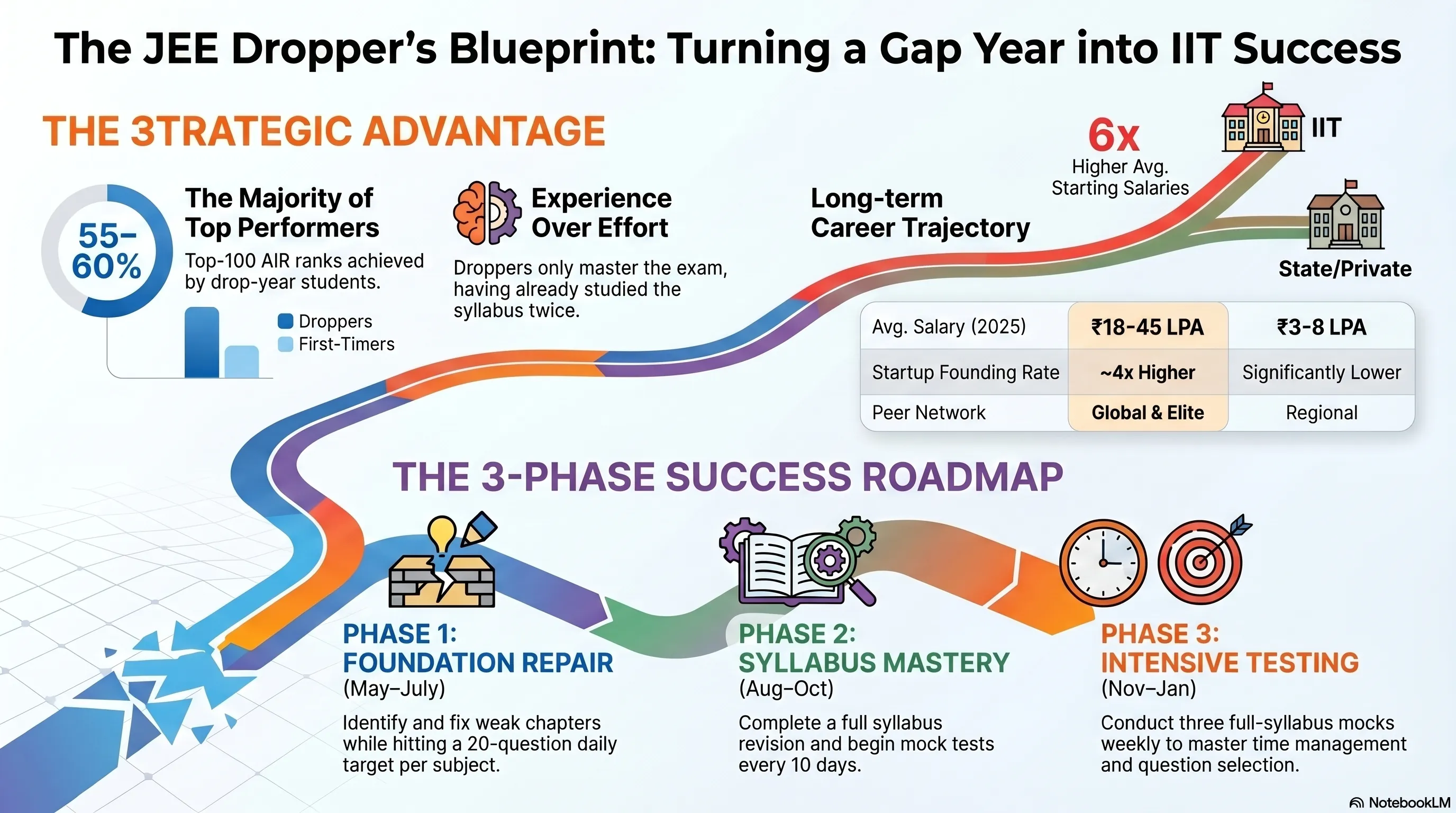
| % of top-100 AIR from drop year | ~55–60% |
According to NTA official data, nearly half of all JEE Main applicants each year are drop-year students. And in the top ranks, the majority come from this group — because they enter with experience, not just effort.
What a Drop Year Actually Gives You
- You have already studied the full 2-year syllabus once. You are not learning from scratch.
- You know exactly where you lost marks — and why.
- You have sat through two JEE Main papers. You know the format, the timing, and the pressure.
- You have zero board exam pressure this time. Your full focus goes to JEE.
That combination — prior syllabus exposure + exam experience + focused preparation — is statistically the strongest position a JEE aspirant can be in.
💡 Expert Tip by N.K. Gupta, 37 years of JEE coaching, Kota: "A first-year JEE student is learning both the subject and the exam simultaneously. A drop-year student only has to master the exam. That is a massive advantage. The students I have seen go from 30–40 percentile to top-500 AIR in one drop year are not rare — they are consistent."
Drop Year vs Compromising: What the Data Actually Says
The alternative to a drop year is typically admission into a state engineering college or a private institute. Many students and families consider this the "safe" option. It is worth examining this choice honestly.
Comparing Outcomes: IIT vs State/Private Engineering
| Factor | IIT Graduate | State/Private Engineering Graduate |
|---|---|---|
| Average starting salary (2025) | ₹18–45 LPA | ₹3–8 LPA |
| Top recruiter access | Google, Microsoft, Goldman Sachs | Limited to regional companies |
| Startup founding rate | ~4x higher | Significantly lower |
| Peer network quality | Global, elite | Regional |
| Lifelong regret risk | Near zero if you tried | High if you didn't |
A drop year costs one year. A compromised engineering degree costs four years — plus the trajectory that follows.
The regret that comes from not trying is permanent. The setback from a drop year is temporary. Choose which one you want to carry.
Join JEE Dropper Batch Now – Online & Offline Available
Start your focused drop year with structured mentorship, expert faculty, and a proven study system. Choose flexible online learning or classroom coaching, follow a disciplined plan, and maximize your chances of securing a top rank in JEE
How Is a Dropper Year Different from a Repeat Year?
The words matter. A repeat year sounds like failure. A rebuild year is exactly what it is — a structured second attempt where you enter more prepared than you have ever been.
What Changes in a Dropper Year
What you already have:
- Complete syllabus knowledge (even if uneven)
- Two JEE Main exam experiences
- A clear picture of your weak chapters
- Emotional resilience — you have been through the pressure and survived it
What you do differently:
- No board exam split focus — 100% JEE
- Start revision from Day 1 instead of Month 6
- Give chapter-wise tests from the beginning, not the end
- Use a mentor to track your progress weekly, not self-assess monthly
Is One Drop Year Enough?
For most students, yes — if used structurally. Students who follow a plan from May/June onwards, complete two full revision cycles before October, and give regular mock tests from the first month typically see dramatically different results. The students who waste the first 3 months of their drop year are the ones for whom it "doesn't work."
Start immediately. The gap between students who make it in a drop year and those who do not is almost always those first 90 days.
What to Do in the First 30 Days of Your JEE Dropper Year
Most students make one critical mistake: they wait. They tell themselves they will "start fresh" after a break. A 3-week break becomes 3 months. By September, they are in the same backlog trap that hurt them the first time.
Your First 30-Day Action Plan
- Days 1–3: Take a genuine mental break. Rest completely. No study, no guilt.
- Days 4–7: Do an honest chapter-wise audit. In each subject, mark every chapter as Strong / Average / Weak. Be brutal.
- Days 8–14: Build a daily timetable. Fix your start time, your subject rotation, and your daily question target.
- Days 15–21: Start from your weakest chapters first — not the easiest ones. Most students default to revision of strong areas. Do the opposite.
- Days 22–30: Give your first chapter-wise JEE Main mock test. Do not wait until you feel "ready." The test will show you where you actually are.
Key rule: Your drop year begins the day after your results, not the day you feel motivated. Motivation is unreliable. Structure is not.
How to Study in a Drop Year: Month-by-Month Roadmap
Phase 1: Foundation Repair (May – July 2026)
Target: Identify and fix all weak chapters across Physics, Chemistry, and Maths.
| Month | Physics | Chemistry | Maths |
|---|---|---|---|
| May | Mechanics (weak chapters) | Physical Chemistry | Algebra |
| June | Electrostatics + Current | Organic Chemistry | Coordinate Geometry |
| July | Optics + Modern Physics | Inorganic + Revision | Calculus (intro) |
Daily question target: 20 questions per subject from chapter modules.
Phase 2: Full Syllabus Revision 1 (August – October 2026)
Target: Complete one full revision of the entire 2-year JEE syllabus. Give full-syllabus JEE Main mocks every 10 days.
Phase 3: Intensive Mock + Revision (November 2026 – January 2027)
Target: 3 full-syllabus mocks per week. Detailed test analysis after every mock. Focus on time management and question selection — skills that are just as important as knowledge.
Phase 4: JEE Main January + JEE Advanced Prep (January – May 2027)
Target: Give the JEE Main January attempt. Immediately shift to JEE Advanced preparation with full-syllabus mocks at Advanced difficulty.
| Milestone | Target Date |
|---|---|
| Full syllabus revision 1 complete | October 2026 |
| Full syllabus revision 2 complete | December 2026 |
| JEE Main January attempt | January 2027 |
| JEE Advanced preparation sprint | February – May 2027 |
Real Students Who Bounced Back: eSaral Success Stories
These are not exceptional cases. They are what structured drop years look like.
Yaman — ranked in the top 1 lakh in his first JEE attempt. Took a drop year with proper mentorship. Cleared JEE Advanced and is now at IIT Bombay.
Harsh secured AIR 44 in JEE Advanced 2026 after taking a drop year.
Ambrose Birani — first attempt did not go as planned. The family pushed for a private college. He chose to drop. Final result: AIR 3, IIT Bombay Computer Science.
One student went from 7 percentile in JEE Main to clearing JEE Advanced and is now studying Computer Science at IIT Patna.
A girl student who faced pressure to skip the drop year on family grounds took one year, cleared JEE Advanced with AIR 160, and graduated from IIT Bombay Electrical Engineering.
These are not outliers. They are students who refused to compromise on a dream they had worked 2 years toward. The only difference between them and students who settled is that they started their drop year immediately and stayed structured throughout.
Frequently Asked Questions
Find answers to common questions.
Is it worth taking a drop year for JEE if I got below 50 percentile?
Yes — if IIT is genuinely your goal. A low percentile in JEE Main does not reflect your ceiling; it reflects the preparation structure you had during a board-exam-heavy year. Drop-year students who get structured coaching and mentorship from May onwards routinely improve by 40–60 percentile points within 6 months.
How many JEE dropper students clear JEE Advanced?
Nearly 47% of all JEE Main applicants are drop-year students, and this group produces a disproportionately high share of top-500 ranks. According to NTA data, drop-year students consistently outperform fresh Class 12 students in JEE Advanced cut-off achievement rates when preparation is structured.
What is the difference between a JEE dropper batch and a regular JEE batch?
A JEE dropper batch is designed for students who have already studied the syllabus once. The pace is faster, the revision schedule starts earlier, and the focus is on exam strategy and weak-area repair rather than concept introduction. Mock test frequency is also much higher — typically 3 per week from August onwards.
Should I join a JEE dropper coaching or self-study?
Structured coaching with live mentorship dramatically outperforms self-study for drop-year students — not because the content is unavailable, but because consistency and accountability are the hardest things to maintain alone. Students with a mentor who tracks their weekly progress consistently show better results than equally capable self-studiers.
Is eSaral good for JEE dropper students?
eSaral's JEE dropper batch is taught by IIT Bombay faculty including Prateek Gupta Sir and Saransh Gupta (AIR-41), with live two-way interactive classes, 5-layer mentorship, and weekly progress tracking. In 2025, eSaral produced 1,550 IITians with India's highest JEE selection ratio for 5 consecutive years — including many drop-year students.