JEE Main 2027 Preparation: 7-Month Roadmap by IIT Bombay Faculty
JEE Main 2027 preparation in 7 months is absolutely possible with the right process. Focus on high-weightage foundation chapters, study 10–12 hours daily, practice JEE-level tough problems, and take topic-wise tests regularly. Students who go from zero to 99 percentile follow a defined process — not shortcuts.
Table of Contents
- Is 7 Months Really Enough for JEE Main 2027?
- How Many Hours Should You Study for JEE Main Daily?
- The Most Important Chapters for JEE Main 2027
- The Correct Process: From Theory to Tests
- Month-by-Month JEE Main 2027 Study Plan
- Common Mistakes That Cost You Percentile
- How to Track Your Progress and Stay Consistent

eSaral › JEE › JEE Main ›JEE Main 2027 Preparation: 7-Month Plan by IIT Faculty

🚀 Checkout 𝐉𝐄𝐄 𝗗𝗿𝗼𝗽𝗽𝗲𝗿 𝗖𝗼𝘂𝗿𝘀𝗲
Is 7 Months Really Enough for JEE Main 2027?
Students ask this question every year. The honest answer: yes — if you follow the right process consistently.
I cracked IIT Bombay in 9 months. Manthan reached IIT Bombay in 7 months. Pankaj made it to IIT Delhi in 8 months. Piyush came from a 2-lakh rank to the 99.81 percentile in a single drop year. These are not outliers — they are the result of a well-defined, repeatable process.
The JEE Main 2027 paper will be harder than what students saw in 2022 or 2023. In JEE Main January 2026, scoring 160–170 marks was enough for approximately 99 percentile. That means you do not need to solve everything — you need to solve the right things, accurately, under pressure.
Seven months is not a shortcut timeline. It is a sprint timeline — and it requires sprint-level discipline from day one.
💡 Expert Tip by Saransh Gupta, IIT Bombay AIR-41: "Students who crack JEE Main in limited time don't study more subjects every day — they master fewer chapters completely. Depth beats breadth every single time in this exam."
How Many Hours Should You Study for JEE Main Daily?
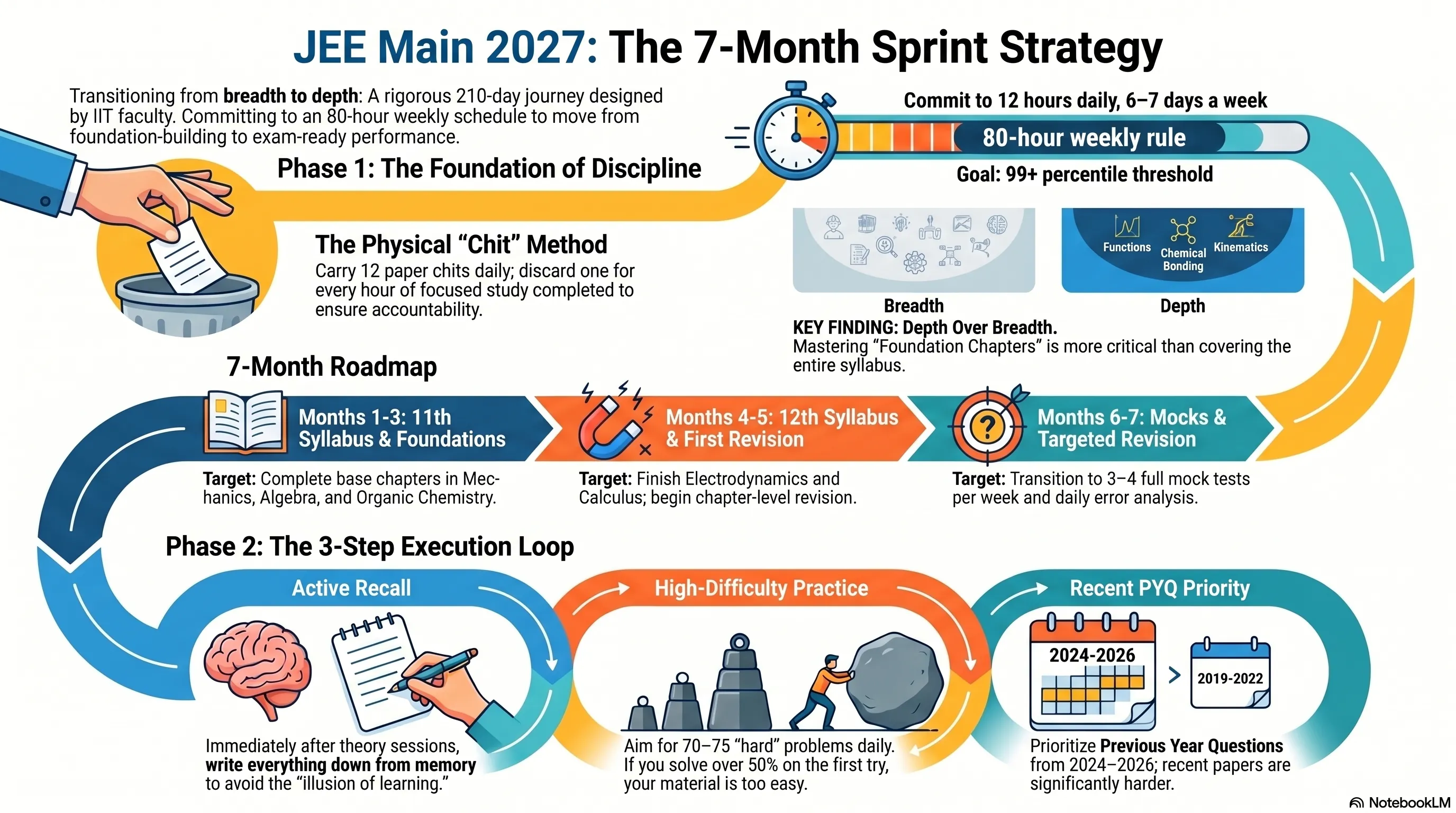
The minimum study target for serious JEE Main 2027 aspirants is 12 hours per day, 6–7 days a week. This adds up to roughly 80 hours per week.
If 12 hours sounds impossible right now, that is fine — build up to it over 2–3 weeks. But if you are not reaching 80 hours per week consistently within a month, a 99+ percentile in January becomes very difficult.
The Chit Method for Tracking Study Hours
Here is a simple tracking system that works:
- Tear 12 small pieces of paper (chits) each morning
- Keep them in your pocket
- Discard one chit for every hour of focused study completed
- Do not sleep until all 12 chits are gone
This sounds basic — but it is one of the most effective self-accountability tools because it makes your progress visible and physical. No app, no habit tracker beats the simplicity of an empty pocket at night.
Weekly Study Hours Breakdown
| Day | Study Hours | Focus Area |
|---|---|---|
| Monday–Friday | 12 hours/day | Theory + Practice (2 chapters) |
| Saturday | 12 hours | PYQ practice + Topic-wise test |
| Sunday | 6–8 hours | Full revision + weak chapter review |
| Weekly Total | ~80 hours | Balanced across all 3 subjects |
The Most Important Chapters for JEE Main 2027
Not all chapters carry equal weight. Whether you are a Class 12 student covering the 11th syllabus alongside boards or a dropper starting fresh, these chapters form the foundation of everything in JEE Main. Skip or weaken any of them, and every harder chapter becomes harder too.
Mathematics Foundation Chapters
- Quadratic Equations — appear directly and are embedded in almost every advanced topic
- Trigonometry — fundamental to calculus, coordinate geometry, and complex numbers
- Functions — the single most important base for all of calculus; limits, continuity, and differentiability all rest on it
Chemistry Foundation Chapters
- Periodic Table and Chemical Bonding — the backbone of all Inorganic Chemistry (IOC); memorising this deeply saves hours in later chapters
- Mole Concept — Physical Chemistry's base; every numerical starts here
- General Organic Chemistry (GOC) — you cannot understand reactions without this
Physics Foundation Chapters
- Kinematics — the language of all mechanics
- Newton's Laws of Motion (NLM) — appear in every mechanics-based question
- Centre of Mass (COM) — critical for advanced problems in mechanics and modern physics
- Work, Power, and Energy (WPE) — concepts recycle across Electrostatics, Electrodynamics, and more
💡 Expert Tip by Saransh Gupta, IIT Bombay AIR-41: "Think of JEE preparation as a 100-floor building. These chapters are the foundation. If even one is weak, the whole structure wobbles — no matter how well you know Rotational Dynamics or Electrochemistry."
For the full official JEE Main syllabus 2027, including topic-wise weightage and chapter distribution, refer to the NTA official website at nta.ac.in.
The Correct Process: From Theory to Tests
This is the most important section in this entire guide. Most students who fail at JEE Main do not lack intelligence — they follow the wrong process.
Here is the proven 6-step process that every successful JEE candidate follows, regardless of coaching centre or self-study approach:
Step 1 — High-Quality Theory (40–45% of your time)
Theory does not mean passive reading. It means active, two-way engagement with concepts. The goal is to understand why a formula works, not just what it is. A good theory session involves:
- Cross-questioning yourself after every concept
- Asking: "What happens if this condition changes?"
- Linking the concept to previous chapters
Step 2 — Same-Day Revision with Active Recall
After every theory session, close your notes and write down everything you remember. Then check. This single habit — called active recall — is backed by decades of learning research and is the reason some students learn in weeks what others don't learn in months.
Do not move to the next chapter without doing a same-day revision.
Step 3 — Tough Practice Problems (40% of your time)
Your practice material quality determines your result. Here is a benchmark to test your material:
If you can solve more than 50% of the toughest exercises in your module on the first attempt, your material is too easy.
JEE Main 2027 is a hard exam. Easy practice creates false confidence. It feels good in the short term, like sugar — but it collapses on exam day.
Aim for 70–75 quality problems per day at the greatest difficulty level your current chapter allows.
Step 4 — JEE Previous Year Questions (PYQs)
Solve PYQs from JEE Main question papers from 2019 to 2026. Focus specifically on the harder questions from recent papers (2024, 2025, 2026) — these reflect the current difficulty level. For JEE Advanced-level practice, refer to JEE Advanced question papers.
Step 5 — Topic-Wise Test (TWT) and Chapter-Wise Test (CWT)
After completing a chapter's theory and practice, take a timed test on that chapter alone. This reveals exactly where your gaps are before you move forward.
Step 6 — Analysis and Revision Loop
After every test:
- Analyse every wrong answer — was it a concept gap, silly error, or time management issue?
- Revisit theory for any concept gap identified
- Redo similar problems in the next practice session
This loop — theory → revision → practice → PYQ → test → analysis → back to theory — is the complete process. Remove any single step, and your result drops significantly.
Month-by-Month JEE Main 2027 Study Plan
Here is a structured 7-month timeline. Adjust based on your current level, but do not skip phases.
| Month | Focus | Target Output |
|---|---|---|
| Month 1 (June) | Foundation chapters: Maths + Physics + Chemistry basics | Complete 6–8 base chapters with full process |
| Month 2 (July) | 11th syllabus Part 1: Mechanics, Algebra, Organic basics | Complete first 40% of 11th topics |
| Month 3 (August) | 11th syllabus Part 2: Electrostatics, Calculus, Physical Chem | Complete the remaining 11th topics |
| Month 4 (September) | 12th syllabus Part 1: Electrodynamics, Coordinate Geometry, IOC | Cover the first 50% of the 12th topics |
| Month 5 (October) | 12th syllabus Part 2 + First full revision cycle | Complete 12th; begin chapter-level revisions |
| Month 6 (November) | Full revision + Full mock tests | 3–4 full mocks per week; analyse all errors |
| Month 7 (December–January) | Intensive mock tests + Targeted revision | Daily mocks; refine strategy for exam day |
Common Mistakes That Cost You Percentile
Mistake 1 — Practising Only Easy Questions
The JEE Main paper has become significantly harder. Students who practise only easy and medium-level questions get shocked on exam day. Solve the hardest level of every module you use.
Mistake 2 — Ignoring One Subject Completely
Every student has a favourite subject. But JEE Main scores all three — Physics, Chemistry, Mathematics — equally. A 99 percentile in Maths cannot compensate for a 60th percentile in Chemistry. Balance is non-negotiable.
Mistake 3 — Reading Without Recalling
Passive reading of notes or watching lectures without active recall creates the illusion of learning. After any session, close everything and write down what you just learned. If you cannot recall it, you have not learned it.
Mistake 4 — Skipping Tests
Tests are not just assessments — they are the most efficient way to learn under exam conditions. Students who skip topic-wise tests perform poorly in mock tests, and students who skip mock tests underperform on exam day.
Mistake 5 — Revising Old PYQs from Easy Years
JEE Main papers from 2019–2022 were significantly easier than those from 2024–2026. Practising only older PYQs builds comfort with a difficulty level that no longer exists in the exam. Prioritise recent-year PYQs.
How to Track Your Progress and Stay Consistent
Consistency over 7 months is harder than any single study session. Here is a practical system:
Weekly check-in: Every Sunday, answer these three questions in writing:
- How many hours did I study this week? (Target: 80)
- How many chapters did I complete with the full process?
- What was my score on this week's tests, and what are my top 3 weak areas?
21-Day Discipline Challenge: Commit to removing your single biggest distraction — social media, gaming, or anything else — for 21 consecutive days. Every person who has cracked IIT from a tough position has done something similar. This is not about punishment — it is about signalling to yourself that you are serious.
The Grind Mindset: The students who crack JEE Main in 7 months are not the smartest — they are the most consistent. Piyush, who went from a 2-lakh rank to 99.81 percentile, was not exceptional in January of his drop year. He was exceptional in his process — every single day.
If you want structured guidance on this entire 7-month journey with IIT Bombay faculty teaching at JEE Advanced depth, explore eSaral's JEE online and offline courses. The courses are built around exactly the process described in this article.
Every revision cycle in this plan depends on having notes worth revising — see our how to make notes for JEE guide before your next one.
🚀 Checkout eSaral Courses
Frequently Asked Questions
Find answers to common questions.
Is it possible to crack JEE Main 2027 in 7 months from scratch?
Yes, cracking JEE Main 2027 in 7 months is achievable with the right process. Students like Manthan (IIT Bombay, 7 months) and Piyush (99.81 percentile from a 2-lakh rank in one drop year) have done it. The key requirements are 10–12 hours of daily study, tough-level practice, and consistent topic-wise testing throughout the preparation period.
How many hours per day should I study for JEE Main 2027?
A minimum of 10–12 hours of focused study daily is required for a serious JEE Main 2027 attempt. This adds up to roughly 80 hours per week. Begin with 8 hours if you are just starting and increase gradually over 2–3 weeks. Students who consistently fall below 70 hours per week rarely reach the 99 percentile mark.
Which chapters are most important for JEE Main 2027?
In Mathematics, prioritise Quadratic Equations, Trigonometry, and Functions. In Chemistry, Mole Concept, Periodic Table, Bonding, and General Organic Chemistry are foundational. In Physics, Kinematics, Newton's Laws of Motion, Centre of Mass, and Work-Power-Energy are essential. Weakness in any of these makes every advanced chapter harder.
What is the best study plan for JEE Main 2027 for a dropper?
A JEE dropper should spend Month 1 strengthening foundation chapters, Months 2–3 on 11th syllabus, Months 4–5 on 12th syllabus, and Months 6–7 on full revisions and mock tests. Daily study hours must reach 12 hours. The most important change from the previous attempt is upgrading to harder practice material and following a structured test-and-analysis loop.
How should I split my time between Physics, Chemistry, and Mathematics for JEE Main?
A balanced split is roughly 35% Mathematics, 33% Physics, and 32% Chemistry by study time. Do not neglect any subject for more than one day. Rotate subjects daily so all three receive consistent attention. Identify your weakest subject and give it slightly more time during the first two months.