eSaral JEE Test Series 2026: India's First AI-Powered Mock Test Analysis for JEE Main
eSaral JEE test series offers 10 full-syllabus JEE mock tests with AI-generated 20-page performance reports that show subject-wise accuracy, time comparison with peers, chapter-wise weak zones, and topic-level breakdowns — all at ₹499, making it the most affordable AI-powered JEE test series in India.
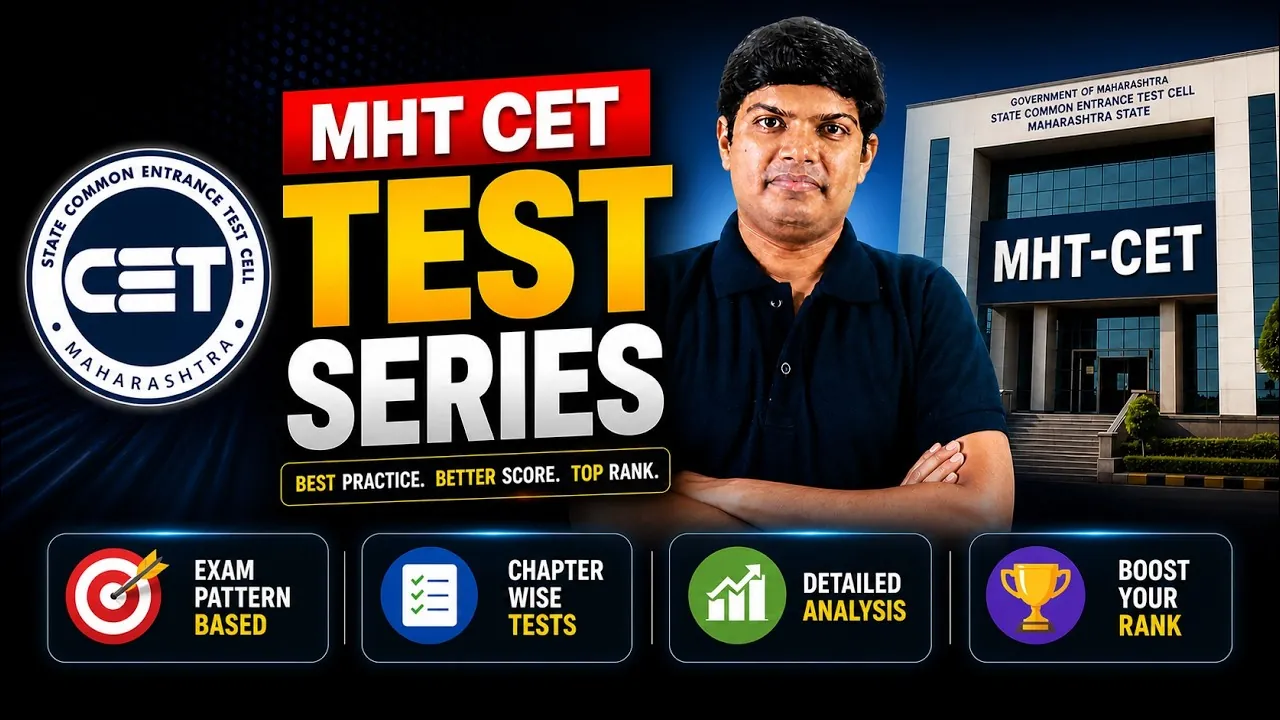
Table of Contents

eSaral › JEE Test Series › JEE Main › eSaral JEE Test Series 2026

🚀 Checkout MHT CET 𝐓𝐞𝐬𝐭 𝐒𝐞𝐫𝐢𝐞𝐬
Why Mock Tests Are the Single Most Underused JEE Tool
Most students treat mock tests as checkpoints — something to do a week before the exam to "see where they stand." That's the wrong approach.
According to NTA data, JEE Main 2024 saw over 1.1 million registered candidates. The difference between rank 500 and rank 5,000 often comes down to 8–10 marks. Those marks aren't lost on concepts — they're lost on time mismanagement, careless errors, and skipping easy questions in hard sections.
How Regular Mock Testing Changes Your Score Trajectory
When done consistently, full-syllabus mock tests build three things that studying cannot:
- Section-switching instinct — knowing exactly when to move on
- Error pattern recognition — identifying the specific question types you mis-mark under pressure
- Speed benchmarking — understanding whether you're faster or slower than your competition on each topic
💡 Expert Tip by Saransh Gupta Sir, IIT Bombay AIR-41: "The students who improved the most in eSaral's 2025 JEE batch weren't those who studied the most. They were the ones who reviewed their test reports chapter by chapter and showed up again for the next test. Repetition plus reflection — that's the formula."
In eSaral's 2025 JEE Main batch, students who took at least 6 full-syllabus mock tests before the exam improved by an average of 12–15 percentile points compared to their first mock test score. That data is internal — but the principle is backed by every serious JEE educator.
What Makes eSaral JEE Test Series Different?
Plenty of platforms offer mock tests. What sets the eSaral JEE test series apart is what happens after you submit.
Most test series give you a score and a solution PDF. eSaral gives you a 20-page AI performance report — the first of its kind for JEE preparation in India. This isn't a gimmick. It's a full diagnostic built on your response data, peer comparison, and chapter-level mapping.
Key Features at a Glance
| Feature | eSaral JEE Test Series |
|---|---|
| Number of Tests | 10 Full-Syllabus Tests |
| Pattern | Exact JEE Main CBT format |
| AI Report | 20-page detailed analysis (per test) |
| Peer Comparison | Yes — real-time vs all test-takers |
| Detailed Solutions | Yes — by eSaral faculty |
| Device Access | App, tablet, and laptop (CBT mode) |
| Price | ₹499 (no extra charges) |
| Extra Device Fee | ₹0 |
The test follows the exact JEE Main pattern: Physics — 50 questions in 90 minutes, Chemistry — 50 questions in 90 minutes, Mathematics — 50 questions in 90 minutes (with subject-wise separate scoring).
💡 Expert Tip by Saransh Gupta Sir, IIT Bombay AIR-41: "JEE Main scoring and MHT-CET scoring work very differently. Physics and Chemistry are combined in MHT-CET, while Maths carries its own separate marks weight. If you're preparing for both, the test pattern matters more than you think — don't mix them up in your prep."
.webp)
How Does the AI Performance Report Work?
This is what makes the eSaral JEE test series stand out from every other option in the market.
The moment you submit your test, the AI engine processes your entire response set — not just what you got right or wrong, but how you approached every question.
What the 20-Page AI Report Shows You
1. Accuracy Breakdown by Subject and Chapter The report tells you which exact chapters dragged your Physics score, which Chemistry topics you're strong in, and where your Maths accuracy drops below 60%. This is not a generic "you scored 65% in Physics." It's "your accuracy in Rotational Mechanics is 38%, while your accuracy in Electrostatics is 81%."
2. Time Comparison with Peers You'll see how much time you spent on each question vs. the average time all other students spent on the same question. If you're spending 4 minutes on questions that top scorers solve in 90 seconds, the report flags that.
3. Question-Level Difficulty Data Every question is tagged by what percentage of students got it right across the entire test-taking cohort. A question that 80% of students answered correctly is an easy question — if you got it wrong, that's a high-priority fix.
4. Chapter and Topic Weak Zone Mapping The report identifies your weakest sub-topics across all three subjects and tells you exactly where to invest revision time before your next test. This is the end-of-test conversation that most students never have.
Step-by-Step: How to Use Your AI Report After Each Test
- Open the report within 30 minutes of finishing your test
- Go to the "Weak Zones" section first — not the score
- List the top 3 sub-topics flagged as weak
- Spend 2–3 focused hours on those sub-topics before the next test
- Track whether those specific sub-topics improve in your next AI report
What Is Covered in the 10 Full-Syllabus Tests?
Each of the 10 tests in the eSaral JEE test series covers the complete JEE Main syllabus as per NTA's official guidelines. The question distribution is designed to mirror the actual difficulty mix seen in JEE Main papers.
Subject-Wise Chapter Coverage (Sample)
| Subject | Core Chapters Covered |
|---|---|
| Physics | Mechanics, Thermodynamics, Electrostatics, Current Electricity, Optics, Modern Physics, Rotational Motion |
| Chemistry | Organic Reaction Mechanisms, Physical Chemistry Numericals, Inorganic (NCERT-based), Coordination Chemistry |
| Mathematics | Calculus (Differential + Integral), Coordinate Geometry, Algebra, Vectors & 3D, Probability |
The difficulty distribution across the 10 tests increases progressively. Tests 1–3 are moderate difficulty, tests 4–7 escalate to great difficulty, and tests 8–10 are designed to be at or above actual JEE Main difficulty to ensure you're well-prepared for anything NTA puts in front of you.
All tests are delivered in CBT (Computer-Based Test) mode, exactly how JEE Main is conducted. This isn't a small detail — many students underperform on actual JEE Main simply because they've only ever practised on paper. Screen-based test-taking is a skill that needs practice.
How to Use the Test Series Results to Fix Weak Areas?
Taking the test is 30% of the work. The 70% happens in the review.
Here's a structured 3-day review protocol to follow after each full-syllabus test:
Day 1 — The Diagnostic (Same Evening, 2 Hours)
- Read the AI report from start to finish
- Mark the 3 weakest sub-topics per subject (total: 9 sub-topics)
- Note the questions you got wrong despite spending the most time — these are "effort-wasted" errors
Day 2 — The Fix (Full Study Session)
- Pick the #1 weakest sub-topic from Physics, Chemistry, and Maths
- Watch the relevant eSaral faculty lecture on that exact concept
- Solve 15–20 targeted problems from that sub-topic only (not a full chapter)
Day 3 — The Verify (1 Hour)
- Solve a short 10-question timed drill on yesterday's weak topics
- Compare your accuracy to your AI report baseline — are you improving?
- Set a reminder to flag that topic again in your next full-syllabus test
This protocol — test, diagnose, fix, verify — is what separates aspirants who plateau at a certain percentile from those who break through it.
If you're deciding between platforms, if price is your primary concern, eSaral wins clearly. If AI-powered diagnostic depth matters to you — and it should — eSaral is currently the only platform in this segment offering this level of post-test analysis.
Frequently Asked Questions
Find answers to common questions.
Is the eSaral test series good for JEE Main 2025 and 2026?
Yes. eSaral's JEE test series is updated to match the current NTA JEE Main pattern for both 2025 and 2026 attempts. Each test follows the official format — 50 questions per subject, 90 minutes per section — so you're practising under the exact conditions of the real exam. Students preparing for both January and April sessions can use it across both attempts.
How does the eSaral AI test analysis report work?
After each test, eSaral's AI engine processes your response data and generates a 20-page report. It shows your accuracy chapter by chapter, compares your time-per-question with all other test-takers, identifies your weakest sub-topics, and flags questions that were easy for most students but you got wrong. This helps you target revision precisely, not generally.
Is eSaral test series good for JEE dropper students?
Absolutely. JEE droppers typically have stronger conceptual knowledge but need to fix speed and accuracy under exam pressure. The eSaral JEE test series is well-suited for droppers because the AI report identifies not just what you're getting wrong but how fast you're working relative to peers — which is the primary gap for most dropper students. Pair it with the eSaral JEE dropper batch for structured conceptual coverage.
What is the price of the eSaral JEE test series?
eSaral JEE test series is priced at ₹499 for 10 full-syllabus tests. The AI performance report is included at no extra charge. There are no additional fees for accessing the tests on multiple devices — mobile app, tablet, and laptop are all included in the same price.
Can I access eSaral JEE test series on a laptop?
Yes. Since JEE Main is conducted in CBT (Computer-Based Test) mode, eSaral's test series is available on the eSaral app (mobile and tablet) as well as via laptop browser — with no additional charges. Practising on a laptop screen is strongly recommended since the actual exam interface is computer-based.