Matrices Class 12 Notes | IIT JEE
Matrices is a high-scoring Class 12 and JEE Algebra chapter that builds the foundation for Determinants and Linear Algebra, covering matrix types, operations, transpose, symmetric and skew-symmetric matrices, elementary operations, inverses, and key properties frequently tested in CBSE Boards and JEE Main.
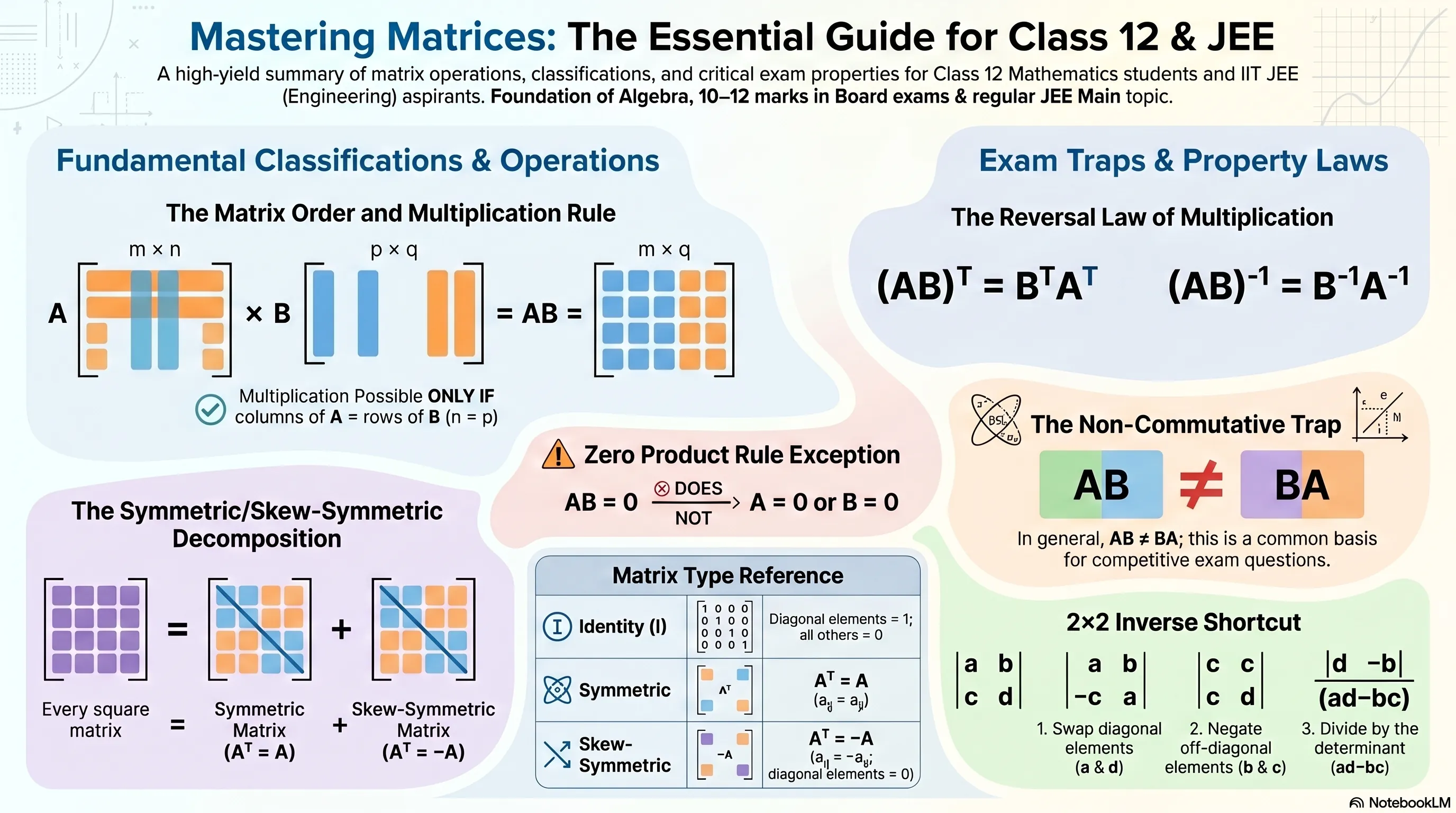
Table of Contents
- Why Matrices Is a High-Priority Chapter for Class 12 and JEE
- Matrices Class 12 Notes
- What Is a Matrix? Basic Definitions and Notation
- Types of Matrices — Complete Classification
- Matrix Operations: Addition, Subtraction and Multiplication
- Transpose of a Matrix and Symmetric Matrices
- Elementary Row and Column Operations
- Invertible Matrices and the Inverse of a Matrix
- Key Formulas and Properties — Quick Reference
- Exam Weightage: JEE Main and CBSE Boards
- How to Study Matrices for Maximum Marks

eSaral › JEE › JEE Main › Matrices Class 12 Notes | IIT JEE

🚀 Checkout eSaral Courses
Why Matrices Is a High-Priority Chapter for Class 12 and JEE
Matrices (Class 12, Chapter 3) is not a standalone chapter — it is the foundation for the entire Algebra section of Class 12 Mathematics. Determinants (Chapter 4), which follows directly, cannot be studied without a solid matrix base. Together, Matrices and Determinants contribute 10–12 marks in CBSE Board exams and appear regularly in JEE Main.
Beyond marks, the Matrices chapter trains a specific type of mathematical thinking — systematic, structured manipulation of organised data — that recurs throughout higher mathematics and engineering.
For CBSE Board students, Matrices is a high-scoring chapter: the questions are formula-based, the patterns are predictable, and students who have practised the standard operations reliably score full marks here.
For JEE students, Matrix questions test deeper properties — particularly elementary operations, rank, and the connection between matrix invertibility and determinants.
💡 Expert Tip by eSaral Mathematics Faculty, IIT Kota: "Matrices is one of those chapters where every mark is earnable. There are no conceptually hard problems here — only students who haven't practised enough. Master the multiplication algorithm, transpose properties, symmetric vs skew-symmetric tests, and the inverse formula for 2×2 and 3×3 matrices. That covers 95% of everything boards and JEE Main will ever ask from this chapter."
Matrices Class 12 Notes
India's Best Exam Preparation for Class 12th - Download Now
India's Best Exam Preparation for Class 12th - Download Now
India's Best Exam Preparation for Class 12th - Download Now
India's Best Exam Preparation for Class 12th - Download Now
India's Best Exam Preparation for Class 12th - Download Now
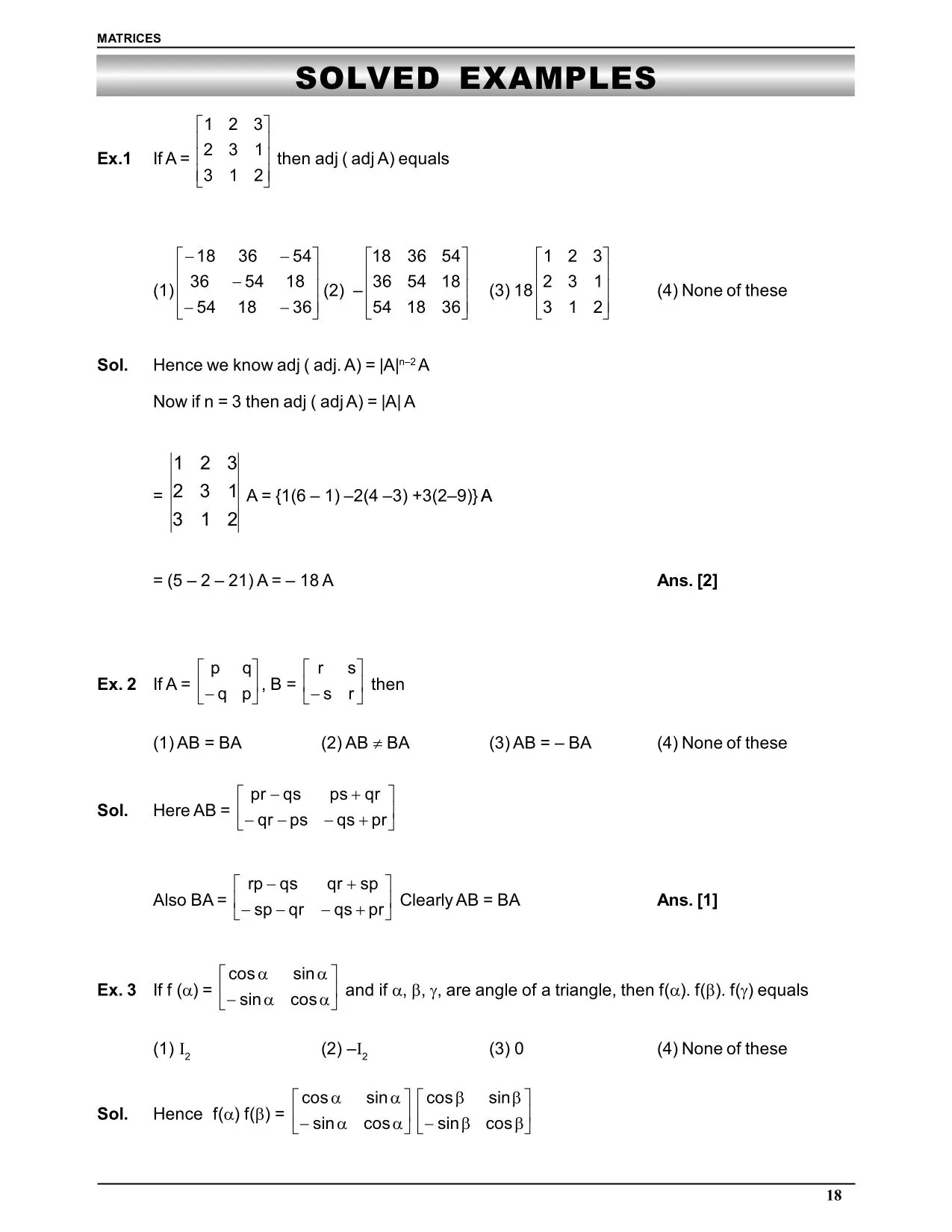
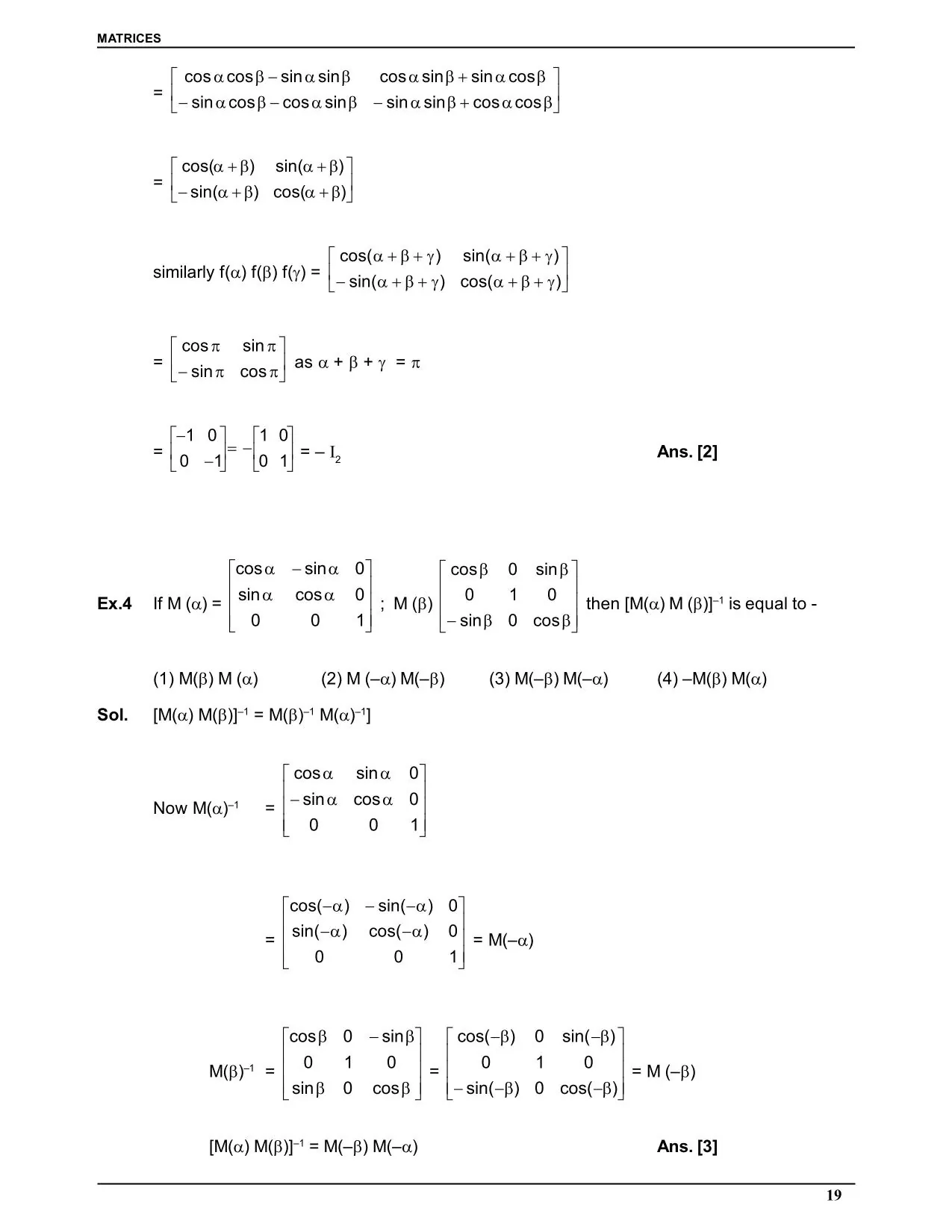
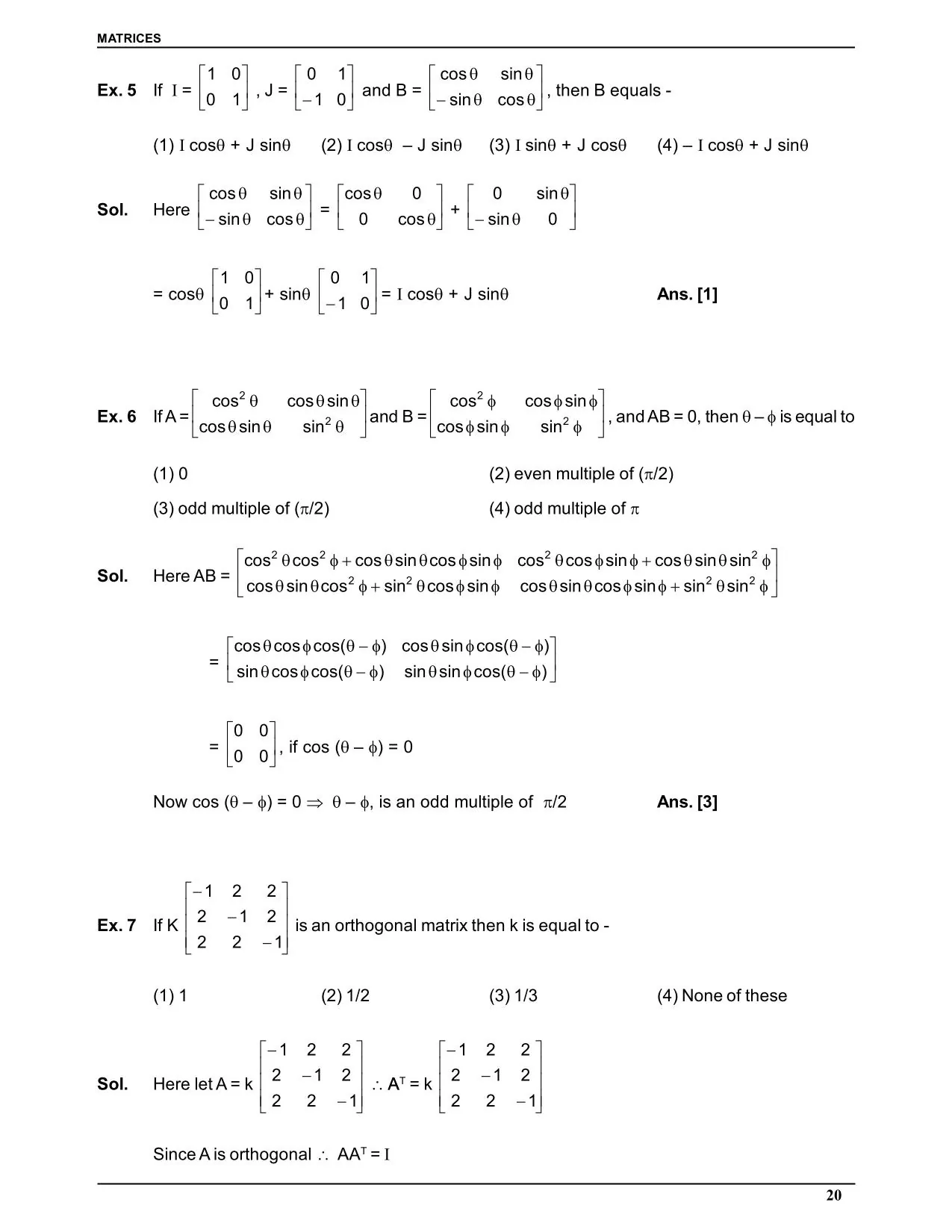
India's Best Exam Preparation for Class 12th - Download Now
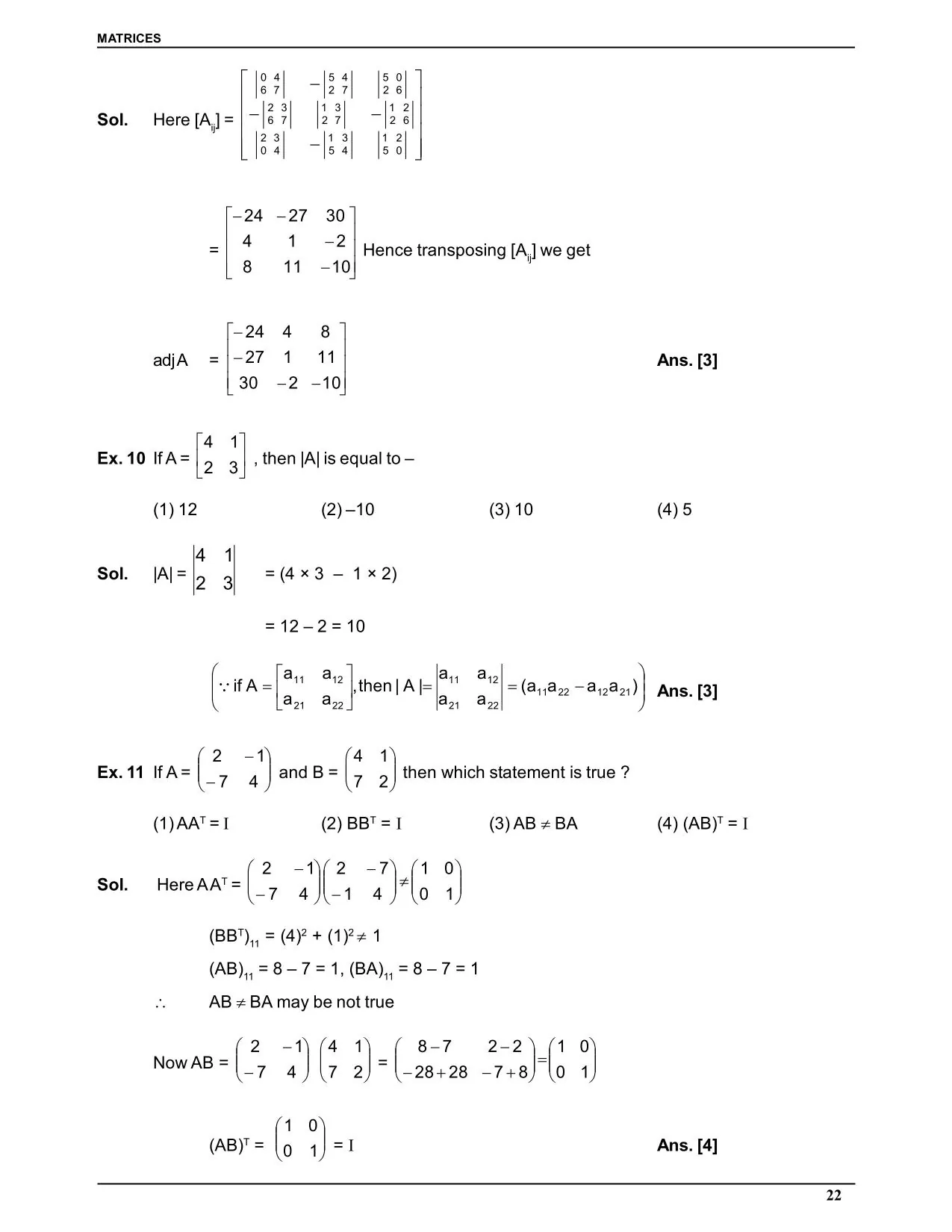
India's Best Exam Preparation for Class 12th - Download Now
What Is a Matrix? Basic Definitions and Notation
Definition
A matrix is a rectangular arrangement of numbers (real or complex) arranged in rows and columns, enclosed in square brackets.
A matrix with m rows and n columns is called an m × n matrix (read as "m by n matrix").
General form:
A=[a11a12⋯a1na21a22⋯a2n⋮⋮⋱⋮am1am2⋯amn]A = \begin{bmatrix} a_{11} & a_{12} & \cdots & a_{1n} \\ a_{21} & a_{22} & \cdots & a_{2n} \\ \vdots & \vdots & \ddots & \vdots \\ a_{m1} & a_{m2} & \cdots & a_{mn} \end{bmatrix}
The element in the i-th row and j-th column is denoted a_ij.
Order of a Matrix
The order of a matrix is written as m × n, where m = number of rows and n = number of columns.
- A 3 × 2 matrix has 3 rows and 2 columns — 6 elements total
- A 2 × 4 matrix has 2 rows and 4 columns — 8 elements total
- Total number of elements in an m × n matrix = m × n
Equality of Matrices
Two matrices A and B are equal (A = B) if and only if:
- They have the same order (same number of rows and columns)
- Every corresponding element is equal: a_ij = b_ij for all i, j
Types of Matrices — Complete Classification
All Types You Must Know for Boards and JEE
| Type | Definition | Example / Condition |
|---|---|---|
| Row Matrix | Matrix with only 1 row | Order: 1 × n |
| Column Matrix | Matrix with only 1 column | Order: m × 1 |
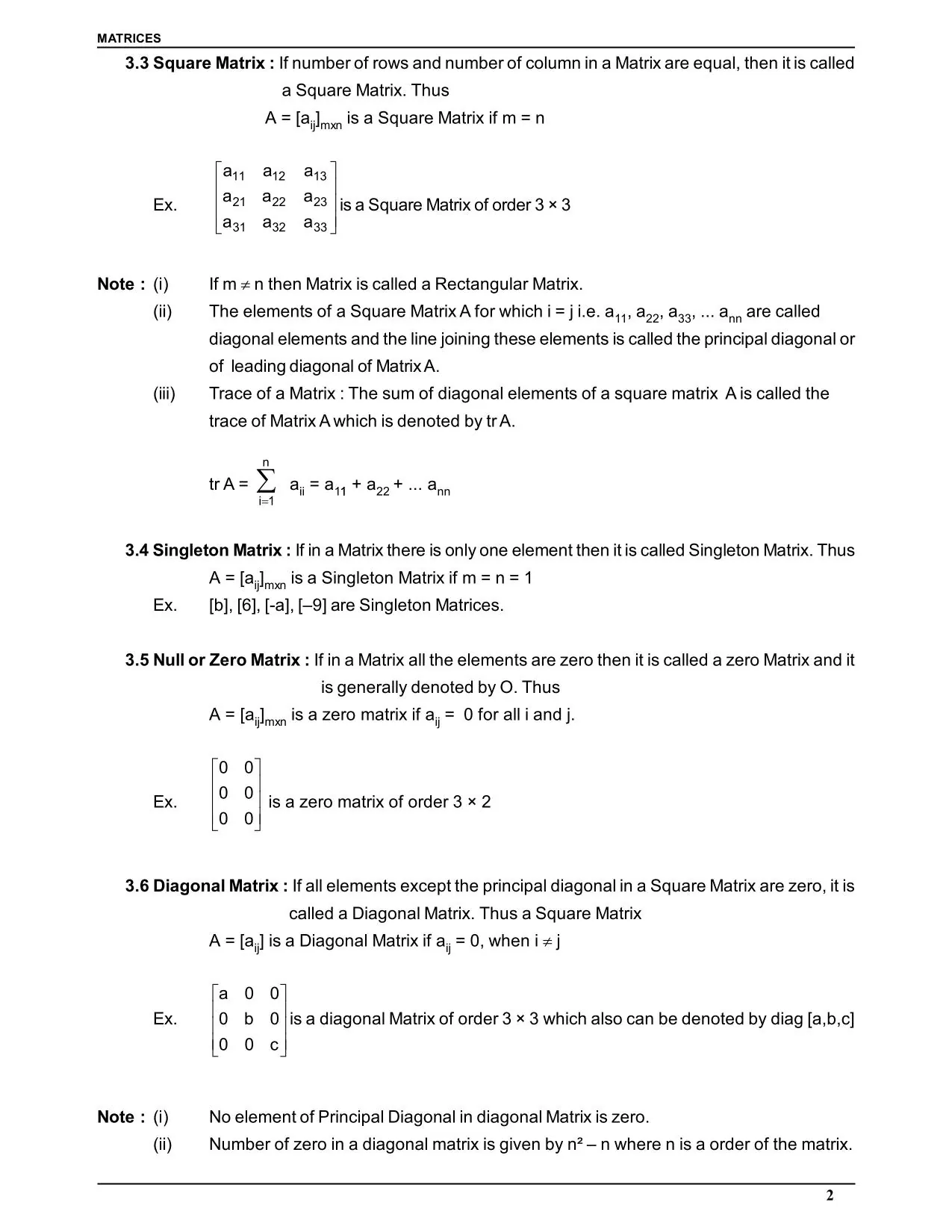
| Square Matrix | Number of rows = number of columns | Order: n × n |
| Diagonal Matrix | Square matrix; all non-diagonal elements = 0 | a_ij = 0 for i ≠ j |
| Scalar Matrix | Diagonal matrix; all diagonal elements are equal | a_ij = k for i = j; 0 for i ≠ j |
| Identity Matrix (I) | Scalar matrix with all diagonal elements = 1 | a_ij = 1 for i = j; 0 for i ≠ j |
| Zero Matrix (O) | All elements are zero | a_ij = 0 for all i, j |
| Upper Triangular | All elements below the main diagonal = 0 | a_ij = 0 for i > j |
| Lower Triangular | All elements above the main diagonal = 0 | a_ij = 0 for i < j |
| Symmetric Matrix | A^T = A | a_ij = a_ji for all i, j |
| Skew-Symmetric Matrix | A^T = −A | a_ij = −a_ji; diagonal elements = 0 |
Key Fact for Exams
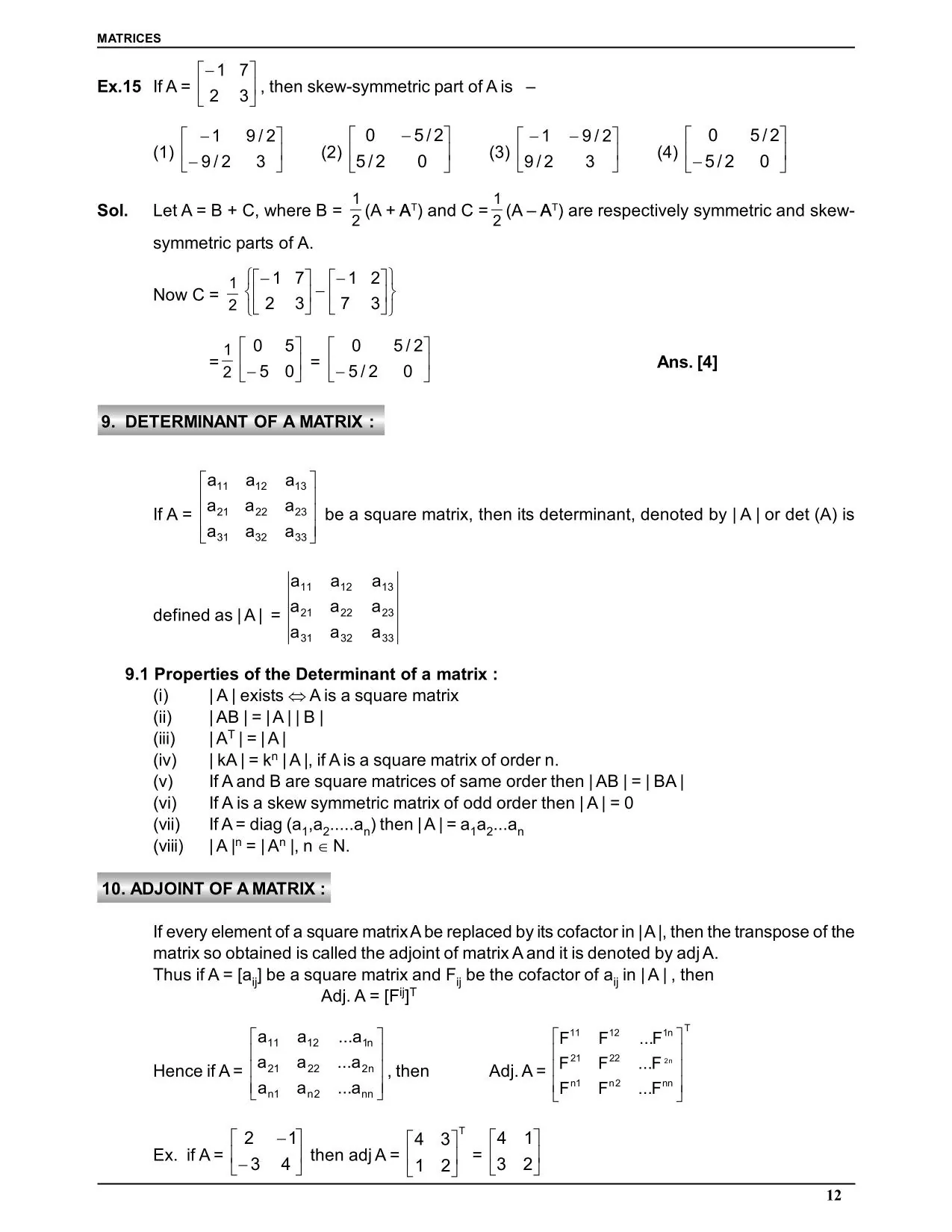
Every square matrix can be expressed as the sum of a symmetric and a skew-symmetric matrix:
A=12(A+AT)+12(A−AT)A = \frac{1}{2}(A + A^T) + \frac{1}{2}(A - A^T)
Where:
- ½(A + A^T) is symmetric
- ½(A − A^T) is skew-symmetric
This result is asked directly in both CBSE Board exams and JEE Main — memorise it and be able to apply it.
Matrix Operations: Addition, Subtraction and Multiplication
Addition and Subtraction
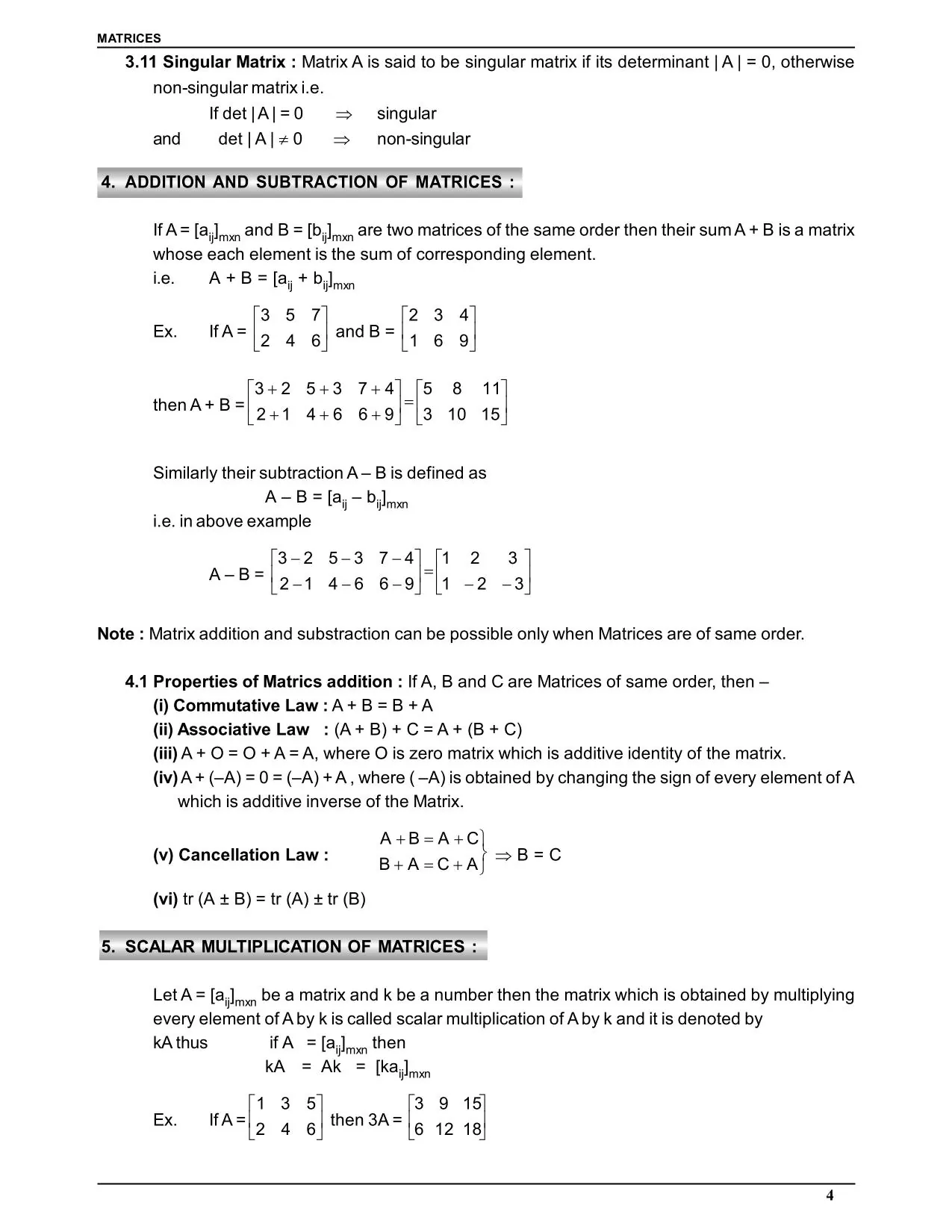
Condition: Two matrices can be added or subtracted only if they have the same order.
Rule: Add (or subtract) corresponding elements.
If A = [a_ij] and B = [b_ij] are both m × n matrices:
- A + B = [a_ij + b_ij]
- A − B = [a_ij − b_ij]
Properties of Matrix Addition:
- Commutative: A + B = B + A
- Associative: (A + B) + C = A + (B + C)
- Identity: A + O = O + A = A (where O is zero matrix)
- Additive Inverse: A + (−A) = O
Scalar Multiplication
If k is a scalar and A = [a_ij], then kA = [k·a_ij] — every element is multiplied by k.
Properties:
- k(A + B) = kA + kB
- (k + l)A = kA + lA
- k(lA) = (kl)A
Matrix Multiplication
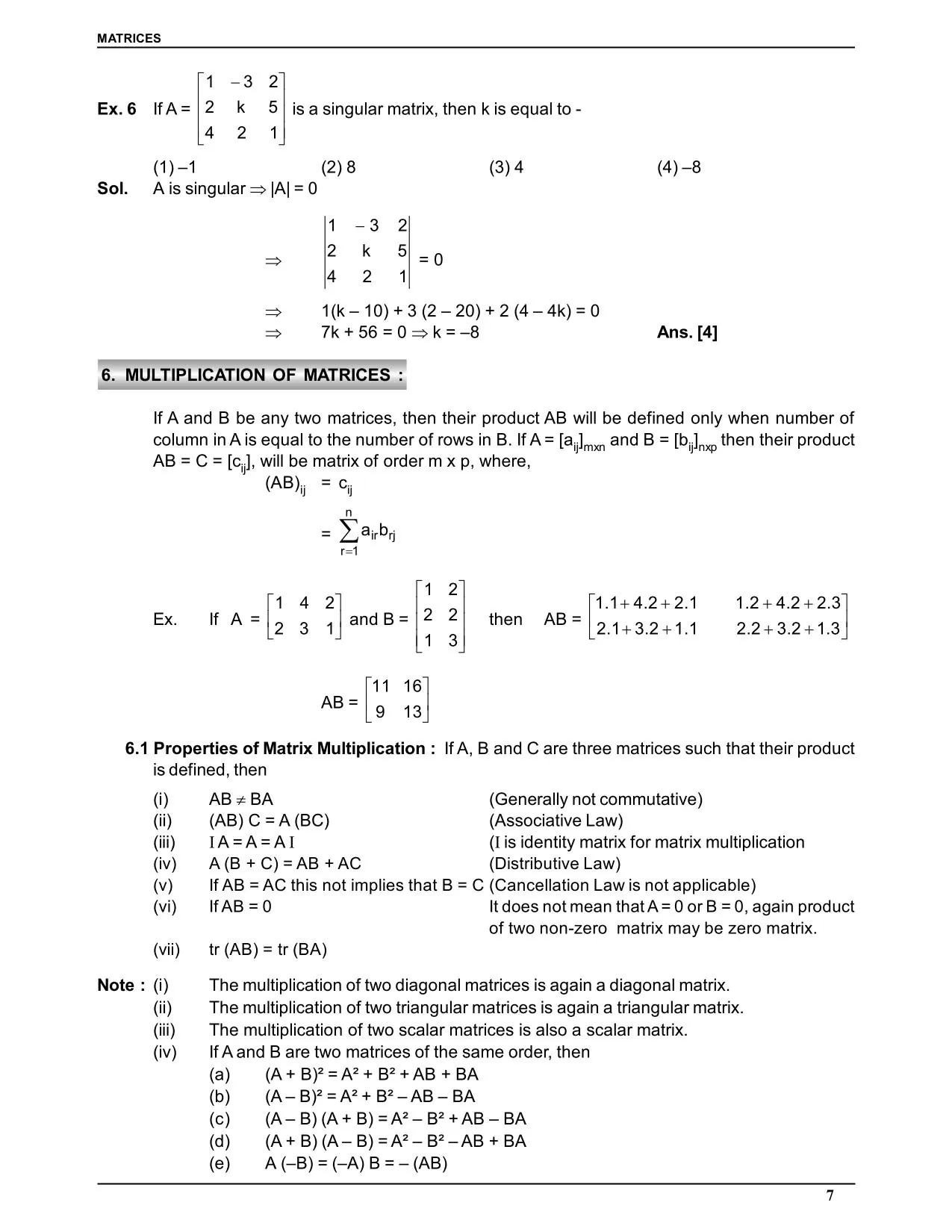
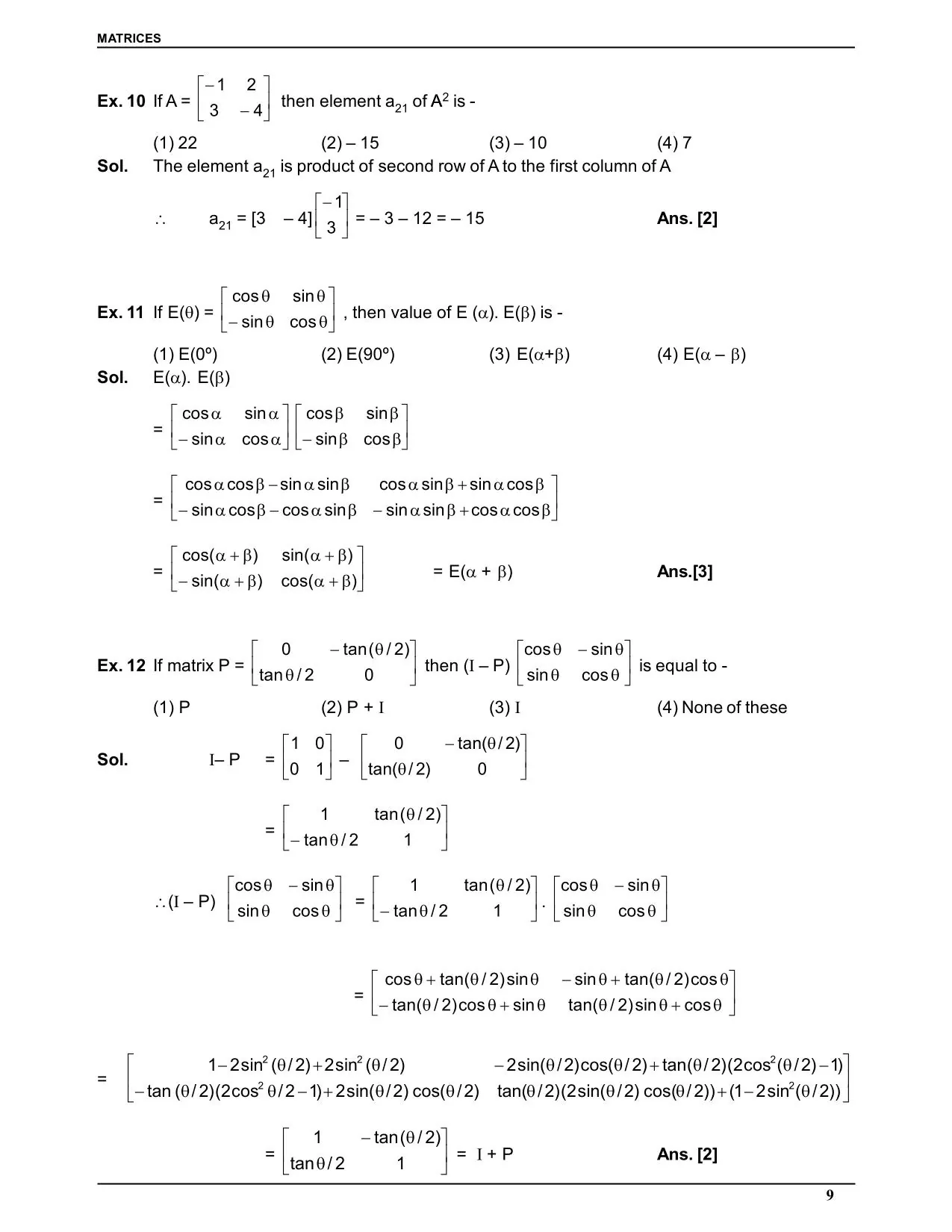
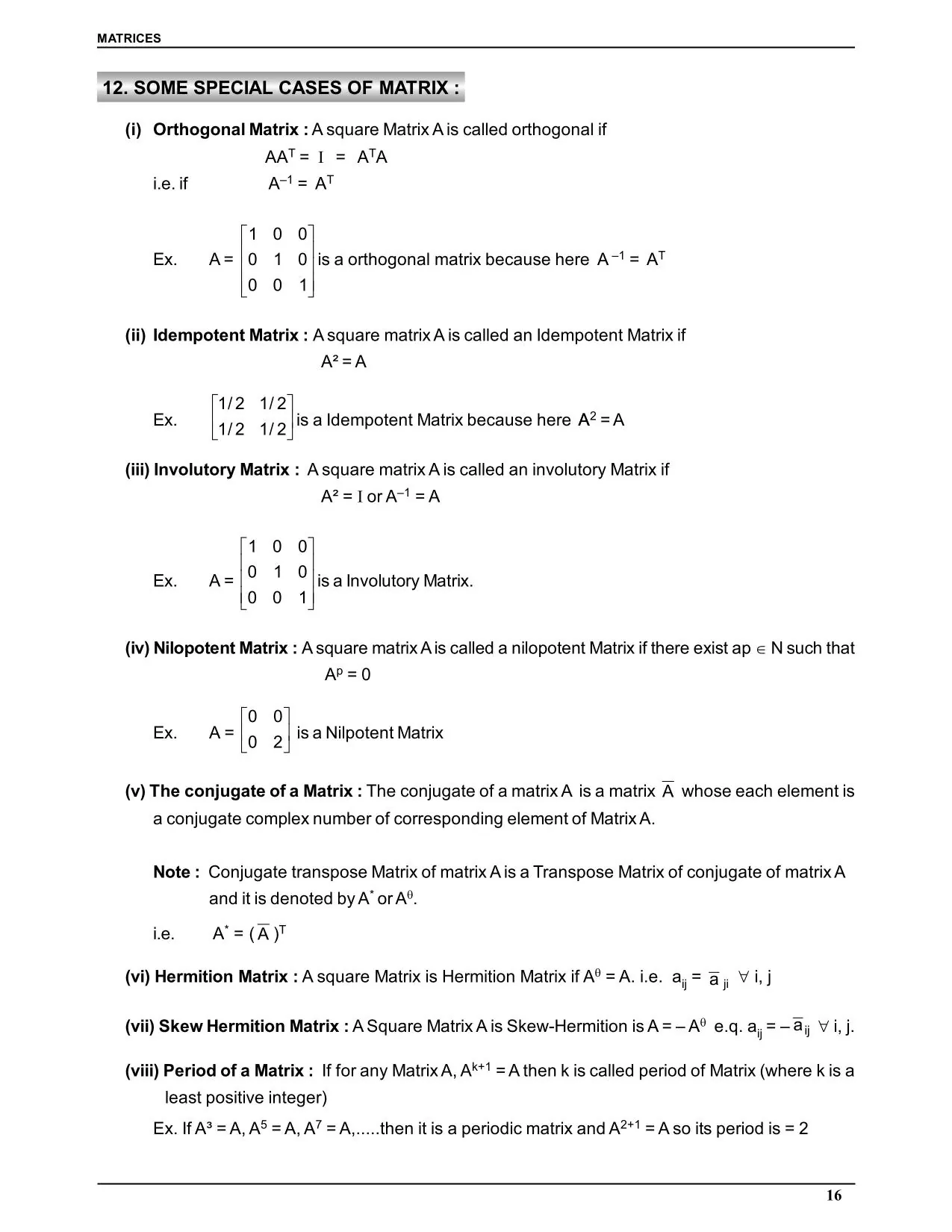
Condition: A (m × n) can be multiplied by B (n × p) only if the number of columns of A = number of rows of B. The product AB has order m × p.
Rule: The (i, j)-th element of AB = sum of products of i-th row of A with j-th column of B.
(AB)ij=∑k=1naik⋅bkj(AB)_{ij} = \sum_{k=1}^{n} a_{ik} \cdot b_{kj}
Properties of Matrix Multiplication:
| Property | Statement | Important Note |
|---|---|---|
| Associativity | (AB)C = A(BC) | Always holds |
| Distributivity | A(B + C) = AB + AC | Always holds |
| Identity | AI = IA = A | I = identity matrix |
| Not Commutative | AB ≠ BA (in general) | Critical: AB ≠ BA |
| Zero product | AB = O does NOT mean A = O or B = O | Critical exception |
| Cancellation | AB = AC does NOT mean B = C | Unless A is invertible |
💡 Expert Tip by eSaral Mathematics Faculty, IIT Kota: "The two most commonly tested 'trap' facts in Matrices questions: (1) matrix multiplication is NOT commutative — AB ≠ BA in general, and (2) AB = O does not imply A = O or B = O. These two non-intuitive properties are the basis of at least one question in most Board exam papers."
Transpose of a Matrix and Symmetric Matrices
Transpose
The transpose of a matrix A (written A^T or A') is obtained by interchanging its rows and columns.
If A is an m × n matrix, then A^T is an n × m matrix.
Properties of Transpose:
| Property | Formula |
|---|---|
| Double transpose | (A^T)^T = A |
| Transpose of sum | (A + B)^T = A^T + B^T |
| Scalar multiplication | (kA)^T = kA^T |
| Transpose of product | (AB)^T = B^T A^T ← Reversal law |
| Triple product | (ABC)^T = C^T B^T A^T |
The reversal law (AB)^T = B^T A^T is tested very frequently in both Board exams and JEE — note the reversal of order.
Symmetric Matrix
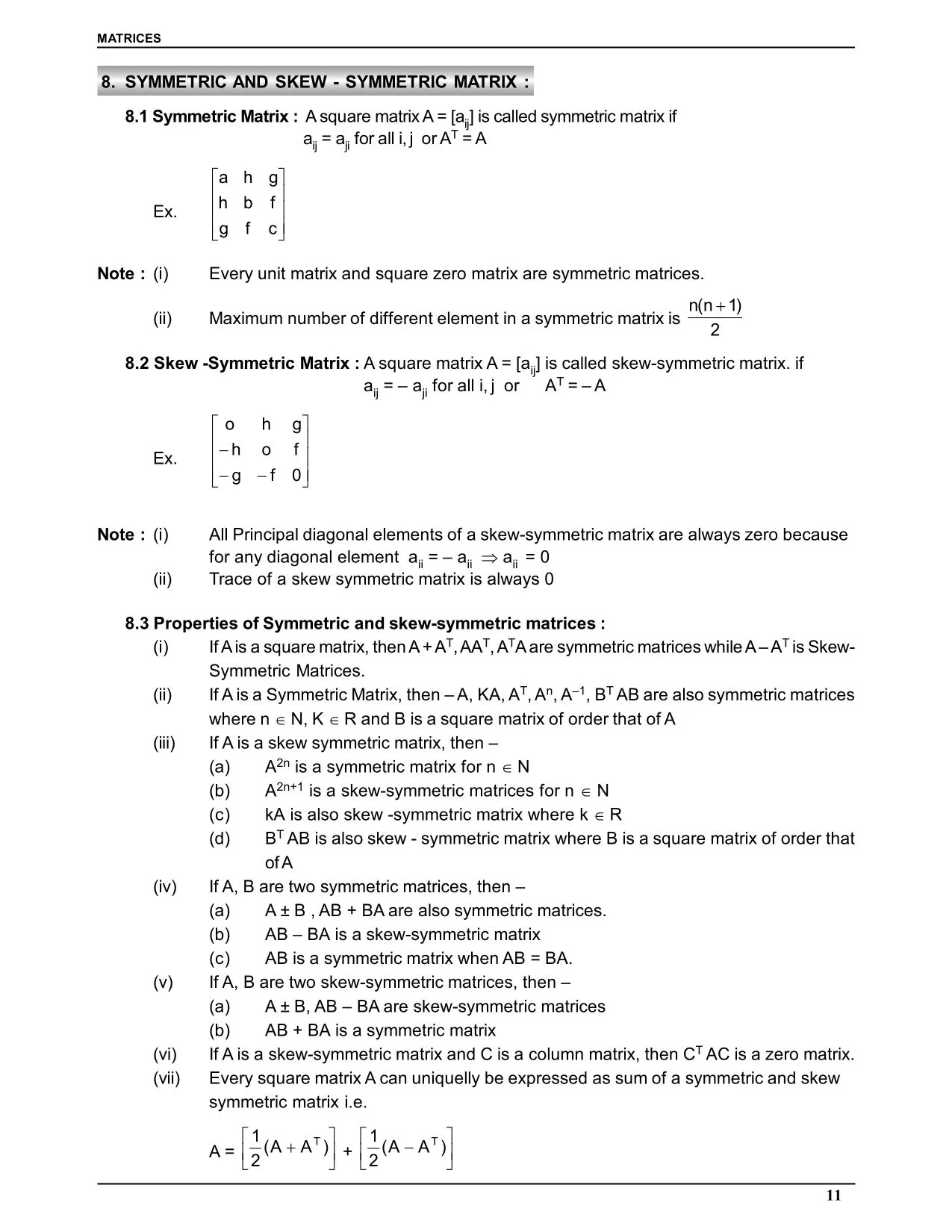
A square matrix A is symmetric if A^T = A, meaning a_ij = a_ji for all i, j.
Skew-Symmetric Matrix
A square matrix A is skew-symmetric if A^T = −A, meaning a_ij = −a_ji for all i, j.
Consequence: All diagonal elements of a skew-symmetric matrix are zero (since a_ii = −a_ii implies a_ii = 0).
Theorem (Frequently Tested in Boards)
- For any square matrix A: A + A^T is always symmetric
- For any square matrix A: A − A^T is always skew-symmetric
Elementary Row and Column Operations
Elementary operations are the building blocks of matrix transformations and are essential for finding the inverse of a matrix using the row-reduction method.
Three Types of Elementary Row Operations
| Operation | Notation | Description |
|---|---|---|
| Row interchange | R_i ↔ R_j | Interchange the i-th and j-th rows |
| Row scaling | R_i → k·R_i | Multiply all elements of i-th row by k ≠ 0 |
| Row replacement | R_i → R_i + k·R_j | Add k times the j-th row to the i-th row |
The same three operations apply to columns (C_i ↔ C_j, etc.).
Key rule for finding inverse using elementary operations:
To find A⁻¹ using row operations, write [A | I] and apply row operations until the left side becomes I. The right side then becomes A⁻¹.
[A∣I]→row operations[I∣A−1][A | I] \xrightarrow{\text{row operations}} [I | A^{-1}]
Invertible Matrices and the Inverse of a Matrix
When Does an Inverse Exist?
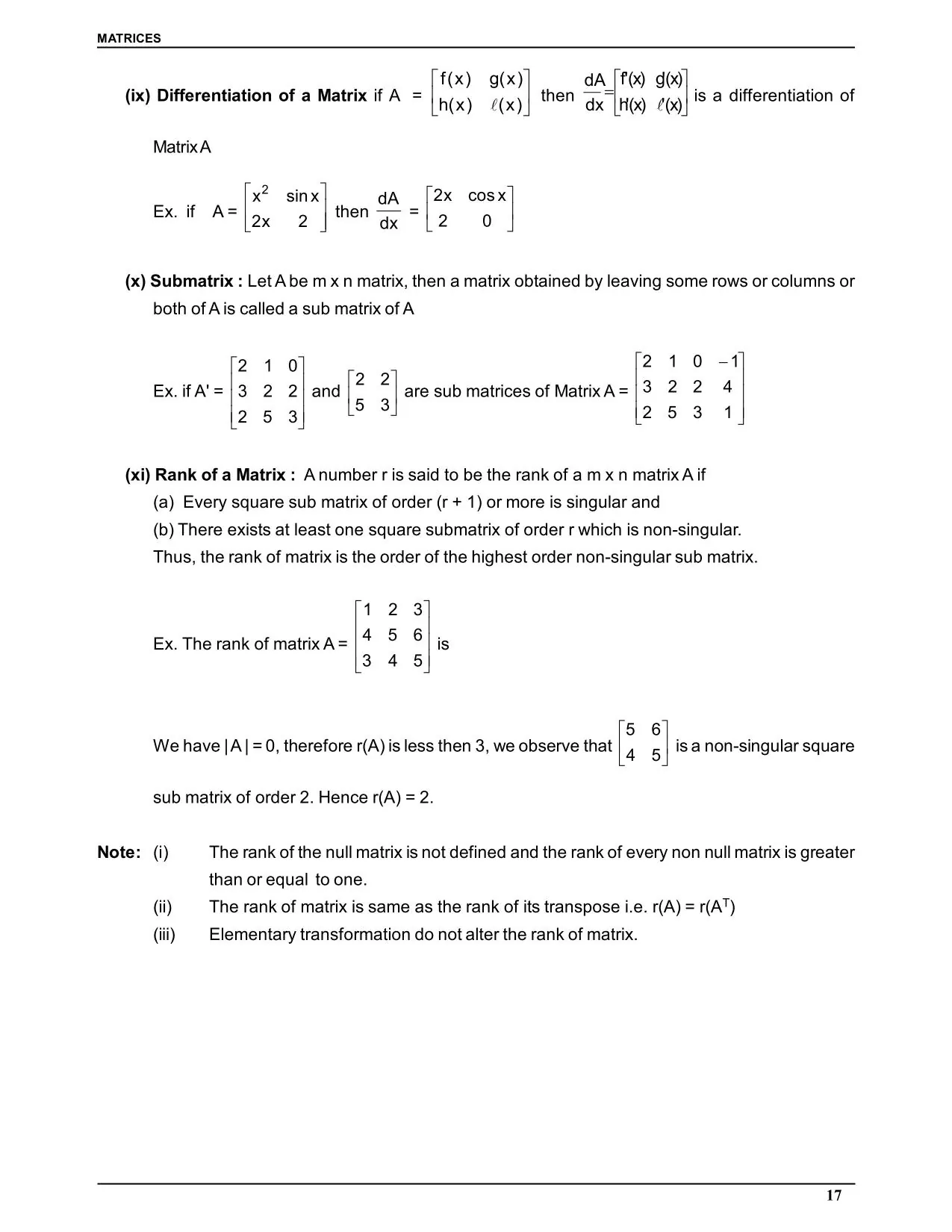
A square matrix A is invertible (non-singular) if and only if there exists a matrix B such that: AB = BA = I
In this case, B is the inverse of A, written A⁻¹.
A matrix is invertible if and only if its determinant ≠ 0 (this links directly to Chapter 4: Determinants).
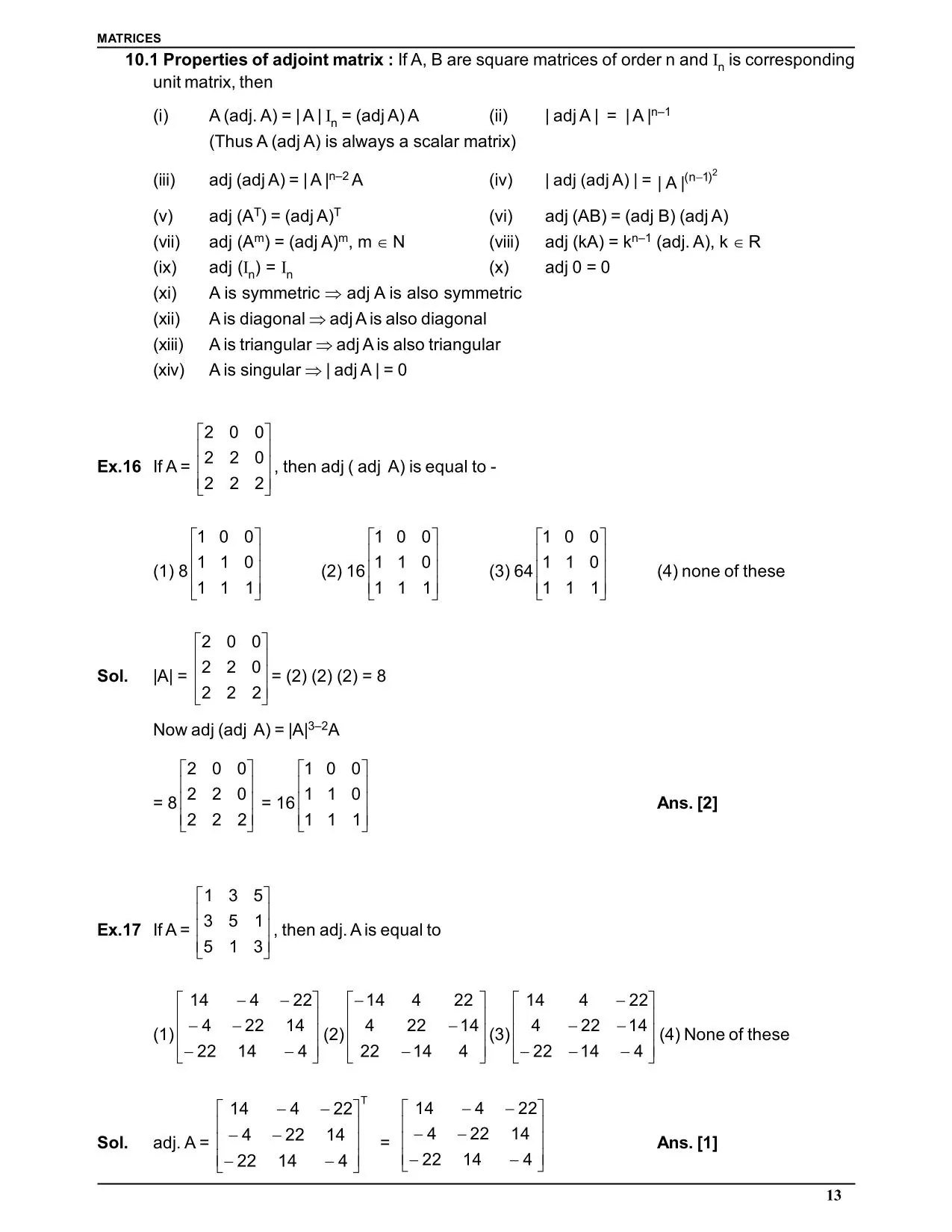
Inverse of a 2 × 2 Matrix
For a 2 × 2 matrix:
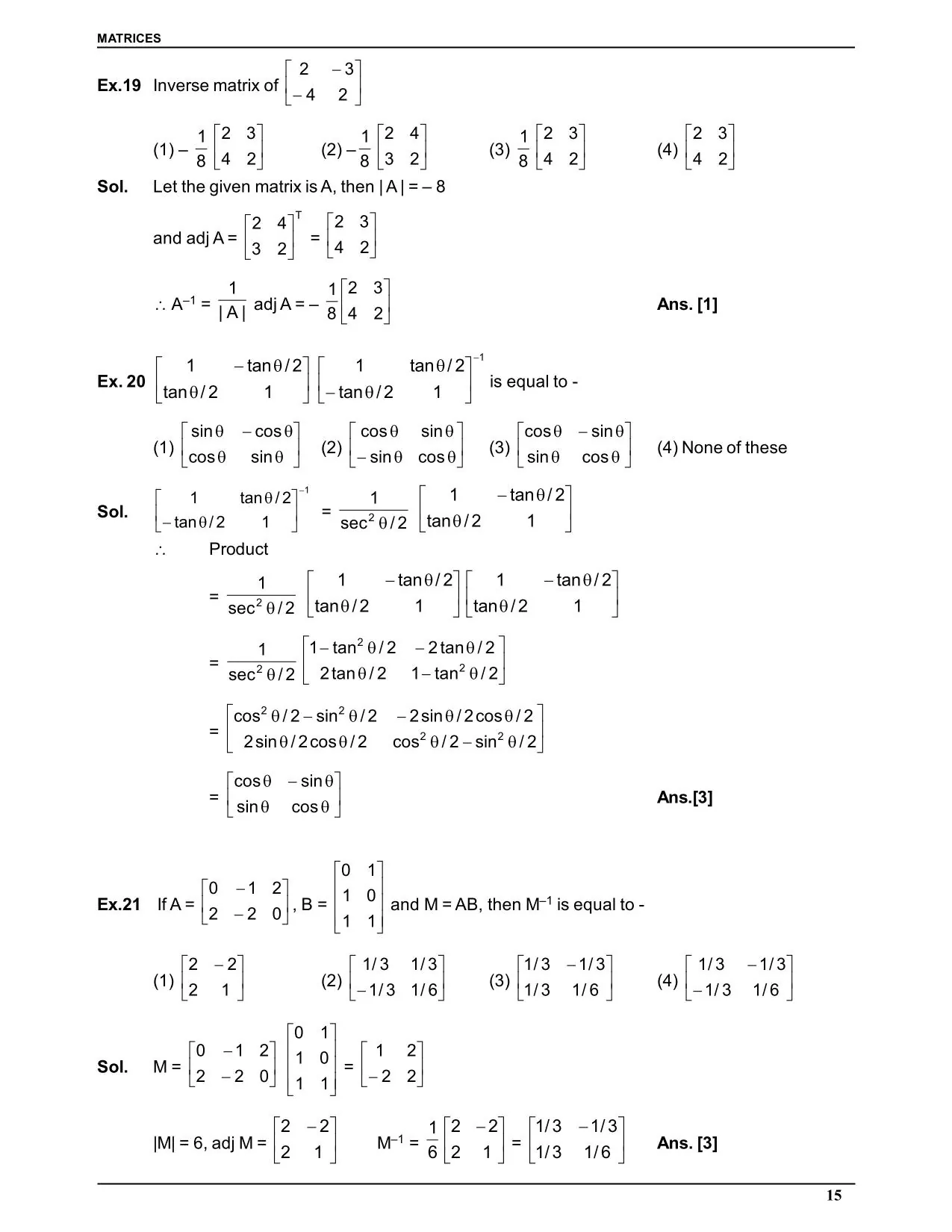
A=[abcd]A = \begin{bmatrix} a & b \\ c & d \end{bmatrix} A−1=1ad−bc[d−b−ca]A^{-1} = \frac{1}{ad - bc} \begin{bmatrix} d & -b \\ -c & a \end{bmatrix}
The quantity (ad − bc) is the determinant of A. If det(A) = 0, the inverse does not exist.
Properties of Matrix Inverse
| Property | Formula |
|---|---|
| Inverse of inverse | (A⁻¹)⁻¹ = A |
| Inverse of transpose | (A^T)⁻¹ = (A⁻¹)^T |
| Inverse of product | (AB)⁻¹ = B⁻¹ A⁻¹ ← Reversal law |
| Inverse of scalar multiple | (kA)⁻¹ = (1/k) A⁻¹ |
Again, note the reversal law for product inverse — identical in structure to the transpose reversal law.
Key Formulas and Properties — Quick Reference
Use this table the night before your Board exam or JEE mock test.
| Concept | Key Formula / Property | Watch Out For |
|---|---|---|
| Order of product AB | m × p (if A is m×n and B is n×p) | Columns of A must equal rows of B |
| AB ≠ BA | Matrix multiplication is NOT commutative | Classic trap question |
| AB = O ≠ A=O or B=O | Zero product does NOT imply zero factor | Classic trap question |
| (AB)^T = B^T A^T | Reversal law for transpose | Order reverses |
| (AB)⁻¹ = B⁻¹A⁻¹ | Reversal law for inverse | Order reverses |
| Symmetric: A^T = A | a_ij = a_ji | Diagonal elements can be anything |
| Skew-symmetric: A^T = −A | All diagonal elements = 0 | a_ii = 0 always |
| A = ½(A+A^T) + ½(A−A^T) | Every square matrix = symmetric + skew-symmetric | Direct Board question type |
| 2×2 inverse | 1/(ad−bc) × [d −b; −c a] | Swap diagonal, negate off-diagonal, divide by det |
| Invertible condition | det(A) ≠ 0 | If det = 0, no inverse exists |
Exam Weightage: JEE Main and CBSE Boards
| Exam | Marks from Matrices | Most Tested Subtopics |
|---|---|---|
| CBSE Board (Class 12) | 5–8 marks (Part of Algebra unit) | Matrix types, operations, transpose, symmetric/skew-symmetric, inverse |
| JEE Main | 4–8 marks (1–2 questions) | Properties of operations, elementary operations, invertibility, system of equations |
| JEE Advanced | Appears within Linear Algebra | Rank, linear dependence, system of equations — more depth required |
What Board Questions Look Like vs JEE Questions
| Board Exam Question Type | JEE Main Question Type |
|---|---|
| "Express matrix A as sum of symmetric and skew-symmetric" | "For what value of k is the matrix A not invertible?" |
| "Find A + B" or "Find AB" | "If AB = BA = I, find B" |
| "Show that A + A^T is symmetric" | "If A is a 3×3 matrix with det(A) = 5, find det(3A)" |
| "Find the inverse of A using elementary row operations" | "Find the matrix satisfying A² − 5A + 6I = 0" |
How to Study Matrices for Maximum Marks
Step-by-Step Study Plan
Step 1 — Learn all types of matrices with one example each (Day 1) Go through the types table in this article. For each type, write one concrete 2×2 or 3×3 example from scratch. Knowing the types is essential because Board questions often ask "identify the type of the following matrix."
Step 2 — Practise matrix multiplication with 5–7 problems (Day 1–2) Matrix multiplication is the most calculation-intensive skill in this chapter. Practise multiplying:
- 2×2 with 2×2
- 2×3 with 3×2 (result is 2×2)
- 3×3 with 3×1 (result is 3×1)
Verify your answer by checking that AB gives the expected order (m × p).
Step 3 — Master transpose properties and symmetric/skew-symmetric tests (Day 2) Write the transpose of any given 3×3 matrix by hand. Check whether it satisfies A^T = A (symmetric) or A^T = −A (skew-symmetric). Practice the decomposition A = ½(A+A^T) + ½(A−A^T) for a 3×3 matrix — this is a standard 5-mark Board question.
Step 4 — Learn the 2×2 inverse formula and row-reduction method (Day 3) Memorise the 2×2 inverse formula: swap diagonal elements, negate off-diagonal elements, divide by determinant. For 3×3 inverses, use the elementary row operation method [A | I] → [I | A⁻¹]. Practise this with 2–3 standard examples.
Step 5 — Solve NCERT exercise questions and previous year Board questions (Day 4–5) CBSE Board matrices questions are almost entirely NCERT-based. Complete all NCERT exercises for Chapter 3. Then solve the last 5 years of Board exam questions from this chapter — you will find the question types are highly repetitive, which means every question you practise is an investment in marks.
🚀 Checkout eSaral Courses
For complete Class 12 Mathematics notes covering all 13 chapters, eSaral has the full set available free.
Frequently Asked Questions
Find answers to common questions.
What are the important topics in Matrices Class 12 for JEE and boards?
The most tested topics are matrix types (especially symmetric and skew-symmetric), matrix multiplication and its properties (non-commutativity, non-cancellation), transpose and its properties (reversal law), the decomposition of a square matrix into symmetric and skew-symmetric parts, and finding the inverse of a matrix using the 2×2 formula or elementary row operations.
What are the key formulas in Matrices Class 12?
The key formulas are: (AB)^T = B^T A^T (reversal law for transpose), (AB)⁻¹ = B⁻¹A⁻¹ (reversal law for inverse), A⁻¹ = 1/(ad−bc) × [d −b; −c a] for 2×2 matrices, A = ½(A+A^T) + ½(A−A^T) (decomposition into symmetric and skew-symmetric parts), and the condition AB = BA = I for invertibility.
How to study Matrices for Class 12 boards and JEE?
Start by learning all matrix types with one concrete example each. Practise matrix multiplication for 2×2 and 3×3 cases. Master transpose properties and the symmetric/skew-symmetric test. Learn the 2×2 inverse formula and the row-reduction method for 3×3. Then solve all NCERT exercises and the last 5 years of Board PYQs — the question types repeat very reliably.
How many marks does Matrices carry in Class 12 boards?
Matrices is part of the Algebra unit in CBSE Class 12 Maths, which carries approximately 10 marks in the Board exam. Matrices and Determinants together contribute this unit's marks, with Matrices typically accounting for 5–8 marks. In JEE Main, 1–2 questions (4–8 marks) appear from Matrices most years.
When does a matrix NOT have an inverse?
A square matrix does not have an inverse when its determinant equals zero — such a matrix is called singular or non-invertible. For a 2×2 matrix A = [a b; c d], the inverse does not exist when ad − bc = 0. This links Matrices directly to the next chapter: Determinants.