Mind Maps for Vernier Caliper and Screw Gauge Revision - Class 11, JEE, NEET
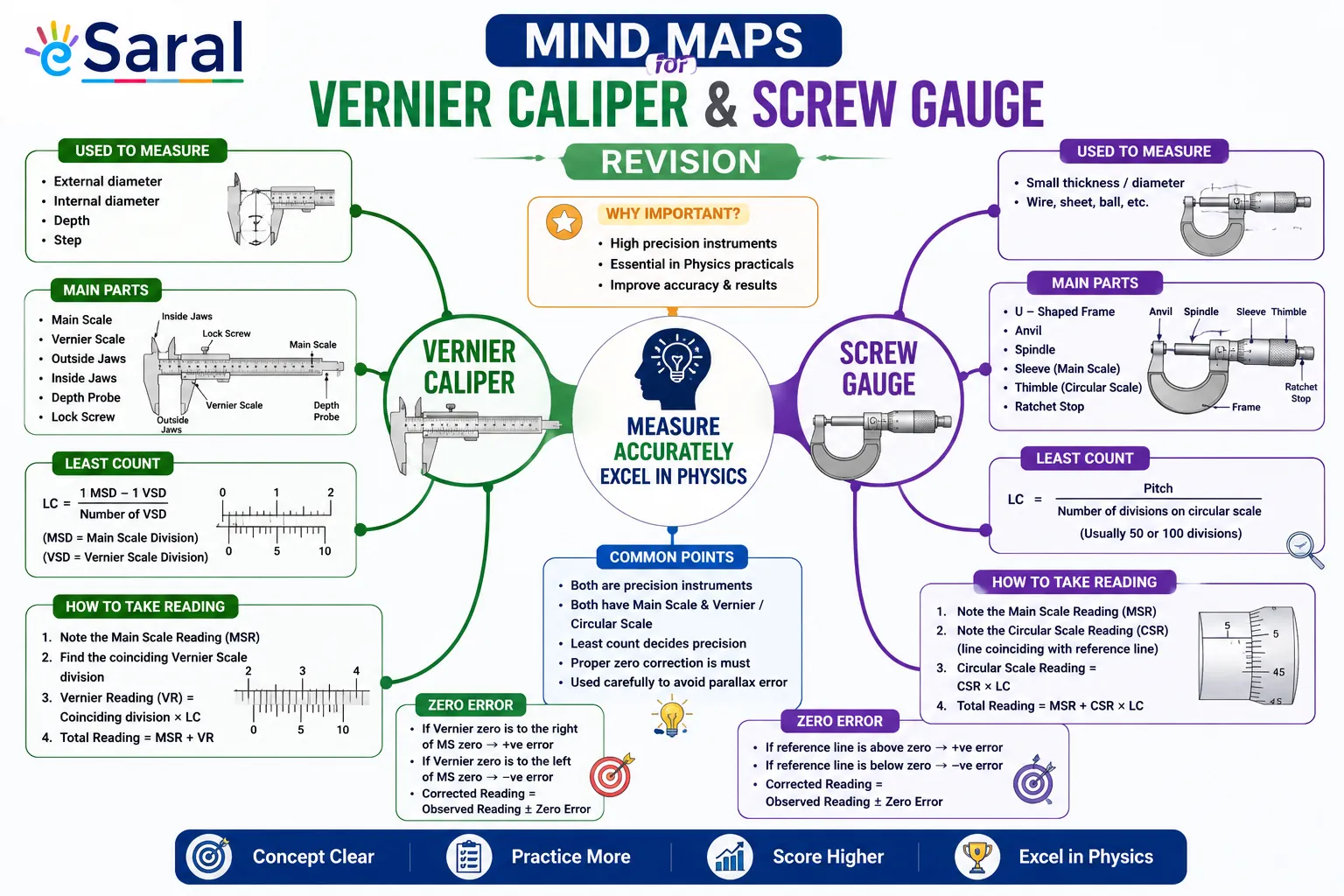
Table of Contents
- What Are Vernier Callipers and Screw Gauges?
- Vernier Calliper — Parts, Formula, and Zero Error
- How Do You Identify and Correct Zero Error in a Vernier Calliper?
- Screw Gauge — Parts, Formula, and Zero Error
- Vernier Caliper vs Screw Gauge — Quick Comparison Table
- Mind Maps for Quick Revision
- How These Topics Are Tested in JEE and NEET
- Sample Question Type (JEE Main Pattern)

eSaral > Class 11 Physics > Vernier Caliper and Screw Gauge

India's Best Exam Preparation for Class 11th - Download Now
India's Best Exam Preparation for Class 11th - Download Now
What Are Vernier Callipers and Screw Gauges?
A vernier calliper and screw gauge are precision instruments used to measure lengths and diameters that a standard ruler cannot measure accurately. They appear in Class 11 Physics Chapter 2: Units and Measurements, which is a foundational chapter for both the JEE and NEET syllabi as defined by NTA (National Testing Agency).
Understanding these instruments is not just about passing practicals. JEE Main regularly includes 1–2 numerical or conceptual questions on least count, zero error correction, and significant figures. In JEE Advanced, instrument-based questions often combine error analysis with real measurement data, demanding a deeper understanding of how these devices work.
Students who have trained with Kota-quality faculty — like those at eSaral, where IIT Bombay topper AIR-41 teach the same concepts they once mastered themselves — consistently report that mind maps speed up last-minute revision dramatically.
Vernier Calliper — Parts, Formula, and Zero Error
What Are the Main Parts of a Vernier Calliper?
A Vernier calliper consists of five important parts that help measure dimensions with high precision.
Main Scale (Fixed Jaw)
Measures in millimetres or centimetres and provides the primary reading.
Vernier Scale (Sliding Jaw)
A secondary scale that slides along the main scale for precise measurements.
External Jaws
Used to measure outer diameters, thicknesses, and lengths.
Internal Jaws
Used to measure inner diameters of hollow cylinders, tubes, and containers.
Depth Probe (Tail)
Measures the depth of holes, slots, and recesses.
What Is the Least Count Formula for a Vernier Calliper?
The Least Count (LC) is the smallest measurement that a Vernier caliper can accurately record.
Where:
- MSD = Main Scale Division
- VSD = Vernier Scale Division
For a Standard Vernier Caliper
1 MSD = 1 mm
1 VSD = 9/10 MSD = 0.9 mm
LC = 1 mm − 0.9 mm = 0.1 mm = 0.01 cm
Vernier Calliper Reading Formula
How Do You Identify and Correct Zero Error in a Vernier Calliper?
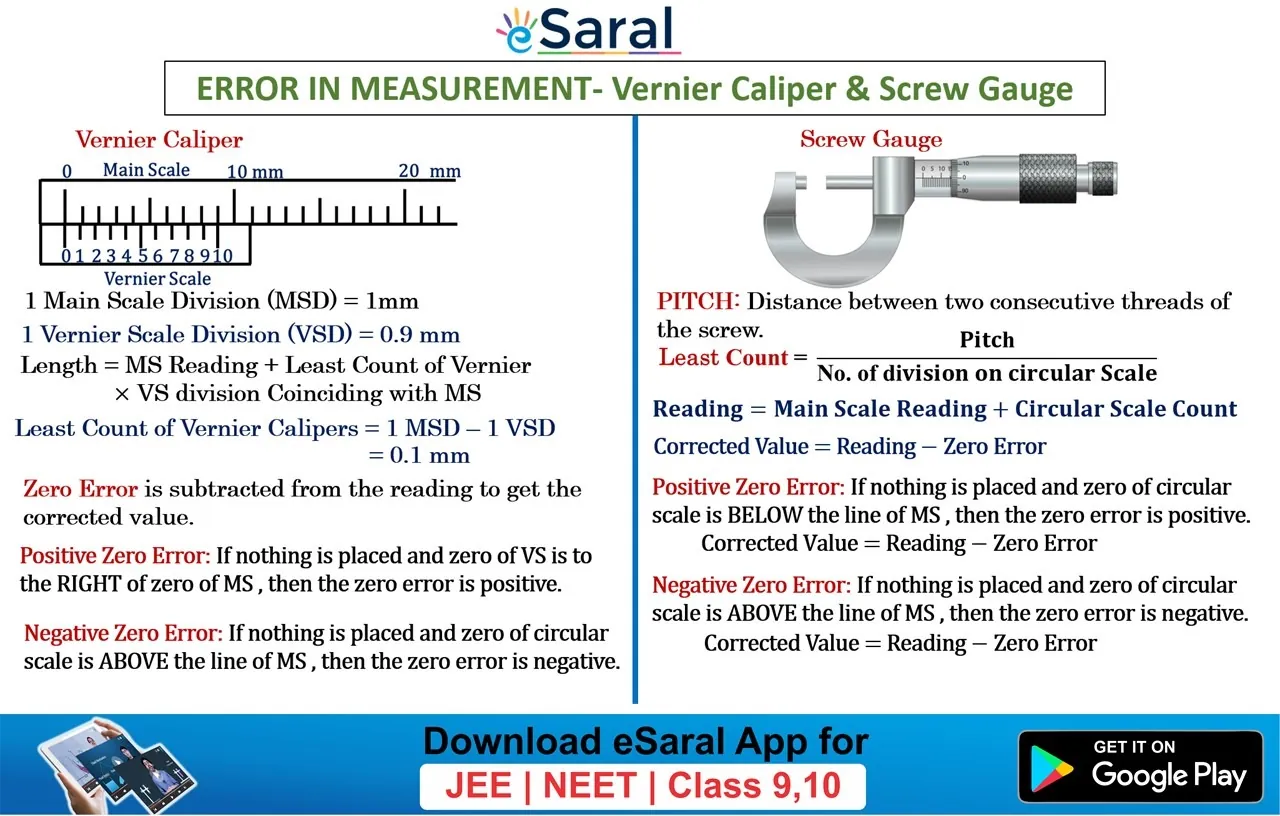
Zero error occurs when the zero mark of the Vernier scale does not coincide with the zero mark of the main scale when the jaws are completely closed.
| Zero Error Type | What You See | Correction |
|---|---|---|
| No Zero Error | 0 of Vernier aligns with 0 of Main Scale | No correction required |
| Positive Zero Error | 0 of Vernier is to the right of the main scale zero | Subtract zero error from the observed reading |
| Negative Zero Error | 0 of Vernier is to the left of the main scale zero | Add the magnitude of zero error |
Corrected Reading = Observed Reading − Zero Error
Screw Gauge — Parts, Formula, and Zero Error
What are the main parts of a screw gauge?
A screw gauge (also called a micrometer screw gauge) consists of:
- Sleeve (Main scale): Fixed, horizontal, graduated in mm and 0.5 mm.
- Thimble (Circular scale): Rotates around the sleeve; usually has 50 divisions.
- Spindle: Moves forward/backward as the thimble rotates.
- Anvil: Fixed reference surface against which the object is held.
- Ratchet: Ensures consistent pressure; prevents over-tightening.
What is the least count formula for a screw gauge?
Least Count = Pitch / Number of divisions on circular scale
Standard values:
- Pitch = distance moved by spindle in one full rotation = 0.5 mm (most common)
- Circular scale divisions = 50
LC = 0.5 mm / 50 = 0.01 mm
Reading formula:
Total Reading = Main Scale Reading + (Circular Scale Division × LC)
How do you find and correct zero error in a screw gauge?
| Zero Error Type | Condition | Correction |
|---|---|---|
| No zero error | 0 of circular scale aligns with reference line when jaws are closed | None |
| Positive zero error | 0 of circular scale is below the reference line | Subtract zero error |
| Negative zero error | 0 of circular scale is above the reference line | Add the magnitude of zero error |
Corrected reading = Observed reading − Zero error (with sign)
Vernier Caliper vs Screw Gauge — Quick Comparison Table
| Parameter | Vernier Caliper | Screw Gauge |
|---|---|---|
| Least Count | 0.1 mm (0.01 cm) | 0.01 mm |
| Range | 0–150 mm (typically) | 0–25 mm (typically) |
| Principle | Difference of two scales | Screw rotation (linear–circular) |
| Zero error correction | Add or subtract from main reading | Add or subtract with sign |
| Precision | Higher than ruler | Higher than Vernier caliper |
| Used for | Outer/inner diameter, depth | Very small lengths, wire diameter |
| JEE/NEET relevance | High — direct numericals | High — combined with error analysis |
Mind Maps for Quick Revision
The mind maps below cover the complete concepts of Vernier caliper, screw gauge, and significant figures as required for Class 11, JEE Main, JEE Advanced, and NEET. Each map is designed to replace multi-page notes with a single-glance visual reference.
What the mind maps cover:
- Vernier caliper: definition, parts, LC formula, types of zero error, reading method
- Screw gauge: definition, parts, pitch, LC formula, zero error, backlash error
- Significant figures: rules for counting, rounding, operations with significant figures
- Error analysis: absolute error, relative error, percentage error, combination of errors
These maps are created by IIT Bombay faculty and reflect the exact depth and style of questions asked in JEE Main and NEET. Students from eSaral's JEE and NEET batches use these maps in the final 48 hours before exams for targeted revision.
[Mind map images are embedded above — scroll up to view and download.]
For the full Chapter 2 theory and solved examples, refer to NCERT Solutions for Class 11 Physics or download the chapter directly from NCERT Books for Class 11.
How These Topics Are Tested in JEE and NEET
What types of questions appear on the Vernier caliper and screw gauge in JEE Main?
According to NTA's official JEE Main syllabus and past paper analysis (2016–2024), questions from this chapter typically fall into three categories:
- Direct LC calculation: Given pitch and number of divisions, find the least count.
- Reading a measurement: Given main scale and circular/Vernier scale readings, find total length.
- Zero error correction: Given a zero error (positive or negative), find the corrected reading.
Frequency: 1–2 questions per JEE Main session from Units & Measurement; screw gauge/Vernier problems appear in approximately 60% of sessions.
How many marks does this chapter carry in NEET?
NEET Physics assigns roughly 2–3 questions to Units, Dimensions, and Measurements (Chapter 2). Practical-based questions on instrument reading have appeared in NEET 2019, 2021, and 2023 papers.
Sample Question Type (JEE Main Pattern)
A screw gauge has a pitch of 0.5 mm and 50 divisions on the circular scale. The circular scale reads 25, and the main scale reads 3.5 mm. Find the total reading.
Solution:
- LC = 0.5 / 50 = 0.01 mm
- Reading = 3.5 + (25 × 0.01)
- Reading = 3.5 + 0.25
- Total Reading = 3.75 mm
For more solved problems and NCERT-aligned practice, explore NCERT Solutions for Class 11 Physics.
Frequently Asked Questions
Find answers to common questions.
How do you correct for negative zero error in a screw gauge?
When a screw gauge has negative zero error, the circular scale zero lies above the reference line when jaws are fully closed. The magnitude of this error must be added to the observed reading. For example, if zero error = −0.03 mm and observed reading = 2.58 mm, corrected reading = 2.58 + 0.03 = 2.61 mm.
What is the least count of a screw gauge?
The least count of a standard screw gauge is 0.01 mm. It equals the pitch divided by the number of circular scale divisions. For a pitch of 0.5 mm and 50 divisions, LC = 0.5/50 = 0.01 mm. Always verify pitch and division count from the question data before solving.
What is the least count of a Vernier caliper?
The least count of a standard Vernier caliper is 0.1 mm (0.01 cm). It is calculated as the difference between one main scale division (1 mm) and one Vernier scale division (0.9 mm). Some advanced Vernier calipers have 20 or 50 divisions, giving a least count of 0.05 mm or 0.02 mm respectively.
What is the difference between zero error and zero correction?
Zero error is the faulty reading shown by the instrument when the actual measurement is zero — it can be positive or negative. Zero correction is the value you apply to fix this error: it is always equal in magnitude but opposite in sign to the zero error. If zero error = +0.02 mm, zero correction = −0.02 mm.
Are Vernier caliper questions asked in NEET?
Yes. NEET Physics includes questions on measurement instruments. Practical-skill-based questions on reading Vernier calipers and screw gauges appeared in NEET 2019, 2021, and 2023. Questions typically involve identifying the correct reading or correcting for zero error. Knowing the mind maps and formulas covered here is sufficient to score full marks on these questions.
What is backlash error in a screw gauge?
Backlash error occurs due to wear and looseness in the screw mechanism of a screw gauge. When you reverse the rotation direction, the spindle does not immediately move, creating a false reading gap. To avoid it, always approach a measurement from the same direction of rotation and use the ratchet stop for consistent pressure.