Mind Maps for Unit & Dimension Revision - Class XI, JEE, NEET

Home >Mind Maps > Mind Map Units and Dimensions

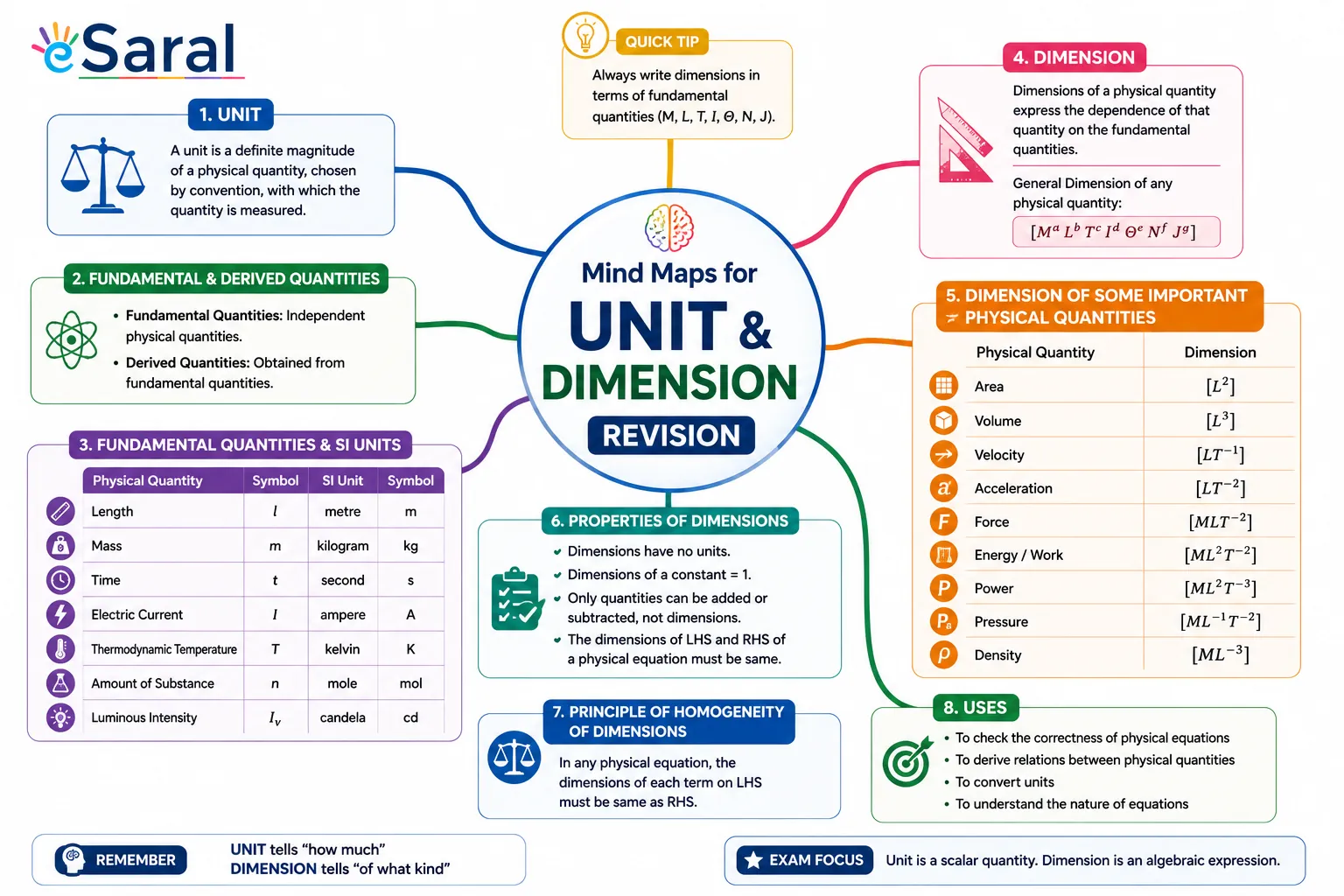
Learn all the formulae and important points of Units and Measurements with this mindmap. Download and share with your friends also.
Download
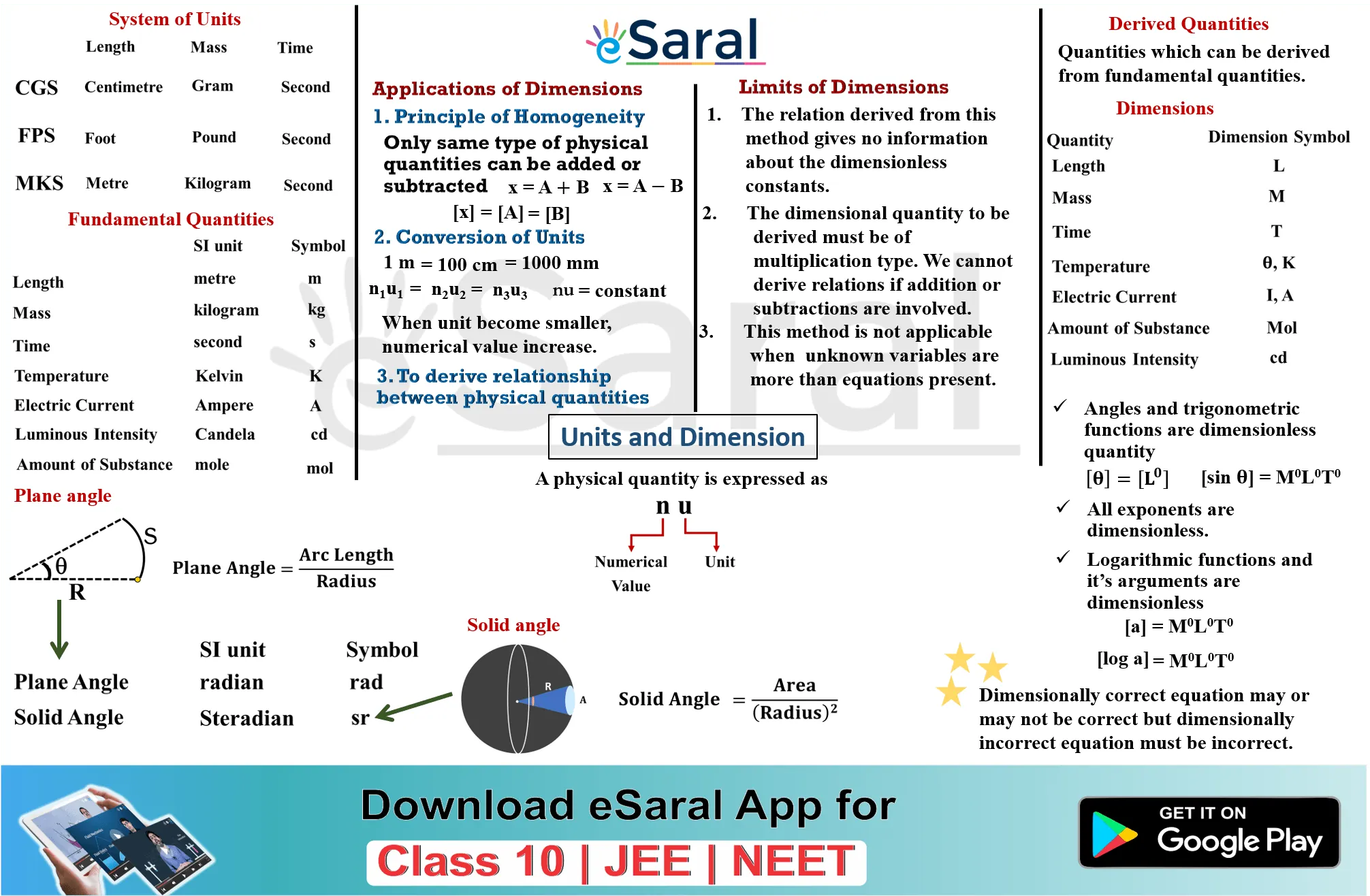
Revise Complete Physics for Class 11, 12, JEE & NEET. Click Here
Frequently Asked Questions
Find answers to common questions.
Is the Units and Dimensions chapter important for NEET?
Yes, Units and Dimensions is important for NEET. It typically contributes 1 question (4 marks) per paper. The question is almost always easy-to-medium difficulty, covering SI units or basic dimensional formulas. A student who revises this chapter properly for 2–3 hours should be able to secure full marks from it reliably
How many base units are there in the SI system?
There are 7 SI base units: metre (length), kilogram (mass), second (time), ampere (electric current), kelvin (thermodynamic temperature), mole (amount of substance), and candela (luminous intensity). These were defined by the General Conference on Weights and Measures (CGPM) and are used as the foundation for all derived units in physics.
What is the dimensional formula of gravitational constant G?
The dimensional formula of gravitational constant G is [M⁻¹L³T⁻²]. It is derived from Newton's law of gravitation: F = Gm₁m₂/r². Rearranging gives G = Fr²/m₁m₂. Substituting dimensions: [MLT⁻²][L²]/[M²] = [M⁻¹L³T⁻²]. This formula appears in both JEE Main and NEET papers.
Which physical quantities have the same dimensional formula?
Several pairs share dimensional formulas: Work and Torque both have [ML²T⁻²]; Impulse and Linear Momentum share [MLT⁻¹]; Angular Velocity and Frequency share [T⁻¹]; Stress and Pressure share [ML⁻¹T⁻²]; Planck's Constant and Angular Momentum share [ML²T⁻¹]. Questions based on this appear regularly in both JEE Main and NEET.
What is the difference between accuracy and precision in measurement?
Accuracy refers to how close a measured value is to the true value. Precision refers to how close repeated measurements are to each other, regardless of whether they match the true value. A measurement can be precise but inaccurate (consistent but biased), or accurate but imprecise (close to truth but scattered). JEE Main tests this distinction directly.
Can dimensional analysis prove the correctness of a formula?
No. Dimensional analysis can only check dimensional consistency — it cannot confirm a formula is fully correct. A formula can be dimensionally consistent and still be physically wrong (for example, if a dimensionless constant is missing or incorrect). Dimensional analysis is a necessary condition for correctness, not a sufficient one.