Mind Maps For Matrices - Class 12, JEE (Main + Advanced)
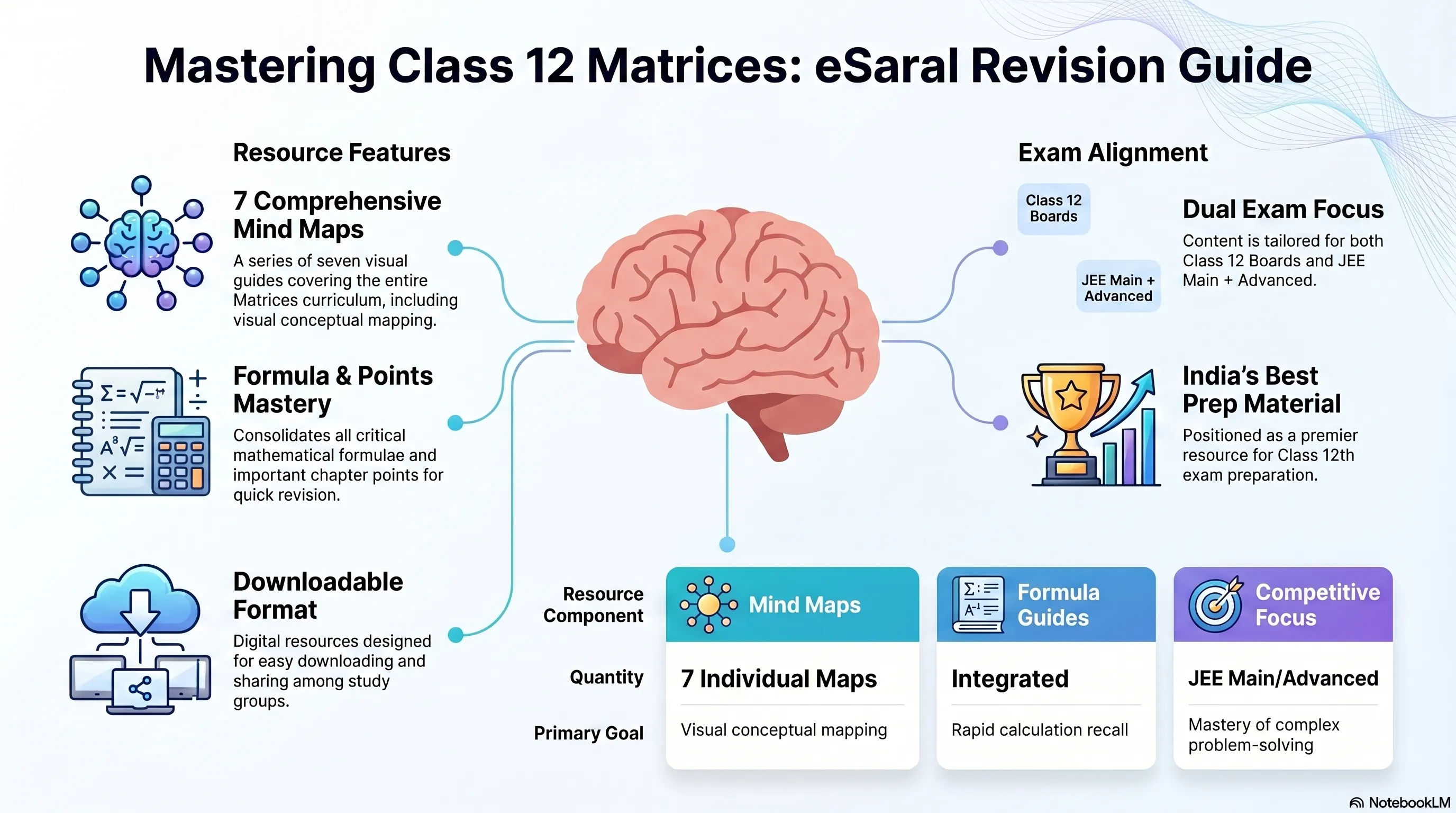
These Matrices Mind Maps for Class 12 provide a concise visual summary of key formulas, concepts, and shortcuts, making revision easier for Board exams, JEE Main, and JEE Advanced.

eSaral › Class 12 ›Mind Maps For Matrices - Class 12, JEE (Main + Advanced)

🚀 Checkout eSaral Courses
Get to learn all the formulae and important points of Class 12th Chapter Matrices through these Mind Maps. Download and share with your friends also.
India's Best Exam Preparation for Class 12th - Download Now
Mind Map - 1
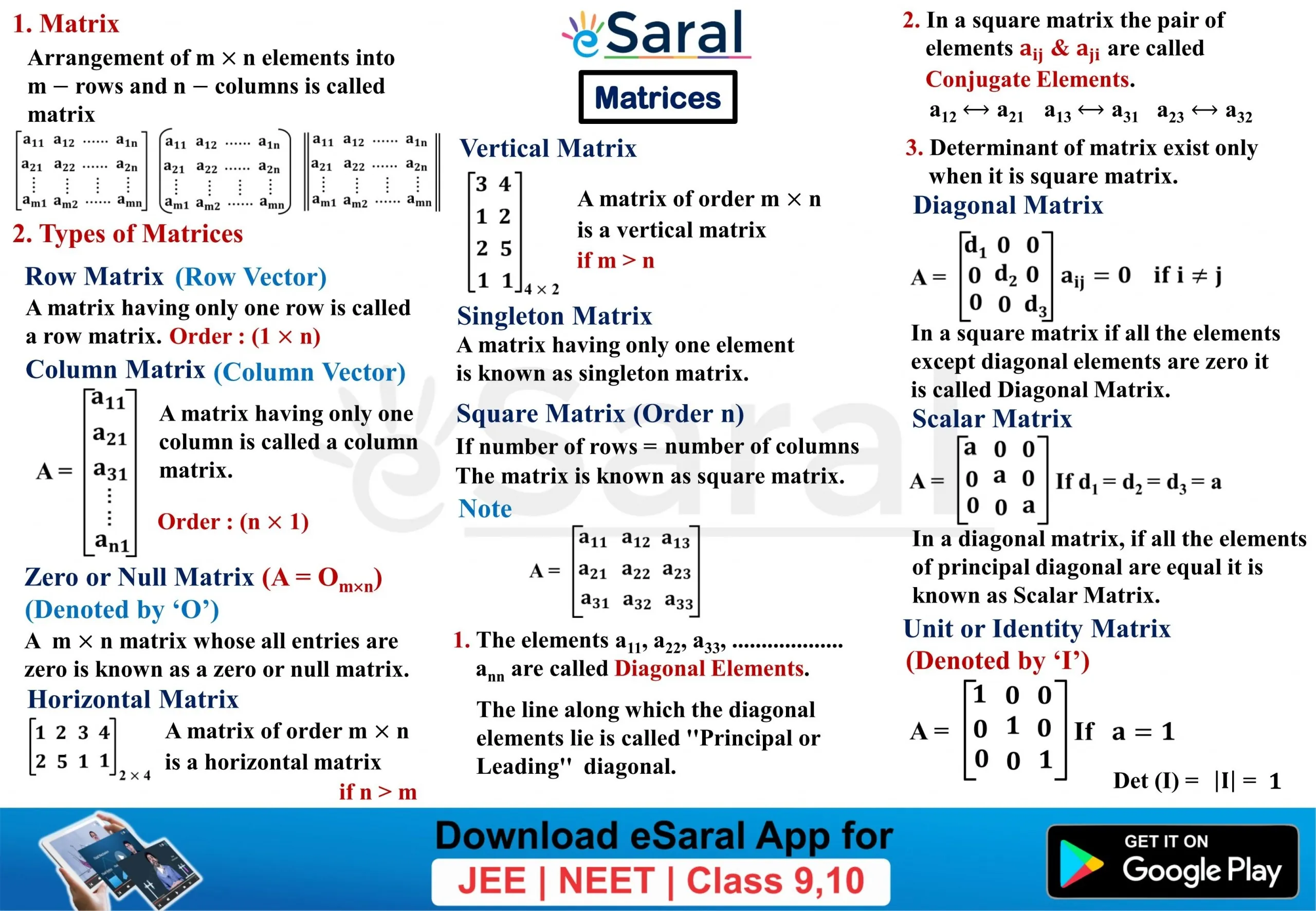
Mind Map - 2
India's Best Exam Preparation for Class 12th - Download Now
Mind Map - 3
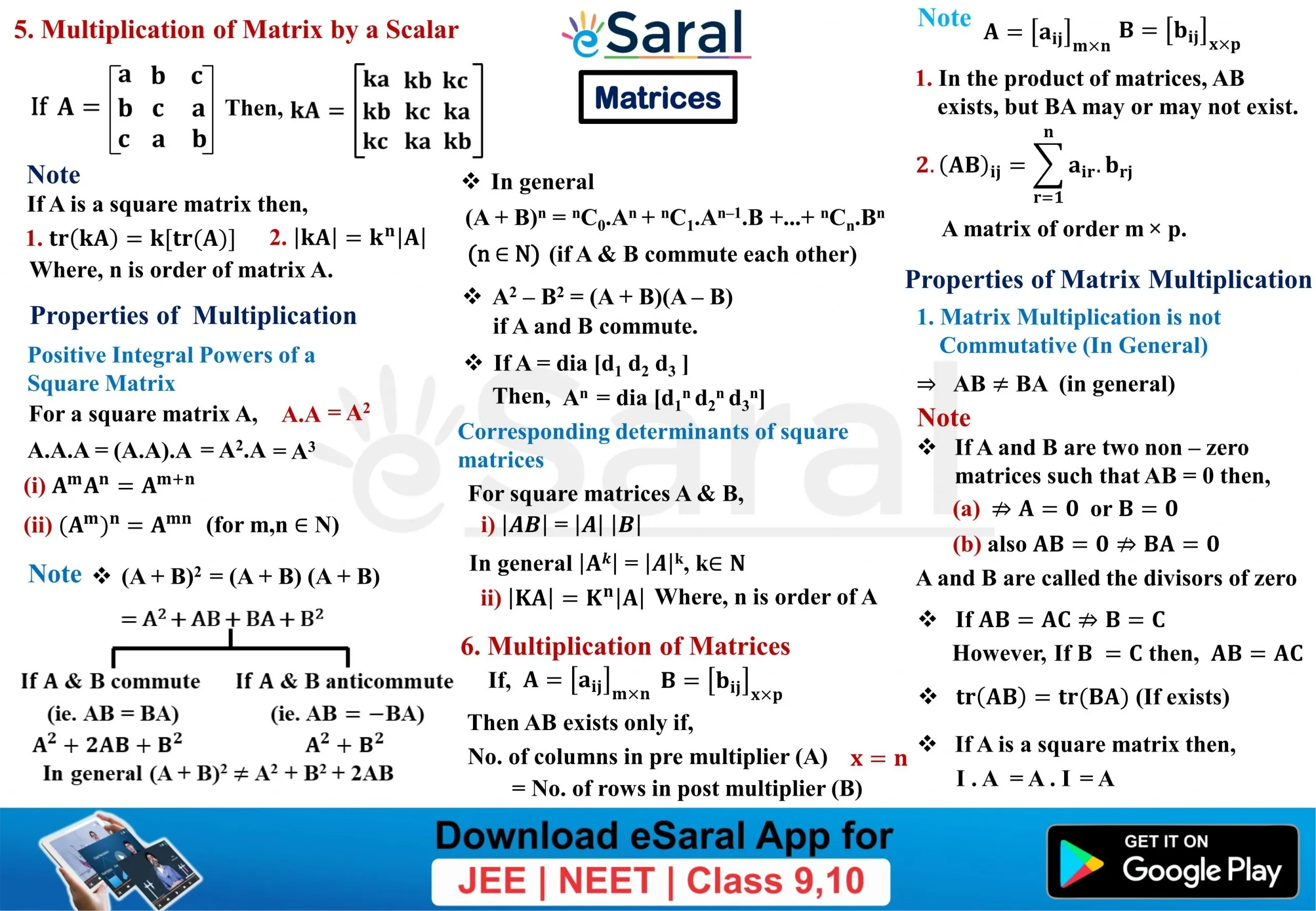
Mind Map - 4
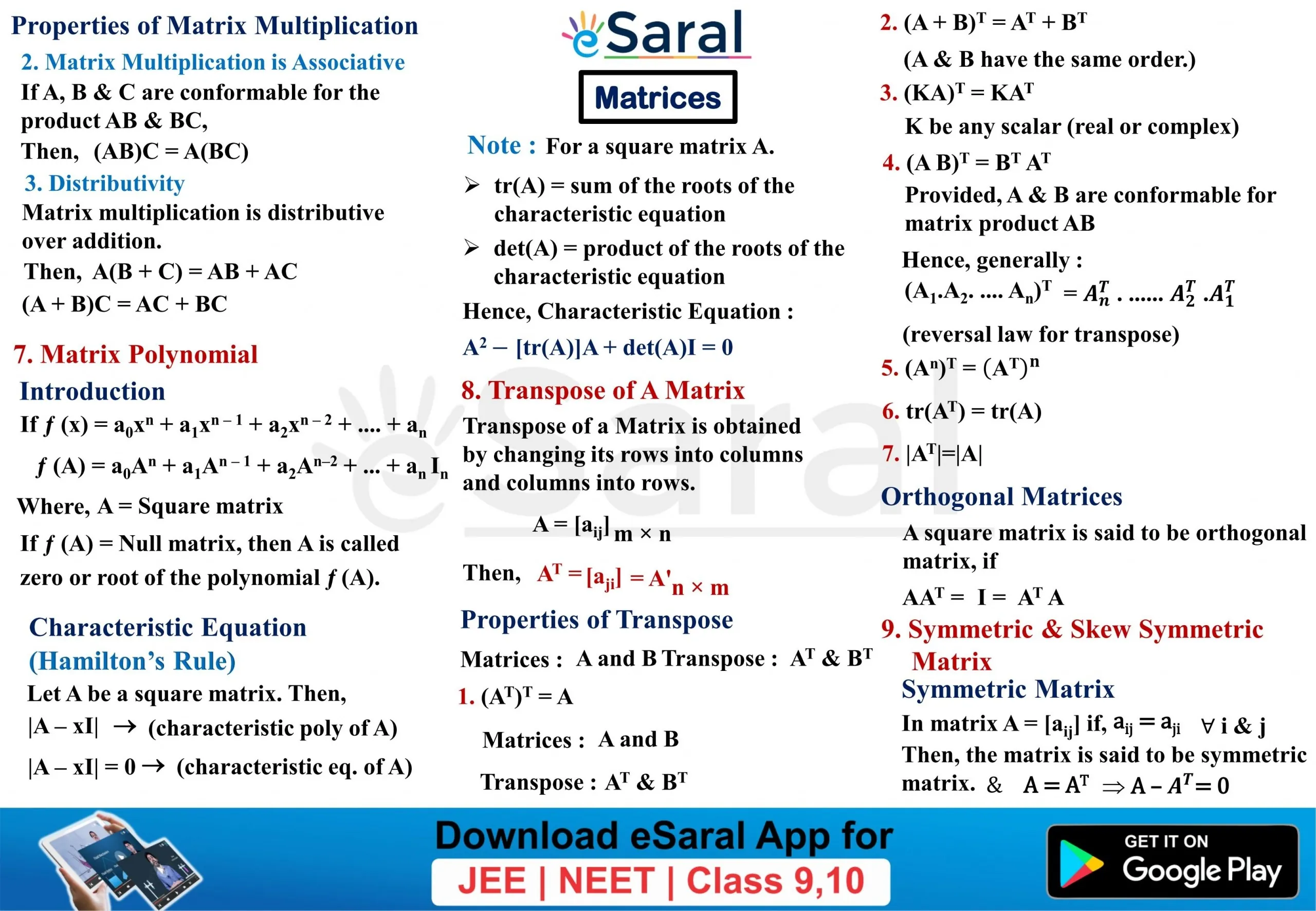
Mind Map - 5
India's Best Exam Preparation for Class 12th - Download Now
Mind Map - 6
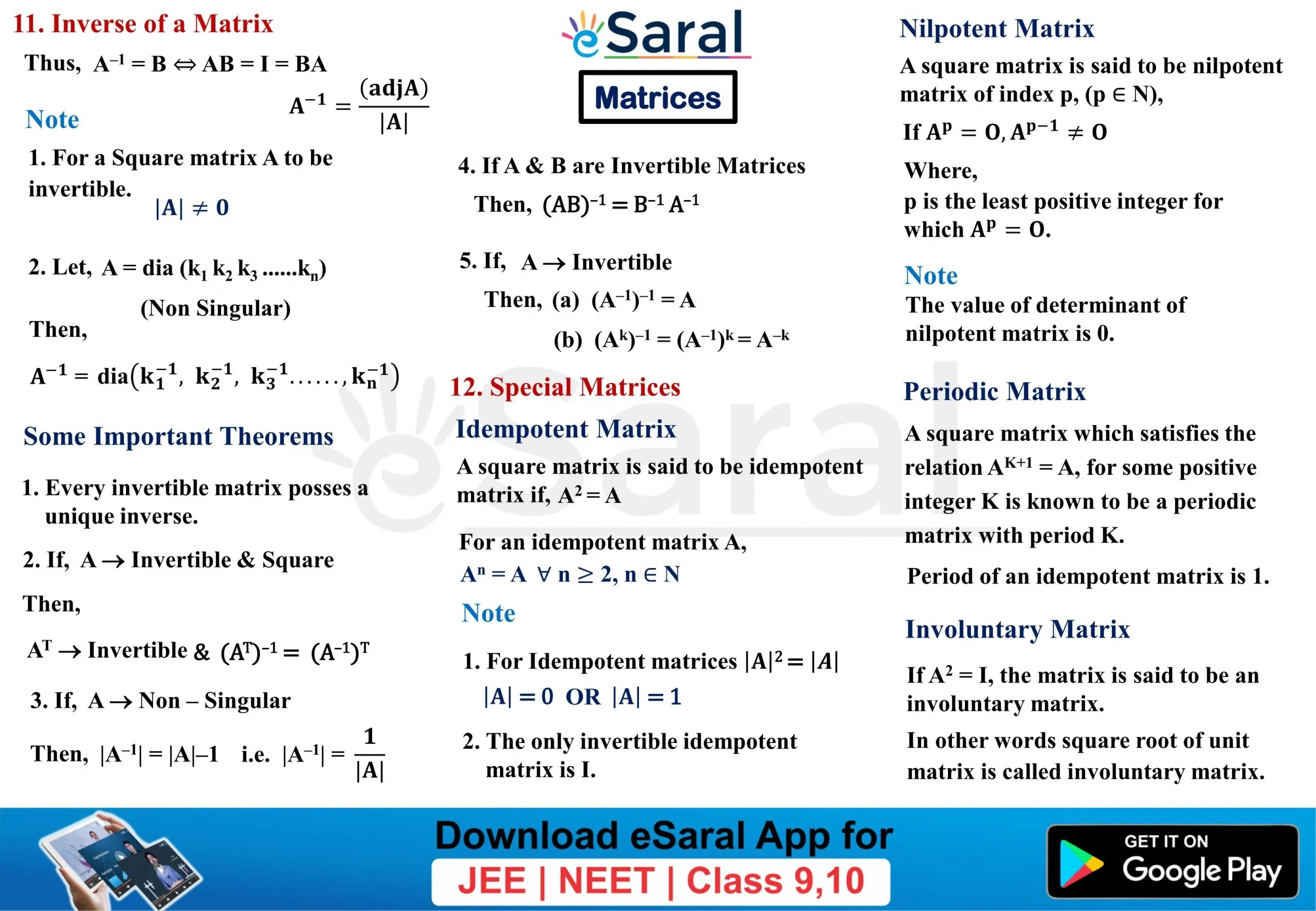
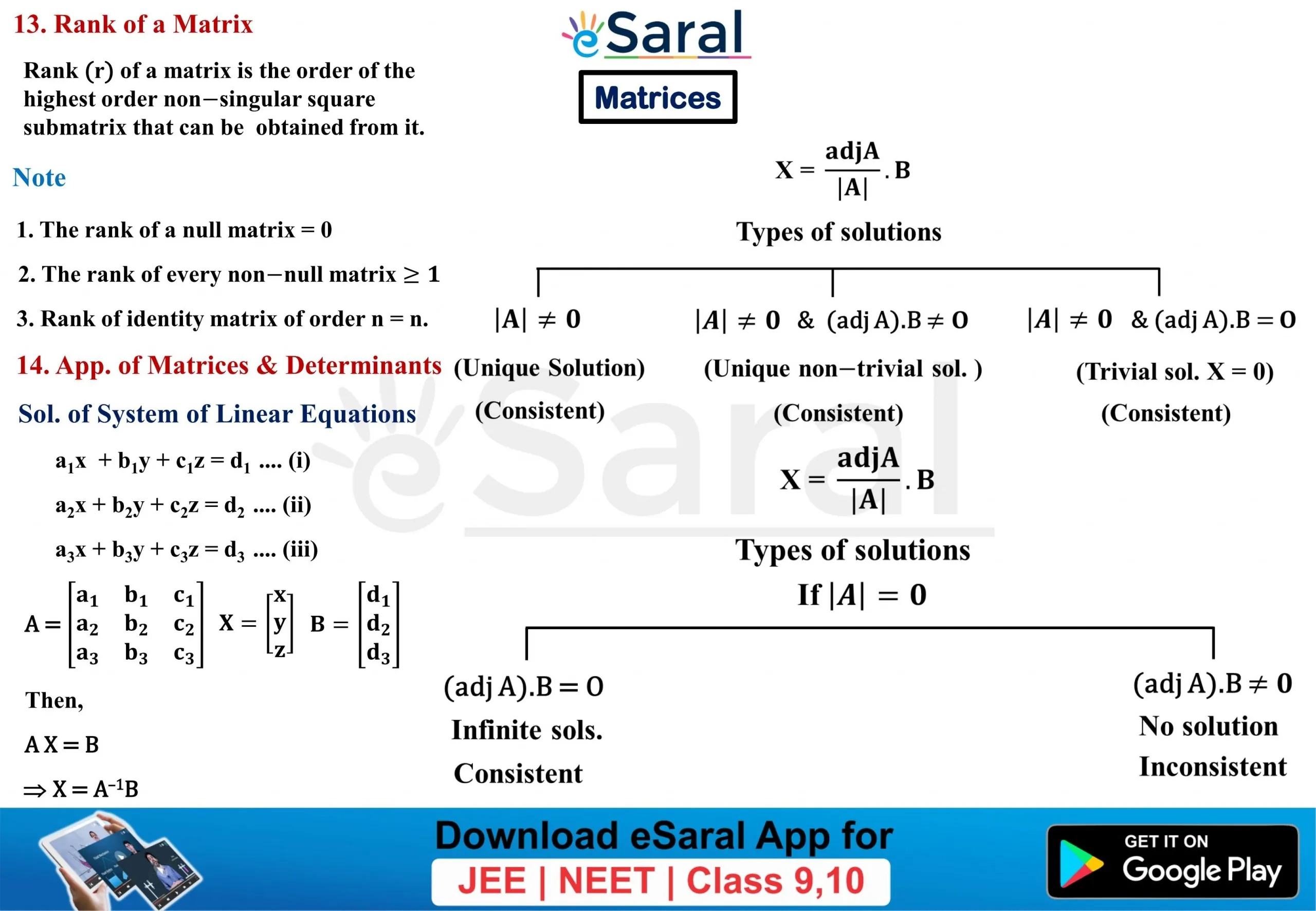
Mind Map - 7
India's Best Exam Preparation for Class 12th - Download Now
Frequently Asked Questions
Find answers to common questions.
What topics are covered in the Matrices mind maps for Class 12?
The 7 mind maps cover types of matrices, matrix operations (addition, subtraction, multiplication), transpose, symmetric and skew-symmetric matrices, inverse and adjoint, elementary transformations, and special matrices like idempotent and orthogonal. Together they address 100% of the Matrices syllabus prescribed by NCERT and tested in JEE Main and JEE Advanced.
Are these mind maps enough for JEE Main preparation?
Mind maps are revision tools, not primary study resources. Use them after completing the Matrices chapter from NCERT and solving practice problems. For JEE Main, pair these maps with previous year questions — the NCERT Solutions for Class 12 Maths are a strong starting point for concept-level clarity before you attempt JEE-level problems.
How many questions come from Matrices in JEE Main?
JEE Main typically includes 1–3 questions from Matrices (often combined with Determinants as a single chapter unit). Based on NTA's official JEE Main papers from 2019 to 2024, the Matrices + Determinants unit has appeared in every single paper, making it one of the most reliably tested topics in the Mathematics section.
What is the difference between symmetric and skew-symmetric matrices?
A symmetric matrix satisfies A = A^T (the matrix equals its transpose), while a skew-symmetric matrix satisfies A = −A^T (the matrix equals the negative of its transpose). Every square matrix can be uniquely written as the sum of one symmetric and one skew-symmetric matrix — a property frequently tested in both board exams and JEE Main.
Can I use these mind maps for Class 12 board exams as well?
Yes. These mind maps are designed to align with the CBSE Class 12 Maths syllabus (NCERT Chapter 3 — Matrices). All topics in the CBSE board exam — types, operations, transpose, inverse — are covered across the 7 maps. Students preparing for boards and JEE simultaneously will find the maps serve both purposes without any gaps.