Mind Maps for Relations and Functions — Class 12 JEE Revision (All Key Concepts Covered)
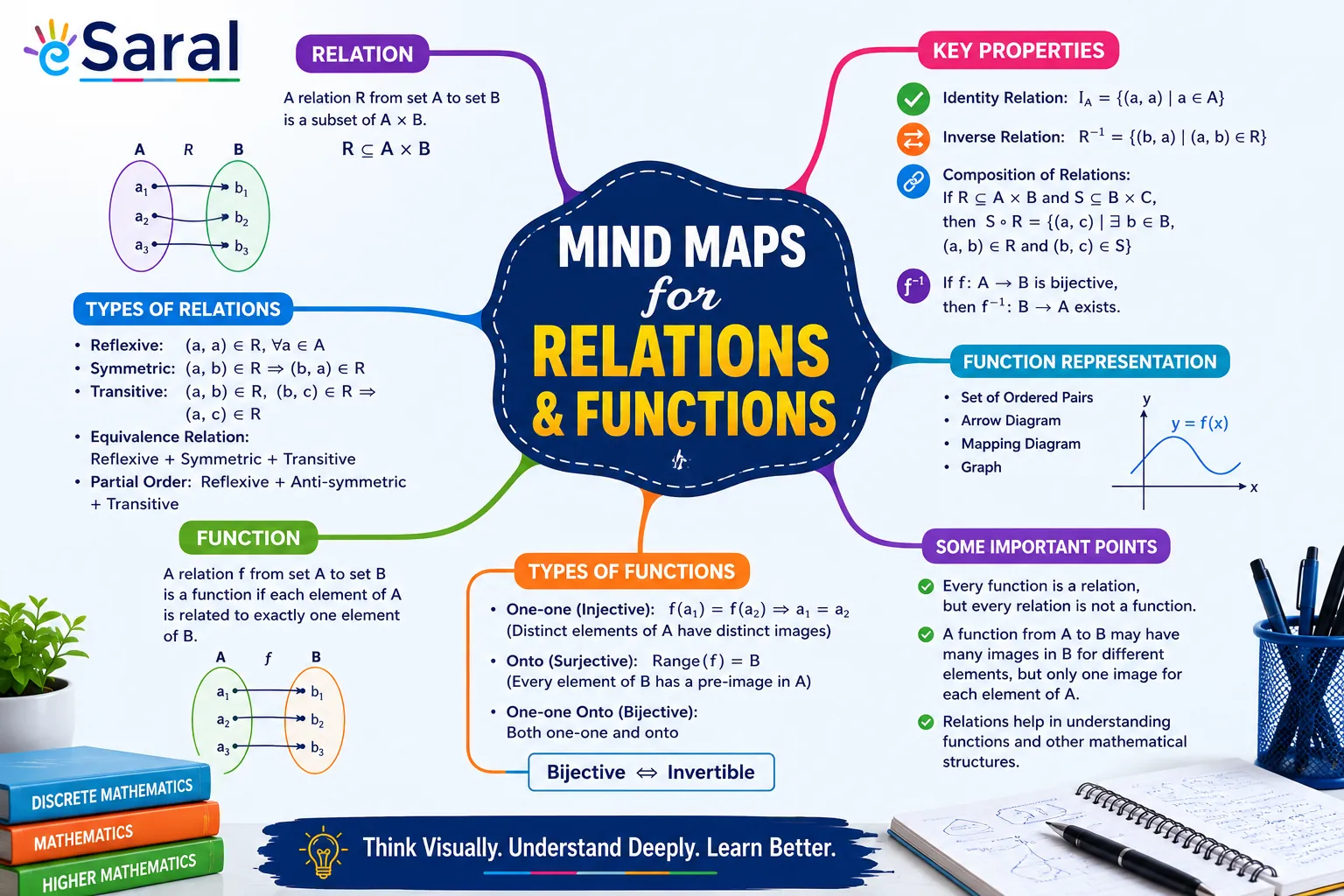

eSaral > Maths Mind Maps > Relations and Functions

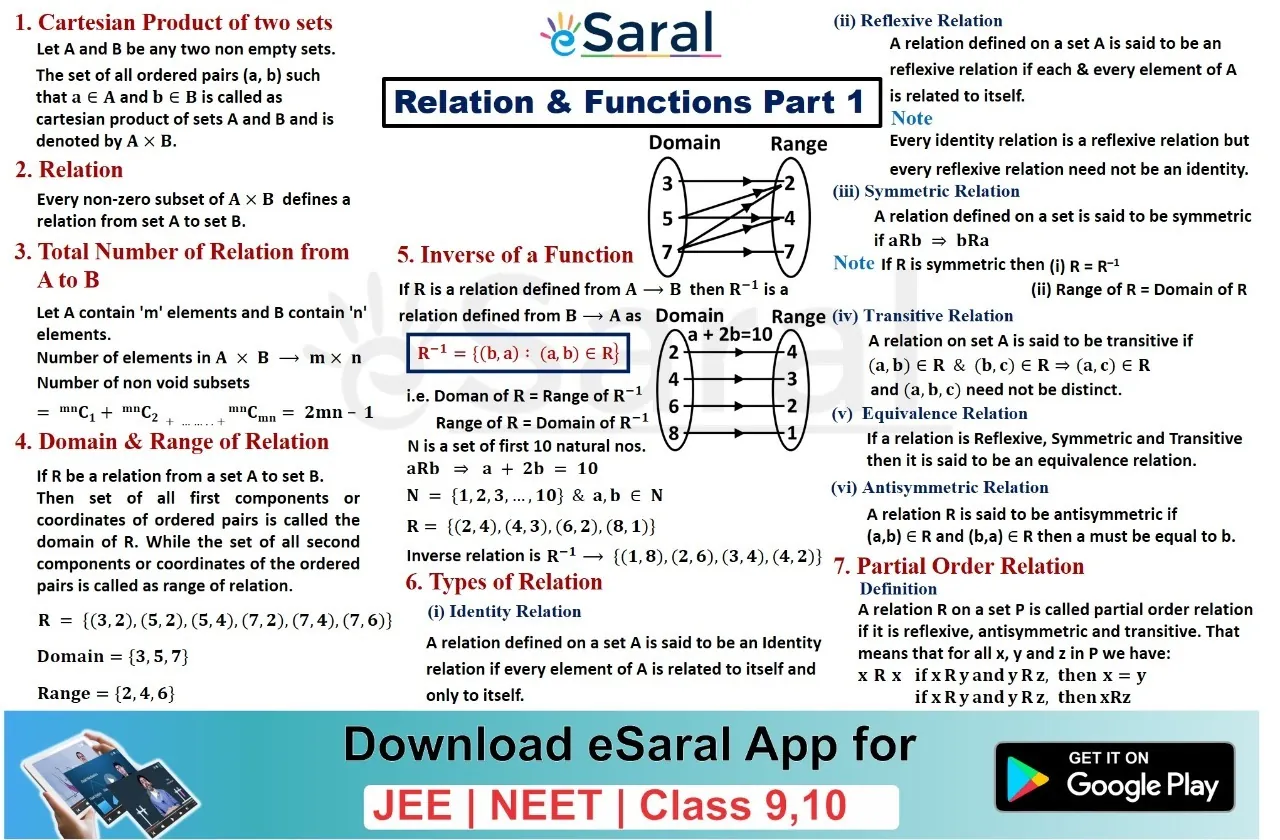
Get to learn all the formulae and important points of Class 12th Chapter Relation & Functions through this Mind Map. Download and share with your friends also.
Relation & Functions (PART 1)
Relation & Functions (PART 2)
Mind Map - 1
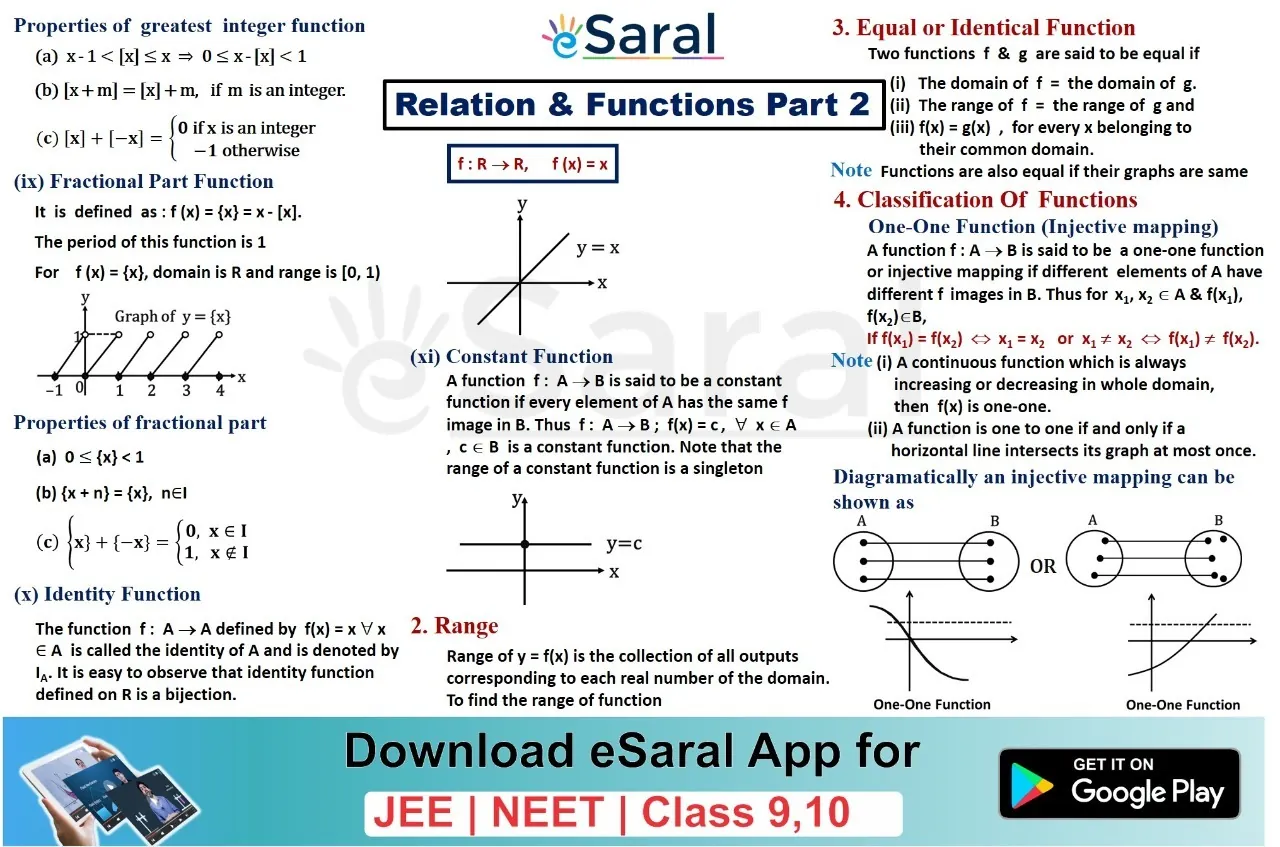
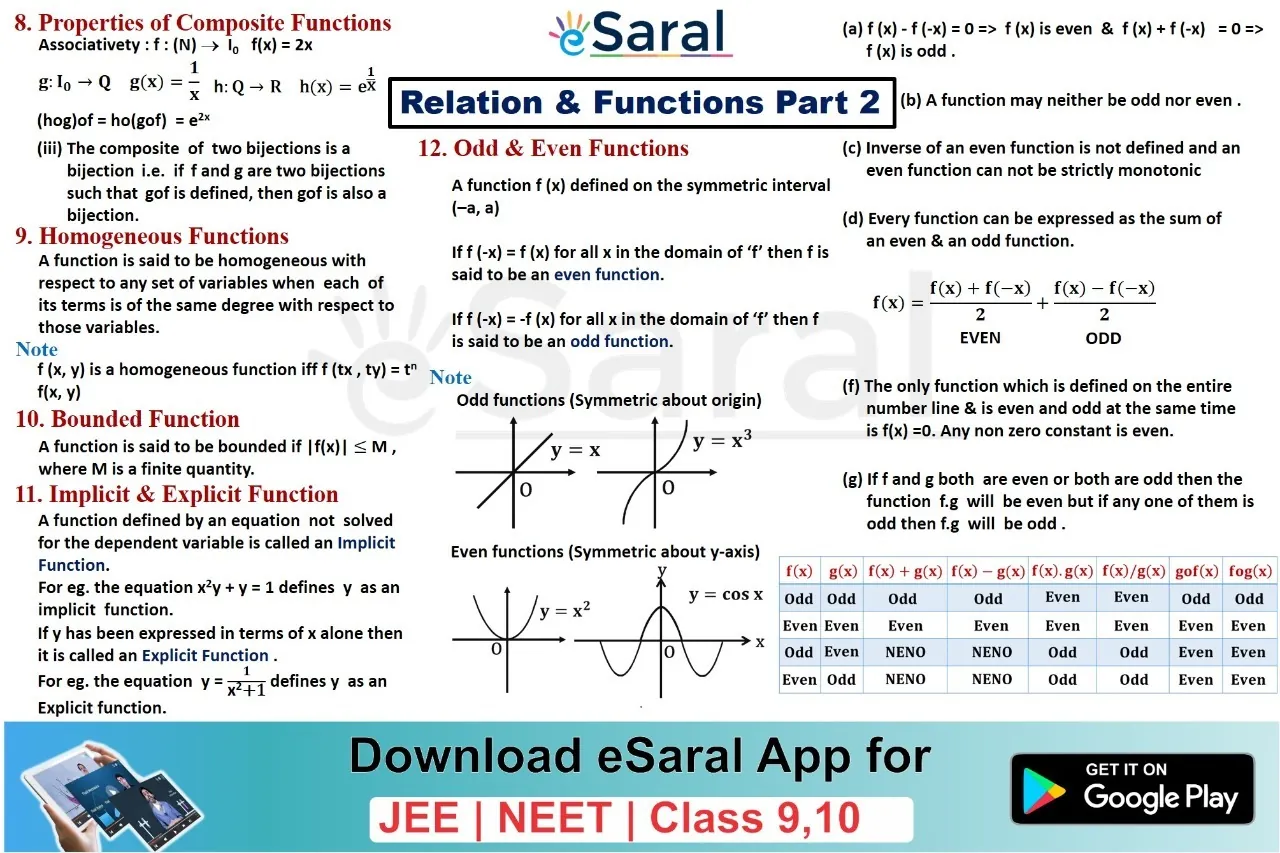
Mind Map - 2
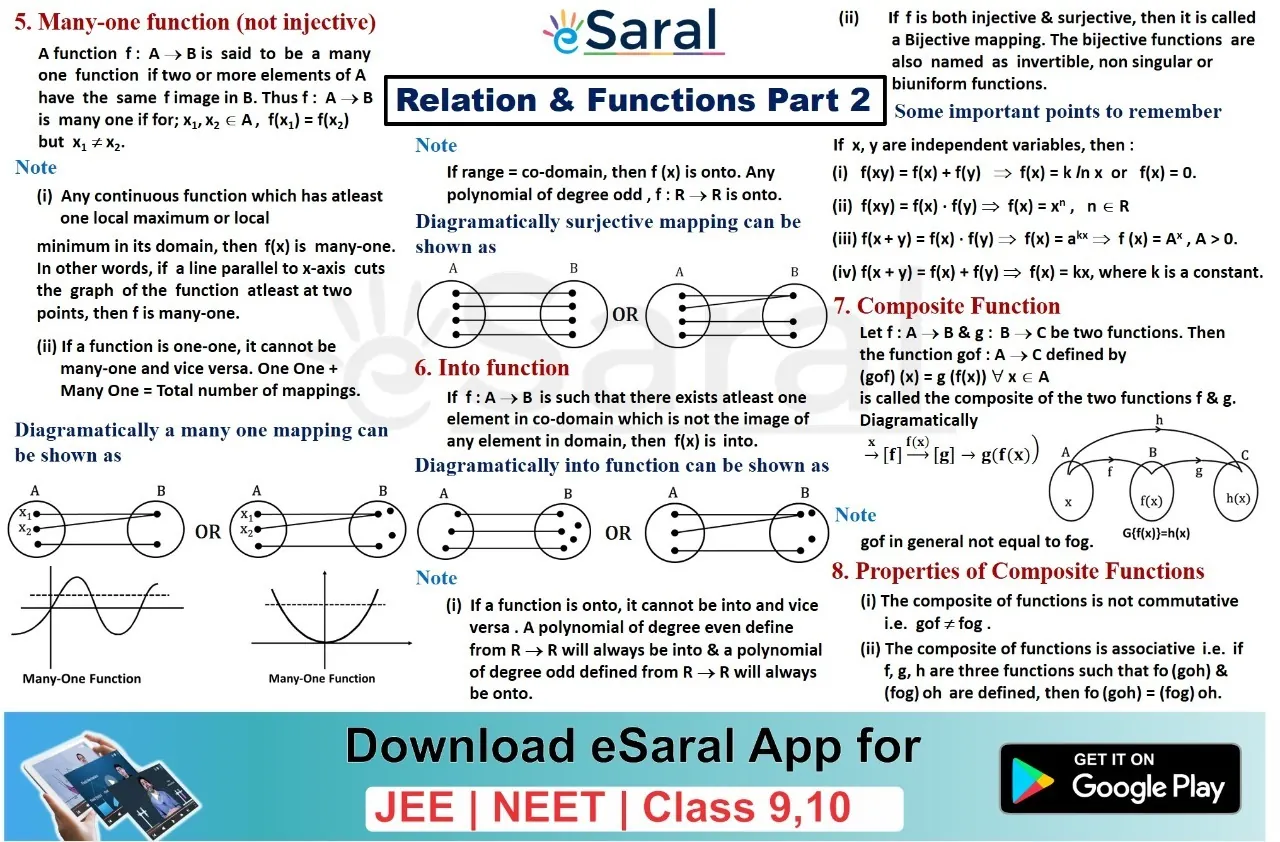
Mind Map - 3
Mind Map - 4
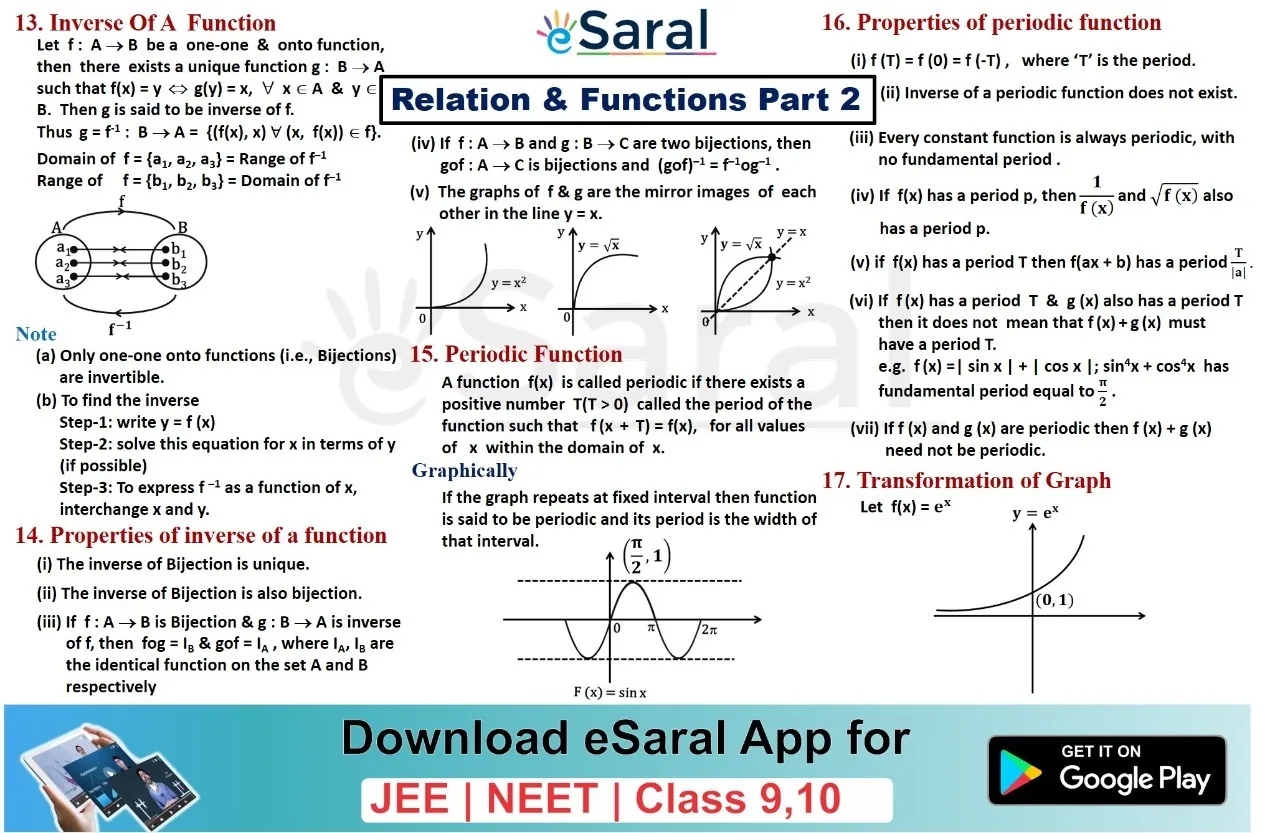
Mind Map - 5
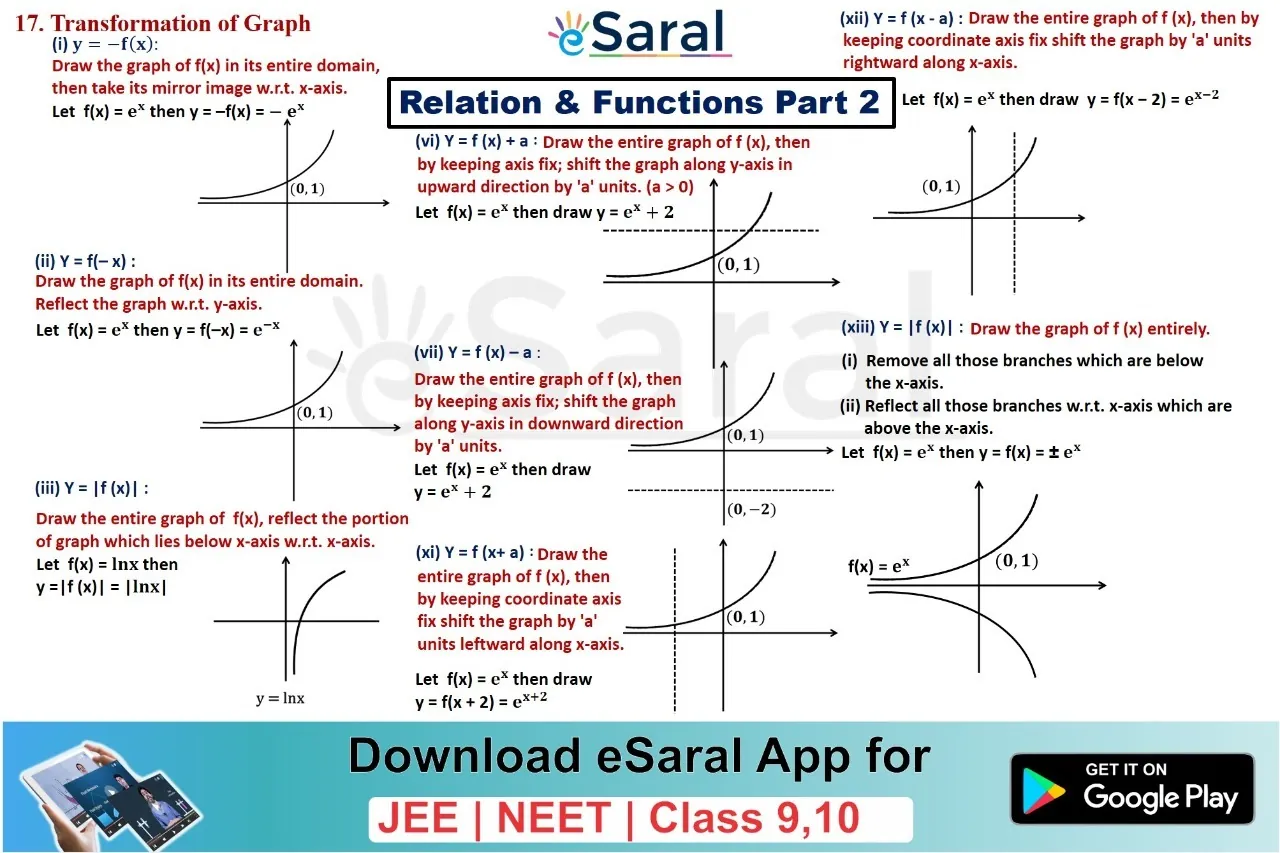
Physics Revision Series by Saransh Gupta Sir (AIR-41, IIT-BOMBAY), Chemistry Revision Series by Prateek Gupta Sir (IIT-BOMBAY, Metallurgy), Maths Revision Series by N.K. Gupta Sir (eSaral Co-founder)
Frequently Asked Questions
Find answers to common questions.
What is the difference between a bijective function and an invertible function?
A function is invertible if and only if it is bijective — meaning it is both one-one (injective) and onto (surjective). These two terms refer to the same condition: bijective tells you about the mapping structure; invertible tells you the consequence — that a valid inverse function f⁻¹ exists. Every bijective function has a unique inverse.
Is Relations and Functions important for JEE Advanced?
Relations and Functions as a standalone chapter has lower direct weightage in JEE Advanced compared to JEE Main. However, the concepts — especially functions, composition, and invertibility — are foundational to Calculus, which carries very high weightage in JEE Advanced. Skipping this chapter is not advisable.
How many questions come from Relations and Functions in JEE Main?
JEE Main typically features 1 to 2 questions directly from Relations and Functions each year. According to NTA's official syllabus, this chapter is part of the Algebra unit. The questions usually test types of relations, counting of functions, and properties of binary operations — making it a high-accuracy, moderate-weightage chapter.
Can I rely only on mind maps without reading NCERT for Relations and Functions?
Mind maps are revision tools, not replacements for the full NCERT chapter. Use NCERT for first-time learning and for understanding proofs and worked examples. Once the chapter is complete, use these mind maps to reinforce and rapidly recall the structure. For detailed worked solutions, refer to NCERT Solutions for Class 12 Maths alongside the maps.
What are binary operations and why are they in Class 12 Maths?
A binary operation ∗ on a set A is a function ∗: A × A → A, meaning it takes two elements from A and returns one element in A. They appear in Class 12 because they generalise arithmetic operations. JEE tests whether a given operation is commutative (a ∗ b = b ∗ a), associative ((a ∗ b) ∗ c = a ∗ (b ∗ c)), and whether identity and inverse elements exist.
How do I check if a relation is an equivalence relation?
To check if a relation R on set A is an equivalence relation, verify three properties: (1) Reflexivity — (a, a) ∈ R for all a ∈ A; (2) Symmetry — if (a, b) ∈ R then (b, a) ∈ R; (3) Transitivity — if (a, b) ∈ R and (b, c) ∈ R then (a, c) ∈ R. All three must hold. If any one fails, the relation is not an equivalence relation.