3D Geometry Mind Maps for Class 12 & JEE
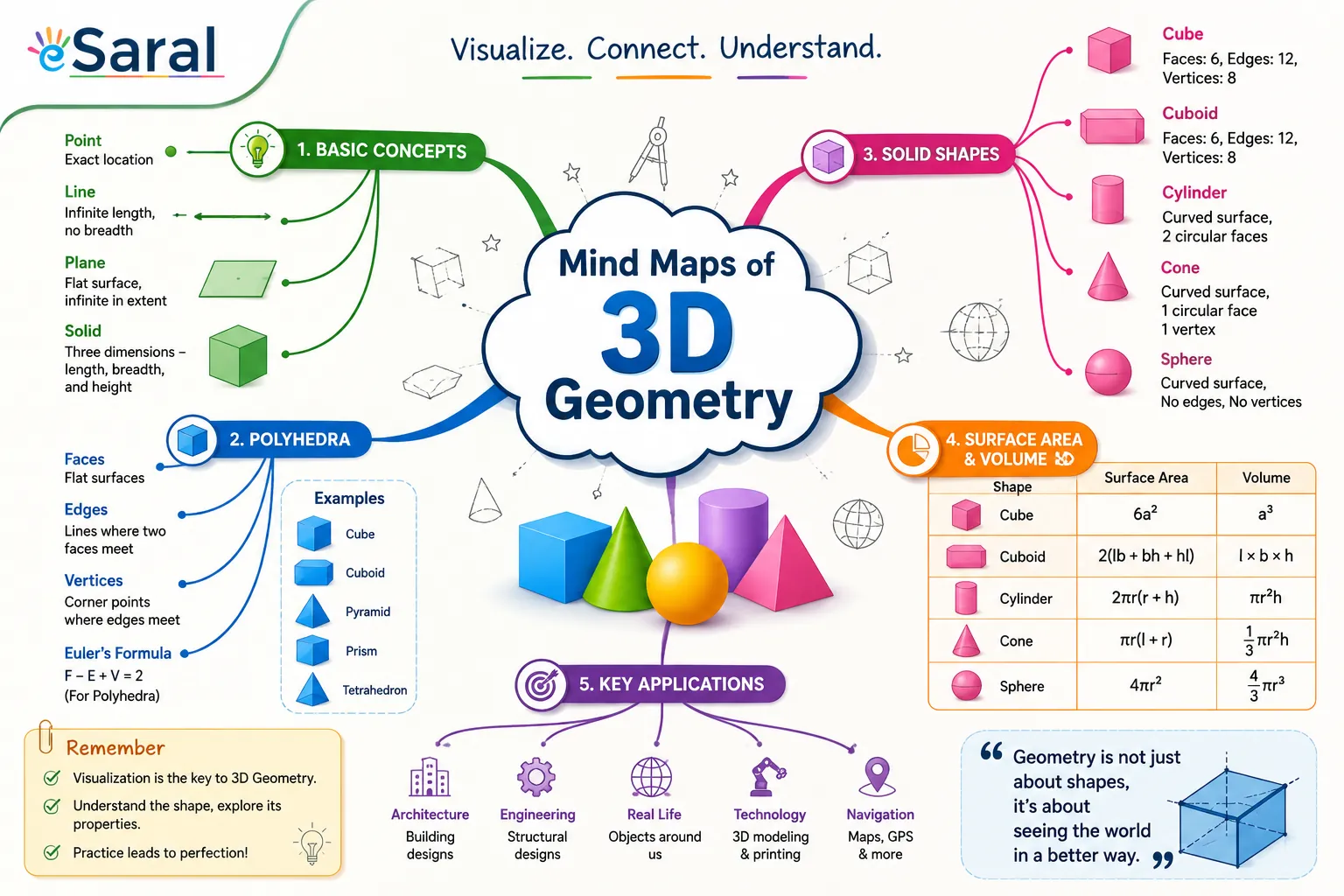
Table of Contents

Home > Study Material & Mind Maps > 3D Geometry Mind Maps – Class 12 & JEE

Why 3D Geometry Matters for JEE Main and Advanced
Three-dimensional geometry is one of the most formula-dense chapters in Class 12 Mathematics, and it consistently appears in JEE Main and JEE Advanced every year. According to the official NTA JEE Main paper pattern, the Mathematics section carries 100 marks, and 3D Geometry alongside Vectors typically accounts for 2–4 questions per paper — that is, roughly 8–16 marks up for grabs from a single chapter.
The challenge students face is not understanding the concepts individually; it is connecting them during a high-pressure exam. Direction cosines, skew lines, foot of perpendicular, angle between a line and a plane — these topics look scattered when studied from a textbook, but become crystal clear when seen as an interconnected visual map.
That is exactly why eSaral's mathematics team, led by N.K. Gupta Sir (eSaral Co-founder), has designed these mind maps: to give you a bird's-eye view of the entire chapter so revision takes minutes, not hours. Students in eSaral's JEE batches have used these maps as their go-to tool in the final 48 hours before the exam.
For detailed step-by-step solutions to every NCERT exercise in this chapter, also refer to NCERT Solutions for Class 12 Maths on eSaral.
What Do These Mind Maps Cover?
The three mind maps collectively cover the complete Class 12 Chapter 11 syllabus (Three Dimensional Geometry) as defined by NCERT and tested in JEE Main and JEE Advanced.
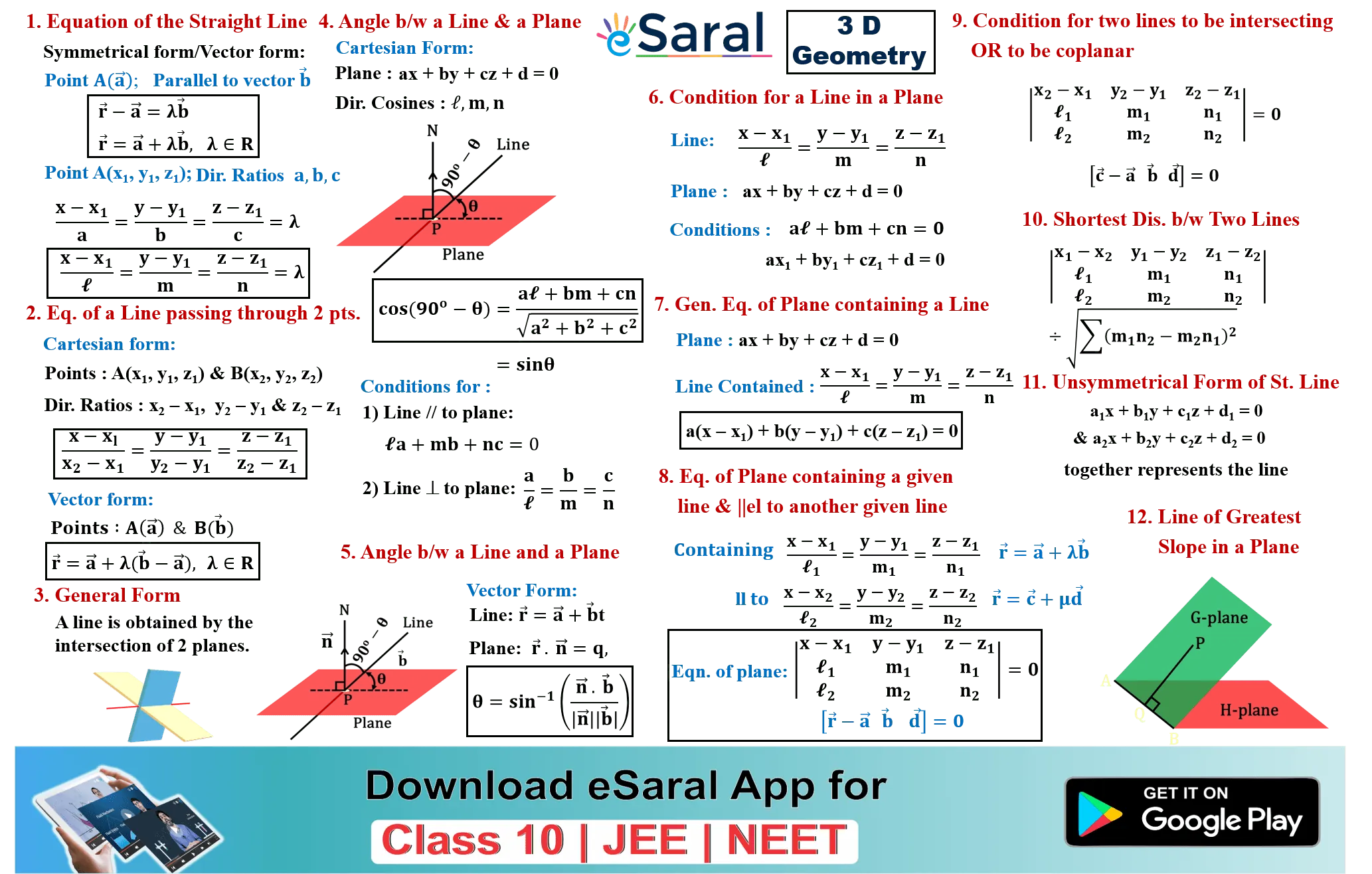
Mind Map 1 – Direction Cosines, Direction Ratios & Straight Lines in 3D
This map covers the foundational building blocks of 3D Geometry:
- Direction cosines (l, m, n) and the identity l² + m² + n² = 1
- Direction ratios and their relationship to direction cosines
- Equation of a line in 3D — both vector form and Cartesian form
- Angle between two lines using direction cosines
- Condition for two lines to be parallel or perpendicular
- Skew lines — definition, shortest distance formula, and worked approach
Students often confuse direction cosines with direction ratios. Remember: direction cosines are the actual cosines of angles made with the coordinate axes and always satisfy l² + m² + n² = 1. Direction ratios are just proportional values — they do not need to satisfy this identity. Get this distinction right and half your errors in this chapter disappear.
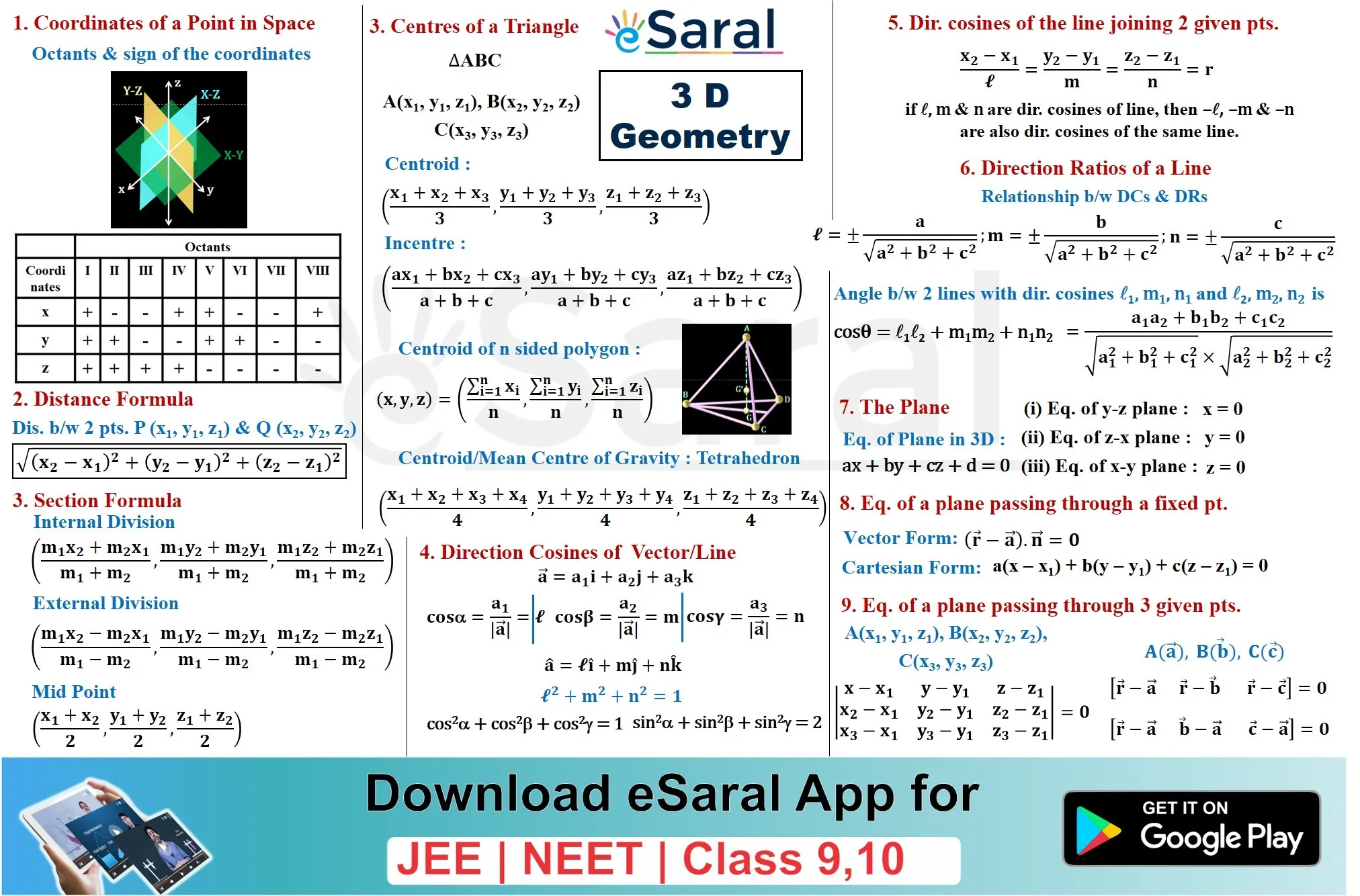
Mind Map 2 – Planes in 3D Geometry
This map focuses entirely on planes, which generate a significant share of JEE questions:
- Equation of a plane — general form, normal form, intercept form
- A plane passing through three points
- Angle between two planes using normal vectors
- Distance of a point from a plane
- Condition for coplanarity of two lines
- A plane containing a given line
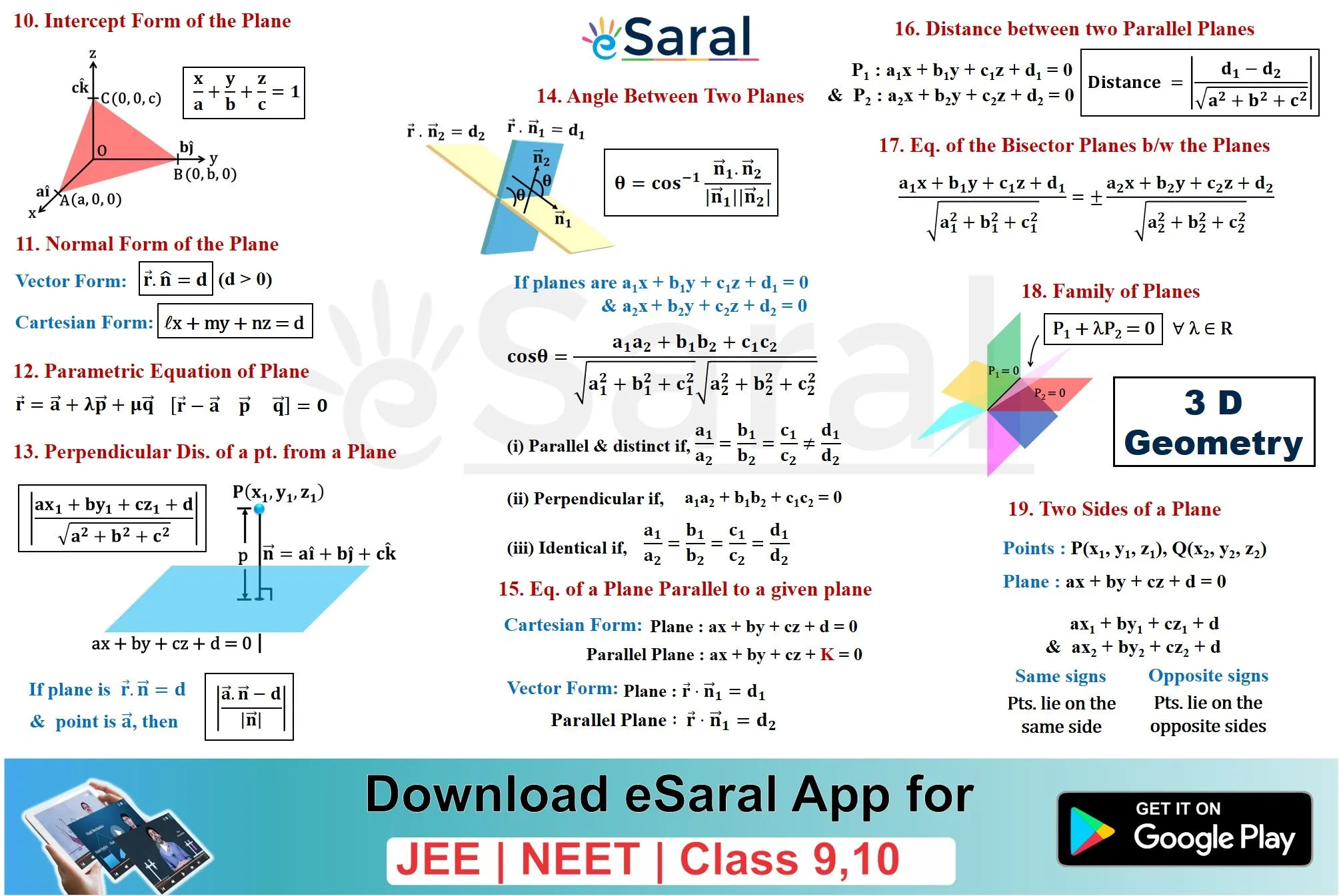
Mind Map 3 – Advanced Topics: Lines, Planes & Their Intersections
The third map ties everything together and addresses the higher-difficulty problems seen in JEE Advanced:
- Angle between a line and a plane
- The foot of a perpendicular from a point to a line and to a plane
- Image of a point in a plane
- Family of planes through the intersection of two given planes
- Distance between parallel planes
- Vector and Cartesian approaches side by side for all key results
In JEE Main, about 60–70% of 3D Geometry questions can be solved using the distance-of-a-point-from-a-plane formula and the condition for perpendicularity of planes. Memorise those two results cold. The mind maps show them highlighted — that is not by accident.
How to Use These Mind Maps for Maximum Revision Benefit
A mind map is only as useful as the revision strategy around it. Here is the method recommended by eSaral's faculty — the same approach used in Kota-quality classroom coaching, now available online.
Step 1 – First Encounter (While Studying the Chapter)
Open the relevant mind map alongside your NCERT textbook or eSaral video lecture. As each concept is introduced, locate it on the map. This builds the mental connections between topics that isolated note-taking cannot.
For NCERT-based practice, pair the mind maps with NCERT Solutions for Class 12 Maths to see exactly how each formula applies to standard problems.
Step 2 – Active Recall Practice (48–72 Hours Later)
Close the mind map. On a blank sheet, try to reconstruct as much of it as you can from memory. Check against the original. Every gap you find is a concept you would have lost marks on in an exam.
Step 3 – Final Revision (Day Before Exam)
Spend 10–15 minutes scanning all three maps. Do not read — scan. At this stage, your brain only needs a trigger to recall what it already knows. The visual structure of a mind map is perfectly suited for this.
Step 4 – Formula Cross-Check During Mock Tests
After every mock test, return to the mind map and identify which formula you either forgot or applied incorrectly. Mark it. Review it before the next mock.
Key Formulas at a Glance – Topic & JEE Weightage Table
| Topic | Mind Map | Key Formula / Result | Approx. JEE Main Weightage |
|---|---|---|---|
| Direction Cosines & Ratios | Map 1 | l² + m² + n² = 1 | Low-Medium (Concept Base) |
| Equation of a Line (Vector) | Map 1 | r = a + λb | Medium |
| Shortest Distance (Skew Lines) | Map 1 | SD = |((b₁×b₂)·(a₂−a₁))| / |b₁×b₂| | High |
| Equation of a Plane (Normal Form) | Map 2 | r · n̂ = d | High |
| Distance of Point from Plane | Map 2 | |ax₁+by₁+cz₁+d| / √(a²+b²+c²) | Very High |
| Angle Between Two Planes | Map 2 | cos θ = |n₁·n₂| / (|n₁||n₂|) | High |
| Angle Between Line and Plane | Map 3 | sin θ = |b·n| / (|b||n|) | Medium-High |
| Image of a Point in a Plane | Map 3 | Derived from the foot of the perpendicular | Medium |
Weightage estimates are based on analysis of JEE Main papers from 2019–2024 (NTA pattern).
Also, explore NCERT Books for Class 12 to read the original chapter alongside these mind maps for a complete understanding.
Get to learn all the formulae and important points of 3-D Geometry in Mathematics Class 12 through this Mind Map. Download and share with your friends also.
MIND MAP 1
MIND MAP - 2
MIND MAP - 3
Prepare for JEE & NEET with Kota's Top IITian & Doctor Faculties!
Physics Revision Series by Saransh Gupta Sir (AIR-41, IIT-BOMBAY), Chemistry Revision Series by Prateek Gupta Sir (IIT-BOMBAY,), Maths Revision Series by N.K. Gupta Sir (eSaral Co-founder)
Frequently Asked Questions
Find answers to common questions.
What is the difference between direction cosines and direction ratios?
Direction cosines (l, m, n) are the actual cosines of the angles a line makes with the x, y, and z axes — they always satisfy l² + m² + n² = 1. Direction ratios (a, b, c) are any three numbers proportional to the direction cosines. They are easier to read from a given equation but must be converted to direction cosines before using trigonometric formulas.
How many mind maps are needed to cover the full 3D Geometry syllabus for Class 12?
Three mind maps cover the complete Class 12 3D Geometry syllabus as per NCERT and JEE Main pattern. Mind Map 1 covers lines and direction cosines, Mind Map 2 covers planes, and Mind Map 3 covers the intersection of lines and planes along with advanced results. Together, they address every formula and concept tested in Board exams and JEE Main.
Is 3D Geometry important for JEE Main 2027 and 2028?
Yes, 3D Geometry is consistently important for JEE Main. Based on NTA's official question papers from 2019 to 2026, Three Dimensional Geometry and Vectors together contribute 2–4 questions per paper. That translates to 8–16 marks. Skipping this chapter is a significant risk, especially since the formulas are finite and learnable in a focused week of study.
Where can I find NCERT solutions for Class 12 Maths Chapter 11?
You can find fully solved NCERT solutions for Class 12 Maths, including Chapter 11 (Three Dimensional Geometry), at eSaral's NCERT Solutions for Class 12 Maths. Each question is solved step by step, with the relevant formula clearly stated — making it easy to cross-reference with the mind maps above.
Are these mind maps enough for JEE Advanced, or do I need extra material?
These mind maps cover all JEE Main-level concepts fully. For JEE Advanced, the same core formulas apply but problems are more multi-step and may combine 3D Geometry with Vectors. Use the mind maps as your formula reference, but also practice JEE Advanced previous year questions separately. eSaral's faculty — including IIT Bombay graduates who have taught thousands of JEE Advanced qualifiers — recommend pairing these maps with solved examples from past papers.
How should I revise 3D Geometry the night before JEE Main?
Spend 15–20 minutes scanning all three mind maps — do not re-read textbook derivations. Focus on the distance-from-plane formula, shortest distance between skew lines, and angle between a line and a plane, as these appear most frequently. Then attempt 5–8 previous year JEE Main questions on the topic to activate your recall under exam conditions