Mole Concept Notes for Class 11, IIT JEE & NEET
Mole Concept is the foundation of Physical Chemistry for JEE & NEET, covering moles, molar mass, Avogadro’s number, stoichiometry, limiting reagent, empirical formula, and concentration formulas essential for solving numerical problems across Chemistry chapters.
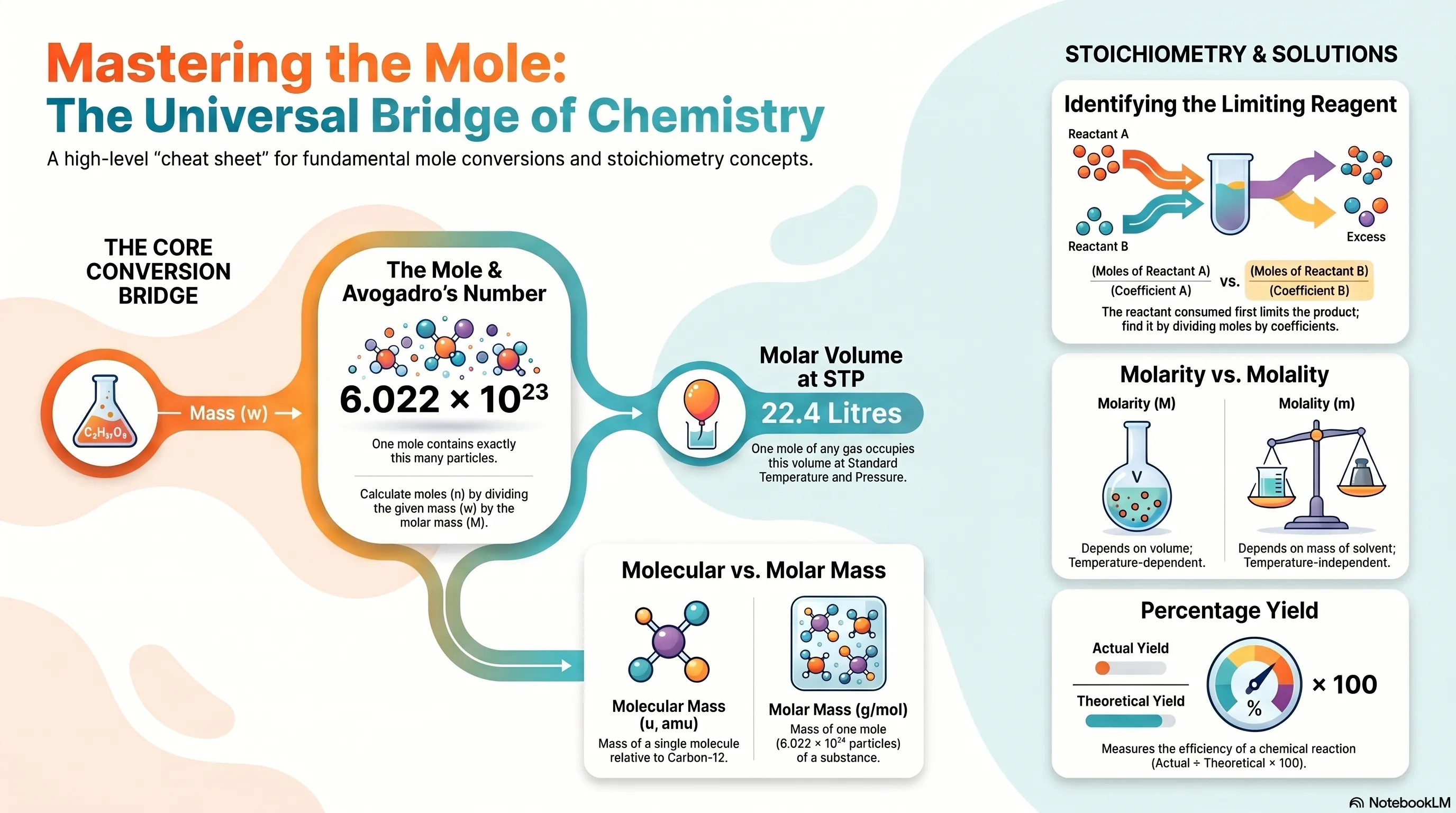
Table of Contents
- Why Mole Concept Is the Most Important Chapter in Class 11 Chemistry
- Mole Concept Notes
- Atomic Mass, Molecular Mass and Molar Mass
- The Mole: Definition and Avogadro's Number
- Mole-Mass-Number Relationships
- Empirical Formula and Molecular Formula
- Percentage Composition and Stoichiometry
- Limiting Reagent and Yield
- Concentration of Solutions
- Key Formulas

eSaral › Class 11›Mole Concept Notes for Class 11, IIT JEE & NEET

🚀 Checkout eSaral Courses
Why Mole Concept Is the Most Important Chapter in Class 11 Chemistry
| Mole Concept Topic | Where It Reappears |
|---|---|
| Mole-mass conversion | Every stoichiometry problem in JEE and NEET |
| Limiting reagent | Yield calculations, industrial chemistry |
| Concentration (molarity, molality) | Solutions chapter (Class 12) |
| Empirical/molecular formula | Organic Analysis, NEET practicals |
| Stoichiometry of reactions | Electrochemistry, Chemical Kinetics |
| Avogadro's number applications | Gas laws, atomic structure |
💡 Expert Tip by eSaral Academic Team, IIT Bombay Faculty: "In JEE Main and NEET, Mole Concept questions appear both as standalone numericals and embedded in Physical Chemistry chapters. Students who skip this chapter or rush through it consistently make arithmetic errors in Electrochemistry, Solutions, and Equilibrium — chapters they feel they know well. Get Mole Concept right first."
India's Best Exam Preparation for Class 11th - Download Now
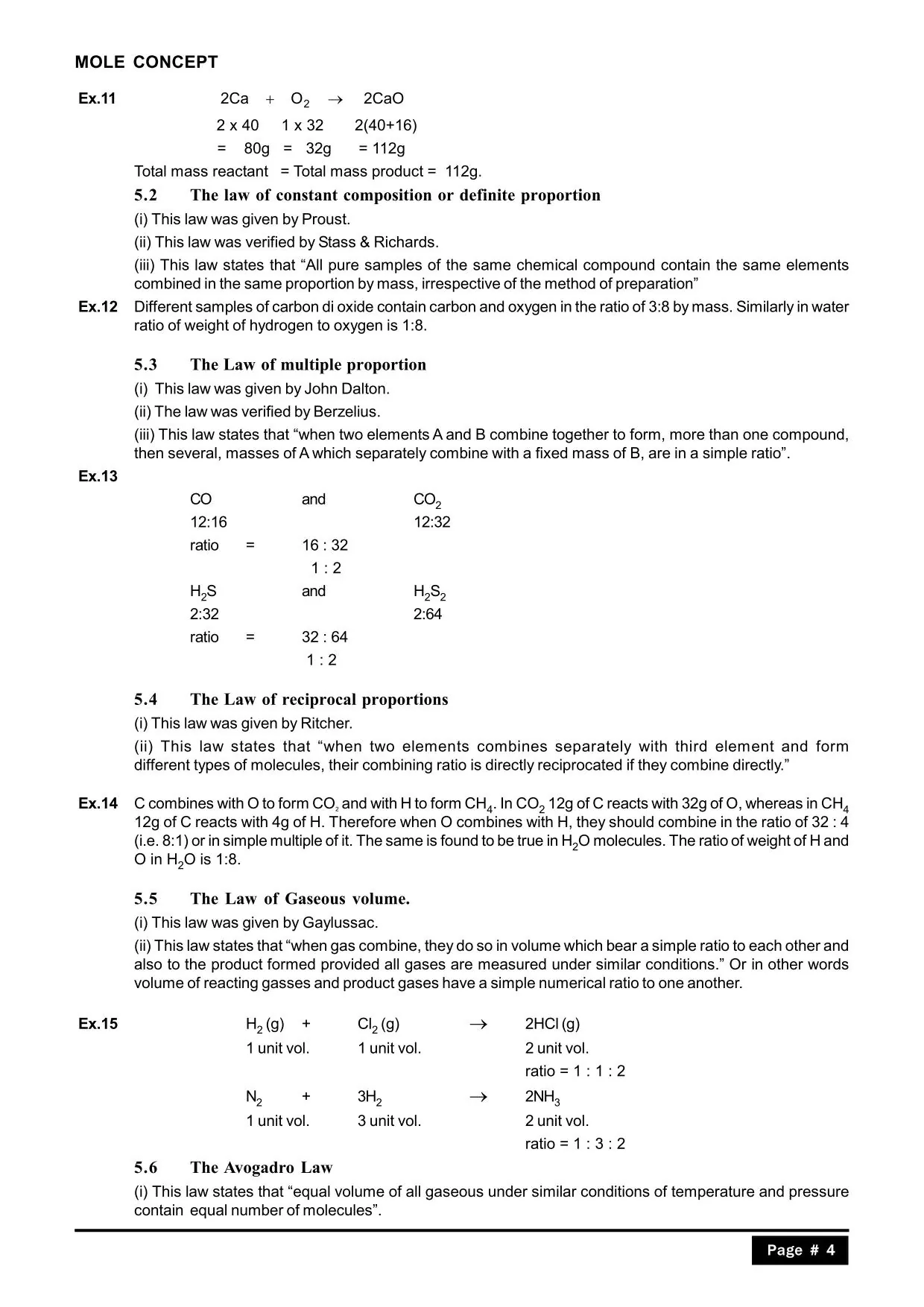
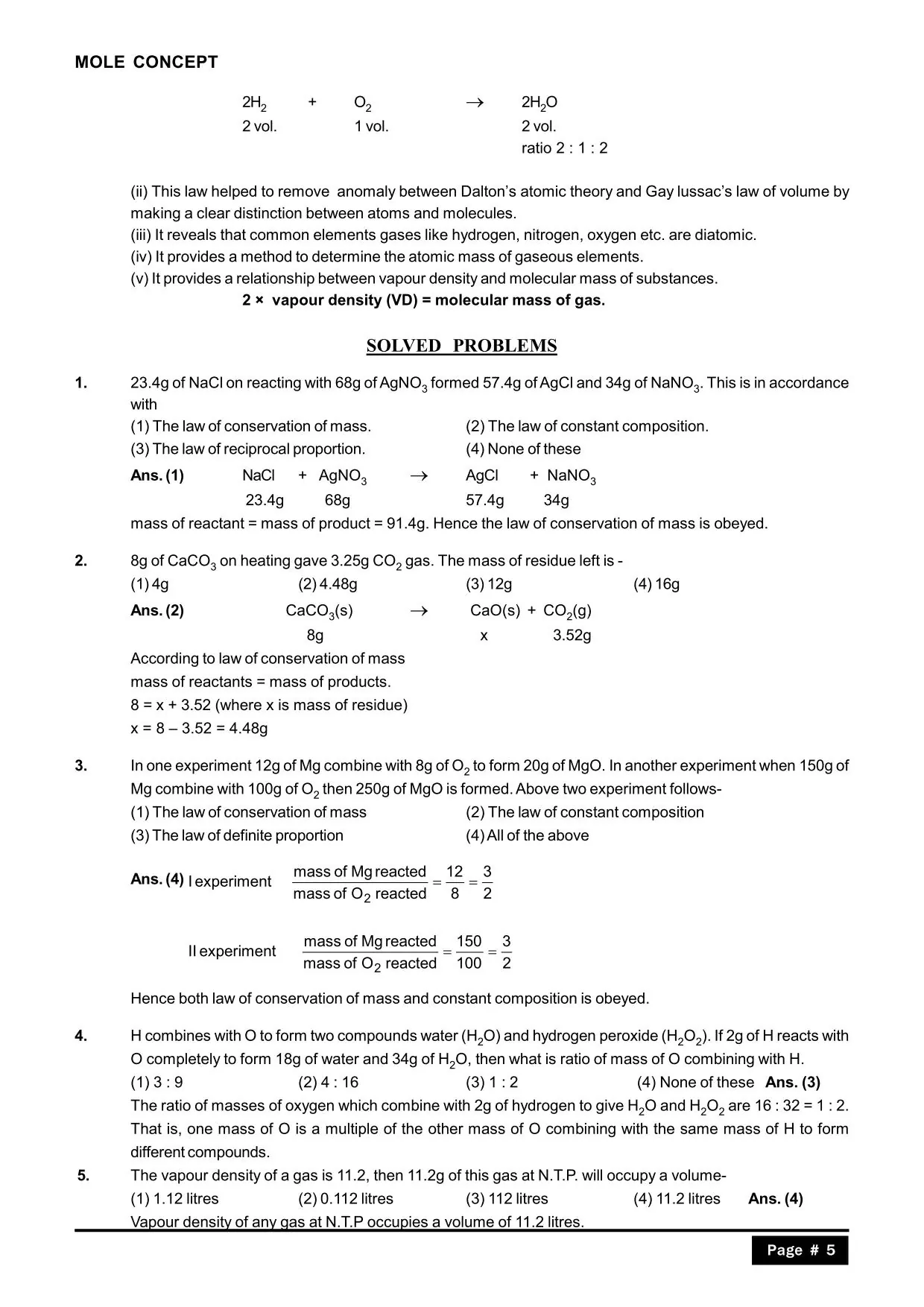
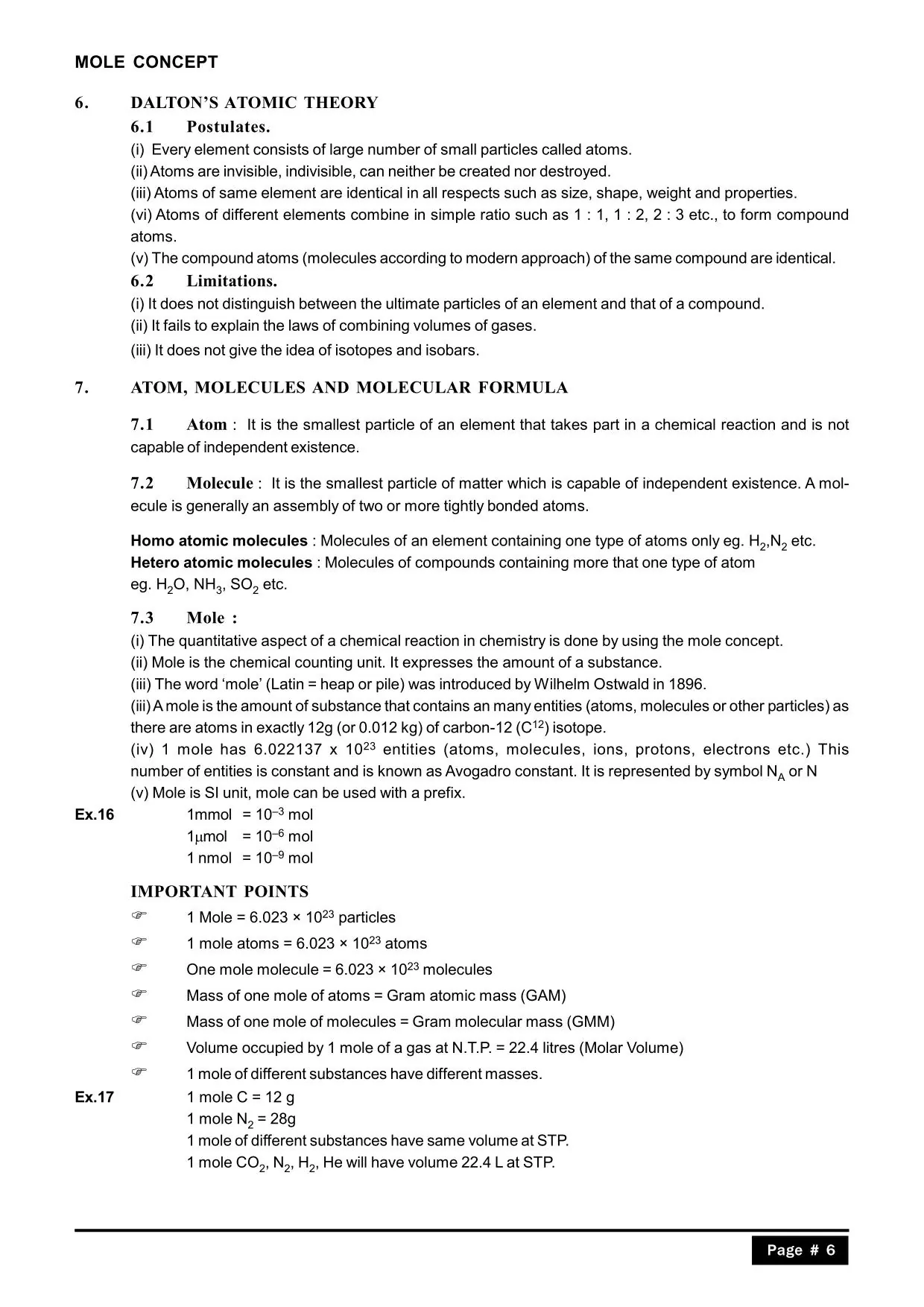
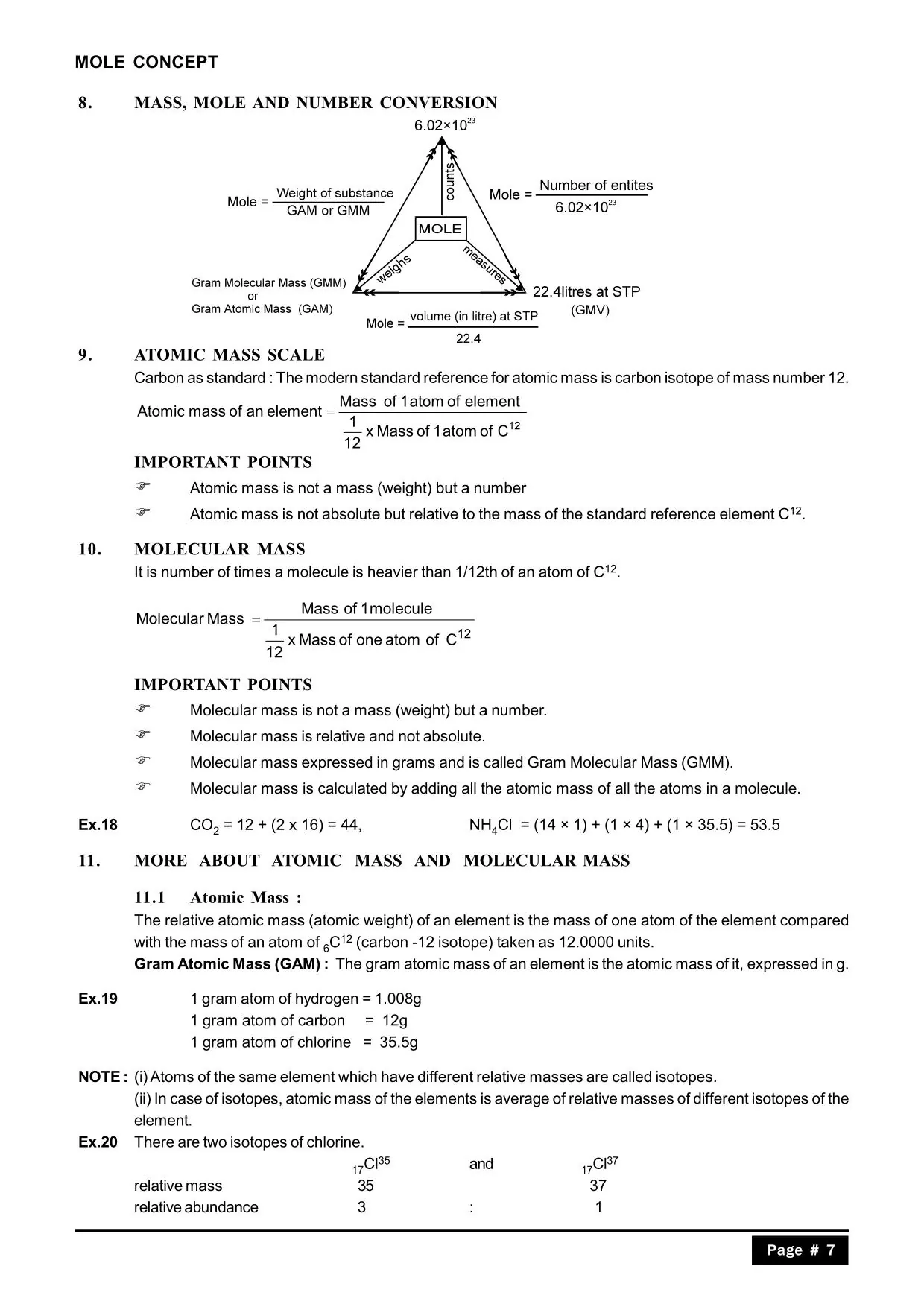
Mole Concept Notes
India's Best Exam Preparation for Class 11th - Download Now
Atomic Mass, Molecular Mass and Molar Mass
Atomic Mass
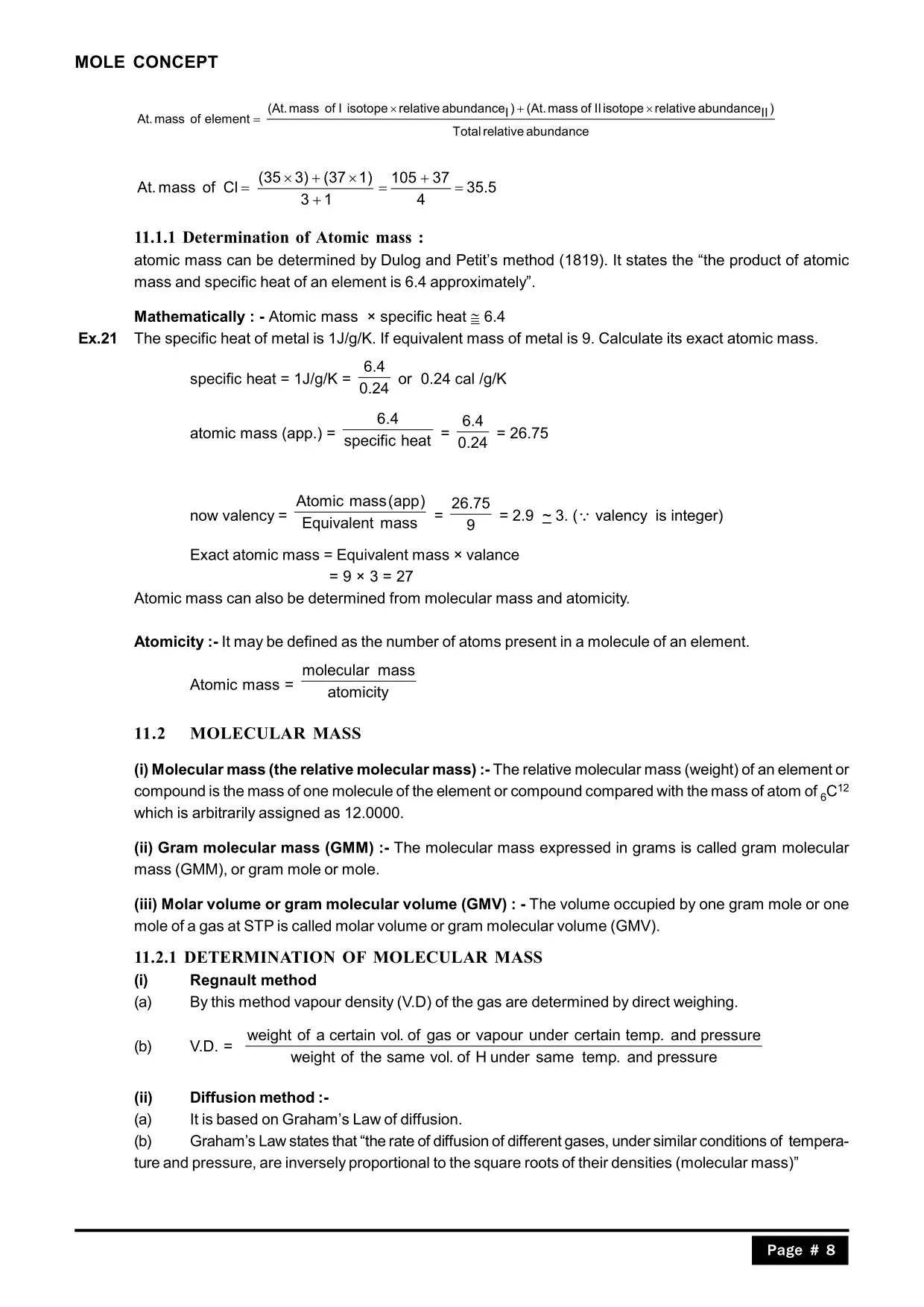
The atomic mass of an element is the mass of one atom of the element relative to 1/12th the mass of a carbon-12 atom.
Atomic mass unit (amu or u): 1 amu = 1.66 × 10⁻²⁷ kg
Atomic masses are relative — they are dimensionless numbers on the atomic mass scale. The atomic mass of hydrogen is 1 u, oxygen is 16 u, carbon is 12 u.
Molecular Mass
The molecular mass of a compound is the sum of atomic masses of all atoms in one molecule.
Example: Molecular mass of H₂SO₄ = 2(1) + 1(32) + 4(16) = 2 + 32 + 64 = 98 u
Example: Molecular mass of Ca(OH)₂ = 40 + 2(16 + 1) = 40 + 34 = 74 u
Molar Mass
The molar mass of a substance is the mass of one mole of that substance, numerically equal to its molecular mass but expressed in grams per mole (g/mol).
- Molar mass of H₂O = 18 g/mol
- Molar mass of NaCl = 58.5 g/mol
- Molar mass of CO₂ = 44 g/mol
Key distinction: Atomic mass and molecular mass are in atomic mass units (u). Molar mass is in grams per mole (g/mol). Numerically they are the same — the unit changes.
The Mole: Definition and Avogadro's Number
Definition of the Mole
One mole is the amount of substance that contains as many elementary entities (atoms, molecules, ions, electrons) as there are atoms in exactly 12 g of carbon-12.
This number is Avogadro's number: Nₐ = 6.022 × 10²³ mol⁻¹
One mole of any substance always contains 6.022 × 10²³ particles of that substance — regardless of what the substance is.
What Does 1 Mole Contain?
| Substance | 1 Mole Contains |
|---|---|
| Any element (e.g., Fe) | 6.022 × 10²³ atoms |
| Any molecule (e.g., H₂O) | 6.022 × 10²³ molecules |
| Any ionic compound (e.g., NaCl) | 6.022 × 10²³ formula units |
| Electrons | 6.022 × 10²³ electrons |
Mass of 1 Mole
| Substance | Molar Mass | Mass of 1 mole |
|---|---|---|
| H₂O | 18 g/mol | 18 g |
| CO₂ | 44 g/mol | 44 g |
| H₂SO₄ | 98 g/mol | 98 g |
| NaCl | 58.5 g/mol | 58.5 g |
| Fe | 56 g/mol | 56 g |
Mole-Mass-Number Relationships
These three conversions are the core of every Mole Concept numerical:
1. Moles from Mass
n = w / M
Where:
- n = number of moles
- w = given mass (in grams)
- M = molar mass (in g/mol)
Example: How many moles in 36 g of water? n = 36 / 18 = 2 moles
2. Number of Particles from Moles
N = n × Nₐ
Where N = number of particles, Nₐ = 6.022 × 10²³
Example: How many molecules in 2 moles of CO₂? N = 2 × 6.022 × 10²³ = 1.204 × 10²⁴ molecules
3. Combined Formula
N = (w / M) × Nₐ
4. Moles of Gas at STP
At Standard Temperature and Pressure (STP: 0°C, 1 atm):
1 mole of any gas occupies 22.4 L (molar volume)
n = V / 22.4 (V in litres at STP)
Example: What volume does 4 g of O₂ occupy at STP? Moles of O₂ = 4/32 = 0.125 mol Volume = 0.125 × 22.4 = 2.8 L
💡 Expert Tip by eSaral Academic Team, IIT Bombay Faculty: "The three-way conversion triangle (mass ↔ moles ↔ number of particles) must be completely automatic. In JEE Main and NEET numericals, the actual calculation is usually straightforward — but students who pause at the conversion step lose time and make errors. Practise 20 conversion problems until they take under 30 seconds each."
Empirical Formula and Molecular Formula
Empirical Formula
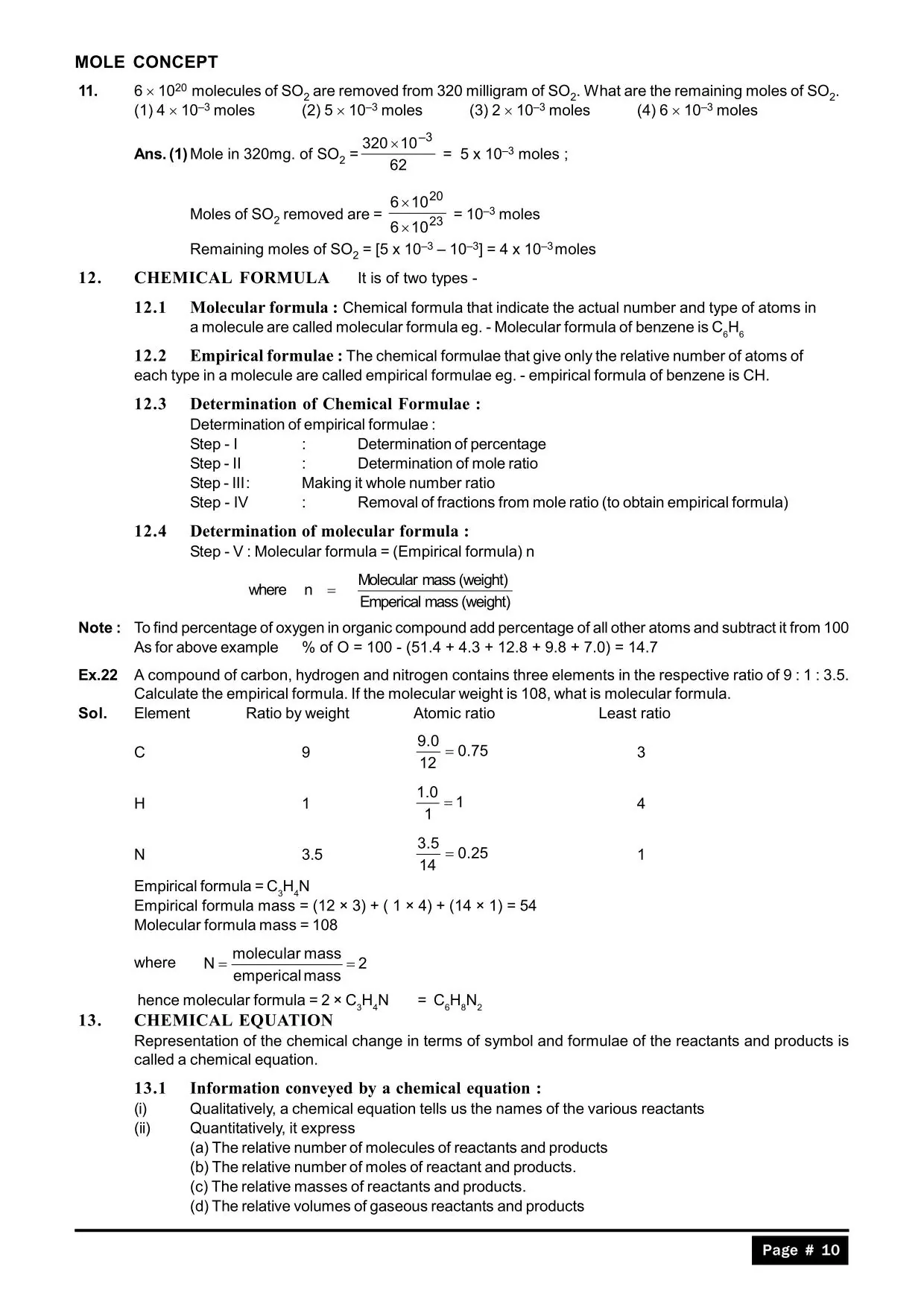
The empirical formula gives the simplest whole-number ratio of atoms in a compound.
Example: Glucose (C₆H₁₂O₆) — empirical formula is CH₂O (ratio 1:2:1)
Molecular Formula
The molecular formula gives the actual number of each type of atom in one molecule.
Molecular formula = n × Empirical formula
where n = Molecular mass / Empirical formula mass
Steps to Find Empirical Formula from Percentage Composition
- Write the percentage of each element (treat as grams in 100 g sample)
- Divide each by the atomic mass to get moles of each element
- Divide all mole values by the smallest mole value
- If ratios are not whole numbers, multiply by a suitable integer
- Write the empirical formula
Example: A compound contains 40% C, 6.67% H, 53.33% O by mass. Find empirical formula.
| Element | % | ÷ Atomic mass | Mole ratio | Simplest ratio |
|---|---|---|---|---|
| C | 40 | 40/12 = 3.33 | 3.33/3.33 = 1 | 1 |
| H | 6.67 | 6.67/1 = 6.67 | 6.67/3.33 = 2 | 2 |
| O | 53.33 | 53.33/16 = 3.33 | 3.33/3.33 = 1 | 1 |
Empirical formula: CH₂O
If molecular mass = 180 g/mol: n = 180/30 = 6 Molecular formula: C₆H₁₂O₆ (Glucose)
Percentage Composition and Stoichiometry
Percentage Composition
% of element = (Mass of element in 1 mole of compound / Molar mass of compound) × 100
Example: % of oxygen in H₂SO₄ (M = 98 g/mol) % O = (64/98) × 100 = 65.3%
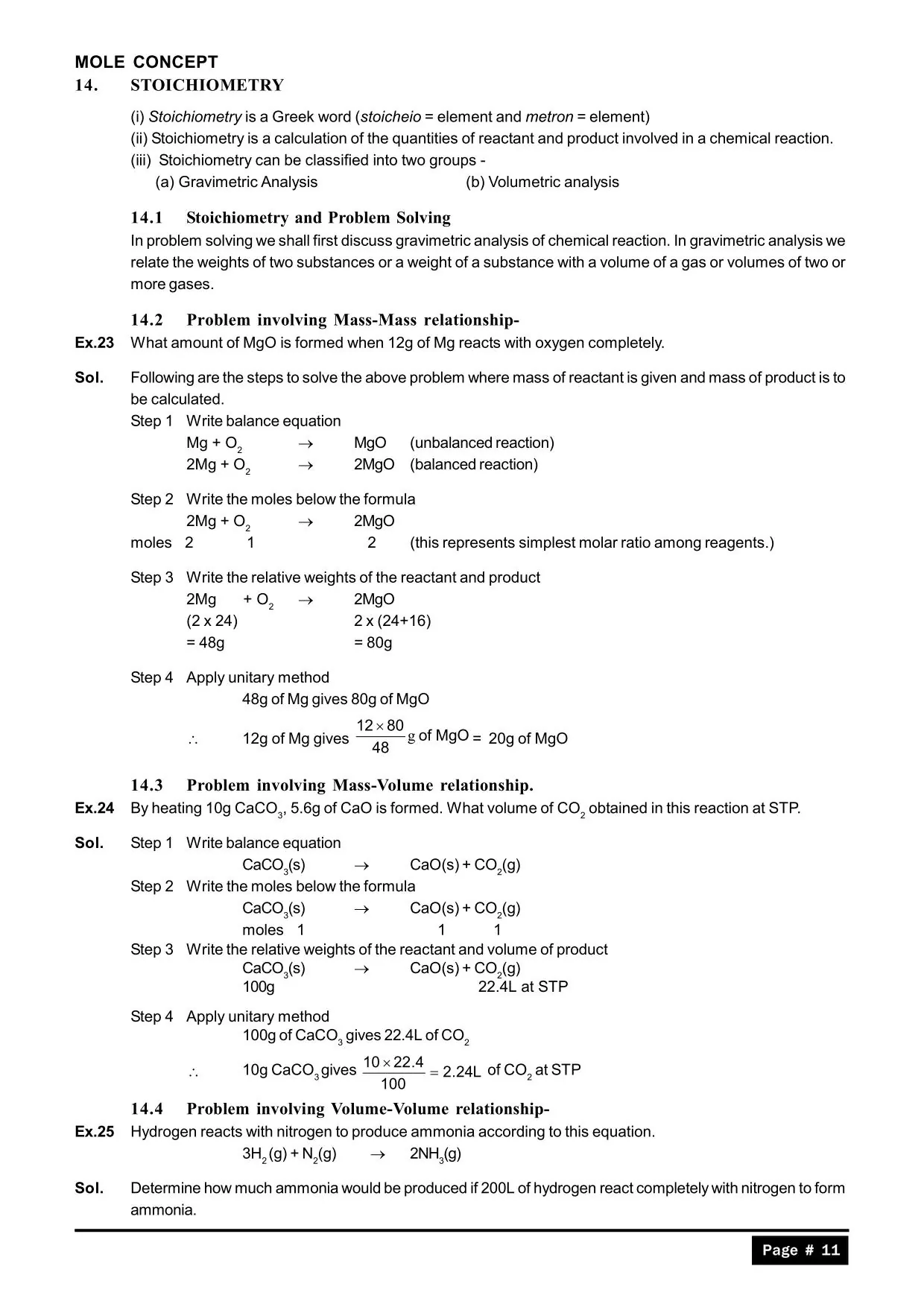
Stoichiometry from Balanced Equations
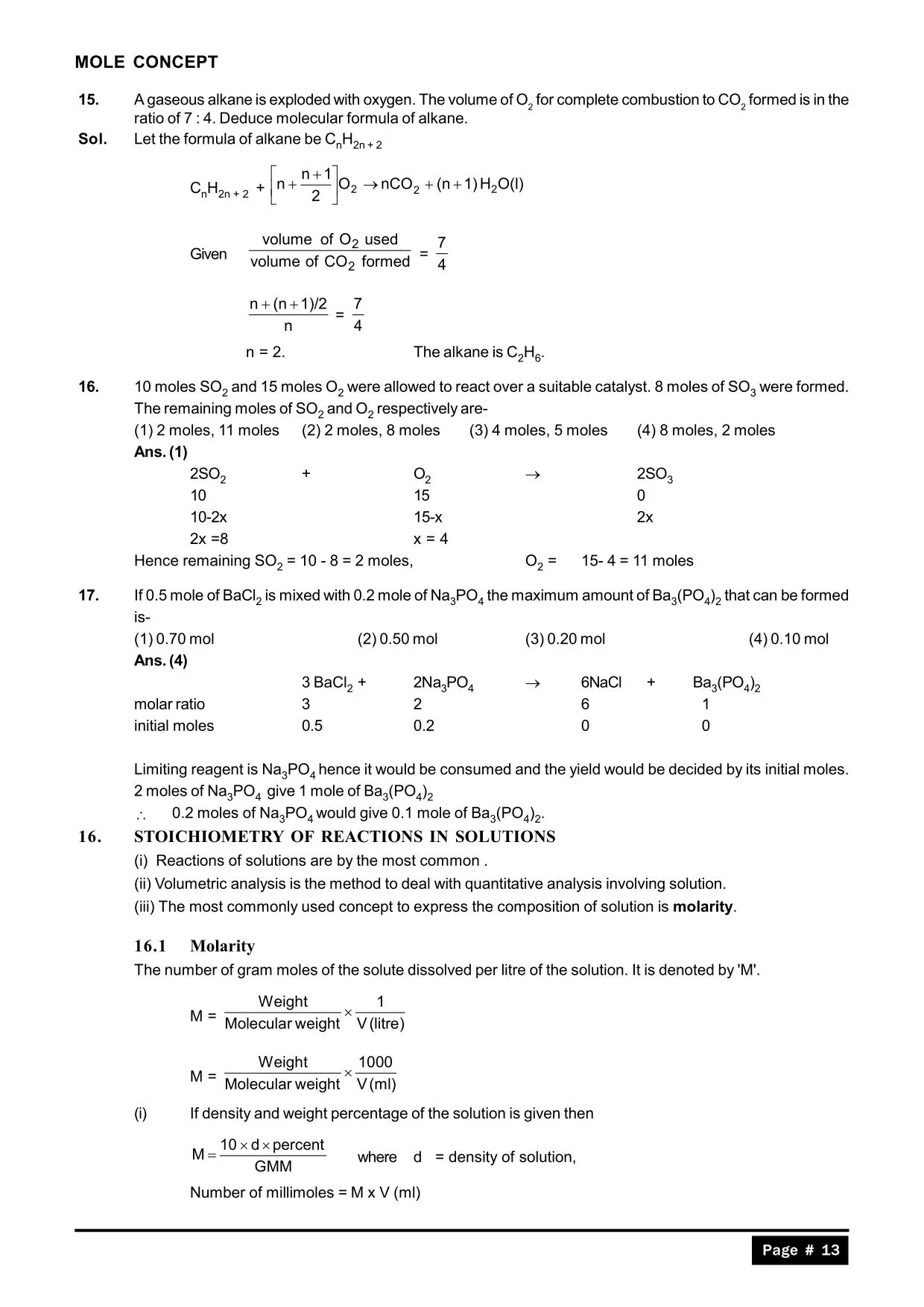
A balanced chemical equation gives the mole ratios of reactants and products.
Example: N₂ + 3H₂ → 2NH₃
- 1 mole N₂ reacts with 3 moles H₂ to produce 2 moles NH₃
- If 28 g N₂ is used: 28/28 = 1 mol N₂ → produces 2 mol NH₃ = 34 g NH₃
- Mass of H₂ needed = 3 × 2 = 6 g
Mole ratio method:
- Convert given mass to moles
- Use the mole ratio from the balanced equation
- Convert moles of product back to mass
Limiting Reagent and Yield
Limiting Reagent
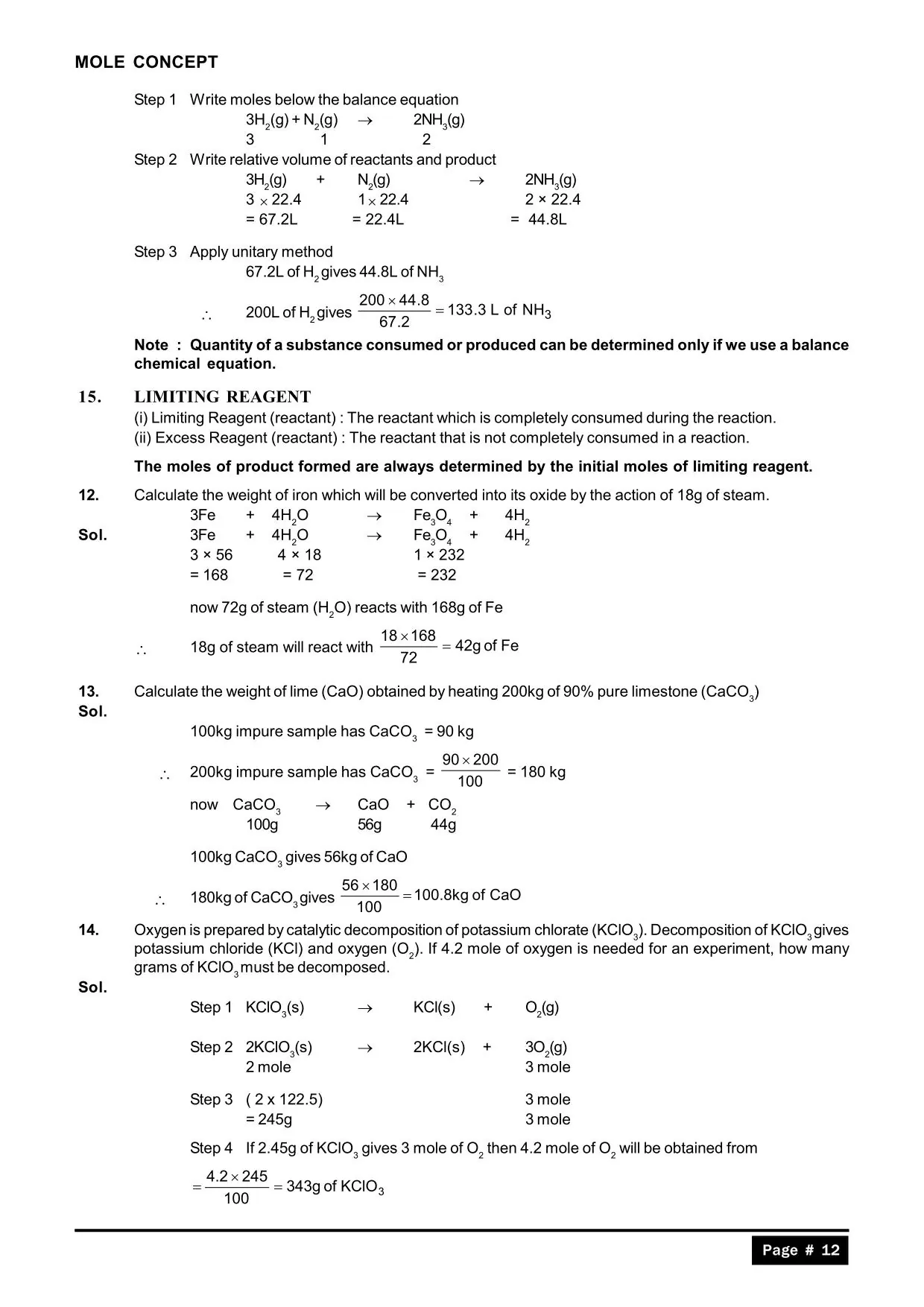
The limiting reagent is the reactant that is completely consumed first in a reaction, limiting the amount of product formed.
Method to find the limiting reagent:
- Calculate moles of each reactant
- Divide each by its stoichiometric coefficient
- The reactant with the smaller value is the limiting reagent
Example: 4 g H₂ and 32 g O₂ react: 2H₂ + O₂ → 2H₂O
- Moles H₂ = 4/2 = 2 mol; stoichiometric coefficient = 2; ratio = 2/2 = 1
- Moles O₂ = 32/32 = 1 mol; stoichiometric coefficient = 1; ratio = 1/1 = 1
Both ratios are equal — both are consumed simultaneously (neither is limiting here). In most problems, ratios differ — the smaller one is the limiting reagent.
Theoretical Yield vs Actual Yield
% Yield = (Actual yield / Theoretical yield) × 100
Theoretical yield is the maximum amount of product calculated from the limiting reagent. Actual yield is what is obtained experimentally (always ≤ theoretical yield).
Concentration of Solutions
Molarity (M)
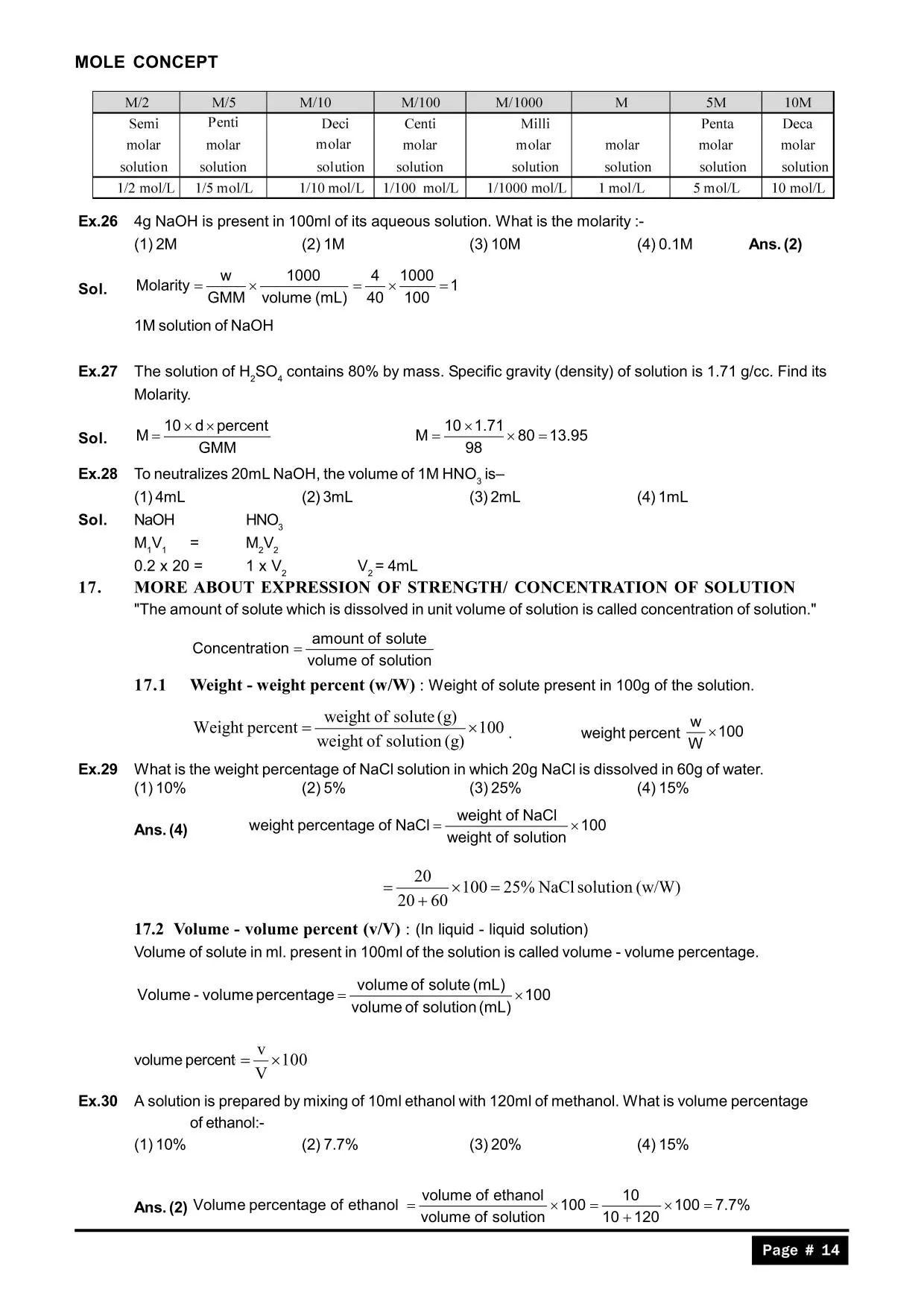
M = moles of solute/volume of solution in litres
M = w × 1000 / (M_solute × V_mL)
Units: mol/L or mol dm⁻³
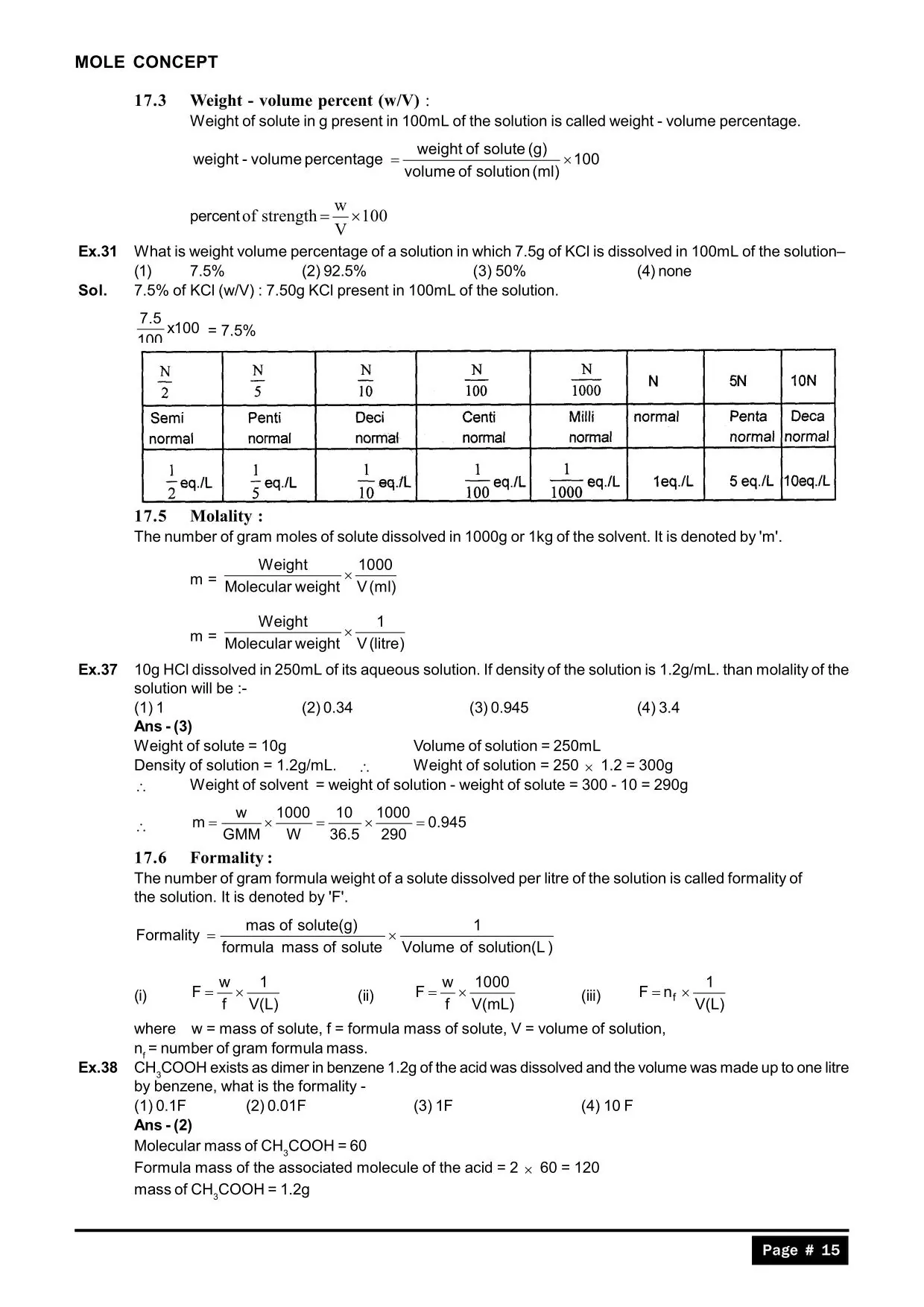
Molality (m)
m = moles of solute/mass of solvent in kg
Units: mol/kg
Key point: Molarity changes with temperature (volume changes). Molality does not (mass is constant). Use molality for colligative properties in Class 12.
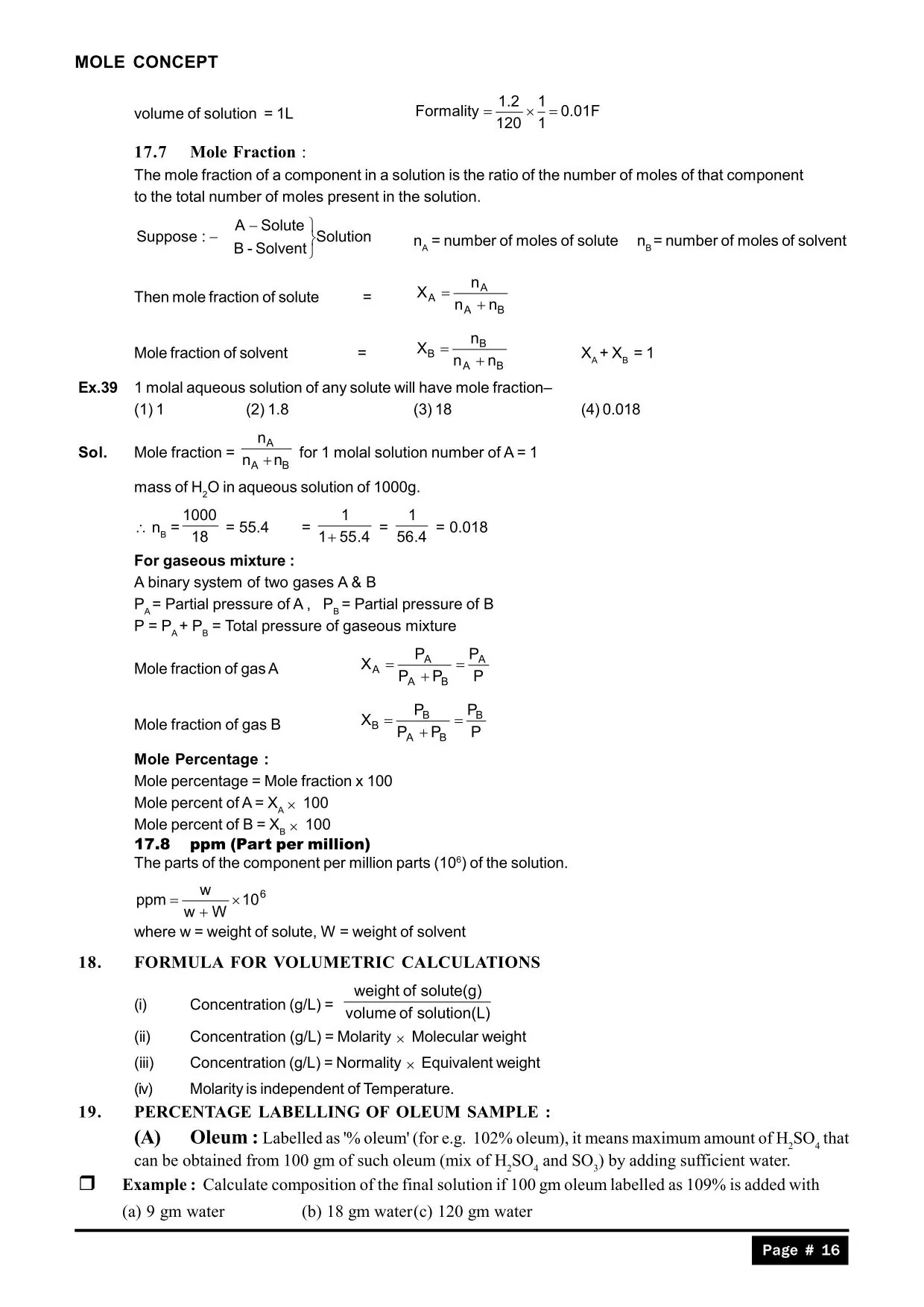
Mole Fraction (χ)
χ_A = n_A / (n_A + n_B)
Sum of mole fractions of all components = 1
Parts per Million (ppm)
ppm = (mass of solute/mass of solution) × 10⁶
Used for very dilute solutions (pollutant concentrations in water/air).
Key Formulas
| Formula | Description |
|---|---|
| n = w / M | Moles from mass |
| N = n × Nₐ | Number of particles from moles |
| N = (w/M) × Nₐ | Particles directly from mass |
| n = V / 22.4 | Moles of gas at STP |
| % element = (mass in 1 mol / M) × 100 | Percentage composition |
| n (mol formula) = M_molecular / M_empirical | Relation between formulas |
| M = w × 1000 / (M_solute × V_mL) | Molarity formula |
| m = moles solute / kg solvent | Molality formula |
| χ_A = n_A / (n_A + n_B) | Mole fraction |
| % yield = (actual/theoretical) × 100 | Percentage yield |
For complete Class 11 Chemistry chapter notes, video lectures, and practice questions covering Mole Concept and all other chapters — for boards, JEE Main, and NEET — download the eSaral App for free study material and video tutorials by Kota's top IITian faculty.
Frequently Asked Questions
Find answers to common questions.
What is the mole concept in Class 11 Chemistry?
The mole concept defines the mole as the SI unit for the amount of substance. One mole contains exactly 6.022 × 10²³ particles (Avogadro's number). The molar mass of a substance in grams per mole is numerically equal to its molecular mass in atomic mass units. It allows conversion between mass (measurable in lab) and number of atoms or molecules (too small to count directly).
What is Avogadro's number and why is it important?
Avogadro's number (Nₐ = 6.022 × 10²³ mol⁻¹) is the number of particles in one mole of any substance. It is important because it bridges the atomic world (atoms, molecules) and the macroscopic world (grams, litres). Every mole concept numerical uses Avogadro's number either directly or through the mole-mass conversion formula n = w/M.
How many marks does Mole Concept carry in JEE Main?
Mole Concept questions appear in 2–3 JEE Main questions per session, either as standalone stoichiometry or concentration calculation problems. More importantly, Mole Concept knowledge is embedded in Solutions, Electrochemistry, Equilibrium, and Kinetics — meaning weakness here affects your score across the entire Physical Chemistry section.
What is the difference between empirical formula and molecular formula?
The empirical formula gives the simplest whole-number ratio of atoms in a compound. The molecular formula gives the actual number of atoms per molecule. Molecular formula = n × empirical formula, where n = molecular mass / empirical formula mass. Example: Glucose molecular formula is C₆H₁₂O₆ but empirical formula is CH₂O (simplest ratio 1:2:1).
What is the molar volume of a gas at STP?
At STP (0°C and 1 atm pressure), one mole of any ideal gas occupies 22.4 litres. This is the molar volume. It is used in the formula n = V/22.4 (V in litres) to convert between volume and moles of gas. This value applies only at STP — at different temperatures and pressures, use the ideal gas equation PV = nRT.