NCERT Solutions for Class 10 Maths chapter 3 - Pair of Linear Equations in Two Variables
Table of Contents

Home » NCERT Solutions » NCERT Solutions Class 10 Maths Chapter 3

Chapter 3 of Class 10 Maths introduces Pair of Linear Equations in Two Variables, one of the highest-scoring and most application-based chapters in the CBSE curriculum. The chapter typically carries 6–8 marks in board exams and forms the algebraic foundation for many real-world problem-solving scenarios, from calculating unknown quantities to forming equations from word problems.
The chapter builds on the single-variable linear equations from earlier classes. Here, students learn to represent situations mathematically using two equations with two unknowns and solve them using four distinct methods. Mastery of this chapter also supports students preparing for competitive exams such as JEE Main, where algebraic reasoning plays an important role.
For a stronger mathematical foundation, you can also explore the NCERT Solutions for Class 11 Maths and NCERT Solutions for Class 12 Maths to understand how these concepts develop in higher classes.
Chapter 3 Exercises – Overview and Topics Covered
Class 10 Maths Chapter 3 contains seven exercises covering theory, graphical representation, algebraic methods, and word problems.
| Exercise | Topic Covered | Number of Questions |
|---|---|---|
| Exercise 3.1 | Introduction – Forming equations from situations | 3 Questions |
| Exercise 3.2 | Graphical method of solution | 7 Questions |
| Exercise 3.3 | Substitution method | 3 Questions |
| Exercise 3.4 | Elimination method | 2 Questions |
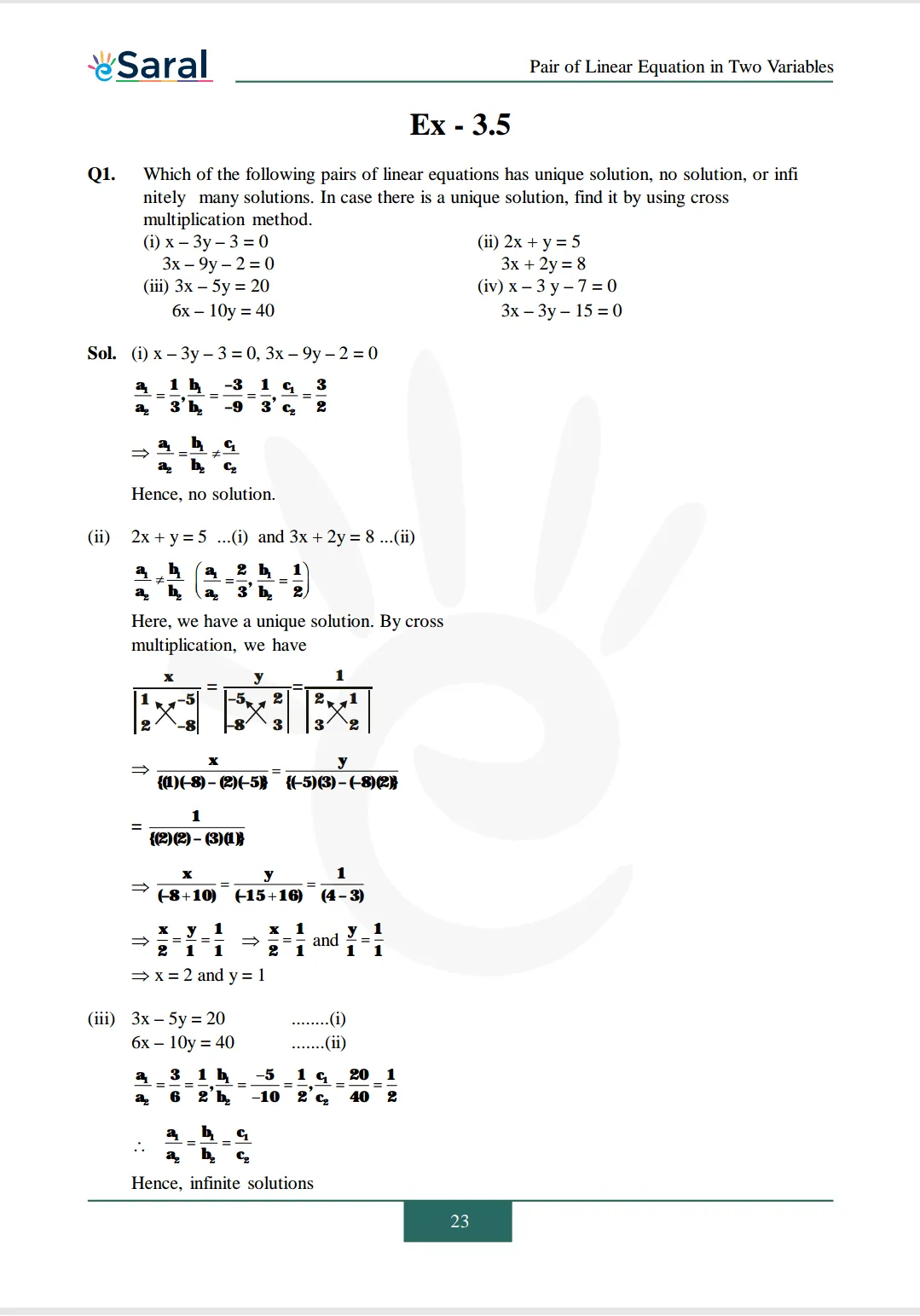
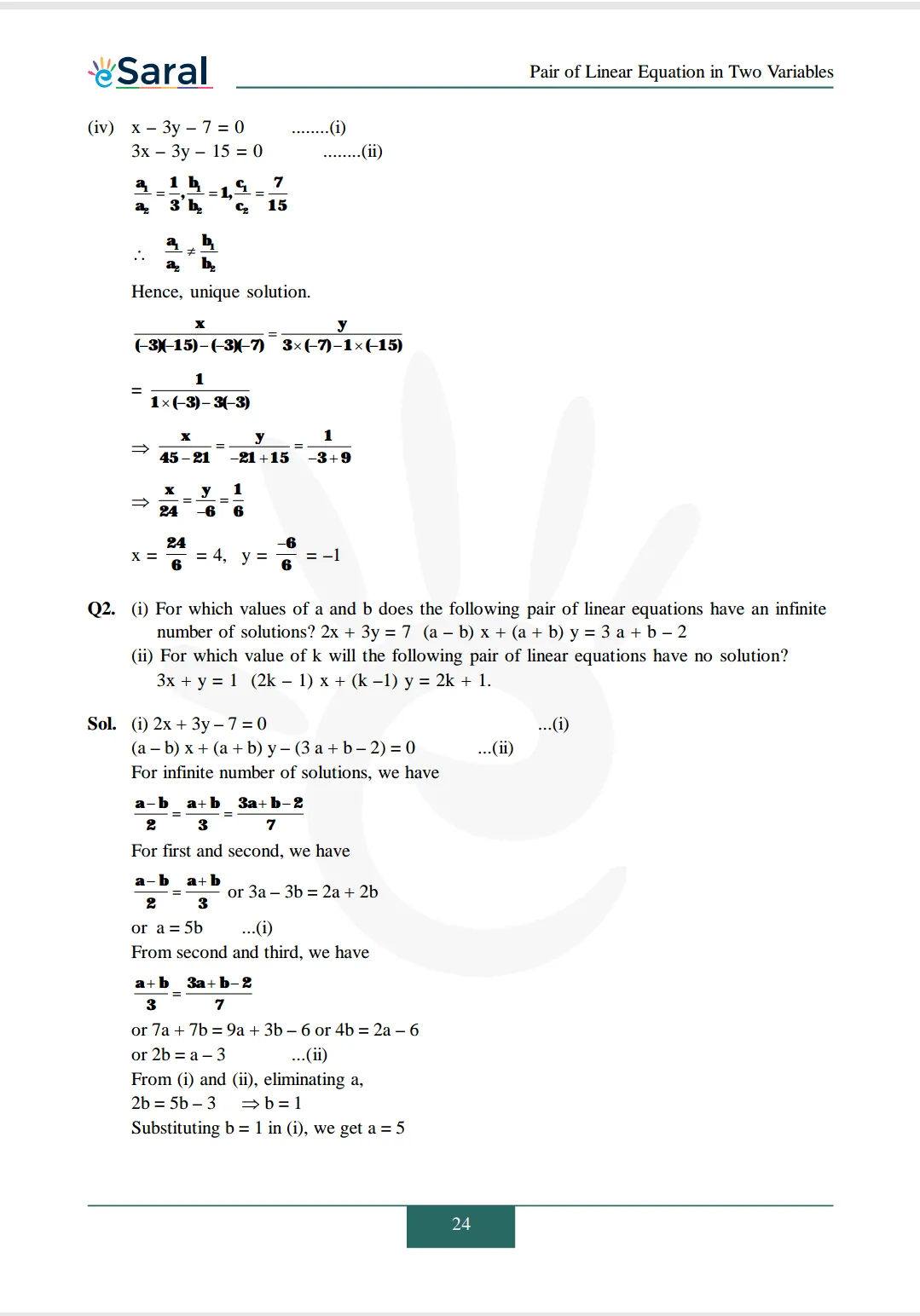
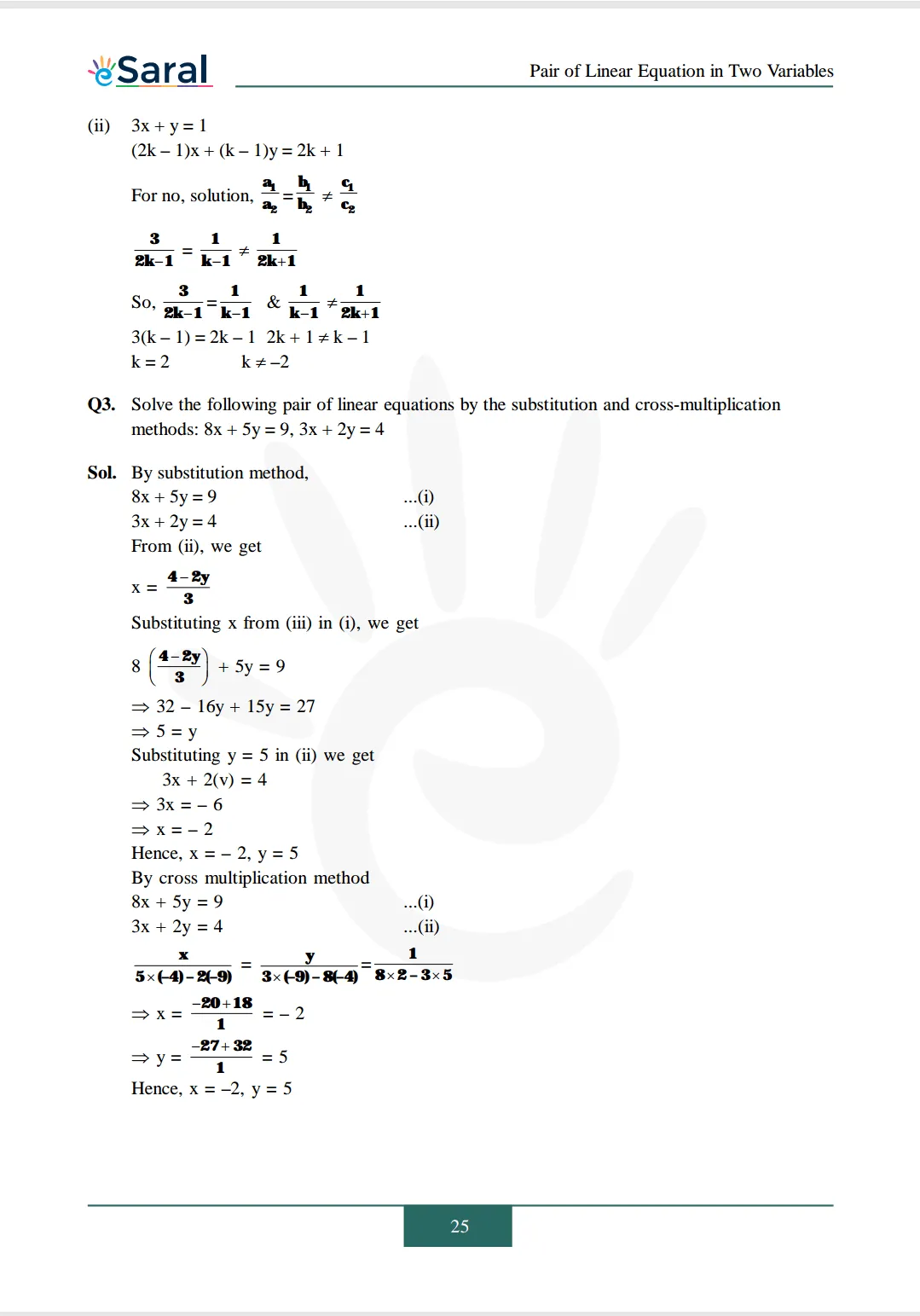
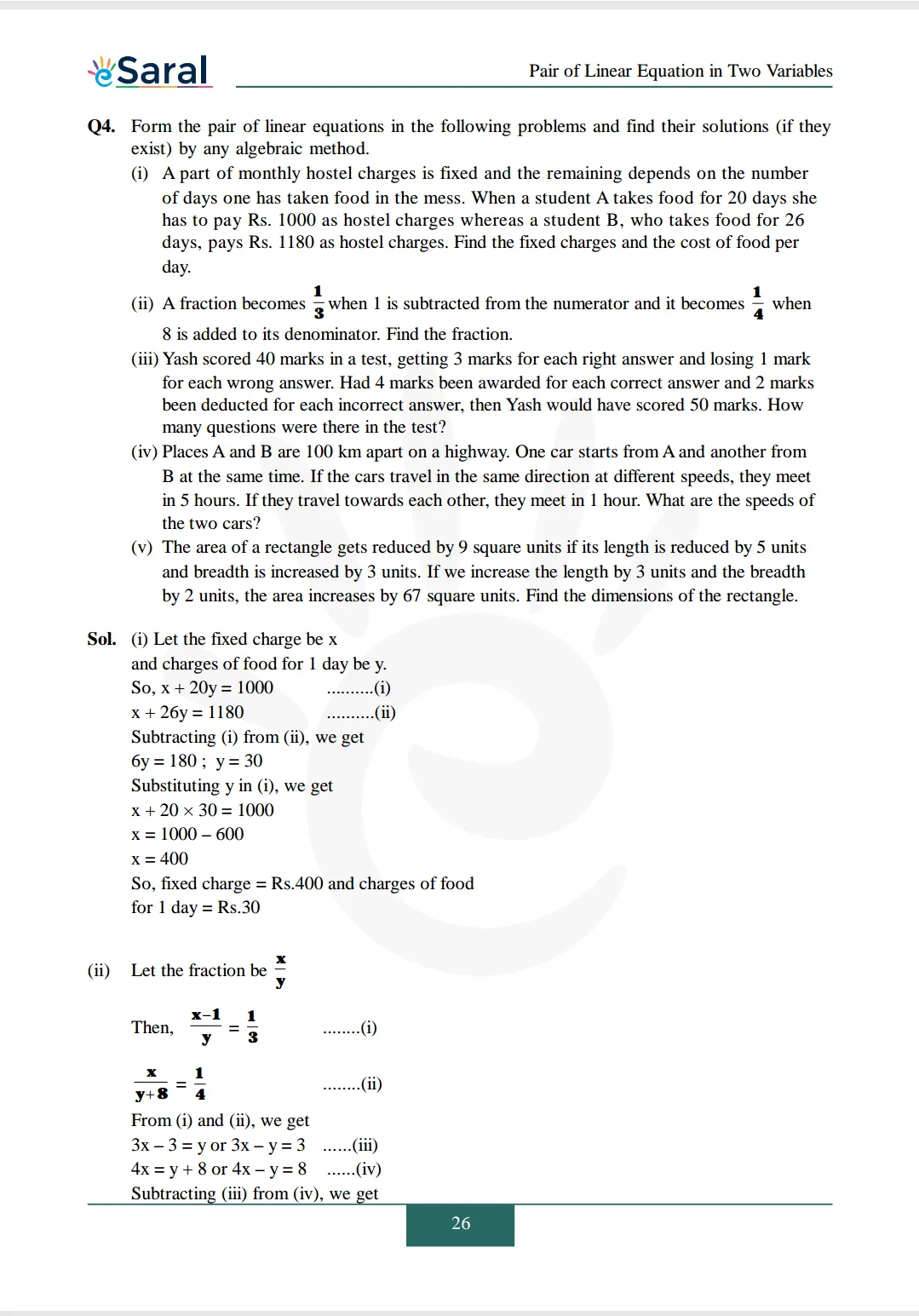
| Exercise 3.5 | Cross-multiplication method | 4 Questions |
| Exercise 3.6 | Equations reducible to linear form | 2 Questions |
| Exercise 3.7 (Optional) | Word problems – Mixed applications | 8 Questions |
Key Concepts Covered in Chapter 3
- What is a pair of linear equations in two variables?
- Graphical representation of consistent, inconsistent, and dependent systems.
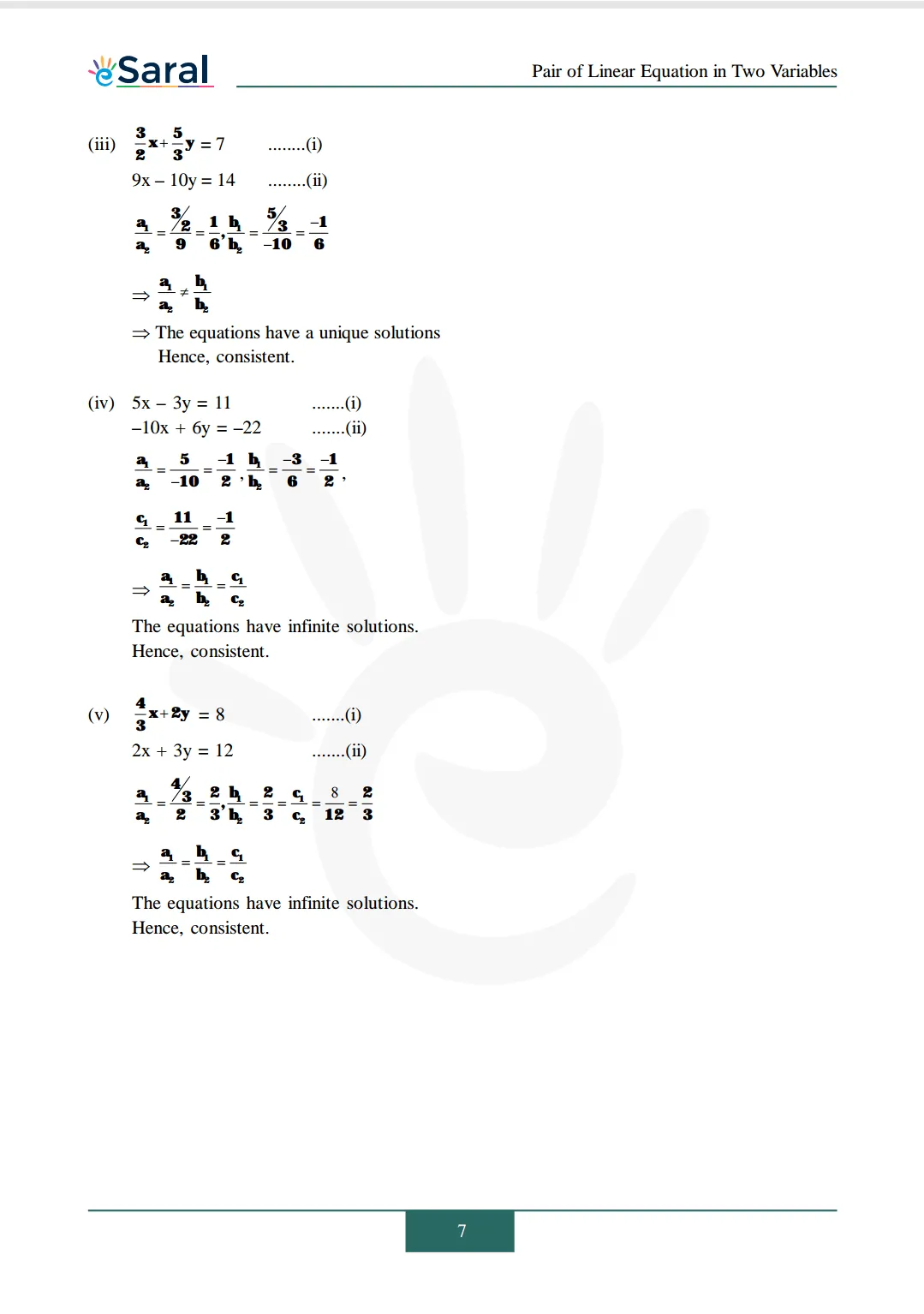
- Algebraic conditions for consistency using the ratios $a_1/a_2$, $b_1/b_2$, and $c_1/c_2$.
- All four solution methods with proofs and solved examples.
- Real-life word problems based on age, speed, distance, cost, and fractions.
Marks Weightage
According to the CBSE Class 10 syllabus, the Algebra unit, which includes Chapter 3, carries 20 marks in the final board examination. Chapter 3 alone generally contributes one case-study question (4 marks) along with one or two short- or long-answer questions worth 2–4 marks each. Performing well in this chapter can significantly improve your overall Mathematics score.
Expert Tip: Students often lose marks not because they cannot solve the equations but because they fail to verify their answers by substituting the values back into both original equations. Always perform this final check—it takes less than 20 seconds and can save valuable marks.
What Are the Methods to Solve a Pair of Linear Equations in Two Variables?
Chapter 3 teaches four standard methods for solving a pair of linear equations. The NCERT Solutions for Class 10 Maths Chapter 3 explain each method with detailed worked examples.
Method 1: Graphical Method
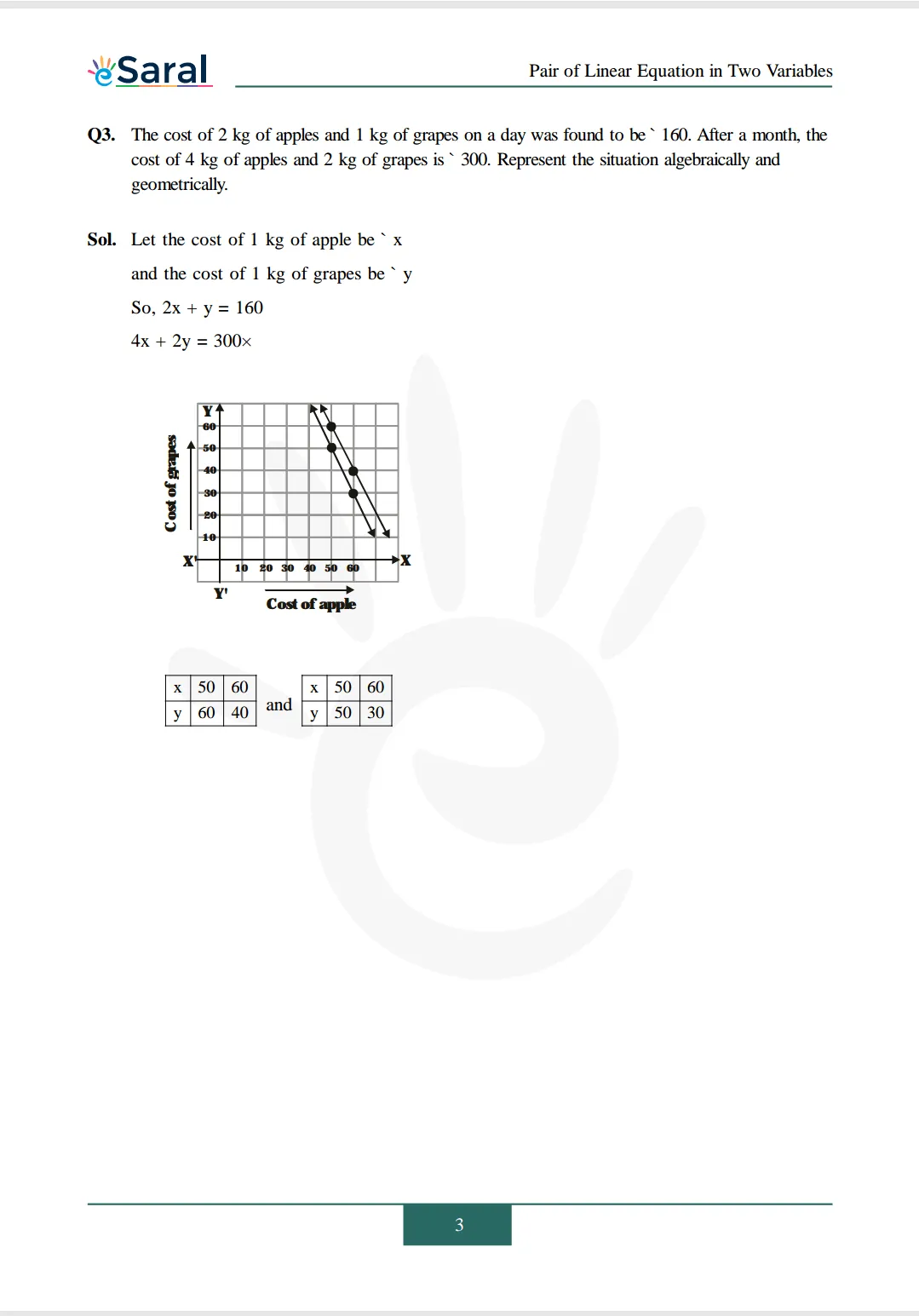
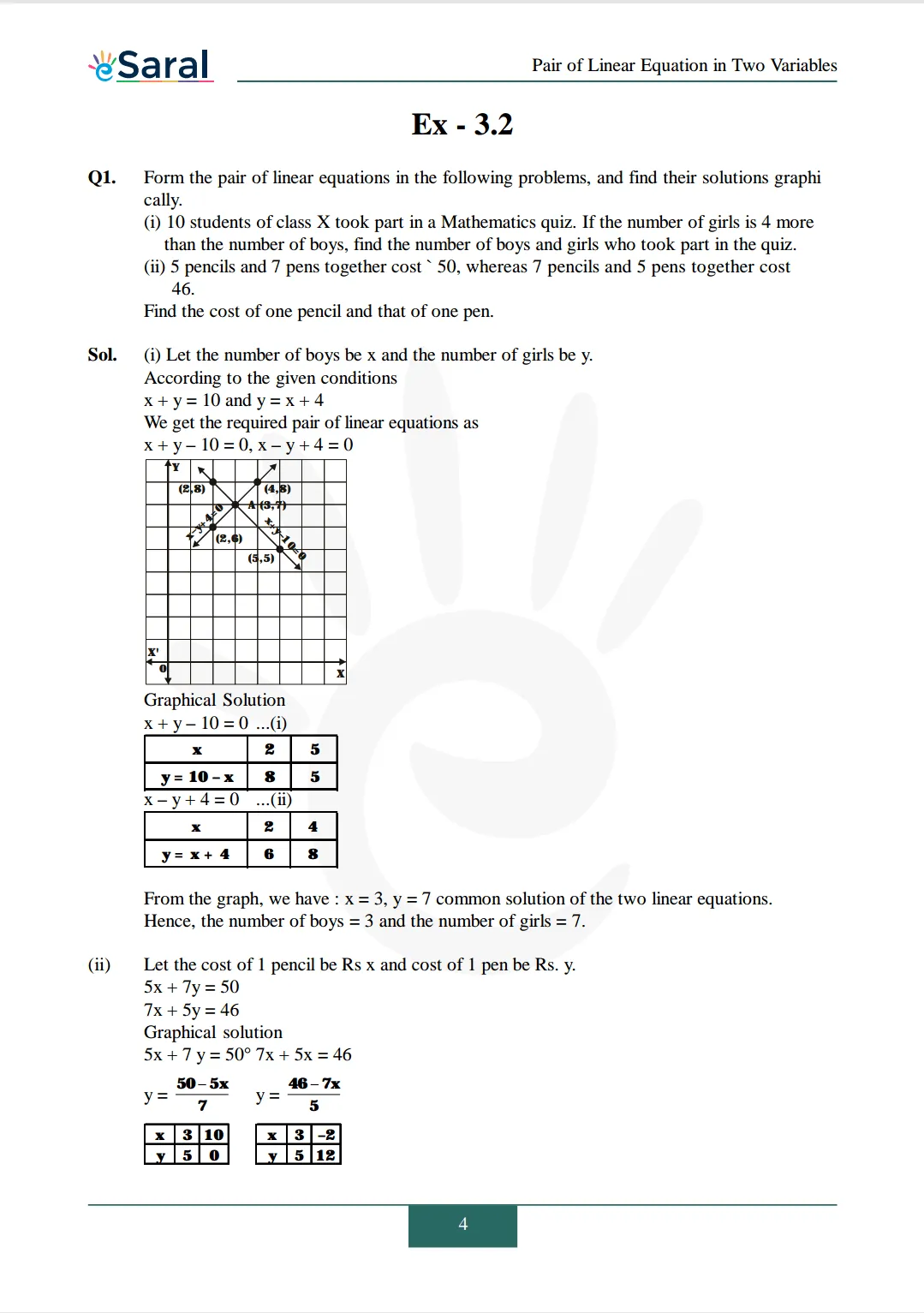
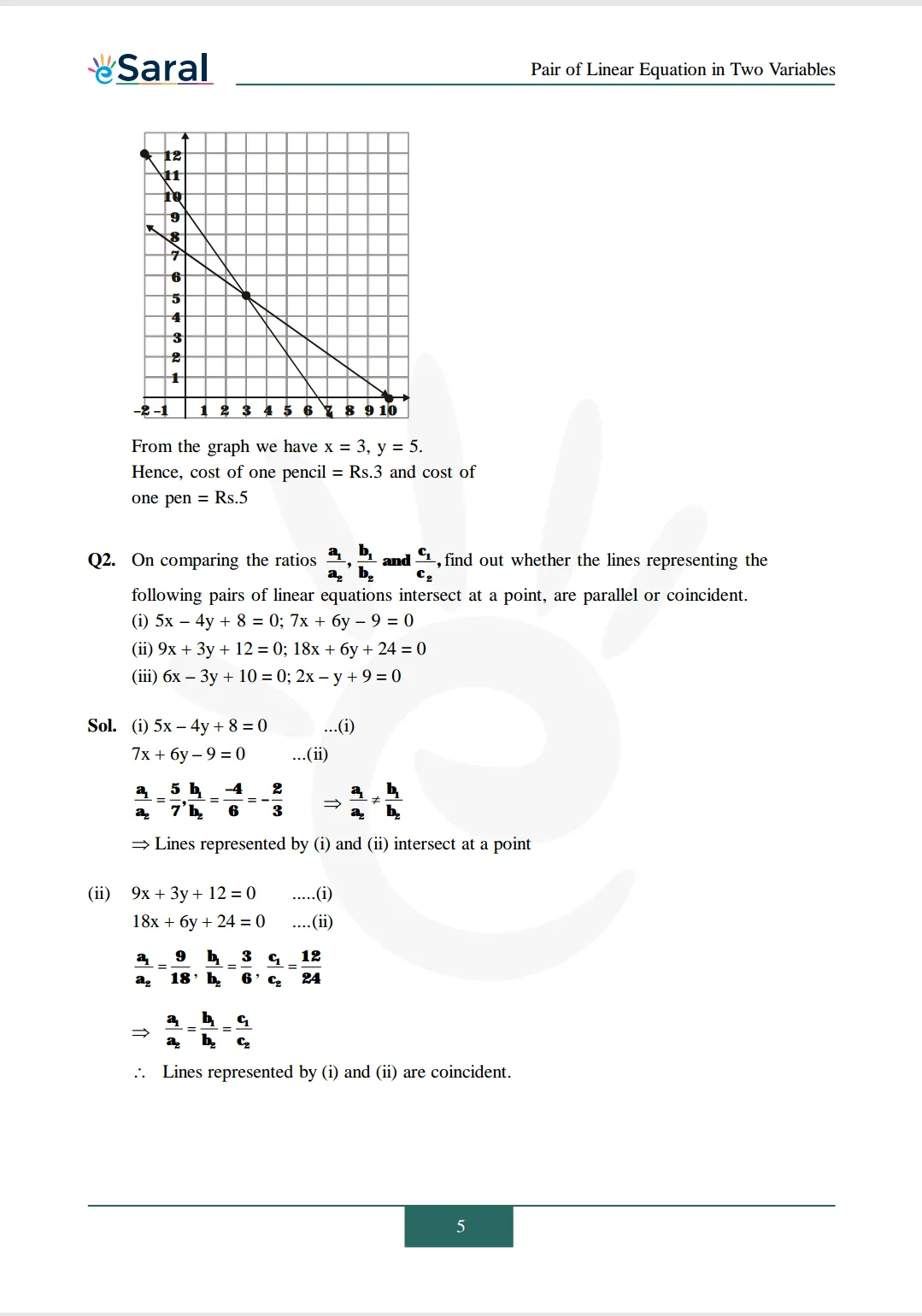
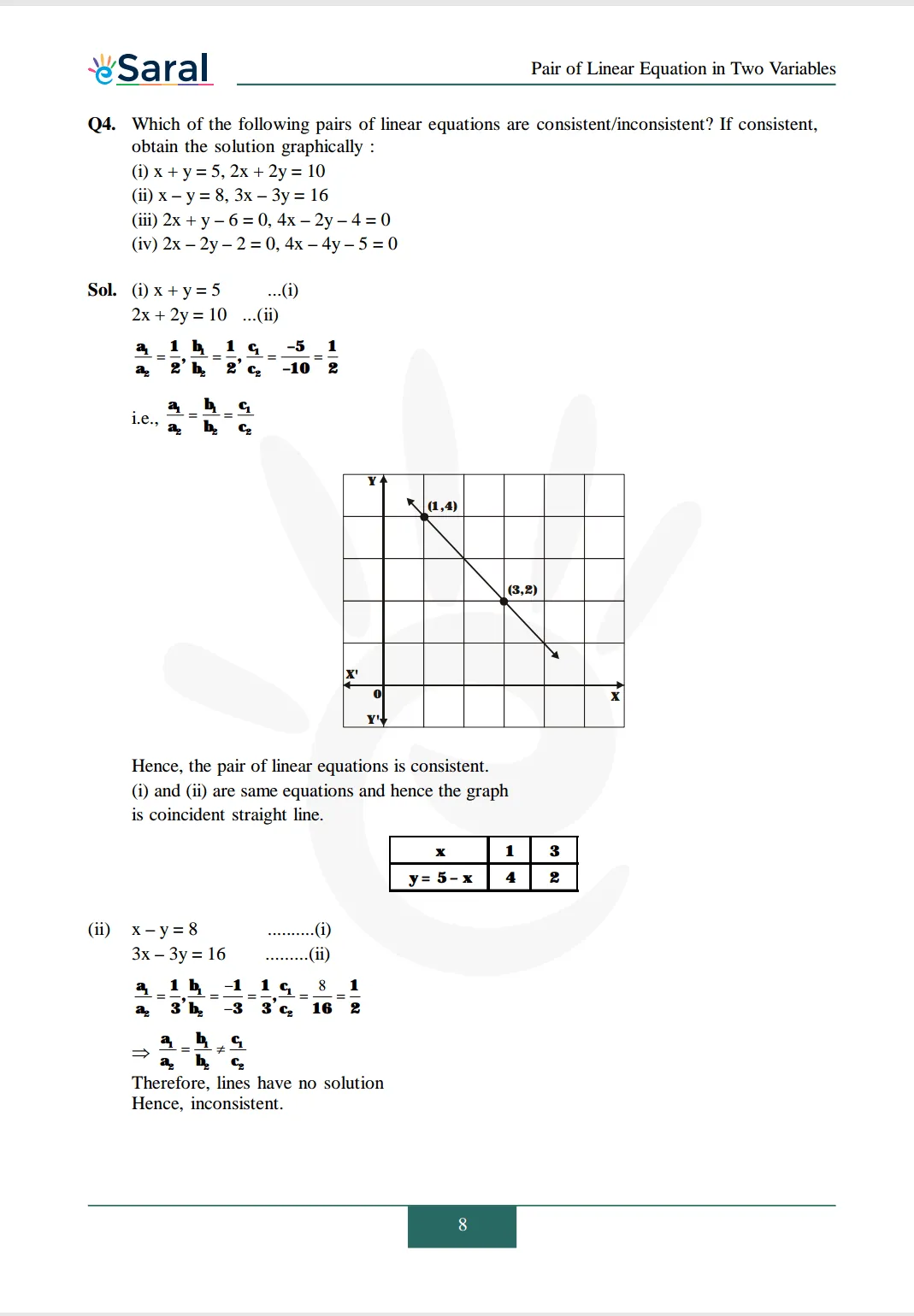
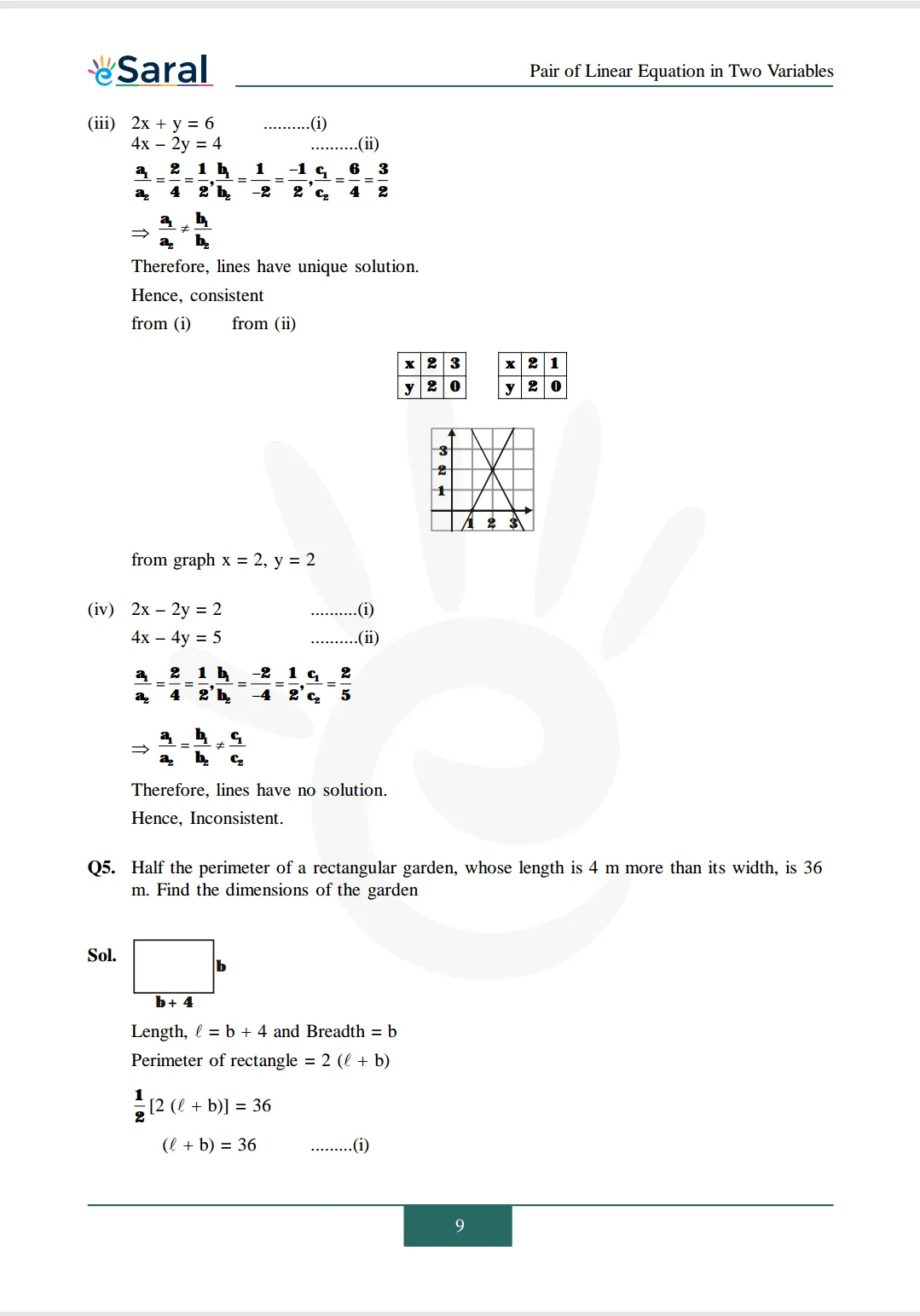
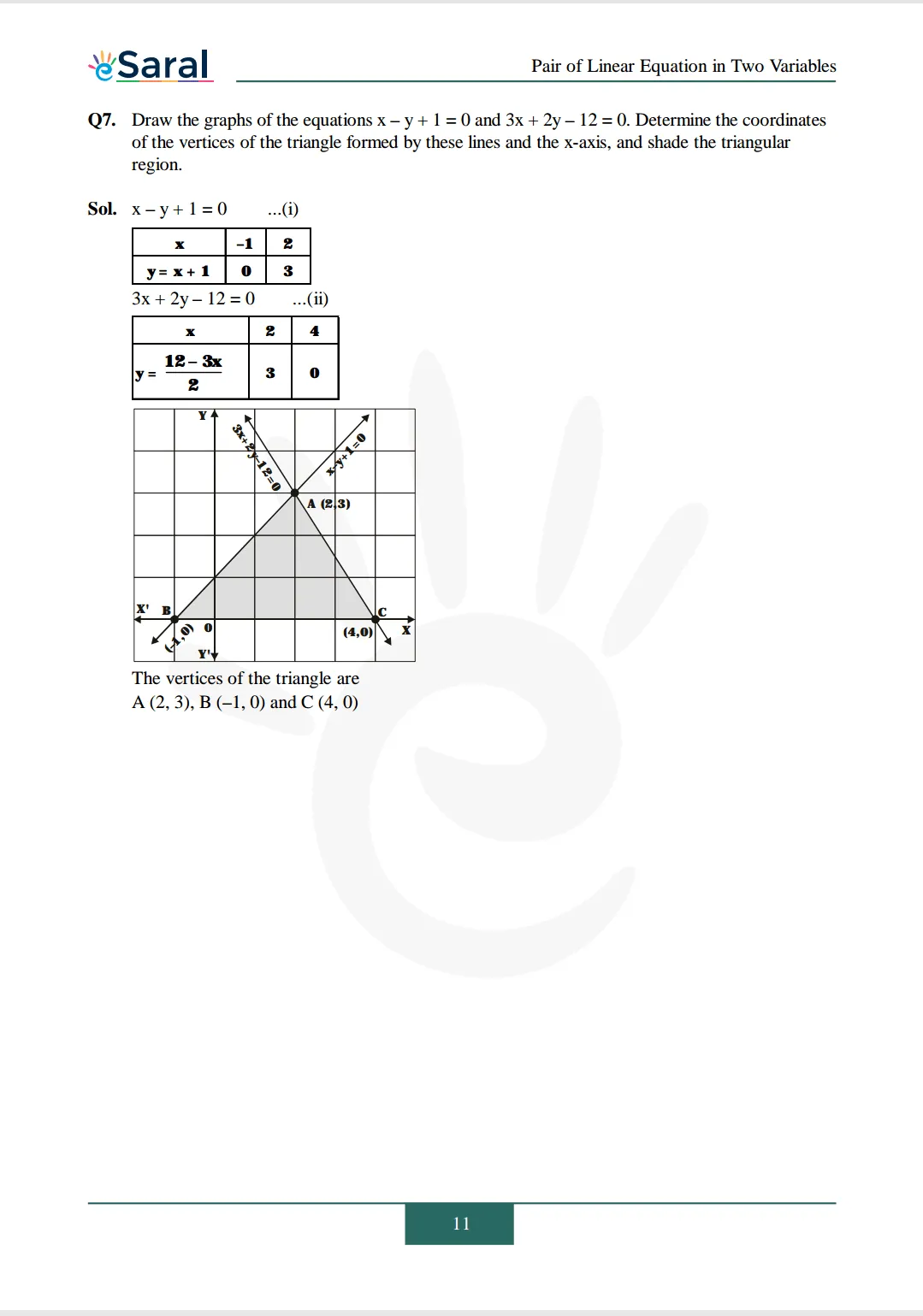
Draw the graphs of both equations on the coordinate plane. The point where the two lines intersect represents the solution. Parallel lines indicate no solution, while overlapping lines indicate infinitely many solutions.
Best used for: Visual understanding and Exercise 3.2 questions.
Method 2: Substitution Method
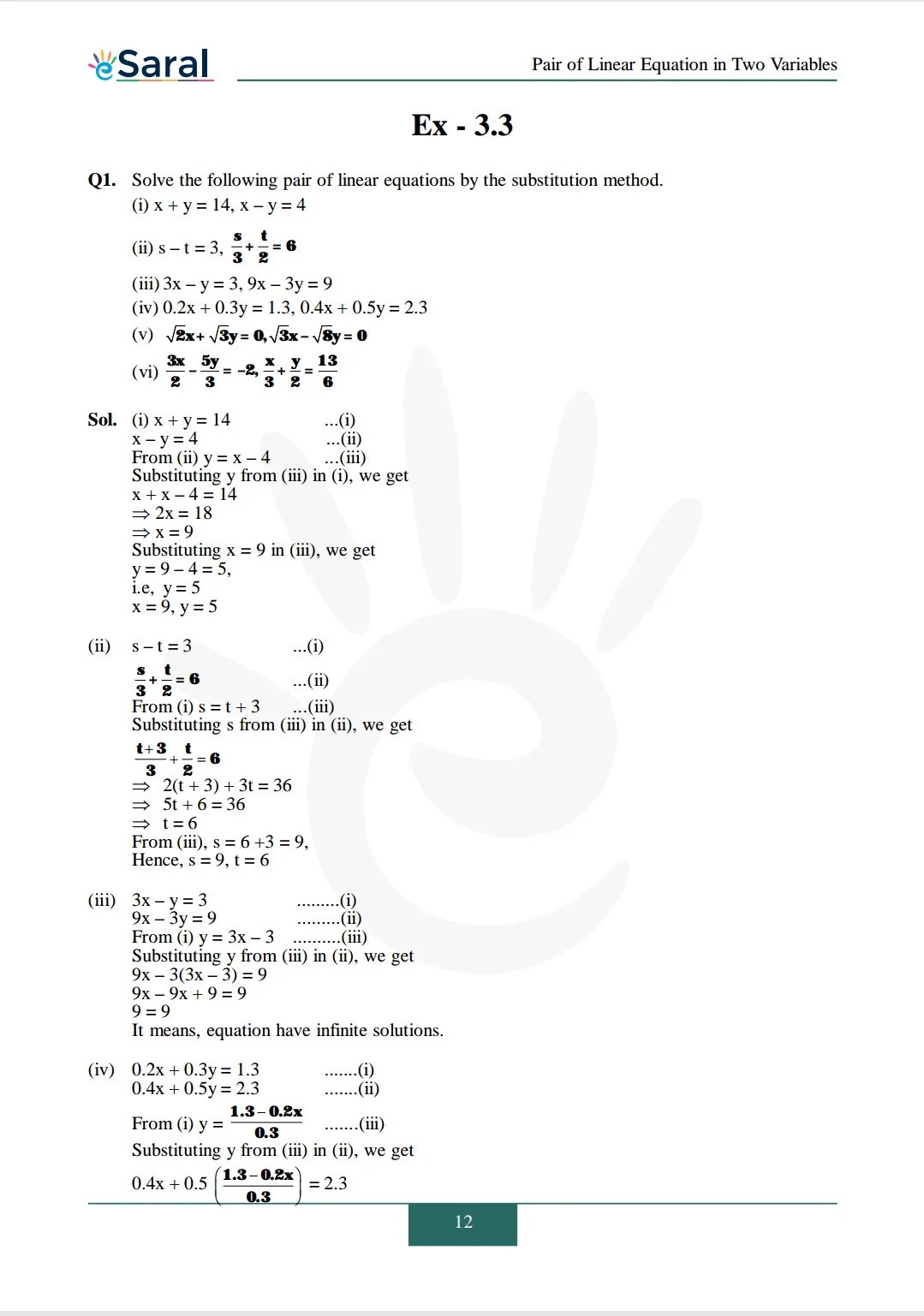
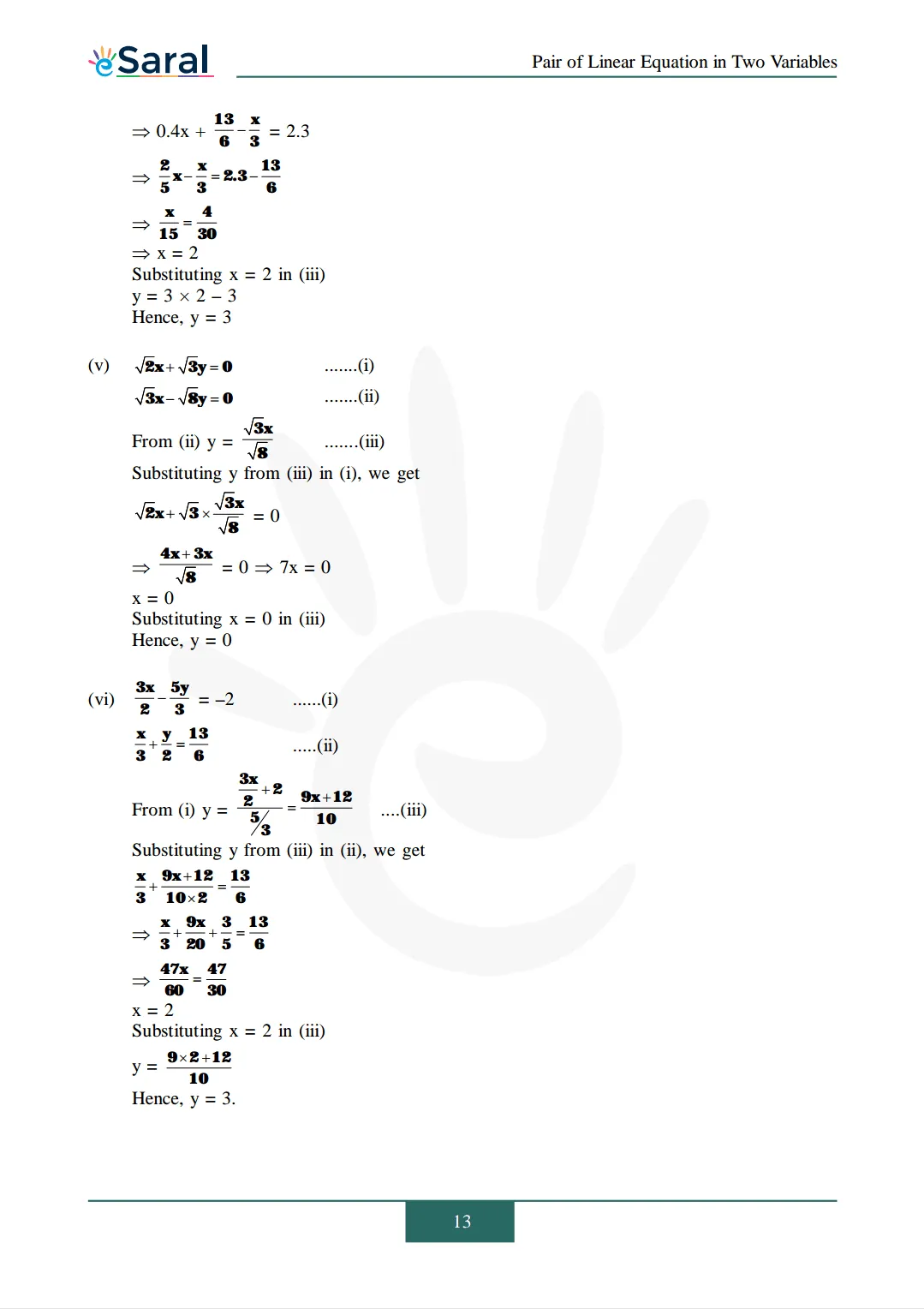
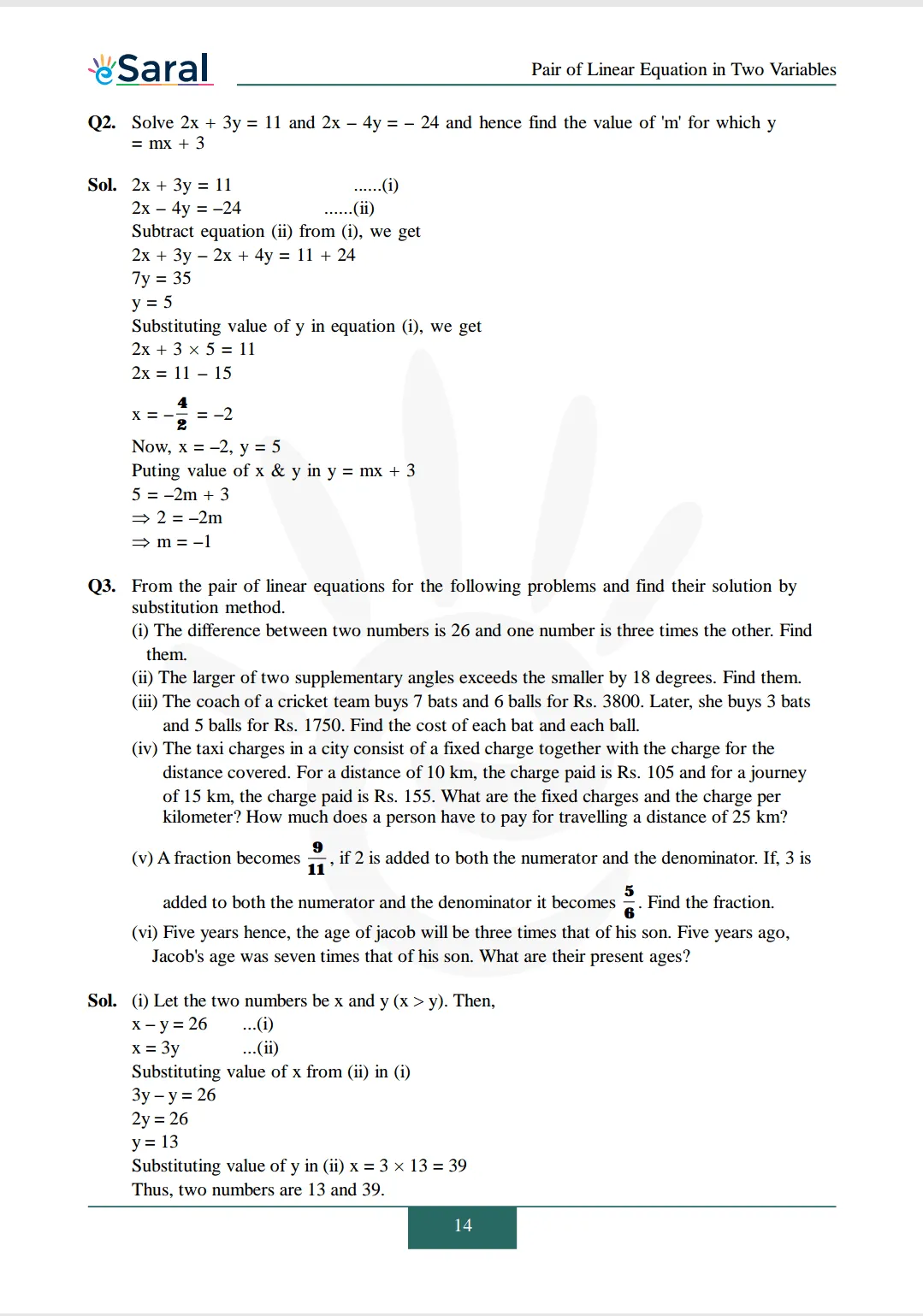
Express one variable in terms of the other using one equation, then substitute the expression into the second equation to obtain a single-variable equation.
Steps
- Express one variable in terms of the other.
- Substitute the expression into the second equation.
- Solve for the remaining variable.
- Substitute the value back to find the second variable.
Best used for: Equations where one variable has a coefficient of 1.
Method 3: Elimination Method
Multiply one or both equations by suitable constants so that the coefficient of one variable becomes the same in both equations. Add or subtract the equations to eliminate that variable and solve.
Best used for: Problems where substitution leads to complicated fractions.
Method 4: Cross-Multiplication Method
This method uses the standard formula based on comparing coefficients:
$\frac{x}{(b_1c_2-b_2c_1)}=\frac{y}{(c_1a_2-c_2a_1)}=\frac{1}{(a_1b_2-a_2b_1)}$
Best used for: Fast algebraic solutions, especially for competitive exam preparation.
Which Method Should You Use—and When?
Choosing the right method can save valuable time during examinations.
| Situation | Best Method |
|---|---|
| You need to visualize the solution. | Graphical Method |
| One equation has a coefficient of 1 for either variable. | Substitution Method |
| Coefficients are whole numbers without simple factors. | Elimination Method |
| You want the fastest algebraic solution. | Cross-Multiplication Method |
| The equation can be reduced to linear form. | Substitution or Elimination Method |
Expert Tip: In CBSE board exams, the Elimination Method is often the quickest approach for word problems. However, Exercise 3.5 usually expects the Cross-Multiplication Method. Learning to identify the appropriate method based on the question pattern can save both time and marks.
Common Mistakes Students Make in Chapter 3
Knowing where students commonly lose marks is just as important as learning the solution methods.
Mistake 1: Incorrect Sign Handling During Elimination
Students frequently make sign errors while subtracting equations, especially when negative coefficients are involved. Rewrite each subtraction step carefully before simplifying.
Mistake 2: Not Checking Consistency Before Solving
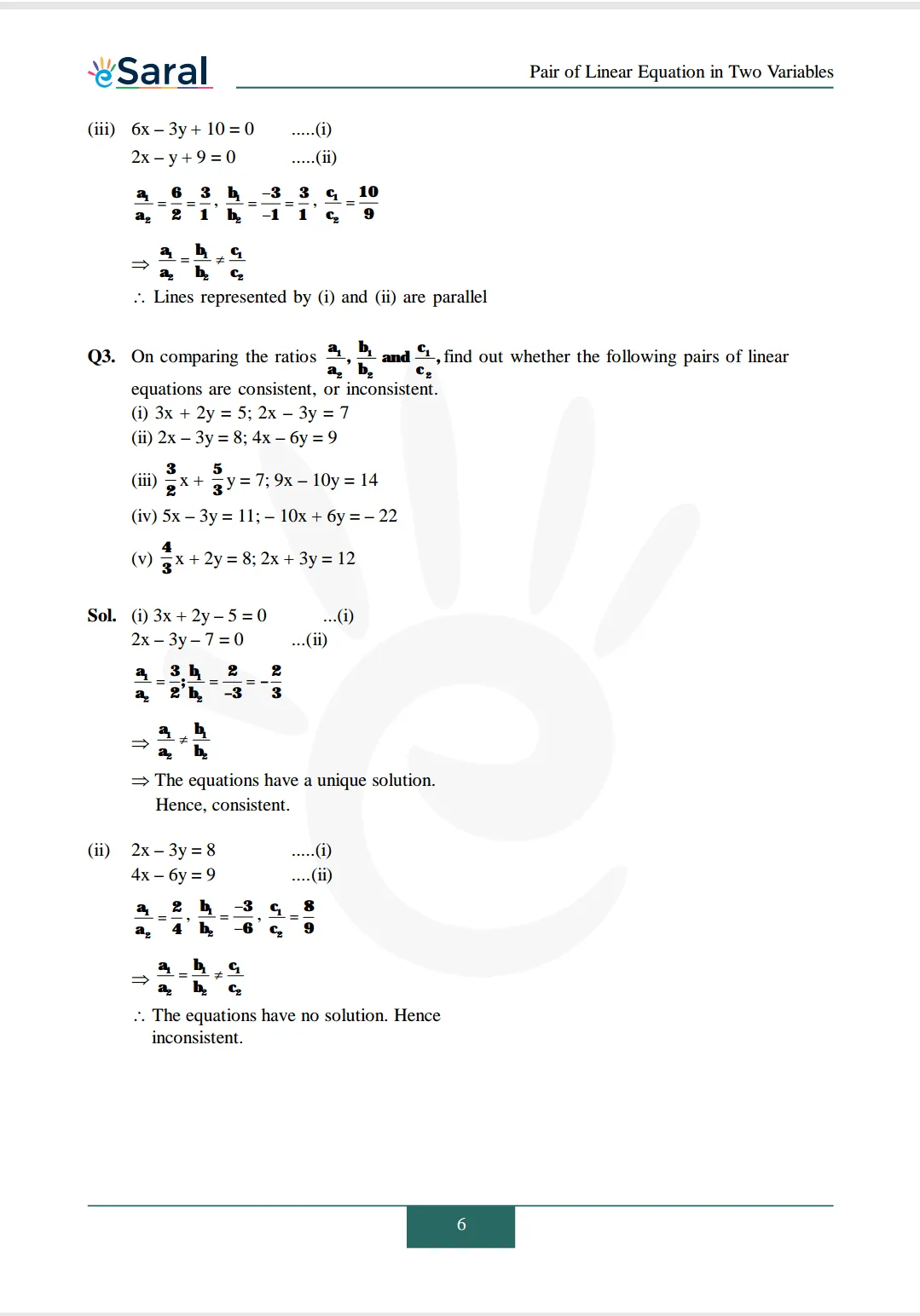
Many students immediately begin solving without checking the consistency conditions. If $a_1/a_2=b_1/b_2\neq c_1/c_2$, the system has no solution. Identifying this condition beforehand prevents unnecessary calculations.
Mistake 3: Errors While Forming Equations from Word Problems
The most challenging part of Exercise 3.7 is converting the given information into two correct equations. Define the variables clearly and read the question carefully before writing the equations.
Mistake 4: Skipping Verification
Always substitute the obtained values of $(x,y)$ back into both original equations. This simple verification step helps eliminate careless mistakes and ensures full marks.
For more structured board exam preparation, explore the complete NCERT Solutions Library on eSaral, covering Class 8 to Class 12 across all major subjects.
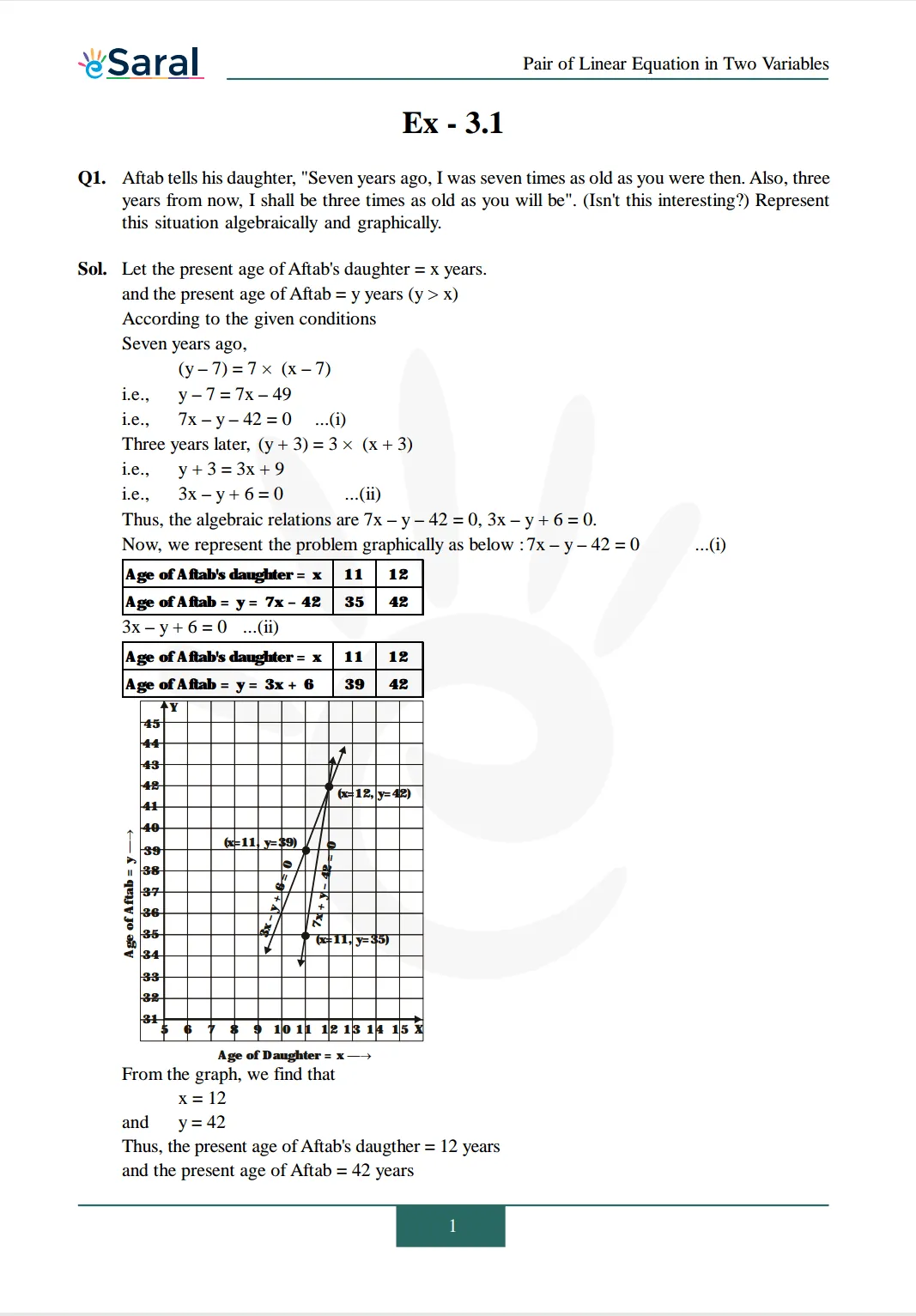
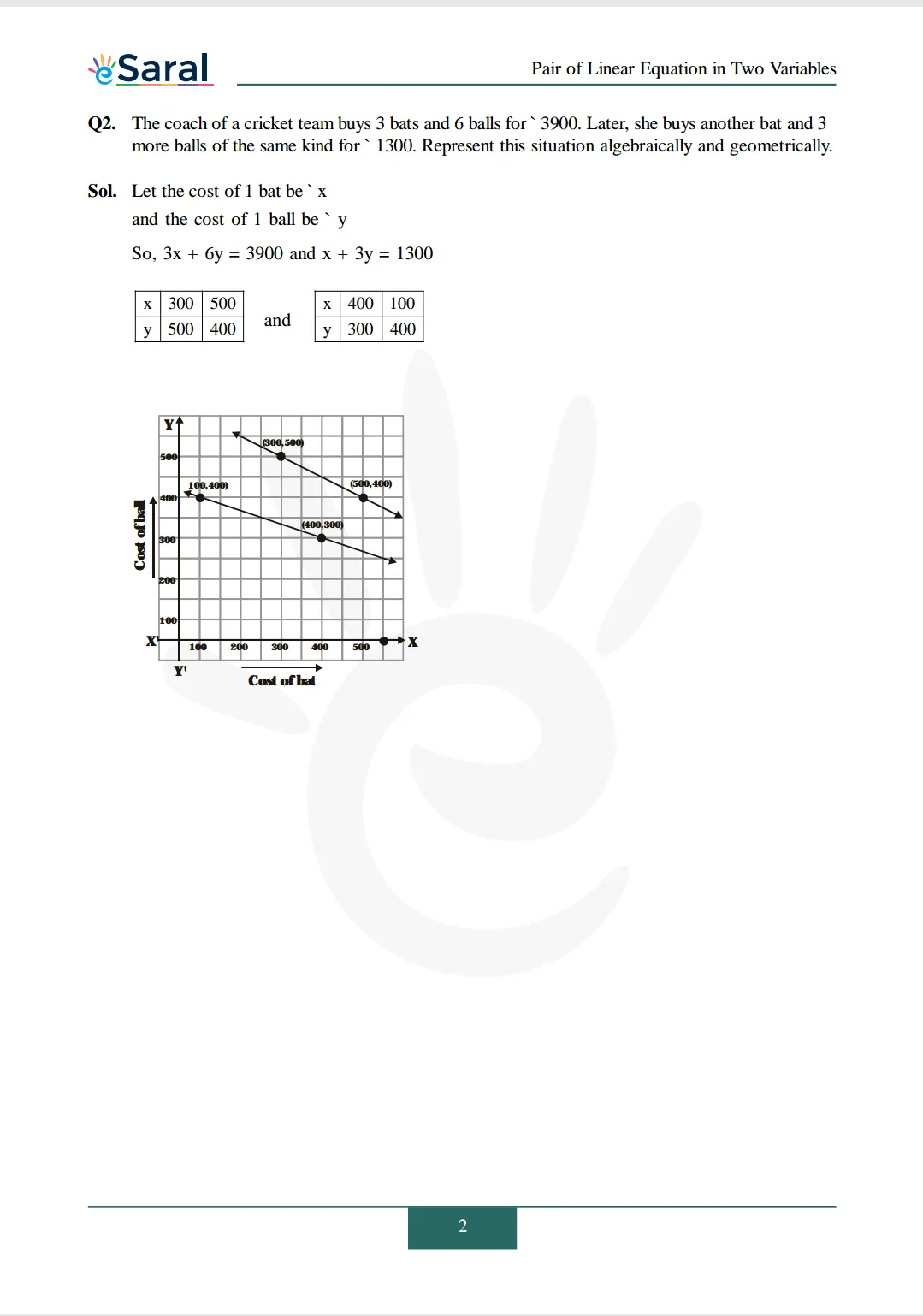
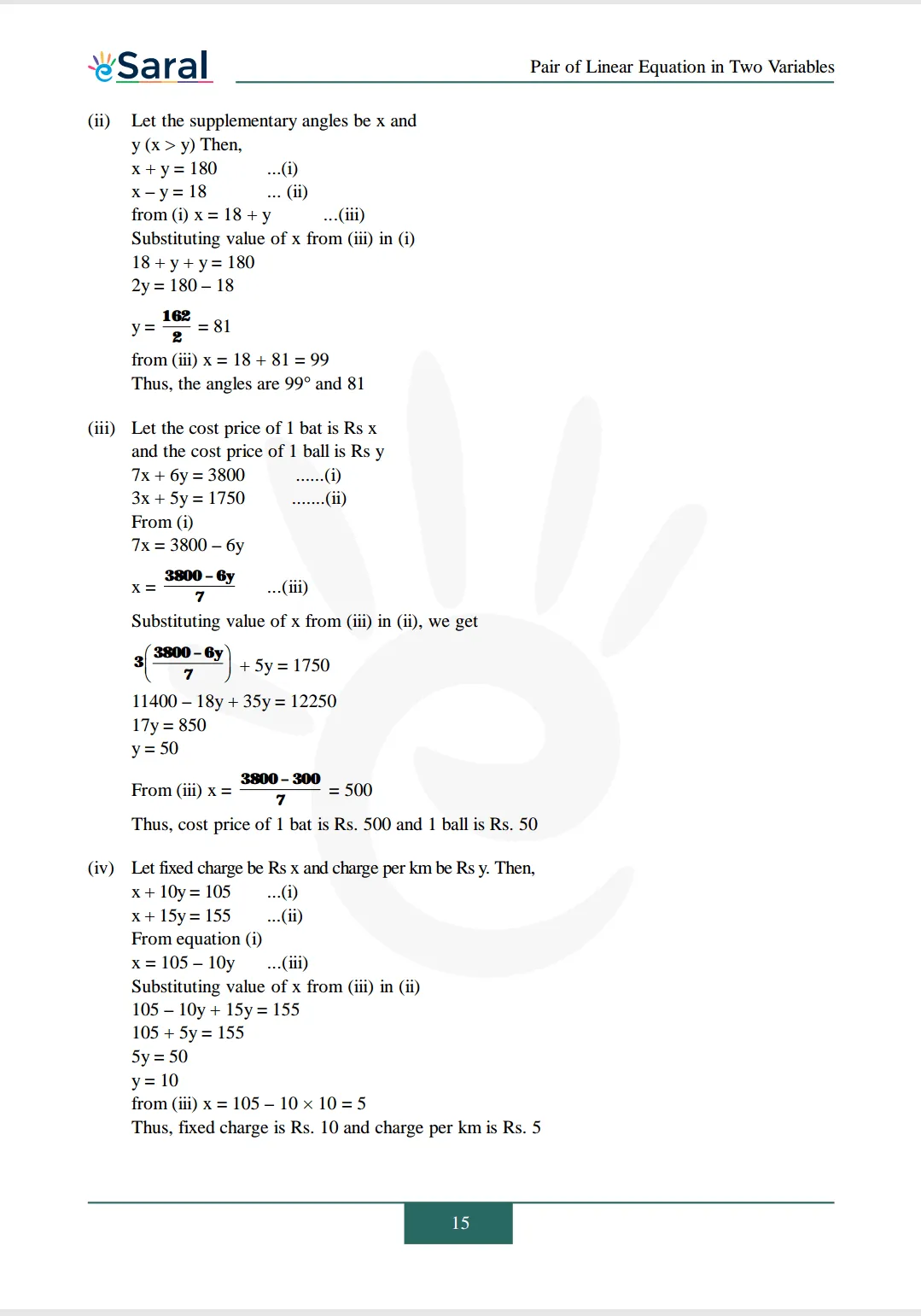
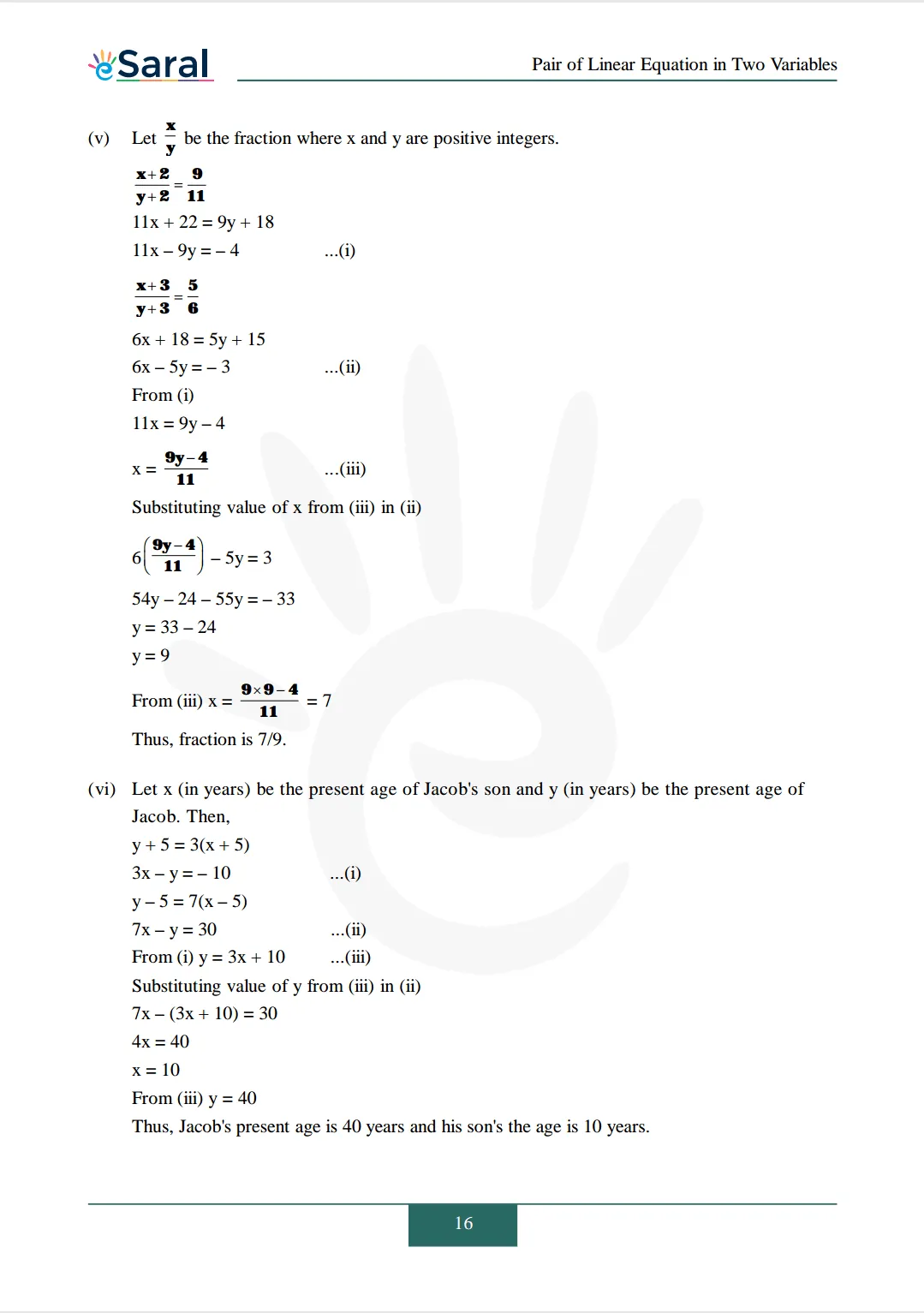
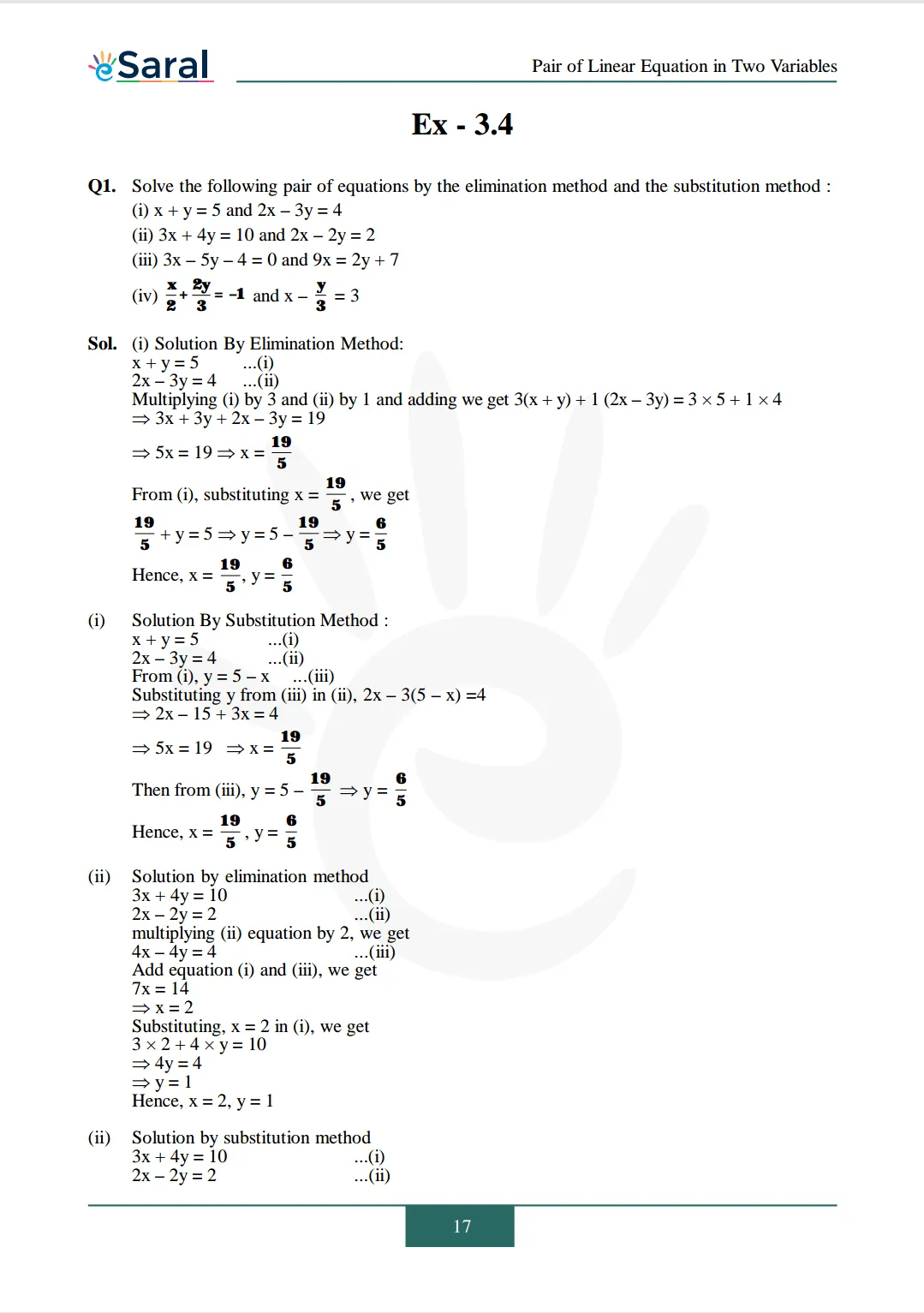
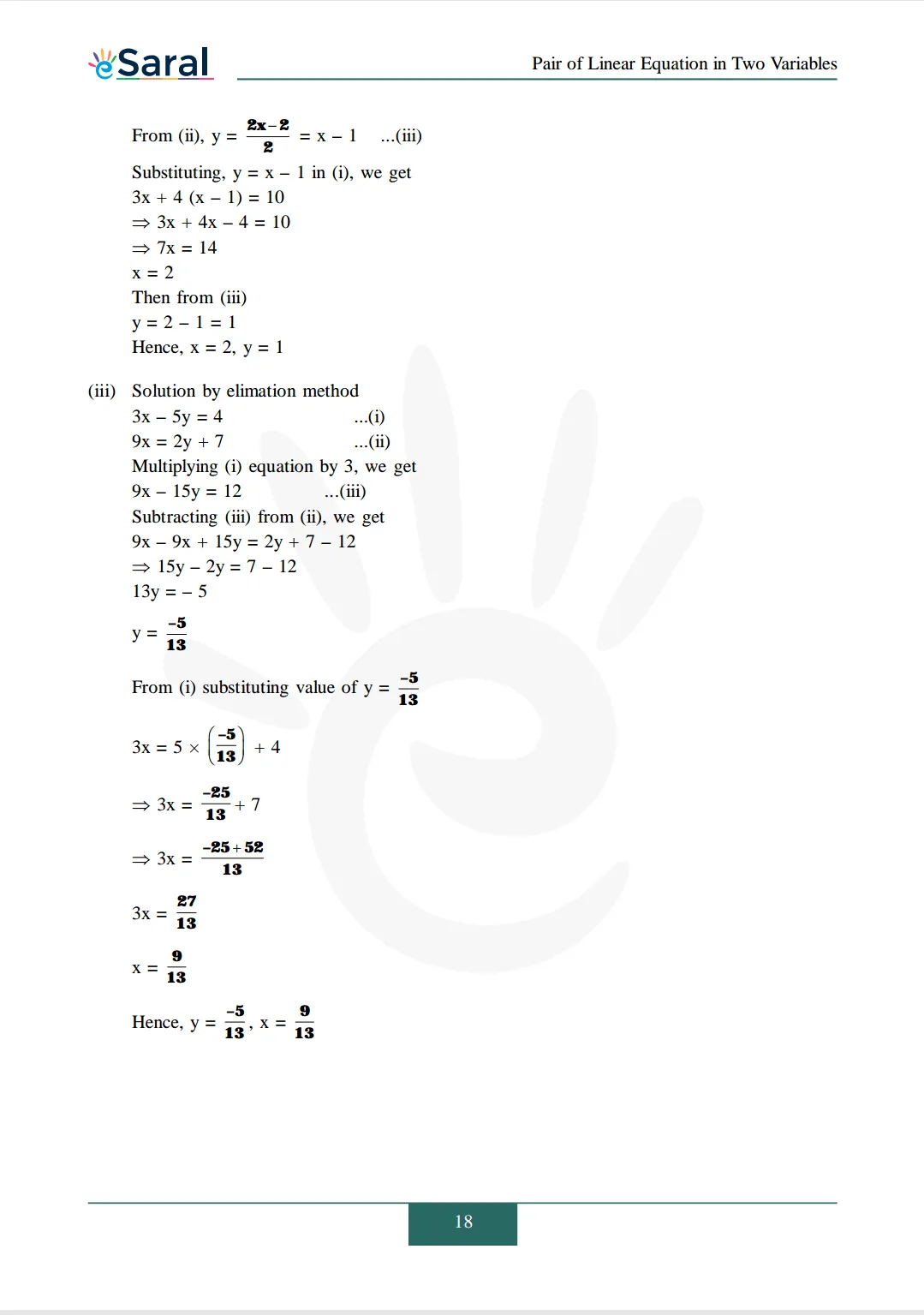
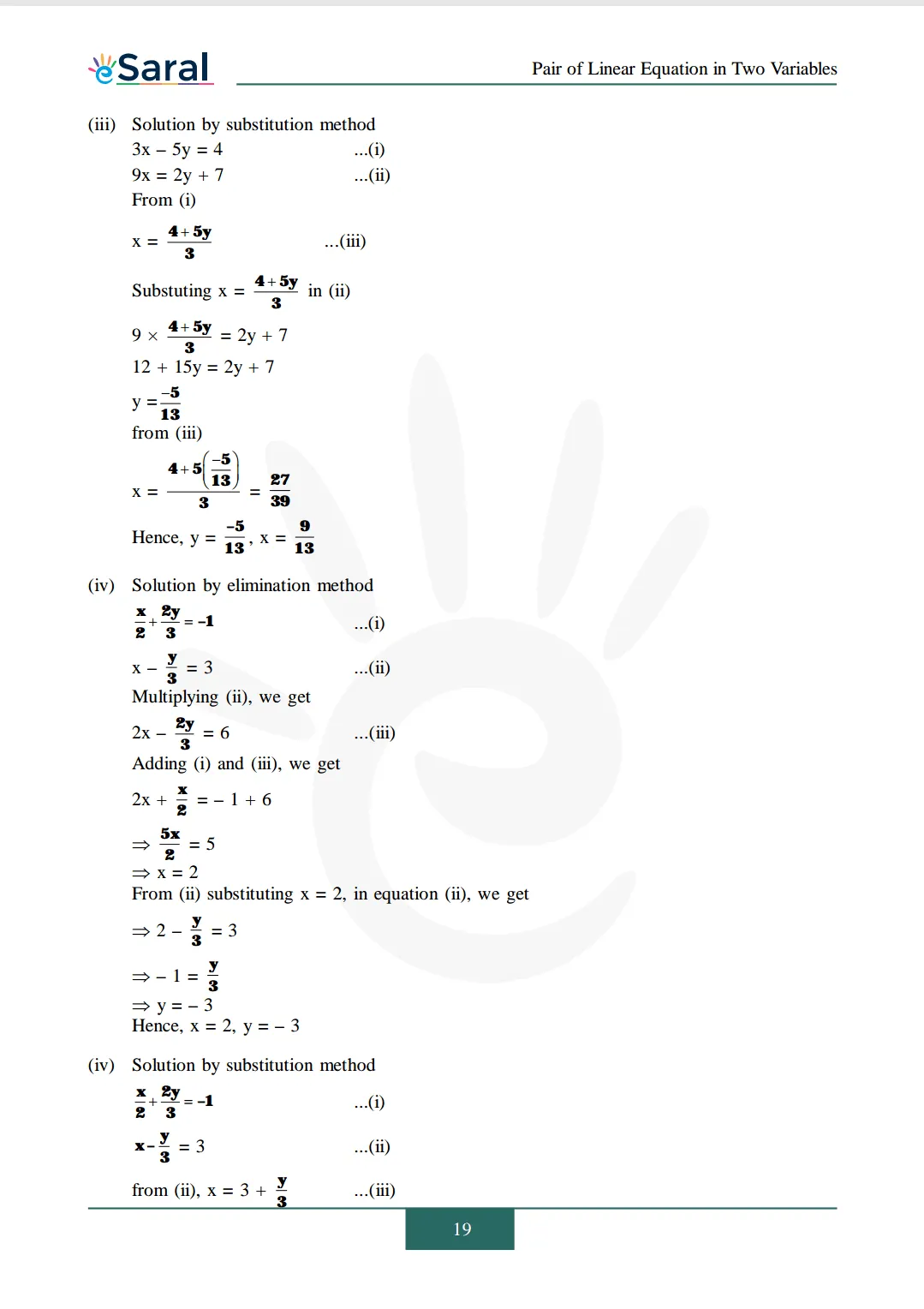
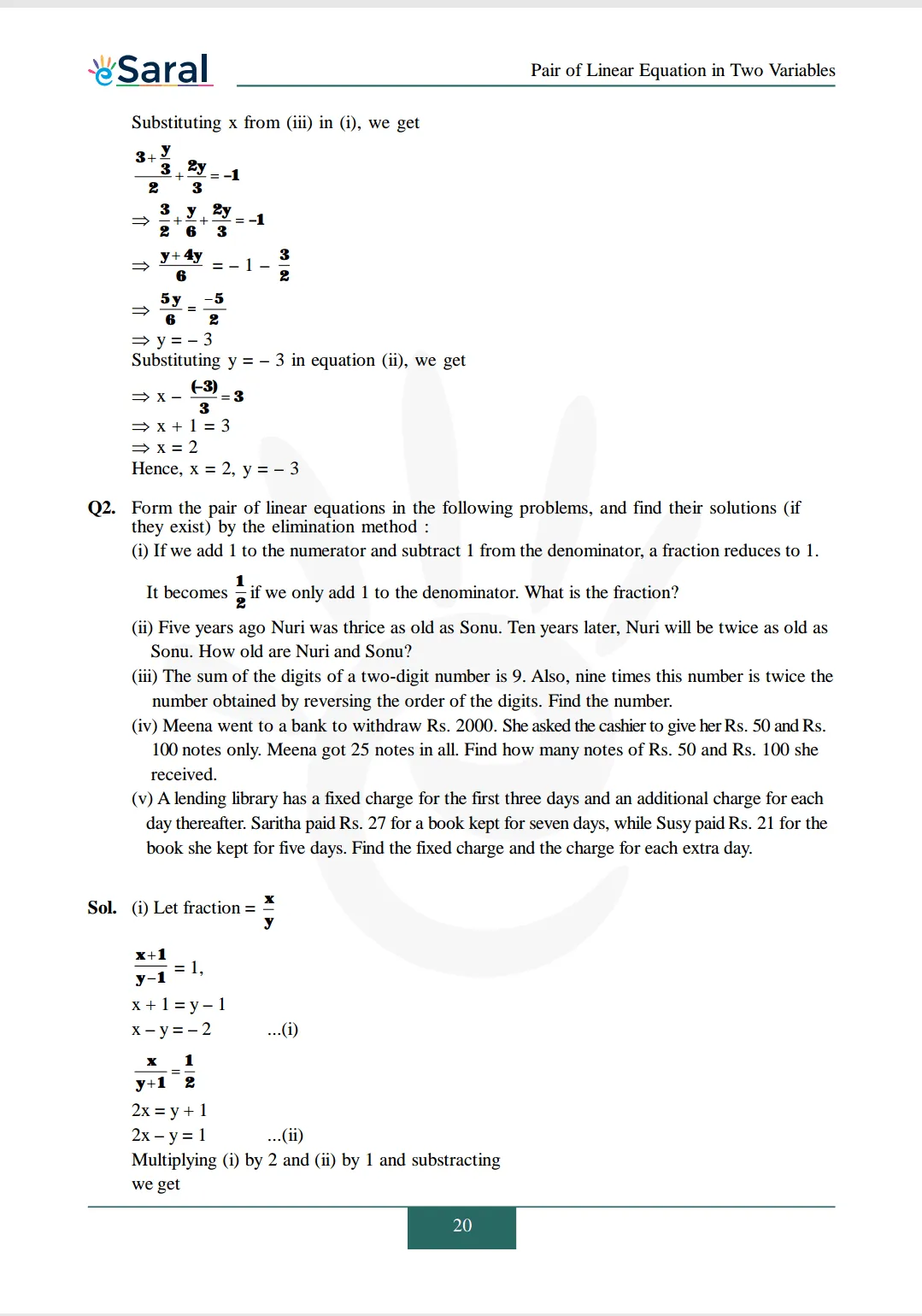
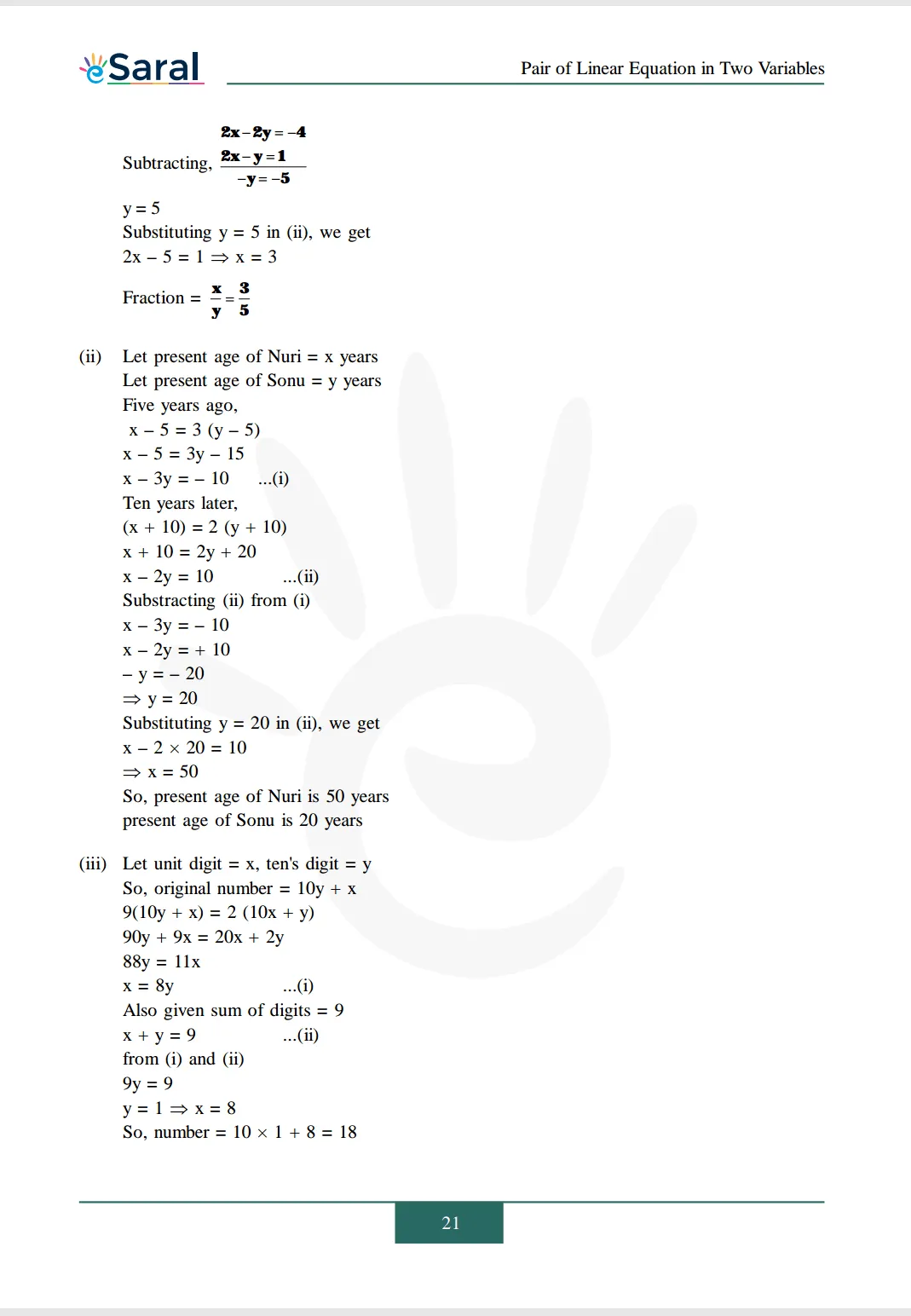
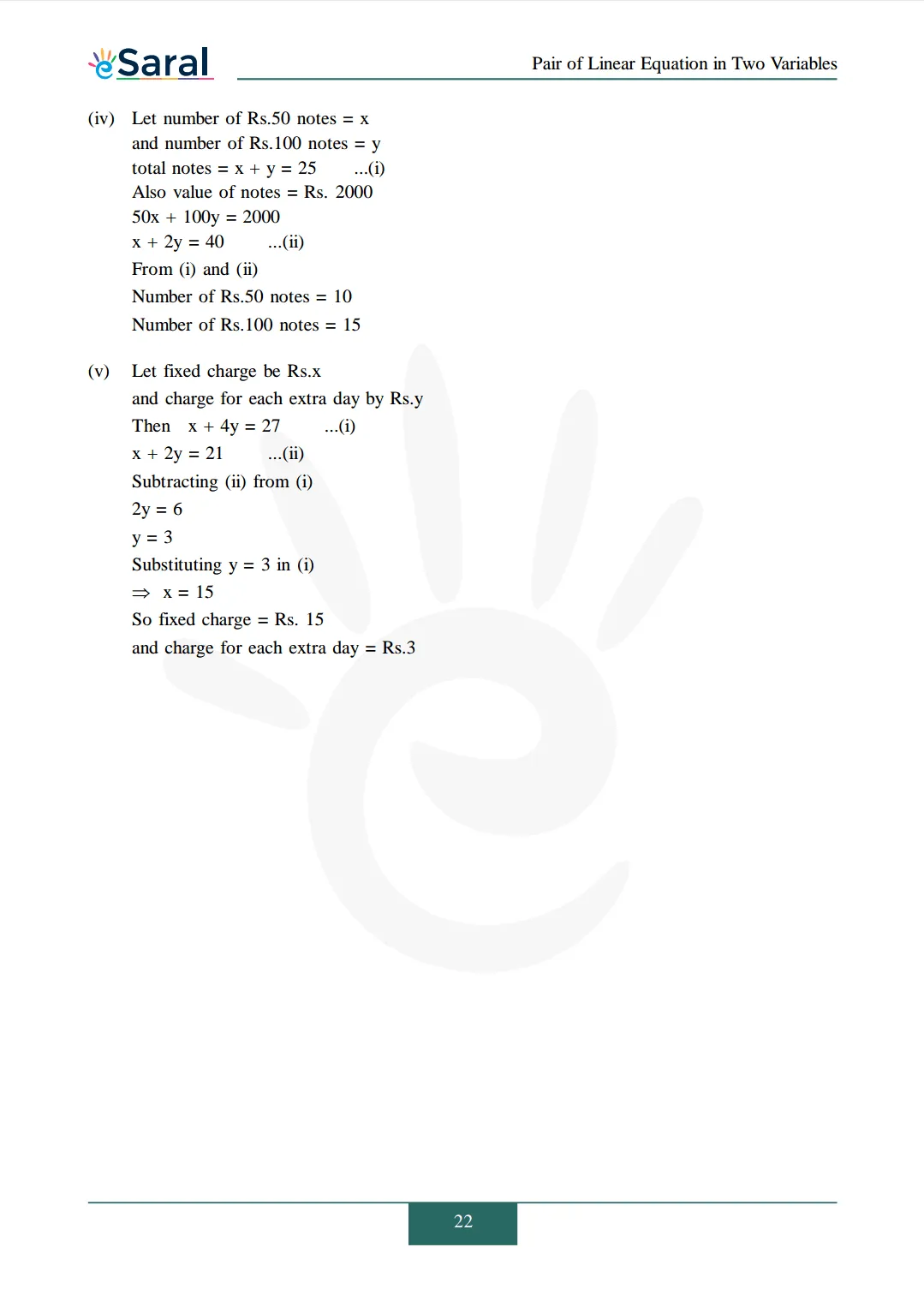
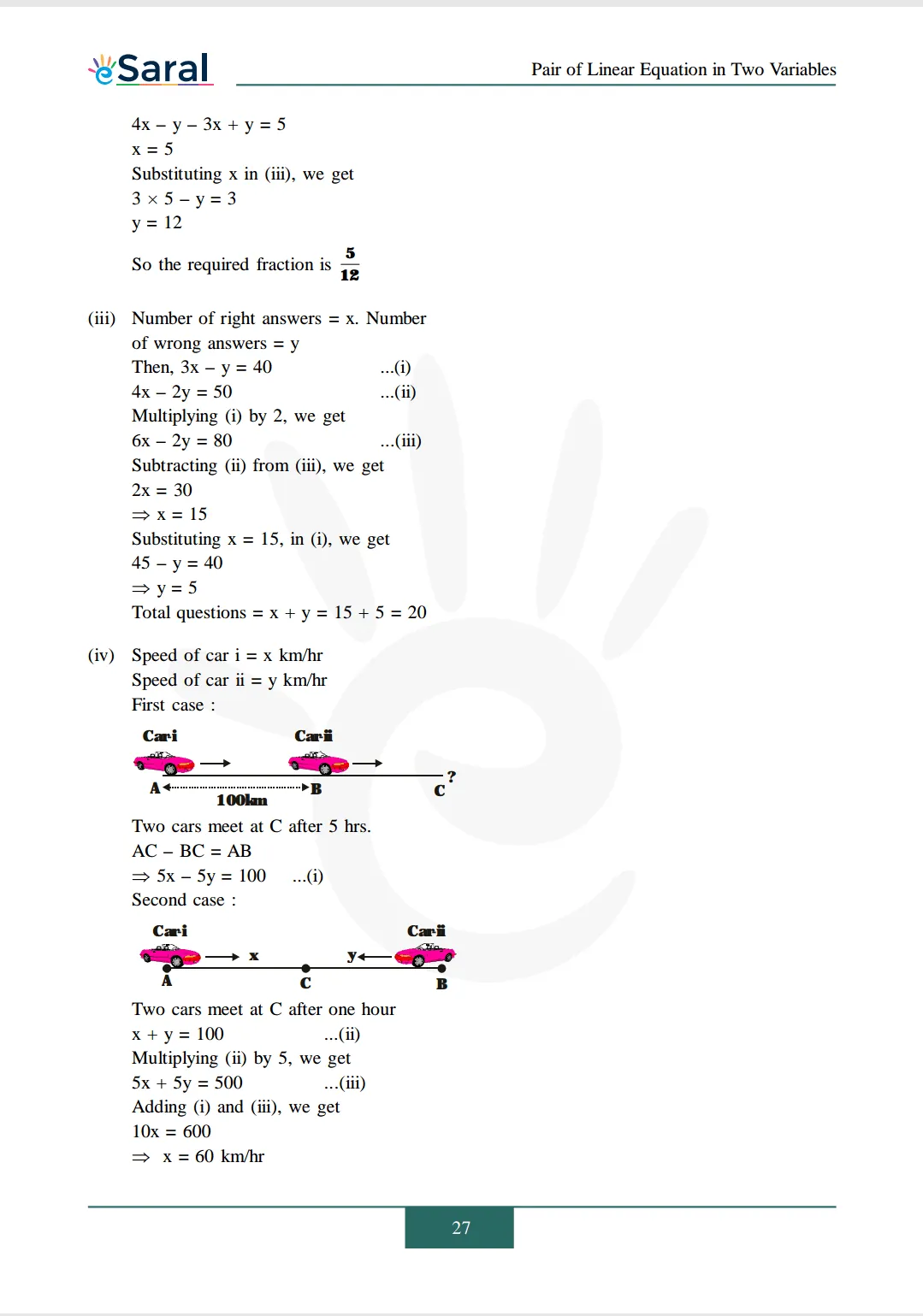
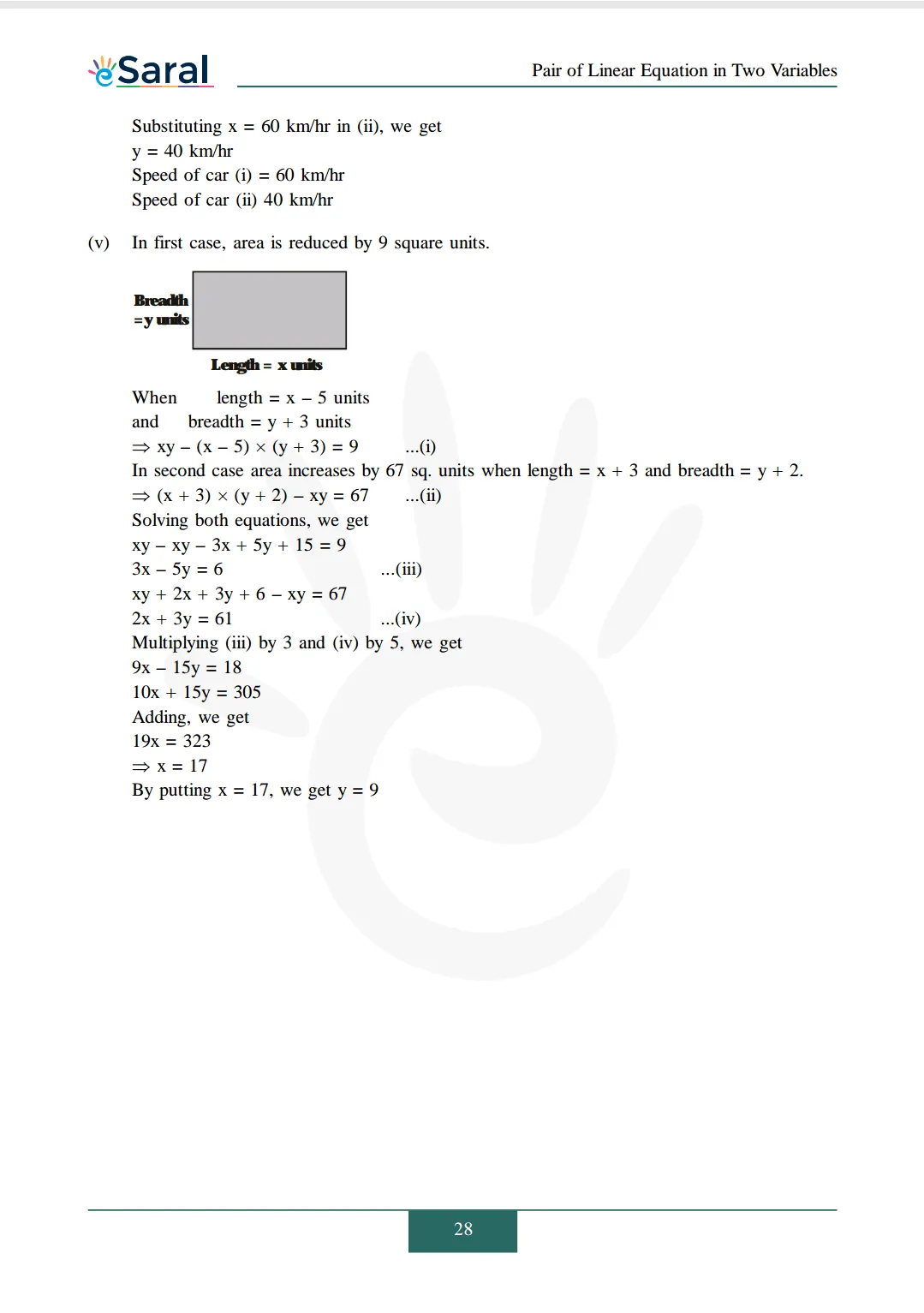
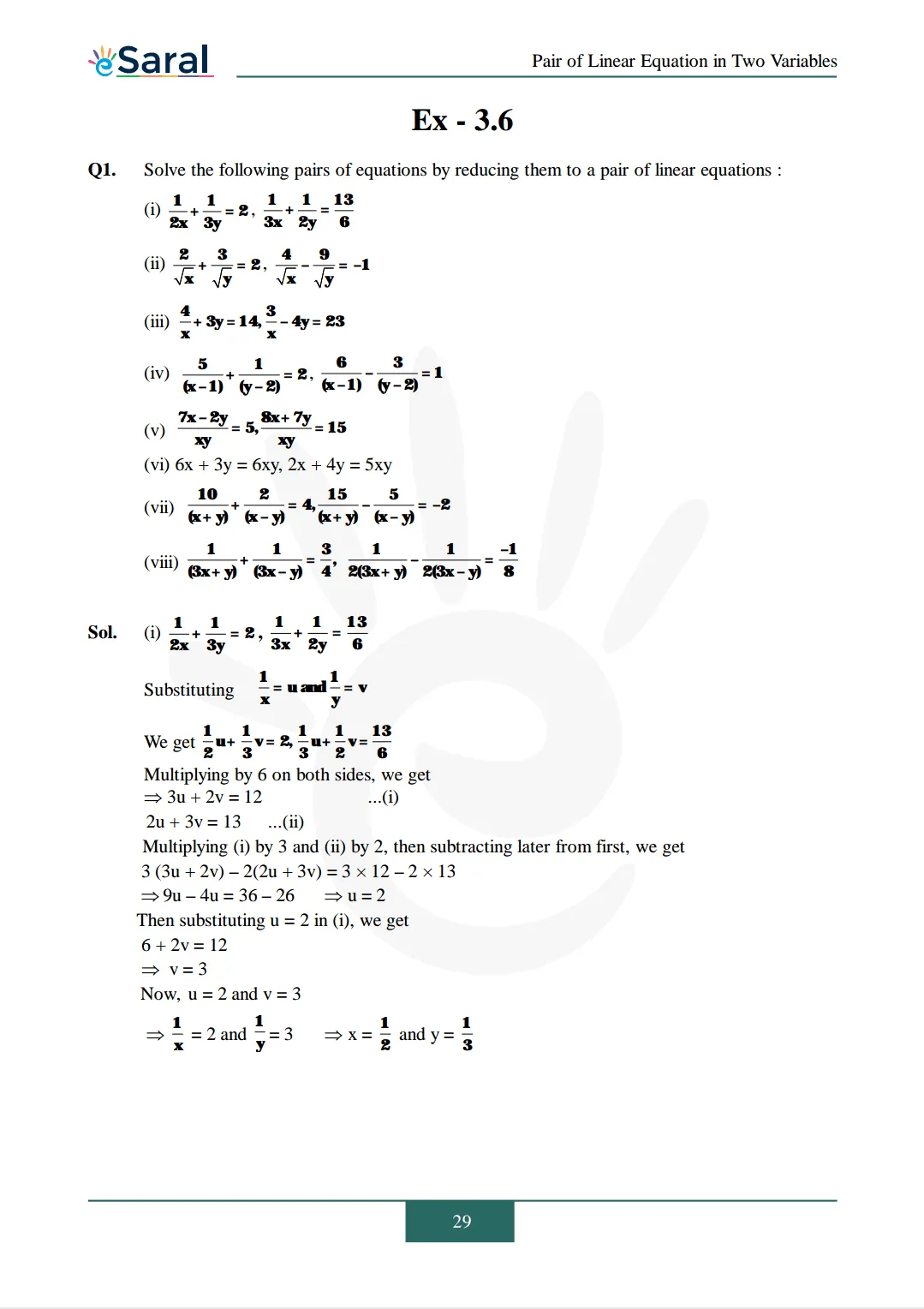
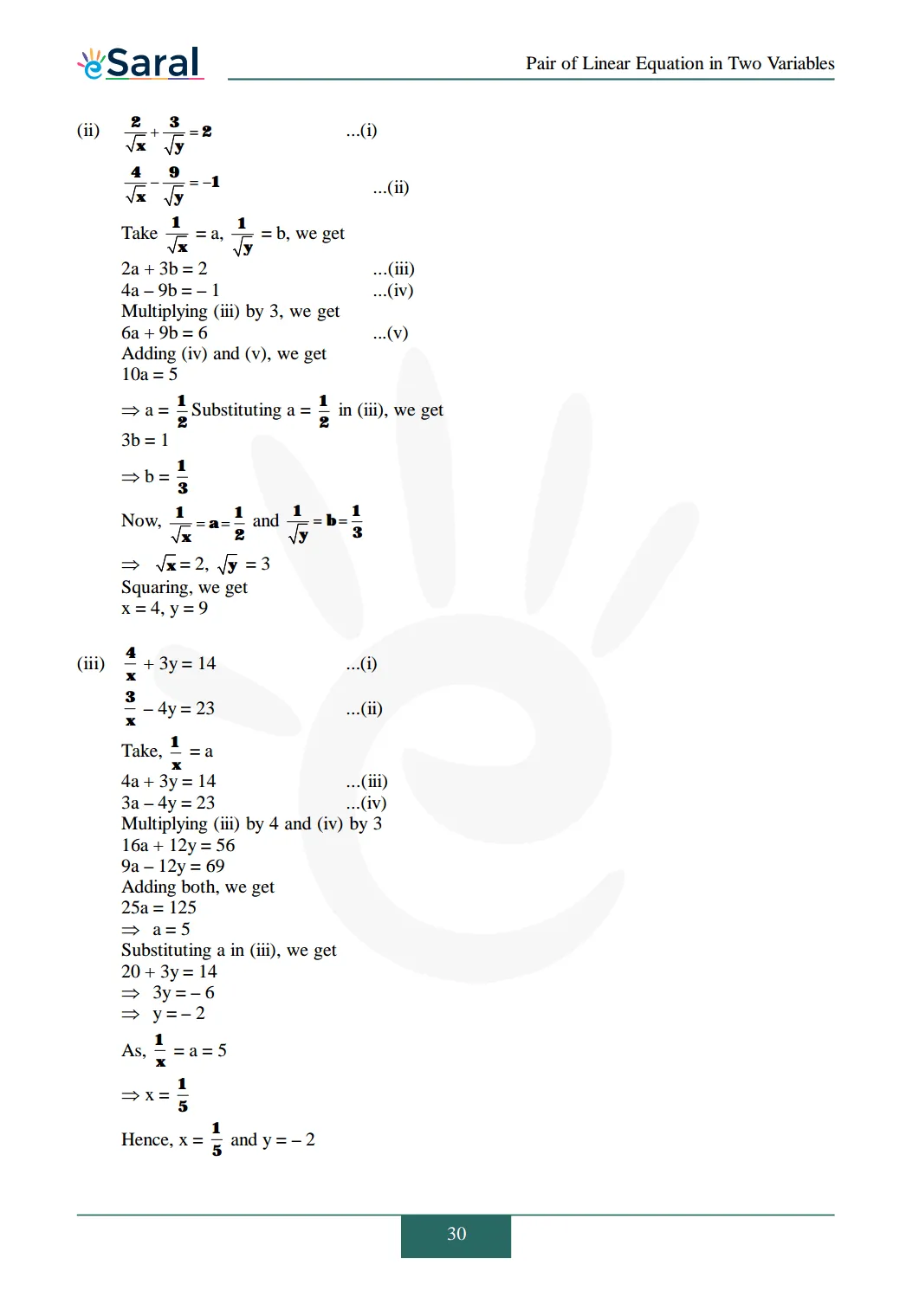
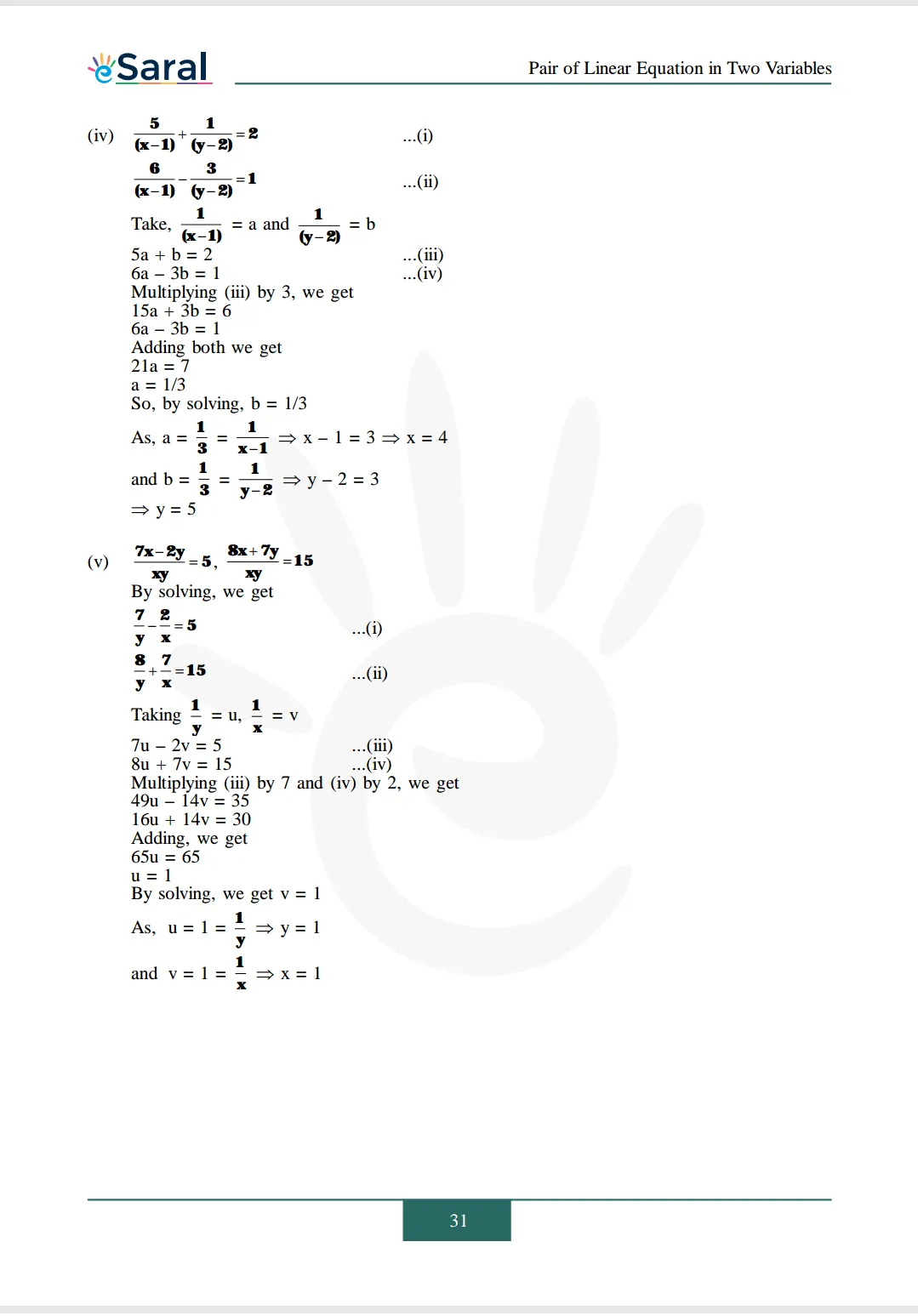
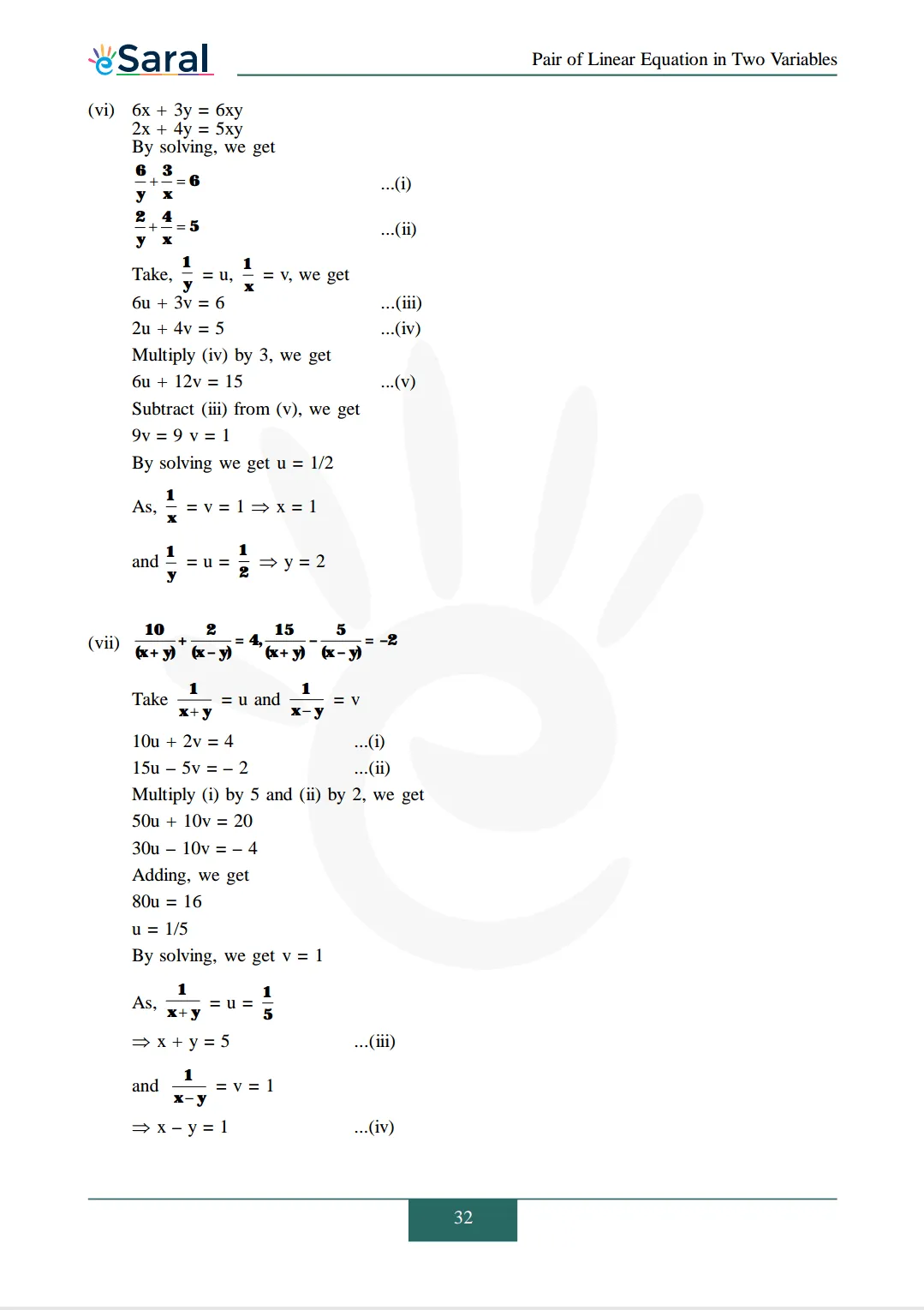
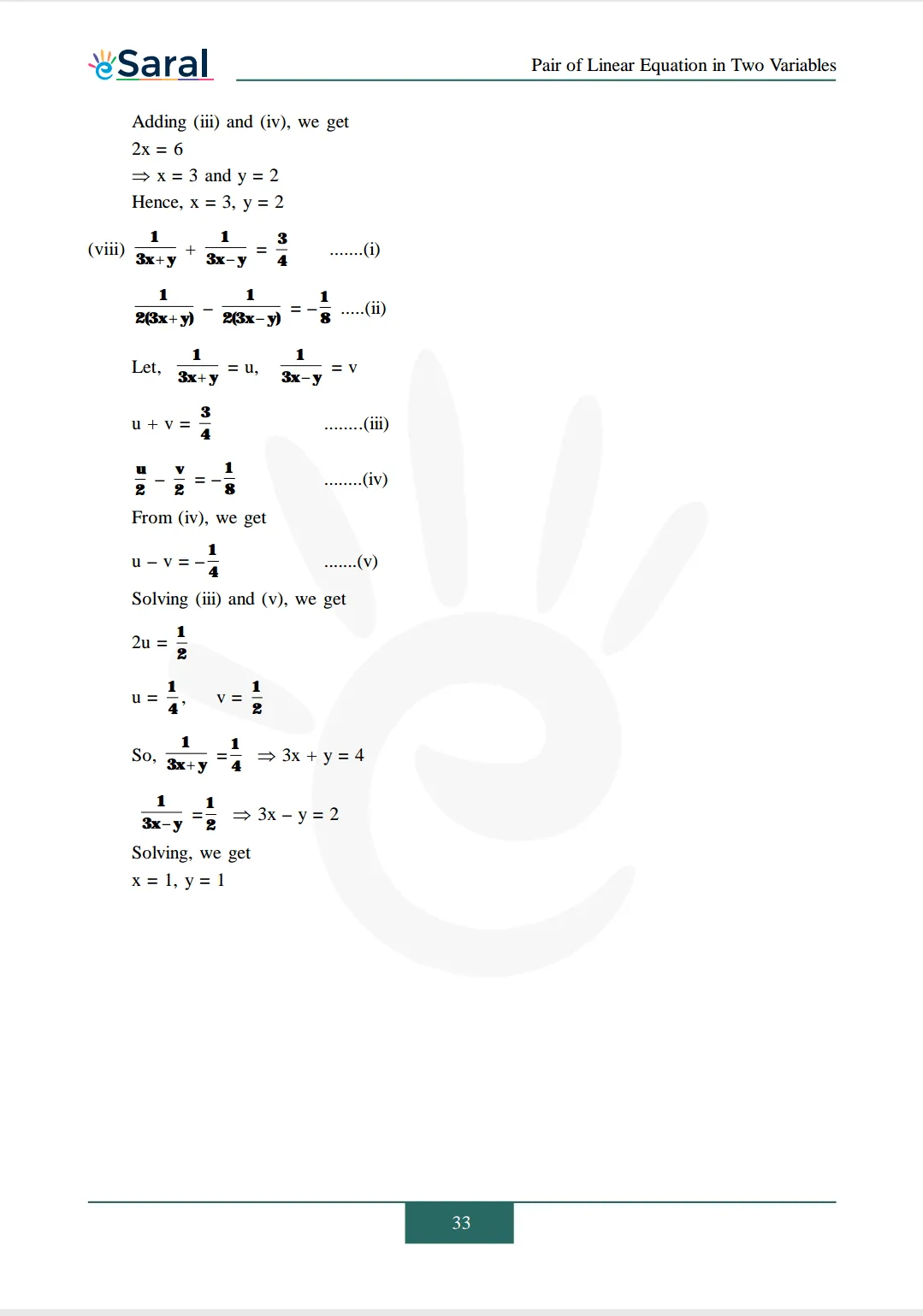
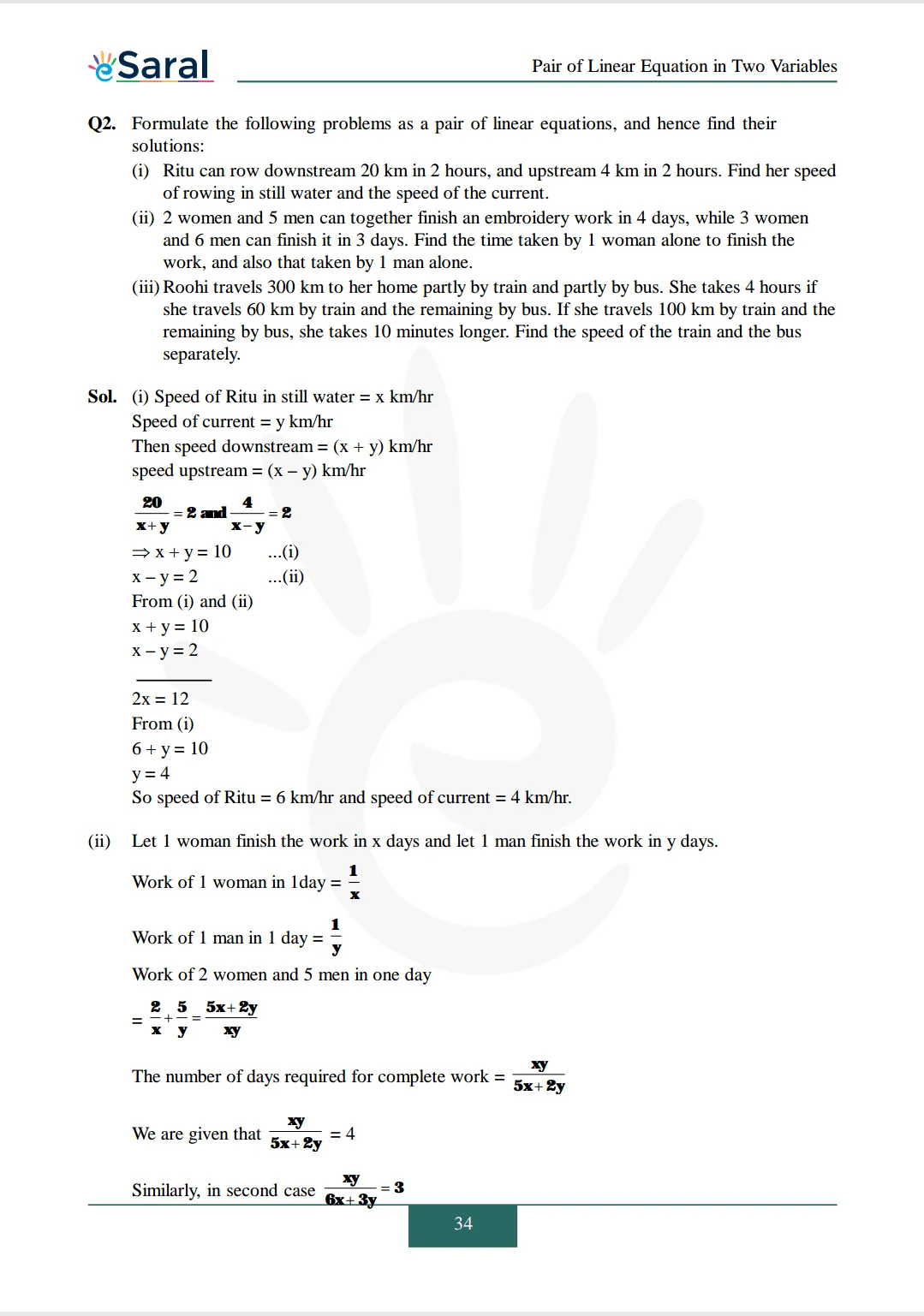
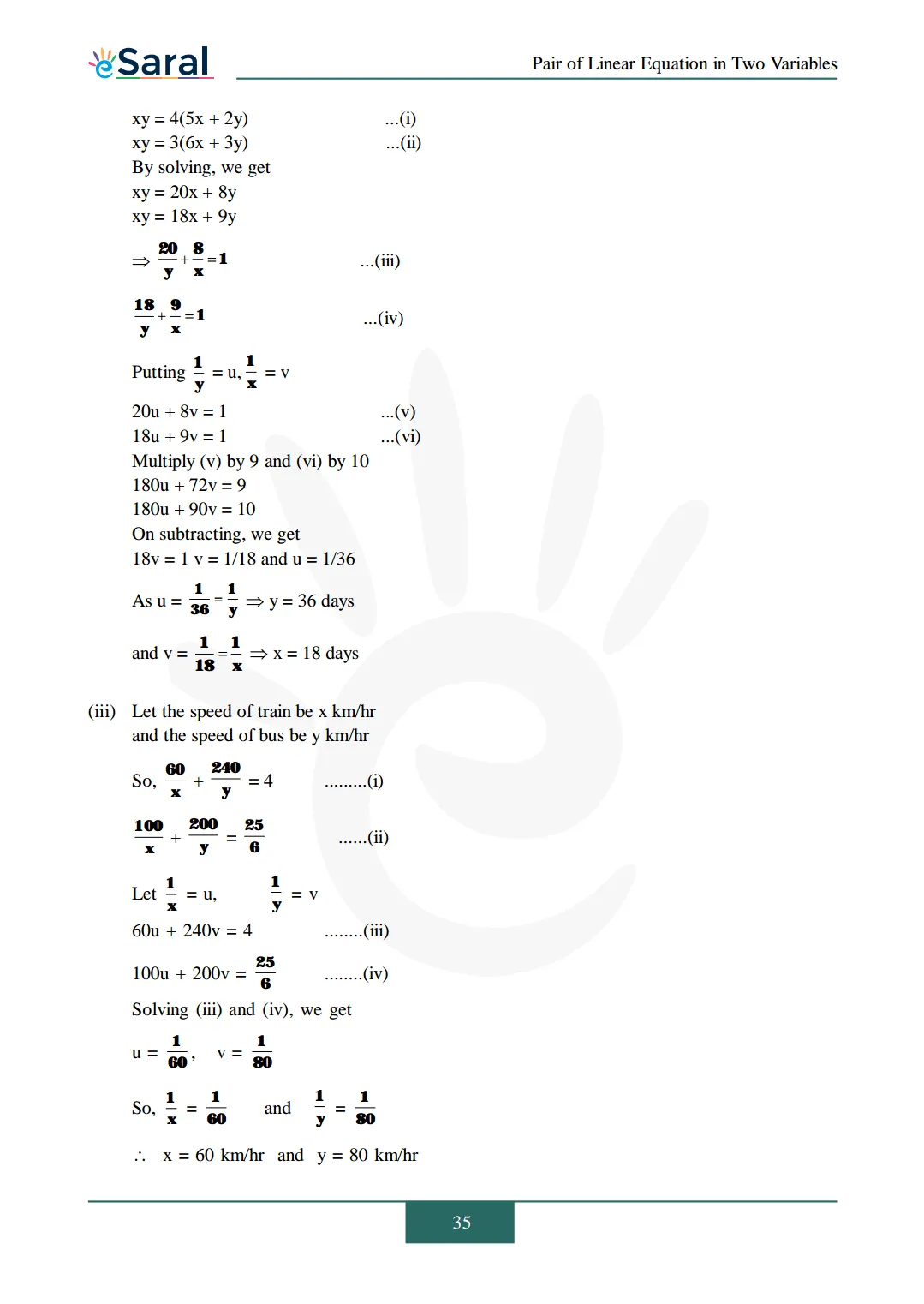
Download The PDF of NCERT Solutions for Class 10 Maths Chapter 3 "Pair of Linear Equations in Two Variables"
So, that’s all from this article. I hope you enjoyed this post. If you found this article helpful then please share it with other students.
Also Read,
Class 10 Maths Revision Notes.
Class 10 Maths Book PDF
Class 10 Maths Exemplar PDF
If you have any Confusion related to NCERT Solutions for Class 10 Maths chapter 3, then feel free to ask in the comments section down below.
For every other chapter's solutions in one place, the NCERT solutions for class 10 Maths hub is where students usually start before drilling into a specific chapter like this one.
To watch Free Learning Videos on Class 10 by Kota’s top faculties, install the eSaral App
Frequently Asked Questions
Find answers to common questions.
Which method is best for solving linear equations in two variables for board exams?
The elimination method is generally the fastest and most reliable for CBSE board exams. It avoids fractions in most standard questions. However, when the question specifically mentions cross-multiplication or the format matches Exercise 3.5, use the cross-multiplication method. Always match your method to what the question expects.
How many exercises are in Class 10 Maths Chapter 3?
Class 10 Maths Chapter 3 has 7 exercises — Exercise 3.1 through Exercise 3.6, plus one optional Exercise 3.7. The exercises cover graphical methods, substitution, elimination, cross-multiplication, and word problems. Exercise 3.7 is optional but highly recommended for board exam preparation as it contains application-based questions.
What is a pair of linear equations in two variables?
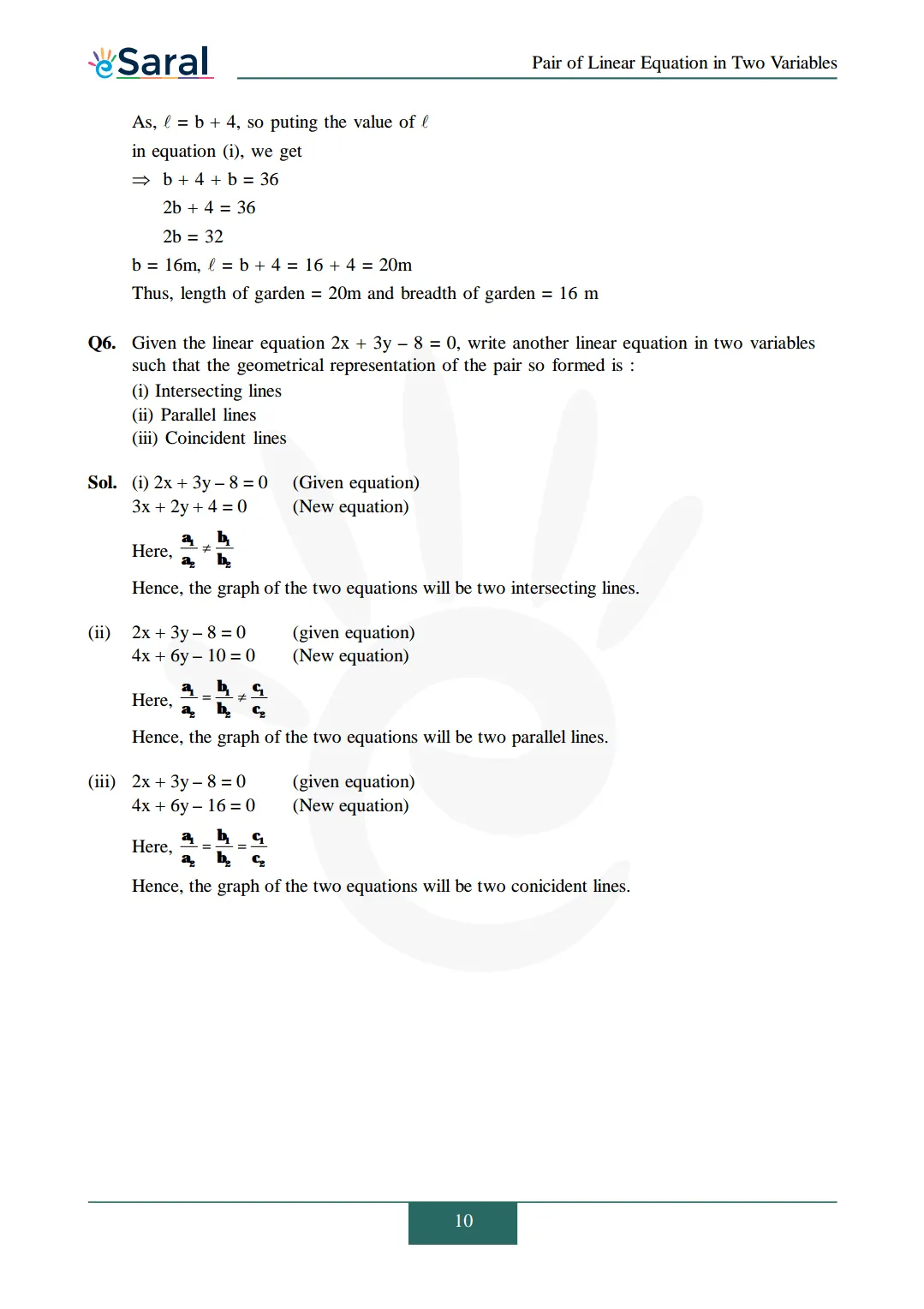
A pair of linear equations in two variables consists of two equations, each of the form ax + by + c = 0, where a, b, and c are real numbers and a and b are not both zero. Together, they represent two straight lines, and solving them means finding the point (x, y) where both equations are satisfied simultaneously.
Can I use these solutions even if I am preparing for competitive exams after Class 10?
Yes. The algebraic thinking developed in Chapter 3 — particularly cross-multiplication and system-solving — directly supports topics in Class 11 and 12 Mathematics. Students planning for JEE or other competitive exams benefit from mastering this chapter deeply. You can also explore NCERT Solutions for Class 11 Maths and NCERT Solutions for Class 12 Maths to build on these concepts
Are these NCERT solutions sufficient for Class 10 board exam preparation?
NCERT solutions are the foundation, but scoring 90%+ requires practising exemplar problems and previous year question papers as well. The eSaral NCERT Solutions PDF covers all NCERT exercises, and you can supplement them with the Class 10 Maths Revision Notes and Exemplar PDF linked on this page for complete preparation.
Is Chapter 3 of Class 10 Maths important for boards?
Yes, Chapter 3 is important. The Algebra unit, which includes Chapter 3, carries 20 marks in CBSE Class 10 Maths. Chapter 3 alone can contribute 6–8 marks through a case-study question and short/long answer questions. Students who practise all exercises typically find these marks easy to secure.