NEET Dropper Preparation Strategy: Avoid This One Mistake (2027)
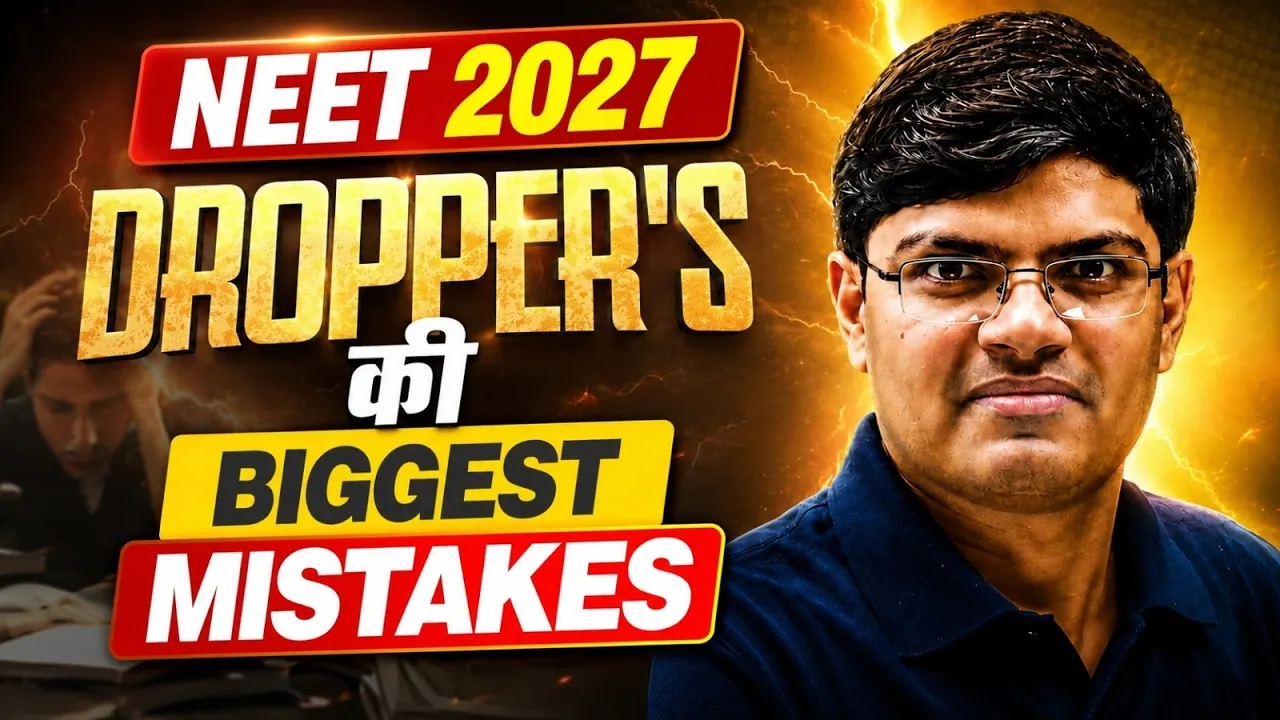
The biggest mistake NEET droppers make is identifying their weak areas randomly instead of analyzing them at the subtopic level. Successful droppers pinpoint exact weak subtopics — not just weak chapters — using precise test analysis, then attack only those areas instead of re-studying everything equally.

eSaral › NEET › NEET Dropper Preparation Strategy: Avoid This One Mistake (2027)

The Difference Between Droppers Who Succeed and Those Who Don't
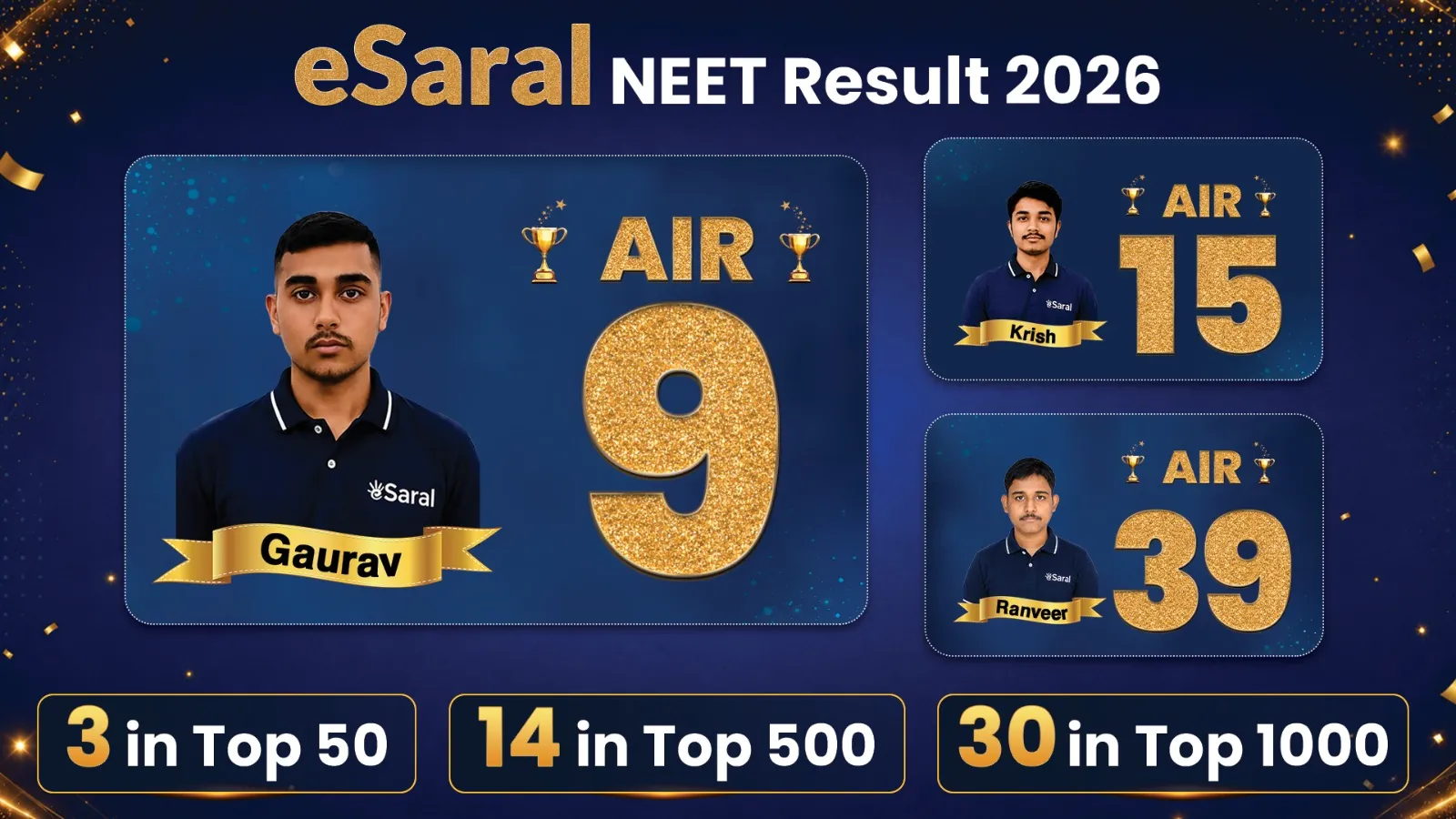
Several droppers from the same batch went on to top medical colleges: Saif to AIIMS Delhi, Prabal to AIIMS Jodhpur, Janvi to GMC Gorakhpur, another student to a college in Jhansi, Premanjali to AIIMS, and Gaurav to AIIMS.
At the same time, many other droppers who worked just as hard — studying late into the night — still missed their target by 5 to 20 marks.
Hard work alone doesn't separate these two groups. Every dropper needs to give their best — 12, 13, even 14 hours of study — and prepare for the realities of NEET 2027, which will run as a computer-based test (CBT), possibly across multiple shifts, including tough, easy, and medium-difficulty versions.
What separates the two groups is a pattern eSaral has identified after analyzing thousands of dropper outcomes: successful droppers already know their academic strengths and weaknesses from the previous year and use that exact experience to change their approach. Droppers who repeat their previous year's mistakes don't make it through.
The One Mistake Most Droppers Make
When asked which subject is their weakest, most students answer at the subject or chapter level — for example, "Physics," or more specifically, "Mechanics," "Electrostatics," or "Capacitors."
But when asked how they know that, most students go blank. The honest answer is they don't actually know — they're randomly labeling chapters as weak without ever running a real analysis.
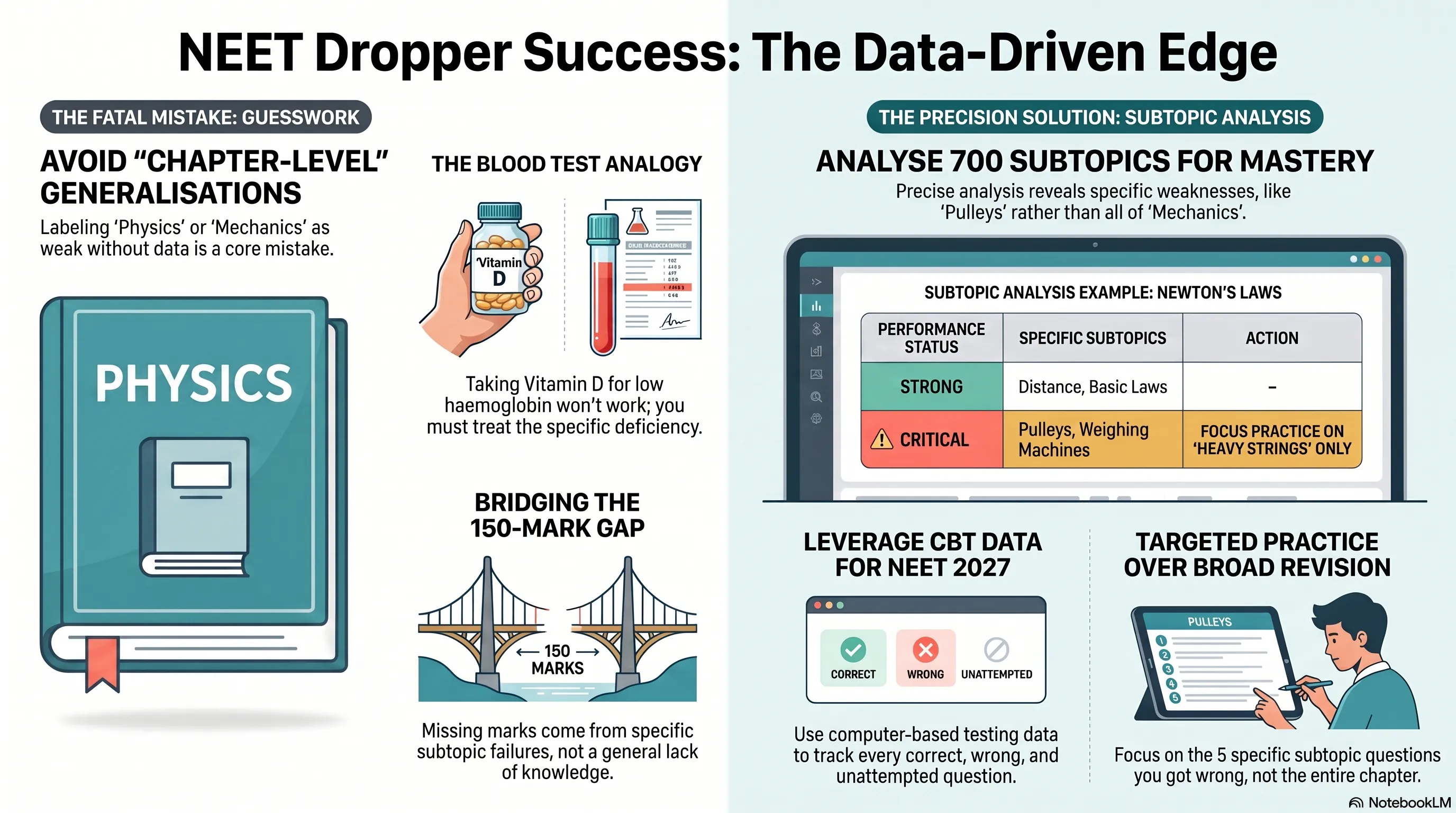
This is the core mistake: identifying weak areas at the chapter level through guesswork, instead of identifying weak areas at the subtopic level through actual data.
Students who go on to succeed work with extreme precision. They drill down to the subtopic level and improve specifically there — not broadly across an entire chapter.
💡 Expert Insight from eSaral's Dropper Analysis: "Jo droppers pichhle saal ke experience ko use karke is saal kuch change karte hain aur ye galti nahi karte hain, woh paar lag jaate hain." (Droppers who use last year's experience to change something this year — and avoid this mistake — are the ones who make it through.)
For full clarity on what NEET actually tests and how the question paper is structured, reviewing the official NEET Syllabus and NEET Exam Pattern alongside your subtopic analysis helps confirm exactly where each weak subtopic fits into the bigger picture.
How Subtopic-Level Analysis Actually Works
To explain precise subtopic analysis, eSaral cites a real example: a student one month into her drop year, with an analysis report built from her previous year's test data.
In the chapter Newton's Laws of Motion, her topic-level performance — Distance, Newton's Law of Motion — showed she was strong overall. But at the subtopic level, her analysis revealed she was specifically weak in Pulley, Weighing Machine, and Heavy String problems.
This was identified purely by counting how many questions she got right, wrong, and left unattempted in that exact subtopic.
In Optics, her overall performance looked strong across most subtopics — but in just one subtopic, Longitudinal Magnification and Image Velocity, she got 5 questions wrong and only 2 right. The analysis system also shows exactly which 5 questions she got wrong, the correct solutions, and additional practice questions from PYQs and modules for that specific subtopic.
This is the level of precision droppers need: not "I'm weak in Optics," but "I'm weak in Longitudinal Magnification and Image Velocity within Optics."
Practicing with actual NEET Previous Year Question Papers — including the NEET 2023, NEET 2022, NEET 2021, NEET 2020, and NEET 2019 papers — gives the additional practice volume needed once a weak subtopic is identified.
Dynamics and Circular Motion: Another Example
The same student's report for Dynamics and Circular Motion showed 3 correct, 1 wrong, and 3 left unattempted — a clear, specific data point that tells her precisely where to focus next, rather than re-studying the entire chapter.
Across the full NEET syllabus of roughly 70–80 chapters, there are an estimated 600–700 subtopics. The job of a dropper is to identify which of those subtopics are genuinely weak and work only on those — not to study everything equally.
Why NEET 2027 Being Computer-Based Changes Your Practice
NEET 2027 will be conducted as a computer-based test (CBT), most likely across multiple shifts — meaning some students will get a tough shift, some an easy one, and some a medium one. Every student must prepare to handle all difficulty levels.
eSaral has built 250+ tests for the 2027 batch, all available in the CBT format. Students studying online take these tests directly on mobile or computer in the CBT format. Students studying offline — in English or Hindi medium — get CBT-format practice at eSaral's computer centers.
Behind every CBT test, eSaral teachers manually tag each question by chapter and subtopic. That tagging is what makes the subtopic-level weak-area analysis possible — the system combines this tagging with each student's answers to generate the precise report described above.
For a clearer sense of how marks are distributed across subjects in the actual exam, reviewing NEET Physics Weightage and NEET Chemistry Weightage alongside your subtopic report helps prioritize which weak areas matter most for your score.
Why Every Student Needs Personal Analysis, Not Just Toppers
A common pattern in coaching is that institutes pick out 20 high-performing students and focus all their attention there, while the remaining 200+ students in a batch get little to no individual attention — this is especially true in Hindi medium batches.
eSaral's stated approach is different: every single student gets this subtopic-level analysis, not just a select few. This is described as the reason behind eSaral's high selection ratio over the years, with a limited number of students still producing strong numbers of selections into AIIMS and government medical colleges.
The analogy used is a blood test: if your hemoglobin is low, taking Vitamin D tablets won't fix it — because you're treating the wrong problem. The same applies to NEET prep: studying everything equally, without knowing exactly which subtopic is weak, means students keep "treating the wrong thing" instead of fixing what's actually costing them marks.
If a student scored 400 last year and needed 550, the missing 150 marks came from specific weak subtopics — not a vague, general weakness. The job is to find those exact subtopics and improve them, rather than studying everything randomly.
Frequently Asked Questions
Find answers to common questions.
What is the biggest mistake NEET droppers make?
The biggest mistake is identifying weak areas randomly at the chapter level instead of analyzing them precisely at the subtopic level. Droppers who repeat this mistake from their previous attempt tend to fall short again, even with strong effort.
How do successful NEET droppers identify their weak topics?
They use subtopic-level test analysis — tracking exactly how many questions they got right, wrong, or left unattempted within each specific subtopic, not just the overall chapter. This precision is what eSaral's analysis reports are built around.
Will NEET 2027 be a computer-based test?
Yes, NEET 2027 is expected to be conducted as a computer-based test (CBT), likely across multiple shifts of varying difficulty. eSaral has prepared 250+ CBT-format tests for 2027 droppers to build familiarity with this format.
How many subtopics does the NEET syllabus actually have?
Across roughly 70–80 chapters, the NEET syllabus contains an estimated 600–700 subtopics. Identifying which specific subtopics are weak — rather than studying every topic equally — is the strategy successful droppers follow.
What does eSaral's NEET dropper course include?
It includes teaching by Kota's top faculty, built-in mentorship, limited batch sizes for two-way teacher interaction, and subtopic-level deep analysis after every test. Scholarships of up to 100% are available based on expected NEET 2026 marks.