Orbit vs Orbital: Key Difference in Atomic Structure (JEE & NEET)
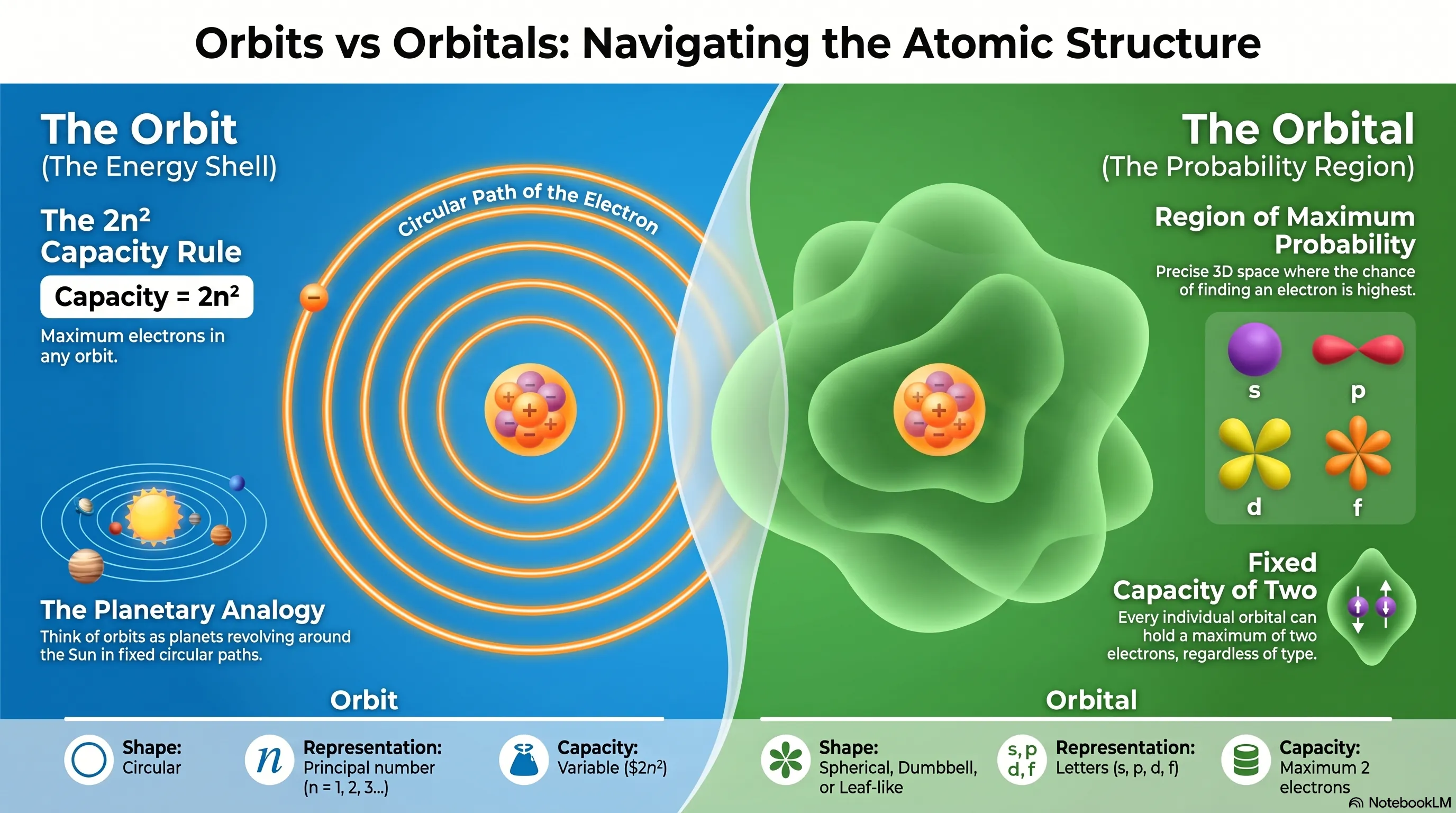
An orbit is the fixed circular path around the nucleus where electrons revolve, also called a shell or energy level, represented by the principal quantum number n. An orbital is the region within that orbit where the probability of finding an electron is maximum. Multiple orbitals together form one orbit. The maximum electrons in any orbit is given by the formula 2n². There are four types of orbitals — s (spherical), p (dumbbell), d (double dumbbell), and f (leaf-like) — and each orbital holds a maximum of 2 electrons.

Table of Contents

eSaral ›Foundation courses ›Orbit vs Orbital: Key Difference in Atomic Structure (JEE & NEET)

What Is an Atom Made Of?
Every atom has a nucleus at its centre. The nucleus contains two types of particles: protons (positively charged, symbol P) and neutrons (neutral, symbol N). Together, protons and neutrons sit inside the nucleus.
Outside the nucleus, electrons (negatively charged, symbol E) move around it. These three — electron, proton, and neutron — are the three fundamental particles of any atom.
| Particle | Symbol | Charge | Location |
|---|---|---|---|
| Electron | E | Negative | Outside nucleus |
| Proton | P | Positive | Inside nucleus |
| Neutron | N | Neutral | Inside nucleus |
With this structure in mind, the next question is: exactly where do electrons move around the nucleus? That is where orbit and orbital come in.
What Is an Orbit in Atomic Structure?
An orbit is the circular path around the nucleus in which electrons revolve. Think of it like planets revolving around the Sun — Earth, Jupiter, and Venus each travel in their own orbit around the Sun. Electrons do the same around the nucleus.
An orbit is also called a shell or an energy level. All three terms refer to the same thing.
These orbits are numbered using n, where n is always a positive integer:
- n = 1 → First orbit (closest to the nucleus)
- n = 2 → Second orbit
- n = 3 → Third orbit
- n = 4 → Fourth orbit, and so on
As n increases, the orbit gets farther from the nucleus.
💡 Key Concept: Orbit = Shell = Energy Level. These three names all describe the same circular path around the nucleus. In different chapters and textbooks you will see all three used interchangeably.
How Many Electrons Can Fit in Each Orbit?
The maximum number of electrons any orbit can hold is given by the formula:
Maximum electrons = 2n²
Where n is the orbit number. Applying this:
| Orbit (n) | Formula | Maximum Electrons |
|---|---|---|
| 1st orbit | 2 × 1² | 2 |
| 2nd orbit | 2 × 2² | 8 |
| 3rd orbit | 2 × 3² | 18 |
| 4th orbit | 2 × 4² | 32 |
This formula — 2n² — must be memorised. It appears across atomic structure, periodic table problems, and electronic configuration questions in both JEE Main and NEET.
What Is an Orbital in Atomic Structure?
An orbital is the region within an orbit where the probability of finding an electron is maximum.
A useful analogy: imagine an orbit as an entire building. The orbital is the individual room inside that building. Students (electrons) actually live in rooms, not in the building as a whole. So while an orbit defines the general region, the orbital is the precise location where an electron is actually found.
Key points:
- Multiple orbitals together make up one orbit
- An electron is found inside an orbital, not simply "in the orbit"
- Each orbital can hold a maximum of 2 electrons
This is the core distinction: the orbit is the path, the orbital is the specific region of highest electron probability within that path.
Types of Orbitals: s, p, d, and f
Within the orbits, there are four types of orbitals in the syllabus. Each has a distinct shape:
| Orbital Type | Shape |
|---|---|
| s orbital | Spherical |
| p orbital | Dumbbell-shaped |
| d orbital | Double dumbbell-shaped |
| f orbital | Leaf-like |
s Orbital — Spherical Shape
The s orbital is spherical — it extends equally in all directions around the nucleus. Its shape is the simplest of all four orbital types.
p Orbital — Dumbbell Shape
The p orbital looks like a dumbbell — two lobes extending outward from the nucleus in opposite directions along an axis.
d Orbital — Double Dumbbell Shape
The d orbital has a double dumbbell shape — more complex than the p orbital, with four lobes arranged around the nucleus.
f Orbital — Leaf-Like Shape
The f orbital has a leaf-like structure — the most complex shape among the four orbital types in the standard syllabus.
💡 Key Rule: Regardless of which orbital type it is — s, p, d, or f — the maximum number of electrons in any single orbital is always 2.
Orbit vs Orbital: Key Differences at a Glance
| Feature | Orbit | Orbital |
|---|---|---|
| Definition | Circular path around the nucleus where electrons revolve | Region where probability of finding an electron is maximum |
| Other names | Shell, Energy Level | s, p, d, f (by type) |
| Represented by | Principal quantum number n (1, 2, 3, 4…) | Letters: s, p, d, f |
| Shape | Circular | Spherical / Dumbbell / Double dumbbell / Leaf-like |
| Max electrons | 2n² | 2 |
| Relationship | Made up of multiple orbitals | Several orbitals together form one orbit |
This table captures the complete orbit vs orbital distinction as covered in the eSaral Foundation / Integrated Course for Atomic Structure Chemistry.
For deeper practice on NCERT Class 11 Chemistry concepts including atomic structure, the NCERT solutions are a strong starting point before moving to JEE-level problems.
Frequently Asked Questions
Find answers to common questions.
What is the difference between orbit and orbital in chemistry?
An orbit is the fixed circular path around the nucleus where electrons revolve — also called a shell or energy level. An orbital is a specific region within that orbit where the probability of finding an electron is highest. Multiple orbitals together form one orbit. The orbit is defined by the principal quantum number n, while orbitals are categorised as s, p, d, or f.
How many electrons can be present in any single orbital?
The maximum number of electrons in any single orbital is 2 — regardless of whether it is an s, p, d, or f orbital. This applies universally across all orbital types. An orbital can be represented as a box, and that box can hold no more than two electrons.
What are the four types of orbitals and their shapes?
The four types of orbitals in the standard Chemistry syllabus are s (spherical shape), p (dumbbell shape), d (double dumbbell shape), and f (leaf-like shape). Each type has a distinct three-dimensional shape that determines how the electron is distributed around the nucleus in that region.
What is the formula for the maximum number of electrons in an orbit?
The formula is 2n², where n is the orbit number. The first orbit holds a maximum of 2 electrons, the second holds 8, the third holds 18, and the fourth holds 32. This formula applies to any orbit and is a core concept in atomic structure for both board exams and competitive exams like JEE and NEET.
Why is orbit vs orbital important for JEE and NEET?
Orbit vs orbital is a foundation concept in atomic structure Chemistry, which directly underpins the Periodic Table and Chemical Bonding chapters. Confusion between the two leads to errors in electronic configuration, quantum number problems, and periodic property questions. The atomic structure topic is also common to both Chemistry and Physics in the integrated JEE and NEET syllabus.