Periplaneta (Cockroach) - NEET Previous Year Questions with Complete Solutions
The cockroach (Periplaneta americana) chapter is a high-scoring and predictable NEET Biology topic covering morphology, digestive, nervous, circulatory, excretory, and reproductive systems, with direct factual questions frequently asked on Malpighian tubules, hepatic caeca, nerve ring, oothecae, and body segmentation.
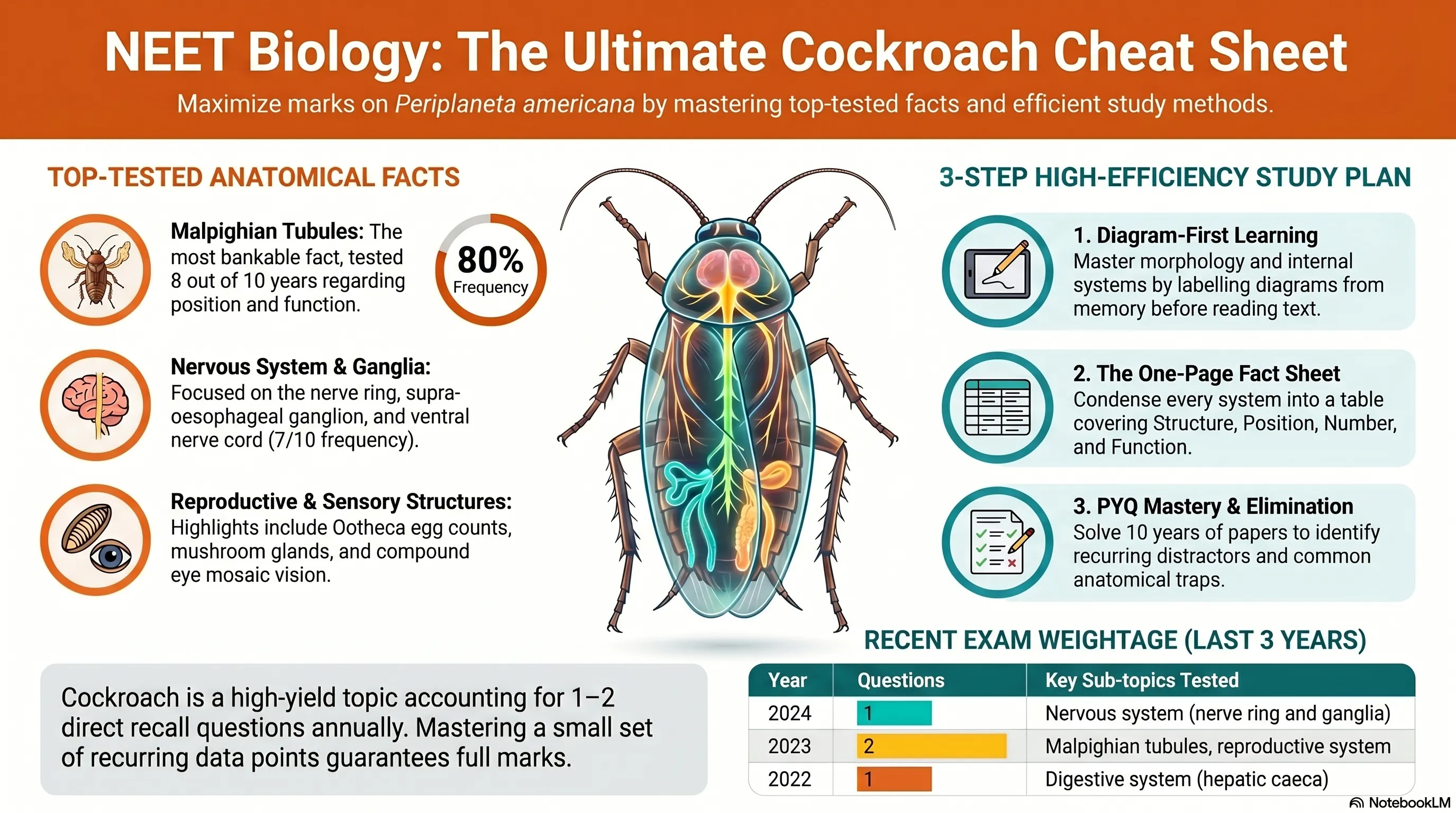
Table of Contents

eSaral › NEET › Periplaneta (Cockroach) - NEET Previous Year Questions with Complete Solutions

🩺 Explore NEET Courses
Cockroach in NEET: Chapter Weightage and Exam Pattern
The cockroach (Periplaneta americana) topic sits within Unit V: Structural Organisation in Plants and Animals of the NEET Biology syllabus. This unit as a whole carries approximately 5% weightage in NEET, and cockroach questions account for a reliable 1–2 questions per paper within that unit.
What makes this topic especially valuable for NEET aspirants is the question type: cockroach questions are almost entirely direct recall — they ask specific anatomical facts that have definite, unambiguous answers. There are no inference-based or application questions. For students who invest 2–3 focused study sessions on this chapter, full marks from cockroach questions is a realistic target every year.
| Exam Year | Questions from Cockroach | Key Sub-topics Tested |
|---|---|---|
| 2024 | 1 | Nervous system — nerve ring and ganglia |
| 2023 | 2 | Malpighian tubules, reproductive system |
| 2022 | 1 | Digestive system — hepatic caeca |
| 2021 | 2 | Sense organs, reproductive structures |
| 2020 | 1 | External morphology — tagmata, segments |
| 2019 | 2 | Nervous system, Malpighian tubules |
| 2018 | 1 | Digestive system, gizzard function |
| 2017 | 2 | Reproductive system, oothecae |
| 2016 | 1 | Circulatory system — open type |
| 2015 | 2 | Morphology, fat body function |
💡 Expert Tip by eSaral Biology Faculty: "Cockroach is one of the most predictable chapters in all of NEET Biology. The same 8–10 facts get tested in rotation year after year: Malpighian tubules, hepatic caeca, nerve ring, oothecae, open circulatory system, number of segments in each tagma, and the type of eyes. Students who make a 1-page fact sheet and revise it 3 times before NEET rarely get these questions wrong."
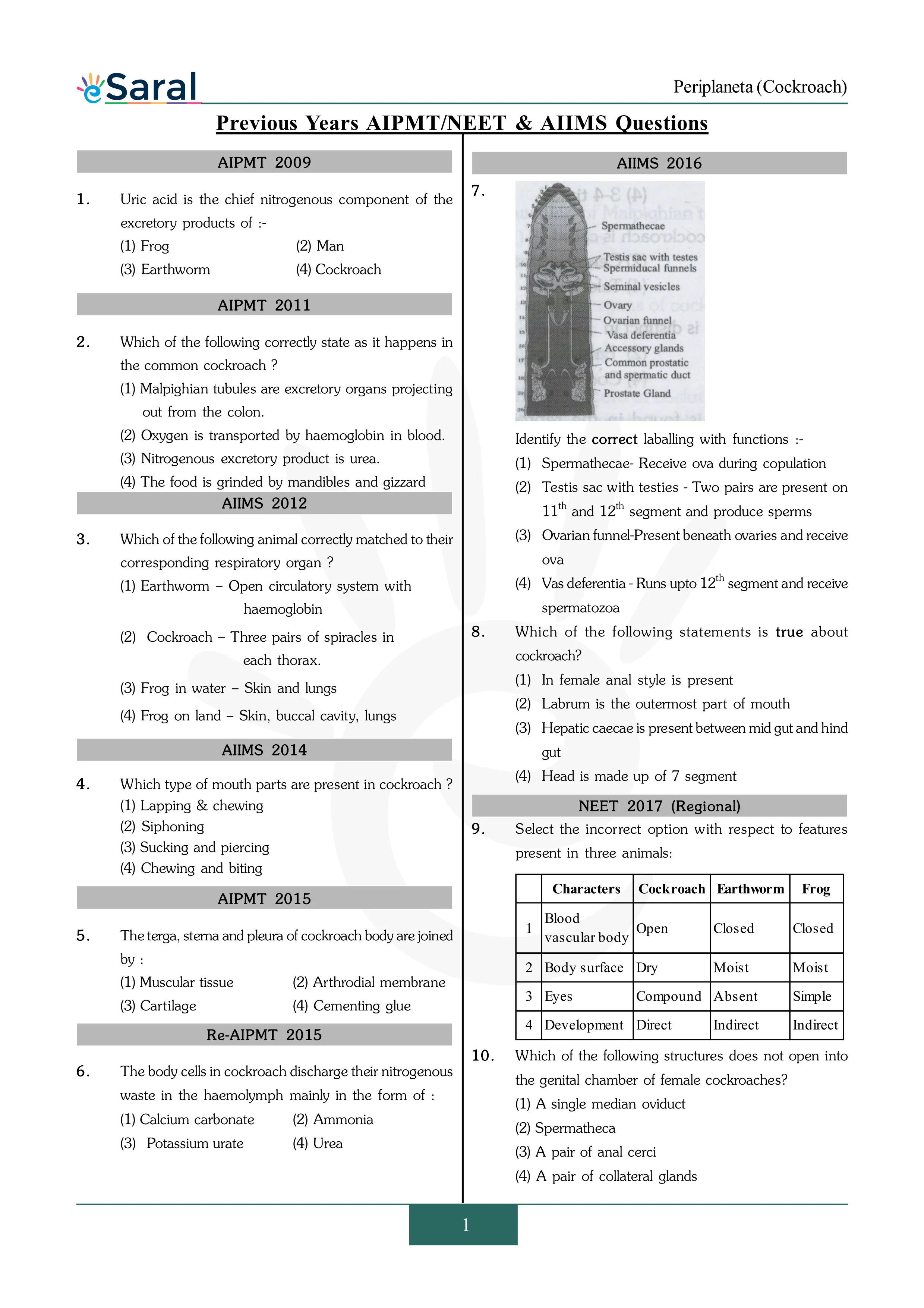
NEET PYQs with Solutions: Morphology and External Features

Most Repeated Topics in Cockroach Biology for NEET
Based on analysis of NEET UG Biology papers from 2015 to 2024, ranked by frequency:
- Malpighian tubules — position, number, function (uricotelic) — appeared in 8 of 10 years
- Nervous system — supra-oesophageal ganglion as brain, nerve ring, ventral nerve cord — appeared in 7 of 10 years
- Compound eyes and mosaic vision — appeared in 6 of 10 years
- Ootheca — structure, number of eggs, production by colleterial gland — appeared in 6 of 10 years
- Hepatic caeca — position (anterior mesenteron) and function — appeared in 5 of 10 years
- Body tagmata and segment count — appeared in 5 of 10 years
- Open circulatory system — 13-chambered heart, haemolymph, ostia — appeared in 4 of 10 years
- Fat body — excretion + storage function — appeared in 4 of 10 years
- Mushroom gland — male accessory reproductive gland — appeared in 3 of 10 years
- Tracheal system and spiracles — 10 pairs of spiracles — appeared in 3 of 10 years
The single most bankable fact in this chapter: Malpighian tubules appeared in 8 of the last 10 NEET papers in some form — either directly asking their function, their position, or their relation to uricotelism. This one fact, known thoroughly, has delivered marks in 8 consecutive NEET papers.
How to Study Cockroach for NEET Efficiently
Step 1: Study the Diagram First, Not the Text (half day)
The cockroach chapter is most efficiently learned from its diagrams. Obtain or draw the following four diagrams:
- External morphology (dorsal view) — labelled with all tagmata, cerci, anal styles, wings
- Digestive system — full alimentary canal from mouth to anus with hepatic caeca and Malpighian tubule positions marked
- Nervous system — supra-oesophageal ganglion, sub-oesophageal ganglion, nerve ring, ventral nerve cord with all ganglia
- Reproductive system — both male (testes, mushroom gland) and female (ovaries, ootheca, brood pouch)
Label these diagrams yourself without looking at the textbook. Every label you cannot recall is a potential wrong answer in NEET.
Step 2: Build a One-Page Fact Sheet (half day)
Condense the entire chapter into a single A4 page with these columns:
- System (digestive, excretory, nervous, reproductive, circulatory)
- Key structure (hepatic caeca, Malpighian tubules, supra-oesophageal ganglion)
- Position / Number / Function — the three facts NEET tests for each structure
Step 3: Solve All Cockroach PYQs From 2015–2024
This chapter has a small and finite set of testable facts. Solving all PYQs from the past 10 years takes under 90 minutes and reveals that the same 8–10 facts rotate through different question phrasings. After this exercise, new NEET questions on cockroach will look familiar — not novel.
Step 4: Use Elimination on MCQ Distractors
NEET cockroach distractors follow a pattern:
- Confuse cockroach structures with prawn/earthworm structures (e.g., two-part body plan of crustaceans)
- Swap male and female reproductive structures (mushroom gland vs colleterial gland)
- Confuse position of hepatic caeca and Malpighian tubules
Knowing the common traps eliminates two wrong options before you even recall the correct answer — reducing a 25% chance to a 50% or 100% chance on guessed questions.
Step 5: Revise the Fact Sheet 48 Hours Before NEET
In the final 48 hours, read each row of your fact sheet, close it, and write it from memory. Any row you cannot reproduce goes on a sticky note for the morning of the exam. Cockroach revision should take no more than 20 minutes at this stage if Steps 1–4 were done properly.
Frequently Asked Questions
Find answers to common questions.
How many questions come from cockroach in NEET biology every year?
Cockroach (Periplaneta americana) contributes 1–2 questions per NEET paper consistently. The topic appeared in every NEET Biology paper from 2015 to 2024 without exception. Questions test specific anatomical facts — Malpighian tubules, hepatic caeca, nervous system organisation, compound eyes, and the reproductive structure ootheca — rather than conceptual understanding.
What are Malpighian tubules in cockroach and what is their function?
Malpighian tubules are the primary excretory organs of the cockroach. They are thin, yellow tubules arising at the junction of the mesenteron (midgut) and ileum (hindgut), numbering 100–150 in Periplaneta americana. They absorb nitrogenous waste (uric acid) from the haemolymph, confirming the cockroach is uricotelic. Water is reabsorbed in the rectum before dry uric acid crystals are excreted.
What is the nervous system of the cockroach and where is its brain?
The cockroach has a ventral nerve cord nervous system. The brain is formed by the supra-oesophageal ganglia, located above the oesophagus. The sub-oesophageal ganglion lies below the oesophagus. Both are connected by circum-oesophageal connectives forming a nerve ring around the oesophagus. The ventral nerve cord runs along the body with 3 thoracic ganglia and 6 abdominal ganglia.
What is ootheca in cockroach?
Ootheca is a dark brown, purse-shaped egg case produced by the female cockroach. Each ootheca contains 14–16 eggs arranged in two rows, enclosed in a hard sclerotised protein case produced by the left colleterial gland. The ootheca is temporarily held in the brood pouch before being deposited. A female produces approximately 9–10 oothecae in her lifetime.
What type of circulatory system does the cockroach have?
The cockroach has an open circulatory system. Blood (haemolymph) is not confined to blood vessels — it flows freely through the haemocoel (body cavity). The heart is 13-chambered (aorta + 12 chambers), located dorsally, and pumps haemolymph forward through the aorta. Each chamber has a pair of ostia through which haemolymph enters.