Permutations and Combinations Class 11 Notes for IIT JEE
Comprehensive Class 11 Permutations and Combinations notes covering counting principles, factorials, permutations, combinations, circular arrangements, identical objects, gaps method, important JEE formulas, solved examples, and exam-focused problem-solving strategies for JEE Main and Advanced.
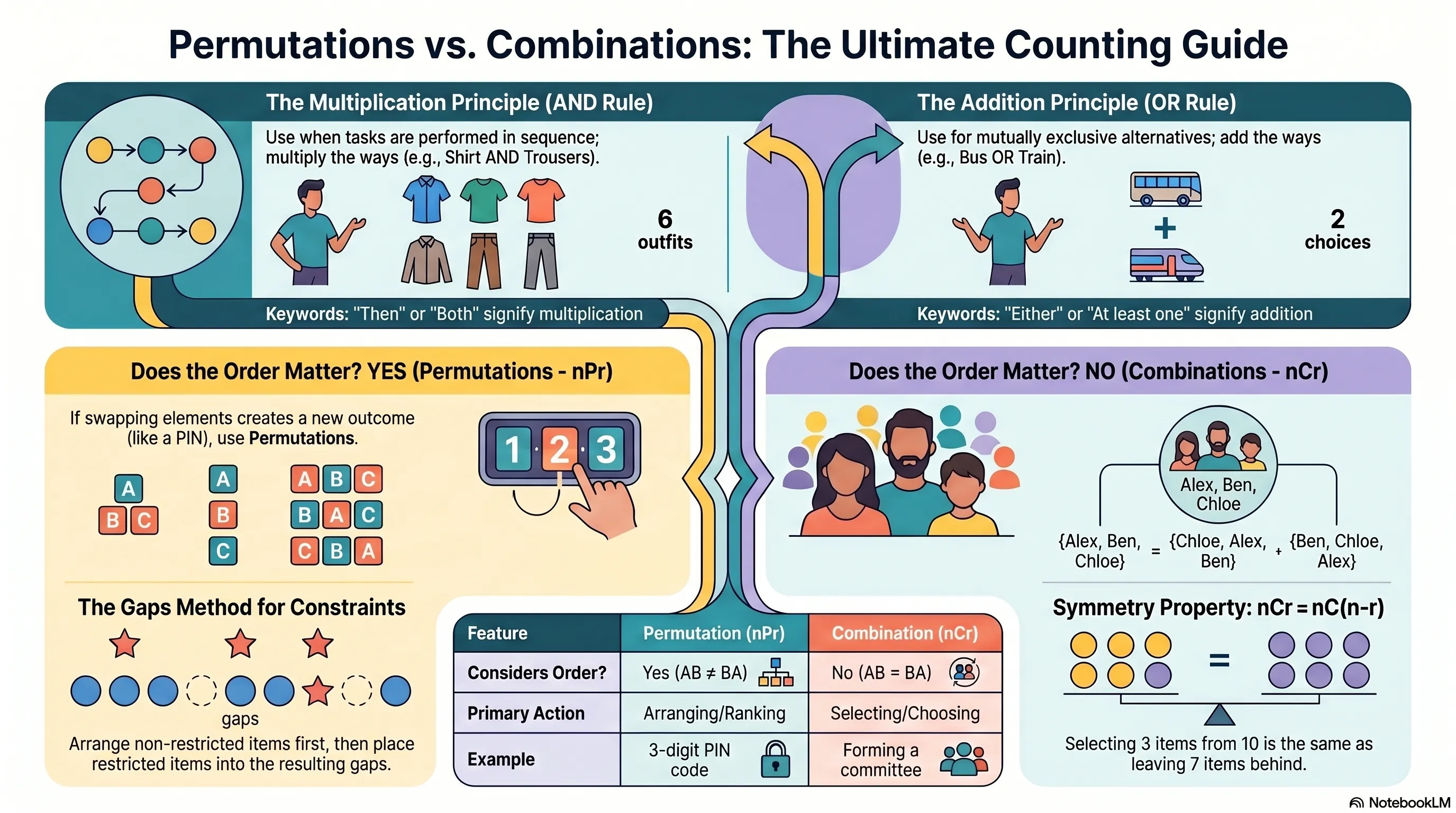
Table of Contents
- Fundamental Principles of Counting
- Permutations and Combinations Class 11 Notes
- Factorial Notation — Definition and Key Results
- Permutations — Formula, Types and Solved Examples
- Combinations — Formula, Properties and Solved Examples
- Key Difference: Permutation vs Combination
- Important Results and Identities for JEE
- Most Important Topics for JEE Main and JEE Advanced
- How to Study Permutations and Combinations for JEE Class 11

eSaral › Class 11› Permutations and Combinations

🚀 Checkout eSaral Courses
Fundamental Principles of Counting
Before permutations and combinations, two counting principles form the foundation of every problem in this chapter.
Multiplication Principle (AND Rule)
If task A can be done in m ways AND task B can be done in n ways, then both tasks together can be done in m × n ways.
Example: A person has 4 shirts and 3 trousers. Total outfits = 4 × 3 = 12 ways
The multiplication principle applies whenever tasks are performed in sequence — completing one AND then the other.
Addition Principle (OR Rule)
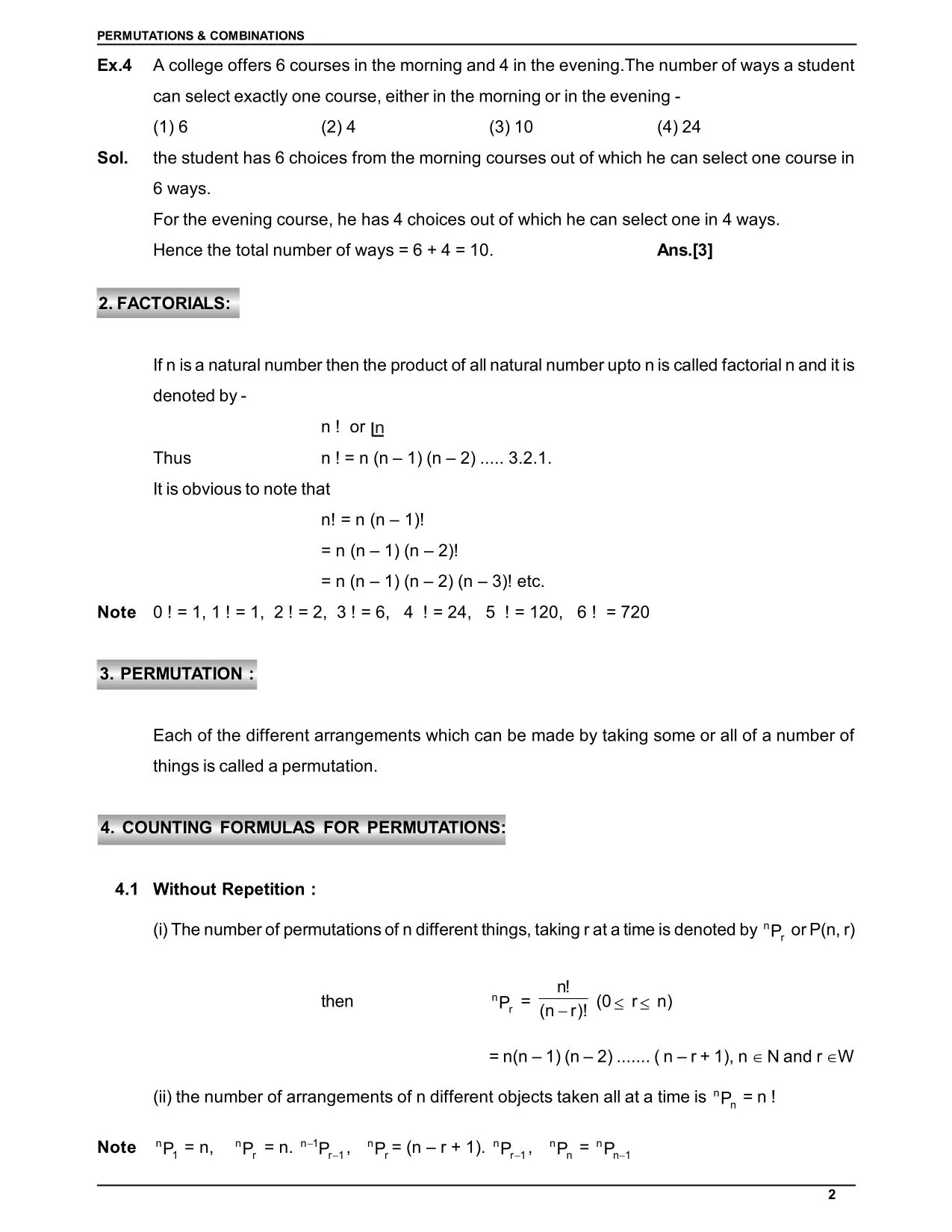
If task A can be done in m ways OR task B can be done in n ways (and tasks are mutually exclusive), then either task can be done in m + n ways.
Example: A student can travel by 3 bus routes OR 2 train routes. Total ways = 3 + 2 = 5 ways
The addition principle applies whenever only one of multiple alternatives is chosen.
How to identify which principle to use:
| Keyword in the problem | Principle |
|---|---|
| "AND", "then", "followed by", "both" | Multiplication |
| "OR", "either", "at least one of" | Addition |
| Mixed multi-step problem | Both, applied at each step |
💡 Expert Tip by Saransh Gupta, IIT Bombay AIR-41: "Every permutation and combination problem, no matter how complex, is built entirely on these two principles. Before writing nPr or nCr, identify the steps and whether each step uses AND (multiply) or OR (add). Students who skip this structure jump to formulas and get wrong answers on JEE problems with constraints."
India's Best Exam Preparation for Class 11th - Download Now
Permutations and Combinations Class 11 Notes
India's Best Exam Preparation for Class 11th - Download Now
India's Best Exam Preparation for Class 11th - Download Now
India's Best Exam Preparation for Class 11th - Download Now
India's Best Exam Preparation for Class 11th - Download Now
India's Best Exam Preparation for Class 11th - Download Now
India's Best Exam Preparation for Class 11th - Download Now
Factorial Notation — Definition and Key Results
Definition
For any positive integer n, n! (n factorial) is defined as:
n! = n × (n−1) × (n−2) × ... × 3 × 2 × 1
Special case: 0! = 1 (by convention — essential for the nCr formula to work when r = 0 or r = n)
Key Factorial Values to Memorise
| n | n! |
|---|---|
| 0 | 1 |
| 1 | 1 |
| 2 | 2 |
| 3 | 6 |
| 4 | 24 |
| 5 | 120 |
| 6 | 720 |
| 7 | 5040 |
| 8 | 40320 |
| 10 | 3628800 |
Useful Factorial Relations
- n! = n × (n−1)!
- (n+1)! = (n+1) × n!
- n! = n × (n−1) × (n−2)! — useful for simplifying expressions
Permutations — Formula, Types and Solved Examples
Definition
A permutation is an arrangement of objects in a definite order. The number of ways of choosing and arranging r objects from n distinct objects is:
nPr = n! / (n−r)! where 0 ≤ r ≤ n
Key Results for Permutations
| Result | Formula | Meaning |
|---|---|---|
| All n objects in a row | n! | Arranging all n objects |
| r from n (order matters) | nPr = n!/(n−r)! | Choosing and arranging r from n |
| nP0 | 1 | Selecting 0 objects — only 1 way |
| nPn | n! | Arranging all n objects |
| nP1 | n | Selecting 1 object from n |
Permutations With Repetition Allowed
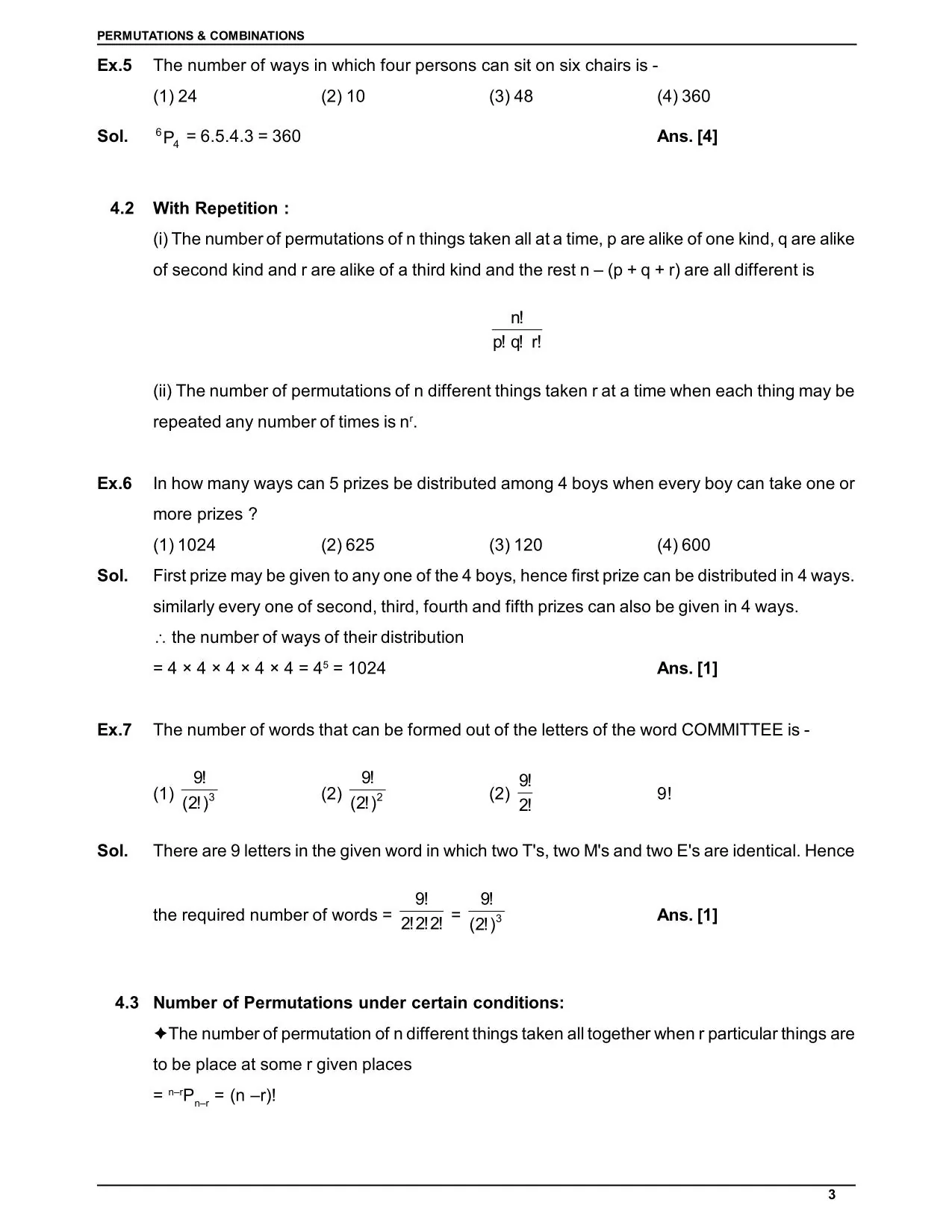
When repetition is allowed, each of the r positions can be filled by any of the n objects:
Number of arrangements = nʳ
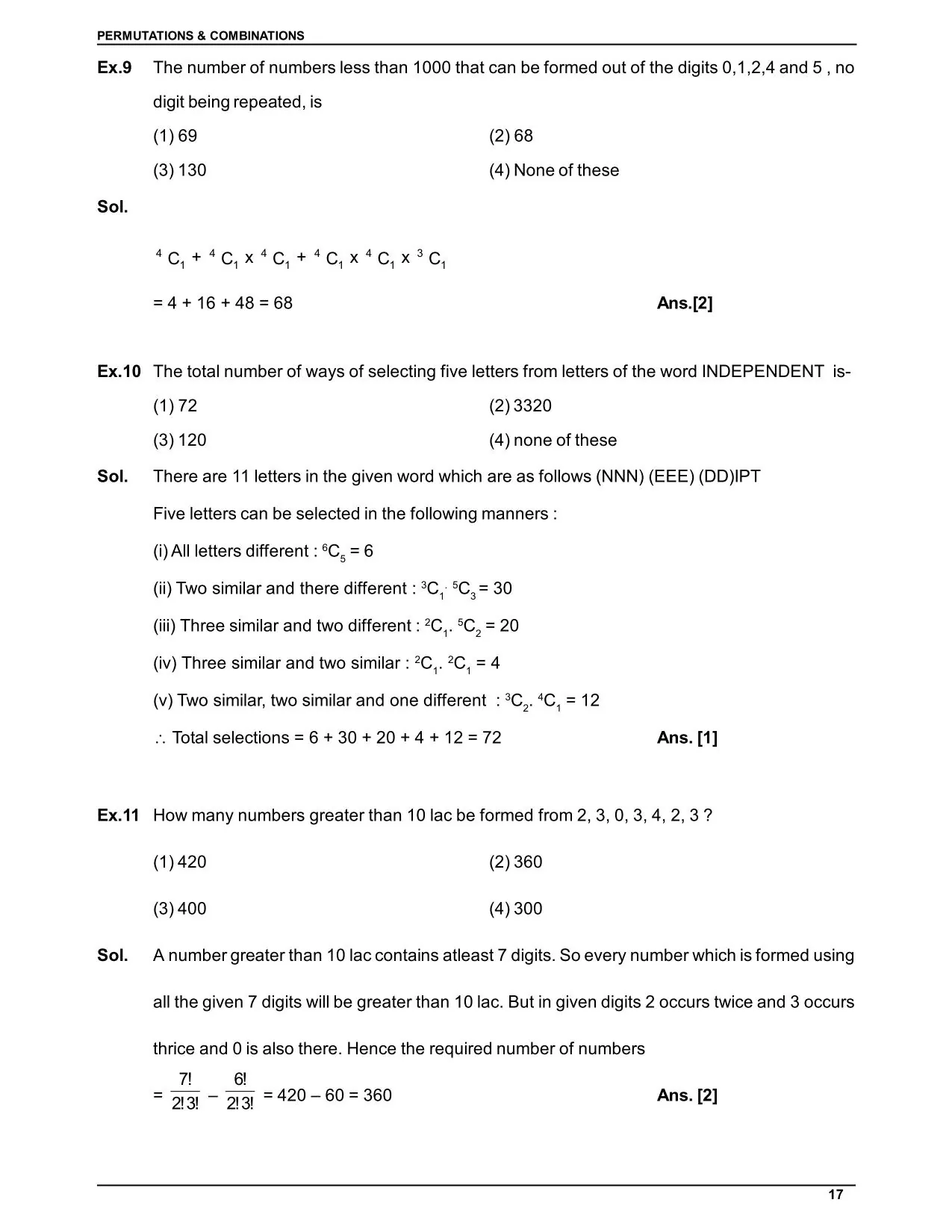
Example: Number of 3-digit numbers formed from digits {1, 2, 3, 4} with repetition = 4³ = 64
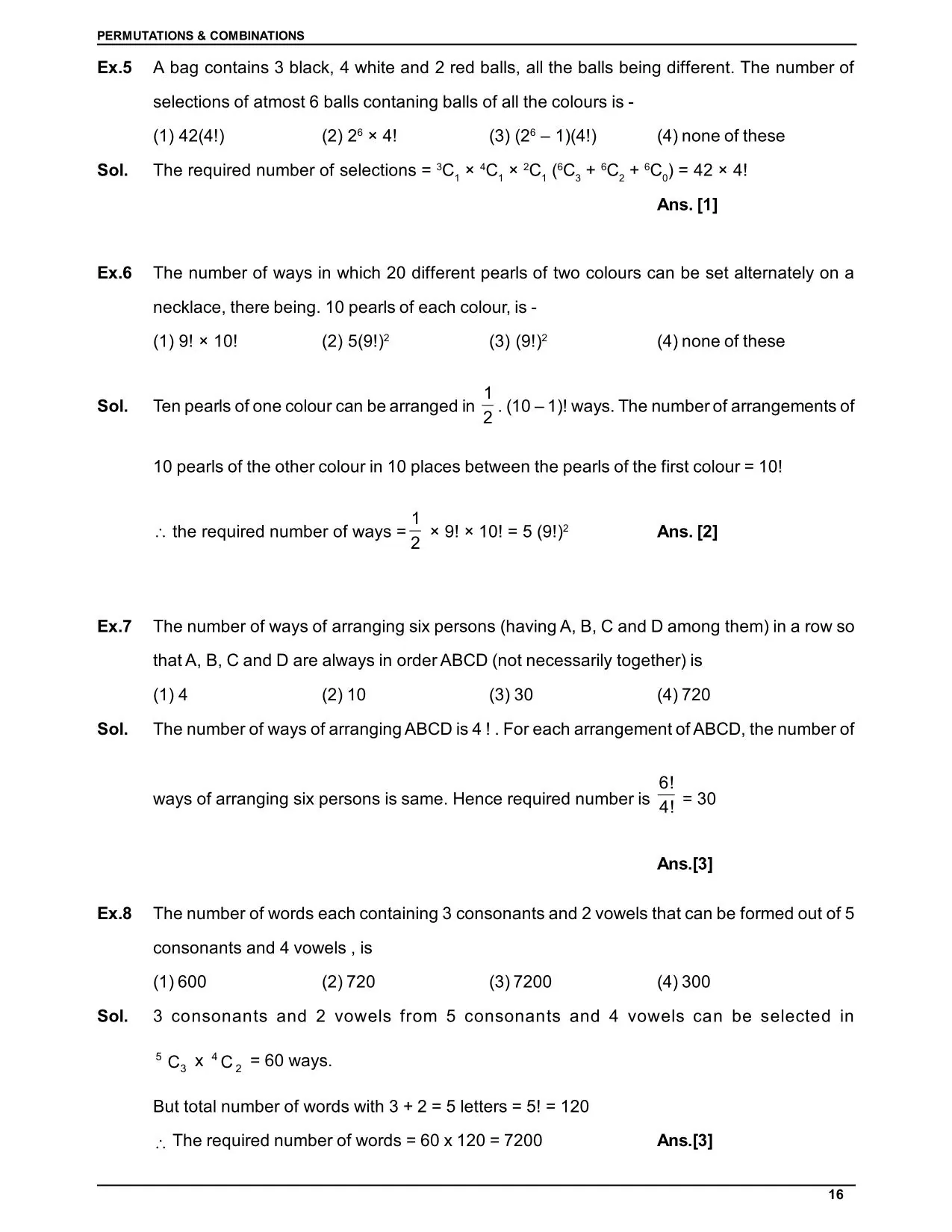
Permutations of Objects Not All Distinct (With Identical Elements)
When n objects include identical groups — p objects of one type, q of another, r of another:
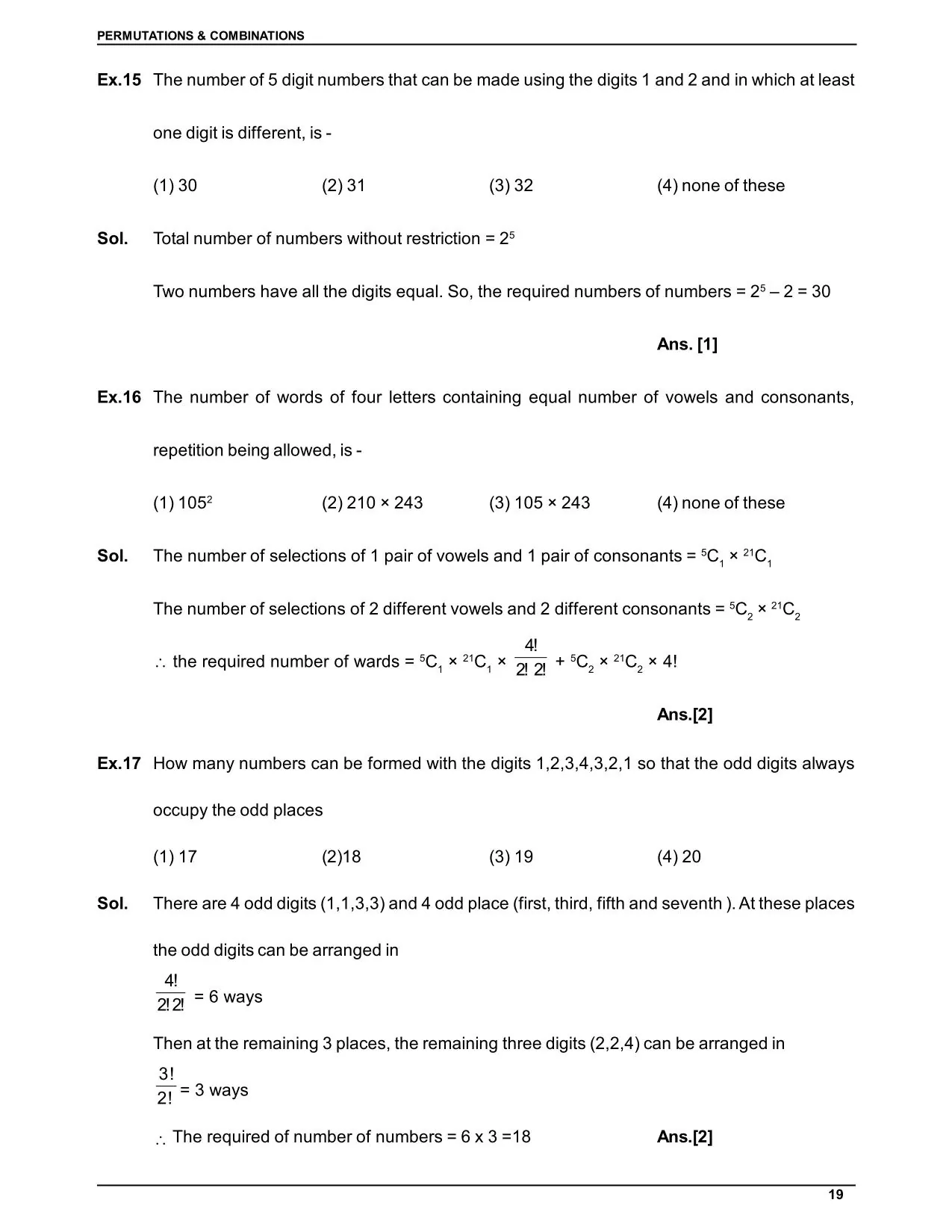
Number of arrangements = n! / (p! × q! × r!)
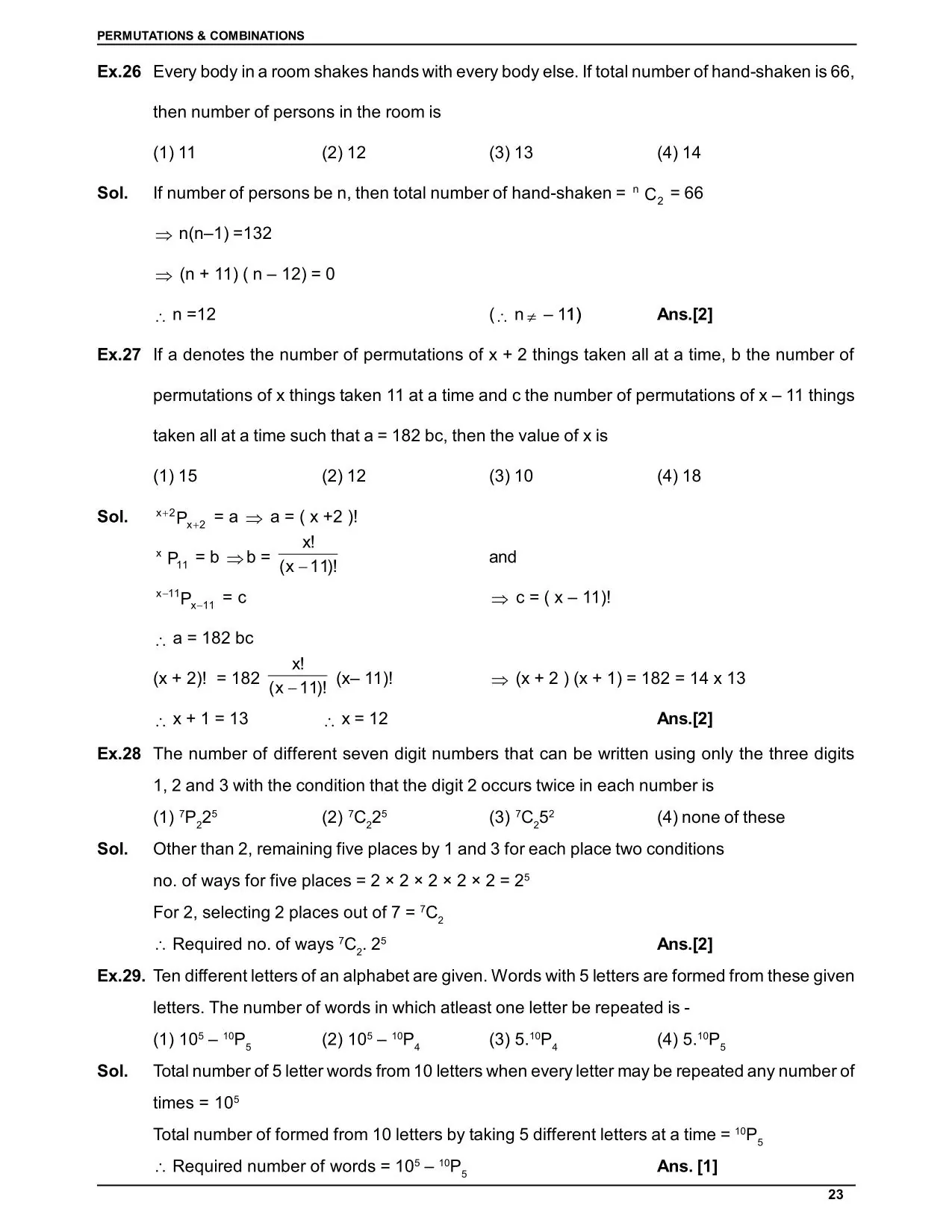
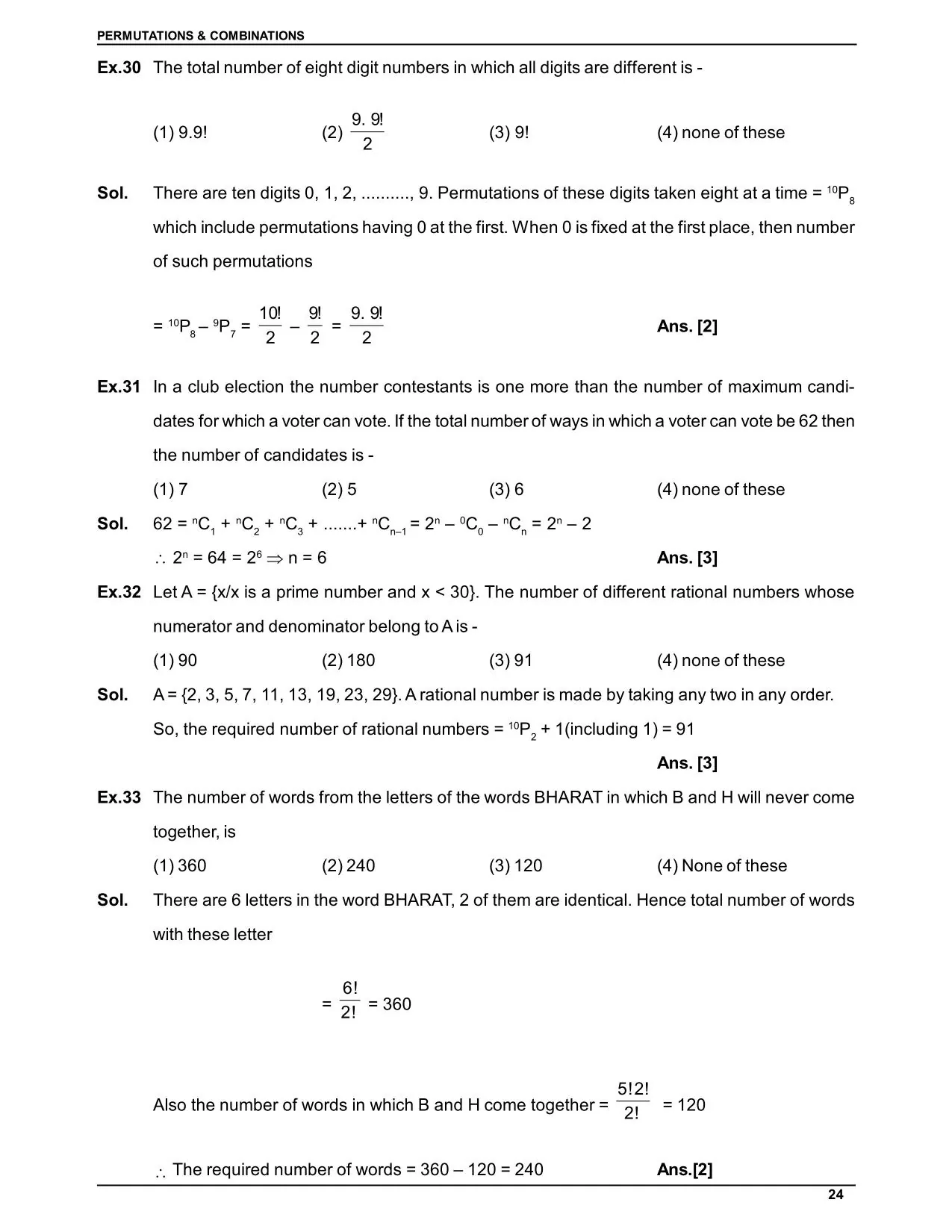
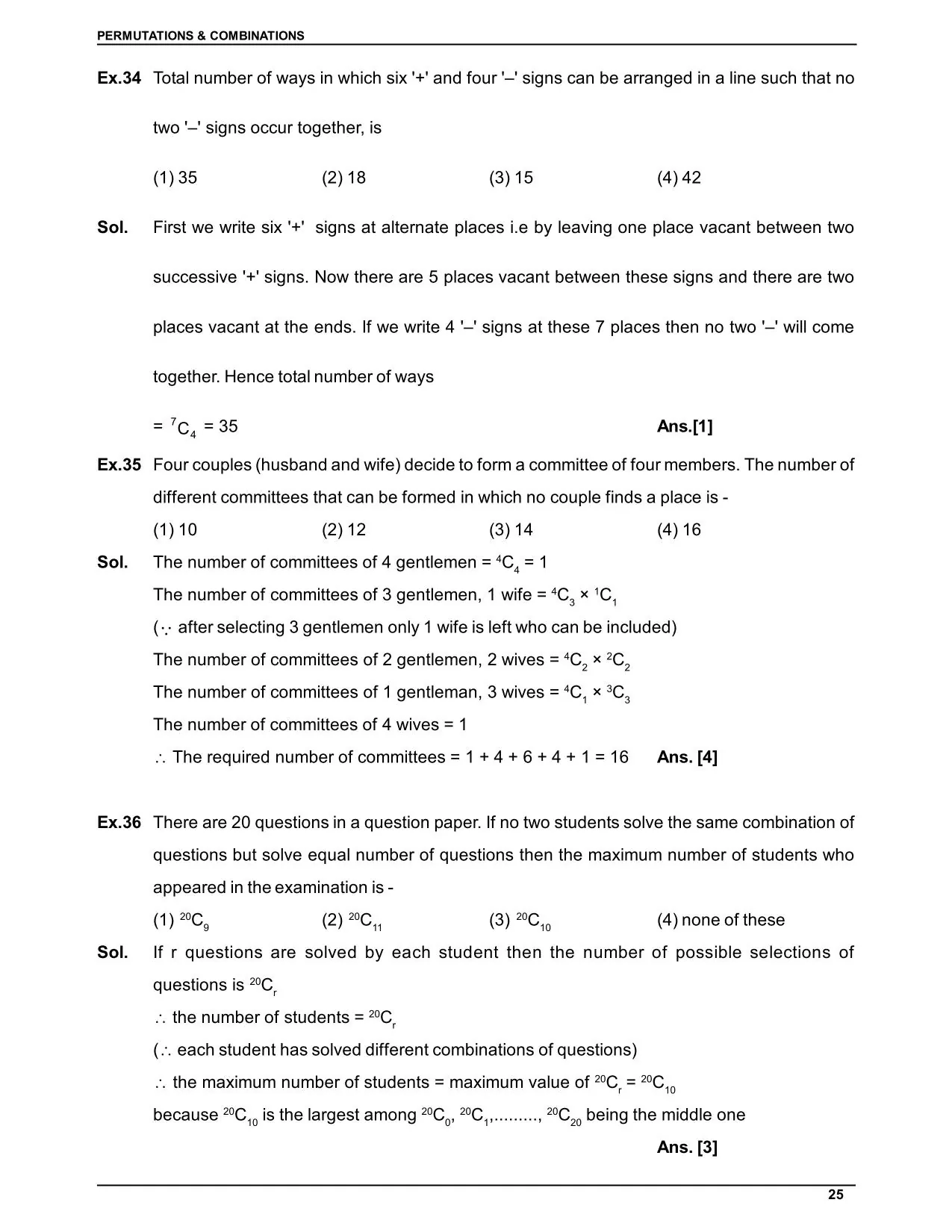
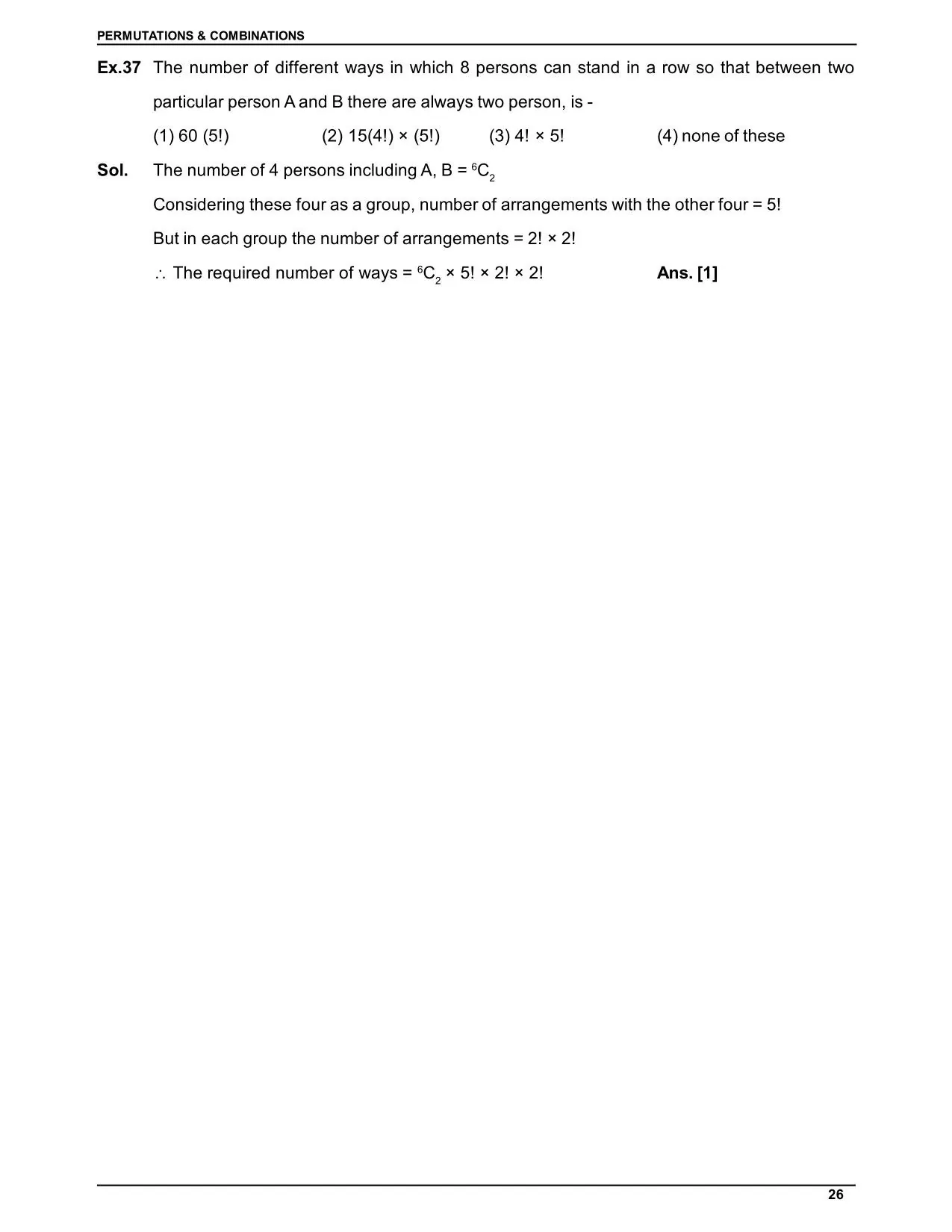
Example: Number of arrangements of letters in the word MISSISSIPPI: Total letters = 11; M=1, I=4, S=4, P=2 Arrangements = 11! / (1! × 4! × 4! × 2!) = 34650
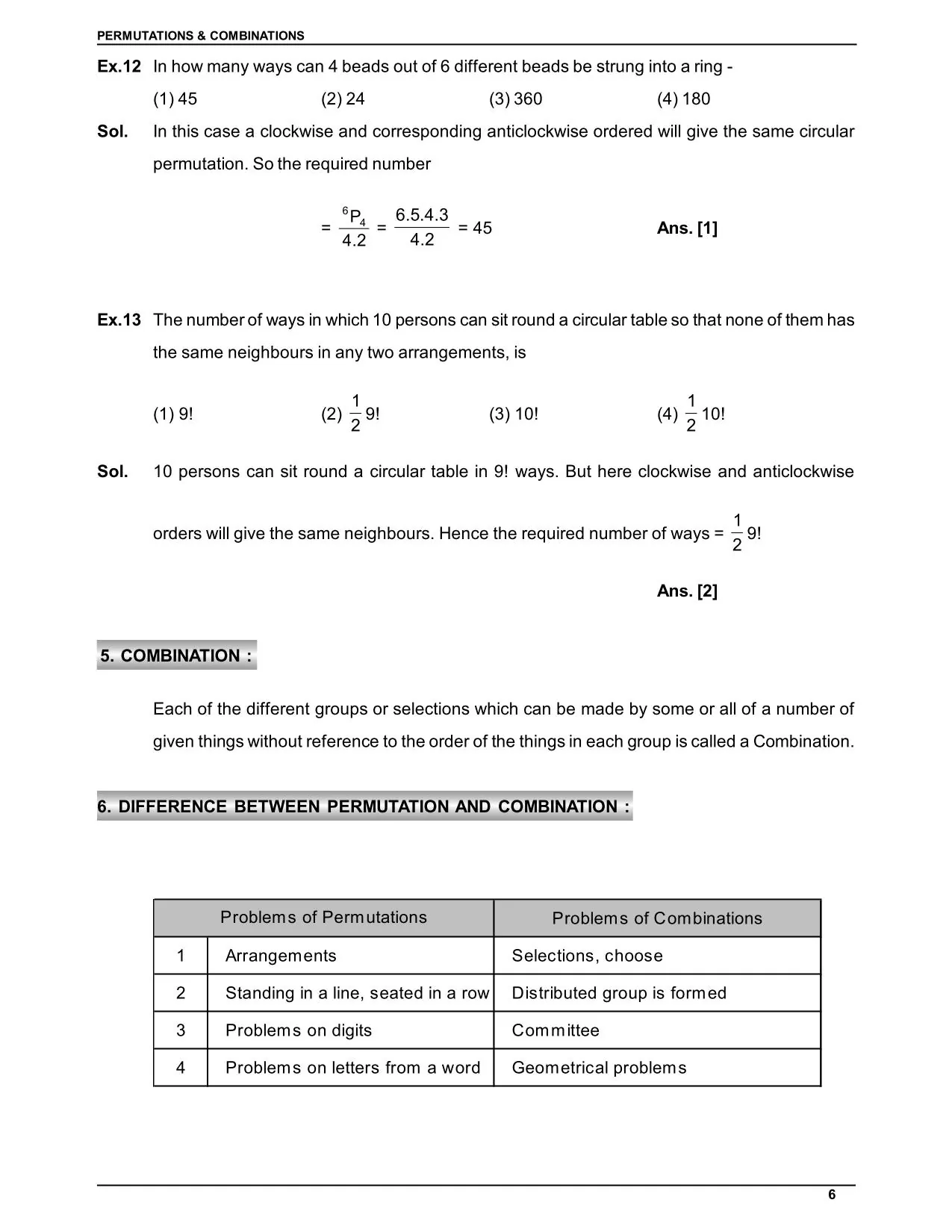
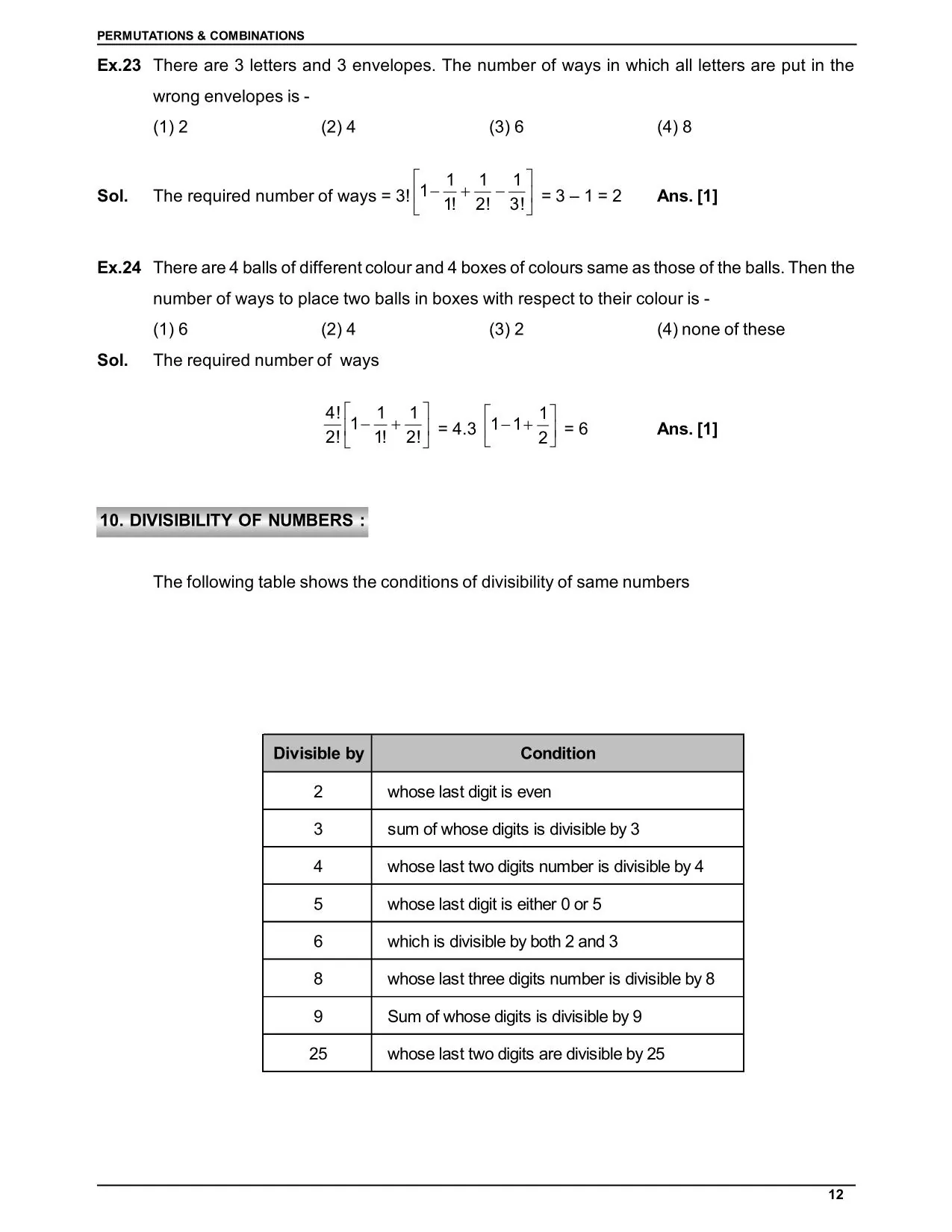
Circular Permutations
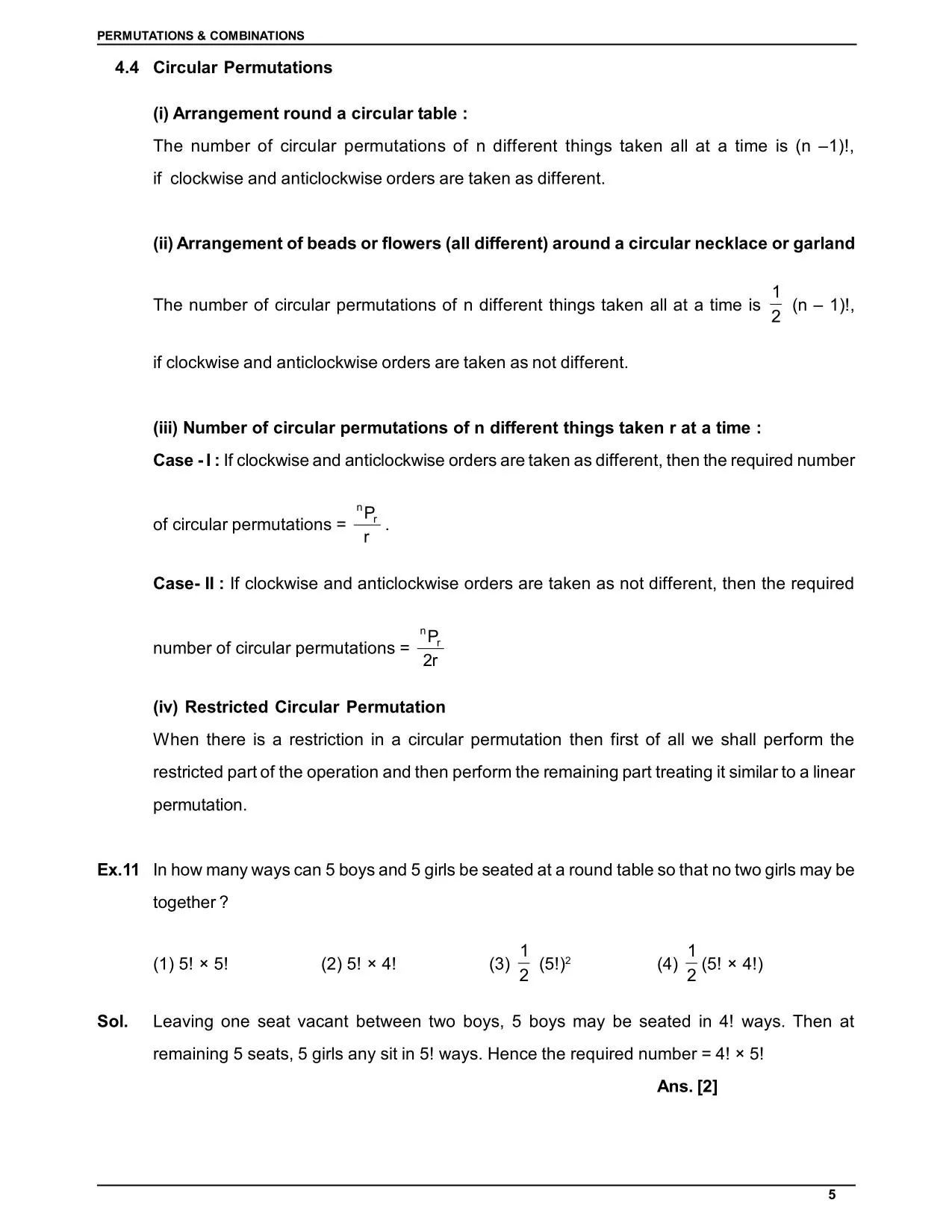
When objects are arranged in a circle (not a line), one position is fixed to remove rotational duplicates:
Circular arrangements of n distinct objects = (n−1)!
When clockwise and anticlockwise are the same (e.g., necklaces, garlands): = (n−1)! / 2
Example: 6 people sitting around a circular table = (6−1)! = 5! = 120 ways
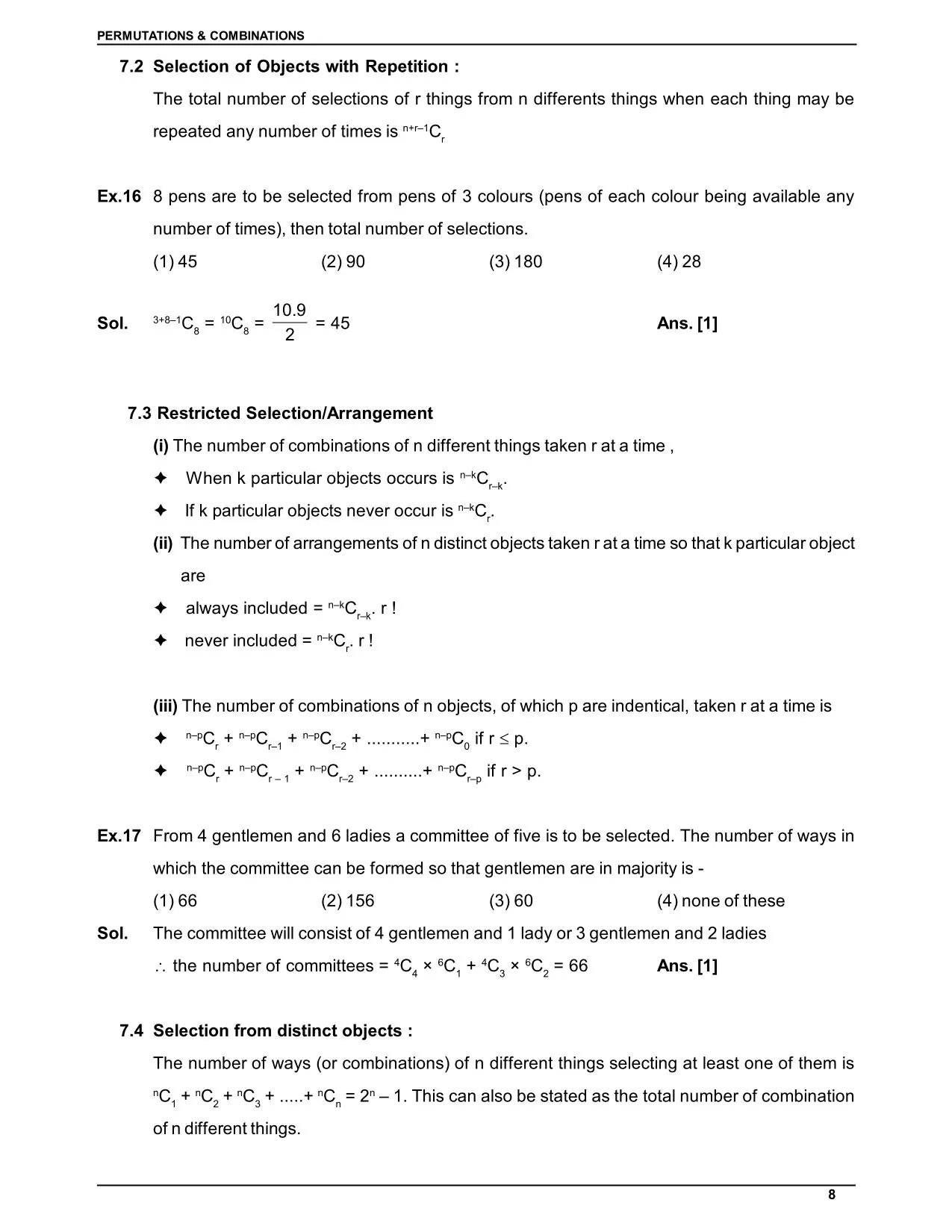
Combinations — Formula, Properties and Solved Examples
Definition
A combination is a selection of objects without regard to order. The number of ways of choosing r objects from n distinct objects is:
nCr = n! / [r! × (n−r)!] where 0 ≤ r ≤ n
nCr is also written as C(n,r) or (nr)\binom{n}{r} (binomial coefficient).
Key Combination Properties
| Property | Statement |
|---|---|
| nC0 = nCn | = 1 |
| nC1 = nC(n−1) | = n |
| nCr = nC(n−r) | Symmetry property |
| nCr + nC(r−1) = (n+1)Cr | Pascal's identity |
| Sum of all nCr (r = 0 to n) | = 2ⁿ |
| Sum of nCr for even r | = Sum for odd r = 2^(n−1) |
The Symmetry Property — Most Used in JEE
nCr = nC(n−r)
This means nC3 = nC7 implies n = 10 (since 3 + 7 = 10 = n). Questions of the type "if nCx = nCy, find n" are solved directly using this property.
💡 Expert Tip: "The symmetry property nCr = nC(n−r) and Pascal's identity nCr + nC(r−1) = (n+1)Cr are the two combination identities that appear most in JEE. Know them as tools, not as statements to quote. When a JEE problem gives you a sum like nC0 + nC1 + nC2 + ... + nCn = 2ⁿ, it is using the binomial theorem with x = 1. Understanding the connection between combinations and the binomial theorem multiplies your problem-solving range significantly."
Solved Example
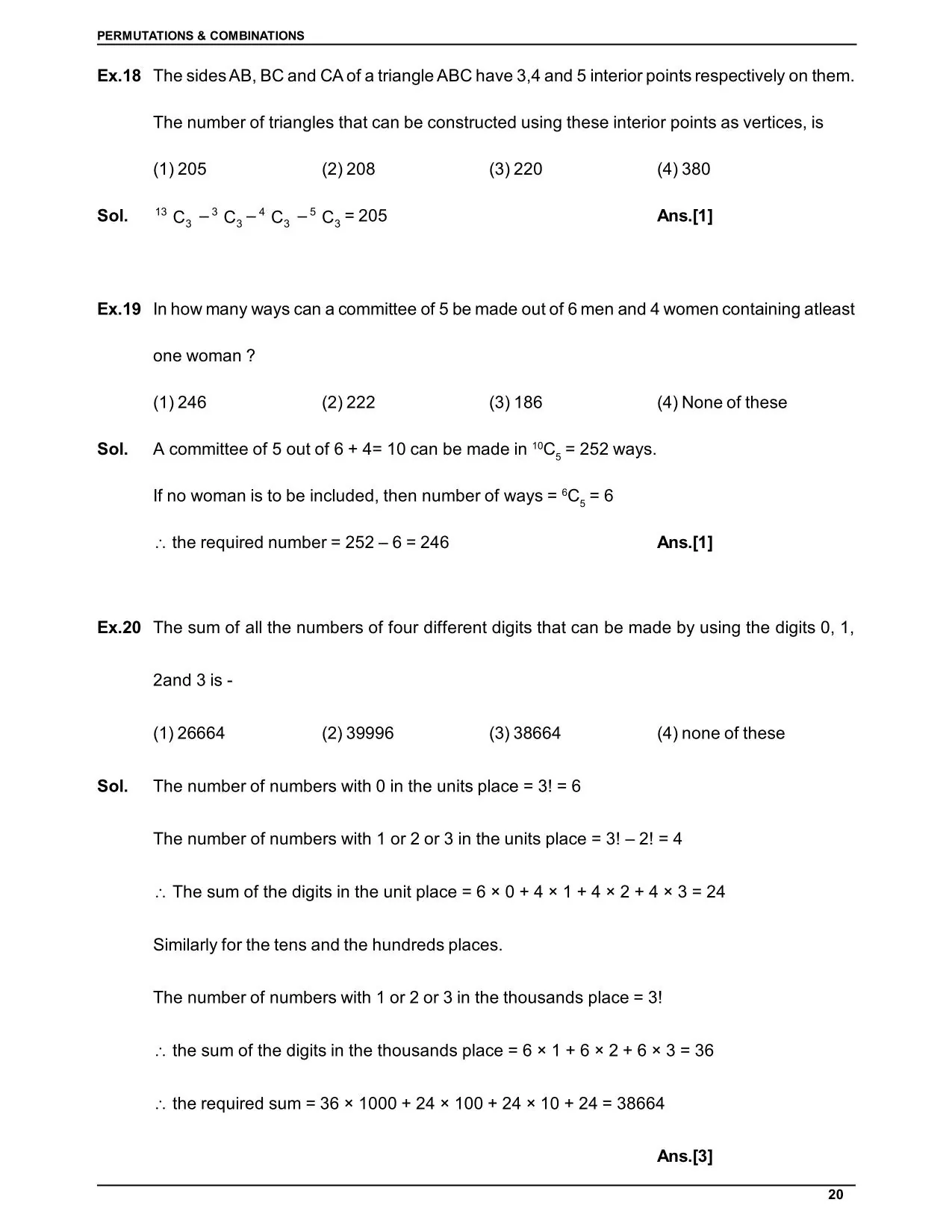
In how many ways can a committee of 3 men and 2 women be formed from 6 men and 5 women?
Selecting 3 men from 6: ⁶C₃ = 6!/(3!×3!) = 20 Selecting 2 women from 5: ⁵C₂ = 5!/(2!×3!) = 10
Both selections must happen (AND principle): Total = 20 × 10 = 200 ways
Key Difference: Permutation vs Combination
This is the most important conceptual distinction in the chapter — and the most common source of errors in JEE problems.
| Feature | Permutation | Combination |
|---|---|---|
| Considers order? | ✅ Yes — AB ≠ BA | ❌ No — AB = BA |
| Formula | nPr = n!/(n−r)! | nCr = n!/[r!(n−r)!] |
| Keyword in problem | Arrange, order, rank, seat, queue | Select, choose, form, group, committee |
| Relationship | nPr = nCr × r! | nCr = nPr / r! |
| Example | Arranging 3 books on a shelf | Choosing 3 books from a shelf |
How to Identify Permutation vs Combination
Ask: Does changing the order of selection produce a different outcome?
- 3 people sitting in 3 specific seats: permutation (swapping seats gives a different arrangement)
- 3 people forming a committee: combination (swapping names gives the same committee)
- PIN code 1234 vs 4321: permutation (different codes — order matters)
- Ingredients in a recipe: combination (same ingredients regardless of order listed)
Important Results and Identities for JEE
These results go beyond NCERT and are tested regularly in JEE Main:
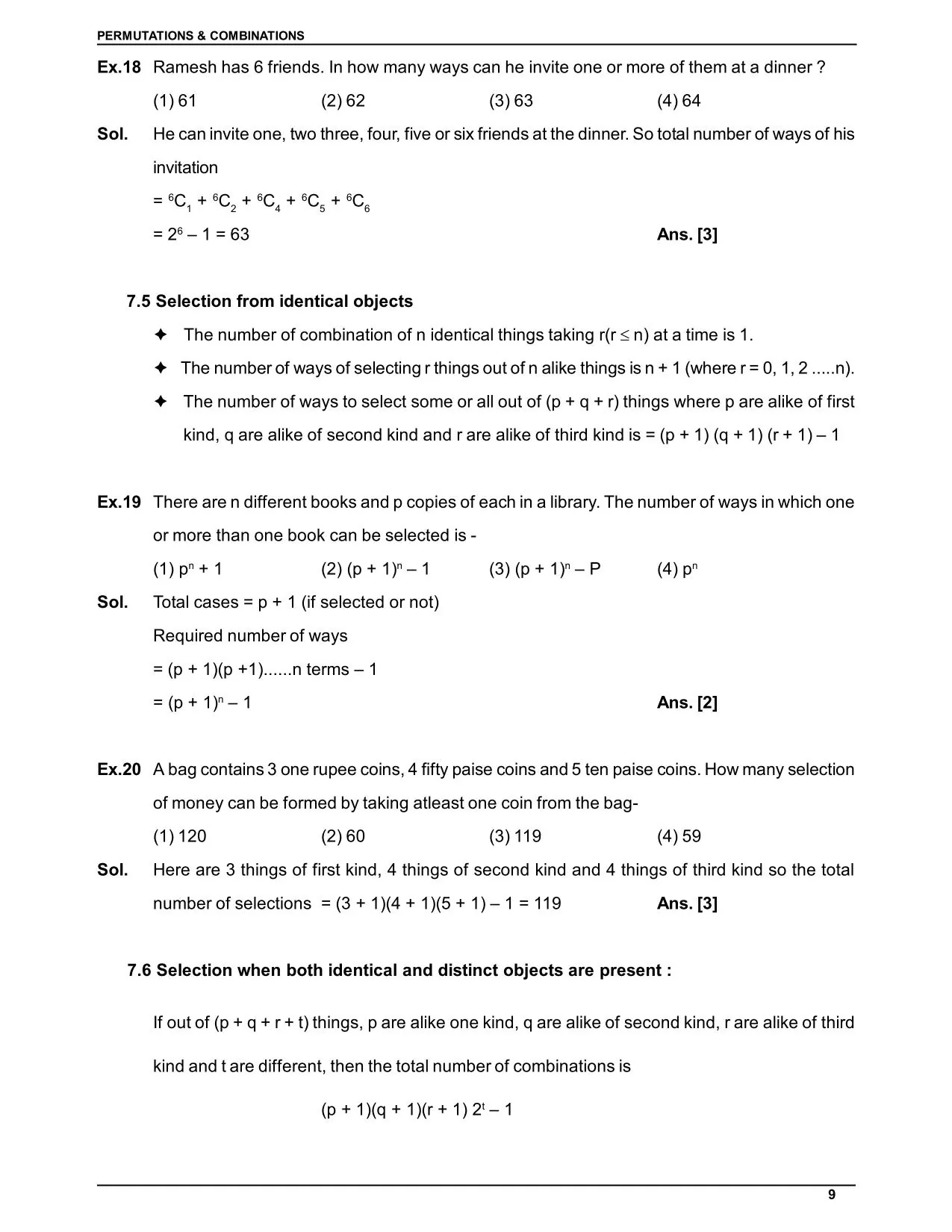
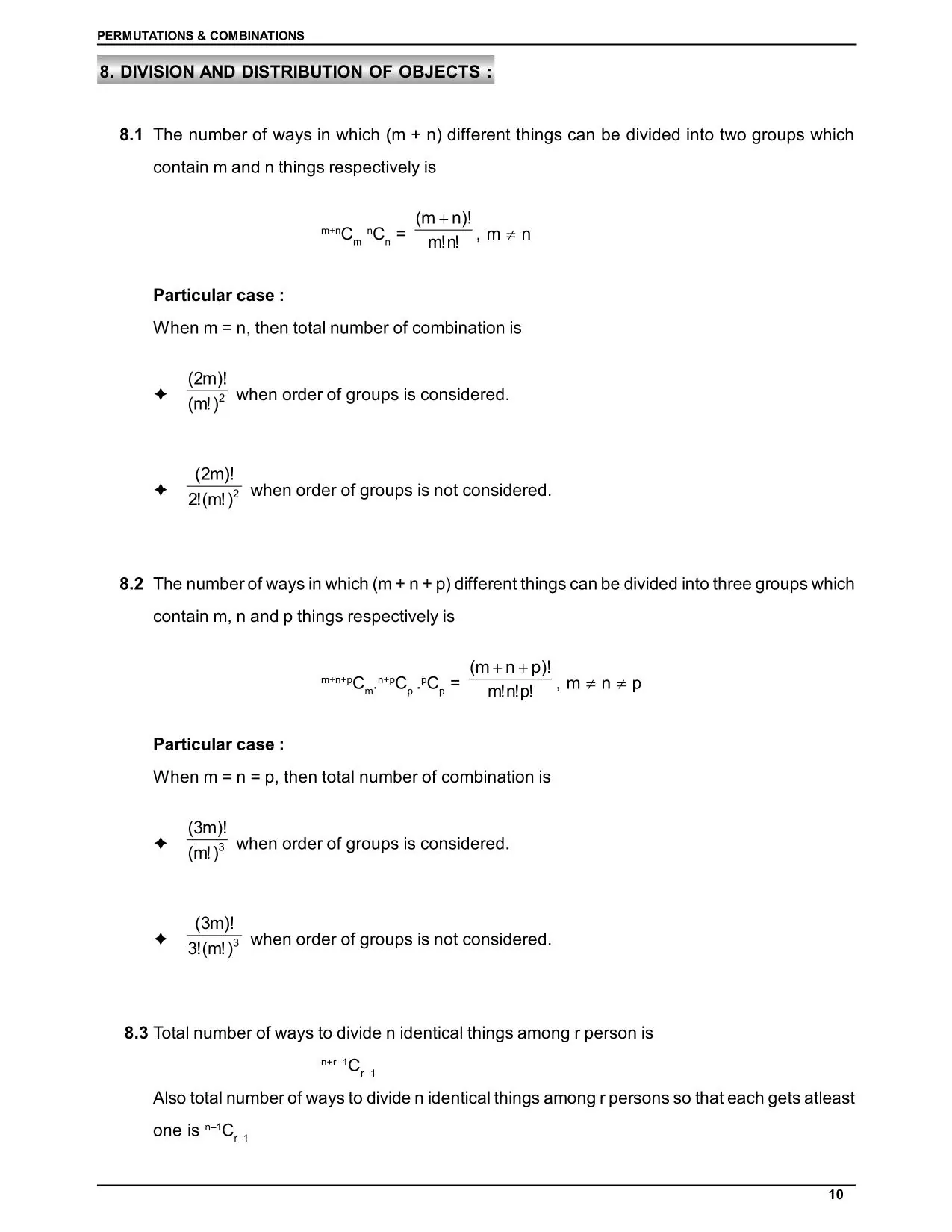
Division into Groups
Dividing 2n objects into two equal groups of n: = (2n)! / (n! × n!) — if the groups are distinguishable (labelled) = (2n)! / (n! × n! × 2!) — if the groups are indistinguishable (unlabelled)
Dividing mn objects into m groups of n each: = (mn)! / [(n!)^m × m!] — if groups are indistinguishable
Distribution of Distinct Objects into Distinct Groups
n distinct objects into r distinct groups (any number per group, including empty): = rⁿ (each object independently chooses one of r groups)
Number of Selections from Groups
Selecting at least one object from n distinct objects: = 2ⁿ − 1 (total subsets minus the empty set)
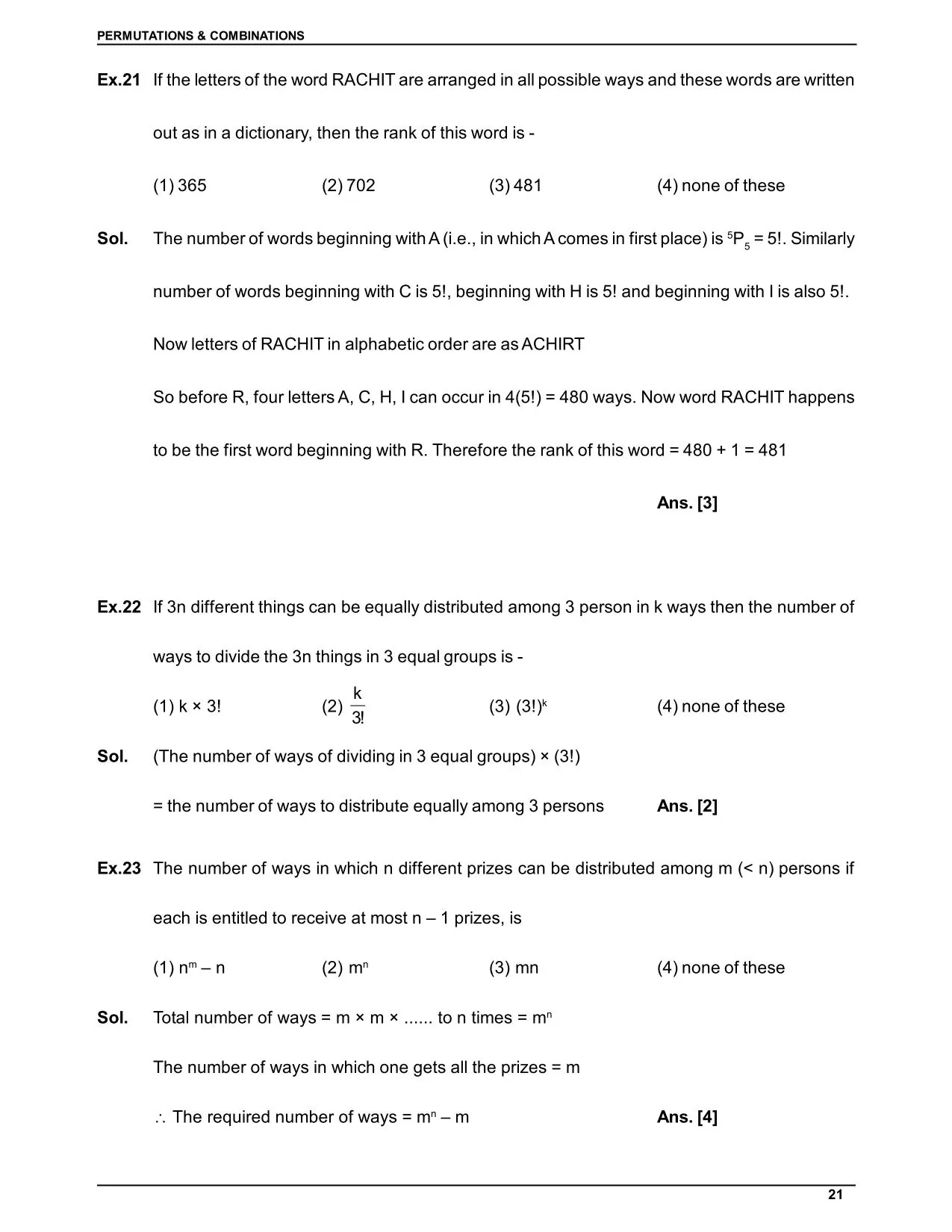
Rank of a Word
To find the rank (position in dictionary order) of a word:
- Count letters smaller than the first letter — say k letters
- Arrangements starting with each smaller letter = (n−1)!
- Fix first letter; repeat for remaining positions
- Sum all counts + 1 = rank
Example: Rank of the word "RICE" among all arrangements of R, I, C, E:
Letters in alphabetical order: C, E, I, R
Words starting with C: 3! = 6 Words starting with E: 3! = 6 Words starting with I: 3! = 6 (all before RICE)
Words starting with R: — RCxx: 2! = 2 — RExx: 2! = 2 — RICx: next is RICE itself (1 more)
Rank = 6 + 6 + 6 + 2 + 2 + 1 = 23
Most Important Topics for JEE Main and JEE Advanced
For JEE Main (1–2 questions per paper)
- Committee/group formation — combinations with constraints (at least one from a group, exactly k from a subset)
- Arrangement with identical elements — n!/p!q!r! type
- Circular permutations — people around tables, beads on a necklace
- nCr properties and identities — symmetry, Pascal's identity, sum = 2ⁿ
- Rank of a word in dictionary order
- Distribution problems — objects into groups, boxes
For JEE Advanced (multi-step problems)
- Constrained selection — at least/at most conditions requiring inclusion-exclusion
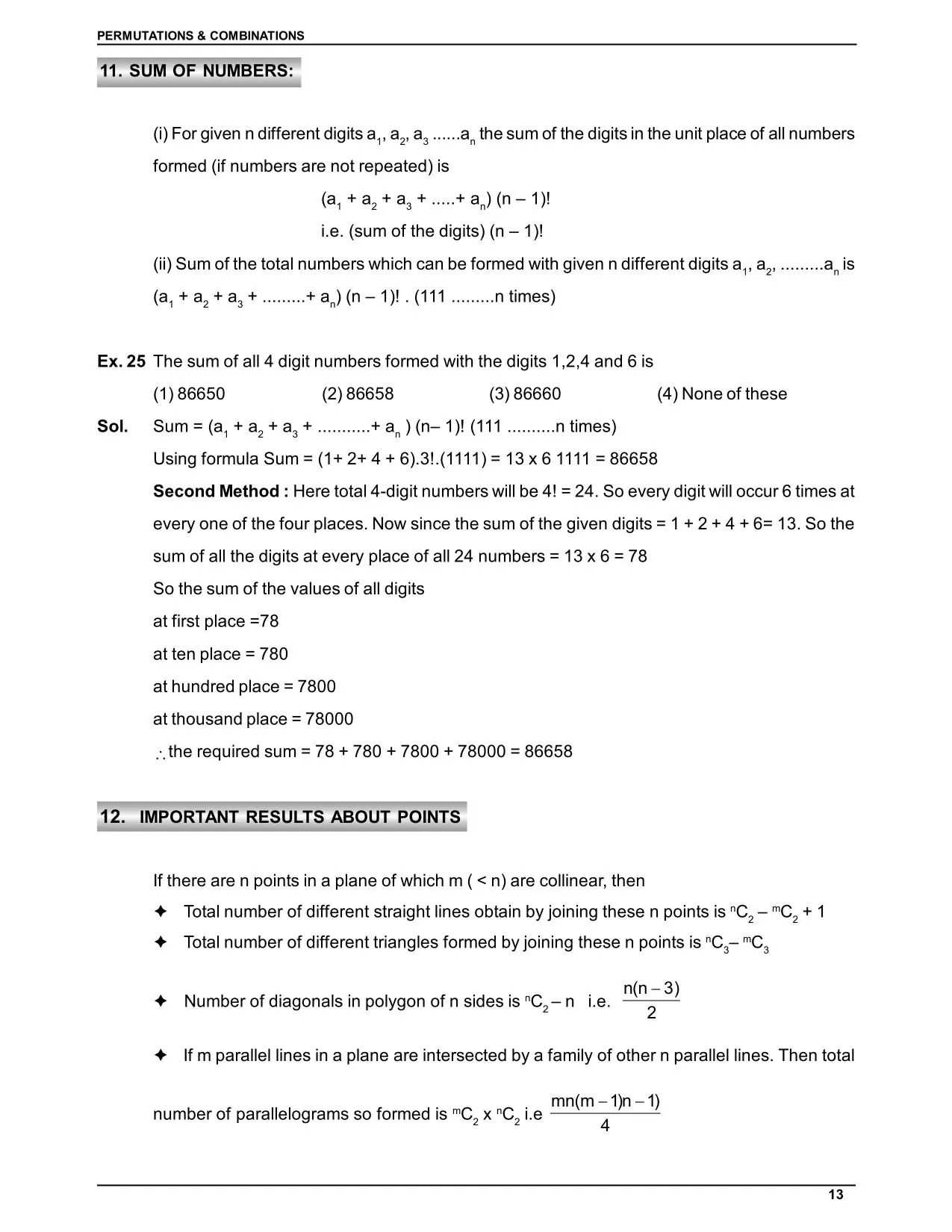
- Gaps method — arrangements where certain objects must not be adjacent
- Multinomial arrangements — objects split across multiple categories
- Combinatorics + probability hybrid — selecting then computing probability
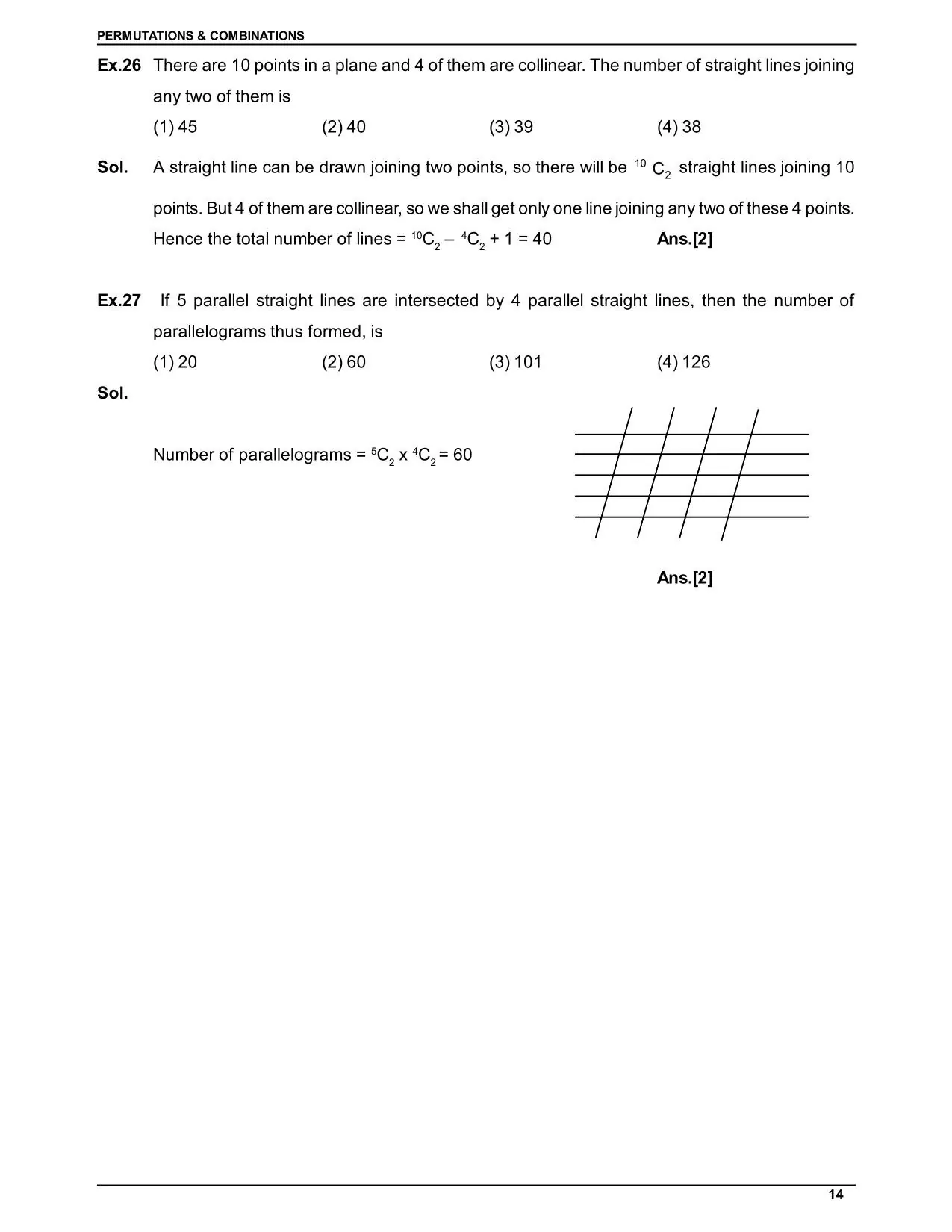
- Geometric combinations — number of triangles, diagonals from n points
The Gaps Method — Critical for JEE
When objects must not be adjacent, use the gaps method:
- First arrange the other objects (without the restricted ones) — say in P ways
- Count the gaps created (n objects create n+1 gaps, including ends)
- Place the restricted objects in the gaps using combinations
Example: Arrange 4 boys and 3 girls in a row such that no two girls are adjacent.
Step 1: Arrange 4 boys in a row: 4! = 24 ways Step 2: Gaps created: _ B _ B _ B _ B _ = 5 gaps. Step 3: Choose 3 gaps from 5 and arrange 3 girls: ⁵P₃ = 60
Total = 24 × 60 = 1440 ways
How to Study Permutations and Combinations for JEE Class 11
Step 1: Understand AND vs OR Before Touching Formulas (half day)
Solve 10 counting problems using only the multiplication and addition principles — no nPr, no nCr. This builds the structural intuition that makes all later formula applications correct.
Step 2: Derive nPr and nCr once, Then Memorise (half day)
Derive the permutation formula from the multiplication principle (n choices for position 1, n−1 for position 2, etc.) and the combination formula from nCr = nPr/r!. Understanding the derivation means you never confuse when to apply each formula.
Step 3: Build Your Formula Card (half day)
Write every formula from these notes on one A4 sheet — factorial results, nPr, nCr, circular permutations, identical elements formula, and the identities table. This card becomes your revision anchor throughout the year.
Step 4: Categorise Every Practice Problem Before Solving
Before writing a single calculation, write:
- Type: permutation/combination / both
- Constraint: none / with repetition / with identical elements / circular / gaps method
- Principle: multiplication/addition / both
This categorisation step takes 10 seconds and prevents the most common error in this chapter — applying the right formula to the wrong type of problem.
Step 5: Solve NCERT Completely, Then Progress to Module Problems
NCERT Chapter 7 covers the foundational question types. After solving all NCERT examples and exercises, work through eSaral's module problems, which introduce constrained selection, gaps method, and distribution problems — the types that appear in JEE Main but not in NCERT.
Frequently Asked Questions
Find answers to common questions.
What is the difference between permutation and combination in Class 11 Maths?
Permutation counts arrangements where order matters — nPr = n!/(n−r)!. Combination counts selections where order does not matter — nCr = n!/[r!(n−r)!]. The test: does changing the order of selection give a different outcome? If yes, use permutation. If no, use combination. nPr = nCr × r! — every permutation is a combination multiplied by the ways to arrange the selected objects.
What is the formula for nPr and nCr?
nPr = n!/(n−r)! — the number of ways to arrange r objects from n distinct objects where order matters. nCr = n!/[r!(n−r)!] — the number of ways to select r objects from n distinct objects where order does not matter. Both require 0 ≤ r ≤ n. Special values: nC0 = nCn = 1, nC1 = n, and nCr = nC(n−r) by the symmetry property.
What is circular permutation and how is it different from linear permutation?
.
In linear permutation, all positions are distinct — n distinct objects give n! arrangements. In circular permutation, only relative order matters (not absolute position), so one object is fixed to eliminate rotational duplicates. n distinct objects in a circle give (n−1)! arrangements. For objects like necklaces where clockwise and anticlockwise are identical, the count is (n−1)!/2
How many questions come from Permutations and Combinations in JEE Main?
JEE Main typically includes 1–2 questions from Permutations and Combinations per paper. Common question types are committee formation with constraints, circular permutations, arrangements with identical elements, rank of a word in dictionary order, and nCr identity applications. JEE Advanced uses combinatorics in more complex multi-step problems, often combined with probability.
What is the gaps method in permutations for JEE?
The gaps method is used when certain objects must not be adjacent. First arrange the other objects (say n of them) in a row — this creates n+1 gaps including the ends. Then place the restricted objects in distinct gaps so no two are next to each other. The restricted objects can be placed in these gaps using nPr or nCr depending on whether their order matters.