Plant Growth and Development - NEET Previous Year Questions with Complete Solutions


eSaral › NEET Biology › NEET Previous Year Questions with Complete Solutions >Plant Growth and Development

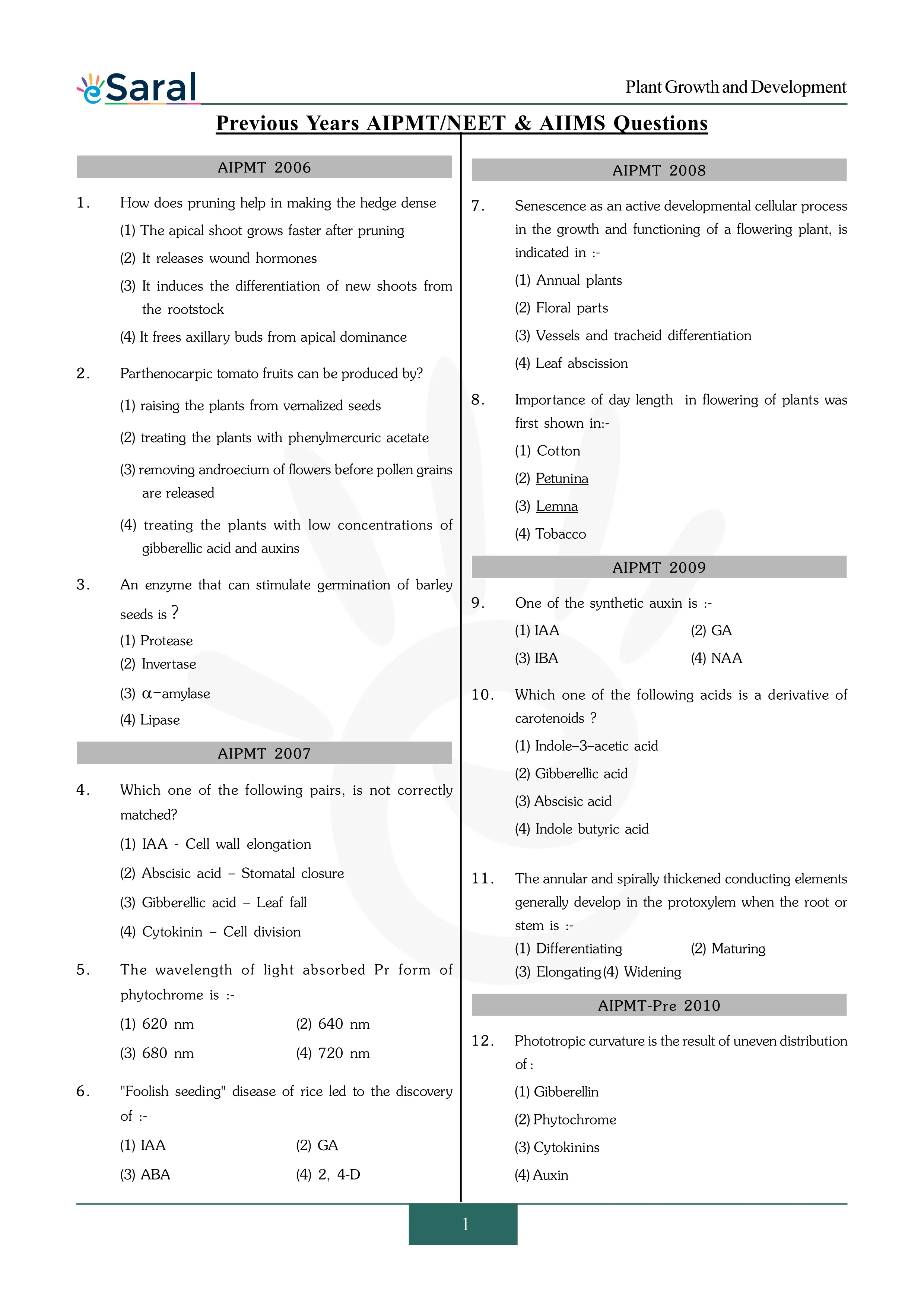
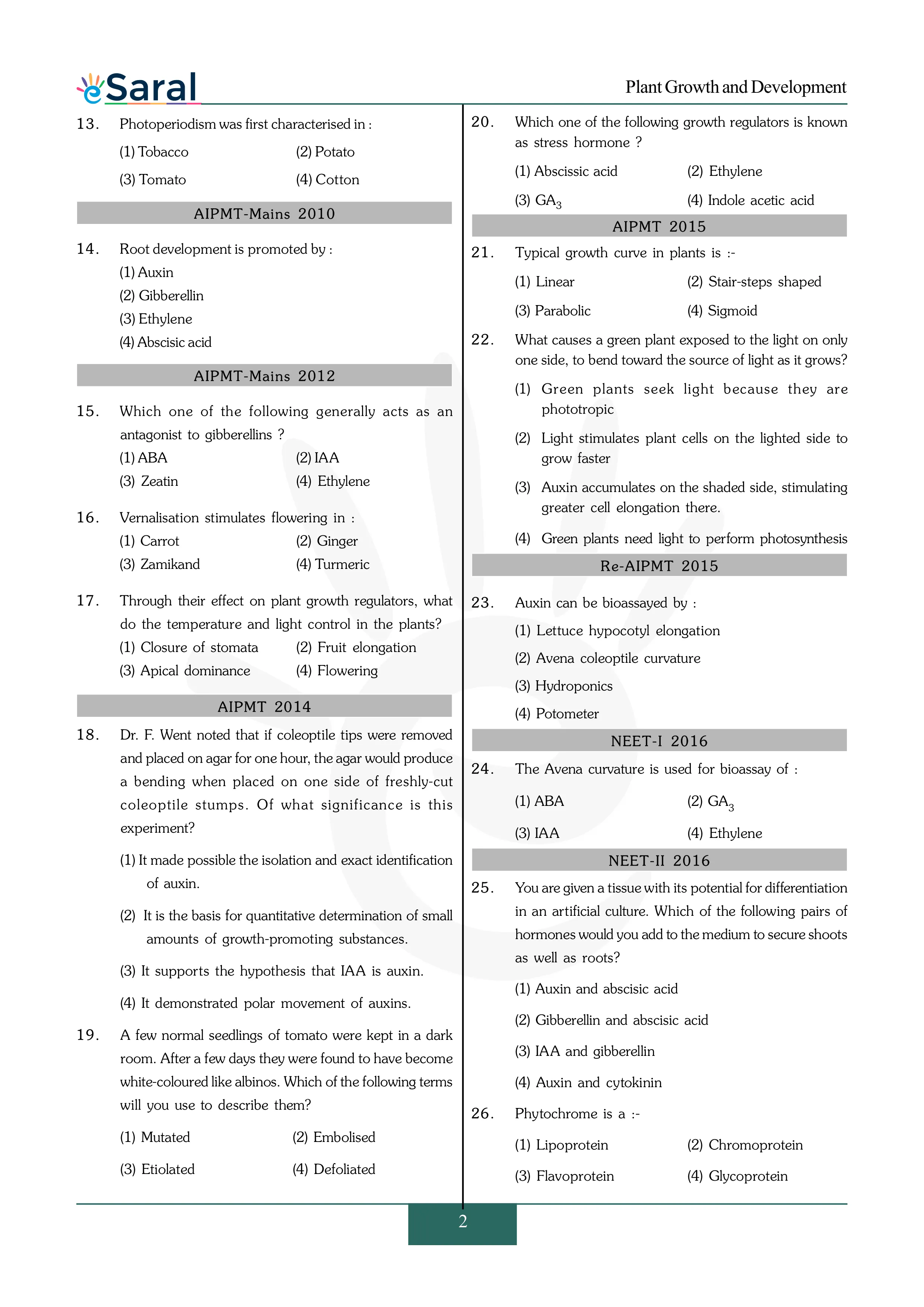
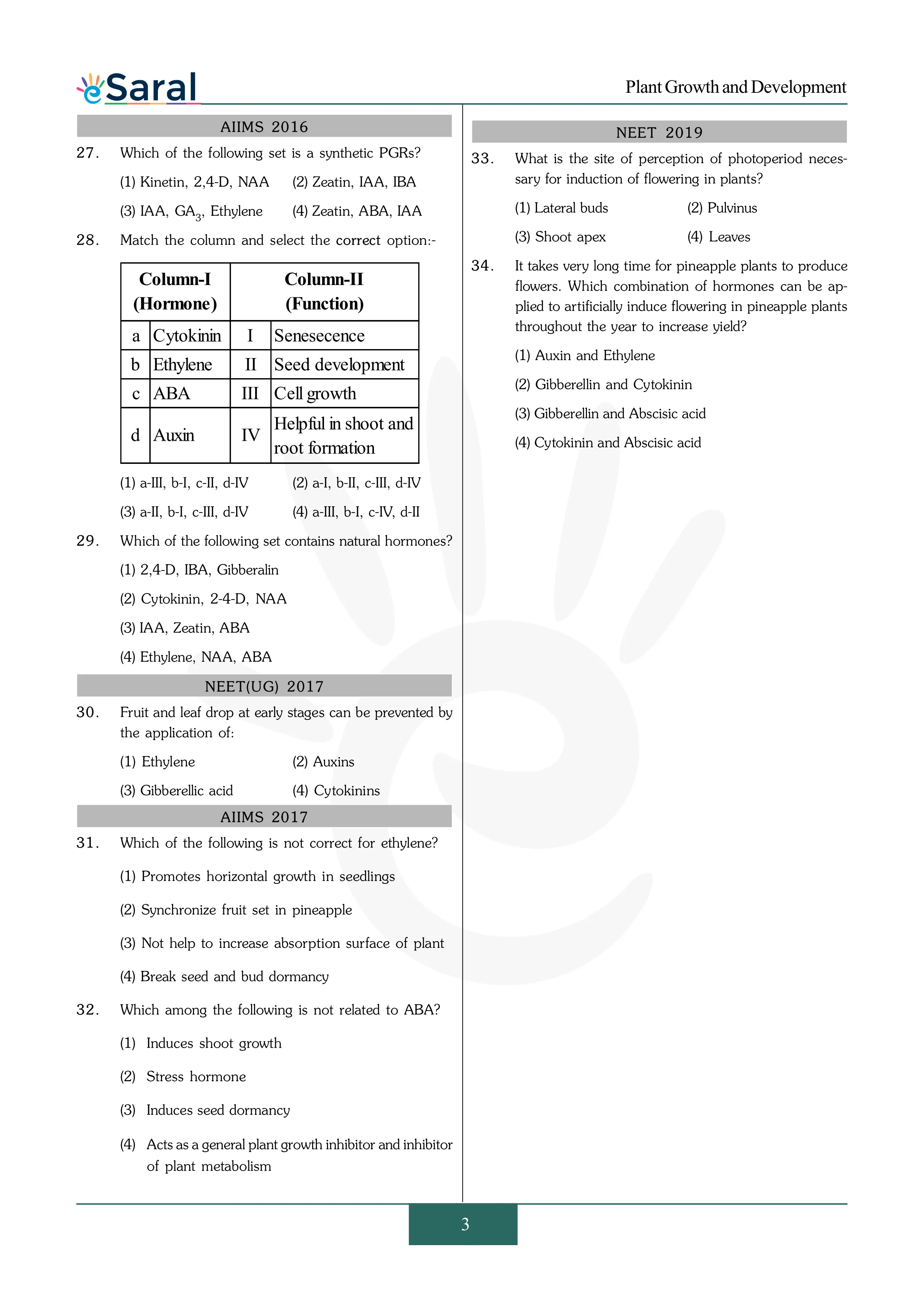
Here you will find Complete Plant Growth and Development NEET Previous Year Questions with detailed solutions.
Get complete NEET previous year questions for Physics, Chemistry, and Biology.
You will find all the solutions at the end of this page:


Frequently Asked Questions
Find answers to common questions.
What is the sigmoid growth curve in plants?
The sigmoid (S-shaped) growth curve represents plant growth over time through three phases: lag phase (slow initial growth), log phase (rapid exponential growth), and stationary phase (growth plateau). The point of inflection marks peak growth rate. NEET frequently asks students to identify phases from a labelled or unlabelled sigmoid curve diagram.
Which plant hormone is most important for NEET?
Auxin is the most tested plant hormone in NEET, followed by gibberellin and ethylene. Questions on auxin cover Went's experiment, apical dominance, phototropism, and differential concentration effects on roots vs. shoots. Knowing all five phytohormones — their source, function, and NEET keywords — is essential for full marks from this section.
How many questions come from Plant Growth and Development in NEET?
NTA asks 2 to 4 questions from this chapter in NEET-UG almost every year. Over the period 2013–2024, approximately 45 questions have been asked in total from this chapter. Plant hormones and growth curves are the most frequently tested areas, making this a high-return chapter for revision time invested.
What is the triple response of ethylene in plants?
The triple response is a classic ethylene effect observed in dark-grown pea seedlings: (1) stunted, thickened stem; (2) horizontal (plagiotrophic) growth; and (3) exaggerated apical hook. This response was first used to detect ethylene and remains a standard NEET question. Ethylene is the only gaseous plant hormone and is produced in highest amounts by ripening fruits.
Is ABA always inhibitory in plants?
ABA is primarily inhibitory — it promotes seed dormancy, closes stomata, and inhibits growth during stress. However, it is not exclusively inhibitory; ABA plays a role in storage protein synthesis in seeds and helps plants survive drought by triggering adaptive responses. For NEET, the focus is on its role in dormancy and stomatal closure.
What is the difference between photoperiodism and vernalisation?
Photoperiodism is the flowering response to the duration of the dark period in a 24-hour cycle, perceived by leaves via phytochrome. Vernalisation is the promotion of flowering by prolonged cold treatment, perceived by the shoot apex. Both ensure seasonal timing of flowering, but they involve different stimuli — light duration vs. cold temperature.