Polynomials - Class 10 Chapter 2 Short Notes (Mind Maps)
Polynomials is a key Class 10 Maths chapter that covers types of polynomials, degree, zeros, relationships between zeros and coefficients, and the division algorithm, making it essential for scoring well in CBSE board exams.
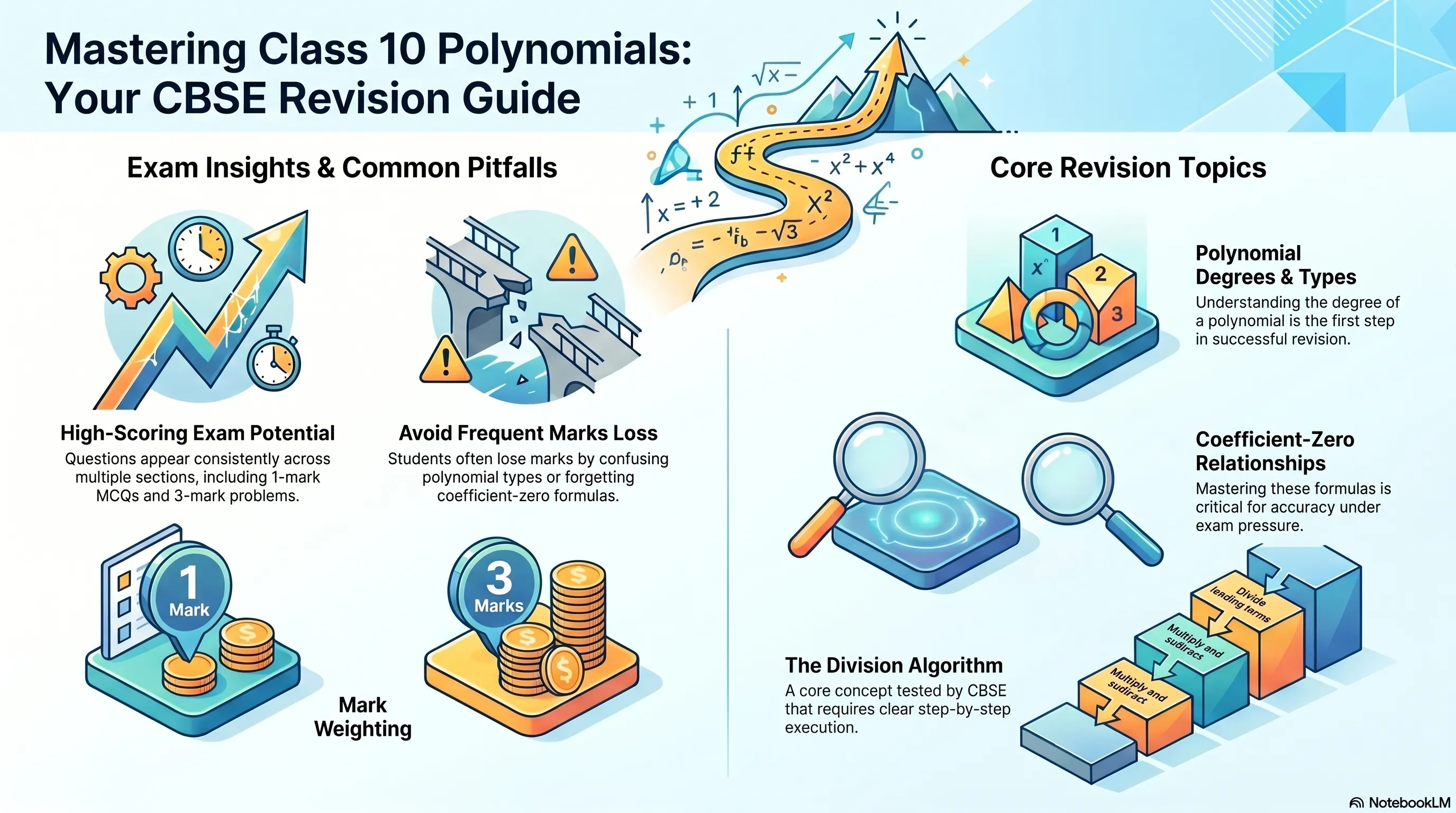
Table of Contents

eSaral ›Foundation courses ›Polynomials - Class 10 Chapter 2 Short Notes (Mind Maps)

Introduction
Chapter 2 of Class 10 Mathematics — Polynomials — is one of the highest-scoring chapters in the CBSE board exam. Every year, questions from this chapter appear across multiple sections, from 1-mark MCQs to 3-mark short-answer problems. Yet many students lose marks simply because they confuse the different types of polynomials or forget the coefficient-zero relationship formulas under exam pressure.
These short notes and mind maps are built to fix that. They cover every concept tested by CBSE — from the degree of a polynomial to the division algorithm — in a format you can revise in under 30 minutes. Whether you are doing a first read-through or a last-night revision before your board exam, this page gives you exactly what you need.
India's Best Exam Preparation for Class 10th - Download Now
This is a good summary, but the NCERT solutions for class 10 Maths page has the complete, exercise-by-exercise solutions for deeper practice.
If this page is being used to revise fast, it's worth knowing there's a structured, all-subject version of that same idea: crash course class 10.
Revise Complete Mathematics for Class 10.
India's Best Exam Preparation for Class 10th - Download Now
Frequently Asked Questions
Find answers to common questions.
What are polynomials in Class 10 Maths?
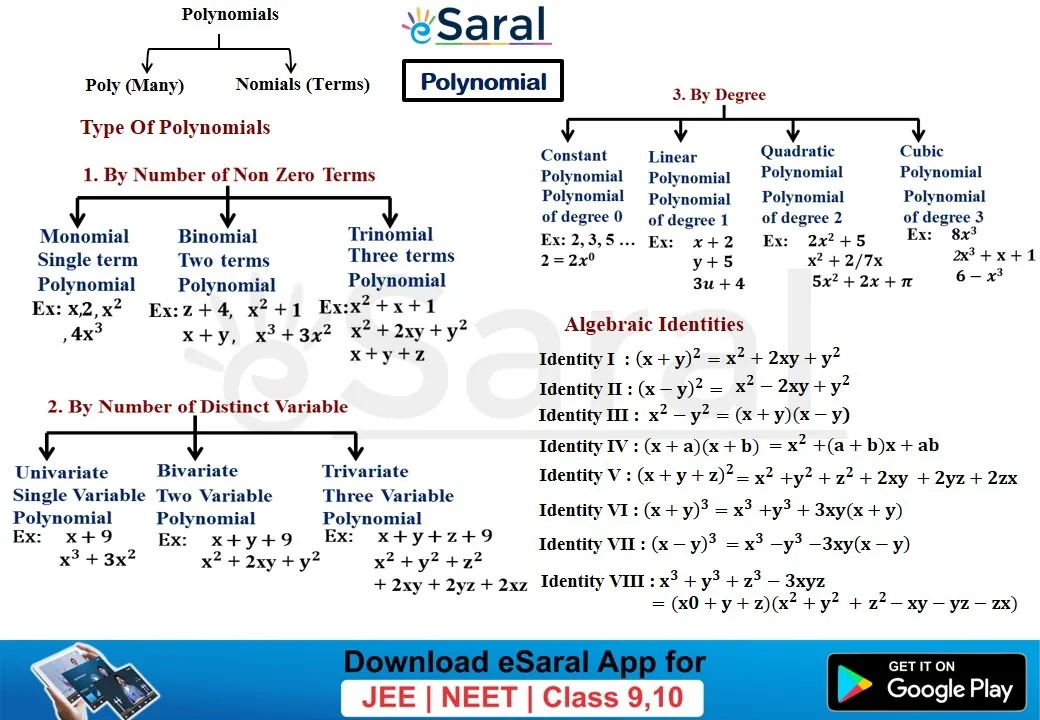
Polynomials in Class 10 are algebraic expressions with one or more terms, where each term has a variable raised to a non-negative integer power. Chapter 2 covers four main sub-topics: types of polynomials, zeroes of polynomials, the relationship between zeroes and coefficients, and the division algorithm. These appear in CBSE board exams every year.
What is the zero of a polynomial?
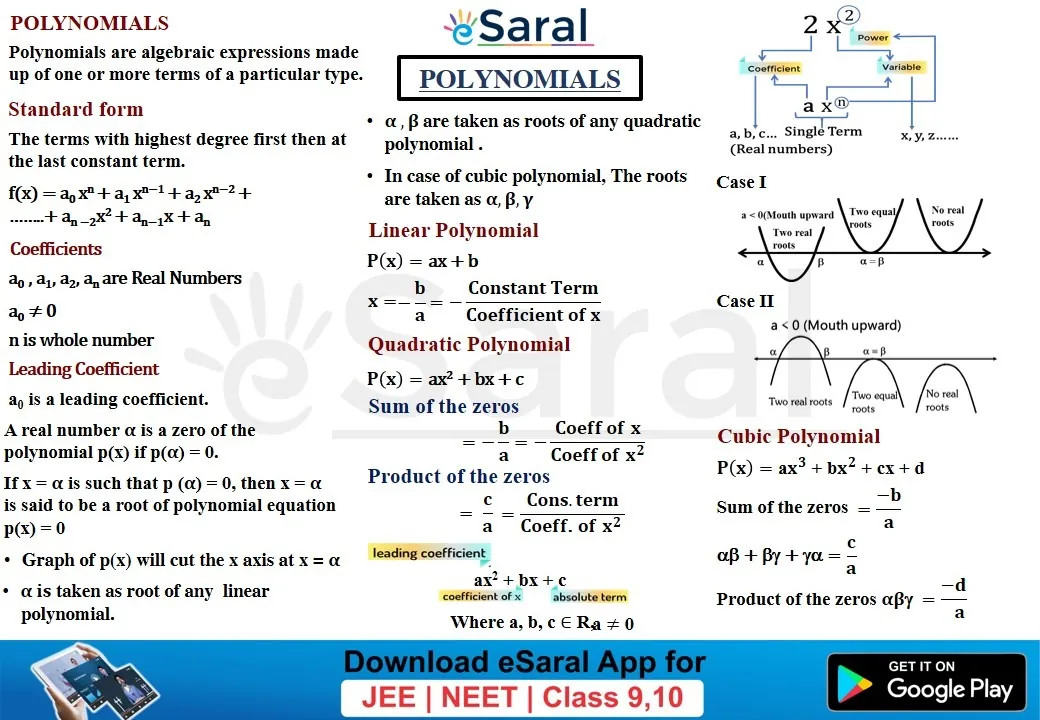
The zero of a polynomial p(x) is the value of x for which p(x) = 0. For example, if p(x) = 2x + 4, then p(−2) = 0, so −2 is the zero. Graphically, the zero is the x-coordinate of the point where the graph crosses the x-axis. A polynomial of degree n has at most n zeroes.
How many zeroes does a quadratic polynomial have?
A quadratic polynomial has at most 2 zeroes. Graphically, its parabola can intersect the x-axis at 0, 1, or 2 points. When it intersects at 2 points, there are 2 distinct real zeroes. When it touches at 1 point, there are 2 equal zeroes. When it does not intersect at all, there are no real zeroes.
What is the relationship between zeroes and coefficients of a quadratic polynomial?
For a quadratic polynomial ax² + bx + c with zeroes α and β: the sum of zeroes (α + β) = −b/a, and the product of zeroes (αβ) = c/a. These two formulas are the most tested in CBSE board exams and must be memorised along with the cubic polynomial versions.
Is the Division Algorithm part of the Class 10 CBSE board exam?
Yes. The Division Algorithm for polynomials is part of the official CBSE Class 10 Mathematics syllabus (as per the NCERT curriculum). It typically appears in 3-mark questions where students are given a polynomial and one of its zeroes and asked to find the remaining zeroes using long division.