Rajya Sabha Features for Class 8: All Key Facts Simply Explained
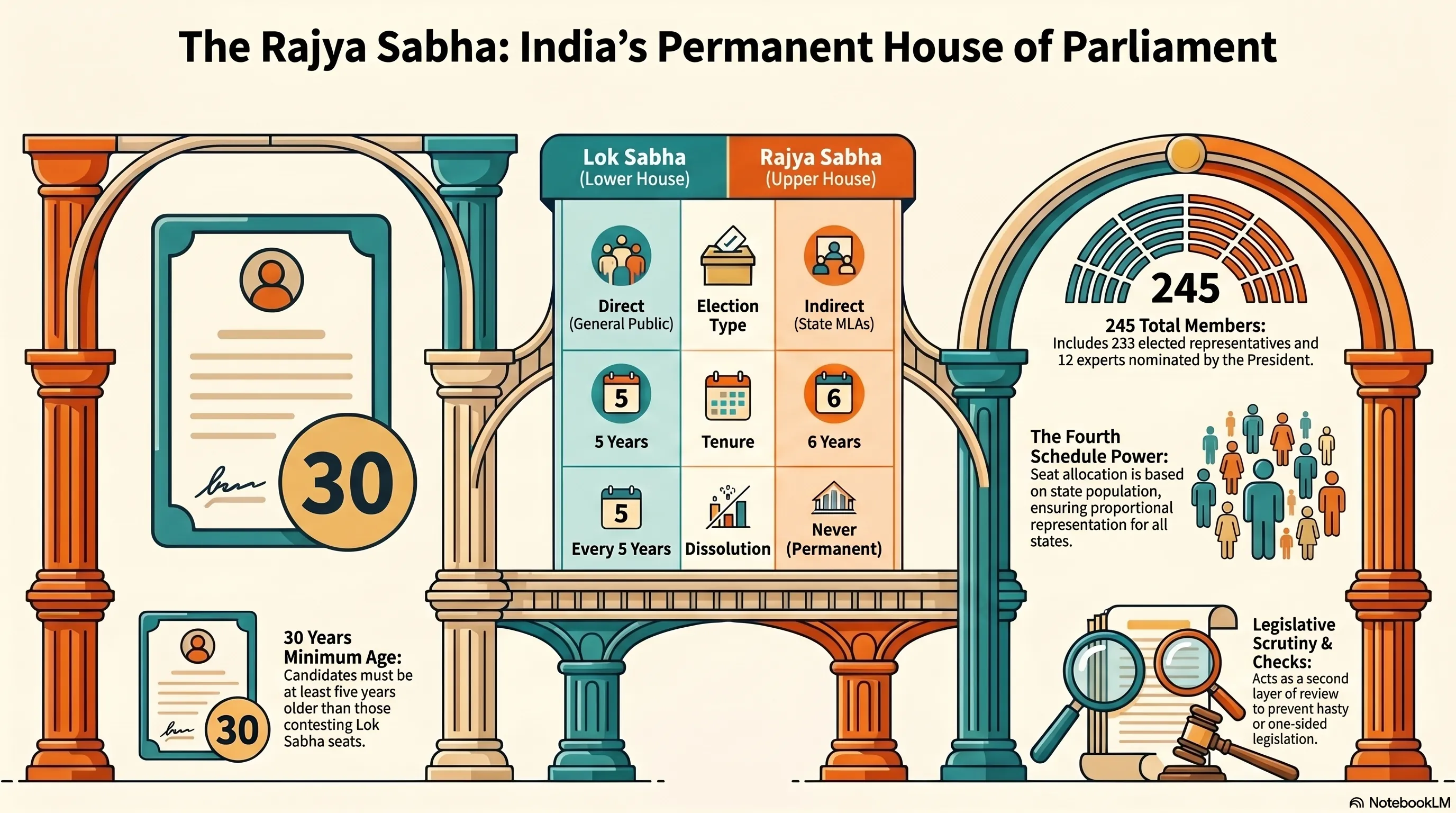
Rajya Sabha is India's upper house of Parliament with a 6-year member tenure. It is a permanent house that never dissolves, uses Single Transferable Vote for indirect elections, has 245 total members (233 elected + 12 nominated), and represents states proportionally based on population as per the Fourth Schedule of the Constitution.
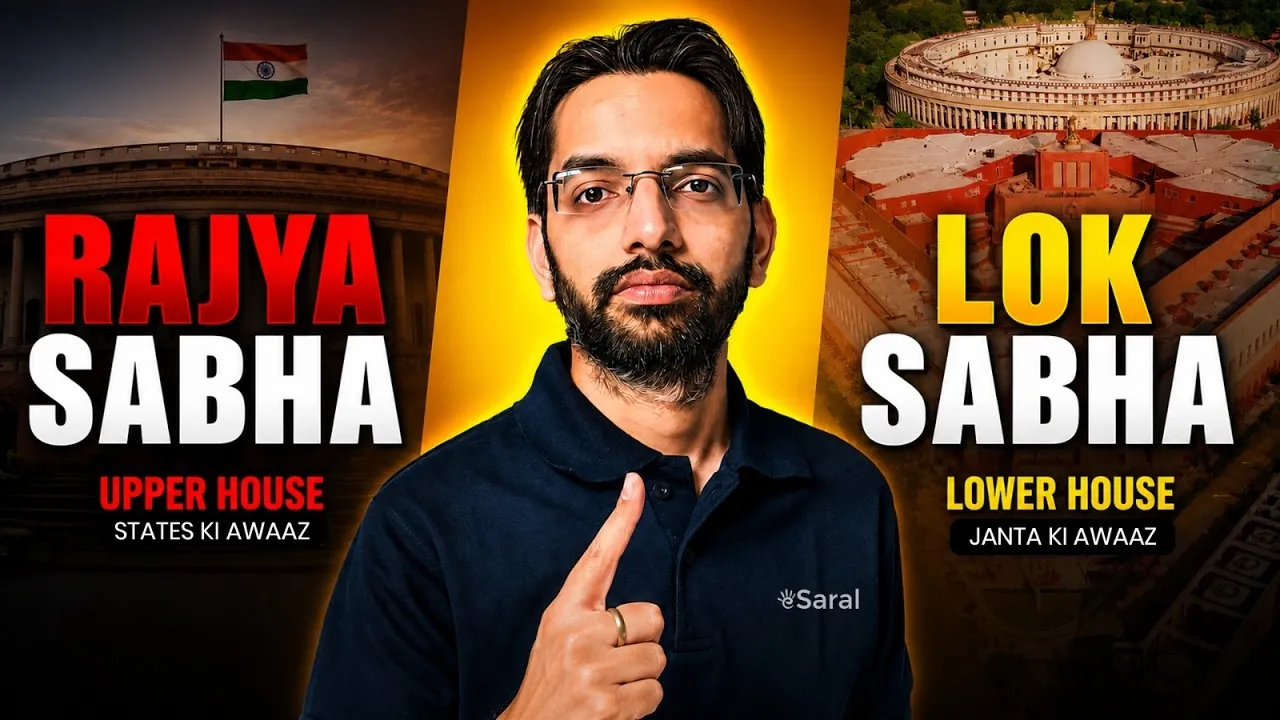
Table of Contents
- What Is the Rajya Sabha and How Is It Different from the Lok Sabha?
- Why Does India Need the Rajya Sabha? The Bicameral Legislature Explained
- How Are Rajya Sabha Members Elected? The Single Transferable Vote System
- Is the Rajya Sabha a Permanent House?
- Proportional Representation in the Rajya Sabha
- Nominated Members and Total Strength of Rajya Sabha
- Money Bill and No-Confidence Motion: What Goes Where?

eSaral ›Foundation courses ›Rajya Sabha Features for Class 8

What Is the Rajya Sabha and How Is It Different from the Lok Sabha?
The most fundamental difference between the Lok Sabha and the Rajya Sabha lies in how their members are elected.
- In Lok Sabha, elections are direct — the general public goes to polling booths and casts votes for their chosen candidate.
- In the Rajya Sabha, elections are indirect — the public first elects its MLAs (Members of the Legislative Assembly), who then sit in the Vidhan Sabha (State Legislative Assembly). These elected MLAs then vote for the Members of Parliament (MPs) who will represent their state in the Rajya Sabha.
| Feature | Lok Sabha | Rajya Sabha |
|---|---|---|
| Type of Election | Direct | Indirect |
| Elected by | General public | State MLAs |
| Tenure | 5 years | 6 years |
| Dissolution | Dissolved every 5 years | Never dissolved (permanent) |
| Minimum age to contest | 25 years | 30 years |
This distinction — direct vs. indirect elections — is the first and most important feature to remember.
🚀 Score 95%+ in Class 10 Boards – Join Now!
🚀 Score 95%+ in Class 10 Boards – Join Now!
Why Does India Need the Rajya Sabha? The Bicameral Legislature Explained
A question students often ask: why do we need the Rajya Sabha at all?
India has a bicameral legislature — meaning two houses — rather than a unicameral one (single house). Here is why that matters.
Imagine a situation where one political party has a strong majority in the Lok Sabha. They could easily pass any bill they want. But because we have the Rajya Sabha, every bill that passes the Lok Sabha must also go through the Rajya Sabha for scrutiny.
💡 Key Concept: Rajya Sabha has the power to scrutinise bills. MPs from different states sit in Rajya Sabha, read the bill carefully, debate it, and only then does it move forward to become law.
This system serves two important purposes:
- Checks and balances — prevent any hasty or one-sided legislation
- State representation — MPs in the Rajya Sabha represent their respective states, giving states a proper voice in Parliament
So the answer to "why was Rajya Sabha created?" is: to give states proper representation in Parliament and to provide a second layer of scrutiny to all bills before they become law.
How Are Rajya Sabha Members Elected? The Single Transferable Vote System
Rajya Sabha does not use a simple voting system. It uses Single Transferable Vote (STV).
What is STV?
Instead of just putting a tick next to one candidate, each voter — remember, voters here are MLAs, not the general public — must write candidate names in priority order:
- 1st priority: Candidate A
- 2nd priority: Candidate B
- 3rd priority: Candidate C
- and so on
This means voting happens openly, not through a secret ballot. Voters publicly indicate their priority preferences. This system is called the Single Transferable Vote, and it ensures a fairer distribution of representation.
This is an important concept that also appears in Class 8 chapters, so make sure you can explain what STV means in your own words.
🚀 Score 95%+ in Class 10 Boards – Join Now!
Is the Rajya Sabha a Permanent House?
Yes — and this is one of the most frequently tested facts about the Rajya Sabha.
Lok Sabha is dissolved after every 5 years when general elections are held. But the Rajya Sabha is never dissolved. It is a permanent house.
How does this work if members come and go?
Every 2 years, one-third (1/3) of Rajya Sabha members retire automatically. New members are elected to fill those seats. This rotation continues endlessly — so the house itself never ceases to exist, even as individual members change.
This is why the Rajya Sabha is called a permanent house. The tenure of each individual member is 6 years, but the house as a whole goes on forever.
Proportional Representation in the Rajya Sabha
Not every state sends the same number of MPs to the Rajya Sabha. The number of seats a state gets is based on its population — this is called Proportional Representation.
A state with a larger population, like Uttar Pradesh, gets more Rajya Sabha seats than a smaller-population state like Rajasthan.
Homework question (as discussed in class): Find out how many Rajya Sabha seats Uttar Pradesh and Rajasthan each have. This is a great way to practice applying what you've learned.
Where is this information officially recorded?
The number of Rajya Sabha seats for each state is listed in the Fourth Schedule of the Indian Constitution. India originally had 8 Schedules, which were later expanded to 12 Schedules. The Fourth Schedule specifically deals with the allocation of Rajya Sabha seats to states.
🚀 Score 95%+ in Class 10 Boards – Join Now!
Nominated Members and Total Strength of Rajya Sabha
The total strength of the Rajya Sabha is 245 members, broken down as:
- 233 elected members — chosen indirectly by state MLAs
- 12 nominated members — appointed by the President of India
These 12 nominated members are typically experts in fields such as literature, science, art, and social service.
💡 Compare with Lok Sabha: Lok Sabha earlier had 2 Anglo-Indian nominated members, but this provision has been removed. However, the 12 nominated members in Rajya Sabha remain in place.
Age eligibility:
- To contest the Lok Sabha: minimum age is 25 years
- To contest the Rajya Sabha: minimum age is 30 years
Money Bill and No-Confidence Motion: What Goes Where?
Two concepts that students often confuse:
Money Bill: A Money Bill is always introduced in the Lok Sabha, not in the Rajya Sabha.
No-Confidence Motion (NCM): A No-Confidence Motion also belongs to the Lok Sabha only.
Both of these are exclusively Lok Sabha proceedings. This distinction comes up regularly in Class 8, 9, and 10 exam papers. Remember: Money Bill → Lok Sabha. NCM → Lok Sabha.
Frequently Asked Questions
Find answers to common questions.
What is the tenure of Rajya Sabha members?
The tenure of each Rajya Sabha member is 6 years. This is longer than Lok Sabha members, whose tenure is 5 years. Every 2 years, one-third of Rajya Sabha members retire and new ones are elected, which is why the house itself never dissolves.
Why is the Rajya Sabha called a permanent house?
Rajya Sabha is called a permanent house because it is never dissolved, unlike Lok Sabha, which dissolves every 5 years. Instead of dissolving, one-third of its members retire every 2 years on a rotational basis. The house continues to exist permanently.
What is Single Transferable Vote in Rajya Sabha elections?
Single Transferable Vote (STV) is the voting system used for Rajya Sabha elections. Instead of choosing just one candidate, voters — who are state MLAs — rank all candidates in order of preference (1st, 2nd, 3rd priority). This is an open voting system, not a secret ballot.
What is the difference between Lok Sabha and Rajya Sabha elections?
Lok Sabha elections are direct — the general public votes for candidates. Rajya Sabha elections are indirect — state MLAs (Members of the Legislative Assembly) vote for Rajya Sabha MPs. The minimum age to contest Lok Sabha is 25 years, while for Rajya Sabha it is 30 years.
Where in the Constitution is the number of Rajya Sabha seats for each state mentioned?
The allocation of Rajya Sabha seats to each state is mentioned in the Fourth Schedule of the Indian Constitution. India has 12 Schedules in total.