Solid State Short Notes for Class 12, IIT-JEE & NEET

eSaral › Class 12 › Chemistry Notes › Solid State Short Notes for IIT JEE & NEET

eSaral provides chemistry short notes for JEE and NEET to help students in revising topics quickly. These notes are completely based on the latest syllabus, and it includes all the tips and tricks that will help you learn chemistry better and score well. The Notes will help you to understand the important topics and remember the key points from an exam point of view. You can also access detailed notes on chemistry here. Download or View Detailed Notes for Chemistry Class 11th Download or View Detailed Notes for Chemistry Class 12th
India's Best Exam Preparation for Class 12th - Download Now
India's Best Exam Preparation for Class 12th - Download Now
Frequently Asked Questions
Find answers to common questions.
What is packing efficiency and which arrangement is most efficient?
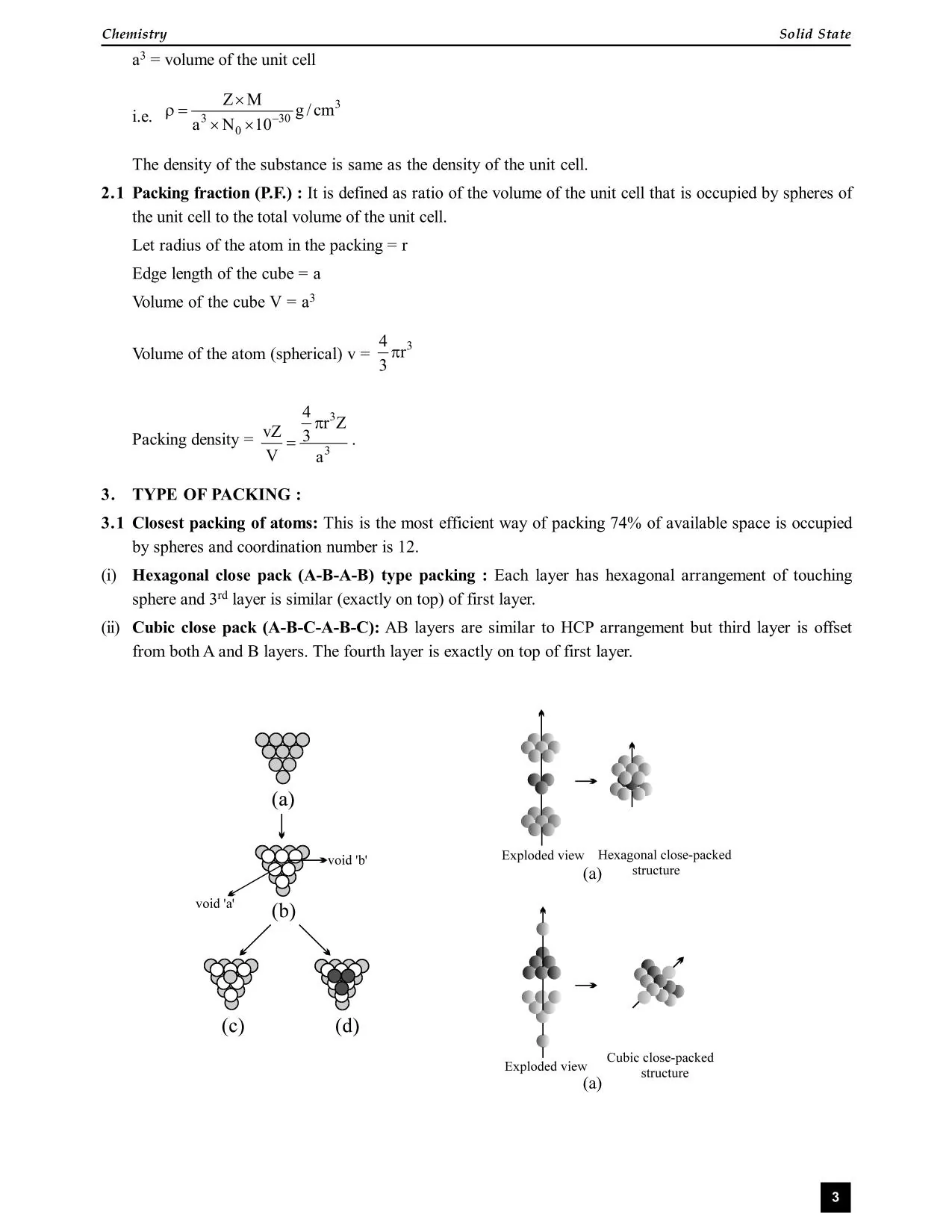
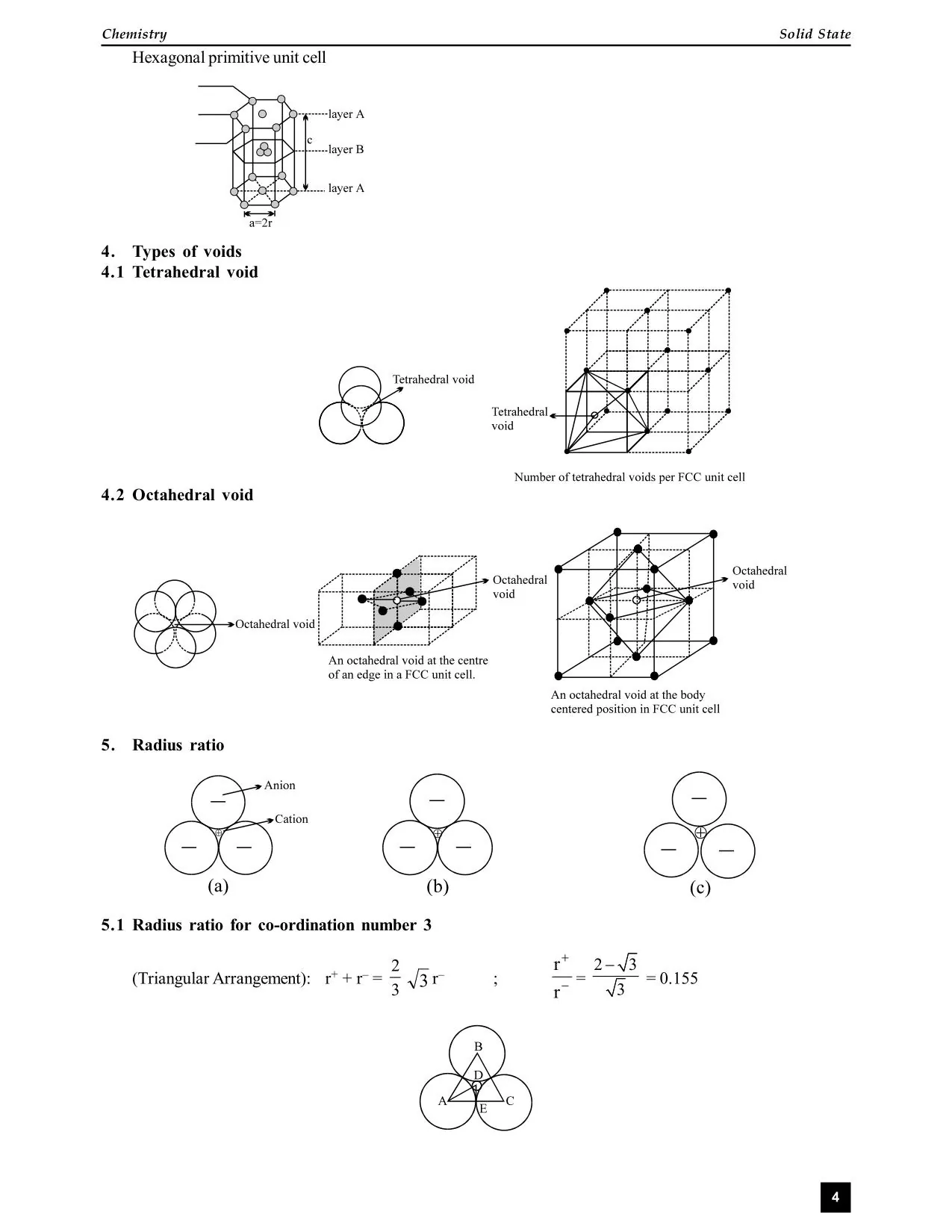
Packing efficiency is the percentage of a unit cell's volume occupied by atoms. FCC (face-centred cubic) and HCP (hexagonal close-packed) arrangements both achieve 74% packing efficiency — the highest possible for equal spheres. BCC achieves 68% and simple cubic only 52.4%. Most metals prefer FCC or HCP for this reason.
How do you calculate the number of atoms in a unit cell?
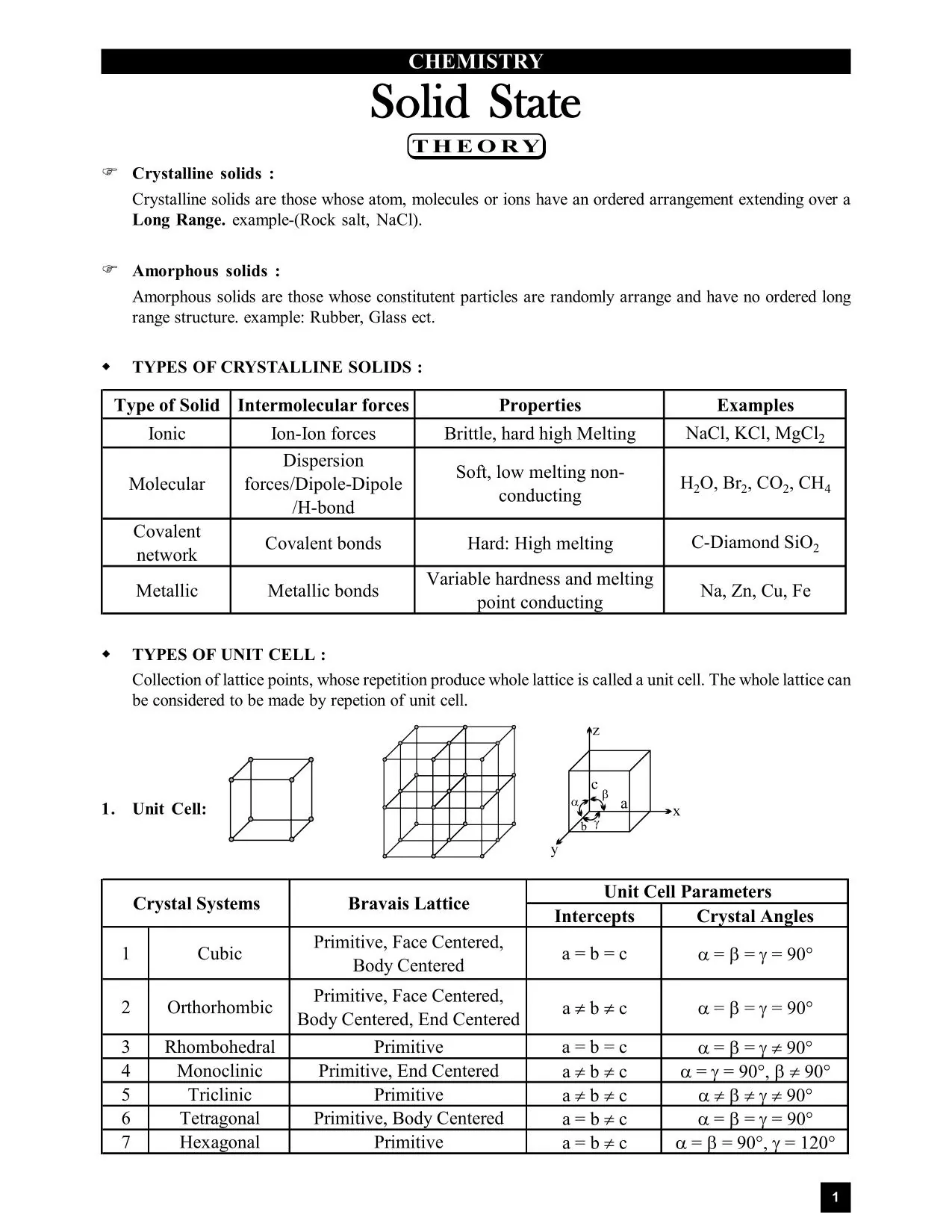
Count each corner atom as 1/8, each face-centred atom as 1/2, each edge-centred atom as 1/4, and each body-centred atom as 1. Simple Cubic gives Z = 1, BCC gives Z = 2, and FCC gives Z = 4. This value of Z is then used directly in the density formula: ρ = ZM / (Nₐ × a³).
What is the difference between Schottky and Frenkel defects?
Schottky defect involves equal numbers of missing cations and anions (vacancies), which decreases density. Frenkel defect involves a cation leaving its lattice site to occupy an interstitial position — density stays the same. Schottky appears in solids with similar-sized ions (NaCl), while Frenkel appears where the cation is much smaller than the anion (AgCl, ZnS).
What is the coordination number in FCC and BCC structures?
In FCC (face-centred cubic), each atom touches 12 nearest neighbours — coordination number is 12. In BCC (body-centred cubic), the body-centre atom touches all 8 corner atoms — coordination number is 8. In simple cubic, each atom touches 6 neighbours — coordination number is 6. Higher coordination number means more efficient packing.
Is Solid State important for NEET or only for JEE?
Solid State is important for both. NEET typically tests 1–2 questions per paper, most often on crystal structure, types of solids, or defects. JEE Main also asks 1–2 questions, often on packing efficiency or density calculations. For CBSE boards, the chapter carries 3–5 marks and defects + crystal systems are the most common topics in the long-answer section.
Why do F-centres give colour to crystals?
F-centres (Farbe centres, German for "colour") are anionic vacancies where electrons are trapped to maintain electrical neutrality. These electrons absorb specific visible-light wavelengths and re-emit others, giving the crystal a characteristic colour. NaCl with F-centres appears yellow; KCl with F-centres appears violet. This is a direct consequence of metal excess defect.