Solutions Class 12 Chemistry Notes: Complete Guide for JEE, NEET & Board Exams
Solutions is a high-scoring Class 12 Chemistry chapter covering concentration terms, Raoult’s law, ideal and non-ideal solutions, colligative properties, osmotic pressure, van’t Hoff factor, and abnormal molecular mass, with strong relevance for CBSE Boards, JEE Main, and NEET through both conceptual theory and numerical problem-solving.
.webp)
Table of Contents
- Why Solutions Is a High-Priority Chapter in Class 12 Chemistry
- Types of Solutions and Concentration Terms
- Solutions | Chemistry Class 12 Notes | IIT-JEE & NEET
- Vapour Pressure and Raoult's Law
- Colligative Properties: All Four Explained {#colligative-properties}
- Abnormal Molecular Mass and van't Hoff Factor {#vant-hoff}
- Key Formulas

eSaral ›Class 12› Solutions Class 12 Chemistry Notes: Complete Guide for JEE, NEET & Board Exams
Why Solutions Is a High-Priority Chapter in Class 12 Chemistry
Here is the exam relevance of the Solutions chapter across different tests:
| Exam | Weightage / Frequency | Most Tested Topics |
|---|---|---|
| CBSE Board (Theory) | 5 marks | Colligative properties, Raoult's law, osmosis |
| JEE Main | 1–2 questions per session | Numericals on ΔTb, ΔTf, osmotic pressure, van't Hoff factor |
| NEET | 1 question most years | Definitions, osmosis, isotonic solutions |
💡 Expert Tip by eSaral Academic Team, IIT Bombay Faculty: "In JEE Main, Solutions questions are almost always numerical — Kb, Kf calculations or van't Hoff factor with electrolytes. In CBSE boards, 3-mark questions often ask you to explain a colligative property with formula and one example. Prepare for both formats separately."
Types of Solutions and Concentration Terms
What Is a Solution?
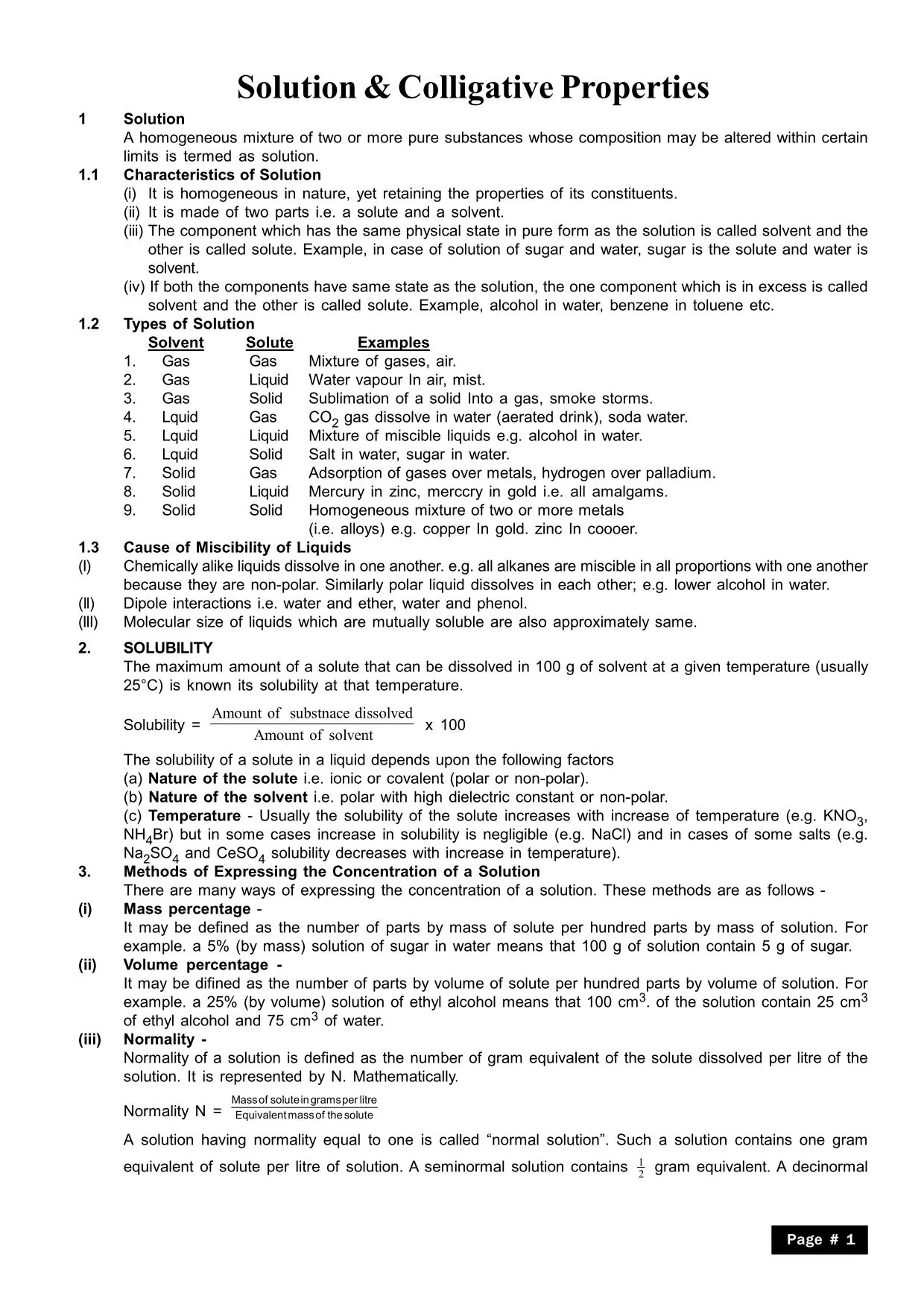
A solution is a homogeneous mixture of two or more components. The component present in the largest amount is the solvent; the component dissolved in it is the solute.
Solutions can be formed between any combination of solid, liquid, and gas phases. The nine possible types are summarised below:
| Solute State | Solvent State | Example |
|---|---|---|
| Gas | Gas | Air (O₂ in N₂) |
| Gas | Liquid | Soda water (CO₂ in water) |
| Gas | Solid | H₂ in palladium |
| Liquid | Gas | Humidity (water vapour in air) |
| Liquid | Liquid | Ethanol in water |
| Liquid | Solid | Mercury in zinc (amalgam) |
| Solid | Gas | Iodine vapour in air |
| Solid | Liquid | Sugar in water |
| Solid | Solid | Copper in gold (alloy) |
Ways of Expressing Concentration
| Term | Formula | Units |
|---|---|---|
| Mass percentage (w/w) | (mass of solute/mass of solution) × 100 | % |
| Volume percentage (v/v) | (volume of solute/volume of solution) × 100 | % |
| Mole fraction (x) | moles of component / total moles | Dimensionless |
| Molarity (M) | moles of solute/litres of solution | mol/L |
| Molality (m) | moles of solute/kg of solvent | mol/kg |
| Normality (N) | gram equivalents/litres of solution | N |
Key distinction for exams: Molarity changes with temperature (volume changes). Molality does not change with temperature (mass is constant). For colligative property calculations, always use molality.
India's Best Exam Preparation for Class 12th - Download Now
Solutions | Chemistry Class 12 Notes | IIT-JEE & NEET
India's Best Exam Preparation for Class 12th - Download Now
India's Best Exam Preparation for Class 12th - Download Now
India's Best Exam Preparation for Class 12th - Download Now
India's Best Exam Preparation for Class 12th - Download Now
Vapour Pressure and Raoult's Law
Vapour Pressure of a Pure Liquid
The vapour pressure of a liquid is the pressure exerted by its vapour in equilibrium with the liquid at a given temperature. It increases with temperature.
Raoult's Law
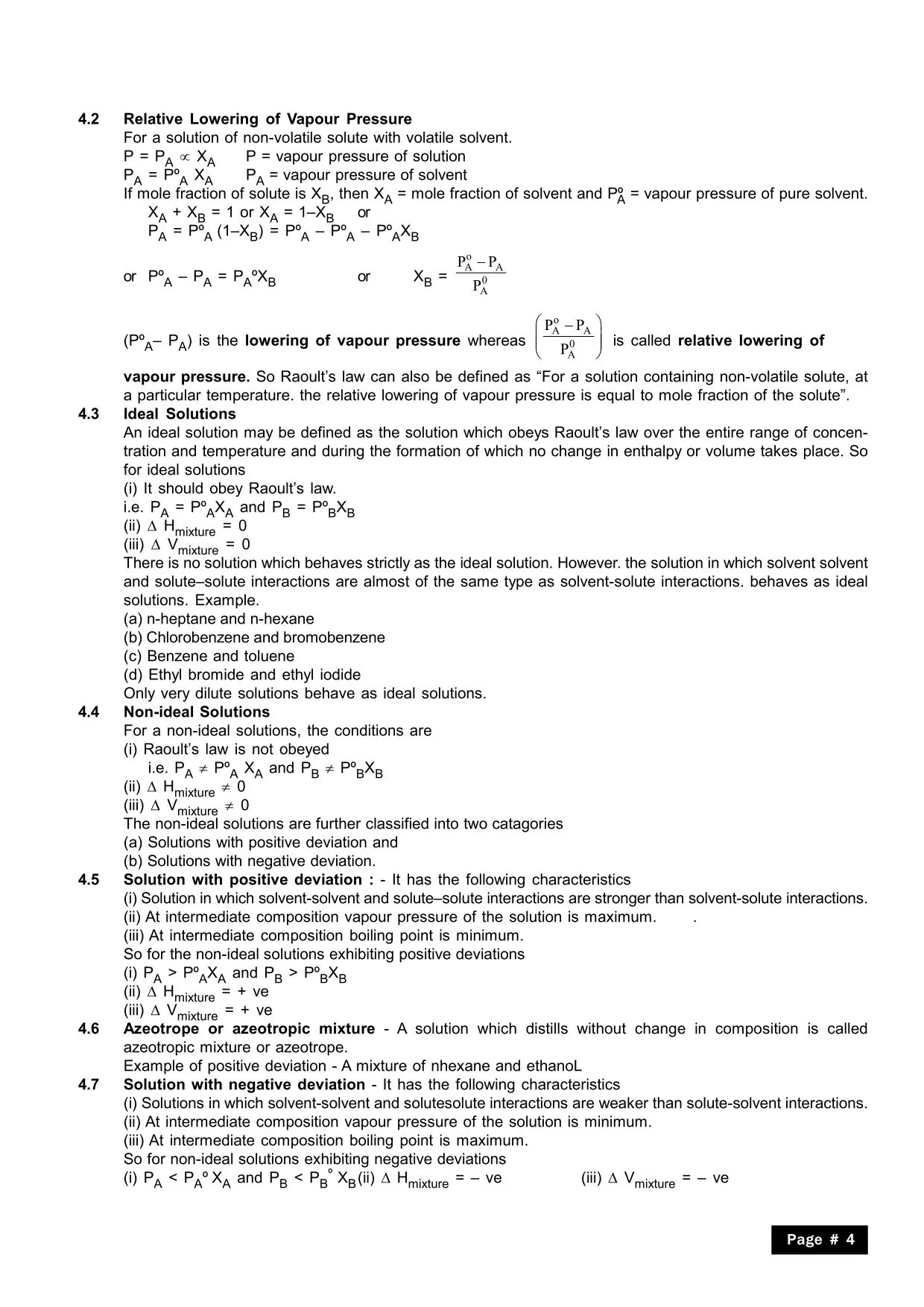
For a solution containing a non-volatile solute, Raoult's Law states:
The vapour pressure of a solvent above a solution equals the vapour pressure of the pure solvent multiplied by the mole fraction of the solvent.
p₁ = x₁ × p₁°
Where:
- p₁ = vapour pressure of solvent above the solution
- x₁ = mole fraction of solvent
- p₁° = vapour pressure of pure solvent
Relative lowering of vapour pressure:
(p₁° − p₁) / p₁° = x₂ (mole fraction of solute)
This is the first colligative property.
Ideal vs Non-Ideal Solutions
| Type | Condition | Example |
|---|---|---|
| Ideal solution | Obeys Raoult's law at all concentrations; ΔHmix = 0, ΔVmix = 0 | Benzene + toluene |
| Non-ideal (positive deviation) | Vapour pressure > Raoult's law prediction; A–B interactions weaker than A–A and B–B | Ethanol + water |
| Non-ideal (negative deviation) | Vapour pressure < Raoult's law prediction; A–B interactions stronger | Chloroform + acetone |
Colligative Properties: All Four Explained {#colligative-properties}
Colligative properties depend only on the number of solute particles — not their chemical nature. All four properties arise from the lowering of the vapour pressure.
1. Relative Lowering of Vapour Pressure
(p₁° − p₁) / p₁° = x₂ = n₂ / (n₁ + n₂)
For dilute solutions: (p₁° − p₁) / p₁° ≈ n₂/n₁ = w₂M₁ / (M₂w₁)
This is used to determine the molar mass of the solute.
2. Elevation of Boiling Point (ΔTb)
A solution boils at a higher temperature than the pure solvent because its vapour pressure is lower. It reaches atmospheric pressure only at a higher temperature.
ΔTb = Kb × m
Where:
- Kb = ebullioscopic constant (molal elevation constant) — depends only on the solvent
- m = molality of solution
From this: M₂ = (Kb × w₂ × 1000) / (ΔTb × w₁)
Common Kb values: Water = 0.52 K kg/mol | Benzene = 2.53 K kg/mol
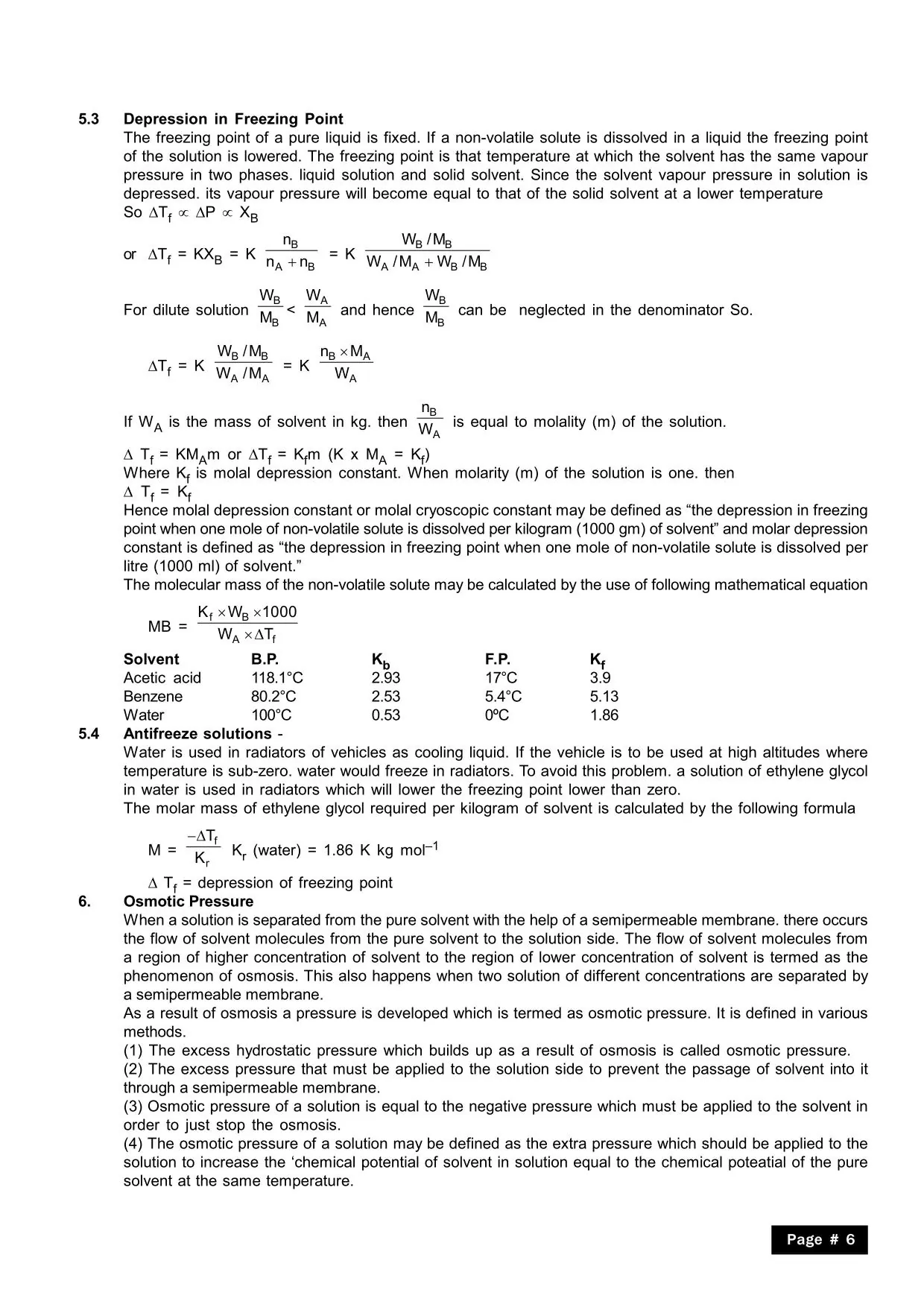
3. Depression of Freezing Point (ΔTf)
A solution freezes at a lower temperature than the pure solvent. The solute particles interfere with the formation of the solid lattice.
ΔTf = Kf × m
Where:
- Kf = cryoscopic constant (molal depression constant)
- m = molality
From this: M₂ = (Kf × w₂ × 1000) / (ΔTf × w₁)
Common Kf values: Water = 1.86 K kg/mol | Benzene = 5.12 K kg/mol
Practical application: Anti-freeze in car radiators, salt on icy roads — both work by depressing freezing point.
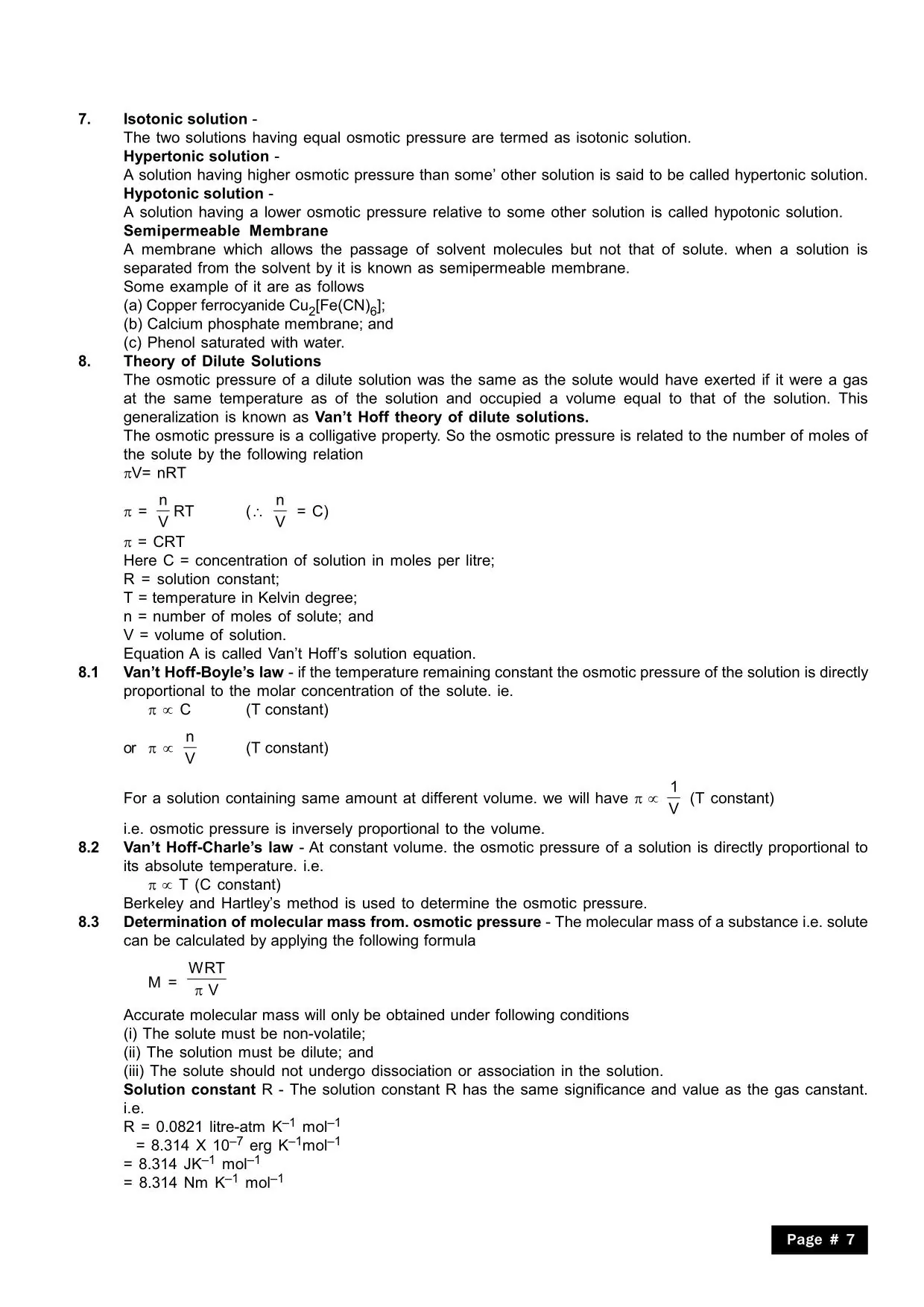
4. Osmotic Pressure (π)
Osmosis is the spontaneous flow of solvent through a semipermeable membrane from a region of lower solute concentration to higher solute concentration.
π = CRT = (n₂/V)RT
Where:
- π = osmotic pressure
- C = molar concentration of solute
- R = 0.0821 L atm mol⁻¹ K⁻¹
- T = temperature in Kelvin
From osmotic pressure: M₂ = w₂RT / πV
Key terms:
- Isotonic solutions: Equal osmotic pressure — no net flow across the membrane
- Hypertonic solution: Higher osmotic pressure than the reference
- Hypotonic solution: Lower osmotic pressure than the reference
💡 Expert Tip by eSaral Academic Team, IIT Bombay Faculty: "Osmotic pressure is the most sensitive colligative property — it can detect extremely small concentrations. This makes it most useful for determining molar masses of high-molecular-weight substances like proteins and polymers. JEE numericals on osmotic pressure frequently test this application."
Abnormal Molecular Mass and van't Hoff Factor {#vant-hoff}
Why Molecular Mass Appears "Abnormal"
Colligative property calculations assume the solute does not associate or dissociate in solution. When a solute dissociates (like NaCl) or associates (like acetic acid in benzene), the actual number of particles differs from what we calculate — making the measured molar mass appear "abnormal."
van't Hoff Factor (i)
i = observed colligative property / calculated colligative property
Or equivalently:
i = total moles of particles after dissolution / moles of solute dissolved
| Case | i value | Example |
|---|---|---|
| No association/dissociation (ideal) | i = 1 | Glucose in water |
| Dissociation | i > 1 | NaCl (i ≈ 2), CaCl₂ (i ≈ 3) |
| Association | i < 1 | Acetic acid in benzene (i < 1) |
Modified Colligative Property Formulas with van't Hoff Factor
- ΔTb = i × Kb × m
- ΔTf = i × Kf × m
- π = i × CRT
- Relative lowering = i × x₂
Degree of Dissociation (α)
For an electrolyte AB that dissociates into n ions:
i = 1 + α(n − 1)
Therefore: α = (i − 1) / (n − 1)
Key Formulas
| Property | Formula | Key Variable |
|---|---|---|
| Raoult's Law | p₁ = x₁ × p₁° | Mole fraction of solvent |
| Relative VP lowering | (p₁° − p₁)/p₁° = x₂ | Mole fraction of solute |
| Boiling point elevation | ΔTb = i × Kb × m | Kb of solvent, molality |
| Freezing point depression | ΔTf = i × Kf × m | Kf of solvent, molality |
| Osmotic pressure | π = i × CRT | Molar concentration, temp |
| Molar mass from ΔTf | M₂ = Kf × w₂ × 1000 / (ΔTf × w₁) | Mass of solute and solvent |
| van't Hoff factor | i = observed/calculated property | Dissociation/association |
| Degree of dissociation | α = (i − 1)/(n − 1) | Number of ions formed |
For complete chapter-wise notes including worked examples, solved numericals, and quick revision sheets for all Class 12 Chemistry chapters, access Complete Class 12 Chemistry Notes on eSaral.
Download the eSaral App for video lectures by Kota's top IITian faculty covering Solutions and all other Class 12 Chemistry chapters — along with JEE Main, JEE Advanced, and NEET practice questions, test series, and previous year question solutions.
Frequently Asked Questions
Find answers to common questions.
What are colligative properties and why do they depend only on number of particles?
Colligative properties are properties of solutions that depend on the number of solute particles, not their chemical identity. They include relative lowering of vapour pressure, boiling point elevation, freezing point depression, and osmotic pressure. They depend only on particle count because these properties arise from the statistical effect of solute particles on the solvent's escaping tendency — regardless of what those particles are.
What is the difference between molarity and molality in the Solutions chapter?
Molarity is moles of solute per litre of solution — it changes with temperature because liquid volume changes. Molality is moles of solute per kilogram of solvent — it does not change with temperature because mass is constant. For colligative property calculations (ΔTb, ΔTf), always use molality. Molarity is used for concentration calculations at a fixed temperature.
What is Raoult's Law and when does a solution deviate from it?
Raoult's Law states that the vapour pressure of a solvent above a solution equals the mole fraction of solvent multiplied by the vapour pressure of the pure solvent. Ideal solutions obey this law exactly. Solutions show positive deviation when solute-solvent interactions are weaker than pure component interactions (e.g., ethanol + water), and negative deviation when they are stronger (e.g., chloroform + acetone).
What is the van't Hoff factor and how is it used in colligative property calculations?
The van't Hoff factor (i) accounts for dissociation or association of solute particles in solution. For dissociating solutes like NaCl, i > 1 (more particles than expected). For associating solutes like acetic acid in benzene, i < 1 (fewer particles). All colligative property formulas are multiplied by i: ΔTb = i × Kb × m, ΔTf = i × Kf × m, π = i × CRT.
How many marks does the Solutions chapter carry in CBSE Class 12 board exams?
The Solutions chapter typically carries 5 marks in CBSE Class 12 Chemistry board exams. Questions usually include a 2-mark conceptual question (explaining a colligative property or Raoult's law) and a 3-mark numerical (calculating molar mass from ΔTf or ΔTb data, or solving an osmotic pressure problem).