Somebody's Mother Summary in English: Stanza-Wise Explanation, Theme, and Moral
Somebody's Mother is a touching poem by Mary Dow Brine that highlights the values of kindness, empathy, and respect for the elderly through the story of a young boy who helps an old woman cross a busy street, teaching that every person matters and small acts of compassion can make a big difference.

Table of Contents

eSaral ›Foundation courses ›Somebody's Mother Summary in English: Stanza-Wise Explanation, Theme, and Moral

About the Poem and the Poet
Somebody's Mother is written by Mary Dow Brine, an American poet. The poem is part of the CBSE English curriculum and is taught in Unit 2 of the prescribed course.
The poem is divided into several stanzas, each moving the story forward — from the old woman waiting alone, to the children rushing past, to one boy making a different choice, and finally to the old woman's prayer for that boy at the end of the night.
📚 Build a Strong Foundation for School Exams, Olympiads & Future Success — Enroll in eSaral Class 8 Now!
Somebody's Mother Stanza-Wise Summary in English
Stanza 1 — Who Is the Old Woman?
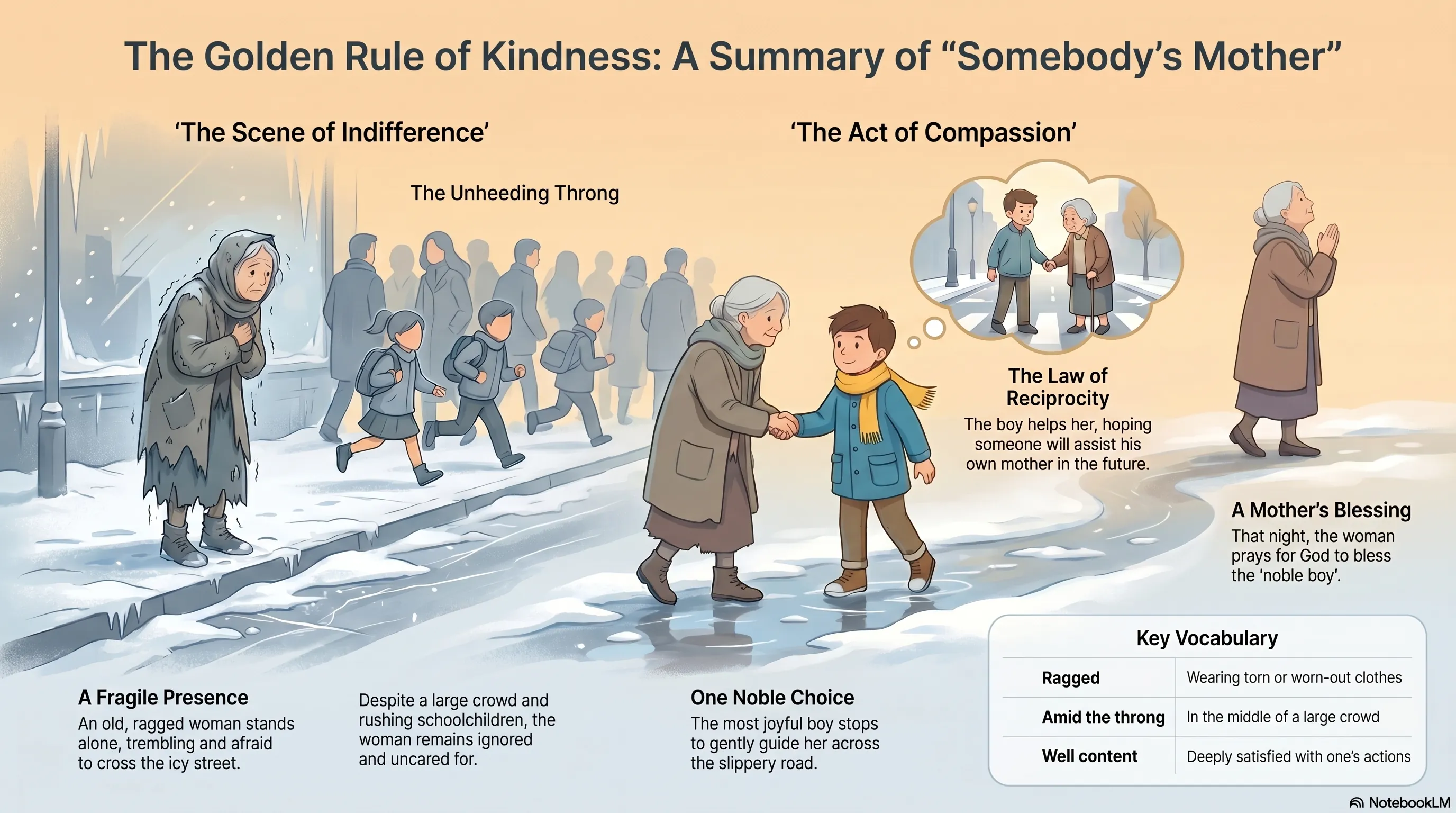
The poem opens by describing a woman who is old, ragged, and grey-haired. It is winter. The streets are wet and slippery from recent snowfall. Because of the biting cold, the old woman is bent and shrunken. She walks very slowly — her feet are aged and weak.
💡 Key Detail: The word ragged means her clothes are torn. Grey refers to her white hair. Together, these details paint a picture of a woman who is poor, old, and physically fragile.
Stanza 2 — Waiting at the Crossing
The old woman reaches a road crossing and stands there for a long time, waiting. She hopes someone will help her cross the busy, slippery road. But even though there is a large crowd of people around her, not a single person pays attention to her. She feels completely alone and ignored in the middle of that crowd.
Nobody even glances at her worried eyes. The phrase "amid the throng" means in the middle of a crowd. The word "uncared for" means nobody cares about her. The word "anxious" means worried or fearful.
Stanza 3 — The Schoolchildren Rush Past
A large group of schoolchildren comes down that same street. School has just ended, and they are laughing, shouting, and celebrating their freedom. They move like a flock of sheep released all at once — fast, noisy, and joyful.
They pass right by the old woman. They are happy and in a hurry. Not one of them offers her a helping hand. The word "hastes" here means moving quickly. The children are so caught up in their own fun that they do not notice her at all.
💡 Think About This: The children are not mean. They are simply not paying attention. This is exactly what the poem asks us to reflect on — how easy it is to miss someone who needs help when we are focused on ourselves.
📚 Build a Strong Foundation for School Exams, Olympiads & Future Success — Enroll in eSaral Class 8 Now!
📚 Build a Strong Foundation for School Exams, Olympiads & Future Success — Enroll in eSaral Class 8 Now!
Stanza 4 — The Old Woman Is Afraid to Move
The old woman does not dare to step into the road alone. The street is wet and icy from the snow. She is afraid that the carriage wheels and horses' feet will knock her down if she tries to cross without support. She stands, trembling with cold, unable to move.
The phrase "afraid to stir" means scared to move. "Slippery street" refers to the icy, wet road. The situation shows how vulnerable she is — surrounded by people, yet completely helpless.
Stanza 5 — One Boy Makes a Different Choice
At last, one boy from the happy group stops. He is described as the "gayest lad of all the group" — the most joyful and energetic boy among them. He walks up to the old woman and whispers gently: "I will help you cross, if you wish to go."
The old woman places her aged hand on his strong young arm. He carefully guides her trembling feet across the wet road, one slow step at a time. He is proud — not arrogantly, but in a warm, quiet way — that his own feet are firm and strong enough to support someone whose feet are shaking.
The word "whispere'd" shows the boy speaks gently, not loudly. "Tremblin' feet" describes her shaking, unsteady steps. "Firm and strong" describes his steady, confident feet in contrast to hers.
Stanza 6 — The Boy Explains His Reason
After helping the old woman, the boy returns to his friends. His heart is happy and fully satisfied — "well content" means deeply satisfied. His friends likely wonder why he stopped. His answer is simple and profound: she is somebody's mother, and even though she is aged and poor and slow, that does not mean she is not important.
He then says something even more meaningful: "I hope some fellow will lend a hand to help my mother." He reasons that if he helps someone else's mother today, perhaps someone will help his own mother someday when she needs it. This is the golden rule at the heart of the poem — do good, and good will return to you.
Stanza 7 — The Old Woman's Prayer
That night, after reaching her home safely, the old woman bows her head in prayer. She prays to God to be kind to the noble boy who helped her. She calls him "somebody's son" — just as she is somebody's mother, he is somebody's son. She prays that God bless him always, because he showed her true kindness when everyone else walked by.
Word Meanings — Difficult Words Explained
| Word / Phrase | Meaning |
|---|---|
| Ragged | Wearing torn, worn-out clothes |
| Grey | White or silver-coloured hair (sign of old age) |
| Amid the throng | In the middle of a large crowd |
| Uncared for | Ignored; nobody paying attention |
| Anxious eyes | Worried, fearful eyes |
| Heeded | Paid attention to |
| Hastes | Moves quickly |
| Afraid to stir | Scared to move from the spot |
| Slippery street | Wet, icy road where one can slip |
| Gayest lad | The most cheerful boy |
| Whisper'd low | Spoke in a soft, gentle voice |
| Tremblin' feet | Shaking, unsteady feet |
| Firm and strong | Steady and powerful (referring to the boy's feet) |
| Well content | Deeply satisfied |
| Bent low | Bowed down (the old woman bowing in prayer) |
📚 Build a Strong Foundation for School Exams, Olympiads & Future Success — Enroll in eSaral Class 8 Now!
Theme of the Poem
The central theme of Somebody's Mother is the importance of kindness and humanity. The poem shows that in a world where most people are too busy to notice others' struggles, one small act of care can make a profound difference.
The poem also explores the idea that every elderly person is someone's mother or father — they deserve respect and help, not indifference. The boy understands this instinctively, and that understanding transforms him from an ordinary child into an extraordinary one.
A secondary theme is the law of reciprocity — what you give comes back to you. The boy believes that because he helps someone's mother today, his own mother will be helped by someone someday. This is not a selfish calculation; it is a hopeful belief in the goodness of the world.
📚 Build a Strong Foundation for School Exams, Olympiads & Future Success — Enroll in eSaral Class 8 Now!
Moral of Somebody's Mother
The moral of the poem is: be kind to others, especially those who are weak and vulnerable, because every person matters to someone. The old woman is not just a stranger — she is somebody's mother. The boy is not just a passerby — he is somebody's son.
The poem also teaches that a single moment of attention and care costs very little but means everything to the person receiving it. We are often so absorbed in our own lives that we do not notice who needs help around us. The poem asks us to slow down, look around, and act.
For your CBSE Class 9 and Class 10 exams, you can find supporting study resources at eSaral's NCERT Solutions for Class 9 and NCERT Solutions for Class 10 to prepare thoroughly for all chapters.
Frequently Asked Questions
Find answers to common questions.
What is the summary of Somebody's Mother in English?
Somebody's Mother is a poem about an old woman who stands alone at a cold, wet road crossing in winter, unable to cross because of her weak legs and the slippery road. A crowd of people and a group of schoolchildren all ignore her. One cheerful boy finally stops, takes her hand, and gently guides her across. That night, the old woman prays to God to bless the kind boy.
What is the moral of the poem Somebody's Mother?
The moral of Somebody's Mother is that we should show kindness to elderly and vulnerable people around us, because every person matters to someone. The poem also teaches the idea that good deeds come back to you — the boy believes that because he helps someone's mother, someone will one day help his own mother too.
Who helps the old woman in Somebody's Mother, and why?
A cheerful schoolboy — described as the happiest in his group — stops to help the old woman cross the road. He explains to his friends that she is somebody's mother, and even though she is aged and poor, she still deserves kindness. He also hopes that someone will similarly help his own mother someday.
What does the old woman do at the end of the poem Somebody's Mother?
At the end of the poem, the old woman reaches home safely. That night, she bows her head in prayer and thanks God for the kind boy who helped her. She prays that God be kind to the noble boy, calling him "somebody's son" — just as she herself is somebody's mother.
What does the phrase "somebody's mother" mean in the poem?
The phrase "somebody's mother" reminds the reader — and the boy's friends — that the old woman is not just a nameless stranger. She is a real person with a family, just like anyone else. The title and the phrase both emphasise that every elderly person deserves dignity and care, not indifference.