Subject Verb Agreement Class 8: All 15 Rules Explained
Subject-Verb Agreement is the set of grammar rules that ensures the verb matches the subject in number and person, with these Class 8 notes explaining all 15 rules through simple definitions, examples, and exam-focused concepts.

Table of Contents
- What Is Subject-Verb Agreement?
- Rule 1: Singular Subject Takes a Singular Verb, Plural Subject Takes a Plural Verb
- Rule 2: Two or More Nouns Joined by "And" Take a Plural Verb
- Rule 3: Two Subjects Referring to One Idea Take a Singular Verb
- Rule 4: One Subject With Multiple Verbs — All Verbs Must Agree
- Rule 5 and 6: Subjects Joined by "Or" or "Nor" Take a Singular Verb
- Rule 7: Subjects Joined by Connectors Like "As Well As" or "Together With"
- Rule 8: Uncountable Nouns Take a Singular Verb
- Rule 9: Collective Nouns Take a Singular Verb
- Rule 10: Quantifiers Like "Both," "Few," and "Many" Take a Plural Verb
- Rule 11: Singular Indefinite Pronouns Take a Singular Verb
- Rule 12: "Not Only... But Also" — the Verb Agrees With the Closest Subject
- Rule 13: Titles of Books and Films Take a Singular Verb
- Rule 14: Some Subjects Look Plural But Are Actually Singular
- Rule 15: Amounts of Time, Money, and Measurement Take a Singular Verb

eSaral ›Foundation courses ›Subject Verb Agreement Class 8: All 15 Rules Explained

What Is Subject-Verb Agreement?
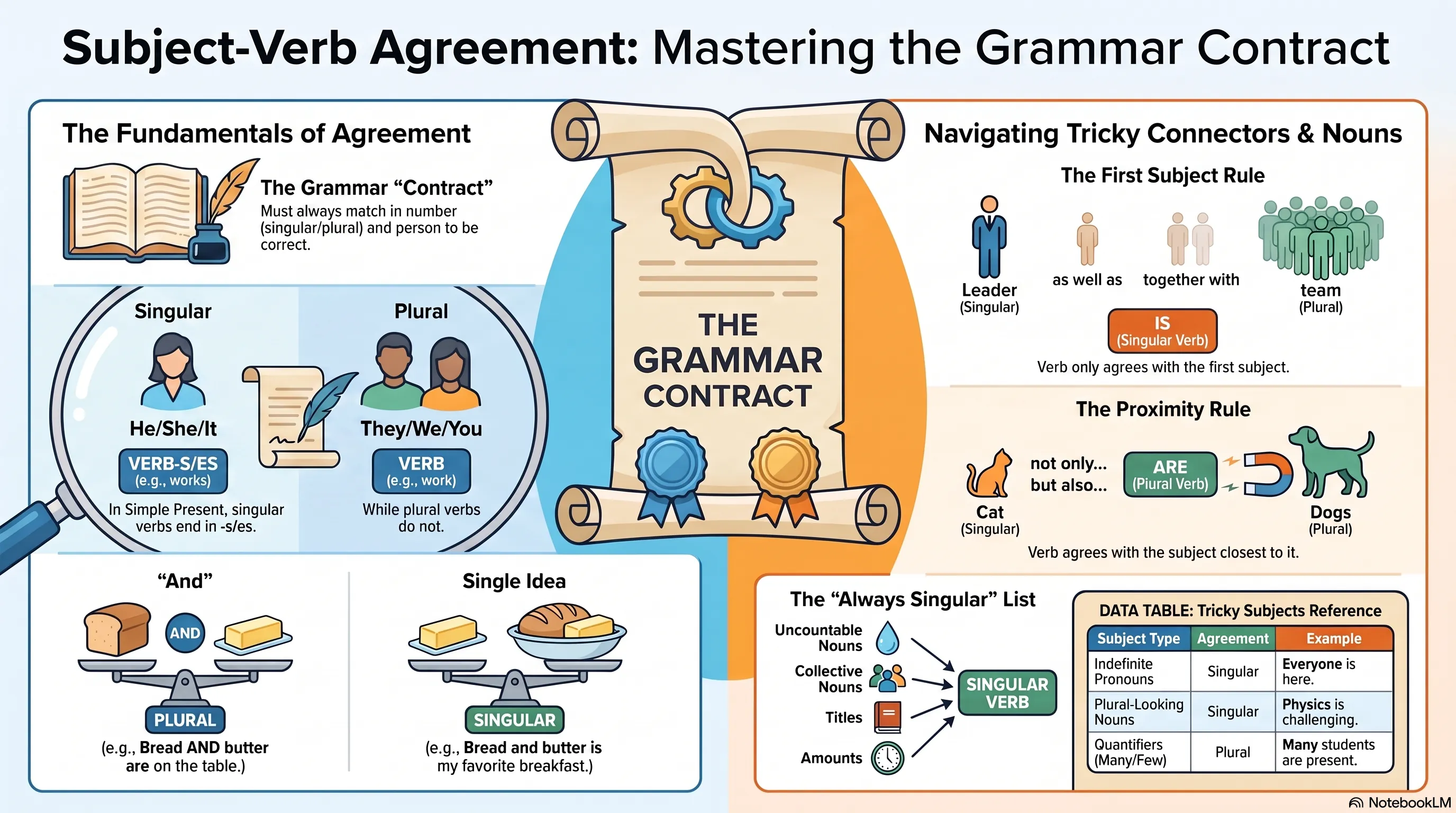
The word "agreement" here means a contract — an agreement between the subject and the verb in a sentence. Just as two people who sign a contract cannot break it under any condition, the subject and verb in a sentence must always match each other.
Subject-Verb Agreement refers to a set of rules that suggest the subject and the verb present in a sentence should agree with each other for the sentence to be grammatically correct. In other words, the verb must agree with the subject in number (singular or plural) and in person (first, second, or third person).
Consider this incorrect sentence: "I are a good girl." Here, "I" is the subject and "are" is the verb — but they do not agree with each other, so the sentence is grammatically wrong. The correct version is "I am a good girl," where "I" (subject) and "am" (verb) agree with each other.
A Quick Way to Spot Singular Verbs
In the Simple Present Tense, a singular verb almost always ends in -s or -es (for example, "works," "teaches"). A verb without -s or -es in the Simple Present Tense is automatically the plural form (for example, "work," "teach"). Keeping this one detail in mind makes most of the rules below much easier to apply.
Rule 1: Singular Subject Takes a Singular Verb, Plural Subject Takes a Plural Verb
If the subject is singular, it always takes a singular verb. If the subject is plural, it always takes a plural verb.
- Example (singular): Alice wakes up early in the morning. "Alice" is a single name, so it is a singular subject, and "wakes" (with -s added) is the singular verb.
- Example (plural): We are going to play. "We" refers to more than one person, so it is a plural subject, and "are" is the plural verb.
Rule 2: Two or More Nouns Joined by "And" Take a Plural Verb
When two or more nouns are joined by the conjunction "and," a plural verb is used.
Example: The king and the courtiers are discussing the strategy. Here, "king" and "courtiers" are joined by "and," so the plural verb "are" is used — and this stays true even with three or more nouns joined by "and" (for example, "the king and the courtiers and the queen are...").
Rule 3: Two Subjects Referring to One Idea Take a Singular Verb
When there are two subjects in a sentence, but together they refer to one single idea, a singular verb is used.
Example: Bread and butter is eaten for breakfast by the kids. "Bread" and "butter" are two separate subjects, but they refer to one combined idea — a single breakfast item — so the singular verb "is" is used instead of "are."
Rule 4: One Subject With Multiple Verbs — All Verbs Must Agree
When there is one subject in a sentence and more than one verb, all the verbs must agree with that subject — whether the subject is singular or plural.
Example: Ravi is a good boy and he thinks that everyone is good. "Ravi" is a singular subject, so even though the sentence uses more than one verb, every verb stays in its singular form.
Rule 5 and 6: Subjects Joined by "Or" or "Nor" Take a Singular Verb
When two or more singular nouns are joined by "or" or "nor," a singular verb is used. Similarly, two singular subjects connected by "either... or" or "neither... nor" also require a singular verb.
- Example: Rita and Sita has joined the class — using the rule for "or"/"nor" style construction with singular nouns, the singular verb "has" is used (not "have," which is the plural form).
- Example: Neither Riya nor Siya has joined the class. Both "Riya" and "Siya" are singular subjects connected by "neither... nor," so the singular verb "has" is used.
Rule 7: Subjects Joined by Connectors Like "As Well As" or "Together With"
When a subject has two nouns or pronouns joined by connectors such as "as well as," "along with," "in addition to," or "together with," the verb agrees with the first subject only — not the second one.
Example: The minister together with the governor is arriving on the protest. "The minister" is the first noun and is singular, so the singular verb "is" is used, even though "the governor" (the second noun) follows. If the first noun were plural, the verb would be plural instead.
Rule 8: Uncountable Nouns Take a Singular Verb
Uncountable nouns always take a singular verb.
Example: The water flows high to low. "Water" cannot be counted, so it is an uncountable noun, and the singular verb "flows" (with -s added) is used.
Rule 9: Collective Nouns Take a Singular Verb
Collective nouns also always take a singular verb.
Example: My team has visited this cafe. "Team" is a collective noun (referring to a group as one unit), so the singular verb "has" is used — not "have," which is the plural form.
Rule 10: Quantifiers Like "Both," "Few," and "Many" Take a Plural Verb
Plural verbs are used with quantifiers such as "both," "few," and "many."
Example: Many students are present in the hall. "Many" is a quantifier, and whenever such a quantifier appears in a sentence, a plural verb must be used without hesitation.
Rule 11: Singular Indefinite Pronouns Take a Singular Verb
A singular verb must always be used with singular indefinite pronouns such as: each, either, neither, anyone, everyone, no one, someone, anybody, everybody, nobody, somebody, anything, everything, nothing, and something.
Indefinite pronouns are different from definite pronouns like "he," "she," and "it," because with indefinite pronouns, it isn't clear exactly who or what the subject is.
- Example: Something was missing yesterday.
- Example: Nobody has brought their car.
Rule 12: "Not Only... But Also" — the Verb Agrees With the Closest Subject
When two subjects are joined by "not only... but also," the verb agrees with the subject that is closest to it.
Example: Not only Sheena but my other friends were also happy for my admission. Here, "my other friends" (plural) is the subject closest to the verb, so the plural verb "were" is used instead of the singular "was."
Rule 13: Titles of Books and Films Take a Singular Verb
Titles of books, magazines, and films take a singular verb, even if the title itself contains a plural noun.
Example: Harry Potter is my favourite book. Even though "Harry Potter" could be read as more than one name, the title is treated as a single unit, so the singular verb "is" is used.
Rule 14: Some Subjects Look Plural But Are Actually Singular
Some subjects might appear plural — such as news, gymnastics, physics, and statistics — but they are actually singular in meaning and therefore take a singular verb.
Example: This information is based on true events. "Information" sounds like it could take a plural verb, but it is grammatically singular, so "is" is the correct verb here.
Rule 15: Amounts of Time, Money, and Measurement Take a Singular Verb
A singular verb is generally used after words that denote an amount — such as time, money, measurement, weight, value, or volume.
Example: Ten thousand rupees is required for a small function. Even though "ten thousand rupees" might look plural, it refers to a single amount of money, so the singular verb "is" is used.
Revising this chapter carefully is worth the time, since it forms the base for correct sentence construction across every other English Grammar topic in Class 8. For more chapter-wise CBSE Class 8 study material, explore eSaral's NCERT Solutions for Class 8 and NCERT Books for Class 8.
Frequently Asked Questions
Find answers to common questions.
What is Subject-Verb Agreement?
Subject-Verb Agreement is a set of rules stating that the subject and verb in a sentence must agree with each other in number and person. If a singular subject takes a plural verb, or vice versa, the sentence becomes grammatically incorrect.
What verb form is used when two nouns are joined by "and"?
When two or more nouns are joined by the conjunction "and," a plural verb is used, as in "The king and the courtiers are discussing the strategy."
Do collective nouns like "team" take a singular or plural verb?
Collective nouns always take a singular verb. For example, "My team has visited this cafe" uses "has," the singular form, rather than "have."
What verb is used with quantifiers like "both," "few," and "many"?
Quantifiers such as "both," "few," and "many" always take a plural verb, as in "Many students are present in the hall."
Which verb form is used with indefinite pronouns like "everyone" or "nobody"?
Singular indefinite pronouns such as each, either, neither, anyone, everyone, no one, someone, anybody, everybody, nobody, somebody, anything, everything, nothing, and something always take a singular verb.
What happens when two subjects are joined by "not only... but also"?
The verb agrees with whichever subject is closest to it. For example, in "Not only Sheena but my other friends were also happy," the plural verb "were" agrees with "my other friends," the closer subject.