That is a Concrete Example Poem Explanation, Summary & Literary Devices (Class 10 English)
"That is a Concrete Example" is a humorous poem by Reginald Arkell about a narrator who visits his neighbour Mrs Jones's unusual garden — built entirely from stones, pebbles, and gravel instead of grass. When the narrator asks to see the beautiful thing he was invited to admire, Mrs Jones quietly tells him he is already standing on it. The poem's central message is that beauty is subjective — one person's rubble is another person's masterpiece. The title is a pun: "concrete" means both the physical building material used in the garden and a clear, specific example of how individual tastes differ.
.webp)
Table of Contents

eSaral ›Foundation courses ›Class 8›That is a Concrete Example Poem Explanation

About the Poet — Reginald Arkell
Reginald Arkell was a distinguished British scriptwriter, comic novelist, and poet. He is best remembered for his witty observations on English rural life and gardening, a subject that runs directly through this poem.
His most celebrated work was the novel Old Herbaceous, now considered a classic of gardening literature. Arkell's writing style is characterised by gentle humour, playful wordplay, and a deep appreciation for the quirky aspects of human nature. His poems often carry two layers of meaning — a surface-level, literal story and a deeper, thought-provoking insight into how people think and feel.
This poem, "That is a Concrete Example," is part of the Wit and Wisdom unit in Class 10 English and showcases Arkell's trademark blend of comedy and philosophy.
Meaning of the Title — What Does "Concrete" Really Mean?
The title is the first literary trick Arkell plays on the reader. The word "concrete" carries two very different meanings here, and understanding both is key to understanding the entire poem.
Literal Meaning of "Concrete"
In its literal sense, concrete refers to the physical building materials — stones, gravel, and pebbles — that Mrs Jones has used to construct her garden. A typical garden is made of organic soil, grass, and plants. Mrs Jones, however, has built hers using small stones and pebbles (gravel) instead. So the title literally describes the material composition of her unusual garden.
Figurative Meaning of "Concrete"
In its figurative sense, "concrete" means clear, specific, and tangible. The poem itself serves as a concrete (unmistakable) example of how individual tastes differ. What one person finds beautiful, another may dismiss as rubble. The title therefore works as a pun — it describes Mrs Jones's stone garden AND signals that this poem is a precise, clear example of a universal human truth.
💡 Expert Tip by eSaral English Faculty: The double meaning in the title is the poem's central literary device — a pun. In your CBSE exam, always explain both the literal and figurative meanings of "concrete" for full marks.
Stanza-Wise Explanation of the Poem
Stanza 1 — Mrs Jones's Unusual Garden
The poem opens with the narrator introducing his next-door neighbour, Mrs Jones. He tells us she has a garden full of stones — not a conventional garden with grass and mud, but one paved with gravel, pebbles, and rocks. The narrator describes it as a "crazy path", meaning the stone pathway running through the garden looks strange and unconventional to him.
The garden also features:
- A lily pond — a small water feature
- A rockery — a large decorative stone arrangement
- A sundial — an ancient device once used to tell the time using the sun's shadow, which Mrs Jones considers a charming addition to her garden
The narrator's tone here is gently mocking. He finds the garden odd, but he is not cruel — just puzzled by Mrs Jones's choices.
Stanza 2 — The Tiny Flowers in the Path
In the second stanza, the narrator notices that Mrs Jones has planted tiny, delicate flowers between the gaps in the stones on her path. He describes these flowers as "so delicate and small" that they barely seem to exist. He wonders aloud what purpose they serve — they are so tiny they don't seem to mean anything to him.
His most memorable line here is that he can't imagine how she even planted them, unless she used a pin to push them into the soil. This is a humorous exaggeration — no one plants flowers with a pin — but it captures just how impossibly small and out-of-place these flowers seem.
💡 Expert Tip by eSaral English Faculty: This stanza contains a key hyperbole ("planted them with a pin"). Identify it clearly in your exam answer and explain that it is used to comic effect, highlighting how microscopic and impractical the flowers seem to the narrator.
Stanza 3 — The Narrator is Invited to See the Garden
In the final stanza, Mrs Jones invites the narrator to come and see her stones — meaning her garden. The narrator arrives and spends a quarter of an hour (15 minutes) standing there, searching for the beautiful thing he has been invited to admire. He eventually calls out: "Where is this lovely thing?"
Mrs Jones's reply is the poem's punchline and its most powerful moment. She calmly tells him: "You are standing on it."
The narrator has been standing on the tiny flowers the entire time without realising it. The very thing he dismissed as pointless and invisible is, to Mrs Jones, the most precious and beautiful part of her garden. This is the poem's central irony — and its central truth.
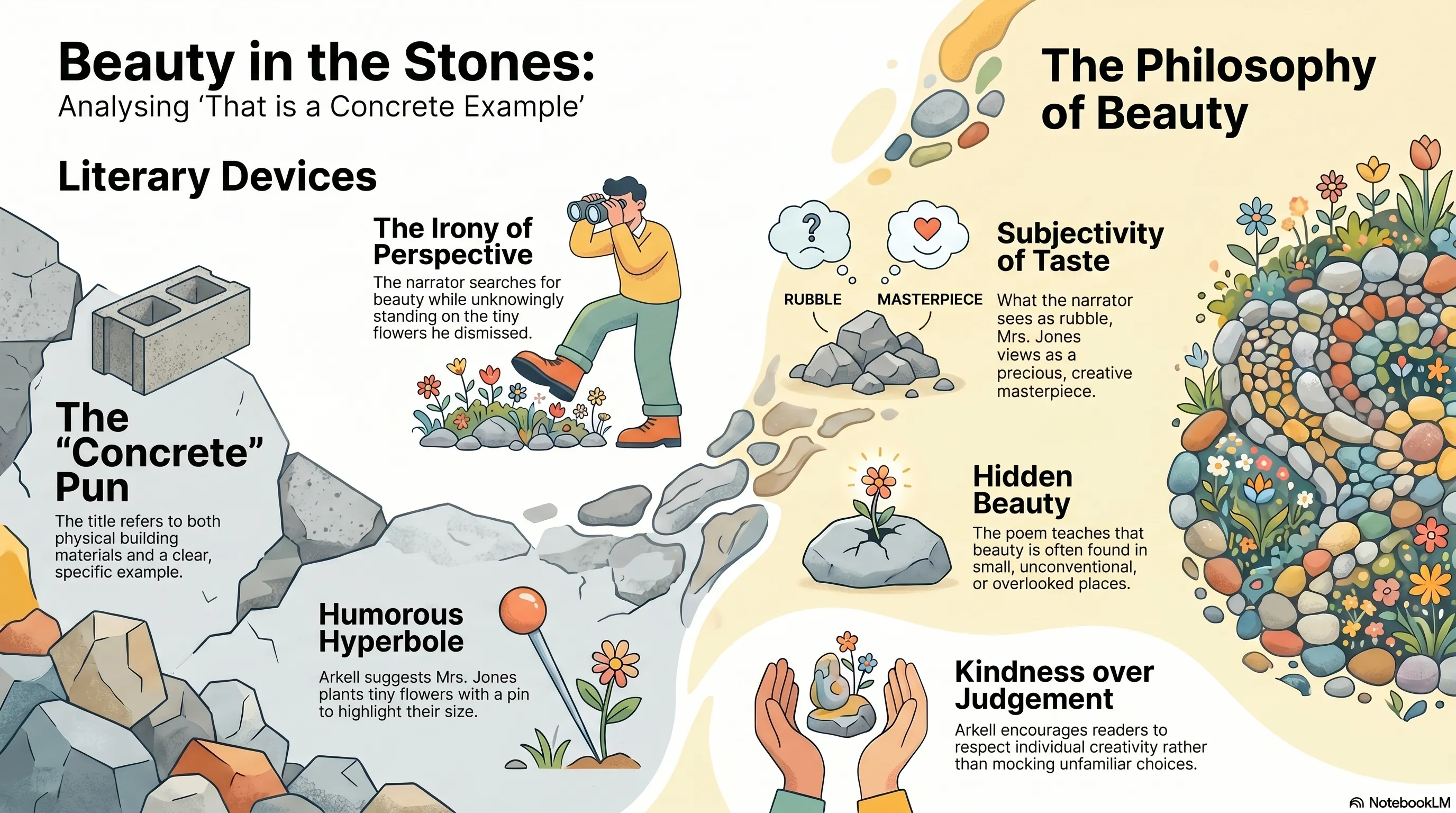
Literary Devices Used in the Poem
Understanding the literary devices is essential for CBSE exam answers. Here is a clear breakdown:
| Literary Device | Example from the Poem | Explanation |
|---|---|---|
| Pun | Title — "Concrete Example" | Double meaning: building material + a clear/specific example |
| Irony | Narrator standing on the very flower he searched for | Expected to find something obvious, reality was the opposite |
| Hyperbole | "Unless she plants them with a pin" | Exaggeration to humorously show how tiny the flowers are |
| Imagery | "Crazy path", "lily pond", "garden full of stones" | Creates a vivid mental picture of the unconventional garden |
| Humour / Wit | The entire structure of invitation → confusion → punchline | Gentle comic tone throughout, characteristic of Arkell |
What is the Pun in "That is a Concrete Example"?
A pun is a play on words where one word carries two meanings. In this poem, "concrete" simultaneously means the building material (stones and gravel) and a clear, specific example. Both meanings apply perfectly, which makes it a masterful title.
What is the Irony in the Poem?
Irony occurs when the outcome is opposite to what was expected. The narrator goes looking for something beautiful and impressive. Instead, the "beautiful thing" is a tiny flower so small that he walked right over it without seeing it.
How is Imagery Used in the Poem?
Arkell uses descriptive phrases — "crazy path", "lily pond", "garden full of stones" — to build a clear visual of a garden that defies convention. This imagery helps the reader picture exactly why the narrator finds the place so baffling.
Central Theme and Message of the Poem
What is the main theme of "That is a Concrete Example"?
The poem's central theme is the subjectivity of beauty and the uniqueness of individual taste. Mrs Jones sees extraordinary beauty in her stone garden and her tiny, almost invisible flowers. The narrator sees only rubble and pointlessness. Neither is wrong — they simply see the world differently.
What is the message the poet wants to give?
Reginald Arkell leaves the reader with four interconnected ideas:
- Everyone is unique. No two people experience beauty in exactly the same way.
- Creativity has many forms. Mrs Jones's stone garden is just as valid an expression of creativity as a conventional flower garden.
- Respect builds harmony. If we respect each other's individual choices, we connect rather than divide.
- Kindness over judgment. Rather than laughing at what others find beautiful, we should appreciate that they find beauty at all.
The poem ends with a gentle reminder: beauty is not just in the grand and the green — sometimes it is hidden in the stones and the small.
Frequently Asked Questions
Find answers to common questions.
What is the poem "That is a Concrete Example" about?
The poem is about a narrator who visits his neighbour Mrs Jones's unconventional stone garden. She has built her garden using pebbles and gravel instead of soil and grass, and planted tiny flowers between the stones. When the narrator asks to see the beautiful thing she invited him to admire, she tells him he is standing on it. The poem illustrates that beauty is subjective and individual tastes differ.
Who wrote "That is a Concrete Example, and which class is it in?
The poem is written by Reginald Arkell, a British comic novelist and poet known for his witty observations on English rural life. It is part of the Class 10 CBSE English curriculum, specifically in the "Wit and Wisdom" unit.
What are the literary devices in "That is a Concrete Example"?
The poem uses several literary devices: a pun in the title ("concrete"), irony when the narrator is found standing on the very flower he searched for, hyperbole when the narrator jokes that the flowers must have been planted with a pin, and imagery through phrases like "crazy path" and "garden full of stones.
What is the irony in "That is a Concrete Example"?
The irony lies in the poem's climax. The narrator spends 15 minutes searching for the beautiful thing Mrs Jones invited him to see. He expects something large, obvious, and conventionally pretty. Instead, Mrs Jones reveals that he has been standing on it the whole time — a tiny flower he didn't even notice. The gap between his expectation and the reality creates the poem's central irony.
What is the significance of the sundial in the poem?
The sundial is mentioned as a "strange device" that Mrs Jones placed in her garden and considers "rather nice." A sundial is an ancient instrument used to tell time by the shadow cast by sunlight. Its inclusion in the poem reinforces the garden's unusual, old-fashioned, and unconventional character — and it is one more detail that the narrator finds puzzling but Mrs Jones finds charming.