The Pot Maker Chapter Summary: Full Story, Lesson & Explanation
The Pot Maker is a story set in a small Nagaland village about a girl named Sentila who dreams of becoming a skilled pot maker like her mother and grandmother. Despite her mother Arenla's refusal to teach her — due to the hard and low-paying nature of the craft — Sentila secretly learns pot making from expert potters and eventually masters the skill through sheer patience, observation, and hard work.
.webp)
Table of Contents
- Introduction to The Pot Maker
- Part One: Sentila's Dream and Arenla's Refusal
- Why Arenla Refused to Teach Pot Making
- The Village Council Gets Involved
- Part Two: Sentila Finally Learns
- The Role of Onuola — The Kind Mentor
- Sentila Makes Her First Pot Alone
- The Ending and What It Means
- Key Lesson from The Pot Maker

eSaral ›Foundation courses ›The Pot Maker Chapter Summary: Full Story, Lesson & Explanation

Introduction to The Pot Maker
Have you ever watched a potter at work — shaping shapeless mud into something beautiful? The chapter The Pot Maker draws on exactly that image. It is set in a small village in Nagaland, and its central character is a young girl named Sentila.
The story explores what happens when a child has a passion that her parents do not support. It shows how patience, persistence, and the help of a kind mentor can turn a dream into reality. The names in this story may feel unfamiliar, but they belong to the Naga community — understanding that makes the cultural setting clearer.
This explanation follows the story as it unfolds across two parts, exactly as covered in the chapter.
Part One: Sentila's Dream and Arenla's Refusal
Ever since Sentila became old enough to accompany her mother and grandmother to the fields and forests, she began to dream of becoming a pot maker — just like them. Watching her mother and grandmother give beautiful shapes to unshaped lumps of clay deeply fascinated her.
Her mother's name is Arenla, and her father's name is Mesouba.
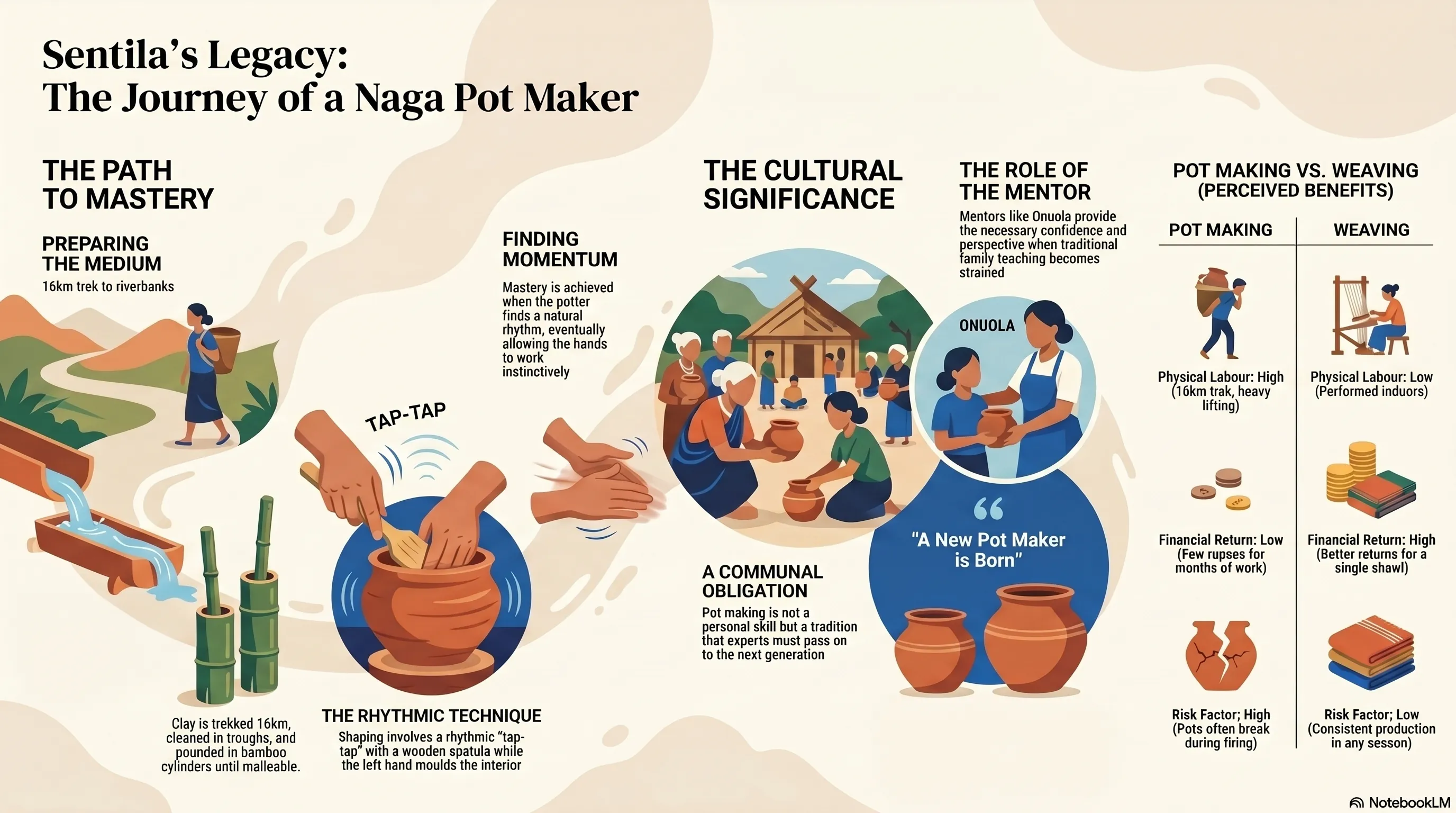
However, Arenla wanted Sentila to become a weaver — not a potter. She believed weaving would earn more money and cause less physical strain. On days when her parents went to the fields, Sentila quietly slipped away and visited expert potters in the village to learn the craft. She watched carefully how clay was mixed with water, pounded, rotated, and shaped using a spatula held in the right hand while the left hand moulded the pot from the inside.
The regular tap-tap of the spatula on the clay was like music to Sentila's ears.
When Arenla and Mesouba found out about Sentila's visits, they were amused at first. They assumed it was a childish phase and that she would soon outgrow her passion for pot making. But Sentila never told her parents how deeply she loved this craft — because she had once overheard a conversation between them.
Why Arenla Refused to Teach Pot Making
In that overheard conversation, Arenla was complaining to Mesouba about Sentila's lack of interest in weaving. Arenla explained clearly why she did not want to teach her daughter pot making:
| Reason | Arenla's Explanation |
|---|---|
| The clay source is far away | The river bank where grey and red clay are found is 16 kilometres from the village |
| The journey is exhausting | She has to climb steeply down to the riverbank and carry heavy loads of clay back up the hill |
| Pounding clay is tedious | Clay must be stuffed into bamboo cylinders and pounded repeatedly to soften it |
| Low earnings | After months of hard labour, the reward is only a few rupees — a very small amount |
| Weaving earns more | A single shawl made through weaving brings a much better return and can be done indoors in any season |
| Pots break during exhaustion | Arenla had often dropped the mould out of sheer tiredness and had to start the entire process all over again |
💡 Key Insight: Arenla's objections were practical and born of lived experience. Her difficulty with pot making was real — but Sentila's love for it was equally real.
The village gossip eventually spread. People began to wonder why Arenla was refusing to pass on a generational skill to her own daughter.
The Village Council Gets Involved
As word spread through the small village, Mesouba was summoned by the Village Council — the local governing body — and asked to explain why Arenla was refusing to teach Sentila the skill of pot making.
Mesouba, speaking in a humble tone, told the elders: "Arenla has never said she will not teach her daughter pot making. We only wanted her to grow stronger after her illness. You will soon see Sentila making the best pots in the village."
This was not entirely the truth. Mesouba was trying to avoid conflict with the council. But the damage was done — he had now committed publicly.
The Village Council reminded Mesouba of something important: pot making is not just a personal skill. It is a tradition passed down from generation to generation. Expert potters are obliged to pass on their skill — first to their own children, and also to anyone willing to learn. The craft belongs to the community, not to any individual.
After this, Mesouba went home and discussed the matter with Arenla. She had no choice but to begin teaching Sentila.
Part Two: Sentila Finally Learns
The following year, Arenla took Sentila to the river bank where the grey and red clay was found. She taught her how to:
- Dig the clay using a daow (a digging instrument)
- Load the clay into a carrying basket
- Soak it in a trough (a large tray filled with water) to clean it
- Stuff it into a bamboo cylinder in the right proportion
- Pound it repeatedly to make it soft and malleable
Sentila was a quick learner. She turned the clay into a malleable dough exactly as her mother had shown her. But when she tried to shape the lump into a pot, she could not even hold it properly.
Arenla sat quietly in the corner and watched her daughter try again and again. Sentila felt shame and frustration — she had dreamed of this for so long, yet the skill would not come to her hands. Arenla eventually stepped in and shaped the lump into a beautiful pot herself.
The sessions continued for almost a year. But Sentila was still unable to learn from her mother's teaching alone.
The Role of Onuola — The Kind Mentor
According to village custom, when a girl comes of age, she is allowed to stay for some nights in a girls' dormitory — a large shared room — supervised by a kind, middle-aged widow. The girls called her Onuola or simply "Auntie."
Onuola had already heard about the trouble in Sentila's family. One evening, when the other girls went to attend a music event, Sentila stayed behind. Onuola noticed her quietly taking out a lump of clay and trying to shape it into a pot.
Onuola watched silently. She noticed that Sentila was far too tense while working. This tension was passing into the clay — and the clay refused to take the right shape. When an exhausted Sentila finally let the misshapen lump fall to the ground, Onuola went to her and said:
"Don't worry, little one. I shall teach you how to make a perfect pot."
What happened next amazed Sentila. Onuola fashioned a beautiful pot effortlessly right before her eyes. Then Onuola asked Sentila to try again.
This time, Sentila picked up a fresh lump of clay — with a confidence she had never felt before — and followed Onuola's instructions carefully. She created a beautiful pot.
But Onuola looked at it and said, "The mouth of the pot is all wrong."
Sentila looked at Onuola in frustration. Onuola smiled and said, "When you work with your mother next time, watch carefully how she shapes the mouth of the pot. You are a quick learner. You will do it well."
Sentila Makes Her First Pot Alone
During the next pot-making session with her mother, Sentila carefully observed how Arenla:
- Held the spatula in her right hand and controlled the rotating clay with her left
- Slackened her rhythm gently when shaping the mouth of the pot
- Added a strip of elongated dough to the mouth to form the rim
Then came the day that changed everything.
On a bright, sunny day, Arenla told Sentila they needed to make as many pots as possible because there would not be enough sunshine to dry them later. They went to the work shed early.
Arenla quickly completed one batch of pots and asked Sentila to take over, saying she had a headache and backache and needed to rest inside. She asked Sentila to try and make as many pots as she could.
Sentila was surprised — but she was determined. She began beating the dough in perfect coordination with her left hand. And then it happened:
Before long, she realised the pot was ready.
She started the next one. Like a sprinter who had suddenly found momentum, she kept going — pot after pot — with the same speed and skill she had noticed in her mother's hands.
When she finally looked at her row of pots, she saw she had made one row more than her mother's tally.
The Ending and What It Means
Exhausted from her labour, Sentila went inside to join her mother for lunch. When she reached the doorstep, she found Arenla lying on the floor — not breathing.
Sentila ran for help. The whole village rushed to the house. Arenla passed away.
The next morning, as Arenla's body was being carried out of the house, Sentila ran after it, crying: "Mother, I did not wish it to happen this way. It simply came to me."
No one in the village understood what she meant — except Onuola.
On her way back, Onuola noticed that the door to the work shed was slightly open. Driven by curiosity, she stepped inside — and stopped in her tracks.
Two rows of freshly made pots stood side by side in perfect symmetry. Onuola could find no difference between one batch and the other. She stood there for a long time, as if witnessing something extraordinary.
Slowly, she walked away — certain of what she had witnessed:
A new pot maker was born.
Key Lesson from The Pot Maker
The chapter leaves us with two powerful lessons — exactly as the story emphasises:
- Follow your ambition, even when others discourage you. Sentila never gave up on her dream of becoming a pot maker, despite her mother's refusal and her own repeated failures.
- Hard work and patience always matter. Pot making is an exhausting craft — fetching clay from 16 km away, pounding it for hours, shaping it carefully, firing it at the right temperature. Yet Sentila kept going. When she finally found her momentum, she equalled and even surpassed her mother in a single sitting.
The story also carries a cultural message: skills and traditions are not the property of one person. They belong to the community and must be passed on from generation to generation.
Frequently Asked Questions
Find answers to common questions.
What is the main theme of The Pot Maker chapter?
The main theme is the power of passion, patience, and hard work. Sentila dreams of becoming a potter and refuses to give up despite her mother's refusal, repeated failures, and a full year of fruitless practice. The chapter shows that when ambition meets persistence, the skill eventually "simply comes" — as Sentila herself says at the end.
Who are the main characters in The Pot Maker story?
The main characters are Sentila (the young girl who wants to become a potter), Arenla (her mother, who is a skilled potter but refuses to teach her), Mesouba (Sentila's father), and Onuola (a kind middle-aged widow who mentors Sentila at a crucial moment). The story is set in a small village in Nagaland.
Why does Arenla refuse to teach Sentila pot making?
Arenla refuses because pot making is, in her experience, exhausting and poorly paid. The grey and red clay needed for pots must be collected from a river bank 16 kilometres away. Carrying the clay uphill, pounding it in bamboo cylinders, and carefully firing the pots takes months — yet the earnings are only a few rupees. She believes weaving would earn Sentila far more with less hardship.
What is the significance of Onuola in The Pot Maker?
Onuola acts as the turning-point mentor in the story. She notices that Sentila is too tense while working, which is stopping the clay from taking the right shape. By calmly demonstrating how to make a beautiful pot and encouraging Sentila to try again with confidence, Onuola gives her the breakthrough she needed. Without Onuola's intervention, Sentila might never have unlocked her skill.
What happens at the end of The Pot Maker chapter?
On a bright sunny day, Arenla asks Sentila to take over pot making alone while she rests. Sentila, finally free from tension, makes pot after pot — exceeding even her mother's count. But when she goes inside, she finds Arenla has passed away. The next morning, Onuola discovers two perfect, identical rows of pots in the shed and realises that a new pot maker has been born in the village.