The Wit That Won the Hearts Summary Class 8: Full Chapter Explanation with Word Meanings
A witty and intelligent Tenali Rama uses humor and clever thinking to resolve a quarrel between King Krishnadeva Raya and Queen Tirumalamba, proving that wit is more powerful than pride and power.
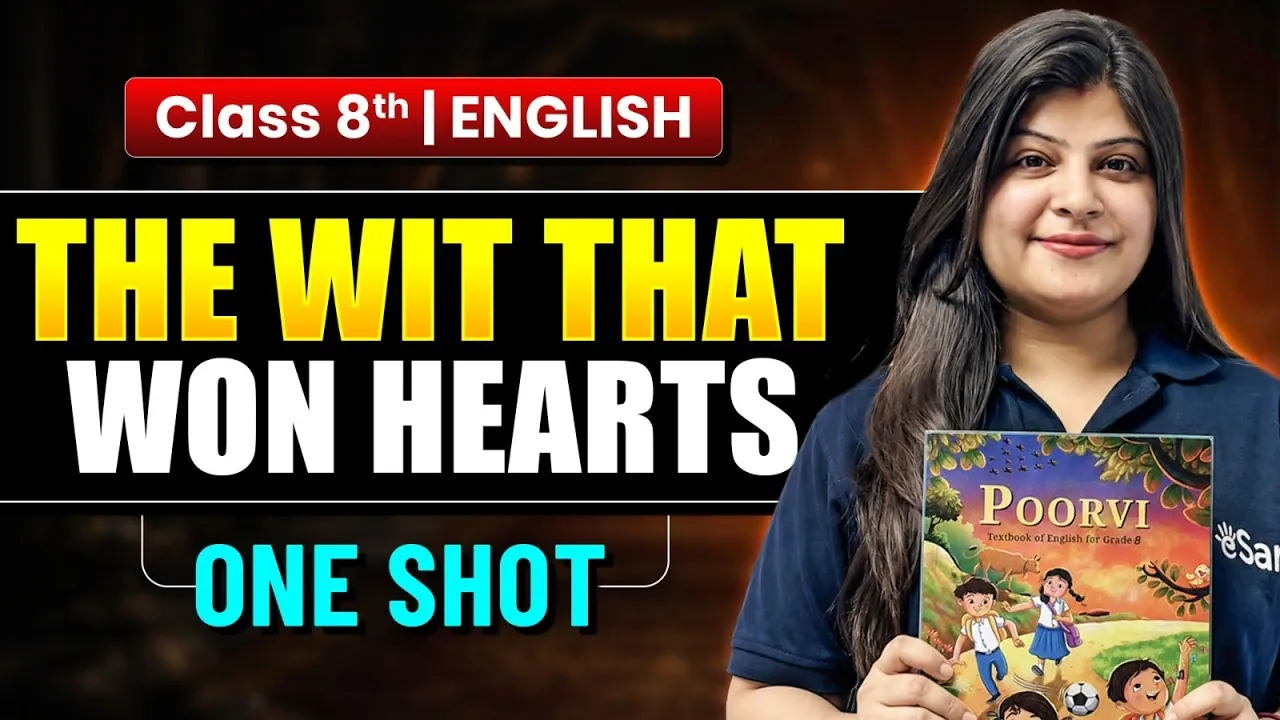
Table of Contents
- About the Chapter — Wit and Wisdom Unit 1
- Who Was Tenali Ramakrishna? Character Introduction
- The Vijayanagara Empire and King Krishnadeva Raya
- The Wit That Won the Hearts — Full Story Summary
- Important Word Meanings from the Chapter
- What Is the Moral of The Wit That Won the Hearts?
- Character Analysis: Tenali Rama, the King, and the Queen

eSaral ›Foundation courses ›Class 8›The Wit That Won the Hearts Summary Class 8

About the Chapter — Wit and Wisdom Unit 1
Class 8 English begins with a unit called Wit and Wisdom, and the very first chapter sets the tone perfectly. "The Wit That Won the Hearts" is a story that teaches students that intelligence, quick thinking, and a sense of humour are more powerful than wealth or brute strength alone.
Before starting the chapter, eSaral teacher Ratika Sharma asks students a simple but sharp question: "Do you know English?" Most students say yes. But the real question is — can you use English smartly? That is the difference between knowing a language and having wit.
💡 Expert Tip by eSaral Academic Team: "Wit" is a skill — the ability to quickly answer any question with intelligence and humour so that the other person is left speechless. This chapter teaches wit not just as a vocabulary word, but as a life skill.
The chapter connects to Indian history and culture, making it engaging beyond just language learning. It is part of the NCERT Class 8 English curriculum and often appears in school exams as a passage, summary, or character-based question. You can access the full NCERT textbook for reference at eSaral's NCERT Books for Class 8.
Who Was Tenali Ramakrishna? Character Introduction
Tenali Ramakrishna — popularly known as Tenali Rama — was a real historical figure from South India, famous for his extraordinary intelligence, sharp wit, and sense of humour. If you have watched the TV show Tenali Rama on Indian television, you already know a little about him.
What Made Tenali Rama Famous?
Tenali Rama was known for solving the most complex riddles and obstacles in King Krishnadeva Raya's court — not through force, but through cleverness. Every time the king faced a difficult situation, he went straight to Tenali Rama. Why? Because Tenali had three powerful qualities working together:
- Quick wit — the ability to think and respond fast
- Deep knowledge — understanding of literature, culture, and human nature
- Sense of humour — making people laugh while making them think
How Is Tenali Rama Similar to Birbal?
A useful parallel from the chapter: just as Emperor Akbar had his Navratnas (nine celebrated courtiers), the most famous being Birbal and the great musician Tansen, King Krishnadeva Raya had his Ashtadiggajas — eight celebrated poets. Tenali Ramakrishna was one of them.
| Ruler | Famous Court | Notable Courtier | Known For |
|---|---|---|---|
| Emperor Akbar (Mughal) | Navratnas | Birbal | Wit and quick answers |
| Emperor Akbar (Mughal) | Navratnas | Tansen | Extraordinary music |
| King Krishnadeva Raya (Vijayanagara) | Ashtadiggajas | Tenali Ramakrishna | Wit, poetry, and advice |
| King Krishnadeva Raya (Vijayanagara) | Ashtadiggajas | Allasani Peddana | Literary masterpieces |
The term Ashtadiggajas means "eight celebrated poets." Do not forget this term — it frequently appears in exam questions.
The Vijayanagara Empire and King Krishnadeva Raya
The chapter opens with background about the Vijayanagara Empire — a historically significant South Indian kingdom. Understanding this background helps you answer context-based questions in exams.
Why Was the Vijayanagara Empire Famous?
The Vijayanagara Empire was renowned (well known, famous) for three things: its glory, its wealth, and its cultural achievements. Literature, art, and architecture flourished there, and the kingdom supported learning in every form.
Who Was King Krishnadeva Raya?
King Krishnadeva Raya ruled the Vijayanagara Empire from 1509 to 1529 CE — a long and prosperous reign. His period is often called the Golden Era of the Vijayanagara Empire because:
- Art, literature, and architecture grew rapidly under his rule
- He was a patron of learning — he actively supported education and skills for all people in his kingdom
- He was not just a warrior (eminent warrior) — he was also a gifted poet
- His two most celebrated works were Amuktamalyada and the Sanskrit epic Jambavati Kalyanam
💡 Expert Tip by eSaral Academic Team: Remember the names of King Krishnadeva Raya's literary works for exams — Amuktamalyada and Jambavati Kalyanam are frequently asked. Also remember his queen's name: Tirumalamba.
The Wit That Won the Hearts — Full Story Summary
Now for the heart of the chapter — the full story explained clearly, section by section.
The Quarrel Between the King and Queen
Even the wisest rulers face moments of disharmony. One day, King Krishnadeva Raya had a quarrel (small fight) with his queen, Tirumalamba, over a seemingly trivial (unimportant) matter.
What happened next? The king stopped speaking to her entirely — not a single word for weeks. He even stopped visiting her palace. The once-cheerful corridors of the queen's palace became quiet and lonely. The queen was deeply distressed and upset, but every attempt she made to resolve the issue failed.
Queen Tirumalamba Seeks Tenali Rama's Help
With no other option left, the queen decided to seek the help of Tenali Ramakrishna — the court's most brilliant and witty poet. She explained everything in detail.
What was the real cause of the quarrel? The king had once recited a poem he had written to the queen late at night. But the queen had had an exhausting day and, during the recitation, began yawning repeatedly. The king believed she was disrespecting his poem, became furious, and stormed off (left angrily). Since that night, he had not spoken to her.
The queen told Tenali: "If I had known this would happen, I would have chosen another day." She pleaded: "Only you can make the king understand."
Tenali Rama's Brilliant Strategy
Tenali Rama agreed to help — but carefully. Notice what he did NOT say. He did not say, "This is easy, I will fix it immediately." That would have been overconfidence. Instead, he said: "If you like, I will try my best to resolve this matter, Your Highness — but this needs a well-planned approach, and I may need time to find the right strategy."
This is itself a lesson in wit: confidence is good, over-confidence kills.
.webp)
The Court Scene — Paddy Cultivation Discussion
The next morning, the royal court was bustling with activity. Ministers and scholars filled the intricately carved courtroom, sunlight streaming through the open windows onto the exquisite rugs below.
The court's discussion that day was about improving paddy cultivation in the empire. One by one, ministers rose to present ideas — some suggested expanding irrigation networks, others advocated for better manure (fertiliser).
Amid all this, Tenali Rama stood quietly at the edge of the court with an amused smile — waiting for his moment.
When the king finally called upon him, all eyes turned to Tenali. He approached the throne carrying a plateful of paddy seeds, bowed low, and said:
"Your Majesty, I bring you a revolutionary type of paddy seeds. If these are sown, the yield will be three times greater than the current result."
A murmur swept through the room. One courtier, known for his sarcasm (taunting others), whispered just loud enough to be heard: "I wonder if these are magic seeds — next he will claim they grow without water." Another muttered, "Perhaps he found them on the moon." Snickers rippled through the court.
The king was unimpressed and irritated. He called Tenali's claim absurd (illogical). He pointed out that such cultivation would need special soil, manure, and pest repellents — and if anything went wrong, the farmers would suffer.
The Twist — Tenali's Real Point
Tenali smiled, satisfied. This is exactly what he had planned. He replied calmly:
"That may be true, Your Majesty. But the real issue lies not with the seeds themselves — but with the person who sows them."
The king frowned, confused. "What is wrong with the person who sows the seed? Speak clearly, Rama!"
Tenali looked around the court with sharp, calm eyes — and then delivered his masterstroke:
"Your Majesty, if one were to sow seeds without proper care, no one would reap a good harvest. Similarly, what if a person had a habit of yawning while sowing? Would the seeds not scatter unevenly?"
The court erupted into laughter. And then — even the king, caught completely off guard, yawned instinctively.
Tenali watched the king keenly and then continued: "Your Majesty, is there anyone in the world who does not yawn? Yawning is as natural as breathing."
The King's Realisation
At that moment, King Krishnadeva Raya's expression shifted. He reflected back on the quarrel — how he had harshly scolded his queen for yawning during his poem recitation. He realised how unfair he had been.
"If I had known that yawning was not a sign of disrespect, I would not have taken her gesture so personally," he thought. Regret filled his heart.
That evening, the king approached the queen's palace with a softened expression. He said gently, "Tirumalamba, I have been foolish. I overreacted and let my pride blind me. I am so sorry."
The queen, who had longed for this moment, smiled and replied: "If you like, we can leave this quarrel behind us — and I would very much like to listen to your poem."
Tenali Rama, who had orchestrated this entire settlement, felt victorious. The king and queen later presented him with valuable gifts for his service. The royal couple's bond was restored, and the palace was once again filled with joy and laughter.
Important Word Meanings from the Chapter
These word meanings are frequently tested in Class 8 exams:
| Word | Meaning |
|---|---|
| Wit | Quick intelligence combined with humour |
| Renowned | Well-known, famous |
| Illustrious | Respected and famous |
| Patron | Supporter (of learning/arts) |
| Acclaimed | Admired and praised |
| Celebrated | Very famous, well known |
| Ashtadiggajas | The eight celebrated poets in King Krishnadeva Raya's court |
| Quarrel | A small fight or disagreement |
| Trivial | Unimportant, of little significance |
| Disharmony | Disagreement, lack of peace |
| Absurd | Illogical, unreasonable |
| Stormed off | Left a place angrily |
| Snickers | Short, quiet laughs |
| Sarcasm | Saying the opposite of what you mean, often to mock |
| Orchestrate | To arrange or plan something carefully |
| Bustling | Busy, full of activity |
| Exquisite | Extremely beautiful, very fine |
| Victorious | Feeling like a winner |
What Is the Moral of The Wit That Won the Hearts?
The moral of "The Wit That Won the Hearts" is: Wit — the combination of knowledge, quick thinking, and a sense of humour — can solve problems that wealth and power cannot.
Tenali Rama did not use force, money, or authority to fix the royal couple's quarrel. He used only his intelligence and a perfectly timed lesson about paddy seeds to make the king see his own mistake.
The chapter also teaches a secondary lesson: do not be over-confident. Tenali could have boasted that he would easily solve the problem. Instead, he said he would try and needed a proper strategy. That humility combined with confidence is the true nature of wit.
As Ratika Sharma explains in eSaral's video lecture on this chapter: "Physics, Chemistry, Biology — these are subjects. But wit? Wit is a life skill. And that is what this chapter truly teaches."
For students who want complete NCERT solutions for this and all other Class 8 chapters, eSaral's NCERT Solutions for Class 8 provide step-by-step explanations for every subject.
Character Analysis: Tenali Rama, the King, and the Queen
Tenali Ramakrishna
- Quick-witted and humorous
- Deeply knowledgeable — a gifted poet and strategist
- Confident but never over-confident
- Loyal to the king and genuinely caring about the court's harmony
- Used indirect communication brilliantly — he never directly told the king he was wrong
King Krishnadeva Raya
- Powerful, wise, and learned — but capable of pride-driven mistakes
- Genuinely gifted as a poet, which made him emotionally sensitive about his work
- Able to accept his mistake once he realised it — a sign of true wisdom
- His reign is called the Golden Era of the Vijayanagara Empire
Queen Tirumalamba
- Patient, emotionally strong, and resourceful
- Knew when to ask for help — seeking Tenali Rama was the right decision
- Forgiving — she did not hold a grudge once the king apologised
- Her name is important for exam answers — always write Tirumalamba, not just "the queen"
💡 Expert Tip by eSaral Academic Team: In exam answers about character traits, use this structure: Name → Key trait → Evidence from the story. For example: "Tenali Rama was witty. This is shown when he used a paddy seeds discussion to make the king realise his mistake without directly confronting him."
Frequently Asked Questions
Find answers to common questions.
What is the summary of The Wit That Won the Hearts Class 8?
The Wit That Won the Hearts is about Tenali Ramakrishna, the witty poet in King Krishnadeva Raya's court. The king quarrels with Queen Tirumalamba after misinterpreting her yawning during his poem recitation. The queen asks Tenali for help. Tenali cleverly uses a paddy cultivation discussion in court to make the king realise his mistake, leading to reconciliation.
Who were the Ashtadiggajas in Class 8 English Chapter 1?
The Ashtadiggajas were the eight celebrated poets in King Krishnadeva Raya's court of the Vijayanagara Empire. The word means "eight renowned poets." Among them, the most famous were Allasani Peddana and Tenali Ramakrishna — known for their literary masterpieces and extraordinary wit.
What is the moral of The Wit That Won the Hearts?
The moral of the chapter is that wit — the combination of knowledge, quick thinking, and a sense of humour — can solve problems that wealth and power alone cannot. Tenali Rama resolved a royal quarrel without using authority or force, only his intelligence and a cleverly timed lesson.
What is the meaning of wit in Class 8 English Chapter 1?
Wit means quick intelligence combined with a sense of humour. A person with wit can answer any question or solve any problem rapidly and cleverly, leaving the other person with nothing to argue. The chapter explains that wit is a skill — it is the mixture of knowledge and humour used at exactly the right moment.
What strategy did Tenali Rama use to reconcile the king and queen?
Tenali Rama used a paddy cultivation discussion in the royal court. He claimed to have revolutionary seeds that could triple the harvest. When the king dismissed the idea, Tenali pointed out that even a person who yawns while sowing cannot be blamed — yawning is as natural as breathing. The king yawned during the same discussion and immediately understood his mistake.
What does "stormed off" mean in The Wit That Won the Hearts?
Stormed off" means to leave a place angrily and abruptly. In the chapter, King Krishnadeva Raya stormed off from the queen's chamber after seeing her yawn during his poem recitation, mistaking it for disrespect. The phrase captures the king's sudden, angry exit from the scene.
Stormed off means to leave a place angrily and abruptly. In the chapter, King Krishnadeva Raya stormed off from the queen's chamber after seeing her yawn during his poem recitation, mistaking it for disrespect. The phrase captures the king's sudden, angry exit from the scene.