Universal Adult Franchise Class 8 Notes: Complete Chapter Guide
Table of Contents
- What Is Universal Adult Franchise?
- How the Voting Age Changed From 21 to 18
- The Election Commission of India
- How the Election Commission Manages Elections
- What Is NOTA?
- How Voting Actually Happens: EVM and VVPAT
- What Is the Model Code of Conduct?
- Elections to the Lok Sabha and State Assemblies {#lok-sabha-elections}
- Elections to the Rajya Sabha
- How Are the President and Vice President Elected?
- Challenges Before India's Electoral System

eSaral ›Foundation courses ›Universal Adult Franchise Class 8 Notes: Complete Chapter Guide

What Is Universal Adult Franchise?
The framers of the Constitution decided that universal adult franchise would be a feature of Indian democracy right from the outset. This means every adult citizen gets one vote, and all votes have equal value — whether the voter is a well-known celebrity or an ordinary citizen.
Universal Adult Franchise means every Indian citizen aged 18 and above has the right to vote, irrespective of caste, creed, race, religion, gender, education, or income. Historically, this right was not always available everywhere: in some countries active and passive citizens were separated after the French Revolution, and in many Arab countries women received voting rights much later. Women were given the right to vote in Switzerland only in 1971 — a fact worth highlighting for objective-type questions.
Universal franchise is not limited to one type of election. Article 326 of the Constitution states that elections to the Lok Sabha, the Legislative Assembly of every state and Union Territory, and all local elections in villages and cities are based on universal adult franchise.
💡 Constitution Fact: The Constitution originally had 395 Articles across 22 Parts and 8 Schedules. Today it has grown to more than 448 Articles, 25 Parts, and 12 Schedules, following more than 130 constitutional amendments — including changes like the introduction of GST and the Women's Reservation Bill, 2023.
Before independence, only about 13% of Indians were allowed to vote, and franchise was not universal.
How Many Voters Did India Have in 2024?
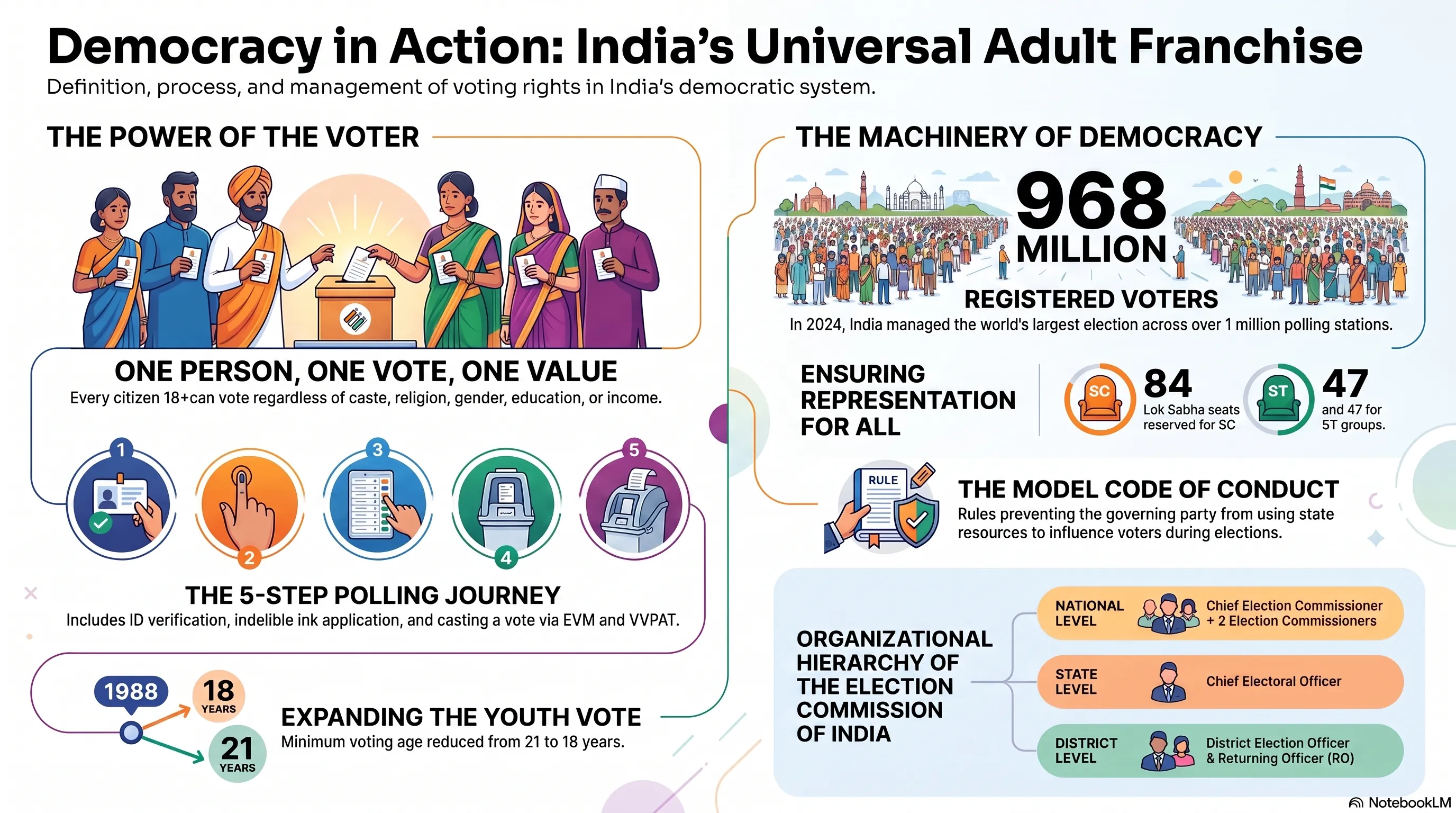
In the summer of 2024, India held its general elections. Around 968 million voters — that is, over 96 crore people — cast their votes across 543 constituencies. To manage an electorate this size, India needs an elaborate, well-organised system that ensures elections take place fairly and freely.
How the Voting Age Changed From 21 to 18
The minimum voting age in India was originally 21 years. It was reduced to 18 years in 1988, so that more citizens could exercise their right to choose their own government and participate more fully in India's participative democracy.
The Election Commission of India
Someone has to plan an exercise of this scale — that responsibility belongs to the Election Commission of India (ECI).
The Election Commission of India is an independent constitutional body, established in 1950, responsible for conducting free and fair elections. It conducts elections to the Lok Sabha, the Rajya Sabha, State Legislative Assemblies, and the offices of the President and Vice President. India's first general election was held in 1951–52. Students can visit eci.gov.in to explore the Commission's facilities and provisions directly.
The Uttiramerur Inscriptions: An Ancient Example
The NCERT textbook references the Uttiramerur inscriptions from the 10th century, which describe a transparent process for selecting representatives. Eligible candidates' names were written on palm leaf fragments and placed in a sealed pot. On the selection day, a young boy would publicly draw out a palm leaf, and a respected individual — after showing his empty hand to the public — would read out the name. This shows that transparent, organised systems for choosing representatives existed in India long before modern elections were introduced.
How Is the Election Commission Structured?
| Level | Officer(s) Responsible |
|---|---|
| National Level | Chief Election Commissioner + two Election Commissioners |
| State Level | Chief Electoral Officer |
| District Level | District Election Officer, Returning Officer (RO), Electoral Registration Officer (ERO) |
At the district level, the Returning Officer (RO) conducts the election, while the Electoral Registration Officer (ERO) manages the voter list — a distinction that is frequently tested and often confuses students.
The head office of the Election Commission of India is located in Delhi. As of July 2026, the Chief Election Commissioner is Shri Gyanesh Kumar.
How the Election Commission Manages Elections
The ECI performs several crucial tasks for every election:
- Fixing the election date
- Registering political parties
- Enforcing the Model Code of Conduct
- Overseeing the entire electoral process
Managing elections in India is a massive task. India has 543 parliamentary constituencies and more than 1 million polling stations, and the ECI has been continuously upgrading its capacity to keep pace with the needs of modern India while conducting free and fair elections.
Reserved Constituencies for SC and ST {#reserved-seats}
Of the total Lok Sabha constituencies, 84 are reserved for persons from the Scheduled Castes and 47 are reserved for the Scheduled Tribes, giving marginalised groups and minorities a guaranteed opportunity to represent themselves in Parliament.
Accessibility Measures Introduced in 2024
The ECI has taken several innovative accessibility measures to ensure no eligible voter is left behind. In 2024, for the first time, elderly citizens and persons with disabilities could cast their vote from home, and the postal voting option was made available for specific categories of voters. Assistive technologies such as Braille-enabled voter cards and app-based requests for wheelchairs and ramps have also been introduced at polling booths.
What Is NOTA?
NOTA stands for "None of the Above." It is an additional option offered in some countries, including India, that allows voters to reject all contesting candidates if they are not satisfied with any of them. NOTA does not change the actual result of the election, but it does send a strong message to society and the Election Commission about the kind of choices voters want. It is considered a fairly powerful tool in a democracy — and a favourite topic for exam questions.
How Voting Actually Happens: EVM and VVPAT
The chapter walks through the step-by-step voting process used in Lok Sabha and State Assembly elections:
- The polling officer checks the voter's name in the voter list and asks for ID proof (usually the voter ID card).
- Indelible ink is applied to the voter's finger, and the voter signs a chit — this ink typically stays on the finger for seven to eight days.
- A third polling officer checks the chit and verifies the ink mark.
- The voter proceeds to the EVM (Electronic Voting Machine) and casts their vote for the party of their choice. A beep sound confirms the vote.
- Simultaneously, the VVPAT (Voter Verifiable Paper Audit Trail) prints a slip that drops into a sealed box, giving the voter a way to confirm their vote went to the correct candidate.
VVPAT is a system that produces a physical paper record, allowing voters to verify that their electronic votes were cast correctly. This paper trail provides a backup for verification and recounting in case of disputes or failure of the electronic system. EVMs and VVPATs have also been used in countries like Namibia and Bhutan with support from the ECI, and other countries have studied this technology and received training from India.
Who Was India's First Voter? {#first-voter}
India's first voter in the 1951 election was Shyam Saran Negi, a school teacher from Himachal Pradesh. He continued to exercise his right to vote for decades, including at the age of 100 in 2017 — a fact that regularly appears in exam questions.
What Is the Model Code of Conduct?
The Model Code of Conduct (MCC) consists of rules that the party in government must follow once elections are announced. This ensures that government resources are not used for election purposes.
Key MCC provisions include:
- No new schemes or projects may be announced that could influence voters once the code is in effect.
- Candidates are expected to exercise discretion and restraint so that elections take place peacefully.
- Influencing voters through gifts in return for votes is punishable — examples cited include saris or household appliances given to women voters, abusive language used against opposing candidates, government officials campaigning for the ruling party, and unaccounted cash bundles found in a candidate's vehicle.
The Model Code of Conduct was first adopted in Kerala in 1960 and was voluntarily followed by representatives of major political parties of the time. The ECI circulated it to political parties during the 62nd general elections, and from 1991 onward it became proactive in ensuring the Code's observance.
T.N. Seshan and Electoral Reform
T.N. Seshan became the Chief Election Commissioner in 1990 and introduced reforms to ensure free and fair elections, including requiring campaigning to follow precise rules, introducing voter ID cards to eliminate proxy voting, and enforcing strict vigilance on candidate spending. He is remembered as the officer who made Indian elections fair, transparent, and fearless.
Elections to the Lok Sabha and State Assemblies {#lok-sabha-elections}
India follows a parliamentary system of government where citizens participate in elections at multiple levels — Lok Sabha, State Assembly, and local bodies such as municipalities.
The country is divided into 543 constituencies for the Lok Sabha. Elected candidates to the Lok Sabha are known as MPs (Members of Parliament), while elected candidates to the State Assembly are known as MLAs (Members of the Legislative Assembly).
What Is First Past the Post (FPTP)? {#fptp}
India uses the First Past the Post (FPTP) system, where the candidate receiving the most votes in a constituency wins — even without securing 50% of the total votes. For example, if candidate A gets 20% of the vote, candidate B gets 14%, and candidate C gets 38%, candidate C wins, simply because they received the highest vote share among all contestants — not because they crossed the halfway mark.
After voting concludes, government formation begins. The political party or coalition winning a majority of seats forms the government. The leader of the majority party typically becomes the Prime Minister at the national level, and the leader of the majority at the state level becomes the Chief Minister. For example, Shri Narendra Modi is India's Prime Minister, while Bhajan Lal Sharma serves as the Chief Minister of Rajasthan.
Elections to the Rajya Sabha
Candidates elected to the Rajya Sabha are also known as MPs, but they are chosen through indirect election — ordinary citizens do not vote directly for Rajya Sabha members. Instead, MLAs vote to elect them.
Of the 245 members of the Rajya Sabha, 233 are elected by the State Legislative Assemblies (MLAs), while the President of India nominates the remaining 12 members from fields such as science and technology, sports, education, art, culture, and music — for example, someone with the stature of Sachin Tendulkar in the field of cricket.
Each state is allotted a different number of Rajya Sabha seats based on population — Uttar Pradesh has more seats than Arunachal Pradesh, for instance, while Rajasthan is allotted 10 Rajya Sabha seats.
The Rajya Sabha is also called the "Permanent House" because it is never dissolved. Members serve a six-year term, and one-third of the members retire every two years. Voting for the Rajya Sabha uses the Single Transferable Vote (STV) system, where MLAs rank candidates by preference so that votes are not wasted.
How Are the President and Vice President Elected?
The President of India is not directly elected by citizens. Instead, an Electoral College consisting of MPs from both Houses of Parliament and MLAs from the State Legislative Assemblies participates in the election, again using the Single Transferable Vote system.
Who Is Not Involved in the President's Election?
The following groups are not involved in electing the President:
- The 12 nominated members of Parliament
- Nominated members of the State Legislative Assembly
- Members of the Legislative Council (Vidhan Parishad) — a body that exists only in some states
- Nominated members of the Union Territories of Delhi and Puducherry
Election of the Vice President {#vp-election}
The Vice President of India is elected by an Electoral College consisting of elected and nominated members of both Houses of Parliament, again using the Single Transferable Vote system. Unlike the President's election, MLAs do not participate here — only both Houses of Parliament are involved.
The Vice President also serves as the Chairman of the Rajya Sabha. In the Lok Sabha, this role is held by the Speaker (currently Om Birla, an MP from Kota). As of this chapter's teaching, India's President is Droupadi Murmu, and the Vice President is CP Radhakrishnan.
Challenges Before India's Electoral System
India's electoral system is celebrated as the world's largest democratic exercise, almost like a festival where people participate enthusiastically through campaigning, rallies, posters, and door-to-door appeals.
However, the chapter also highlights real challenges:
- The growing influence of money in elections
- A significant proportion of candidates with criminal records
- Voter apathy — a term describing citizens who do not turn out to vote at all
The Election Commission has set spending limits for candidates contesting Lok Sabha and State Assembly elections, and candidates must submit a detailed account of their election expenditure to the Commission after the election concludes.
Frequently Asked Questions
Find answers to common questions.
What is Universal Adult Franchise?
Universal Adult Franchise means every Indian citizen aged 18 and above has the right to vote, regardless of caste, creed, race, religion, gender, education, or income, with every vote carrying equal value. This principle was built into Indian democracy from the outset and is protected under Article 326 of the Constitution.
When was the voting age changed from 21 to 18?
India's minimum voting age was lowered from 21 to 18 years in 1988. The change was made so that a larger number of young citizens could participate in choosing their government.
What is NOTA in Indian elections?
NOTA stands for "None of the Above," an option that lets voters reject all contesting candidates. It does not change the election result, but it sends a clear message to society and the Election Commission about voter dissatisfaction
What is the difference between a Returning Officer (RO) and an Electoral Registration Officer (ERO)?
The Returning Officer (RO) is responsible for conducting the election at the district level, while the Electoral Registration Officer (ERO) manages and maintains the voter list. Both roles sit under the Election Commission's district-level structure.
How does the First Past the Post (FPTP) system work in Lok Sabha elections?
Under First Past the Post, the candidate who receives the most votes in a constituency wins the seat, even without crossing 50% of total votes. This differs from systems that require an absolute majority to declare a winner.
How are Rajya Sabha members elected?
Rajya Sabha members are elected indirectly: of 245 total members, 233 are elected by State Legislative Assembly members (MLAs) using the Single Transferable Vote system, while the President nominates the remaining 12 members from fields like science, sports, art, and culture.