What Is the NEET Cutoff Likely to Be in 2027 for Government Colleges: Honest Estimates & Prep Roadmap

Table of Contents

eSaral › NEET › What Is the NEET Cutoff Likely to Be in 2027 for Government Colleges

Somewhere between a late-night mock test and a WhatsApp forward quoting "NEET cutoff crossed 700 this year," a lot of students spiral. You start wondering — will my preparation ever be enough? If you've searched "NEET 2027 cutoff for government colleges" at midnight, this article is written exactly for you.
The good news: cutoffs are not random. They follow patterns, and those patterns are knowable. The eSaral Academic Team has tracked NEET cutoff data across years, categories, and quota types — and we're going to break it down in a way that's honest, not scary.
By the end of this article, you'll know the realistic target score for 2027, what drives that number, and — most importantly — a clear plan to get there.
Why So Many Students Worry About This
The anxiety around NEET cutoffs is real, and it makes complete sense. You're making a decision today — how hard to study, which topics to prioritise — based on a number that doesn't exist yet. That's a genuinely uncomfortable position.
A few things make this worse:
-
Social media panic: Viral posts claiming "you need 700+ to even look at a government college" circulate every year. Most are exaggerated or apply only to top-10 colleges.
-
Category confusion: The cutoff for AIQ (All India Quota) seats and state quota seats are very different. Many students don't know which one applies to them.
-
Year-to-year variation: A difficult paper in one year brings cutoffs down; an easy paper pushes them up. This unpredictability feels threatening when you're planning years.
Understanding why the worry exists is the first step to separating genuine data from noise.
💡 Expert Tip by eSaral Academic Team: "Don't plan your preparation around the cutoff — plan it around 650+ marks. That buffer handles year-to-year variation and keeps every option open for you."
NEET Cutoff Trends: What the Data Actually Shows
Here's a clean look at NEET UG AIQ general category cutoffs (closing rank/marks) for government colleges over recent years, sourced from NTA and MCC data:
|
Year |
General Category Cutoff (AIQ) |
Approx. Marks Range |
|
2019 |
701 rank zone |
595–615 |
|
2020 |
Competitive year |
610–640 |
|
2021 |
Higher difficulty |
600–630 |
|
2022 |
Moderate paper |
625–660 |
|
2023 |
Easier paper |
650–685 |
|
2024 |
Moderate-tough |
630–665 |
|
2025 |
Mixed difficulty |
635–670 |
Note: "Government college" here refers to the broad pool of state government + central government MBBS seats. Top AIIMS/JIPMER seats require 680–720. Data sourced from NTA.ac.in and MCC counselling records.
Two things stand out from this data:
-
The cutoff has been gradually rising over five years, driven by more applicants and better preparation tools.
-
The swing between years is 30–50 marks — which is why a buffer matters more than precision.
You can review official NEET question papers from past years to understand difficulty patterns yourself.
What Is the NEET 2027 Expected Cutoff for Government Colleges?
The NEET 2027 expected cutoff for government colleges will likely fall between 620–680 marks for general category AIQ seats. State quota seats across most states will sit in the 550–630 marks range. OBC/SC/ST categories will have lower cutoffs — typically 490–560 marks for state quota government seats.
These estimates are based on three factors:
Factor 1: Applicant Volume Is Rising
NEET 2025 saw over 24 lakh registered candidates — the highest ever. More applicants = higher competition = slightly higher cutoffs, even if the paper difficulty stays the same.
Factor 2: Paper Difficulty Cycles
NTA does not maintain a fixed difficulty level. Years with tougher papers bring cutoffs down by 20–40 marks. If 2027 is a tougher paper (which is statistically likely after moderate years), expect the lower end of the range.
Factor 3: Seat Availability
New government medical colleges have been added under NMC guidelines every year. More seats = slightly lower cutoffs, all else being equal. India has added nearly 8,000 MBBS government seats over the past four years.
Your safe target: 650 marks. At 650, you are competitive for the overwhelming majority of government MBBS seats in India — AIQ and state quota both.
💡 Expert Tip by eSaral Academic Team: "Aiming for exactly the cutoff is like driving with zero fuel reserve. Target 650+ and you protect yourself from bad-day scenarios — a headache during the exam, one chapter you blanked on, anything."
What Actually Determines Your Admission Score?
Understanding this stops you from fixating on a single number. Your NEET score is the product of three subject areas — and the distribution is not equal.
|
Subject |
Questions |
Max Marks |
Typical Topper Share |
|
Biology (Botany + Zoology) |
90 |
360 |
290–340 |
|
Chemistry |
45 |
180 |
140–165 |
|
Physics |
45 |
180 |
120–150 |
Biology is your biggest lever. A student scoring 320/360 in Biology and decent marks in Chemistry + Physics can cross 650 without needing exceptional Physics performance. Check the NEET exam pattern and NEET Chemistry weightage to plan subject-wise.
Which Topics Actually Move Your Score?
From NEET papers between 2019–2026, these topics appear with the highest frequency:
-
Biology: Genetics & Evolution, Human Physiology, Plant Physiology, Ecology
-
Chemistry: Organic Chemistry (reaction mechanisms), Coordination Compounds, Chemical Bonding
-
Physics: Mechanics, Modern Physics, Current Electricity
Mastering high-weightage chapters consistently is more valuable than surface-covering the entire NEET syllabus without depth.
Your Realistic Roadmap to Hit the Cutoff
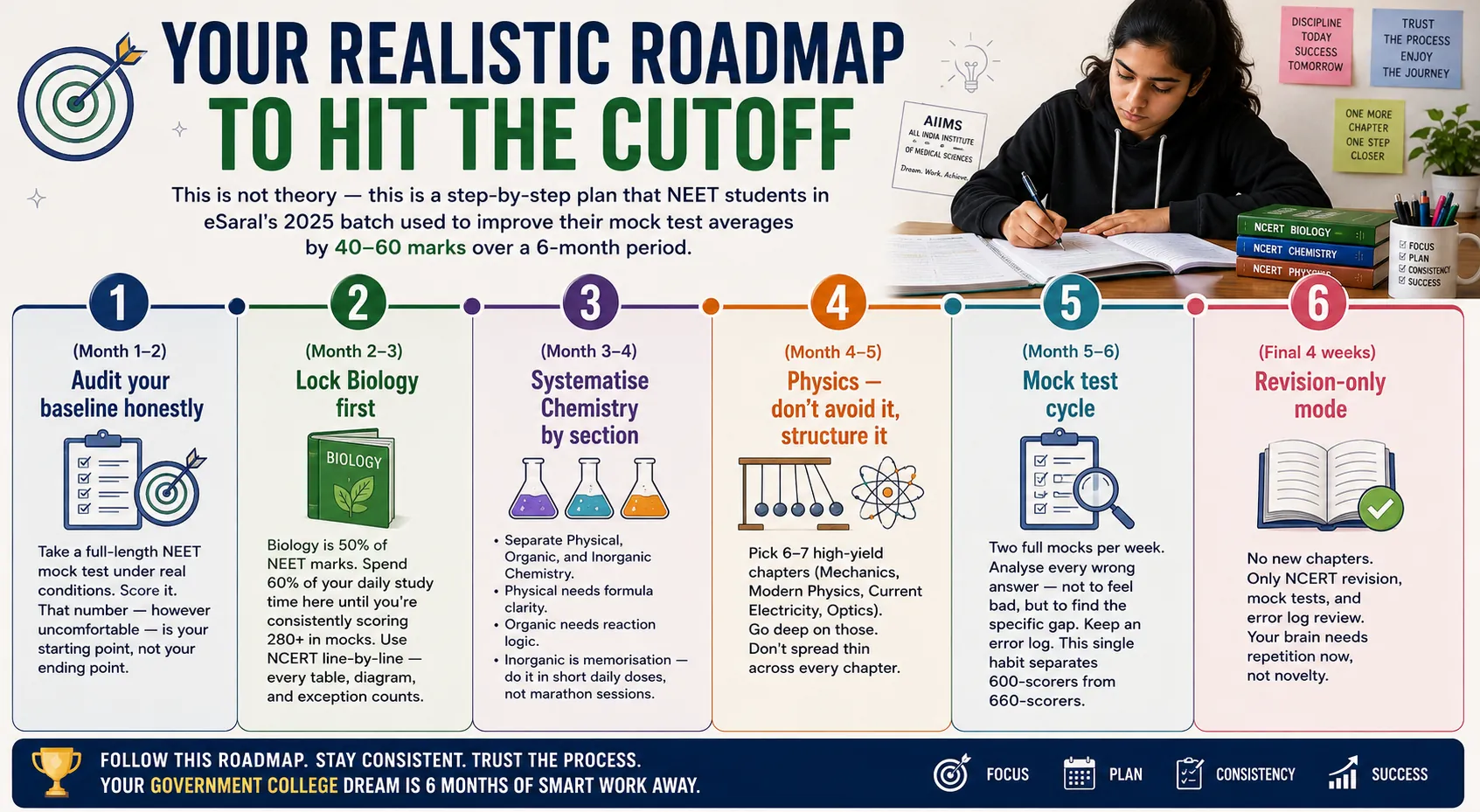
This is not theory — this is a step-by-step plan that NEET students in eSaral's 2026 batch used to improve their mock test averages by 40–60 marks over 6 months.
Step 1 (Month 1–2): Audit your baseline honestly
Take a full-length NEET mock test under real conditions. Score it. That number — however uncomfortable — is your starting point, not your ending point.
Step 2 (Month 2–3): Lock Biology first
Biology is 50% of NEET marks. Spend 60% of your daily study time here until you're consistently scoring 280+ in mocks. Use NCERT line-by-line — every table, diagram, and exception counts.
Step 3 (Month 3–4): Systematise Chemistry by section
Separate Physical, Organic, and Inorganic Chemistry. Physical needs formula clarity. Organic needs reaction logic. Inorganic is memorisation — do it in short daily doses, not marathon sessions.
Step 4 (Month 4–5): Physics — don't avoid it, structure it
Pick 6–7 high-yield chapters (Mechanics, Modern Physics, Current Electricity, Optics). Go deep on those. Don't spread thin across every chapter.
Step 5 (Month 5–6): Mock test cycle
Two full mocks per week. Analyse every wrong answer — not to feel bad, but to find the specific gap. Keep an error log. This single habit separates 600-scorers from 660-scorers.
Step 6 (Final 4 weeks): Revision-only mode
No new chapters. Only NCERT revision, mock tests, and error log review. Your brain needs repetition now, not novelty.
Common Mistakes Students Make When Panicking About Cutoffs
When cutoff anxiety hits, students make predictable mistakes. Knowing them in advance means you can catch yourself.
-
Studying cutoff numbers instead of chapters: Spending an hour researching "exact cutoff for Government Medical College X" instead of completing one Biology chapter. The cutoff does not change based on how much you research it.
-
Treating AIQ cutoffs as the only benchmark: Most students are eligible for state quota — where cutoffs are 40–80 marks lower. Know your actual target.
-
Switching strategies mid-year based on "news": Every year, someone claims "NEET 2027 paper will be much harder/easier." Nobody knows. Stick to your plan.
-
Ignoring NCERT for "advanced" material: Students who score 660+ in NEET almost always credit NCERT mastery. Going beyond NCERT before mastering it is a common high-achiever trap.
-
Comparing mock scores in October to toppers' final scores: Your October mock average is not your April NEET score. Growth in the final 6 months is real and measurable.
Frequently Asked Questions
Find answers to common questions.
How has the NEET cutoff for government colleges changed over the years?
The NEET qualifying cutoff for government college admission has risen gradually — from approximately 595–615 marks (2019) to 635–670 marks (2025) for general category AIQ seats. The rise tracks increased applicant numbers and better student preparation resources. A 30–50 mark swing is typical between years based on paper difficulty.
Is 550 marks enough to get a government college seat in NEET 2027?
It depends on your state and category. For OBC/SC/ST candidates in several states, 550 marks can secure a state quota government seat. For general category AIQ seats, 550 is below the expected cutoff. To be safe across most options, aim for 620+ in the general category.
What is the NEET cutoff likely to be in 2027 for government colleges in general category?
The NEET 2027 cutoff for general category AIQ government college seats is expected to be in the 620–680 marks range. State quota seats will be lower — roughly 550–630 marks — depending on the state. These are projections based on trends from 2019–2025 and may shift with exam difficulty and applicant volume.
How many marks out of 720 should I target to be safe for a government MBBS seat in NEET 2027?
Target 650 out of 720 as your preparation benchmark. At this score, you are competitive for the vast majority of government MBBS seats across AIQ and state quota in nearly every state. Scores above 680 open AIIMS and top-tier central government institutions.
Will NEET 2027 cutoffs go up or down compared to 2025?
If the 2027 paper is moderate-to-easy, expect cutoffs to edge up slightly. If it's tougher, they may dip 20–40 marks. Neither you nor any coaching institute can predict this with certainty. The most rational response is to target 650+ and remove the uncertainty from your plan entirely.
Does the NEET cutoff differ between AIQ and state quota seats?
Yes, significantly. All India Quota (AIQ) cutoffs apply to 15% of seats and are more competitive — typically 30–60 marks higher than state quota cutoffs. State quota seats (85%) are filled based on your home state merit list, with state-specific cutoffs that are generally lower than AIQ. Know which quota applies to you.
What score do I need in NEET 2027 to get into a government medical college?
For most government MBBS seats — AIQ and state quota combined — a score of 620–650 marks in the general category is the realistic competitive range for NEET 2027. Targeting 650+ gives you a meaningful buffer and keeps top government colleges within reach.