Which Chapters Are Most Frequently Asked in JEE Main Physics
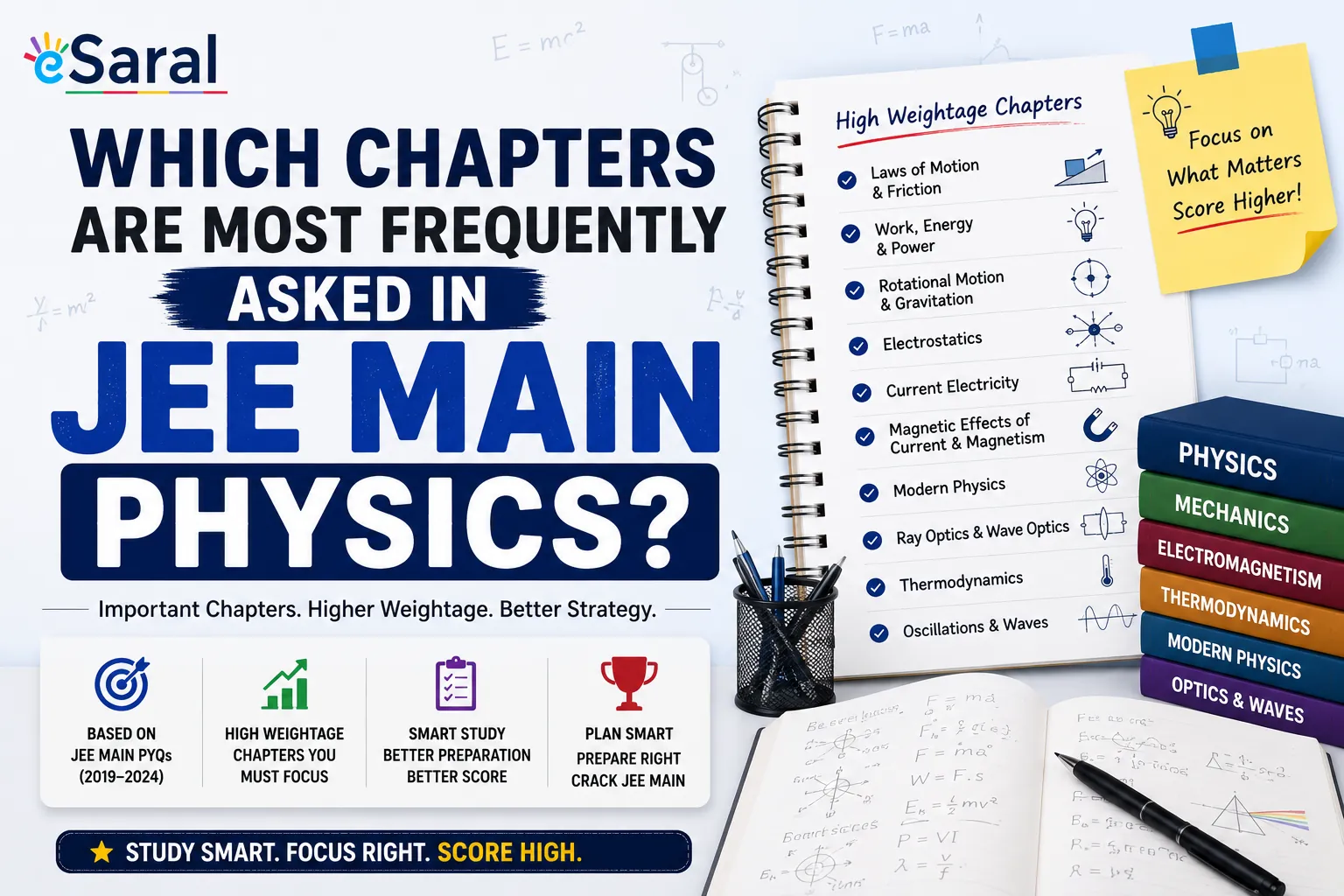
Table of Contents

eSaral › JEE › Which Chapters Are Most Frequently Asked in JEE Main Physics

So you are sitting with your Physics textbook, looking at 20+ chapters, and wondering where to even begin. That feeling of "I don't know what to study first" is not a sign of weakness — it is actually a very normal response to a syllabus that feels enormous. The good news is that JEE Main Physics has clear, consistent patterns. You can work smart once you know where the marks actually come from.
This guide is built on a chapter-wise analysis of JEE Main question papers. The eSaral academic team has studied these patterns closely, because helping students prioritise is one of the most important things a teacher can do. By the end of this article, you will know exactly which chapters deserve your deepest attention, which ones need light coverage, and how to plan your next few weeks realistically.
Let us get into it.
Why Students Worry About Physics Chapter Selection
Physics anxiety is one of the most common things we hear from JEE aspirants, and it almost always comes from the same place: the syllabus looks uniform on paper, but it definitely is not uniform in the exam.
When every chapter in your NCERT looks equally important, you feel like you must master all of it perfectly before the exam. That pressure is real, but it is also based on a false assumption. NTA does not ask equal questions from every chapter. Some chapters appear in almost every session. Others are asked once in several years. Knowing this difference is not "shortcut thinking" — it is smart strategy.
JEE ki taiyari mein prioritisation hi asli skill hai. Working on every chapter with equal intensity, especially under time pressure, is one of the fastest ways to underperform. The students who score 150+ in Physics are rarely the ones who "studied everything" — they are the ones who identified the right chapters early and built genuine depth there.
JEE Main Physics Chapter-Wise Weightage
Here is what the data from official JEE Main question papers actually shows, aggregated across six years of sessions.
| Chapter / Topic Area | Avg. Questions per Session | Approx. Weightage |
|---|---|---|
| Mechanics (Laws of Motion, Work-Energy, Rotation, Gravitation) | 7–8 | 28–32% |
| Electrostatics & Current Electricity | 4–5 | 16–20% |
| Modern Physics (Photoelectric Effect, Atoms, Nuclei) | 2–3 | 8–12% |
| Waves & Sound | 1–2 | 4–8% |
| Ray & Wave Optics | 2–3 | 8–10% |
| Magnetic Effects of Current & Magnetism | 2–3 | 8–10% |
| Thermodynamics & Kinetic Theory of Gases (KTG) | 1–2 | 4–8% |
| Semiconductors & Communication Systems | 1–2 | 4–6% |
| Simple Harmonic Motion (SHM) & Oscillations | 1 | ~4% |
| Fluid Mechanics & Surface Tension | 1 | 3–4% |
Which Physics Chapters Should You Focus on First?
Prioritisation does not mean ignoring chapters — it means building depth where the marks are highest, and keeping other chapters at a solid working level.
Tier 1: Must-Master Chapters (Do These First)
These appear in virtually every JEE Main session and carry the highest combined weightage. Skipping or rushing these is the single biggest Physics mistake a student can make.
-
Laws of Motion & Friction
-
Work, Energy & Power
-
Rotational Motion & Moment of Inertia
-
Electrostatics (Electric Field, Potential, Capacitors)
-
Current Electricity (Kirchhoff's Laws, Wheatstone Bridge)
-
Modern Physics (Photoelectric Effect, Atomic Structure, Nuclear Physics)
-
Ray Optics & Optical Instruments
Tier 2: High-Value Supporting Chapters
These appear frequently but with slightly less consistency. Build these after Tier 1 is solid.
-
Magnetic Effects of Current & Magnetism
-
Electromagnetic Induction (EMI) & AC Circuits
-
Waves & Sound
-
Thermodynamics & Kinetic Theory of Gases (KTG)
-
Simple Harmonic Motion (SHM)
Tier 3: Light Coverage Chapters
These appear occasionally — usually 1 question per session at most. Do not ignore them entirely, but do not spend equal time here.
-
Semiconductors & Electronic Devices
-
Communication Systems
-
Surface Tension & Viscosity
-
Thermal Expansion
You can review the full JEE Main syllabus to cross-check every chapter against this priority framework.
How Many Questions Come From Mechanics in JEE Main Physics?
Mechanics is the single largest contributor to JEE Main Physics and this has been consistent for six years running.
On average, 7 to 8 out of 25 Physics questions in each JEE Main session come directly from Mechanics topics. That is nearly 30% of the entire Physics section from one broad area alone. If you include Fluid Mechanics and SHM (which share conceptual roots with classical mechanics), that number moves closer to 9–10 questions.
This means that a student who masters Mechanics thoroughly can secure approximately 28–32 marks from Physics before even touching other chapters. For a subject where every mark matters, that is a powerful position to be in.
💡 Expert Tip by eSaral Academic Team:"Rotational Motion and Work-Energy are the two sub-topics within Mechanics where most students lose marks they should not. Concept clarity here especially on moment of inertia and energy conservation — is worth at least 2–3 extra questions per attempt."
You can study real question patterns yourself by going through JEE Main 2023 question papers and marking chapter sources for every Physics question. It is one of the most eye-opening exercises you can do.
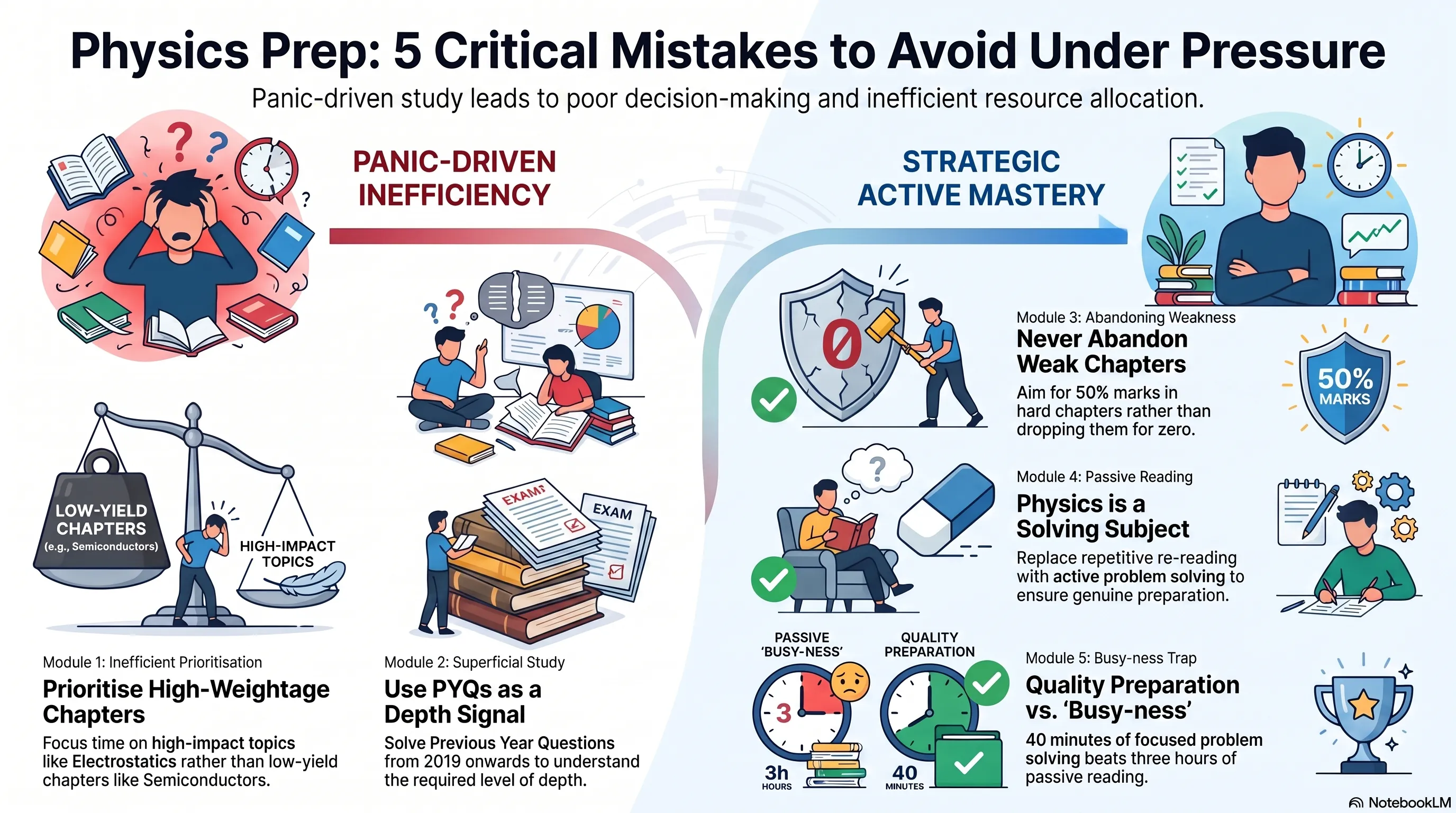
Common Mistakes Students Make When Panicking About Physics
Frequently Asked Questions
Find answers to common questions.
Is Modern Physics important for JEE Main?
Yes, Modern Physics is consistently important for JEE Main Physics. Topics like the Photoelectric Effect, Atomic Structure (Bohr's model), and Nuclear Physics appear in almost every session, contributing 2–3 questions. It has a high concept-to-marks ratio, meaning a relatively small study investment can yield reliable marks.
Which Physics chapter has the highest weightage in JEE Main?
Mechanics has the highest weightage in JEE Main Physics, contributing 7–8 questions per session on average — roughly 28–32% of the Physics section. Sub-topics like Rotational Motion, Work-Energy-Power, and Laws of Motion are asked most consistently and should be prioritised before any other Physics chapter.
Which chapters are most frequently asked in JEE Main Physics?
The most frequently asked chapters in JEE Main Physics are Mechanics (Laws of Motion, Work-Energy, Rotational Motion), Electrostatics, Current Electricity, Modern Physics, and Ray Optics. Based on NTA question paper data from 2019–2024, these chapters together account for approximately 60–65% of the Physics section in each session.
Which Physics chapters are easy but high-scoring in JEE Main?
Modern Physics and Ray Optics are considered relatively accessible compared to their weightage. Modern Physics involves mostly formula-based and concept-based questions that are predictable in structure. Ray Optics questions on mirrors, lenses, and prisms follow standard patterns that repeat year to year — making both chapters excellent return-on-investment choices.
Can I skip Thermodynamics for JEE Main Physics?
Thermodynamics should not be completely skipped — it contributes 1–2 questions per session. However, it is a Tier 2 topic, meaning you should build depth in Mechanics and Electrostatics first. A focused 3–4 day revision of Thermodynamics and Kinetic Theory of Gases is enough to capture most of the marks from this area.
How many questions come from Electrostatics and Current Electricity in JEE Main?
Electrostatics and Current Electricity together contribute 4–5 questions per JEE Main session on average, making this one of the most important paired topic areas in Physics. Concepts like Gauss's Law, capacitors, Kirchhoff's Laws, and the Wheatstone Bridge appear with high regularity across all JEE Main sessions.