Why Do I Feel More Anxious in Dropper Year Than During Class 12?

Table of Contents
- The Honest Answer: Why This Anxiety Is Different
- Why This Feeling Is So Common Among NEET/JEE Droppers
- What Actually Matters in NEET/JEEand What Doesn't
- A Realistic 8-Week Anxiety-to-Action Roadmap
- Common Mistakes Students Make When Panic Sets In
- How to Build a Daily Routine That Calms the Mind and Scores Marks

eSaral › NEET › Why Do I Feel More Anxious in Dropper Year Than During Class 12?

Sitting at your desk in June or July, you might feel something that didn't exist in Class 12: a low, persistent hum of dread. Your friends have moved to college. Your Instagram is full of their hostel reels. And you're here, staring at the same NCERT you studied last year, wondering why your brain won't cooperate.
Here's the truth: this anxiety is not a sign that you made the wrong choice. It's a completely predictable psychological response to a very specific situation. The eSaral Academic Team has worked with thousands of repeater students across NEET and JEE batches, and this feeling comes up in almost every one of them.
This article explains exactly why dropper year anxiety hits harder, what it means for your preparation, and most importantly, what you can do about it starting today.
The Honest Answer: Why This Anxiety Is Different
Dropper year anxiety is qualitatively different from Class 12 stress. In Class 12, the exam was one of many responsibilities- boards, attendance, family events, school life. Failing to clear JEE or NEET felt bad, but it was still somewhat external. This year, the exam is your only job. That shift changes everything.
The Identity Trap
When NEET or JEE becomes your sole identity for 12 months, every mock score feels like a verdict on your intelligence and future. A bad score in Class 12 was disappointing. The same score in dropper year feels catastrophic, even when it is not.
Psychologists call this cognitive fusion: you have fused your sense of self-worth with your rank. The result is that anxiety is no longer about the exam. It is about *you*. That makes it far harder to shake off after a bad practice session.
The Timeline Pressure Is Real But Manageable
NEET UG is conducted once a year by NTA. That single-shot structure creates genuine urgency. But urgency and panic are not the same thing. Urgency, channelled properly, sharpens focus. Panic, left unchecked, causes avoidance. The difference between a dropper who clears and one who doesn't often comes down to which one they choose to act on.
💡 Expert Tip by eSaral Academic Team: Anxiety tells you something matters to you. That's actually useful. The goal isn't to eliminate it; it's to stop it from running your schedule.
Why This Feeling Is So Common Among NEET/JEE Droppers
You are not uniquely anxious. You are having a near-universal dropper experience.
The Social Comparison Effect
Every dropper student knows someone who got through on the first attempt. Social media amplifies this relentlessly. The human brain is wired to compare, but it compares your internal experience (doubt, fatigue, confusion) with someone else's external highlight reel (college photos, rank announcements). This comparison is structurally unfair and always will be.
The Sunk Cost Spiral
Many droppers think: * I've already spent a year on this. If I fail again, that whole year was wasted. * This is the sunk cost fallacy in action. The year is not a deposit you can lose. Every hour you study now has full value regardless of what came before.
Absence of Peer Structure
In Class 12, school gave you a built-in structure: timetable, teachers, classmates, deadlines. Dropper year removes all of that. Self-directed study is cognitively harder. Without external scaffolding, anxiety fills the gaps where routine used to be. This is why structured coaching matters so much in repeater batches.
💡 Expert Tip by the eSaral Academic Team: Dropper-year anxiety peaks in two windows: the first two months (adjustment shock) and the six weeks before the exam (performance terror). Both are predictable—both pass.
What Actually Matters in NEET/JEEand What Doesn't
One of the best antidotes to free-floating anxiety is concrete knowledge. When you know exactly what the exam tests, the unknown shrinks. Here is what actually moves the needle.
NEET UG: The Real Weightage Picture
According to NTA data, NEET UG carries 720 marks across Biology (360), Chemistry (180), and Physics (180). Biology alone is worth 50% of the paper. Students who over-index anxiety on Physics and ignore Botany/Zoology are misreading the exam entirely.
|
Subject |
Total Marks |
Questions |
Key Focus |
|
Botany |
180 |
45 |
NCERT line-by-line accuracy |
|
Zoology |
180 |
45 |
Diagrams, human physiology |
|
Chemistry |
180 |
45 |
Organic reactions, Physical numericals |
|
Physics |
180 |
45 |
Concept clarity + formula application |
Review the NEET exam pattern carefully; knowing the structure removes a significant layer of anxiety.
High-Weightage Areas to Prioritise First
For NEET Chemistry, Organic Chemistry and Coordination Compounds together account for a large share of questions. Check the NEET Chemistry weightage data to plan your revision priority order. Similarly, Mechanics and Electrostatics dominate Physics; the NEET Physics weightage breakdown will show you exactly where your time pays off most.
The full NEET syllabus is not as large as it feels when anxiety is distorting your perception of it.
A Realistic 8-Week Anxiety-to-Action Roadmap
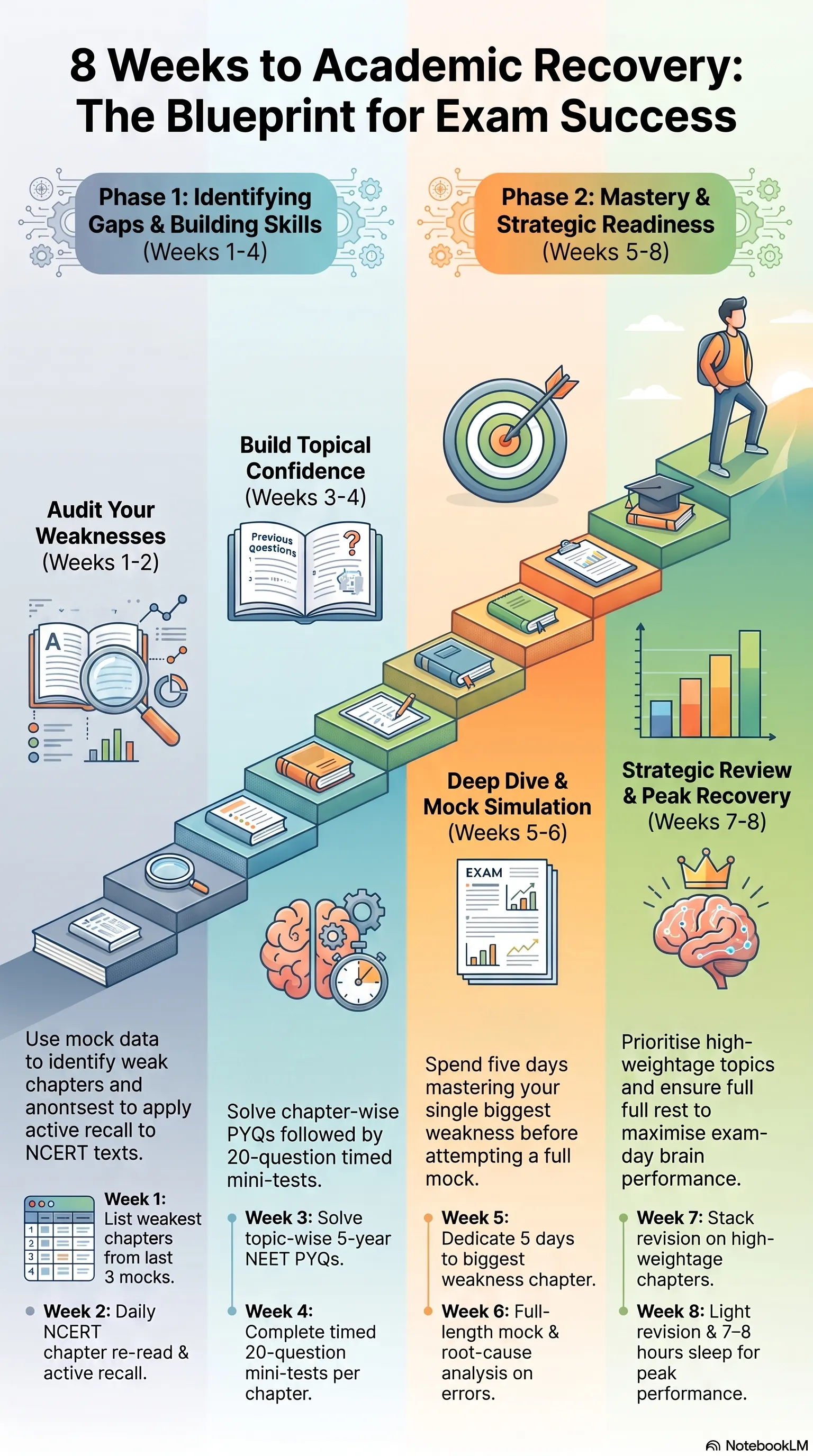
This is not a motivational pep talk. It is a numbered, time-bound plan that students in eSaral's 2025 dropper batch used to recover from mid-year anxiety slumps and improve their mock scores by an average of 40–60 marks in eight weeks.
-
Week 1: Audit, Don't Avoid. Sit with your last three mock papers. List your weakest chapters by name. Do not estimate; look at the actual data. This one act reduces anxiety because vague fear is always worse than a known list.
-
Week 2: Re-read NCERT in your lowest-scoring subject. One chapter per day, active recall at the end (close the book, write what you remember). Biology students: highlight every bold term.
-
Week 3: Solve previous year papers chapter-wise. Start with NEET question papers from the last five years. Do not attempt full papers yet; do chapter-wise question banks to build confidence topic by topic.
-
Week 4: Introduce timed practice. Solve 20-question mini-tests per chapter with a timer. Accuracy under time pressure is a learnable skill, not a talent.
-
Week 5: Fix your one biggest weakness completely. Pick the single chapter that has cost you the most marks. Spend five full days on it. One chapter mastered beats five chapters half-revised.
-
Week 6: Full mock, then debrief. Take one complete full-length mock. Spend equal time on the debrief as on the test. Every wrong answer needs a root cause (concept gap, silly error, time pressure, or guess).
-
Week 7: Revise high-weightage topics only. Use the weightage data from eSaral to stack your revision in favour of chapters that appear every year.
-
Week 8: Consolidate and rest. Light revision only. Sleep 7–8 hours. A well-rested brain on exam day outperforms an exhausted one by a measurable margin.
Common Mistakes Students Make When Panic Sets In
Panic produces predictable, counterproductive behaviours. Recognising them is the first step to avoiding them.
Mistake 1: Switching Resources Constantly
Anxiety says: * Maybe this book is the problem. * So you buy a new module, download a new app, switch to a different teacher's videos. But the problem is rarely the resource; it is the depth of engagement with what you already have. Yeh resource hopping ek trap hai.
Mistake 2: Studying Long Hours With Zero Retention
10 hours of distracted study produces less learning than 4 hours of focused, active recall. If you are re-reading the same page without absorbing it, you are performing the motion of studying, not the substance of it.
Mistake 3: Avoiding Mock Tests
Many anxious droppers stop taking full mocks because the score will make me feel worse. This is exactly backwards. Low mock scores before the exam are information. Low scores during the exam are the actual problem. Avoid mocks now, and you lose your only diagnostic tool.
Mistake 4: Isolating Completely
Cutting off from friends and family to focus often increases anxiety, not reduce it. Brief social contact- even a 20-minute walk or a phone call- is cognitively restorative. Isolation is not discipline; it is deprivation.
Mistake 5: Ignoring Physical Health
Sleep debt reduces memory consolidation. Skipping meals spikes cortisol. These are not soft lifestyle suggestions- they are biology. Your brain encodes memories during deep sleep. Dropper year is won partly in the hours you are not studying.
How to Build a Daily Routine That Calms the Mind and Scores Marks
Is There a Proven Daily Schedule for Dropper Students?
Yes. A structured daily routine reduces decision fatigue, which is one of the hidden drivers of dropper anxiety. When every hour is already decided, your brain does not spend energy worrying about what it *should* be doing.
|
Time Slot |
Activity |
Duration |
|
6:00–7:00 AM |
Light exercise + breakfast |
60 min |
|
7:00–10:00 AM |
High-focus subject (Biology/Maths) |
3 hours |
|
10:00–10:20 AM |
Break (no phone) |
20 min |
|
10:20 AM–1:00 PM |
Second subject (Chemistry/Physics) |
~2.5 hours |
|
1:00–2:00 PM |
Lunch + rest |
60 min |
|
2:00–5:00 PM |
Previous year questions + revision |
3 hours |
|
5:00–6:00 PM |
Walk / social time / free |
60 min |
|
6:00–8:30 PM |
Weak chapter focus |
2.5 hours |
|
9:30 PM |
Screens off, wind down |
— |
|
10:30 PM |
Sleep |
7.5–8 hours |
This schedule totals approximately 11 hours of study, with built-in recovery. Jab routine set ho jaati hai, anxiety ka room bahut kam ho jaata hai.
How Do You Measure Progress So Anxiety Doesn't Fill the Gap?
Track one number daily: questions attempted vs. questions correct, by chapter. A rising accuracy rate- even from 40% to 55%- is real, visible proof of progress. Anxiety thrives in the absence of data. Give it data instead.
Frequently Asked Questions
Find answers to common questions.
How do I stop overthinking during my dropper year for JEE or NEET?
Overthinking decreases when you replace open-ended worry with concrete action. Write down the exact chapters that concern you, assign one to each day of the week, and measure your accuracy daily. Structured action gives the anxious mind something real to hold onto instead of imagined worst-case scenarios.
Is it normal to feel more anxious and depressed in dropper year?
Yes, it is completely normal. Studies on exam-related stress in Indian medical and engineering aspirants consistently show that repeater-year students report higher anxiety than first-attempt students. You are not weak or uniquely struggling — you are in a high-pressure situation that most people in your position also find difficult.
Why is dropper year more stressful than Class 12 for NEET aspirants?
Dropper year is more stressful because the exam becomes your sole focus and identity. In Class 12, failure was one outcome among many. In dropper year, it feels like a verdict on your intelligence. This psychological shift — not the exam itself — is what makes anxiety spike. Recognising this pattern is the first step to managing it.
My friends are in college and I'm still preparing. How do I deal with the comparison?
Comparison with peers in college is one of the top reported stressors in dropper year. Remember: their timeline and yours are simply different, not ranked. Thousands of doctors and IITians cleared their exams in a second attempt. The destination is the same. The route is yours to own.
Should I talk to someone about dropper year mental health, or just push through?
You should do both. Talking to a parent, mentor, or counsellor does not mean you are giving up — it means you are managing your preparation intelligently. Unaddressed dropper year mental health stress can spiral into avoidance behaviours that hurt your scores. Seeking support is a strategic move, not a weakness.
How many hours should a dropper student study per day?
8–11 hours of focused study is the effective range for most NEET/JEE dropper students. Anything beyond 12 hours with poor sleep produces diminishing returns. Quality matters more than duration — 6 hours of active recall beats 10 hours of passive re-reading every single time.
How do I know if my anxiety is normal or if it's affecting my preparation seriously?
Normal dropper year anxiety comes and goes, and you can still study when it peaks. If you find yourself unable to open your books for days at a time, sleeping excessively as avoidance, or feeling hopeless consistently for more than two weeks, speak to a mental health professional. There is no shame in it — and addressing it early protects your preparation.