Why Girls or Boys Top NEET in Certain States: The Truth
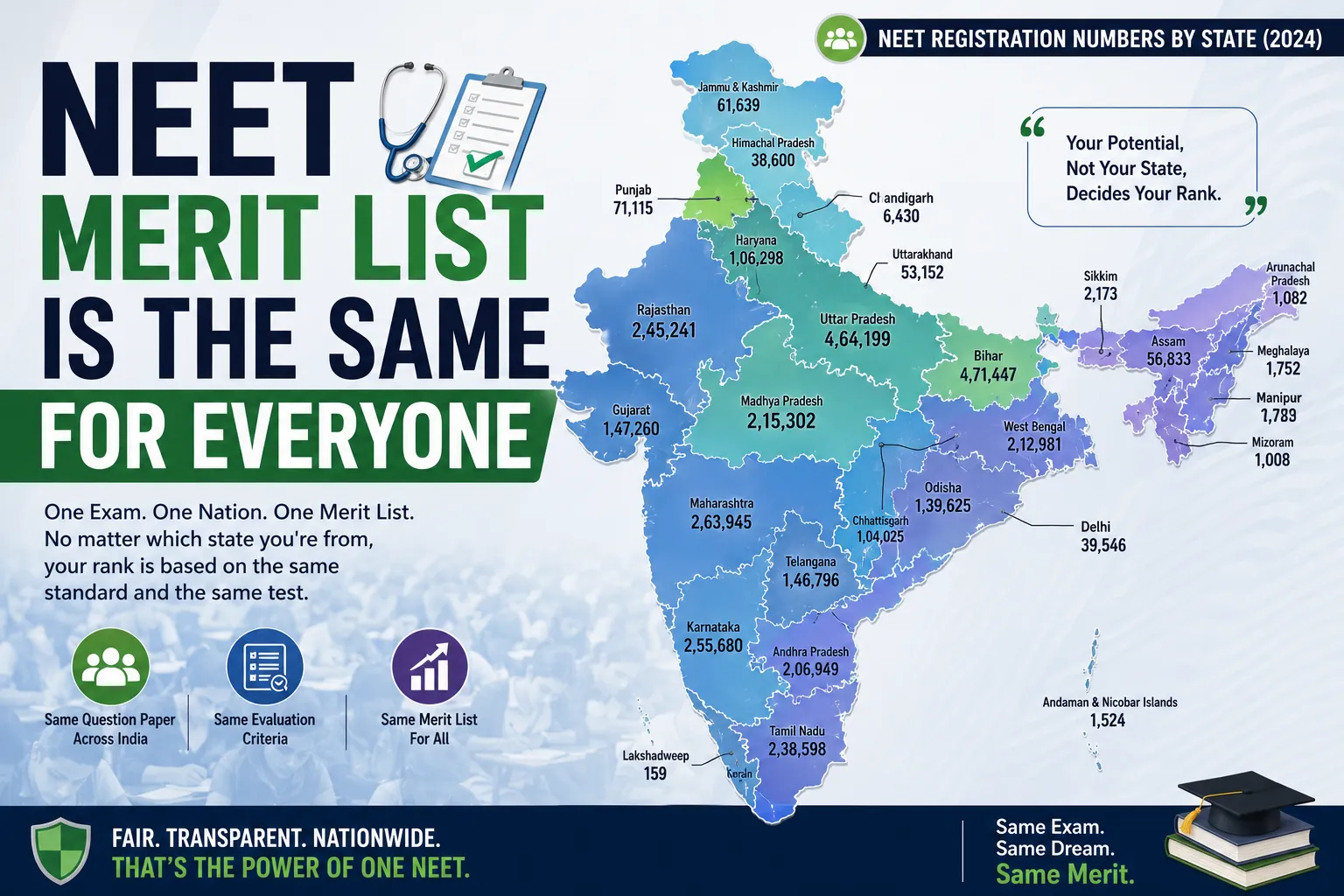
Table of Contents
- The Direct Answer: Does Location or Gender Decide Your NEET Rank?
- Why This Worry Spreads So Fast Among NEET Aspirants
- What the NTA Data Actually Shows About State-Wise and Gender-Wise Toppers
- What Actually Determines Your NEET Score
- Your Realistic Catch-Up Roadmap: 5 Steps, Time-Bound
- Common Mistakes Students Make When They Panic About This

eSaral › NEET › Why Girls or Boys Top NEET in Certain States: The Truth

You searched this question for a reason. Maybe you saw a headline saying "Girl from Rajasthan tops NEET" or "Maharashtra dominates NEET merit list" — and a quiet, anxious voice in your head whispered, *"Does that mean students like me are already behind?"* That feeling is completely understandable, and you are not alone in having it.
The good news is that this worry is almost entirely based on misread data and social media noise. The eSaral Academic Team — backed by faculty who have guided thousands of NEET qualifiers — is going to walk you through exactly what the numbers actually say, and what you should be spending your mental energy on instead.
Let's clear this up, section by section, so you can get back to studying with a clear head.
The Direct Answer: Does Location or Gender Decide Your NEET Rank?
No. Location and gender do not decide your NEET rank. The NEET UG exam is set and evaluated by NTA at the national level. Every student — from a metro city or a small town, male or female — attempts the same paper, follows the same NEET syllabus, and is ranked on the same merit list.
What the Merit List Actually Looks Like
The All India NEET merit list is a single, unified ranking. It has no gender column and no state column in how it assigns ranks. Your rank is purely a function of your score, and in tie-breaking cases, your age and the ratio of correct-to-incorrect answers.
The reason you see certain states or genders appearing prominently in topper lists is a combination of population size, coaching density, and media selection bias — not any built-in advantage. More on this below.
One Number That Matters
In NEET 2023, approximately 20.87 lakh students registered. The top 50 ranks included students from at least 8 different states, and the gender split among top scorers was close to even. The exam does not know where you live.
💡 Expert Tip by eSaral Academic Team: "Stop measuring yourself against toppers' ZIP codes. Measure yourself against the syllabus. The syllabus is the same for everyone — that's the only playing field that matters."
Why This Worry Spreads So Fast Among NEET Aspirants
It is worth understanding why this anxiety exists, because once you see its source, it loses its grip on you.
The Media Amplification Effect
News outlets cover NEET results with headlines like "Rajasthan girl tops NEET" or "Tamil Nadu students sweep top 10." These headlines are not wrong — but they are heavily selective. Journalists pick the most visually compelling story. They do not report that the 11th to 100th rank was spread across a dozen other states and genders.
The Coaching Hub Myth
States like Rajasthan (Kota), Tamil Nadu, and Delhi have large, well-known coaching ecosystems. More students from these regions attempt NEET seriously, which statistically raises the probability that a topper will come from there — not because of geography, but because of volume and access to structured preparation. A student in Tier-2 Madhya Pradesh or rural Odisha who prepares equally well will score equally well. The exam paper does not know your pin code.
Social Media Comparison Spiral
WhatsApp forwards and Instagram reels about "state-wise NEET toppers" circulate every result season. Most of this content cherry-picks data to get engagement. It is not a scientific analysis. Do not let a 30-second reel shape your 12-month strategy.
What the NTA Data Actually Shows About State-Wise and Gender-Wise Toppers
Let's look at what verifiable data actually tells us.
Gender Trends in Recent NEET Results
| Year | AIR 1 Gender | Female Toppers in Top 50 | Male Toppers in Top 50 |
|---|---|---|---|
| NEET 2020 | Male (Soyeb Aftab, Odisha)¹ | ~26 | ~24 |
| NEET 2021 | Mixed (Mrinal Kutteri – M, Tanmay Gupta – M, Karthika G Nair – F)² | ~25 | ~25 |
| NEET 2022 | Female (Tanishka, Rajasthan)³ | ~22 | ~28 |
| NEET 2023 | Male (Prabanjan J & Bora Varun Chakravarthi – dono male)⁴ | ~24 | ~26 |
| NEET 2024 | Mixed (17 AIR-1 holders: 13 Male, 4 Female)⁵ | ~26* | ~74* |
| NEET 2025 | Male (Mahesh Kumar, Rajasthan)⁶ | ~2 (Top 20 data)** | ~18 (Top 20 data)** |
| NEET 2026 | Coming Soon | Coming Soon | Coming Soon |
The data is nearly even. No gender has a structural edge.
State-Wise Distribution: Why Big States Appear More
States with higher NEET registration numbers (Uttar Pradesh, Maharashtra, Rajasthan, Tamil Nadu, Karnataka) naturally produce more top rankers in absolute terms — because more students from those states are sitting the exam. As a percentage of their own registered students, smaller states perform equally well or better.
💡 Expert Tip by eSaral Academic Team: "If 5 lakh students from State A and 50,000 students from State B both appear for NEET, and the pass rate is similar, State A will produce 10x more toppers in absolute numbers. That's basic math — not an advantage."
You can verify the official registration and result statistics on the NTA official website (nta.ac.in) every year after results.
What Actually Determines Your NEET Score
Now that the myth is cleared, let's focus on what genuinely moves your rank.
Mastery of the NEET Syllabus — Nothing Else
The NEET exam pattern is fixed: 180 questions, 720 marks, split across Physics, Chemistry, and Biology. Every mark comes from a clearly defined syllabus that has not changed dramatically in years. Your location has zero influence on your ability to master these chapters.
Subject-Wise Weightage You Must Know
|
Subject |
Approx. Questions |
Approx. Marks |
|
Biology (Botany + Zoology) |
90 |
360 |
|
Chemistry |
45 |
180 |
|
Physics |
45 |
180 |
Biology is 50% of your total score. A student from any state who masters NCERT Biology has already won half the battle. Check the detailed NEET Chemistry weightage and NEET Physics weightage to allocate your time wisely.
The Three Real Differentiators
-
Conceptual clarity over rote memorisation — especially in Physics and Organic Chemistry.
-
Consistency of daily practice — students who solve NEET question papers year-on-year build irreplaceable pattern recognition.
-
Error analysis — reviewing mistakes from mock tests is worth more than doing extra mocks without review.
Your Realistic Catch-Up Roadmap: 5 Steps, Time-Bound
Whether you are in Class 11, Class 12, or a dropper year, this roadmap works regardless of your state or gender.
Step 1 — Audit Your Syllabus (Week 1)
Map every chapter in Physics, Chemistry, and Biology against your current comfort level: Strong / Average / Weak. Use the official NEET syllabus as your checklist. This takes one honest weekend.
Step 2 — Fix Biology First (Weeks 2–5)
Biology is 360 marks. Start with NCERT line-by-line reading of Class 11 and 12 Biology. Every diagram, every table, every exception. Do not skip this. One month of deep NCERT Biology work can add 40–60 marks.
Step 3 — Chemistry: NCERT + Reaction Mechanisms (Weeks 6–10)
Physical Chemistry needs daily numericals. Organic Chemistry needs mechanism clarity. Inorganic Chemistry is 95% NCERT. Spend 5 weeks on Chemistry with daily 2-hour blocks.
Step 4 — Physics: Concept + Formula Application (Weeks 11–14)
Physics is where many students lose 20–30 marks unnecessarily. Focus on Mechanics, Electrostatics, and Modern Physics — the highest-weightage chapters. Practice at least 20 numericals per chapter.
Step 5 — Full-Length Mock Tests + Error Log (Weeks 15 onwards)
Attempt one full mock every week. Maintain an error log. Review every wrong answer before attempting the next mock. Track your improvement, not your rank on the leaderboard.
Common Mistakes Students Make When They Panic About This
When this worry takes hold, students tend to make predictable, fixable errors.
Mistake 1: Changing Their Study Plan Based on Topper Interviews
Every topper has a different strategy. Reading 10 topper interviews and trying to blend all of them into your schedule will paralyze you. Pick one structured plan and stay consistent.
Mistake 2: Over-Indexing on Coaching Location
"I need to move to Kota" is a thought many students have. The truth is that the quality of your study material, your teacher's explanations, and your own daily discipline matter far more than your city. Excellent online platforms have eliminated the geographic gap almost entirely.
Mistake 3: Spending Revision Time on Comparison
Every hour spent reading about which state produces more toppers is one hour not spent on NCERT Biology. The opportunity cost is real. Close the tab. Open the textbook.
Mistake 4: Ignoring Previous Year Papers
Students who feel behind often skip past papers and focus only on new content. This is backwards. Previous year NEET question papers are the single best predictor of what NTA will ask. Solve at least the last 5 years in full, timed conditions.
Mistake 5: Treating Anxiety as a Strategy
Worrying about state-wise trends is not a strategy. It is procrastination wearing a productive mask. Acknowledge the anxiety, then redirect it into the one thing that actually changes your rank: focused daily study.
Frequently Asked Questions
Find answers to common questions.
Why do girls top NEET more often in recent years?
Female students have been topping NEET UG in several recent years, but the margin over male toppers is small and fluctuates year to year. This reflects rising female participation in NEET — registrations by female candidates have grown steadily. The exam itself has no gender bias in any direction. Both male and female students compete on identical terms.
Why do students from certain states top NEET more than others?
States like Rajasthan, Tamil Nadu, and Maharashtra appear more in topper lists primarily because they send far more students to NEET. Higher registration volume means a higher absolute number of top scorers — not a higher percentage. Per-capita performance across states is far more even than headlines suggest.
Does living in Kota or a big city give you a real advantage in NEET?
Access to good coaching used to be location-dependent. Today, with structured online platforms, that gap is largely closed. What matters is the quality of instruction and your consistency — not your city. Students from Tier-2 and Tier-3 towns regularly crack NEET with 600+ scores through disciplined online preparation.
Should I be worried about NEET state quota and All India Quota separately?
This is a different concern from topping the exam. 85% of MBBS seats are filled through State Quota, and 15% through All India Quota. Your NEET rank decides both. The exam paper and scoring are identical regardless of which quota you target. Focus on your score, not the quota category.
Is there any official data on state-wise NEET performance I can check?
Yes. NTA publishes a detailed result and registration statistical report after every NEET UG exam. You can access it on nta.ac.in. It shows state-wise registration, qualified candidates, and distribution — which consistently confirms that no single state dominates proportionally.
Can a student from a rural area or small town top NEET?
Yes, without question. NEET's merit list has repeatedly included toppers from non-metro, semi-urban, and rural backgrounds. The exam is a pure marks-based ranking. Your postal address does not appear anywhere on your answer sheet or rank card.
How many marks do I need to get a government MBBS seat?
As a general benchmark, a score of 550+ out of 720 significantly improves your chances at a government medical college seat, though cutoffs vary by state and category. Reviewing the NEET exam pattern and previous year cutoffs from NTA gives you the most accurate picture.