Alcohol, Ether & Phenol- NEET Previous Year Questions with Complete Solutions
Alcohols, Phenols and Ethers is an important NEET Organic Chemistry chapter covering reactions, mechanisms, acidity, distinguishing tests, and named reactions, with 1–3 conceptual questions asked regularly every year.
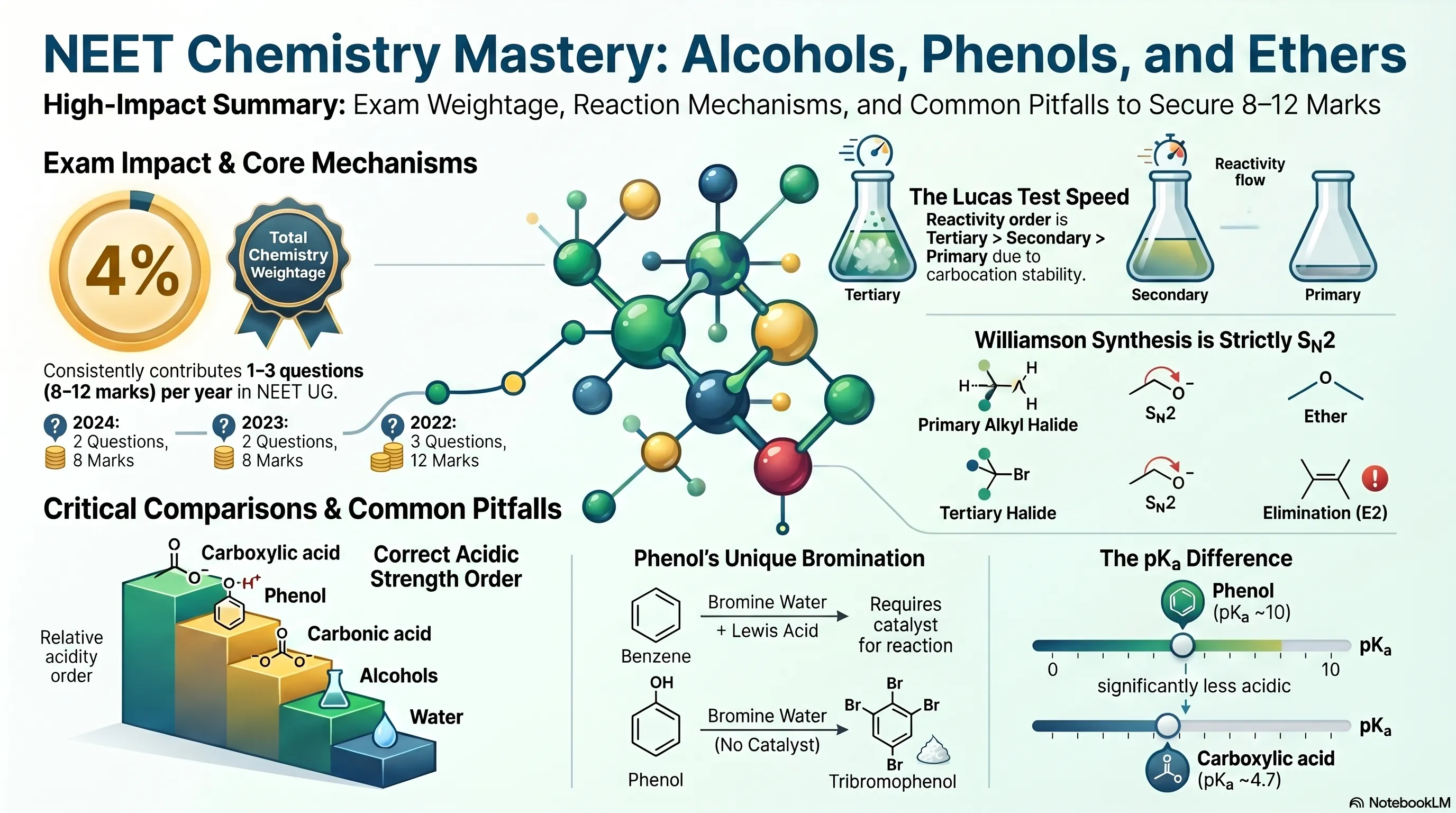
Table of Contents

eSaral › NEET › Alcohol, Ether & Phenol- NEET Previous Year Questions with Complete Solutions

Chapter Weightage of Alcohol, Ether & Phenol in NEET
Alcohols, Phenols and Ethers (NCERT Class 12 Chemistry Chapter 11) consistently contributes 1–3 questions per year in NEET UG, representing approximately 4% of the total Chemistry section.
This may appear modest, but the chapter is deceptively high-impact: questions here test reaction mechanisms and conceptual reasoning — the type that separates a 640 score from a 680 score. Students who skip this chapter or prepare it superficially lose marks they could reliably have secured.
Year-Wise Question Frequency
| NEET Year | Questions from Alcohol/Ether/Phenol | Marks |
|---|---|---|
| NEET 2024 | 2 | 8 |
| NEET 2023 | 2 | 8 |
| NEET 2022 | 3 | 12 |
| NEET 2021 | 2 | 8 |
| NEET 2020 | 2 | 8 |
| NEET 2019 | 1 | 4 |
Source: NTA NEET official question papers. Weightage calculated as a proportion of 180 Chemistry marks (45 questions × 4 marks).
💡 Expert Tip by Prateek Gupta, IIT Bombay: "This chapter has a very high concept-to-marks ratio in NEET. Three to four hours of targeted revision — focused entirely on reaction mechanisms and acidic character comparisons — can reliably secure 8–12 marks. That is not a chapter to skip."
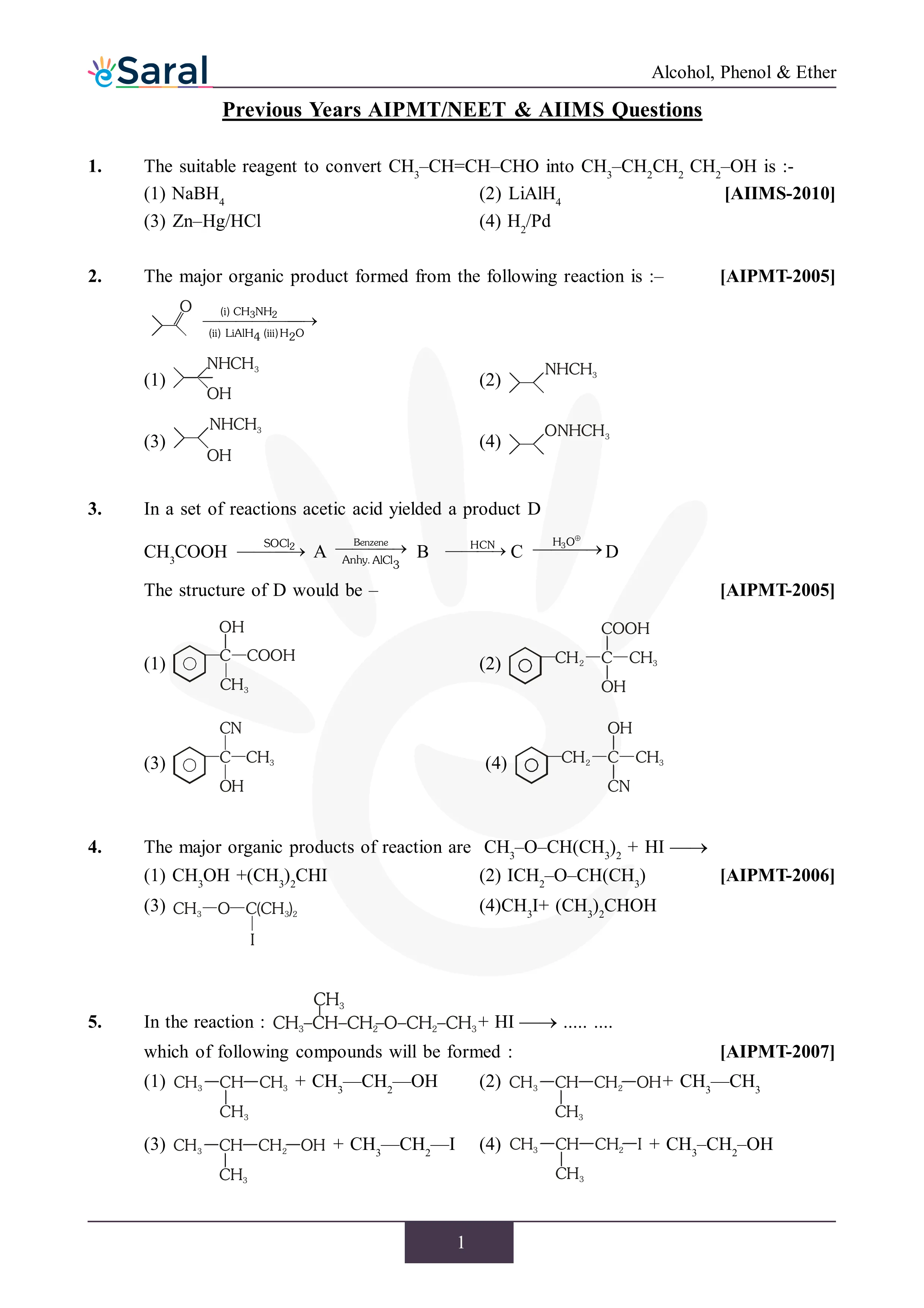
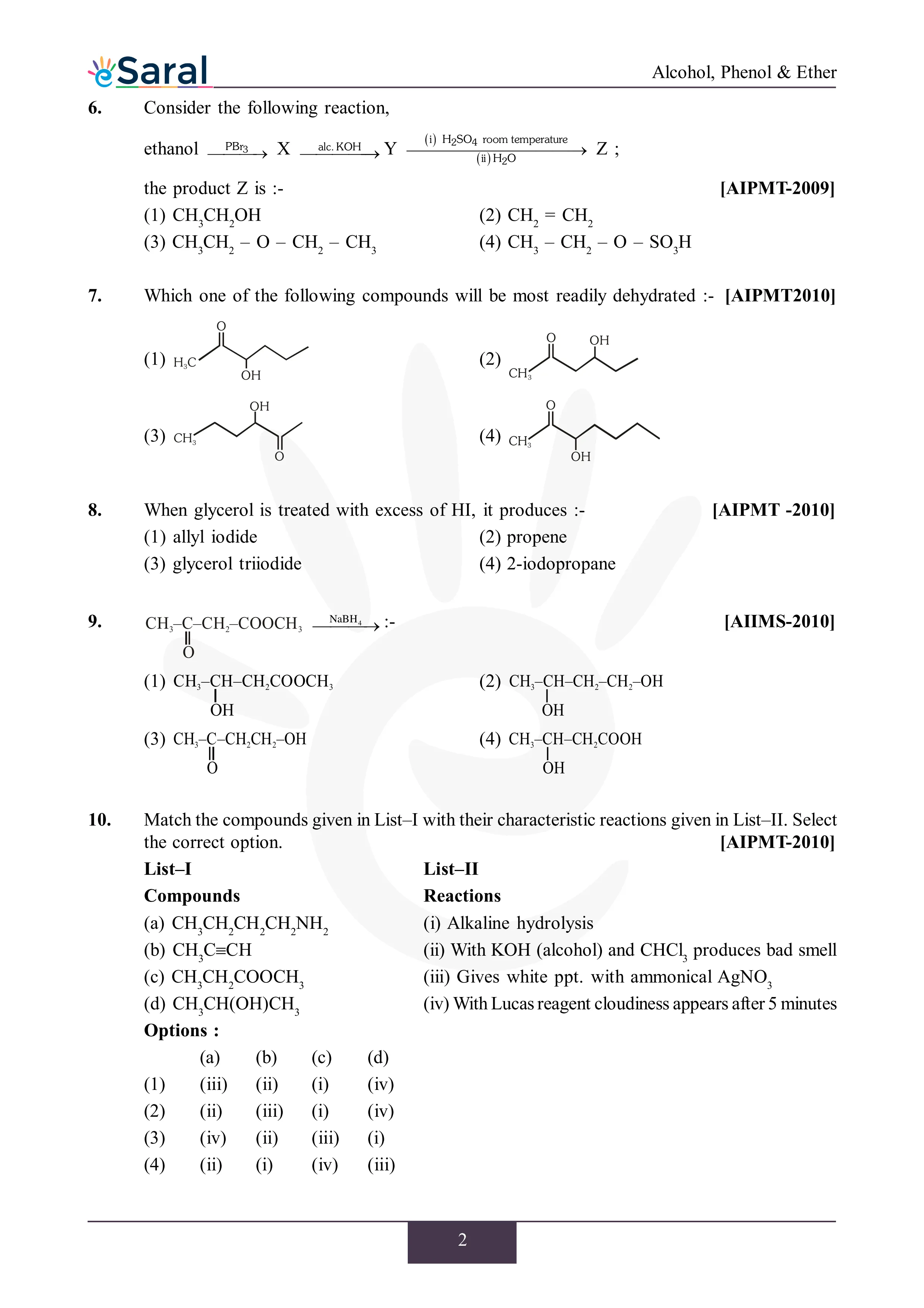
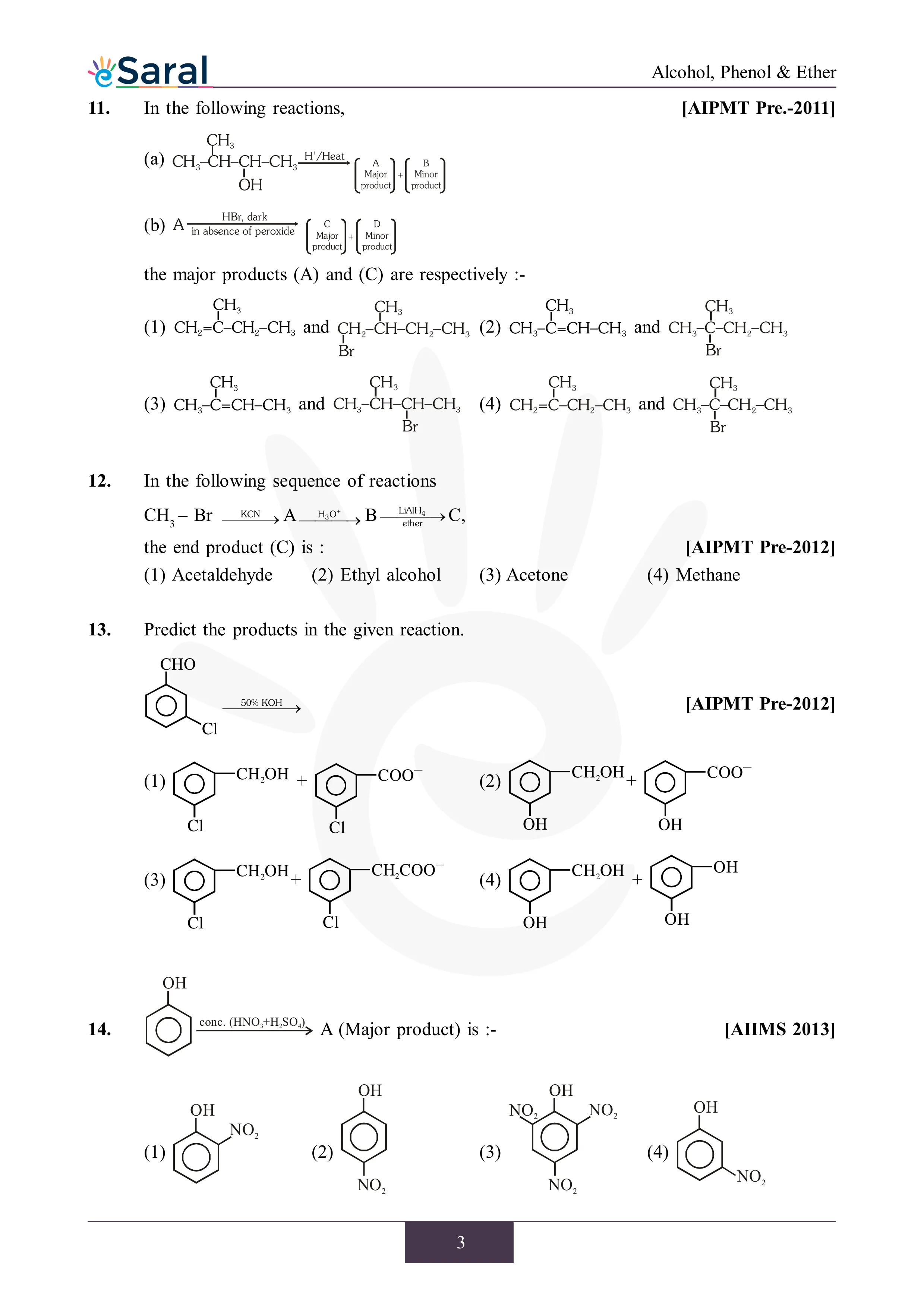
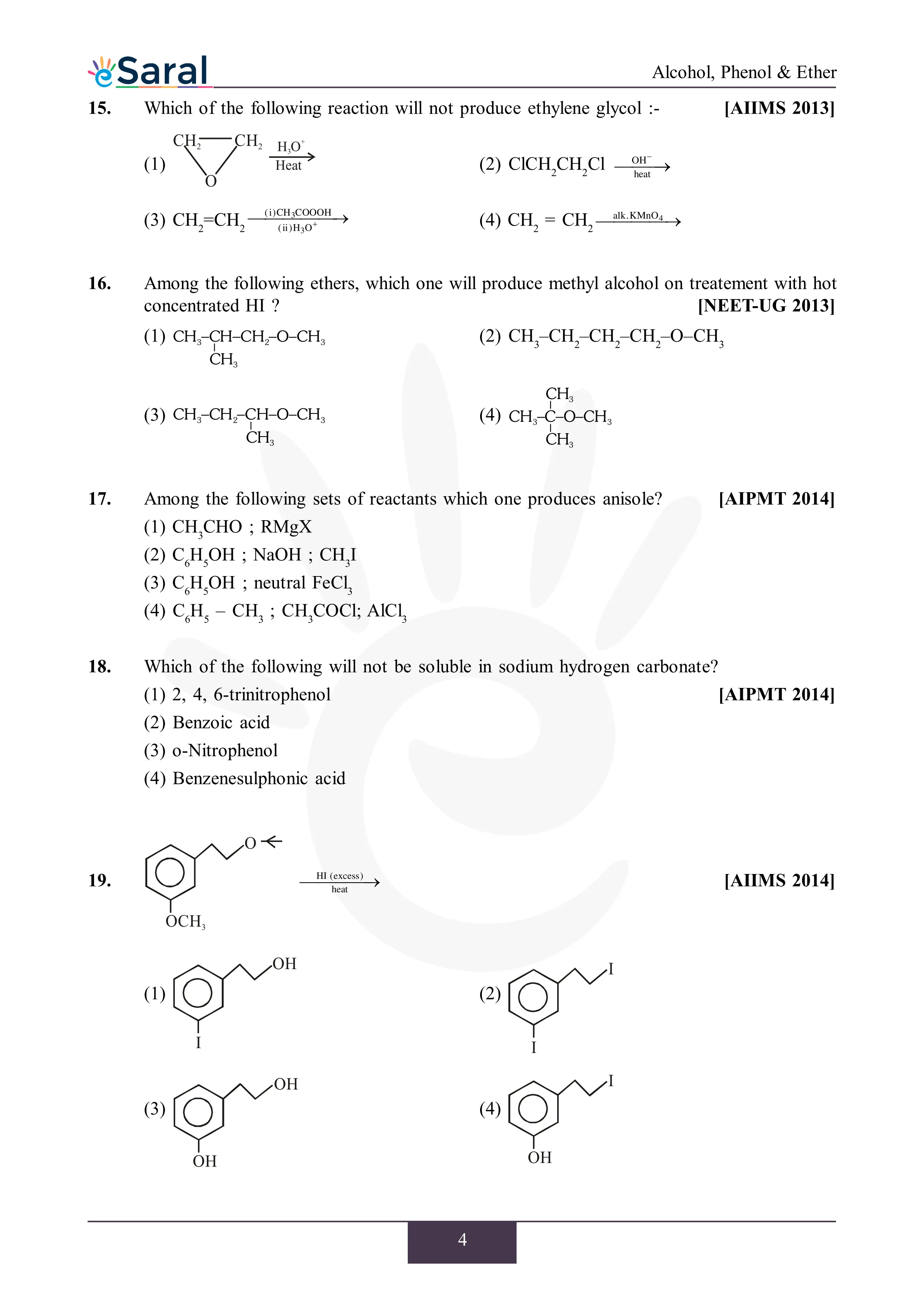
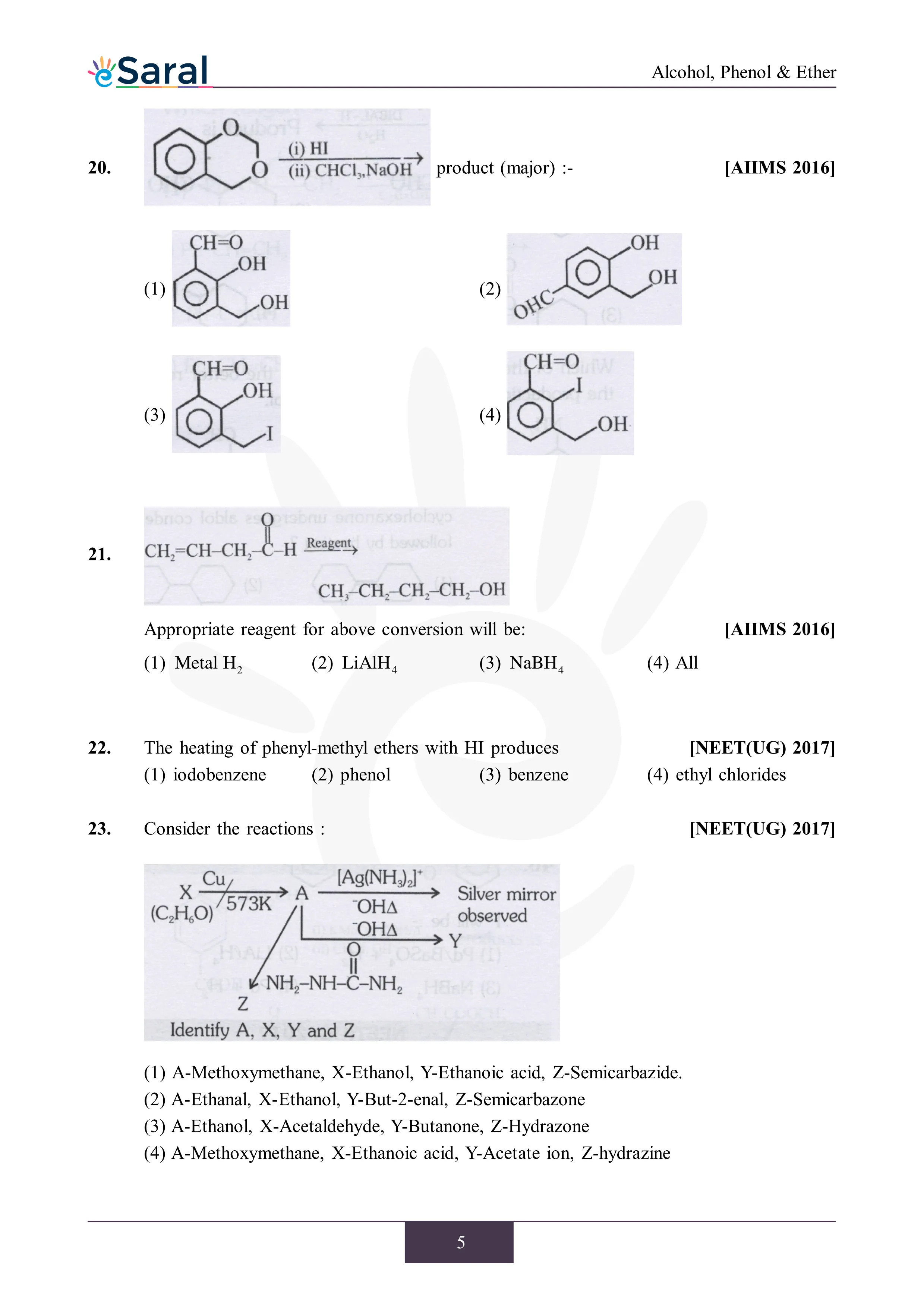
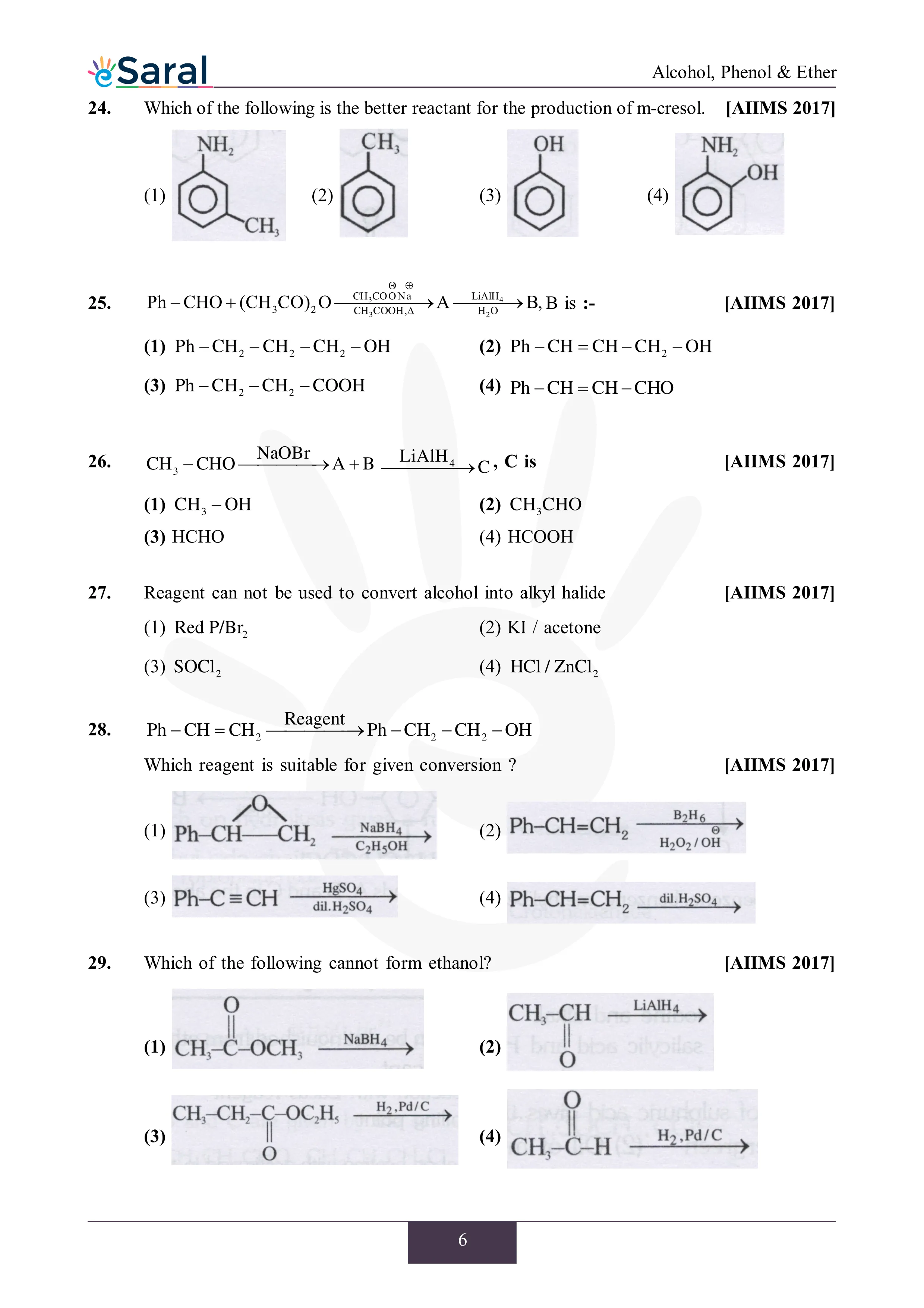
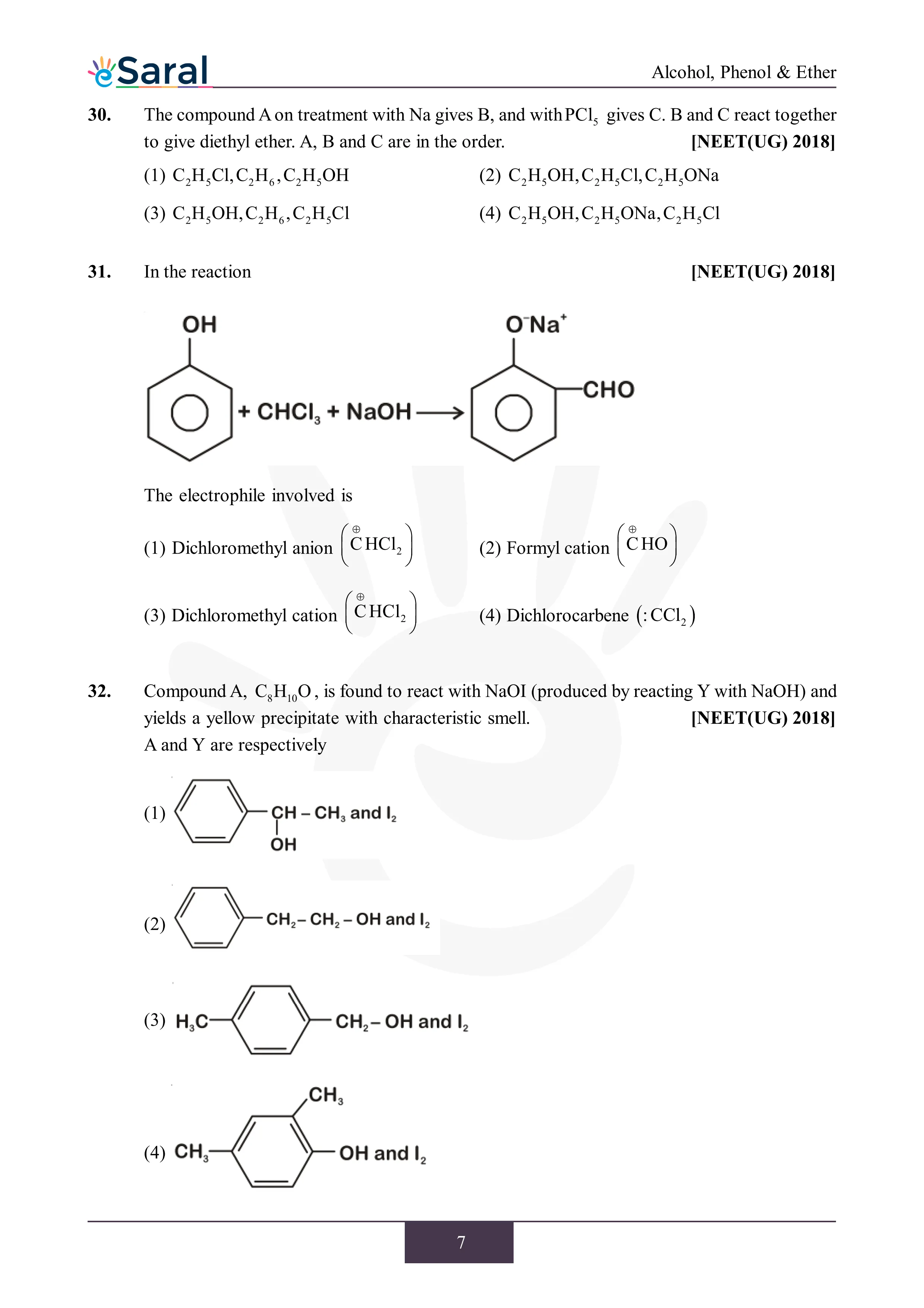
NEET Previous Year Questions — Alcohol, Ether & Phenol (Solved)
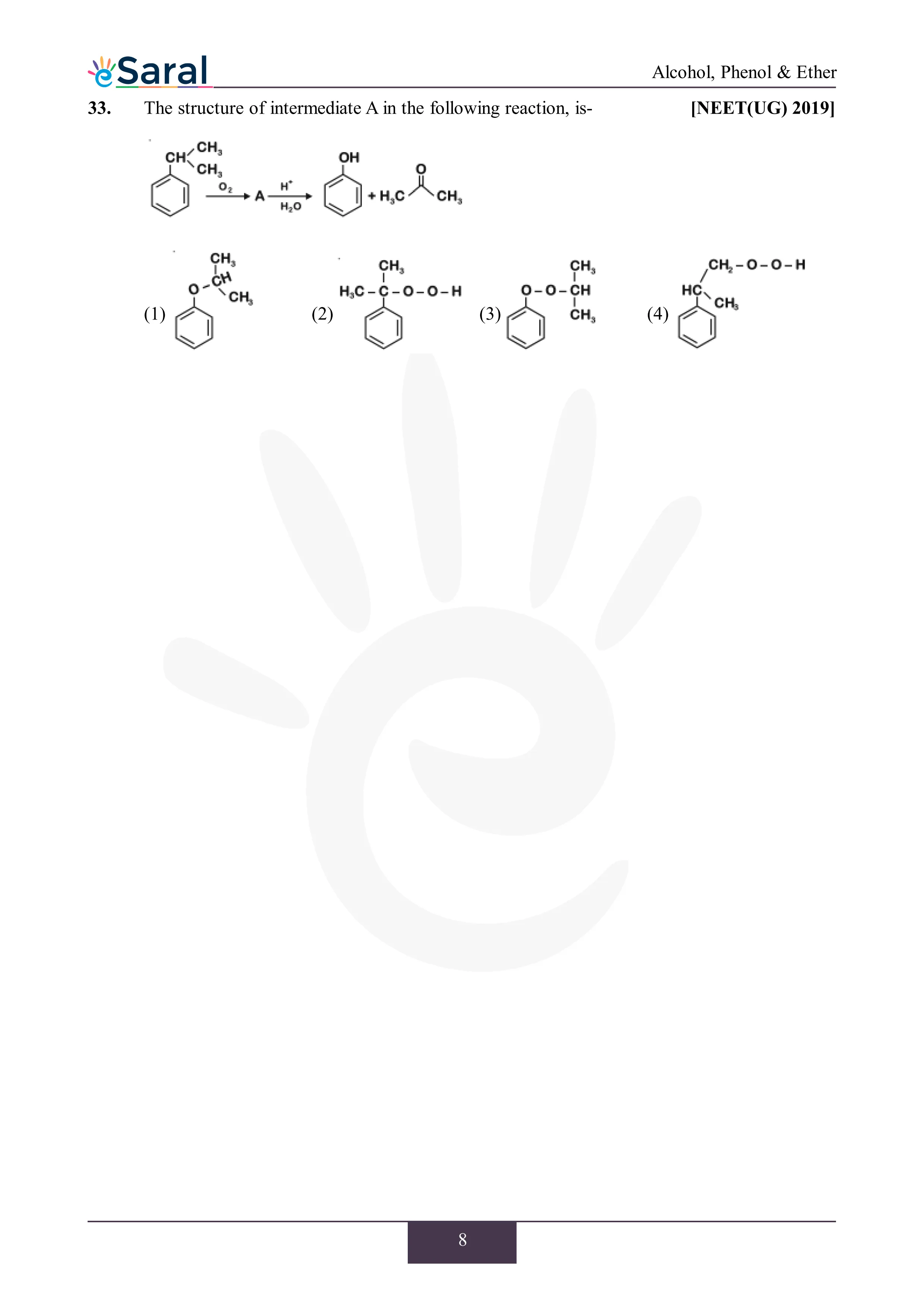

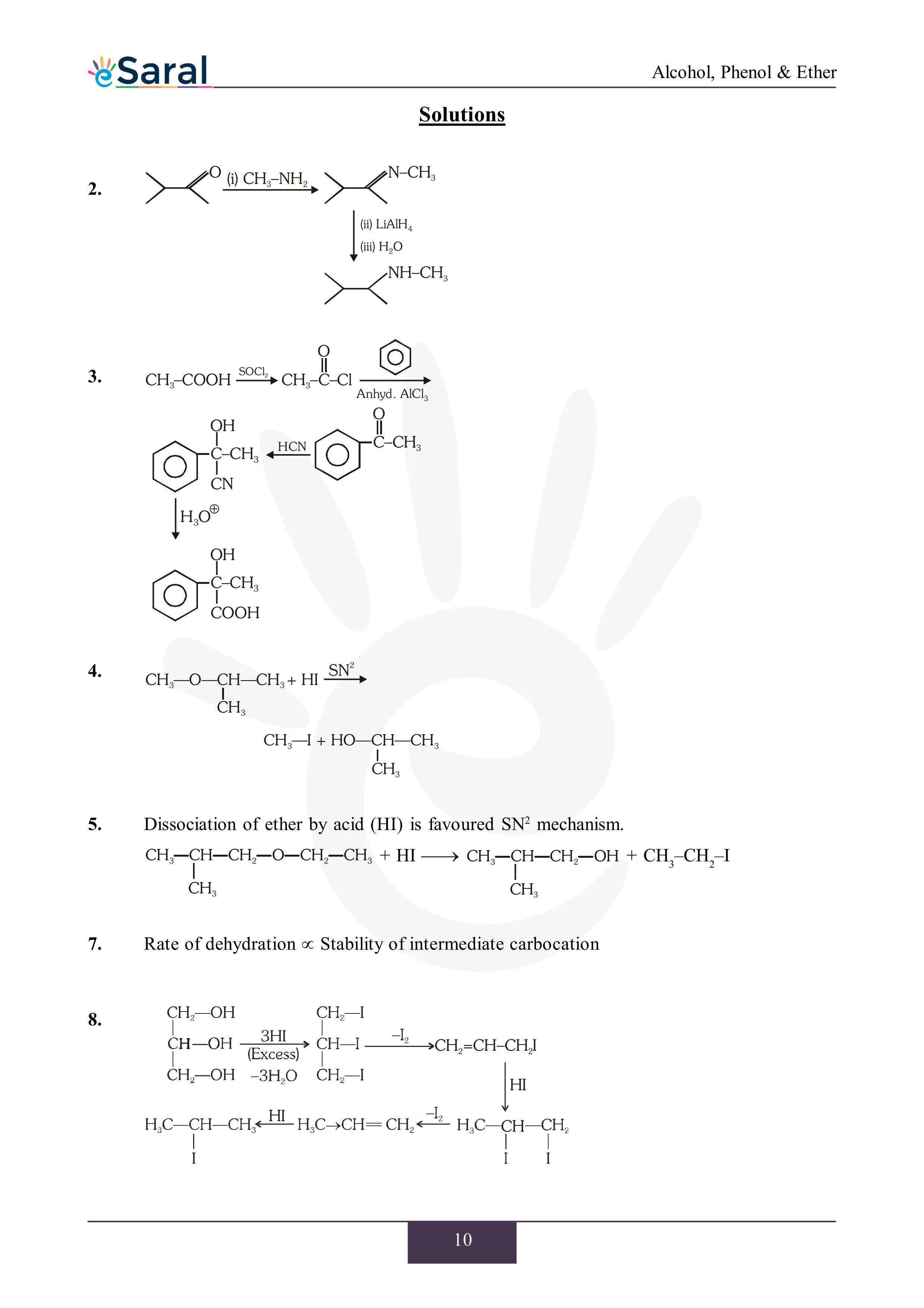
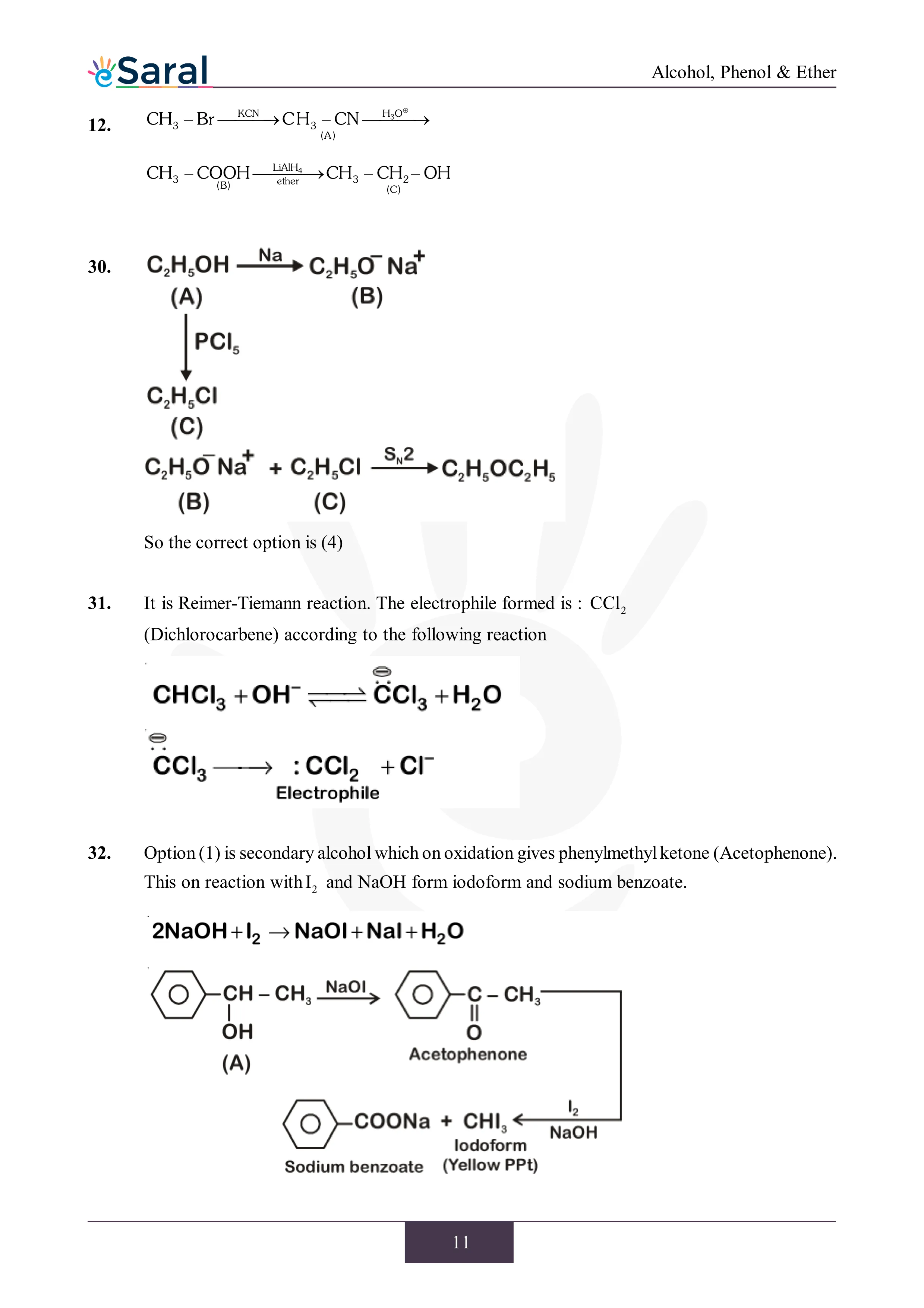
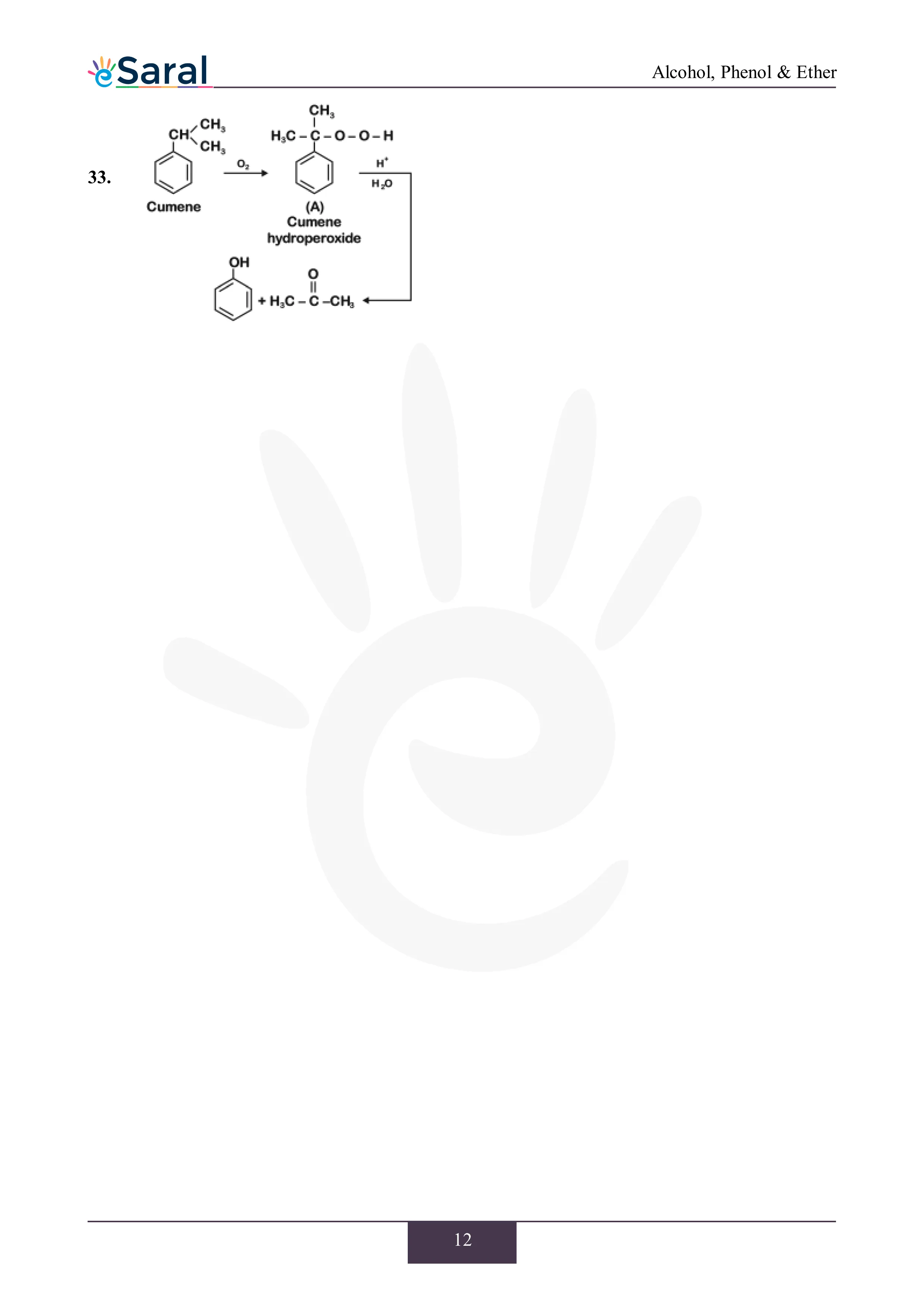
Key Reactions You Must Know for NEET
These are the reactions that appear either as direct questions or as the reasoning behind multi-step problems. Know the reagent, product, and mechanism for each.
Alcohols — Must-Know Reactions
| Reaction | Reagent | Product | Mechanism |
|---|---|---|---|
| Dehydration to alkene | conc. H₂SO₄, 170°C | Alkene (Saytzeff product) | E1 or E2 |
| Dehydration to ether | conc. H₂SO₄, 140°C | Dialkyl ether | SN2 |
| Oxidation (1° alcohol) | PCC or K₂Cr₂O₇/H⁺ | Aldehyde (PCC) or Carboxylic acid (K₂Cr₂O₇) | Oxidation |
| Oxidation (2° alcohol) | K₂Cr₂O₇/H⁺ | Ketone | Oxidation |
| Oxidation (3° alcohol) | Strong oxidant | No reaction (no α-H) | — |
| Reaction with Na | Na metal | Sodium alkoxide + H₂ | Acid-base |
| Lucas test | ZnCl₂ + conc. HCl | Alkyl chloride (turbidity) | SN1 (3°,2°) / SN2 (1°) |
| Iodoform test | I₂ + NaOH | CHI₃ (yellow ppt) | Halogenation |
| Victor Meyer's test | HNO₂ | Colour: 1° red, 2° blue, 3° colourless | — |
Phenols — Must-Know Reactions
| Reaction | Reagent | Product | Key Point |
|---|---|---|---|
| Bromination | Br₂ water | 2,4,6-tribromophenol (white ppt) | No catalyst needed |
| FeCl₃ test | FeCl₃ solution | Violet/purple colour | Qualitative test for phenol |
| Nitration | dil. HNO₃ | Mixture of o- and p-nitrophenol | Mild conditions |
| Kolbe reaction | CO₂ + NaOH → acidify | Salicylic acid (2-hydroxybenzoic acid) | Carboxylation at ortho |
| Reimer–Tiemann | CHCl₃ + NaOH | Salicylaldehyde (2-hydroxybenzaldehyde) | Formylation at ortho |
| Reaction with NaOH | NaOH | Sodium phenoxide + H₂O | Phenol is more acidic than alcohol |
Ethers — Must-Know Reactions
| Reaction | Reagent | Product | Mechanism |
|---|---|---|---|
| Williamson synthesis | R–ONa + R'–X | R–O–R' (ether) | SN2 |
| Cleavage (excess HI) | Excess HI | 2 moles alkyl iodide | SN1 or SN2 |
| Cleavage (1 mole HI) | 1 mole HI | Alkyl iodide + alcohol | SN2 preferentially |
💡 Expert Tip by Prateek Gupta, IIT Bombay: "In NEET, Williamson synthesis always goes SN2. If you are asked whether the reaction proceeds by SN1 or SN2, the answer is SN2 — the alkoxide is a strong nucleophile and the reaction happens at the alkyl halide carbon by backside attack. This is tested almost every alternate year."
Common Mistakes Students Make in This Chapter
Mistake 1 — Reversing the Lucas Test Reactivity Order
Many students remember "primary reacts fastest" because primary alcohols are simplest. The correct order is tertiary > secondary > primary — tertiary is fastest because the SN1 mechanism requires a stable carbocation, and tertiary carbocations are most stable.
Mistake 2 — Thinking Br₂ Water Reacts with Benzene the Same Way as Phenol
Benzene needs a Lewis acid catalyst (FeBr₃) for bromination. Phenol does not — the –OH group activates the ring so powerfully that aqueous Br₂ alone produces tribromination. This contrast is a direct NEET question.
Mistake 3 — Confusing Acidic Strength Order
Correct order: Carboxylic acid > Phenol > Carbonic acid > Alcohols > Water
Students frequently place alcohol above water, or phenol above carbonic acid. The pKa values:
- CH₃COOH: ~4.7
- C₆H₅OH (phenol): ~10
- H₂CO₃: ~6.4 (first dissociation)
- C₂H₅OH: ~16
- H₂O: ~15.7
Note: Phenol is a weaker acid than carbonic acid — this is why CO₂ + H₂O can displace phenol from sodium phenoxide in the Kolbe reaction.
Mistake 4 — Applying SN1 to Williamson Synthesis
Williamson synthesis is strictly SN2. Using a tertiary alkyl halide leads to elimination (E2), not substitution — this is why Williamson synthesis always uses a primary alkyl halide. This mechanism detail appears directly in NEET options.
| Common Error | Correct Understanding |
|---|---|
| Primary alcohol reacts fastest in Lucas test | Tertiary reacts fastest (SN1, stable carbocation) |
| Benzene and phenol brominate the same way | Phenol needs no catalyst; benzene needs FeBr₃ |
| Williamson synthesis via SN1 | Always SN2; tertiary halides cause elimination |
| Phenol is more acidic than carboxylic acid | Carboxylic acid is stronger (pKa ~4.7 vs ~10) |
How to Prepare Alcohol, Ether & Phenol for NEET
Step-by-Step Preparation Plan
Step 1 — NCERT First, Completely NEET is an NCERT-based exam. Every reaction in this chapter that appears in NCERT has been asked in NEET at least once. Read Chapter 11 of Class 12 NCERT Chemistry from start to finish — not as a skimming exercise, but with active note-taking of every named reaction and reagent.
Step 2 — Build Your Reaction Summary Sheet Create a single A4 sheet with all reactions from the tables above. Organise by compound class (alcohols, phenols, ethers), with reagent → product → mechanism in three columns. This sheet will serve as your final-week revision tool.
Step 3 — Solve All PYQs on This Page First Before attempting any practice set, complete all questions on this page. These are actual NEET questions — they show you exactly what the exam asks. Note the question type (mechanism-based, comparison-based, name-reaction-based) for each.
Step 4 — Practise Distinguishing Tests NEET loves questions that ask you to identify an unknown compound from a reaction outcome. Know these cold:
- Lucas test → distinguishes 1°, 2°, 3° alcohols
- FeCl₃ test → confirms phenol (violet colour)
- Br₂ water → confirms phenol (white precipitate)
- Iodoform test → confirms CH₃CH(OH)– or CH₃CO–
- Victor Meyer's test → colour codes for 1°, 2°, 3°
Step 5 — Attempt Chapter-Wise Mock Test After completing NCERT + PYQs, take a 20-question timed chapter-wise test. Aim for 90%+ accuracy before moving on. For a full NEET chapter-wise practice set with solutions, visit eSaral's NEET PYQ chapter-wise section.
Time to Spend on This Chapter
| Preparation Stage | Time Required |
|---|---|
| NCERT reading + notes | 3–4 hours |
| Reaction summary sheet | 1 hour |
| PYQ practice + analysis | 2–3 hours |
| Chapter-wise mock test | 1 hour |
| Total | 7–9 hours |
For a chapter carrying 4% weightage in NEET, 7–9 focused hours is a high-return investment. Most students either underinvest (and lose predictable marks) or overinvest (and crowd out higher-weightage chapters). This time estimate reflects the optimal balance.
Frequently Asked Questions
Find answers to common questions.
What is the weightage of Alcohol, Ether and Phenol in NEET?
Alcohol, Ether and Phenol carries approximately 4% weightage in NEET, contributing 1–3 questions (4–12 marks) annually. Based on NEET papers from 2019 to 2024, the chapter has appeared in every year's paper. Acidic nature of phenol, Lucas test, Williamson synthesis, and electrophilic substitution reactions are the most consistently tested topics.
Which topics from Alcohol Phenol and Ether are most important for NEET?
The highest-priority topics are: the acidic nature of phenol (and its comparison with alcohols and carboxylic acids), the Lucas test reactivity order (tertiary > secondary > primary), Williamson ether synthesis (SN2 mechanism), electrophilic substitution of phenol (especially bromination with Br₂ water), and named reactions — Kolbe and Reimer–Tiemann. These appear in almost every NEET paper in some form.
How do I distinguish between alcohols, phenols, and ethers in NEET questions?
Use these tests: (1) Lucas test — ZnCl₂ + conc. HCl distinguishes 1°, 2°, 3° alcohols by turbidity speed. (2) FeCl₃ test — violet colour confirms phenol. (3) Br₂ water — white precipitate (2,4,6-tribromophenol) confirms phenol. (4) Na metal — both alcohols and phenols react; phenol reacts more vigorously. (5) NaOH — only phenol dissolves (alcohol does not react with NaOH).
What is the reactivity order in the Lucas test?
Tertiary alcohols react immediately at room temperature (instant turbidity). Secondary alcohols react on gentle warming (turbidity in 5 minutes). Primary alcohols do not react at room temperature — they require heating or do not react under Lucas conditions. This order is because tertiary carbocations are most stable, favouring the SN1 mechanism that drives the reaction.
What is Williamson ether synthesis and why is it always SN2?
Williamson ether synthesis is the reaction of a sodium alkoxide (R–ONa) with an alkyl halide (R'–X) to produce an ether (R–O–R'). It proceeds exclusively via SN2 because the alkoxide is a strong nucleophile that attacks the alkyl halide carbon from the back in a concerted single-step reaction. If a tertiary alkyl halide is used, the bulky substrate undergoes E2 elimination instead of substitution — which is why Williamson synthesis always uses a primary alkyl halide.