Biological Classification Class 11 NEET: Five Kingdom System Explained
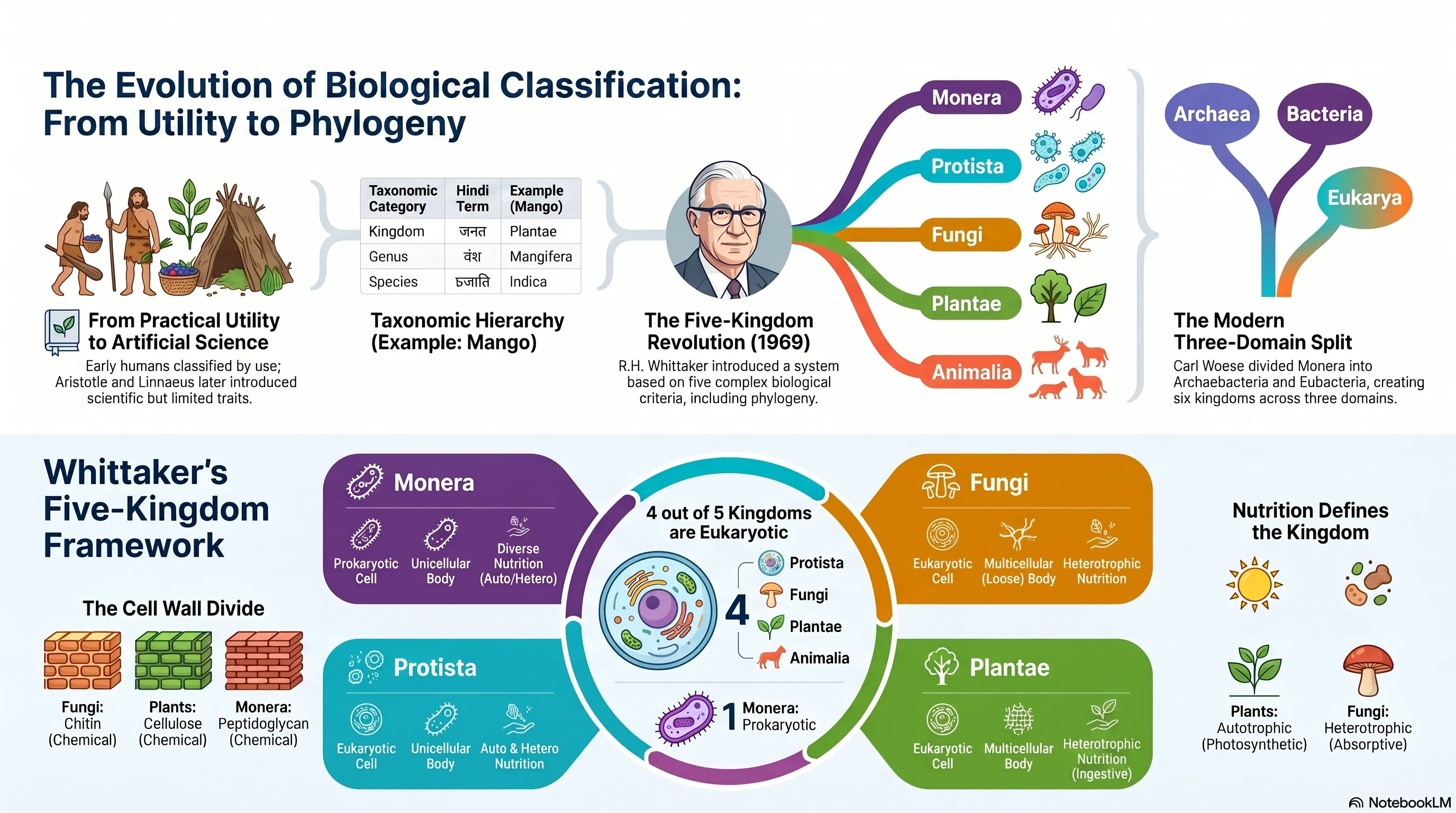
Biological classification in Class 11 Biology divides all living organisms into five kingdoms: Monera, Protista, Fungi, Plantae, and Animalia. This system, proposed by R.H. Whittaker in 1969, is based on five criteria: cell type, body organisation, cell wall composition, mode of nutrition, and reproduction.

Table of Contents
- Why Do We Classify Living Organisms?
- What Is Taxonomy? Understanding Taxon and Taxonomic Categories
- Three Types of Classification Systems in Biology
- Whittaker's Five Kingdom Classification: Basis and Criteria
- Cell Wall Differences Across the Five Kingdoms
- Body Organisation Across the Five Kingdoms
- Mode of Nutrition Across the Five Kingdoms
- Reproduction Across the Five Kingdoms
- Key Corrections the Five Kingdom System Made
- Carl Woese and the Six Kingdom System

eSaral › NEET › Biological Classification Class 11 NEET: Five Kingdom System Explained

Why Do We Classify Living Organisms?
Since the beginning of civilisation, humans have observed the organisms around them — plants, animals, and other life forms. Two things drove the urge to classify them: fear and curiosity. Some organisms frightened early humans; others were useful for food, clothing, or shelter. This practical need to distinguish one organism from another led to the first attempts at biological classification.
The NCERT text for this chapter states it clearly: early classification efforts were not based on scientific criteria. They were based on practical utility — what the organism was used for, whether it was edible, and whether it caused harm. This is called use-based classification (or the Practical System of Classification). Groups like cereals, pulses, and vegetables are everyday examples: these are not single organisms, but groups defined by how humans use them.
As thinking became more scientific, classification systems moved from utility-based groupings toward systems based on observable biological features.
What Is Taxonomy? Understanding Taxon and Taxonomic Categories
Taxonomy, or वर्गिकी in Hindi, is the science of classification. More specifically, it means assigning every living organism to a taxon — a defined biological group.
Scientists have identified seven main taxonomic categories, arranged in a hierarchy from most specific to broadest:
| Taxonomic Category | Hindi Term | Example (Mango) |
|---|---|---|
| Species | प्रजाति | indica |
| Genus | वंश | Mangifera |
| Family | कुल | Anacardiaceae |
| Order | गण | Sapindales |
| Class | वर्ग | Dicotyledonae |
| Division / Phylum | संघ / विभाग | Angiospermae |
| Kingdom | जगत | Plantae |
The full scientific name of mango — Mangifera indica — follows from this system. Indica represents the species; Mangifera represents the genus. Every organism can be placed within these seven categories. Assigning an organism to its correct taxon within this hierarchy is what taxonomy is.
Three Types of Classification Systems in Biology
Classification systems in biology have evolved through three broad stages. Understanding the difference between them is important for NEET.
1. Use-Based Classification (Practical System)
The earliest form. Organisms were grouped based on their usefulness to humans: food, clothing, and shelter. No scientific criteria were applied. This is not considered a scientific classification system.
2. Artificial Classification
The first genuinely scientific attempts at classification, though limited. Artificial classification systems used only one or two morphological or reproductive characters as the basis for grouping organisms. Both vegetative (morphological) and reproductive (sexual) characters were given equal importance.
Aristotle was the first to use scientific criteria. He divided all living organisms into two groups — plants and animals. Plants were further divided into three groups based on habit: herbs (शाक), shrubs (क्षुप), and trees (वृक्ष). Animals were classified based on the presence or absence of red blood: those with red blood were called Enaima; those without (or with colourless blood) were called Anaima.
Linnaeus worked within the two-kingdom framework as well, placing all organisms into either Plantae or Animalia. His classification of plants was based on the characteristics of the androecium (the male reproductive part of the flower). Critically, Linnaeus grouped bacteria, fungi, blue-green algae, bryophytes, pteridophytes, gymnosperms, and angiosperms all within the plant kingdom — because all of them have a cell wall. This ignored the fundamental distinction between prokaryotic and eukaryotic cells.
3. Natural and Phylogenetic Classification
Modern classification systems use many more characters: internal anatomy, ultrastructure, embryology, chemical composition of the organism, mode of nutrition, reproductive characters, and evolutionary relationships. When classification is based on a wide range of such characters, it is called natural classification. When evolutionary history (phylogeny) is also incorporated — which became possible after Darwin — it is called phylogenetic classification.
All classification systems in use today are natural or phylogenetic systems.

Whittaker's Five Kingdom Classification: Basis and Criteria
In 1969, R.H. Whittaker proposed the five-kingdom classification system. It was a landmark advance over all previous systems because it incorporated multiple characters that earlier systems had ignored entirely.
Whittaker based his five-kingdom classification on five criteria:
- Cell type — prokaryotic or eukaryotic
- Body organisation — unicellular or multicellular; if multicellular, whether at the tissue, organ, or organ system level
- Mode of nutrition — autotrophic or heterotrophic
- Reproduction — method of reproduction used
- Phylogenetic relationships — evolutionary history
The five kingdoms are:
| Kingdom | Cell Type | Body Organisation | Nutrition |
|---|---|---|---|
| Monera | Prokaryotic | Unicellular | All types |
| Protista | Eukaryotic | Unicellular | Autotrophic & heterotrophic |
| Fungi | Eukaryotic | Multicellular (loose tissue) | Heterotrophic only |
| Plantae | Eukaryotic | Multicellular | Autotrophic (photosynthetic) |
| Animalia | Eukaryotic | Multicellular | Heterotrophic only |
💡 NEET Exam Point: A frequently asked NEET question is — "In Whittaker's five kingdom classification, how many kingdoms contain eukaryotic organisms?" The answer is four: Protista, Fungi, Plantae, and Animalia. Only Monera contains prokaryotic organisms.
Cell Wall Differences Across the Five Kingdoms
The composition of the cell wall is one of the most tested topics from this chapter in NEET. The details differ significantly across kingdoms.
| Kingdom | Cell Wall Present? | Composition |
|---|---|---|
| Monera | Yes (except Mycoplasma) | Peptidoglycan (not cellulose) |
| Protista | In some (e.g., Chrysophyta, Dinoflagellates) | Cellulose (where present) |
| Protista (Euglenoids, Slime moulds, Protozoa) | No | — |
| Fungi | Yes | Chitin (not cellulose) |
| Plantae | Yes (all) | Cellulose |
| Animalia | No | — |
This table explains a major flaw in Linnaeus's two-kingdom system. He placed all cell-wall-bearing organisms in Plantae. But the cell wall of fungi is made of chitin, not cellulose. And bacteria have cell walls made of peptidoglycan. The two-kingdom system did not account for these differences in cell wall composition, which is precisely why it was inadequate.
Body Organisation Across the Five Kingdoms
How an organism's body is organised — its level of structural complexity — is another key criterion in Whittaker's system.
- Monera: All are unicellular (prokaryotic)
- Protista: All are unicellular eukaryotes — this is the defining feature of the entire kingdom
- Fungi: Multicellular, with a loose (non-rigid) tissue organisation
- Plantae: Multicellular; lower plants like algae and bryophytes have tissue-level organisation; higher plants (pteridophytes, gymnosperms, angiosperms) have tissue system or organ-level organisation
- Animalia: Multicellular; have tissue, organ, and organ system levels of organisation
The Protista kingdom is particularly interesting. Whittaker used it as a collecting group for all unicellular eukaryotes — which meant removing organisms from both the old plant kingdom and the old animal kingdom. Unicellular algae like Chlamydomonas and Chlorella, previously placed in Plantae, were moved to Protista. Unicellular animals like Amoeba and Paramecium, previously placed in Animalia because they were heterotrophic and lacked a cell wall, were also moved to Protista.
Mode of Nutrition Across the Five Kingdoms
Whittaker's classification explicitly addresses how each organism obtains its nutrition — something the two-kingdom system never did. The diversity here is greatest in Monera.
Kingdom Monera
All four types of nutrition are found here:
- Photoautotrophic — organisms like cyanobacteria that perform photosynthesis
- Chemoautotrophic (Chemosynthetic autotrophs) — organisms that generate energy by oxidising inorganic compounds
- Photoheterotrophic — heterotrophs that use light energy
- Chemoheterotrophic — parasites and saprotrophs that absorb nutrients from living or dead organic matter
Kingdom Protista
Both autotrophic and heterotrophic nutrition. Chrysophytes and dinoflagellates are photosynthetic autotrophs. Euglena is photosynthetic during the day and switches to heterotrophic feeding at night. Slime moulds are entirely saprotrophic. Protozoans feed like animals — heterotrophic, often parasitic.
Kingdom Fungi
Entirely heterotrophic. No fungus performs photosynthesis. Fungi are either saprotrophic (feeding on dead organic matter) or parasitic (feeding on living hosts). This is a critical distinction — Linnaeus had placed fungi in Plantae, but plants are photosynthetic autotrophs. Fungi are not. Whittaker corrected this by creating a separate kingdom for them.
Kingdom Plantae
All plants are photosynthetic autotrophs.
Kingdom Animalia
All animals are heterotrophic. Their dominant mode of nutrition is holozoic — they ingest food first and digest it internally within a gut. This is different from fungi and bacteria, which secrete enzymes externally and absorb the digested products through their surface (osmotrophic nutrition).
Reproduction Across the Five Kingdoms
The method of reproduction was the fifth criterion Whittaker used.
- Monera: Conjugation occurs — two bacteria exchange genetic material. True sexual reproduction (involving gamete fusion) does not occur in prokaryotes.
- Protista: True sexual reproduction begins here. Gametes fuse to form a zygote. This is the origin of genuine sexual reproduction in the living world.
- Fungi: Sexual reproduction via gamete fusion and zygote formation.
- Plantae: Sexual reproduction via fertilisation.
- Animalia: Sexual reproduction via fertilisation.
Key Corrections the Five Kingdom System Made
Three major corrections that Whittaker's system made over the two-kingdom classification are directly relevant to NEET.
1. Bacteria and Cyanobacteria moved out of Plantae → into Monera In the two-kingdom system, bacteria and cyanobacteria were in Plantae because they have cell walls. But their cells are prokaryotic — they have no nuclear membrane. Whittaker separated all prokaryotic organisms into Kingdom Monera.
2. Unicellular eukaryotes moved into Protista Unicellular algae (Chlamydomonas, Chlorella) were in Plantae; unicellular animals (Amoeba, Paramecium) were in Animalia. Whittaker placed all of them in a new kingdom — Protista — because they are all unicellular eukaryotes.
3. Fungi separated from Plantae Fungi were in Plantae because they have cell walls. But their cell walls are made of chitin, not cellulose. More importantly, fungi are entirely heterotrophic — they cannot photosynthesise. Whittaker created a separate Kingdom Fungi to correct this placement.
For NEET questions from this chapter, practise with NEET 2023 Question Paper and NEET 2022 Question Paper to see how these concepts are actually tested. A full archive of NEET Question Papers is available on eSaral.
Carl Woese and the Six Kingdom System
After Whittaker, Carl Woese proposed the Three Domain System of Classification, which divided the living world into six kingdoms across three domains.
- Domain Archaea → one new kingdom: Archaebacteria
- Domain Bacteria → Kingdom Monera
- Domain Eukarya → Protista, Fungi, Plantae, Animalia (four kingdoms from Whittaker's system)
Woese effectively split Whittaker's Monera into two kingdoms: Archaebacteria and Monera. This gives six kingdoms in total. Classification systems will continue to evolve as our understanding of living organisms deepens.
Frequently Asked Questions
Find answers to common questions.
What is biological classification and why is it important for NEET?
Biological classification is the science of organising living organisms into groups based on shared characteristics. For NEET, this chapter is important because it covers the five kingdom system, the basis of each kingdom, and differences between classification systems — all of which are tested directly in NEET Biology. Questions from this chapter have appeared in previous NEET papers consistently.
What are the five kingdoms in Whittaker's classification system?
The five kingdoms are Monera, Protista, Fungi, Plantae, and Animalia. Whittaker proposed this system in 1969. It is based on five criteria: cell type (prokaryotic or eukaryotic), body organisation, cell wall composition, mode of nutrition, and phylogenetic relationships. This is the primary classification system covered in Class 11 NEET Biology.
What is the difference between artificial and natural classification in biology?
Artificial classification, as used by Aristotle and Linnaeus, was based on only one or two morphological or reproductive characters. Natural classification uses a much wider range of characters — including internal anatomy, cell structure, embryology, biochemistry, and mode of nutrition. Phylogenetic classification additionally includes evolutionary history. All modern systems are natural or phylogenetic.
How many kingdoms in Whittaker's system have eukaryotic organisms?
Four kingdoms contain eukaryotic organisms: Protista, Fungi, Plantae, and Animalia. Only Kingdom Monera contains prokaryotic organisms. This is a frequently asked NEET question — the answer is four, not five.
What is the difference between Whittaker's five-kingdom system and Carl Woese's classification?
Whittaker divided all life into five kingdoms. Carl Woese later proposed the Three Domain System, which created six kingdoms by splitting Monera into two: Archaebacteria (in Domain Archaea) and Monera (in Domain Bacteria). The other four kingdoms (Protista, Fungi, Plantae, Animalia) were placed in Domain Eukarya.