Breathing and Exchange of Gases - NEET Previous Year Questions with Complete Solutions

Table of Contents

eSaral › NEET › Biology › Breathing and Exchange of Gases Previous Year Questions with Complete Solutions

Here you will get Complete Breathing and Exchange of Gases NEET Previous Year Questions with complete and detailed solutions.
Get complete NEET previous year questions for Physics, Chemistry and Biology.
You will find all the solutions at the end of this page:

High-Frequency Sub-Topics You Must Master
Mechanism of Breathing and Lung Volumes
What does NEET ask here? Questions test whether you can distinguish between lung volume terms and identify the muscles involved in inspiration vs. expiration.
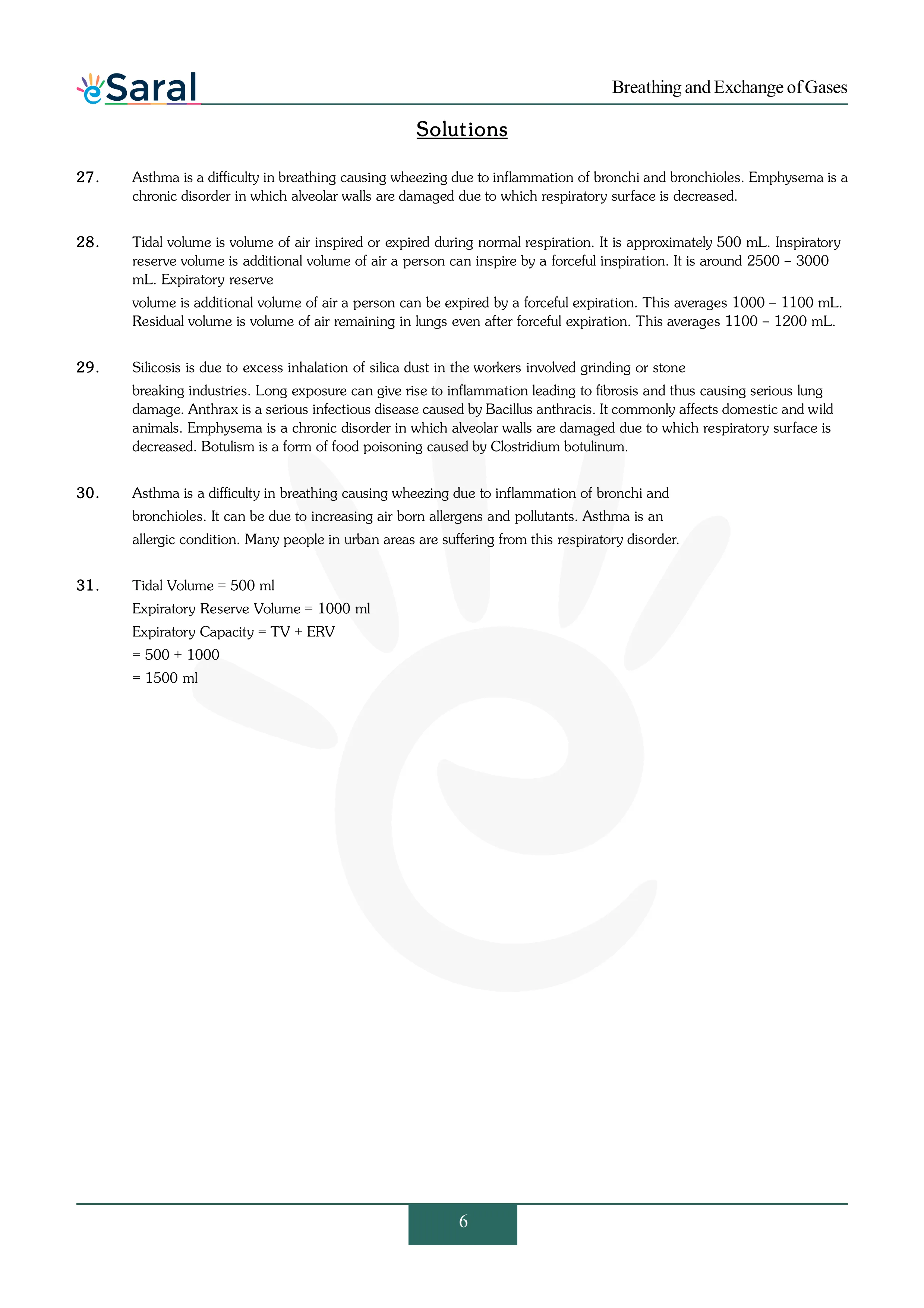
Lung Volumes and Capacities — Quick Reference
| Term | Value (Approx.) | What It Means |
|---|---|---|
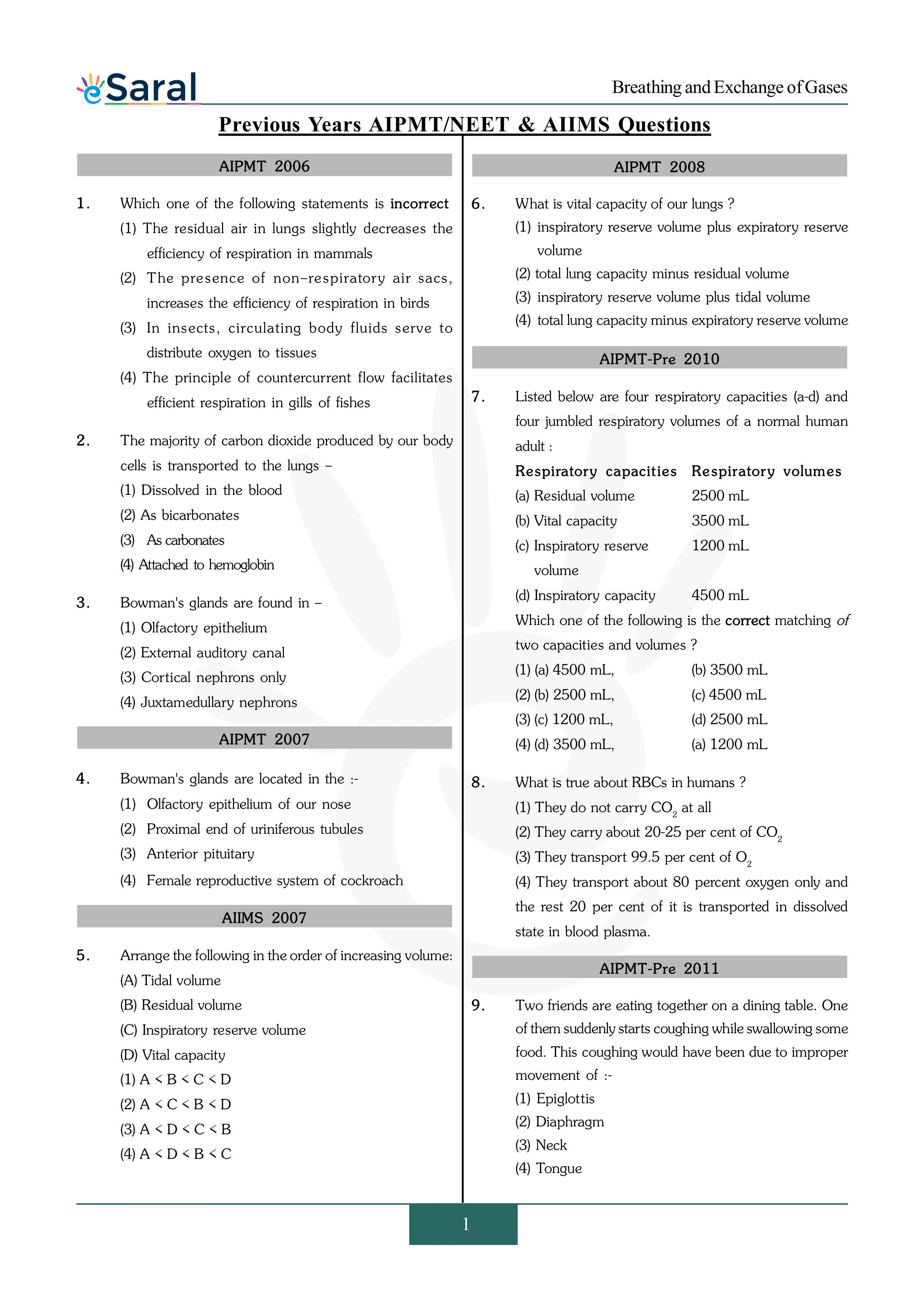
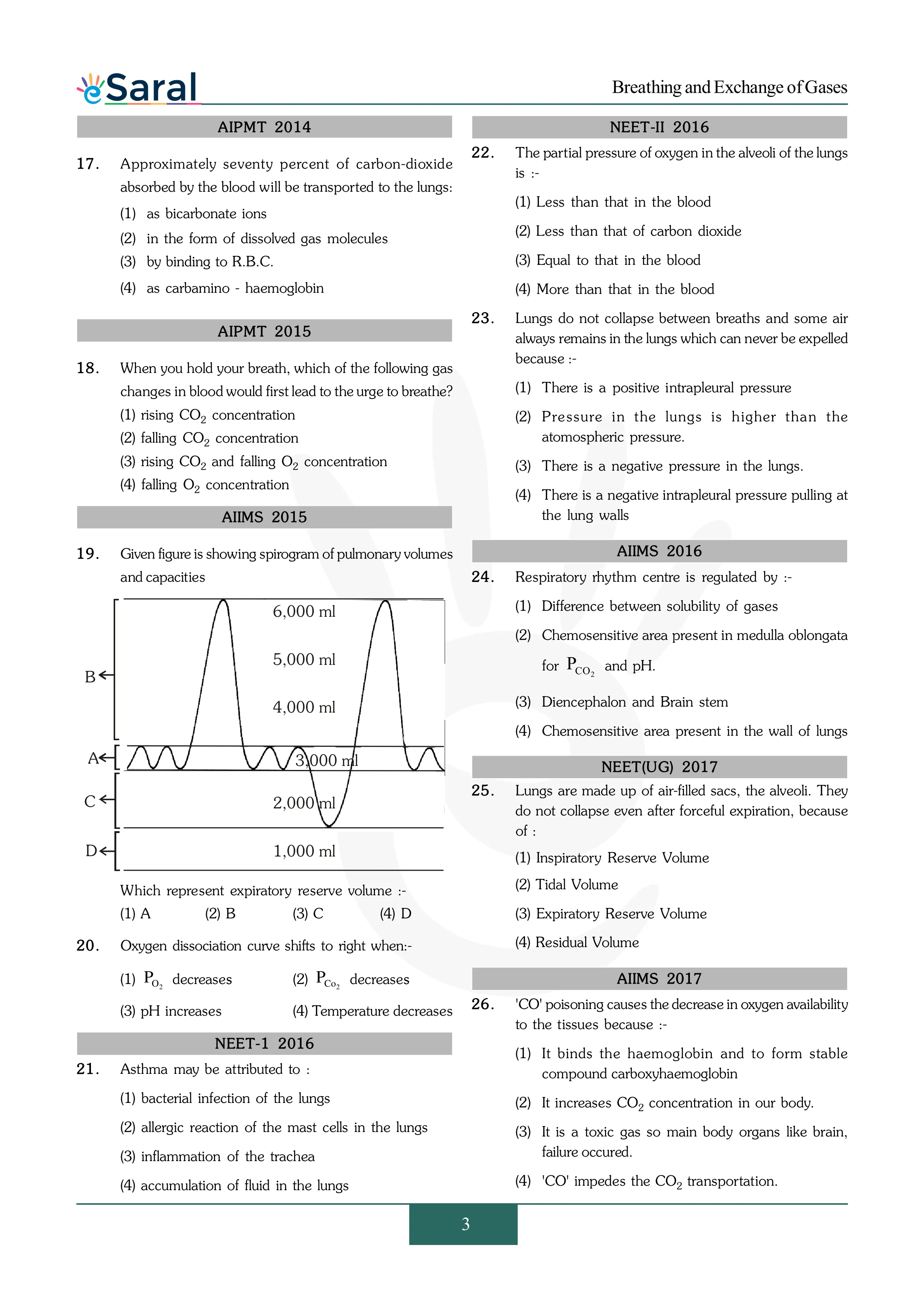
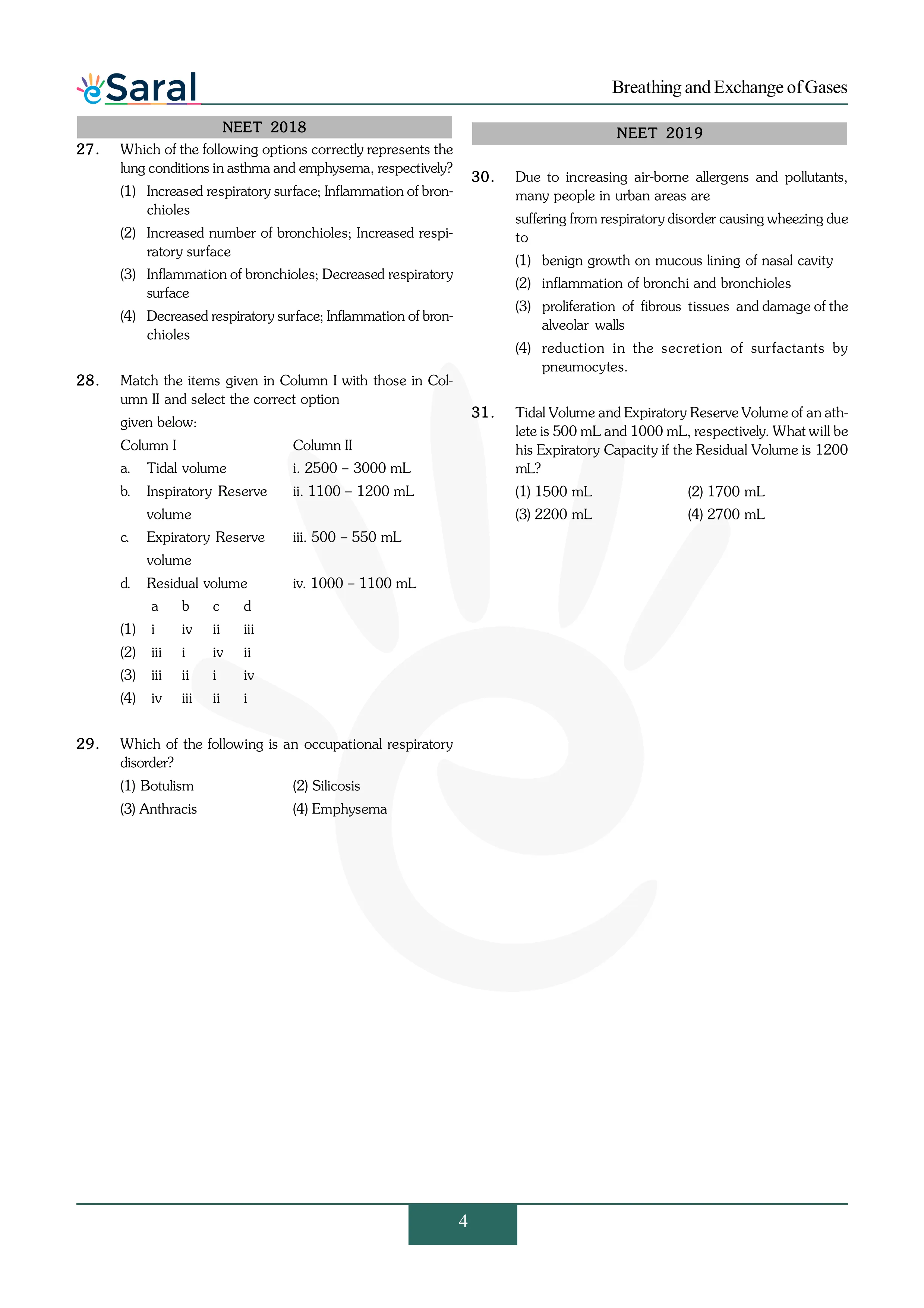
| Tidal Volume (TV) | 500 mL | Air moved in one normal breath |
| Inspiratory Reserve Volume (IRV) | 2500–3000 mL | Extra air inhaled beyond TV |
| Expiratory Reserve Volume (ERV) | 1000–1100 mL | Extra air exhaled beyond TV |
| Residual Volume (RV) | 1100–1200 mL | Air that never leaves the lungs |
| Vital Capacity (VC) | ~4600 mL | TV + IRV + ERV |
| Total Lung Capacity (TLC) | ~5800 mL | VC + RV |
Muscles to know:
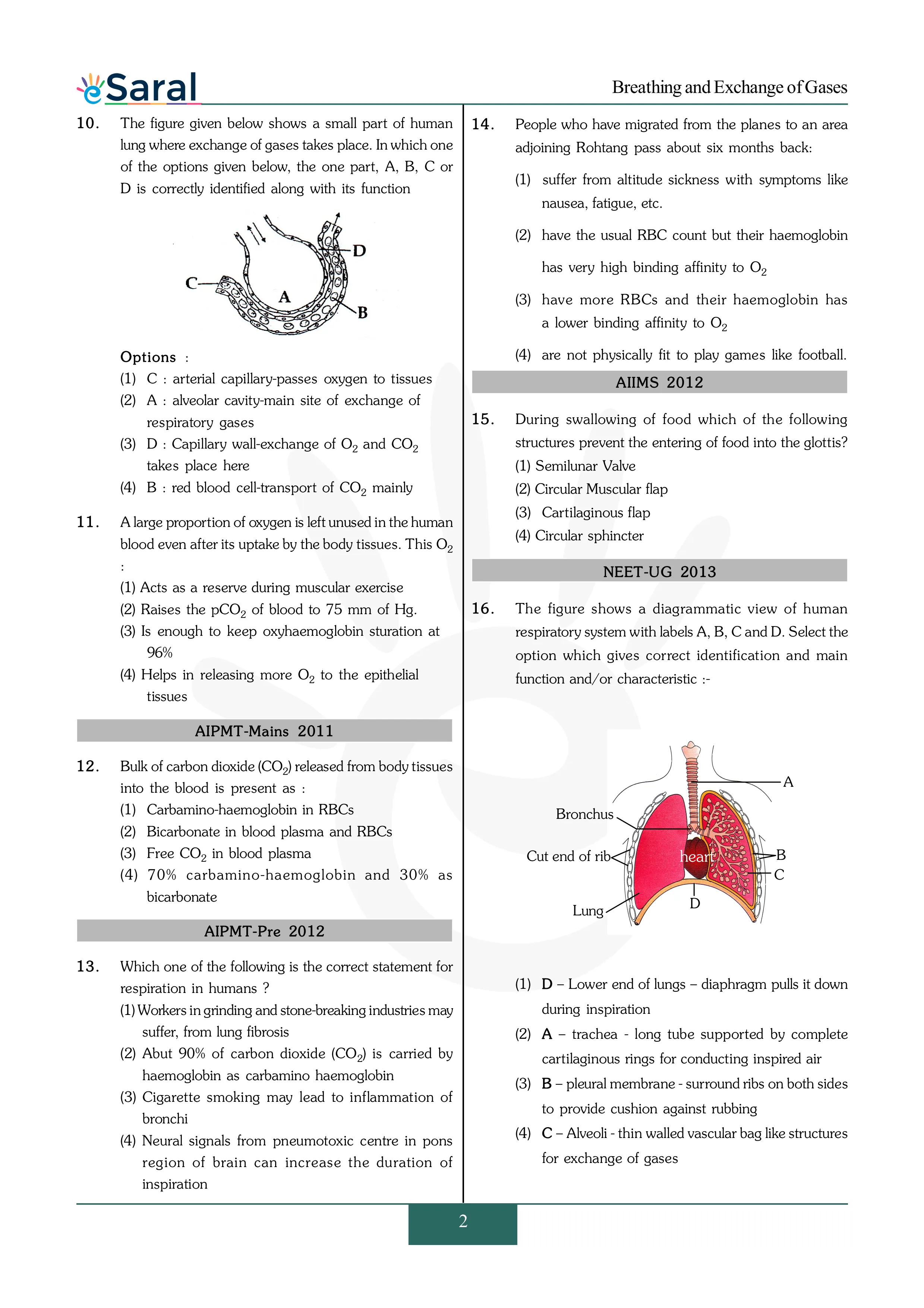
- Inspiration: External intercostals + diaphragm contract → thoracic volume increases → pressure falls below atmospheric → air enters.
- Expiration (quiet): Passive recoil; internal intercostals are active only in forced expiration.
Conclusion and Next Steps
3 Key Takeaways
1. Prioritise transport of gases and lung volumes — these two sub-topics together account for ~70% of NEET questions from this chapter and are fully covered in NCERT Class 11 Biology Chapter 17.
2. Memorise exact values — partial pressures (pO₂ at alveoli = 104 mmHg, at tissues = 40 mmHg), CO₂ transport percentages (70% as HCO₃⁻), and lung capacity values. NEET regularly tests exact figures.
3. Practise PYQs year-by-year — many questions repeat in structure if not in exact wording. Solving the full PYQ set above trains pattern recognition faster than reading the chapter twice.
For even deeper preparation, explore the complete NCERT Solutions library on eSaral — every chapter, every class, with detailed explanations built by Kota-quality faculty.
Every question on this page traces back to one chapter of the NCERT textbook — the full book, for cross-checking any of them, is here: ncert biology class 11.
If you want to prepare this chapter in a structured video format with faculty who hold a verified IIT Bombay rank (AIR-41), download the eSaral app and access the NEET Biology course. Our students who completed the Human Physiology module in the 2024 batch averaged 4 correct answers from this unit alone — making it one of the strongest scoring areas in their result.
Bookmark this page and return after each revision cycle to re-attempt the PYQs under timed conditions.
Frequently Asked Questions
Find answers to common questions.
What is the difference between vital capacity and total lung capacity?
Vital Capacity (VC) is the maximum air a person can exhale after a maximum inhalation — approximately 4600 mL. Total Lung Capacity (TLC) is VC plus Residual Volume (about 1200 mL), giving roughly 5800 mL. Residual Volume cannot be exhaled, which is why TLC is always greater than VC.
Which sub-topic of Breathing and Exchange of Gases has the most NEET questions?
Transport of gases — specifically CO₂ transport modes, partial pressures, and the oxygen-haemoglobin dissociation curve — has the highest question frequency. Lung volumes and capacities come second. Together, these two sub-topics account for roughly 70% of all questions from this chapter in NEET papers from 2010 to 2024.
How many questions come from Breathing and Exchange of Gases in NEET every year?
NEET-UG consistently has 2–4 questions from Breathing and Exchange of Gases every year. Based on NTA papers from 2016 to 2024, the chapter has never given fewer than 2 questions. It is one of the most predictable chapters in NEET Biology because the entire syllabus is contained within a single NCERT chapter
What is the chloride shift and has it been asked in NEET?
The chloride shift (Hamburger's phenomenon) is the movement of chloride ions (Cl⁻) into red blood cells when bicarbonate ions (HCO₃⁻) move out into the plasma during CO₂ transport. It maintains electrical neutrality in RBCs. Yes — this has been directly tested in NEET 2018 and 2020, making it a must-memorise fact.
Is breathing and exchange of gases important for NEET 2025 and 2026?
Yes. NTA has not removed this chapter from the NEET syllabus. It remains part of Unit 5 (Human Physiology) of Class 11 Biology. Given its consistent 2–4 question contribution and high NCERT alignment, it is one of the highest return-on-investment chapters for NEET preparation in both 2025 and 2026.
What is the Bohr effect and why does NEET ask about it?
The Bohr effect describes how increased CO₂ concentration or decreased blood pH reduces haemoglobin's affinity for oxygen, causing more O₂ to be released at metabolically active tissues. NEET asks about it because it appears directly in NCERT Class 11 Biology and tests whether students understand cooperative binding and the shape of the dissociation curve.