CBSE Class 10 Sample Papers: Solved Class 10 Board Exam Question Papers [PDF Download]
Class 10
"Will I be able to score 90+ in boards? What if the paper pattern is different this year?"
If these questions are running in your mind right now, then you're exactly where thousands of Class 10 students are today. Your are scheduled from Board Exam - February 17 to March 10, 2026 — and the clock is ticking.
👉 To understand the complete chapter-wise weightage, you should first check the updated CBSE Class 10 Syllabus.
.webp)
CBSE released the official Class 10 Solved Sample Papers on September 16, 2024, giving you the exact blueprint of what's coming in your board exams.These solved 10 class question paper or sample papers show you exactly how to tackle every question type.
👉 Also revise the most scoring topics using our Important Maths Formulas for Class 10 to avoid losing marks on basic calculations.
Students who practice with official sample papers typically see their marks jump by 15-25 points. For the first time, CBSE has even released dedicated Hindi-medium papers for selected subjects, making sure no student is left behind.
The Best Part?
Every single sample paper is available as a free PDF download right here. No hidden fees, no registrations — just direct access to the exact question formats and marking schemes you'll face in your boards.
Download CBSE Class 10 Sample Paper 2025–26 PDFs (All Subjects)
| SUBJECT | Sample Question Paper | Marking Scheme |
| Science | SQP | MS |
| Mathematics (Basic) | SQP | MS |
| Mathematics (Standard) | SQP | MS |
| Social Science | SQP | MS |
| English (Language & Literature) | SQP | MS |
| English (Communicative) | SQP | MS |
| Hindi A | SQP | MS |
| Hindi B | SQP | MS |
| Sanskrit (Communicative) | SQP | MS |
| Sanskrit | SQP | MS |
| Computer Application | SQP | MS |
👉 For deeper practice, solve the last 10 years of CBSE Class 10 Previous Year Question Papers.
👉 If you need quick revision, use our Class 10 Short Notes & Revision Videos.
Each subject follows CBSE's assessment framework with an 80+20 marks distribution. The CBSE board conducts theory exams worth 80 marks, while internal assessments make up 20 marks through periodic tests, projects, assignments, and practical work. Skill-based subjects like AI, IT, and Financial Literacy have a different split with 50 marks theory and 50 marks practical.
The CBSE Class 10 Sample Papers give an exact idea of what the board exam will include,

Students can choose between Basic and Standard levels in Mathematics based on their future academic plans.
India's Best Exam Preparation for Class 10th - Download Now
Detailed Subject-Wise Blueprint of CBSE Board Exam 2025-26
👉 Make sure you are studying from the latest textbooks. Download free PDFs of NCERT Books for Class 10.
English CBSE BOARD Exam Paper 2025
English is often treated as a "scoring subject," but many students lose 10-15 marks due to poor answer structure. The marking scheme reveals: Literature carries maximum weight, but writing skills questions are often easier to score in.
What CBSE Board 2026 English Sample Paper Covers
The English Language and Literature sample paper (Code 184) has three main sections:
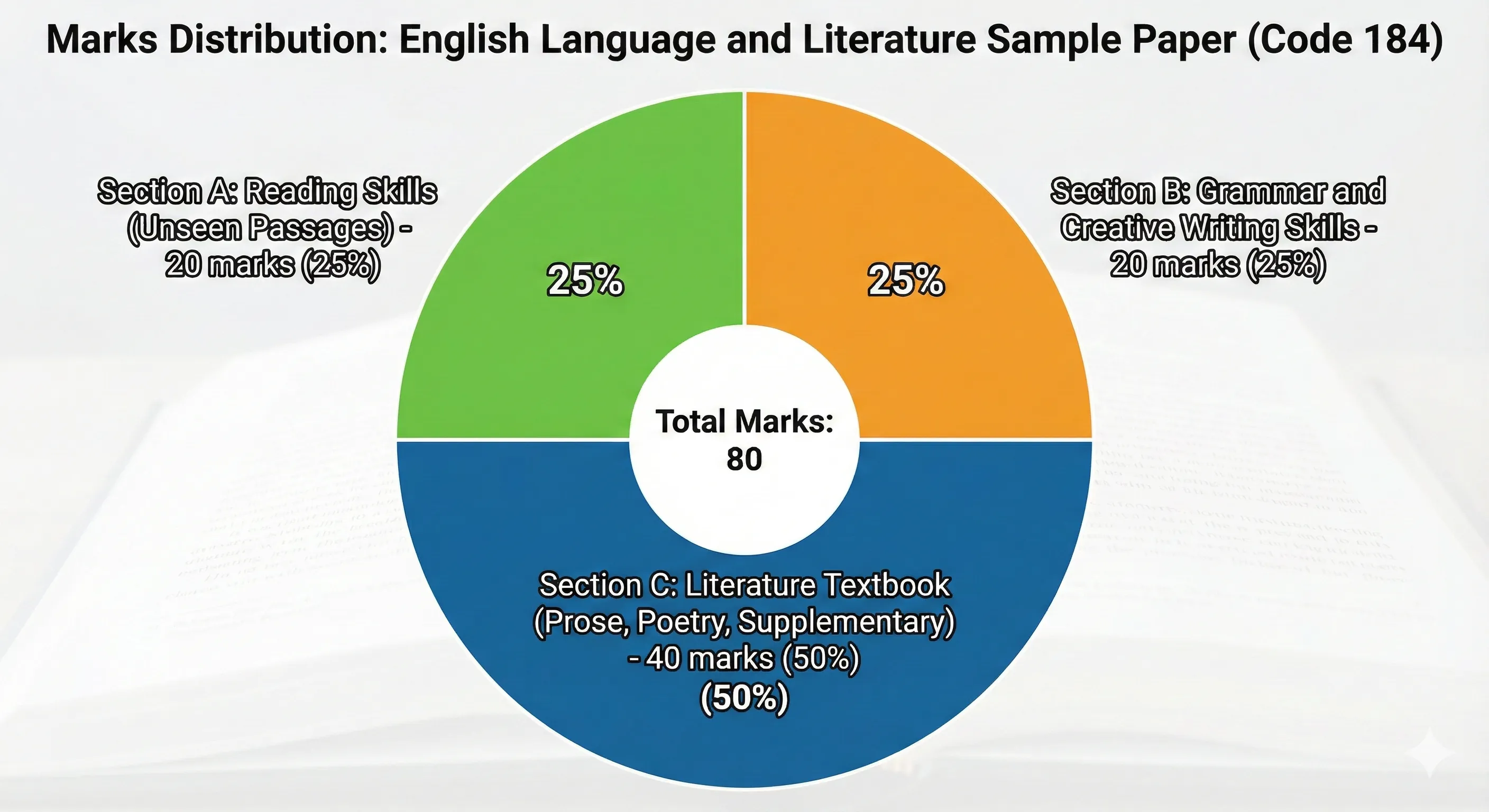
· Section A: Reading Skills (20 marks) (unseen passages)
· Section B: Grammar and Creative Writing Skills (20 marks)
· Section C: Literature Textbook (40 marks) (prose, poetry, supplementary)
Students must answer all 11 questions in the paper. Half of these questions test their understanding of concepts. The paper mixes different types of questions like MCQs, short answers, and long-form responses. Students need to show their skills in decoding, analyzing, inferring, and vocabulary.
Hindi A & B CBSE Board Exam Paper 2025-26
Hindi A vs Hindi B: Know the Difference
Hindi A: Advanced literature analysis, complex writing skills. Choose this only if Hindi is your strength.
Hindi B: Practical communication focus, simpler grammar. Better option for most students where Hindi isn't the primary language at home.
Both papers follow the same 80-mark pattern, but difficulty levels vary significantly.
What CBSE Board 2026 Hindi Sample Paper Covers
The Hindi A sample paper tests advanced literary components through an 80-mark theory paper with four sections:
· Section A: Unseen Comprehension (अपठित गद्यांश) - 14 marks
· Section B: Practical Grammar (व्यावहारिक व्याकरण) - 16 marks
· Section C: Textbook and Supplementary Textbook - 30 marks
· Section D: Creative Writing - 20 marks
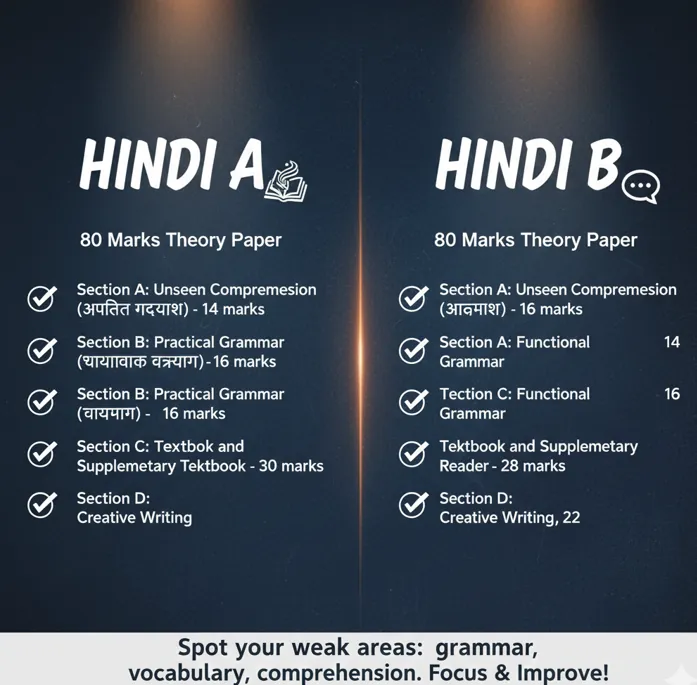
Hindi B sample paper takes a different approach by focusing on functional communication skills:
· Section A: Unseen Comprehension - 14 marks
· Section B: Functional Grammar - 16 marks
· Section C: Textbook and Supplementary Reader - 28 marks
· Section D: Creative Writing - 22 marks
Students can spot their weak areas in grammar, vocabulary, or comprehension and focus on improving them before exams.
Science CBSE Board Exam Paper 2025
One paper, three subjects, 80 marks that can make or break your percentage.
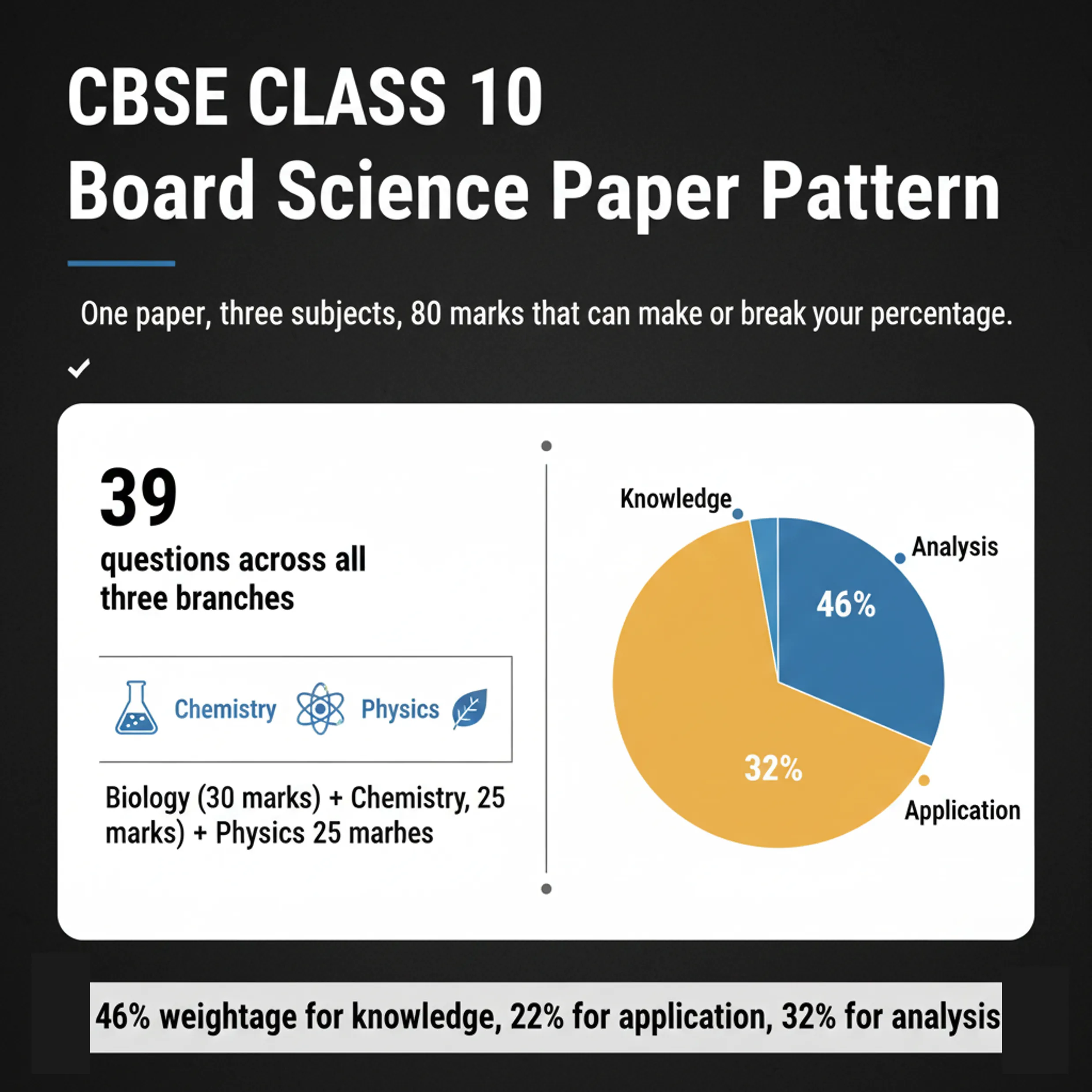
The paper structure is fixed:
· 39 questions across all three branches
· Biology (30 marks) + Chemistry (25 marks) + Physics (25 marks)
· 46% weightage for knowledge, 22% for application, 32% for analysis
Key insight from the solutions: Case-based questions appear in every section. These aren't just theory — they test your ability to apply science concepts to real situations.
What CBSE Board 2026 Science Sample Paper Covers
The paper follows an 80+20 marks format. Students get 80 marks for theory and 20 marks from internal assessments. The latest pattern consists of 39 compulsory questions spread across all three science disciplines. Students can choose from internal choices in 33% of questions, which lets them pick questions they know best.
The paper focuses on practical understanding with 50% competency-based questions rather than memorization. Students will find various question types including Multiple Choice Questions (MCQs), assertion-reasoning type questions, short answers, and long answers.
👉 For chapter-by-chapter solved exercises, refer to NCERT Solutions for Class 10.
Maths CBSE Board Exam Paper 2025
CBSE offers two math papers, and your choice here decides your future options- CHOOSE WISELY
Mathematics Standard (041):
· Essential if you want science/commerce with maths in Class 11-12
· 5 sections with higher-order thinking questions
· Case studies worth 4 marks each — practice these daily
· Step-by-step solutions show exactly how to score full marks
Mathematics Basic (241):
· Ideal for students not continuing with maths after Class 10
· Same syllabus, but easier application-based questions
· Perfect for humanities students or those focusing on other subjects
Important: You cannot take maths in Class 11 if you choose Basic. Choose Standard if you're unsure about your future stream.
What CBSE Board 2026 Maths Sample Paper Covers
Both Mathematics options share common curriculum themes such as Number Systems, Algebra, Coordinate Geometry, Trigonometry, Statistics, and Probability. The main difference lies in their question complexity:
|
Feature |
Standard Maths (041) |
Basic Maths (241) |
|
Difficulty |
Moderate to high with multi-step problems |
Easy to moderate with direct questions |
|
Question Depth |
Higher mathematical abilities, conceptual depth |
Simpler, formula-based approach, fewer HOTS |
|
Marking Structure |
80 marks theory + 20 marks internal |
80 marks theory + 20 marks internal |
Social Science CBSE Board Exam Paper 2025-26
Four subjects in one paper: History, Geography, Political Science, Economics.
Critical warning: Map work carries 3-5 marks and requires exact accuracy. Practice physical and political maps regularly — there's no partial marking for wrong locations.
Question pattern:
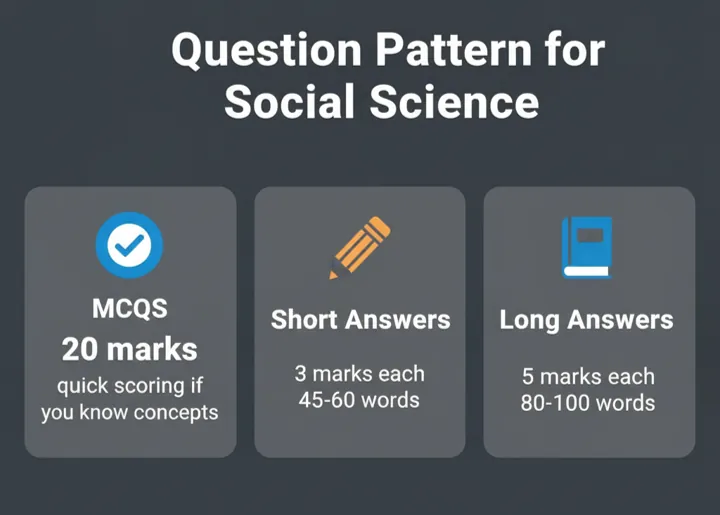
· MCQs: 20 marks (quick scoring if you know concepts)
· Short answers: 3 marks each (45-60 words)
· Long answers: 5 marks each (80-100 words)
What CBSE Board 2026 Social Science Sample Paper Covers
The 2025 Social Science sample paper has six different sections (A-F) with 37 questions you must answer. Here's how the marks are divided:
· Section A: Multiple choice questions (20 questions, 1 mark each)
· Section B: Very short answer questions (4 questions, 2 marks each)
· Section C: Short answer questions (5 questions, 3 marks each)
· Section D: Long answer questions (4 questions, 5 marks each)
· Section E: Case-based questions (3 questions, 4 marks each)
· Section F: Map-based questions (1 question, 5 marks)
Half of the questions test practical understanding instead of memorization.
Sanskrit CBSE Board Exam Paper 2025-26
Sanskrit is taken by fewer students, which often means better percentile rankings.
Paper sections:
· Comprehension and creative writing
· Grammar (sandhi, samāsa, pratyaya)
· Literature from prescribed texts
Strategic advantage: Sanskrit solutions show exact answer formats in Devanagari script — practice writing in the script regularly.
What CBSE Board 2026 Sanskrit Sample Paper Covers
The Sanskrit sample paper follows an 80+20 marks structure with 18 questions across four detailed sections:
| Section | Topic | Sanskrit Name | Marks | Weightage |
| A | Unseen Reading Comprehension | अपठितावबोधनम् | 10 | 12.5% |
| B | Writing Skills | रचनात्मक कार्यम् | 15 | 18.75% |
| C | Applied Grammar | अनुप्रयुक्त व्याकरणम् | 25 | 31.25% |
| D | Reading Comprehension (Textbook) | पठितावबोधनम् | 30 | 37.5% |
· Section A: Unseen Reading Comprehension (अपठितावबोधनम्) - 10 marks
· Section B: Writing Skills (रचनात्मक कार्यम्) - 15 marks
· Section C: Applied Grammar (अनुप्रयुक्त व्याकरणम्) - 25 marks
· Section D: Reading Comprehension (पठितावबोधनम्) - 30 marks
The paper has different question types like MCQs, short answers, and long-form responses. Students need to work on grammar rules, classical literature analysis, translation work, and composition writing.
Computer Applications CBSE Board Exam Paper 2025-26
CBSE's dual-exam system for 2025-26 offers Computer Applications sample papers that help students learn programming concepts and database management skills. These papers follow a clear pattern to test both theory knowledge and hands-on abilities.
What CBSE Board 2026 Computer Application Sample Paper Covers
The Computer Applications exam has an equal marks distribution:
|
Component |
Marks |
|
Theory |
50 |
|
Practical |
50 |
|
Total |
100 |
The paper covers Python programming concepts, database management, web technologies, and practical skills. The theory paper has five sections (A-E) that include MCQs and case-based problems.
Why Solved Sample Papers Are Your Biggest Advantage in Class 10 Boards
👉 Also practice the most expected questions for all subjects using CBSE Important Questions for Class 10.
Most students think board exam success comes from memorizing every chapter perfectly. But that's not how toppers actually work.
The real difference between a 95% scorer and a 75% scorer isn't how much they studied — it's what they practiced with.
Students who solve 5-7 official sample papers consistently outscore those who only rely on textbooks by 15-25 marks. That's the difference between a good result and an exceptional one.
Here's why solved sample papers beat every other study resource:
Join our Telegram channel for class 9th and 10th to get Free Study Material, Free Notes & many more.
India's Best Exam Preparation for Class 10th - Download Now
Sample Papers = Exact Blueprint of Your Actual Exam
CBSE doesn't create sample papers randomly. These papers precisely mirror the structure and format you'll face in your actual board examination. Unlike textbooks written years ago, these papers follow the most recent exam pattern prescribed by CBSE.
This means you get firsthand experience with:
· Exact mark distribution across different sections
· Updated chapter weightage — some topics now carry more marks
· Latest question formats including the new competency-based questions
Every year, CBSE makes subtle changes that can completely throw off unprepared students. This year, Science and Social Science patterns have been revised. If you're still practicing with old formats, you're setting yourself up for confusion on exam day.
Master Every Question Type Before Exam Day
Sample papers expose you to the complete range of questions: MCQs, Very Short Answer (VSA), Short Answer (SA), and Long Answer (LA) types.
But here's what most students miss:
Different concepts are tested in different ways. Some topics almost always appear as MCQs. Others consistently show up as analytical long-answer questions. When you know these patterns, you can prioritize your study efforts smartly.
The marking schemes reveal examiner secrets.
The 10 class question paper show exactly how examiners award marks for different answer types. You learn not just what to write, but how to structure responses for maximum marks.
CBSE's new case-based and competency-based questions require specific answering techniques. Without practicing these formats, you're gambling with your marks.
Build Unshakeable Exam Confidence
Regular sample paper practice transforms your exam-day performance:
Time Management Mastery: Solving papers under timed conditions teaches you to allocate time efficiently across sections. No more spending 45 minutes on one tough question while rushing through the rest.
Zero Exam Anxiety: When you've seen every possible question format multiple times, nothing in the actual paper surprises you. Your mind stays calm and focused on scoring marks.
Self-Assessment Power: Sample papers work like mirrors — they reveal exactly where your preparation stands. You discover which topics you've mastered and which need urgent attention.
Lightning-Fast Problem Solving: Consistent practice makes you faster at recognizing question patterns and applying the right approach.
3-Hour Exam Stamina: Board exams demand sustained concentration for three full hours. Most students struggle with this mental endurance. Regular practice builds this stamina naturally.
As CBSE officially states: "Sample question papers help you know the design, pattern and types of questions".
Bottom line: Each solved paper you complete doesn't just test your knowledge — it builds the specific skills needed to convert that knowledge into maximum marks.
These papers are your personal roadmap to high scores. They show exactly what examiners expect and how to deliver it perfectly in your answers.
What's Actually Inside These Sample Paper PDFs? (The Real Content Breakdown)
Most students download sample papers and never actually look inside properly. They flip through, attempt a few questions randomly, and wonder why their marks don't improve.
Here's what you'll actually find when you open these official CBSE solved PDFs — and why each element matters for your board exam score.
Every Paper Follows the Same Blueprint
CBSE doesn't create question papers randomly. Every single paper follows an exact structure that's repeated across all subjects:
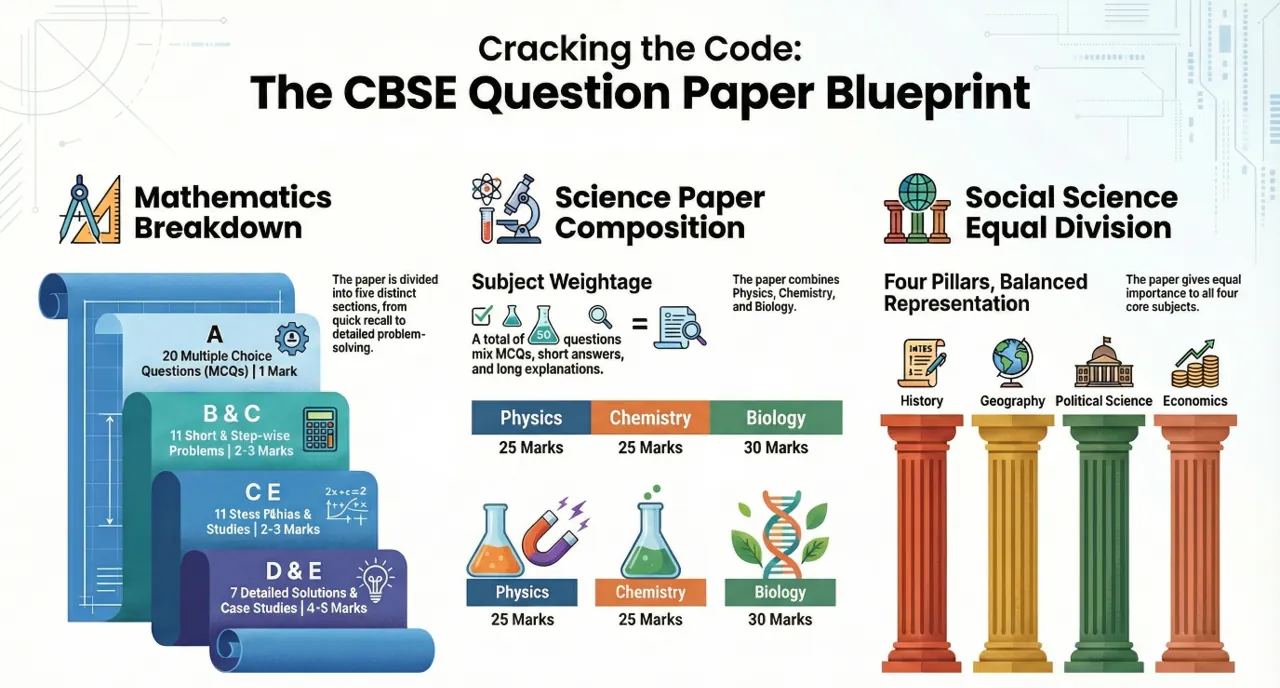
Mathematics breaks down like this:
· Section A: 20 MCQs (1 mark each) — quick recall questions
· Section B: 5 short problems (2 marks each) — basic application
· Section C: 6 step-wise questions (3 marks each) — method + calculation
· Section D: 4 detailed solutions (5 marks each) — full problem-solving
· Section E: 3 case studies (4 marks each) — real-world applications
Science integrates all three subjects: Physics (25 marks), Chemistry (25 marks), Biology (30 marks) — with 39 total questions mixing MCQs, short answers, and long explanations.
Social Science divides equally: History, Geography, Political Science, Economics — each getting balanced representation across MCQs and descriptive questions.
Why does this matter?
Because knowing the blueprint means you can plan your time. You know exactly how many 1-mark questions to expect versus 5-mark essays. No surprises, no panic.
The Marking Scheme Reveals Everything
This is where most textbooks fail you completely. Regular practice books show you questions and answers — but not how examiners actually award marks.
The official marking schemes show:
· Which specific steps earn you marks in math problems
· Exact keywords examiners look for in science explanations
· How partial credit works when your final answer is wrong
· Alternative methods that are equally acceptable
Example: In a 5-mark math problem, you might get 2 marks for the correct formula, 2 marks for proper substitution, and 1 mark for the final calculation. Even if you mess up the arithmetic, you can still score 4/5.
The language papers break down writing tasks completely: how many marks for content, how many for grammar, how many for presentation. You stop guessing what examiners want.
Four Question Types You'll Face Every Time
Every CBSE paper mixes the same four question formats:
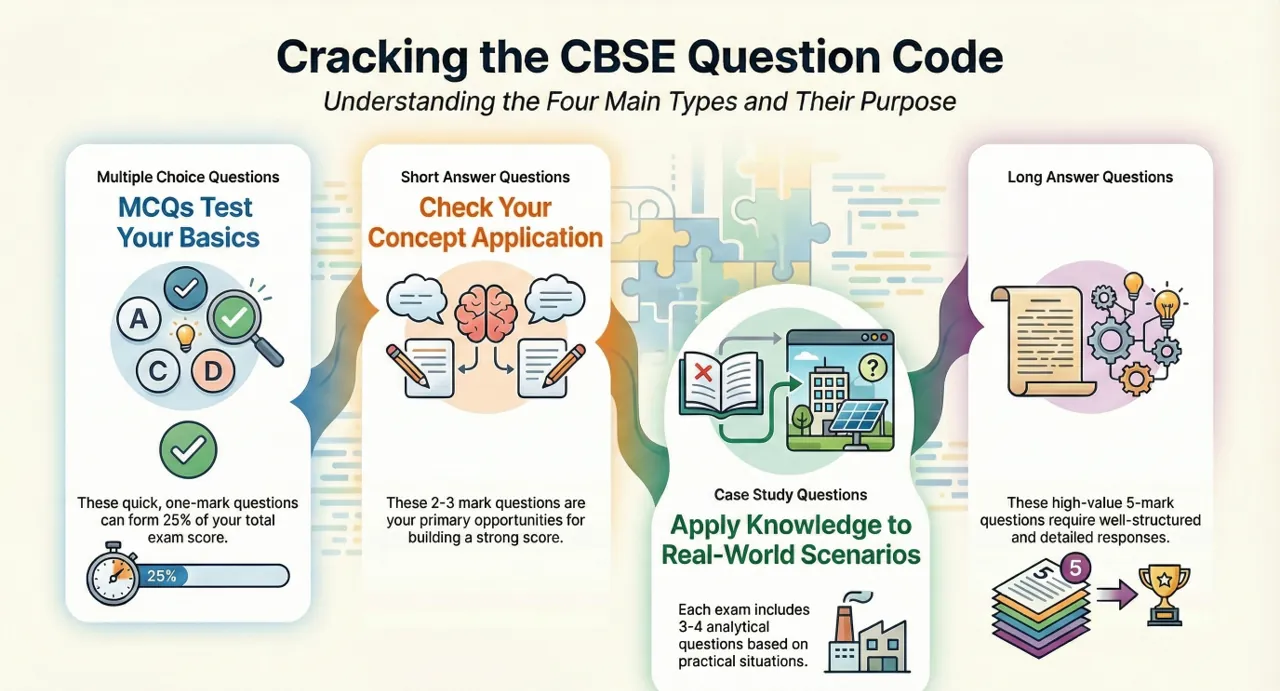
MCQs test your basics. One mark each, but they add up fast. Science gives you 20 MCQs worth 20 marks total — that's 25% of your paper from quick-answer questions.
Short answers check concept application. Usually 2-3 lines, 2-3 marks each. These are your bread-and-butter scoring opportunities if you know the material.
Case studies are the new reality. Real-world scenarios that test whether you can apply what you've learned. Each subject now includes 3-4 of these analytical questions.
Long answers reveal depth. 5-mark questions that separate the prepared students from the rest. The solved papers show you exactly how to structure these responses with proper headings and logical flow.
What makes these PDFs powerful is seeing the complete marking breakdown. You understand not just what to write, but how examiners evaluate every part of your answer.
Subject-Wise Breakdown: What Each Paper Actually Tests
Most students make the same mistake: they treat all subjects the same way. But here's the reality — each CBSE Class 10 subject has its own personality, its own tricks, its own marking patterns.
Understanding these differences is what separates average scorers from those who cross 90+. Let's break down what you're actually facing in each paper.
Maths: The Make-or-Break Decision Between Standard and Basic
CBSE gives you two math options: Standard (041) and Basic (241). But this isn't just about difficulty levels — this choice can literally decide your future academic path.
Mathematics Standard is for students heading to Class 11-12 with Math or eyeing competitive exams. Expect moderate to high difficulty questions, multi-step problem solving, and plenty of HOTS (Higher Order Thinking Skills) problems. The paper throws proof-based questions and complex case studies at you.
Mathematics Basic targets students who want to finish with Math after Class 10. Easier questions, more direct applications, formula-based problems — but don't think it's a free ride.
The catch? If you take Basic Math but later want Math in higher classes, you'll need to pass Standard level in a compartment exam. Students who plan to continue with Math MUST take Standard. No shortcuts here.
Choose wisely. This decision affects not just your Class 10 marks, but your entire academic future.
Science: Three Subjects Packed Into One Paper
Science paper = Physics + Chemistry + Biology all fighting for your attention in 3 hours. 39 total questions spread across all three branches.
The mark distribution tells the real story:
· Biology: 30 marks
· Chemistry: 25 marks
· Physics: 25 marks
But here's what the marking scheme actually tests:
· 46% for demonstrating knowledge (memory + understanding)
· 22% for applying concepts (can you use what you know?)
· 32% for analysis and evaluation (critical thinking)
Translation: Cramming facts won't get you far. Case-based questions appear in all three sections, demanding real-world application skills.
English: Where Literature Rules
English paper has three clear battlegrounds:
· Reading Skills (15 marks): Unseen passages that test comprehension
· Grammar and Writing Skills (15 marks): Language application under pressure
· Literature (35 marks): Prose, poetry, supplementary readings
Notice something? Literature carries the highest weightage. Students who ignore poems and stories for "easier" grammar sections are setting themselves up for disappointment.
Social Science: The Map Work Trap
Social Science integrates History, Geography, Political Science, and Economics. But many students panic seeing the map-based questions (typically 3-5 marks) that test geographical and historical locations.
Here's the breakdown that matters:
· MCQs: 20 marks across all four subjects
· Short answers: 15 marks (3 marks each)
· Long answers: 20 marks (5 marks each)
The trend: Case-based questions are taking over. Expect real-world scenarios that demand critical thinking, not just textbook regurgitation.
Hindi A vs Hindi B: Choose Your Battle
Two completely different approaches:
Hindi Course A = Advanced literature analysis + sophisticated writing. Built for students with Hindi as first language or strong foundation. Heavy weightage on literature and creative expression.
Hindi Course B = Practical communication + basic grammar. Perfect for second-language Hindi students. Less literary analysis, more functional grammar.
Key difference: Reading comprehension in A features complex passages, while B sticks to clear, accessible texts.
Bottom line: Don't pick based on "which seems easier." Pick based on your actual Hindi proficiency level.
Each subject demands its own strategy. Master the patterns, and the marks will follow.
Join our Telegram channel for class 9th and 10th to get Free Study Material, Free Notes & many more.
India's Best Exam Preparation for Class 10th - Download Now
The Right Way to Practice Sample Papers (Most Students Get This Wrong)
Most students think solving sample papers means just answering questions and checking solutions. Wrong.
The difference between a 75% student and a 90% student isn't how many papers they solve — it's HOW they solve them.
Here's the exact method that top scorers use to extract maximum value from every sample paper:
Create Real Exam Conditions (Non-Negotiable)
Your practice environment must match your exam environment. Find a quiet room where nobody will disturb you. Put your phone in another room — not on silent, not face down, completely away.
Set a timer for exactly 3 hours. Not 2 hours 45 minutes. Not 3 hours 15 minutes. Exactly 3 hours.
Once you start, you cannot pause. No water breaks every 30 minutes. No "quick toilet breaks." You sit and complete the entire paper in one shot. This builds the mental stamina you need to maintain focus for the full board exam duration.
Keep only these items on your desk: pen, pencil, eraser, geometry box, rough paper, and one water bottle. Nothing else.
Smart Question Selection Strategy
Don't start with Question 1 just because it's first.
Golden Rule: Start with your strongest subject or section first.
Why this works:
· You secure easy marks early
· Confidence builds as you progress
· Anxiety reduces when you see familiar questions
If Maths is your strong suit, attack those questions first. If English feels comfortable, begin there. Build momentum with success.
The 15-Minute Review Rule
Here's what separates smart students from the rest:
Reserve the last 15 minutes for review. Not 10 minutes, not 5 minutes — exactly 15 minutes.
During this review phase:
· Check all calculations for silly errors
· Ensure no questions are left blank
· Fix spelling mistakes and grammar errors
· Verify all diagrams are properly labeled
This single habit can add 5-10 extra marks to your score. Yet most students skip this step and rush to check solutions immediately.
Only after completing your self-review should you look at the provided answers. This two-step process trains your brain to catch errors independently.
Practice Frequency That Actually Works
Solve one sample paper every 3-4 days. Not daily (you'll burn out), not weekly (too slow).
Every 3-4 days gives you:
· Time to analyze mistakes properly
· Space to implement improvements
· Consistent practice without exhaustion
Follow this system religiously, and you'll develop the exam temperament that distinguishes toppers from average performers.
The Hidden Secrets of CBSE Marking Schemes: Why Most Students Leave 10-15 Marks on the Table
"I wrote everything correctly, but still lost marks. Why?"
This frustration hits thousands of Class 10 students every year. They know the content, they attempt all questions, but their marks don't reflect their preparation. The problem? They don't understand how CBSE examiners actually award marks.
Here's the reality: CBSE marking is step-wise, not result-wise. Your final answer might be wrong, but you can still score 3 out of 5 marks if you follow the right process.
Most students never learn this. They practice content but ignore the marking strategy.
Let's change that.
Step 1: Decode the Step-Wise Marking System
Every CBSE marking scheme breaks down marks into smaller components. Think of it like this:
5-mark question breakdown:
· Formula identification: 1 mark
· Correct substitution: 2 marks
· Calculation process: 1 mark
· Final answer: 1 mark
This means even if your calculation goes wrong in the end, you can still score 4/5 marks by showing proper method.
The golden rule: Show every step, even if it seems obvious to you.
Step 2: Create Your Personal Error Analysis Chart
After solving each sample paper, make this simple table:
|
Question No. |
Marks Lost |
Exact Reason |
How to Fix |
|
15 |
2/5 marks |
Missing formula step |
Always write formula first |
|
23 |
1/3 marks |
Calculation error |
Double-check math |
This systematic tracking reveals your mistake patterns. Most students lose marks in the same 2-3 ways repeatedly.
Common mark-losing mistakes:
· Jumping straight to calculations without writing formulas
· Missing keywords that examiners specifically look for
· Poor handwriting making answers unclear
· Not attempting questions due to time pressure
Step 3: Master the Art of "Examiner-Friendly" Answers
The marking scheme shows you exactly what examiners want to see. Study the model answers carefully:
For Maths/Science: Write method → Formula → Substitution → Answer For English/Hindi: Introduction → Main points with examples → Conclusion For Social Science: Definition → Explanation → Examples → Impact
Pay attention to keywords. If the marking scheme says "any 3 points," make sure you write exactly 3 clear, distinct points.
Pro tip: Underline or highlight key terms in your answers. This helps examiners spot the points they're looking for quickly.
Remember: Your job is not just to know the answer. Your job is to present it the way CBSE wants to see it.
This difference in approach can easily add 10-15 marks to your total score without studying any new content.
Your Board Exam Victory Starts Today
Sample papers are not just practice material. They are your exam blueprint.
You now have the exact weapon that top scorers use to dominate Class 10 boards. While other students waste time with random questions and outdated materials, you have access to the official CBSE papers that mirror your actual exams.
Here's what happens next:
Download these solved sample papers today. Set up a proper practice schedule. Sit with each paper like it's the real exam — timer running, distractions gone, focus sharp.
Every paper you solve builds your exam stamina. Every marking scheme you study teaches you the examiner's mind. Every mistake you analyze becomes a lesson that saves marks in the real exam.
Your board exams are not a mystery anymore. The question formats, the marking patterns, the time pressure — you'll face all of this in these sample papers first. When you walk into the exam hall in February, nothing will surprise you.
The choice is simple:
You can keep worrying about "what if the paper is tough" or "what if I don't score well."
Or you can take these sample papers, practice systematically, and walk into your boards with the confidence of someone who's already seen it all.
Your Class 10 result depends on what you do in the next few weeks. Not what you did in Class 9. Not what happened in your unit tests. What you do right now with these sample papers.
Download them. Practice them. Master them.
All the best, beta. Go show these boards what you're made of. 💪
Comparison Table (Subjectwise CBSE Board Exam 2026 paper Structure)
|
Subject |
Paper Structure |
Marks Distribution |
Key Features |
Download Sources |
|
English |
3 sections: Reading (20), Grammar/Writing (20), Literature (40) |
80 theory + 20 internal |
- 11 compulsory questions- 50% competency-based questions |
- CBSE Academic website- Sample Question Paper section |
|
Hindi A & B |
4 sections: Comprehension, Grammar, Literature, Creative Writing |
80 theory + 20 internal |
- Hindi A: Advanced literary focus- Hindi B: Communication focus |
- CBSE Academic website- DigiLocker |
|
Science |
3 sections: Biology (30), Chemistry (25), Physics (25) |
80 theory + 20 internal |
- 39 compulsory questions- 33% questions with choice options |
- CBSE Academic website- Vedantu platform |
|
Mathematics |
Standard (041) and Basic (241) options |
80 theory + 20 internal |
- Common syllabus with varied difficulty- Standard path for Science/Commerce |
- CBSE Academic website- Both English/Hindi versions |
|
Social Science |
6 sections (A-F) with 37 questions |
80 theory + 20 internal |
- 50% competency-based questions- Map work component |
- CBSE Academic website- Previous years (2016-2024) |
|
Sanskrit |
4 sections: Reading, Writing, Grammar, Literature |
80 theory + 20 internal |
- 18 total questions- Multiple formats (MCQ, short answers) |
- CBSE Academic website- 10 practice sets |
|
Home Science |
4 sections (A-D) with varied question types |
70 marks total |
- MCQs and case studies- Theory with practical elements |
- CBSE Academic website- Educational platforms |
|
Computer Applications |
Theory and Practical components |
50 theory + 50 practical |
- Python programming focus- Database management studies |
- CBSE Academic website- SQP 2025-2026 section |
Useful Class 10 Study Resources
https://www.esaral.com/cbse/class-10-syllabus/
https://www.esaral.com/important-formulas-of-maths-class-10/
https://www.esaral.com/cbse/cbse-previous-year-question-papers-class-10/
https://www.esaral.com/ncert-books/ncert-books-class-10/
https://www.esaral.com/class-10-short-notes-revision-videos/
https://www.esaral.com/ncert-solutions/ncert-solutions-class-10/
https://www.esaral.com/cbse/important-questions-class-10/
FAQs for CBSE Class 10 Sample Papers 2026
Q1. How to score 95% in Class 10 using sample papers?
You can easily target 95%+ if you use sample papers the right way. Follow these steps:
-
Solve at least 1–2 sample papers every week in strict exam-like conditions.
-
Analyse mistakes after every paper—focus on weak chapters.
-
Revise NCERT thoroughly, especially formulas, definitions, and diagrams.
-
Use marking scheme to understand how CBSE gives marks—this improves answer presentation.
-
Track timing while solving papers to improve speed + accuracy.
Consistent practice of sample papers helps you understand question patterns, improve writing skills, and reduce exam pressure—making 95% achievable.
Q2. Are CBSE sample papers enough to score 90+?
Yes, CBSE sample papers are enough to score 90+, but only if:
-
You complete NCERT first.
-
You practice CBSE sample paper, PYQs, and school pre-board papers also.
-
You understand the marking scheme and follow the answer pattern.
CBSE sample papers help you predict the exam format, but scoring 90+ also depends on revision, concept clarity, and regular practice.
Q3. Is Class 10 Maths Basic easier than Standard?
Yes, Maths Basic is easier than Maths Standard.
-
Maths Basic contains simpler questions, more direct formulas, and fewer application-based problems.
-
Maths Standard has more higher-order, conceptual, and tricky questions.
Choose Maths Basic if you don’t want to pursue Maths in Class 11.
Choose Maths Standard if you plan to take Science/Commerce with Maths later.
Q4. Are the CBSE Class 10 Sample Papers 2026 based on the latest pattern?
Yes. All sample papers follow the latest CBSE competency-based pattern for the 2025–26 board exams.
Q5. Do these sample papers include solutions?
Yes. Each paper comes with expert-verified solutions and detailed explanations.
Q6. How many sample papers should a student solve?
Students should solve at least 5 sample papers per subject for best results.