Class 12 Chemistry Chapter 1 Notes - Solid State
Class 12 Chemistry Chapter 1 – Solid State explains the structure, properties, classification, crystal lattices, unit cells, packing efficiency, and defects in solids, making it a high-scoring chapter for CBSE, JEE Main, and NEET preparation.
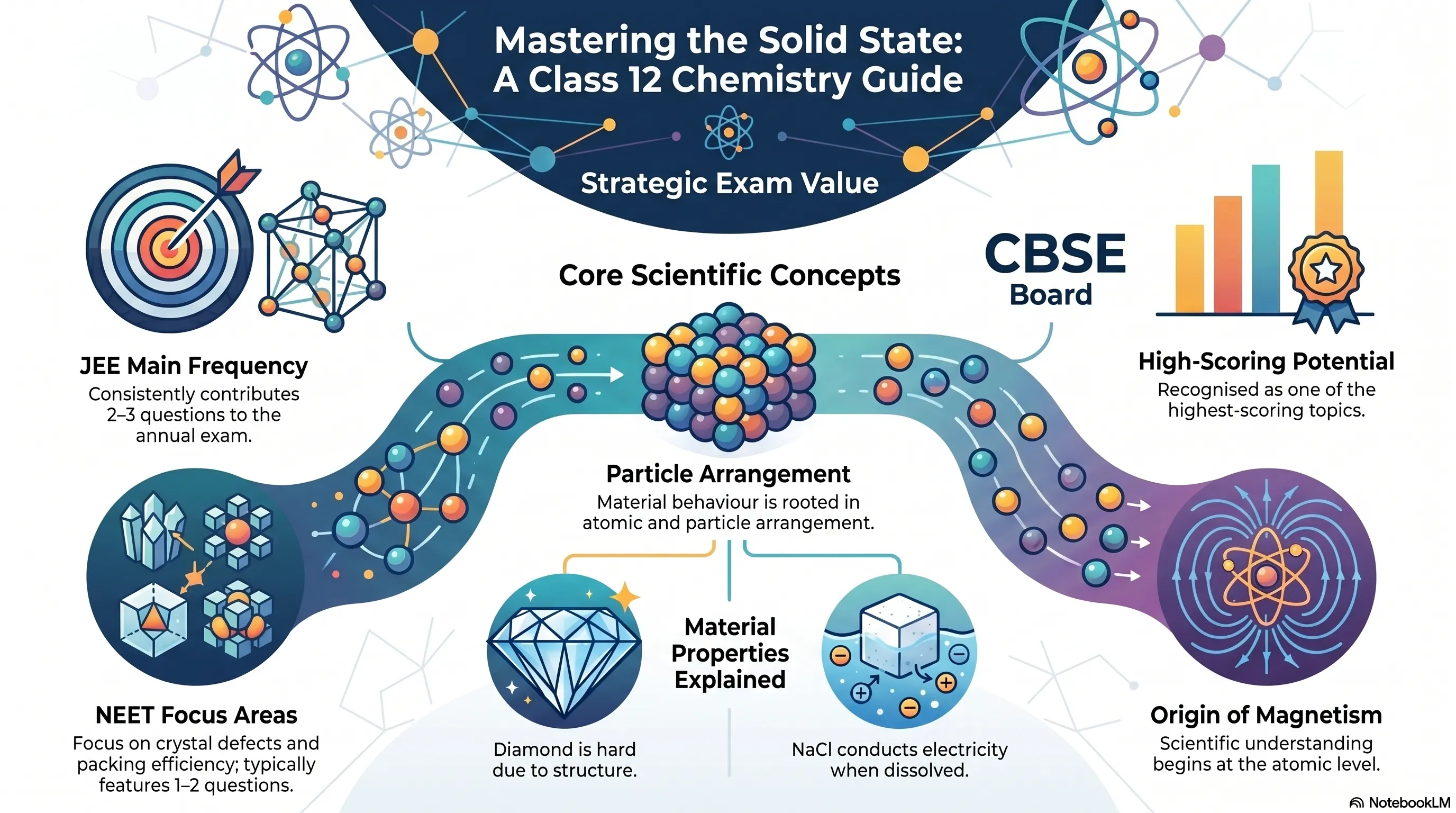
Table of Contents

eSaral › Class 12 ›Class 12 Chemistry Chapter 1 Notes - Solid State

🚀 Checkout eSaral Courses
Introduction
Solid State is the first chapter of Class 12 Chemistry and one of the highest-scoring topics in both CBSE board exams and competitive entrance tests. JEE Main consistently draws 2–3 questions from this chapter every year, and NEET typically includes 1–2 questions focused on crystal defects and packing efficiency.
The chapter builds your understanding of why solids behave the way they do — why diamond is hard, why NaCl conducts electricity when dissolved but not in solid form, and why some materials are magnetic. These are not abstract questions; they are rooted in the arrangement of particles at the atomic level.
Class 12 Chemistry Chapter 1 Notes - Solid State
India's Best Exam Preparation for Class 12th - Download Now
India's Best Exam Preparation for Class 12th - Download Now
India's Best Exam Preparation for Class 12th - Download Now
India's Best Exam Preparation for Class 12th - Download Now
India's Best Exam Preparation for Class 12th - Download Now
India's Best Exam Preparation for Class 12th - Download Now
Frequently Asked Questions
Find answers to common questions.
What are the most important topics in Solid State for JEE Main?
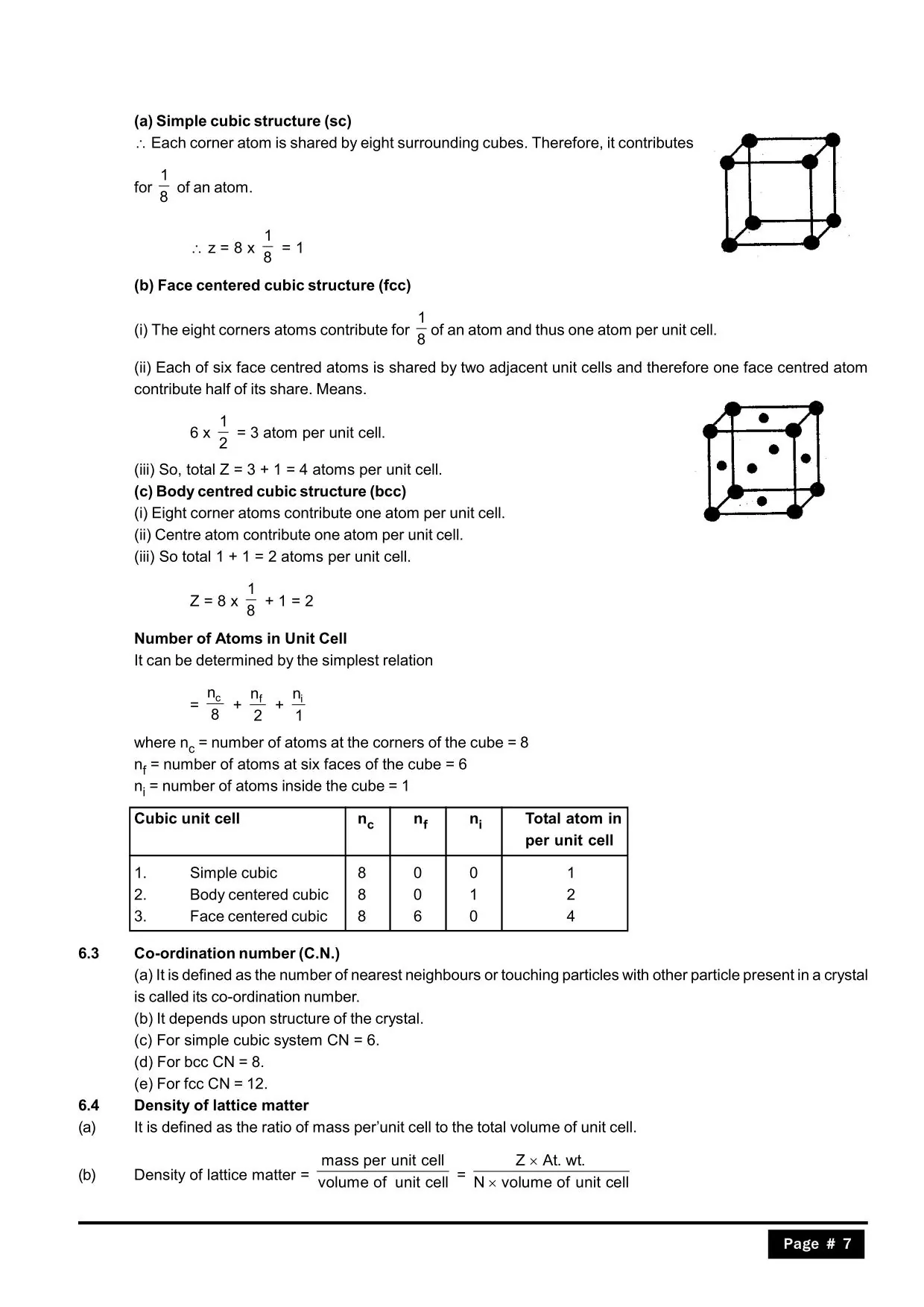
The most important topics for JEE Main are packing efficiency, number of atoms per unit cell, density calculations using the unit cell formula, and types of crystal defects (Schottky and Frenkel). NTA's official question papers from 2019–2024 show that packing efficiency and defects together account for nearly 60% of questions from this chapter.
What is the difference between Schottky and Frenkel defects?
Schottky defects involve equal numbers of cations and anions missing from lattice sites — density decreases and it occurs in solids with similar-sized ions like NaCl. Frenkel defects involve a cation shifting to an interstitial position — density stays nearly the same and it occurs in solids with large size differences between ions, like AgCl and ZnS.
How do you calculate the packing efficiency of FCC?
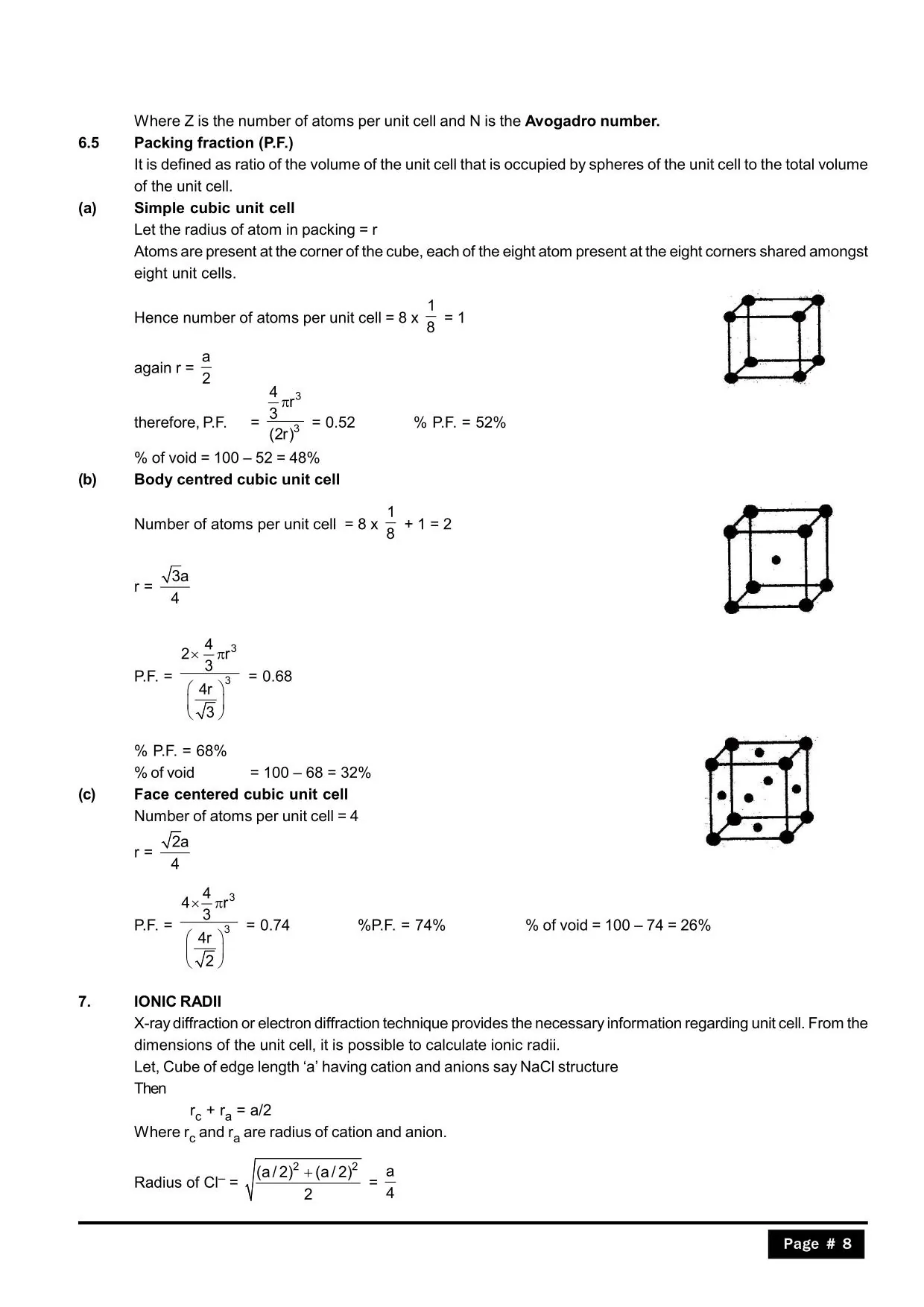
In an FCC unit cell, there are 4 atoms. The face diagonal equals 4r, so the edge length a = 4r/√2 = 2√2 r. Volume of 4 atoms = 4 × (4/3)πr³. Volume of unit cell = a³ = (2√2 r)³ = 16√2 r³. Packing efficiency = (4 × 4πr³/3) / (16√2 r³) × 100 = 74.05%.
What is an F-centre in a crystal?
An F-centre (Farbe centre, from the German word for colour) is an anionic vacancy in a crystal that is occupied by an electron. These trapped electrons absorb visible light and cause the crystal to appear coloured. Excess sodium in NaCl creates F-centres that make the crystal appear yellow. This concept appears in both JEE and NEET.
What is the coordination number in BCC and FCC structures?
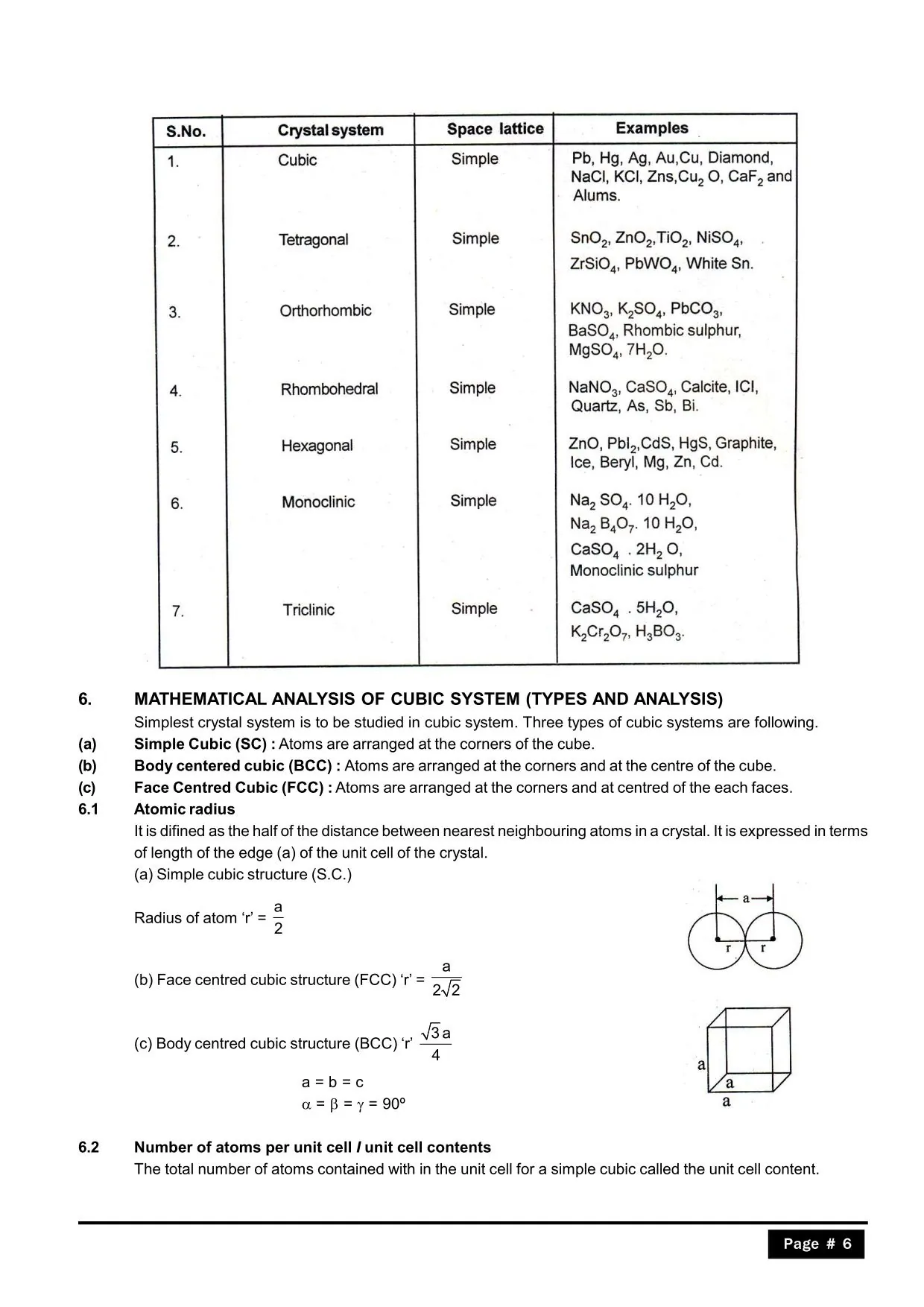
In a BCC (body-centred cubic) structure, the coordination number is 8 — each atom is directly surrounded by 8 nearest neighbours. In an FCC (face-centred cubic) structure, the coordination number is 12 — each atom is surrounded by 12 nearest neighbours. Higher coordination number means more efficient packing and greater density.