Class 10 CBSE Board Exam Preparation: How to Score 95% Even If You Were Average
Class 10 CBSE students can achieve 95%+ marks through consistent year-long preparation, multiple revision cycles, regular testing, strong NCERT-based study, subject-specific strategies, and personalized mentorship that ensures accountability, doubt resolution, and steady academic progress.


Table of Contents
- Why Average Students Can Score 95% in Class 10 CBSE Boards
- The Year-Long Study Plan That Actually Works
- How Many Hours Should You Study for Class 10 Boards Daily?
- Subject-by-Subject Strategy: Science, Maths, English and SST
- How Does Mentorship Help You Score 95% in Class 10?
- Revision Strategy: How to Revise Four Times Before Boards

eSaral ›Foundation courses ›Class 10 CBSE Board Exam Preparation: How to Score 95% Even If You Were Average

Why Average Students Can Score 95% in Class 10 CBSE Boards
Every year, thousands of students who scored 70–80% in Class 9 come out of Class 10 boards with 95% or above. This is not luck. It is a system.
The gap between an average student and a top scorer in Class 10 CBSE is almost never about intelligence. It is about three things: starting early, getting proper guidance, and clearing doubts before they pile up. Students who wait until December or January to get serious almost always leave marks on the table — even if they study hard in the final weeks.
This year, eSaral's Class 10 students produced results that prove this point. Avni scored 499 out of 500 in CBSE Class 10 boards, becoming a national topper. The Maharashtra Board Rank 1 student also came from eSaral — scoring a perfect 500 out of 500. Across UP Board, Bihar Board, MP Board, and JNK Board, eSaral students held positions in the top 10 merit lists. And at the aggregate level, nearly 1 in 3 eSaral students scored 95% or above — and nearly 1 in 2 crossed 90%.
💡 Expert Tip by Prateek Gupta, IIT Bombay: "I scored 92% in my Class 10 boards by studying seriously only in the last month and a half. It has always been a regret. Had I studied consistently throughout the year, 97–98% was absolutely achievable. Don't make the same mistake. Start now."
These results did not happen because these students were born brilliant. They happened because each student had proper guidance, a teacher who noticed when they missed class, and a study structure that left no subject behind.
The Year-Long Study Plan That Actually Works
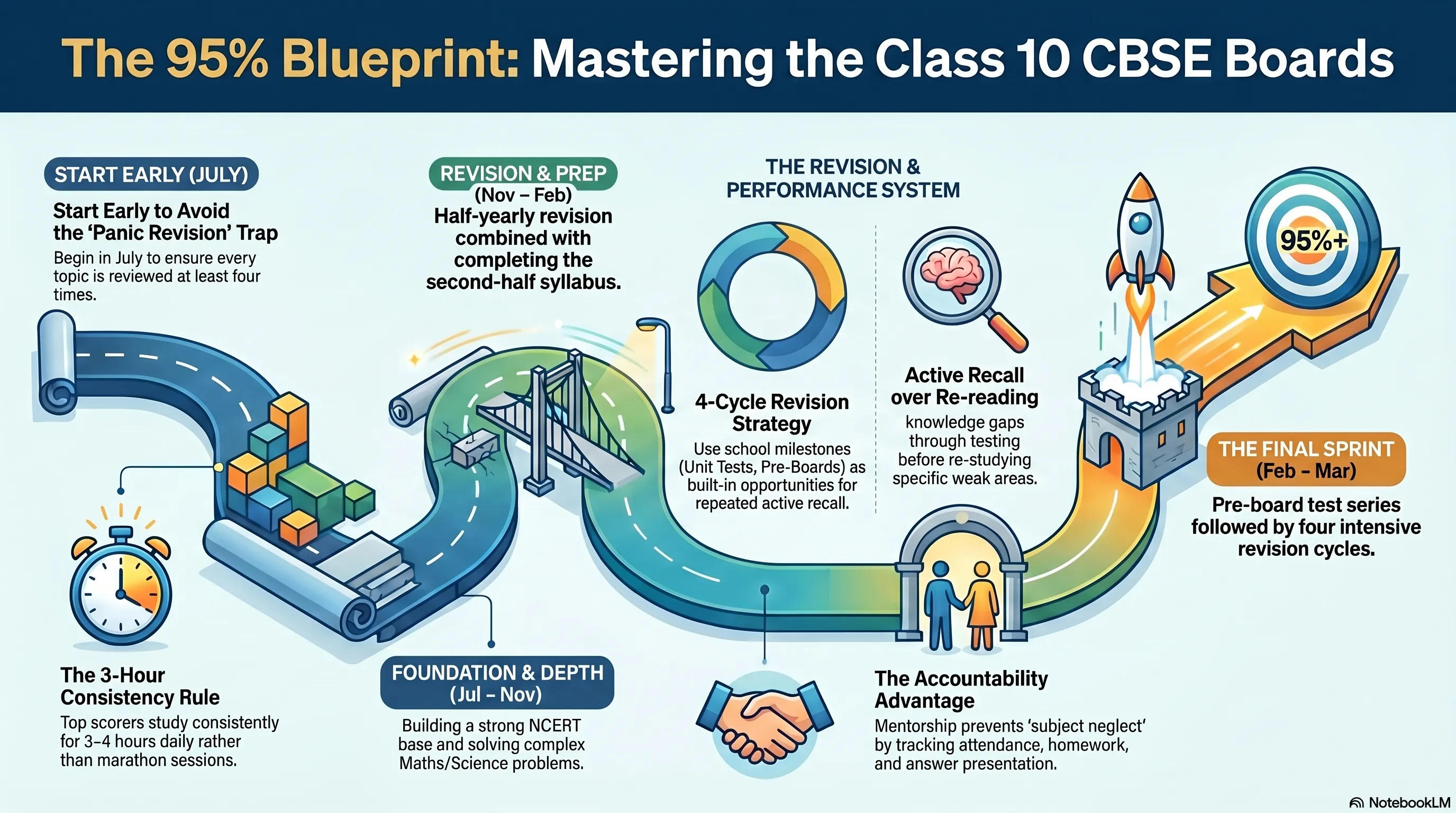
Most students divide their year into two phases: "enjoying school life" and "panic revision." That approach caps your score at 85–88%. Scoring 95% or above requires a different approach: consistent daily effort, spread across the full year.
Here is the month-by-month plan that eSaral's 95%+ students followed:
| Phase | Period | Focus |
|---|---|---|
| Phase 1 — Foundation | Jul–Sep 2026 | Cover all Class 10 chapters as taught in school; build strong NCERT base |
| Phase 2 — Depth Building | Oct–Nov 2026 | Chapter tests, doubt clearing, harder problem-solving in Maths and Science |
| Phase 3 — Half-Yearly Prep | Nov–Dec 2026 | Half-yearly exam revision + combined chapter tests |
| Phase 4 — Second Half Syllabus | Jan–Feb 2027 | Remaining chapters + Revision 1 of first-half syllabus |
| Phase 5 — Pre-Board Sprint | Feb–Mar 2027 | Pre-board test series + Revision 2 and 3 |
| Phase 6 — Board Exam Final | Mar 2027 | Revision 4 + subject-gap exam filling in the inter-exam gaps |
What Makes This Plan Work
The key is that revision is built into the plan from the start — not added as a last-minute scramble. By the time the board exam arrives, every student following this plan has seen every topic at least four times. That repetition is what converts a "studied it once" memory into a "can answer it under pressure" memory.
Notice how the half-yearly exam is not treated as a distraction. It is treated as Revision Opportunity 1. Your school's unit tests, periodic tests (PT1, PT2), and pre-board exams are all revision milestones — not separate exam preparations. Use each of them.
How Many Hours Should You Study for Class 10 Boards Daily?
A Class 10 student aiming for 95% in CBSE boards should study 3–4 hours per day on school days, and 6–7 hours during vacations and the final pre-board weeks.
This is not about studying 8 hours a day. Avni, the national topper with 499/500, did not study 8 hours every day. She studied consistently — every day — for 2–3 focused hours throughout the year. The Maharashtra Board Rank 1 student did the same.
Recommended Daily Schedule for a Class 10 Student
| Time Block | Activity |
|---|---|
| 6:30 AM – 7:30 AM | Quick revision of previous day's topics / reading NCERT |
| School hours | School attendance + active classroom participation |
| 4:30 PM – 6:00 PM | Live online coaching class (eSaral Champ batch) |
| 6:30 PM – 8:30 PM | Self-study: homework, chapter problems, SST reading |
| 9:00 PM – 9:30 PM | Review day's work; mark unanswered questions for mentor |
What Not to Do
- Do not skip SST because it feels boring. SST has caught many students off-guard — it contributes 80 marks to your total and is entirely manageable with consistent reading.
- Do not leave Maths for last. This year's CBSE Class 10 Maths paper was significantly harder than previous years. Students who had only practised easy problems were not prepared. Practise Class 10 Maths NCERT Solutions fully, including all examples and exercises.
- Do not rely only on self-study. Students who studied without a structured system and without teacher interaction consistently ended up at 80–85% — not 95%.
Subject-by-Subject Strategy: Science, Maths, English and SST
Each Class 10 CBSE subject has a different preparation approach. Here is what works for each:
| Subject | Key Strategy | Common Mistake to Avoid |
|---|---|---|
| Maths | NCERT all exercises, all examples; level-by-level practice | Skipping difficult exercise questions |
| Science | NCERT line-by-line + diagram practice + numerical in Physics | Ignoring Biology diagrams and Chemistry equations |
| English | Grammar rules + reading comprehension daily + literature notes | Leaving writing section practice for last |
| SST | Chapter-wise notes + map work + previous year papers | Cramming the entire SST syllabus in 2 weeks |
How to Study Maths for 95%
Maths is the subject that separates 88% students from 95% students. The students who score full marks in Maths do two things differently:
- They complete every NCERT exercise question — not just the ones their teacher assigns
- They practise under timed conditions at least once a week
Work through NCERT Solutions for Class 10 chapter by chapter. Do not jump to sample papers before you have finished the NCERT exercises at least twice.
How to Study Science for 95%
Science is split into Physics, Chemistry, and Biology. Each has different demands:
- Physics: Focus on numericals — Current Electricity, Light (Reflection and Refraction), and Human Eye. Practice derivations and ray diagrams.
- Chemistry: Balance chemical equations and memorise the reactions in Acids, Bases and Salts, and Metals and Non-metals. These are high-repeat topics in board exams.
- Biology: Life Processes, Heredity, and our Environment carry maximum weightage. Draw and label every diagram at least 10 times each.
Use the Class 10 Science previous year question paper from 2023 to understand the question pattern and identify which chapters need your deepest attention.
How Does Mentorship Help You Score 95% in Class 10?
Mentorship is the single biggest factor that separates eSaral's students from those who prepare alone. This is not a motivational statement — it is backed by results.
What the 5-Layer Mentorship System Does
Every eSaral Champ student is assigned two personal mentors — separate from their subject teachers. These mentors do the following throughout the year:
- Attendance tracking: Miss a class, receive a call the same day. No falling behind silently.
- Homework checking: All subjects — including SST — checked regularly so no subject gets neglected
- Notes review: Your written answers are reviewed so you know whether your presentation will score full marks
- Progress tracking: Study hours, test scores, and chapter completion are monitored week by week
- Video call check-ins: Regular one-to-one video conferences between student, parents, and mentor — so parents know exactly what their child is doing and where support is needed
Why This Changes Everything for Average Students
Most average students do not fail because they are incapable. They fail to reach 95% because no one is watching. When there is no accountability, Maths gets skipped because it is hard. SST gets ignored because it feels like too much to read. English writing practice never happens.
Mentors fix this. They are like a senior sibling who has been through it — they guide your time management, help you balance school activities and coaching, and call you out when you fall off the schedule.
In limited-batch settings like eSaral's Champ course, every teacher knows every student by name. That kind of attention is not possible in a class of thousands. JEE ki taiyari and board prep both suffer when students are lost in a crowd — and the same applies to Class 10 boards.
Revision Strategy: How to Revise Four Times Before Boards
Four revisions sound like a lot. But when you follow the year-long plan above, these revisions happen naturally — you are not adding extra study time you are using the built-in opportunities your school and coaching system already provide.
The 4-Revision Cycle for Class 10 CBSE
| Revision | When | Format |
|---|---|---|
| Revision 1 | Before half-yearly exam (Nov–Dec) | In-class with teacher, chapter-by-chapter |
| Revision 2 | Before unit test / PT2 (Jan–Feb) | Self-study + doubt clearing session |
| Revision 3 | Before Pre-Board 1 (Feb) | Test series + full-syllabus mock test |
| Revision 4 | Between Pre-Board and Board exam | Inter-exam gap sessions, weak subject focus |
How to Make Revision Stick
Most students revise by re-reading their notes. This is the weakest form of revision. The revisions that produce 95% scores look different:
- Attempt a test first — identify what you actually cannot recall
- Re-study only what the test showed you cannot recall — not everything
- Write out answers — do not just read; reproduce them on paper
- Do one previous year question paper per subject after each revision cycle
When you revise this way — with active recall and written reproduction — each revision cycle takes less time than the one before, and your retention on exam day is dramatically higher.
How Many Tests Should You Attempt Before Boards?
eSaral's Champ course includes chapter tests, combined tests, half-yearly tests, pre-board series, and inter-board-exam revision tests. Across a full year, you will attempt multiple tests per chapter — and each test comes with a detailed analysis report showing where you dropped marks and why.
The students who studied the test analysis reports — not just the scores — were the ones who crossed 95%. A score without analysis is just a number. An analysis without a follow-up study plan is just information. Use both together.
Frequently Asked Questions
Find answers to common questions.
How can an average student score 95% in Class 10 CBSE boards?
An average student can score 95% in Class 10 CBSE boards by starting preparation from the first day of the academic year, studying 3–4 focused hours daily, completing all NCERT exercises, clearing doubts one-to-one with teachers, and completing at least four full revision cycles. Students who followed this approach at eSaral — including those who were average in Class 9 — achieved 95%+ results in 2025.
How many hours should a Class 10 student study daily for board exams?
A Class 10 student should study 3–4 hours per day on school days and 6–7 hours during vacations. Consistency matters more than volume — studying 3 hours every day across the full year produces better results than studying 8 hours a day for the last two months. National topper Avni (499/500 in CBSE 2025) followed a steady daily schedule throughout the year.
Which subjects are most important for scoring 95% in Class 10 CBSE?
All five subjects matter, but Maths and Science carry the highest difficulty risk. This year's CBSE Class 10 Maths paper was significantly harder than previous years — students who had only practised easy questions lost marks. SST is often underestimated: it is 80 marks and fully scorable with consistent reading. English requires daily grammar and writing practice, not last-minute cramming.
Is NCERT enough for Class 10 CBSE board exams?
Yes, NCERT is the primary and most important resource for Class 10 CBSE boards. All board exam questions are NCERT-based — especially in Science, Maths, and SST. Complete every NCERT exercise, every in-text question, and every example. Do not move to reference books until NCERT is fully covered. Thorough NCERT preparation combined with previous year papers is sufficient for 90%+.
How should I prepare for Class 10 Maths to avoid losing marks?
Complete every NCERT exercise in Class 10 Maths NCERT Solutions at least twice, including all examples. Practice under timed conditions weekly. The most common reason students lose Maths marks is skipping difficult exercises and only practising easy problems. Board papers test all difficulty levels — prepare for all of them.