Class 12 Physics Electromagnetic Induction Notes for IIT JEE & NEET
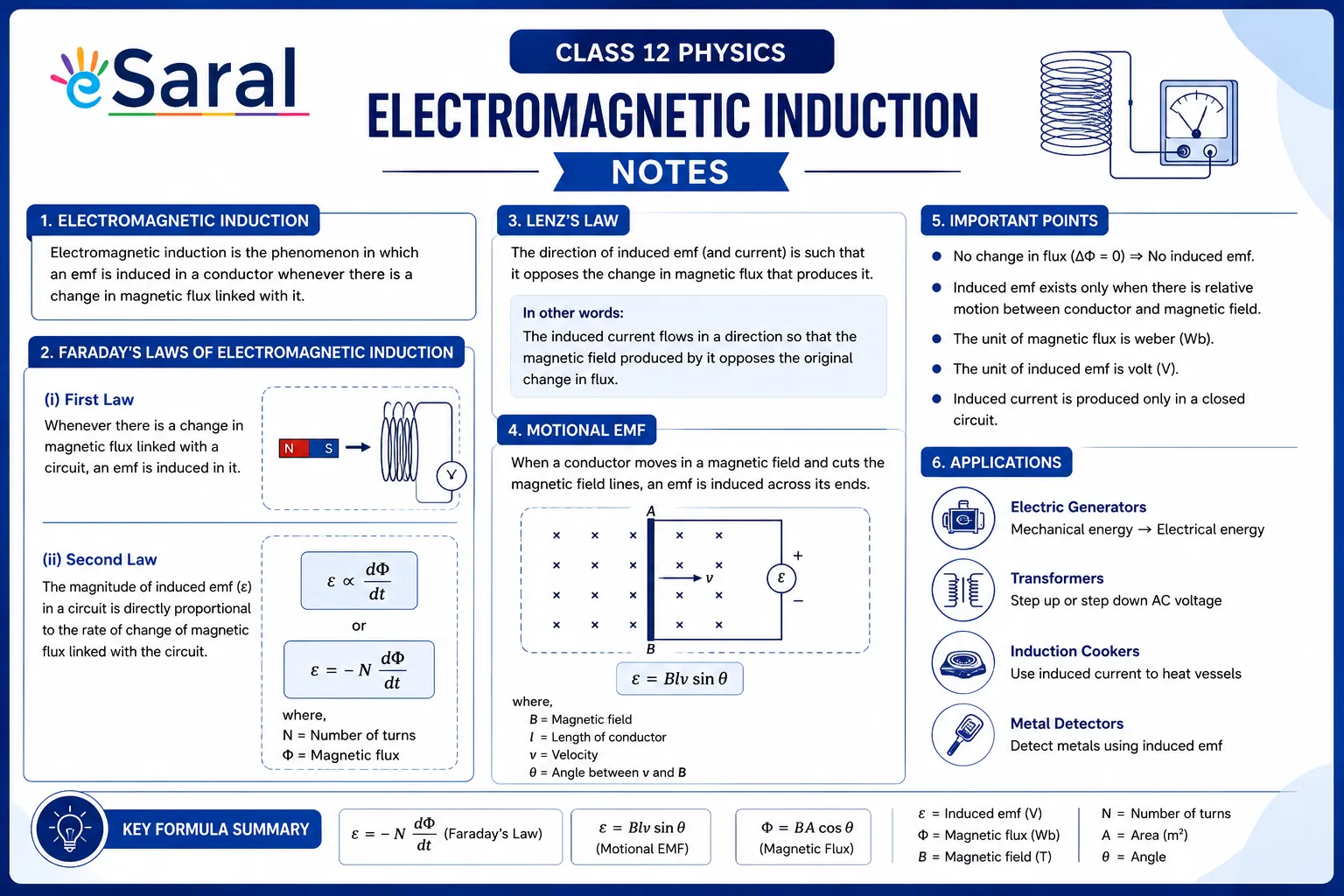
Table of Contents

Home > Class 12 Physics Notes > Electromagnetic Induction Notes Class 12

Class 12 Physics Electromagnetic Induction Notes comprises Magnetic Flux, Faraday Law of Electromagnetic Induction, Lenz Law, Induced Charge, Induced Electric Field, etc. Get to learn how magnetism can produce electricity and many more in his chapter.eSaral Provides free detailed notes of each and every chapter to help you in exams like IIT JEE, NEET and Board Preparation.
India's Best Exam Preparation for Class 12th - Download Now
What Is Electromagnetic Induction?
Electromagnetic induction is the phenomenon of generating an electric current (or EMF) in a conductor placed in a changing magnetic field. First demonstrated experimentally by Michael Faraday in 1831, this principle is the foundation of electric generators, transformers, and induction motors — all of which appear repeatedly in JEE and NEET papers.
Why Does EMI Happen?
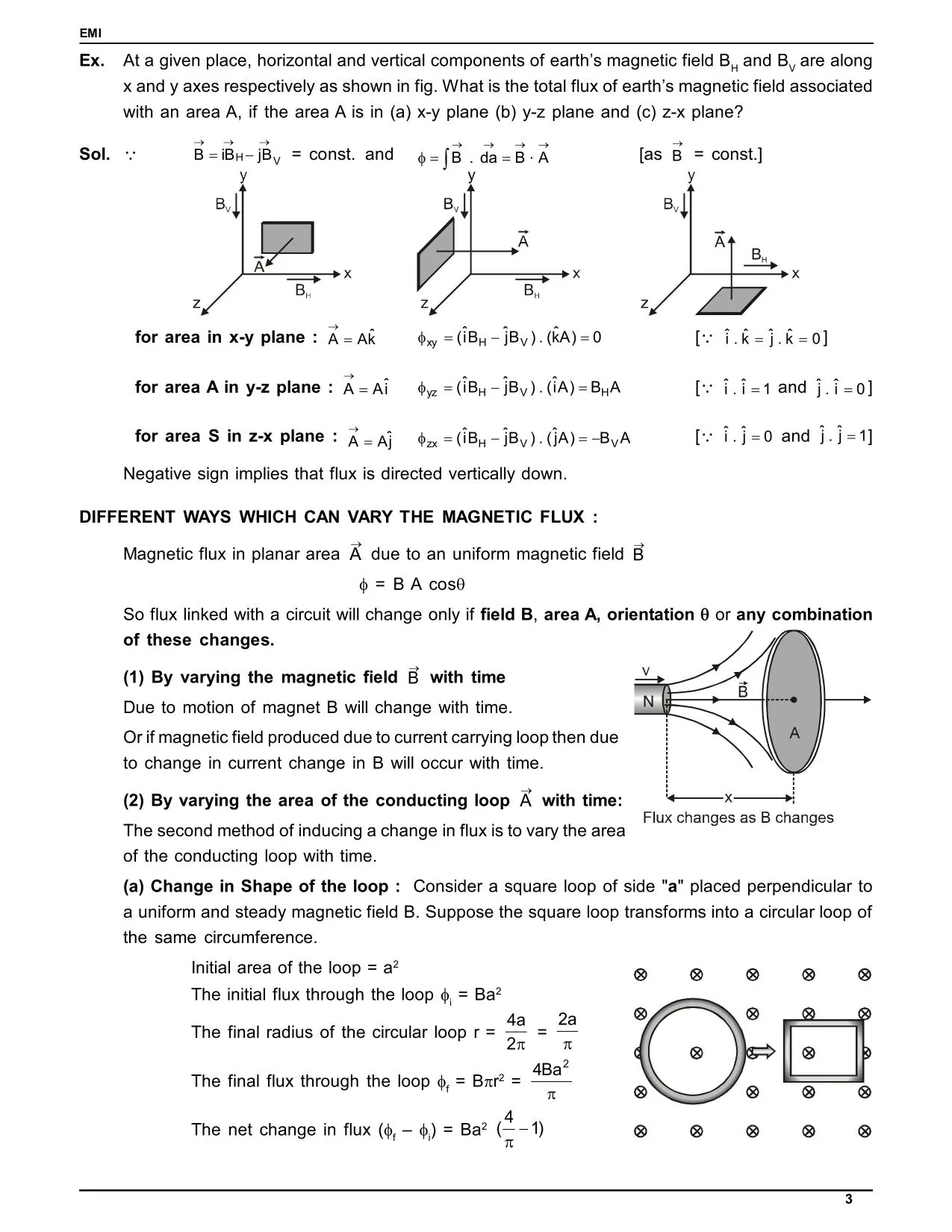
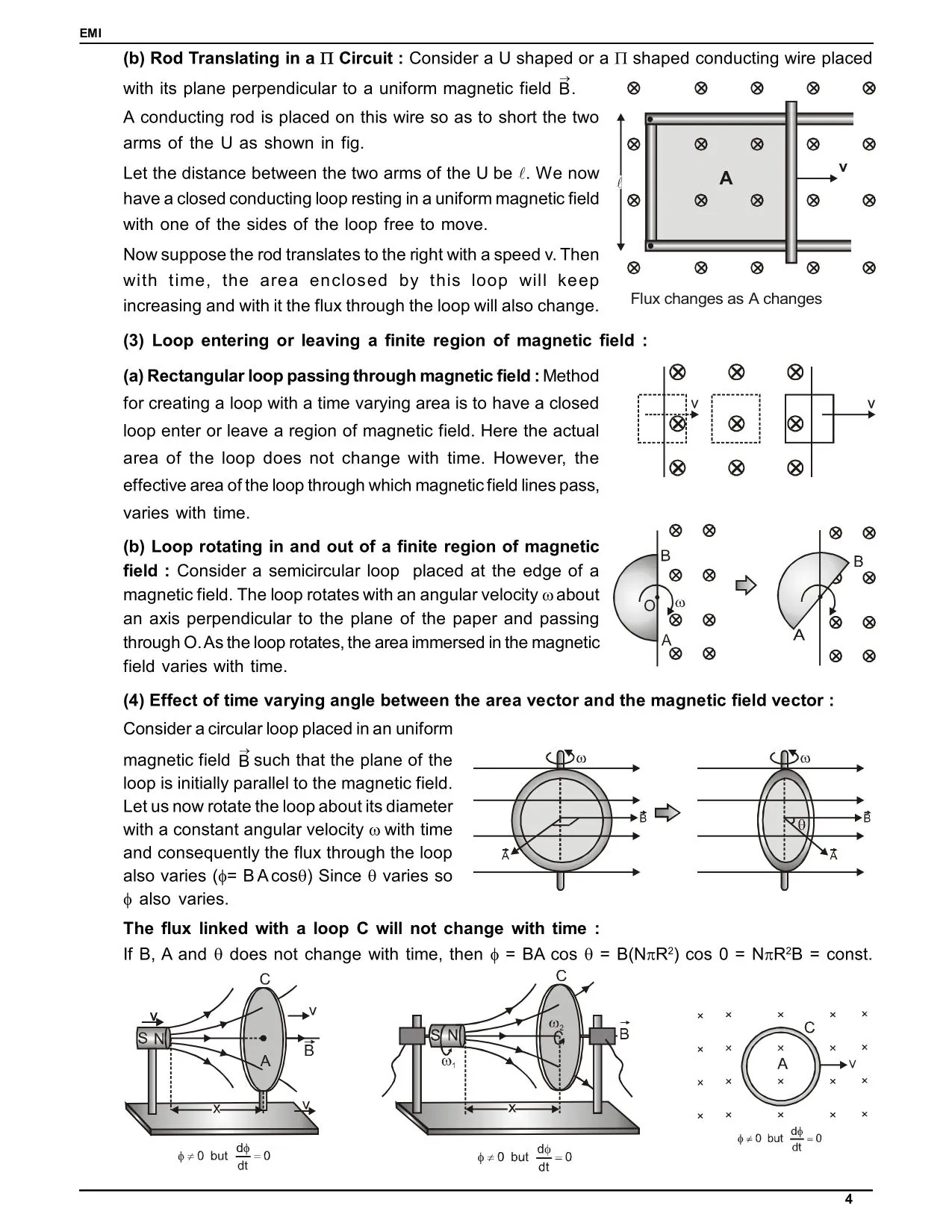
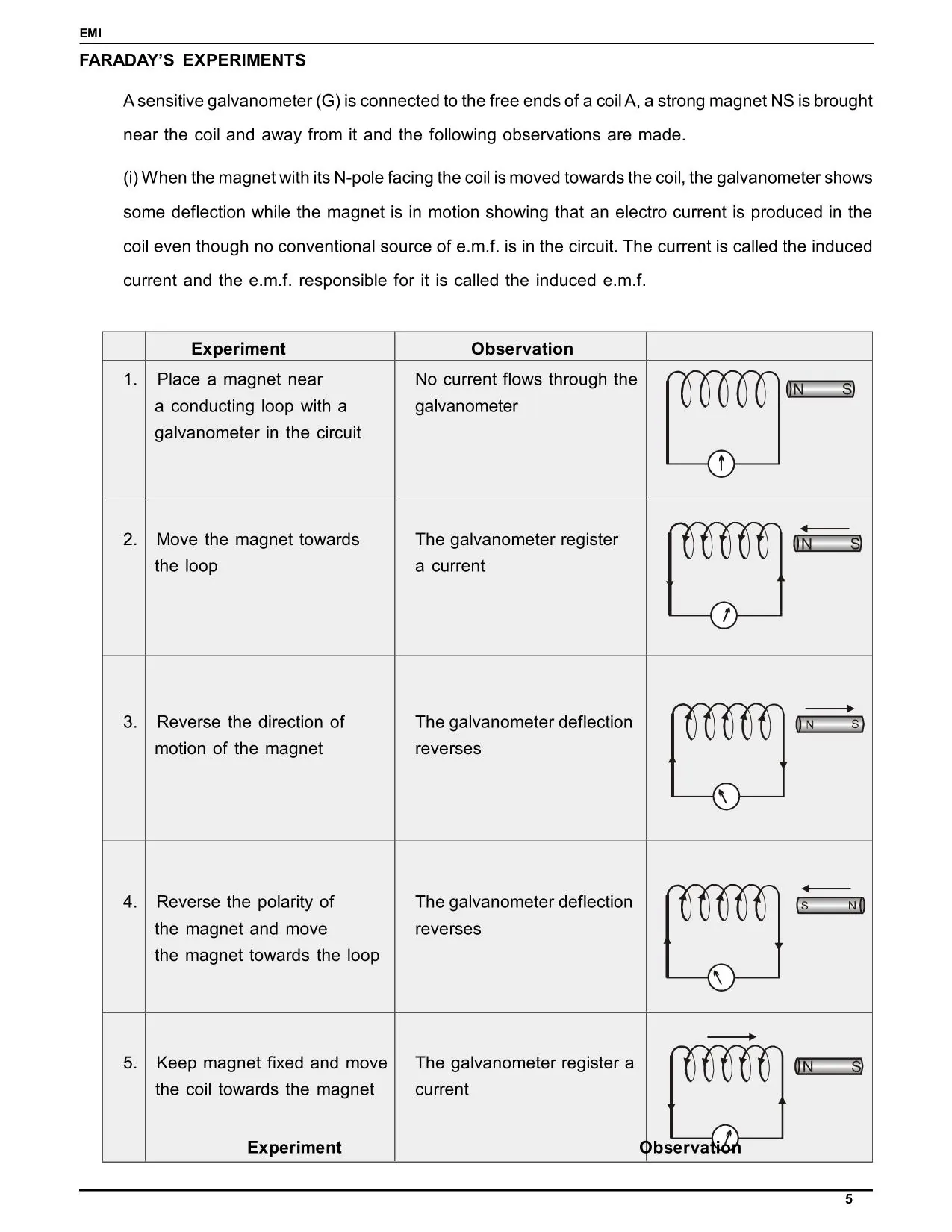
A current is induced whenever the magnetic flux linked with a closed circuit changes with time. The change can arise because:
- The magnitude of the magnetic field B changes.
- The area of the loop changes (e.g., a sliding rod on rails).
- The angle between B and the area vector changes (e.g., a rotating coil).
Key Terms to Know Before You Begin
| Term | Symbol | Unit |
|---|---|---|
| Magnetic Flux | Φ | Weber (Wb) |
| Induced EMF | ε | Volt (V) |
| Self-Inductance | L | Henry (H) |
| Mutual Inductance | M | Henry (H) |
| Rate of change of flux | dΦ/dt | Wb/s = V |
Magnetic Flux — Definition and Formula
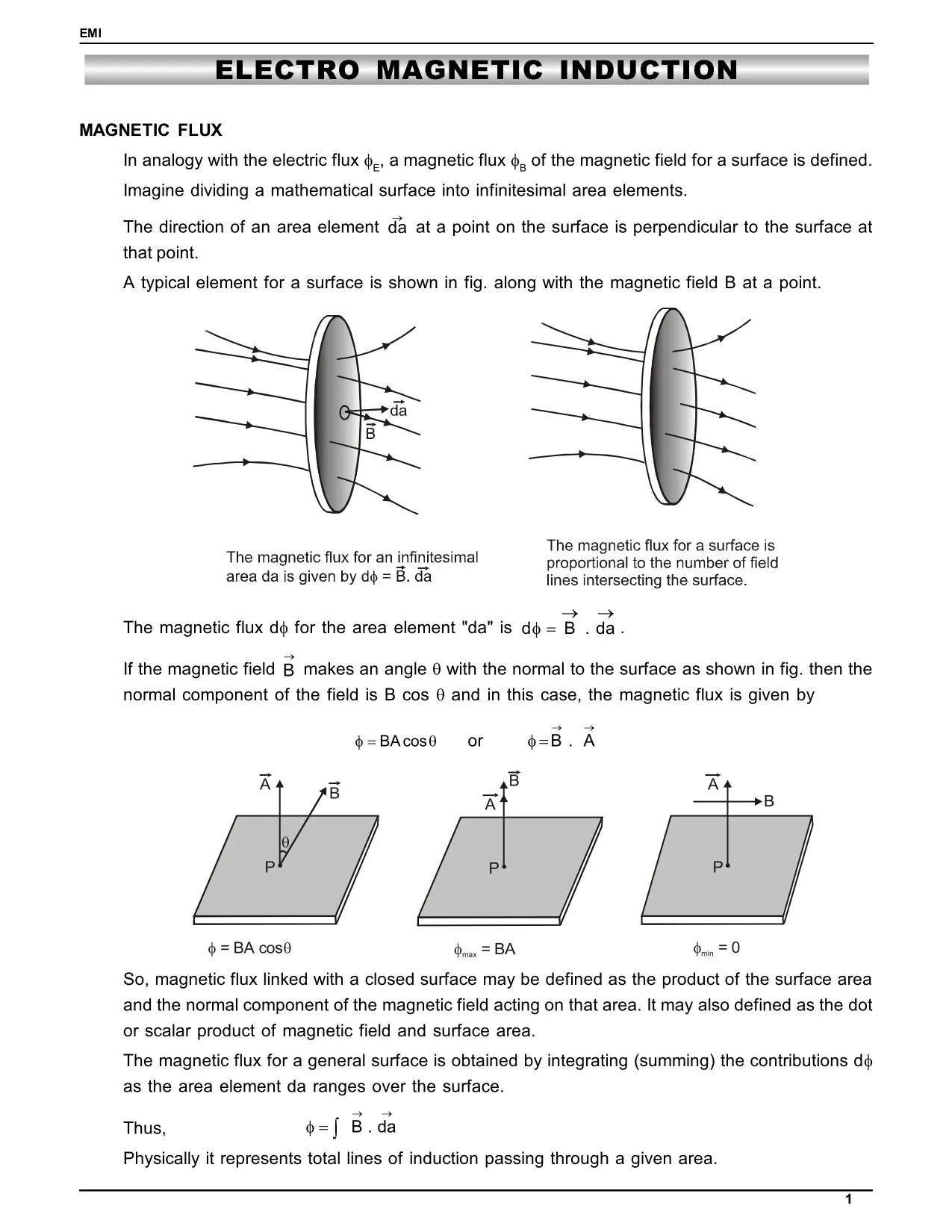
Magnetic flux (Φ) through a surface is the total number of magnetic field lines passing through that surface.
Formula:
$$\Phi = \vec{B} \cdot \vec{A} = BA\cos\theta$$
where B is the magnetic field strength (T), A is the area of the surface (m²), and θ is the angle between B and the normal to the surface.
Special Cases
- θ = 0° → Φ = BA (maximum flux, field perpendicular to surface)
- θ = 90° → Φ = 0 (field parallel to surface, no flux)
- θ = 180° → Φ = −BA (field anti-parallel to normal)
Units and Dimensions
- SI unit: Weber (Wb) = V·s = T·m²
- CGS unit: Maxwell; 1 Wb = 10⁸ Maxwell
- Dimensional formula: [M L² T⁻² A⁻¹]
In JEE problems, always draw the area vector (normal to the loop) first and then find the angle with B. Students who skip this step almost always get the sign of induced EMF wrong — and that can cost you marks in integer-type questions.
Faraday's Laws of Electromagnetic Induction
What does Faraday's First Law state?
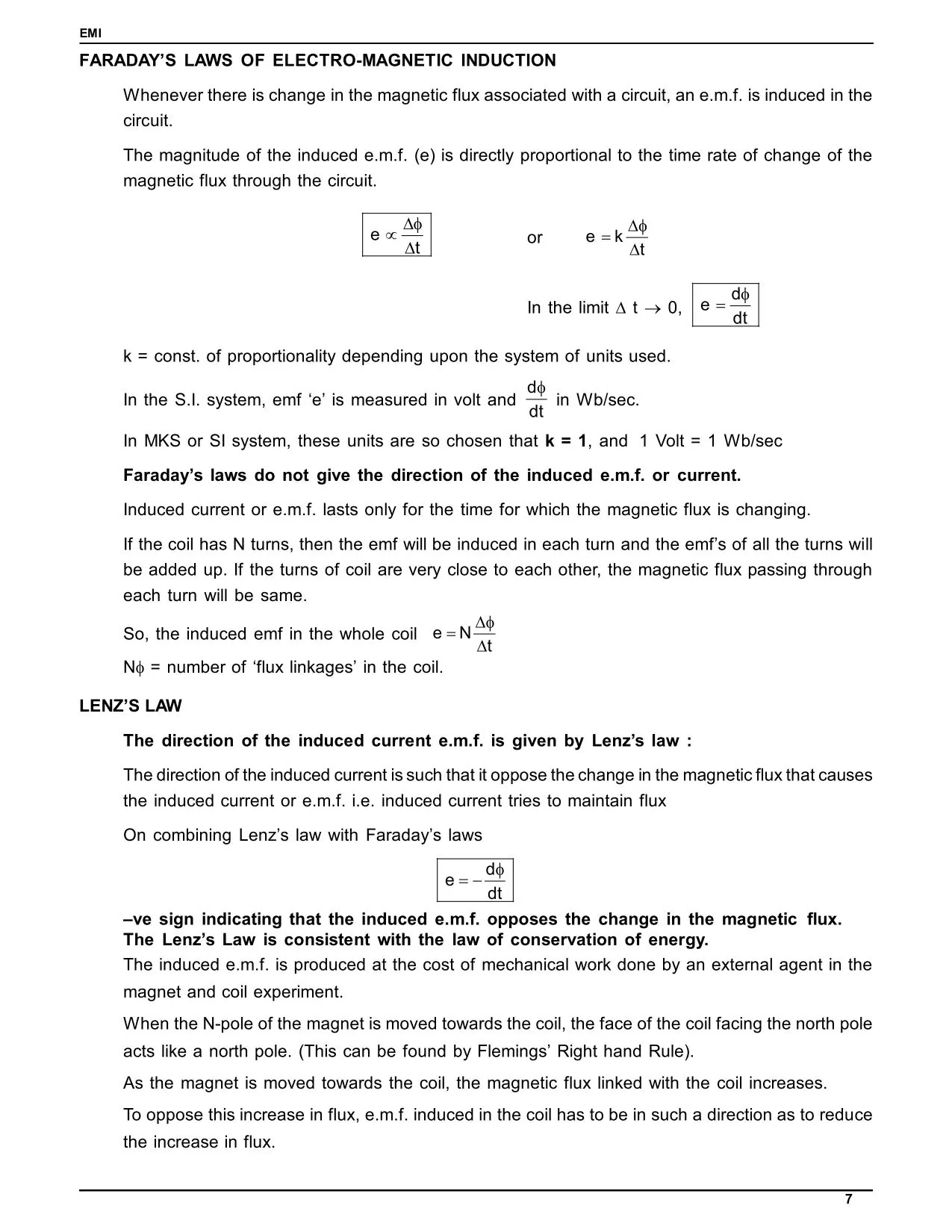
Faraday's First Law states that whenever the magnetic flux linked with a circuit changes, an EMF is induced in the circuit. The induced EMF exists only as long as the flux is changing — it disappears the moment flux becomes constant.
What does Faraday's Second Law state?
Faraday's Second Law gives the magnitude of the induced EMF:
$$|\varepsilon| = \frac{d\Phi}{dt}$$
For a coil of N turns:
$$|\varepsilon| = N\frac{d\Phi}{dt}$$
The negative sign (from Lenz's law) is included in the full expression:
$$\varepsilon = -N\frac{d\Phi}{dt}$$
Calculating Induced EMF — Step-by-Step
- Write the expression for flux Φ at time t.
- Differentiate Φ with respect to t.
- Multiply by −N to get ε.
- Use Lenz's law to assign the correct direction.
Lenz's Law and Conservation of Energy
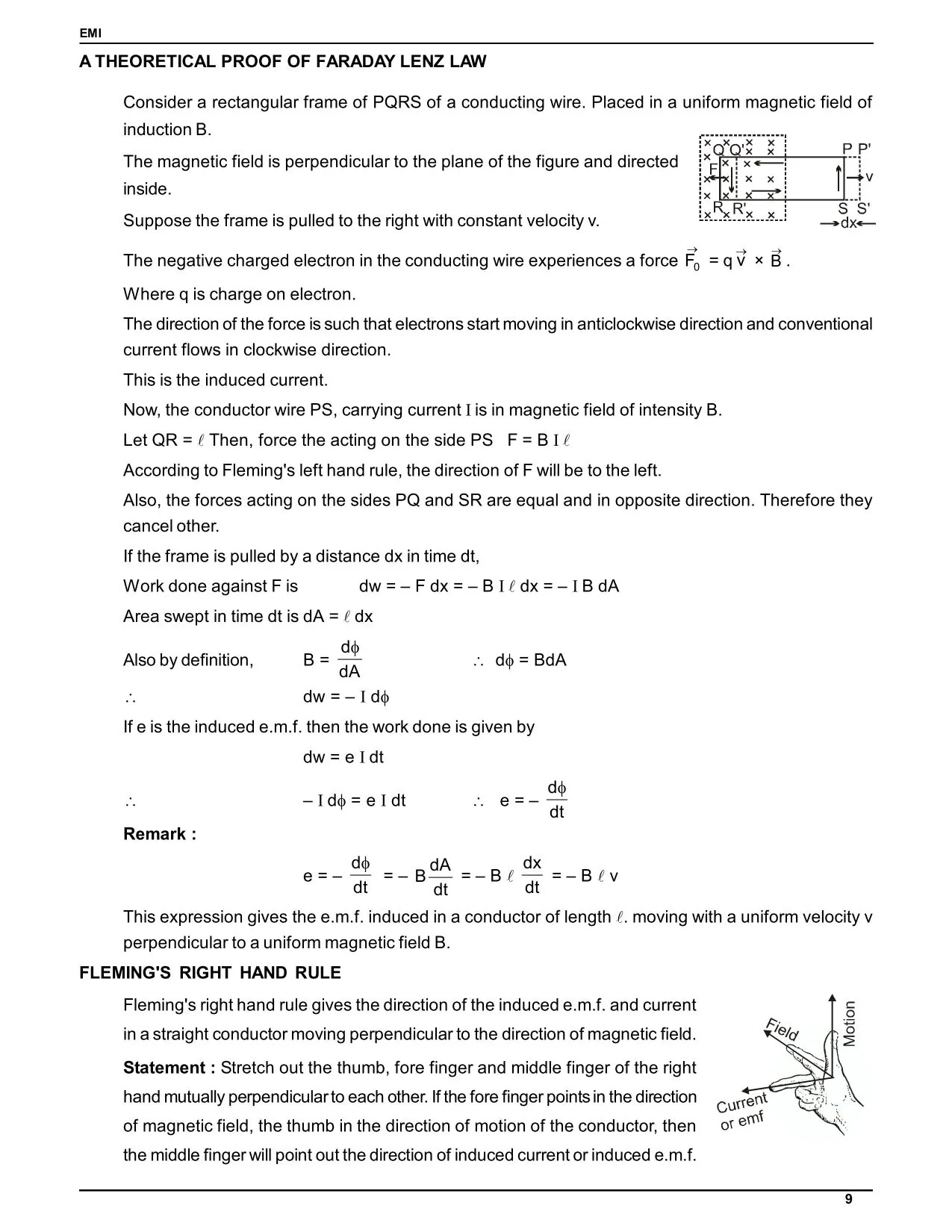
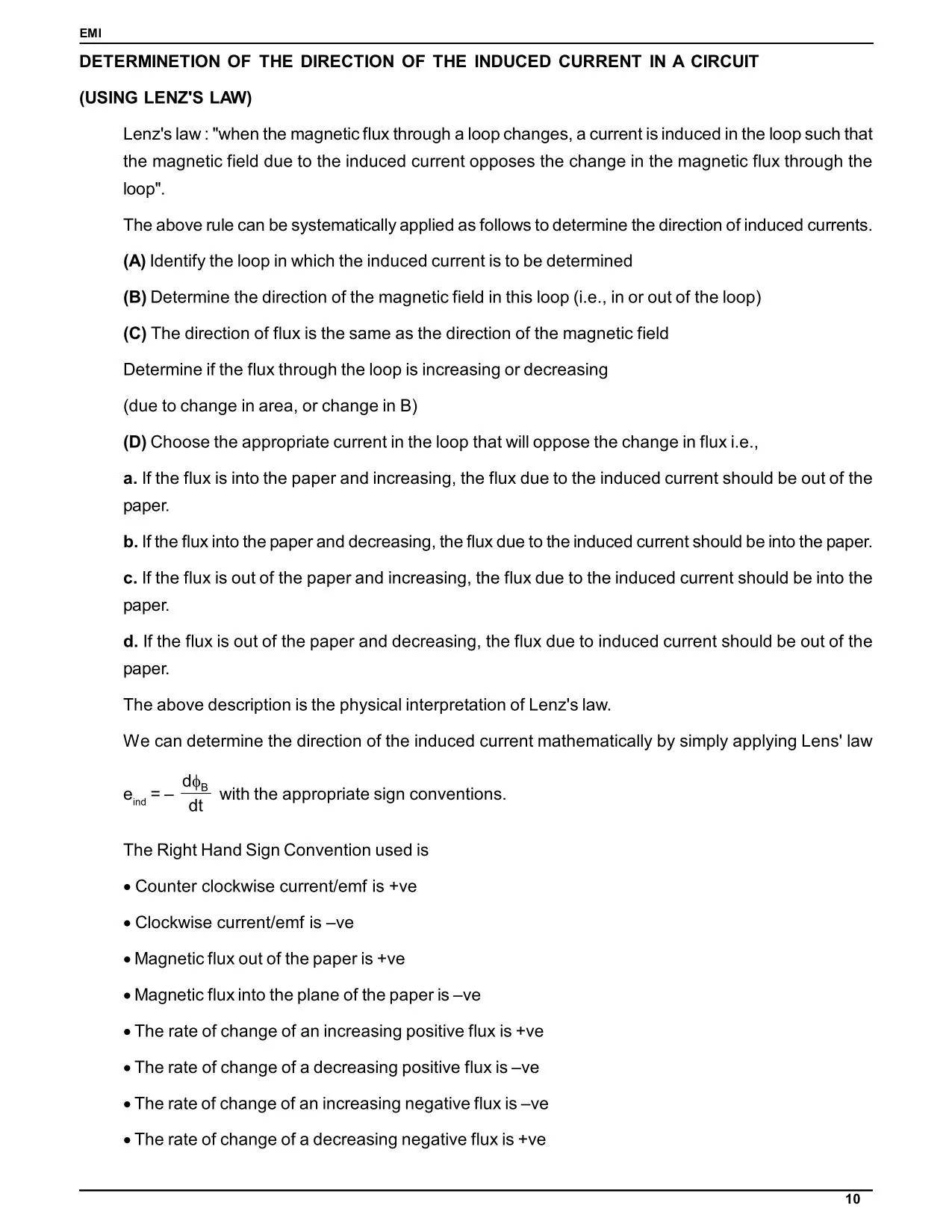
Lenz's Law states that the direction of the induced current is always such that it opposes the cause that produces it (i.e., opposes the change in flux).
Mathematically, this is the reason for the negative sign in Faraday's equation:
$$\varepsilon = -N\frac{d\Phi}{dt}$$
How Is Lenz's Law a Consequence of Energy Conservation?
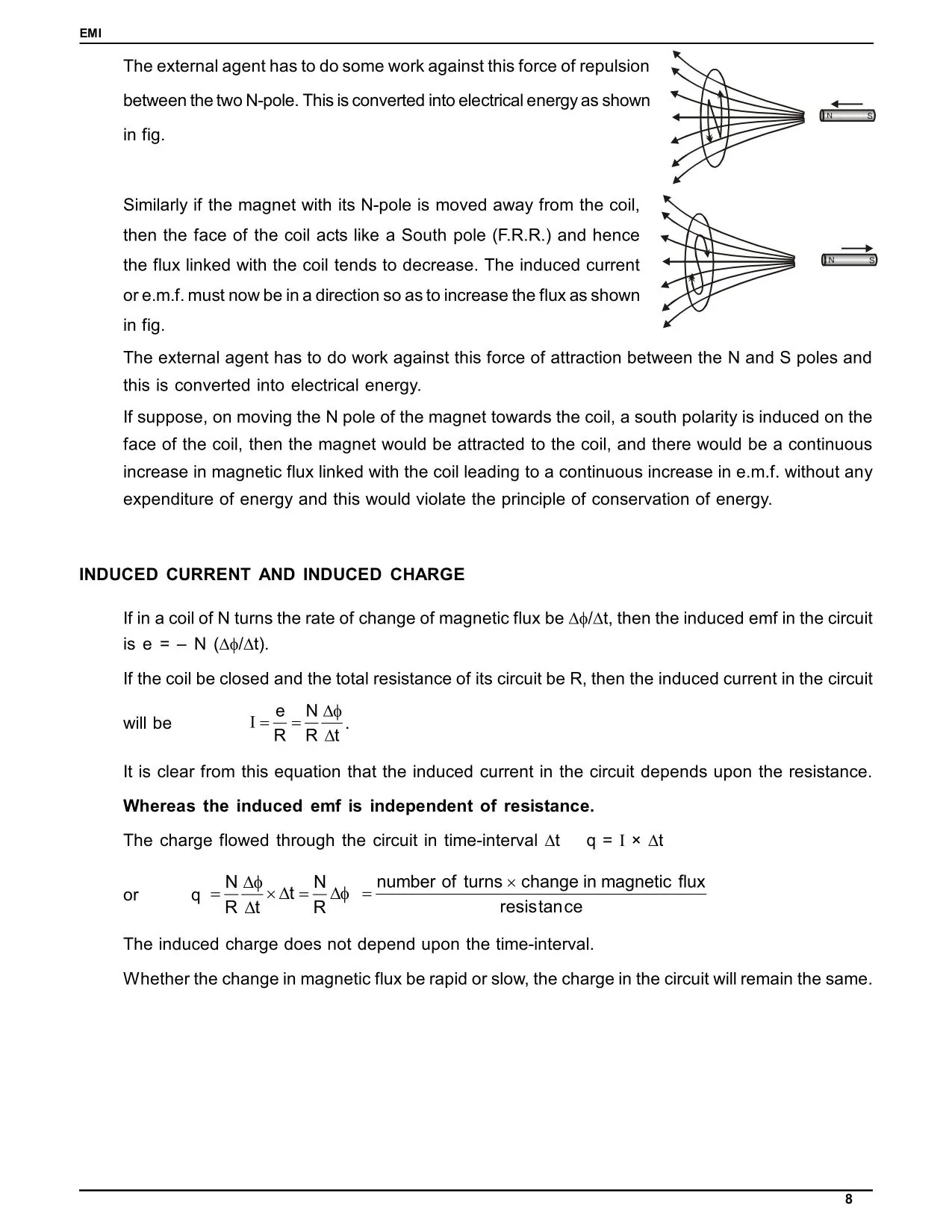
If the induced current aided the change in flux instead of opposing it, the current would increase the flux, which would further increase the current, creating energy from nothing. This violates the law of conservation of energy. Lenz's law ensures that mechanical work must be done against the opposing magnetic force to sustain the induced current.
Lenz's Law Quick Reference
| Situation | Change in Flux | Direction of Induced Current |
|---|---|---|
| Magnet approaching loop (N-pole first) | Increasing | Opposes approach (repels magnet) |
| Magnet moving away from loop (N-pole) | Decreasing | Supports magnet (attracts it back) |
| Current in nearby coil increasing | Increasing | Opposes increase |
| Current in nearby coil decreasing | Decreasing | Opposes decrease |
What Is Motional EMF and How Is It Calculated?
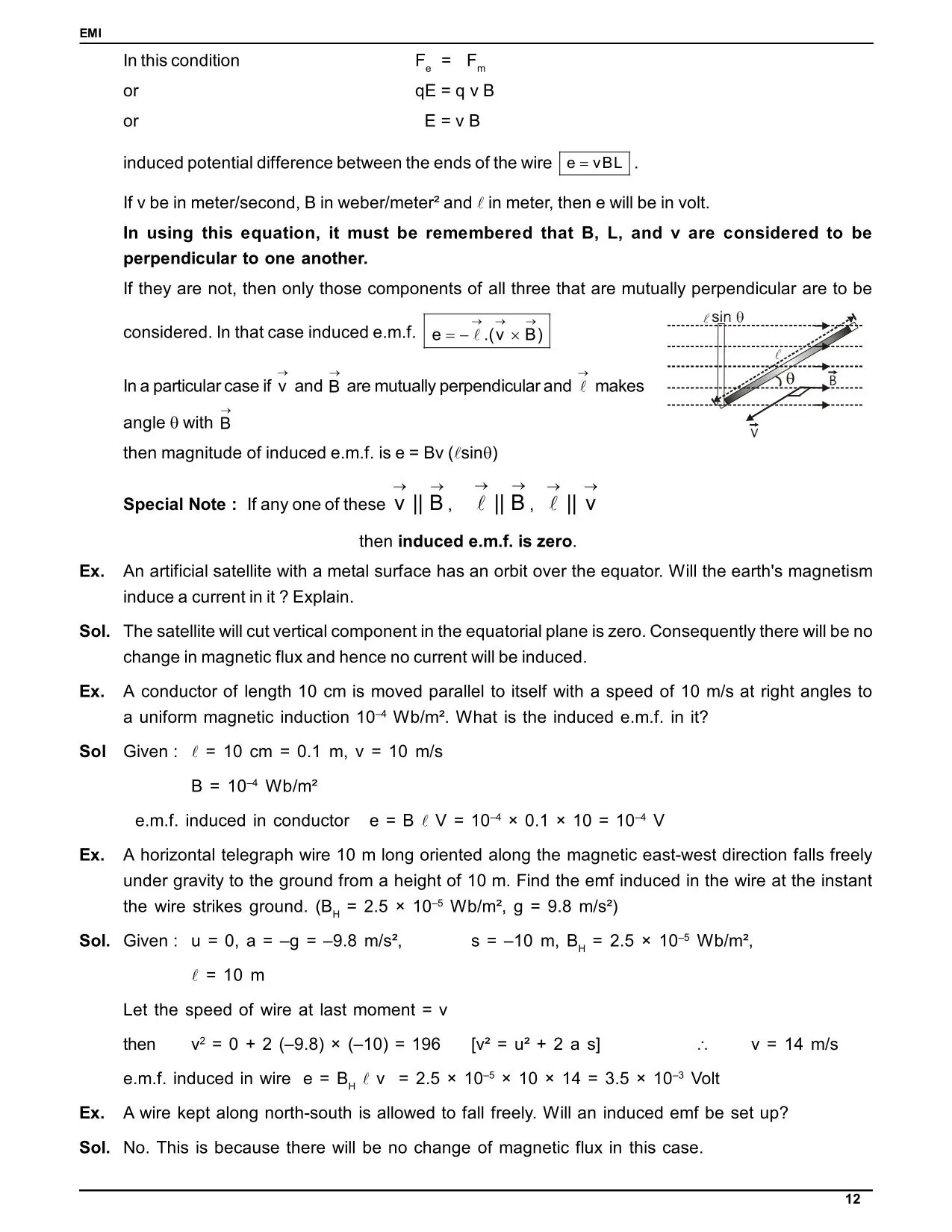
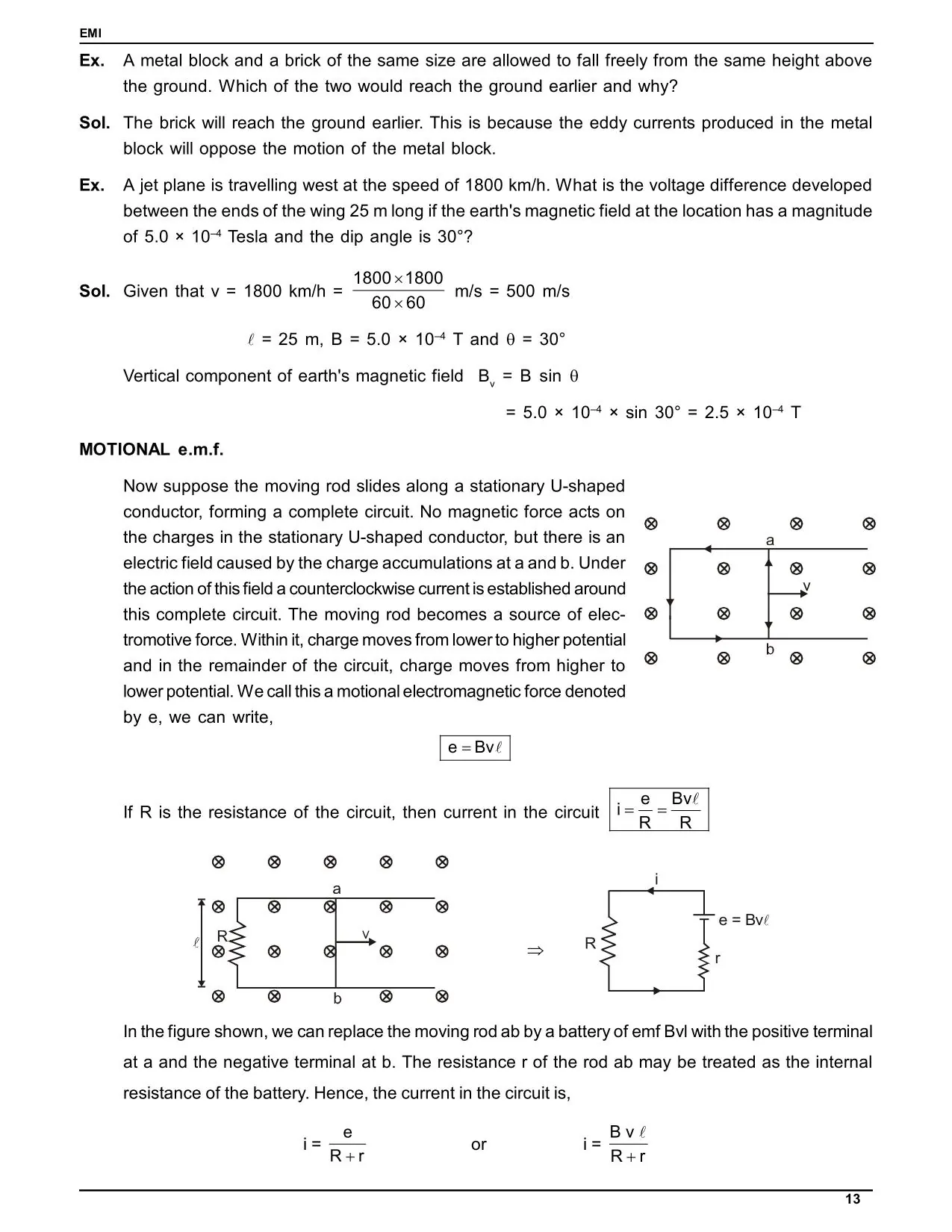
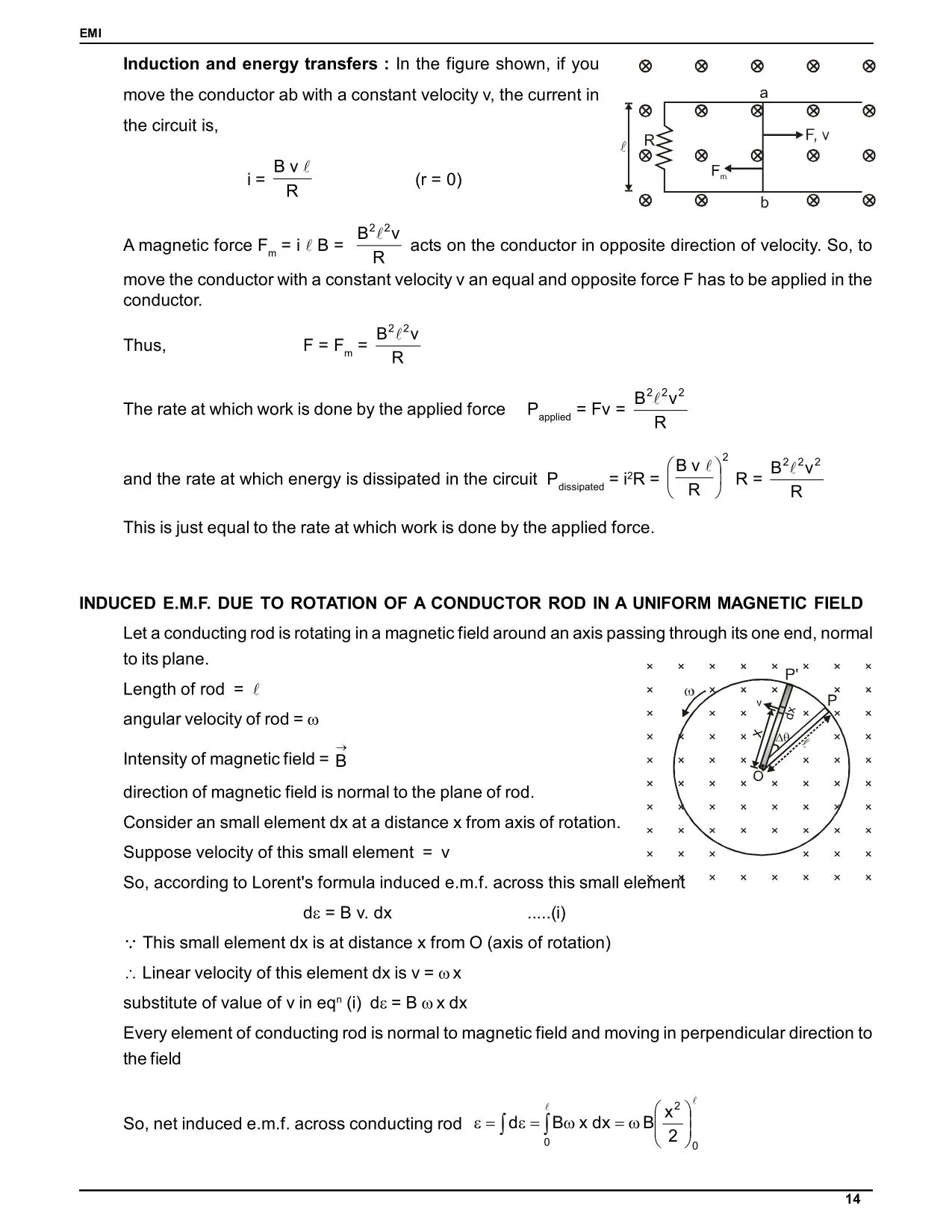
Motional EMF is the EMF induced when a conductor moves through a magnetic field. If a rod of length l moves with velocity v perpendicular to a uniform magnetic field B, the free electrons in the rod experience a Lorentz force, creating a potential difference.
Formula:
$$\varepsilon = Blv$$
For a rod making angle θ with the direction of motion:
$$\varepsilon = Blv\sin\theta$$
Motional EMF in a Rotating Rod
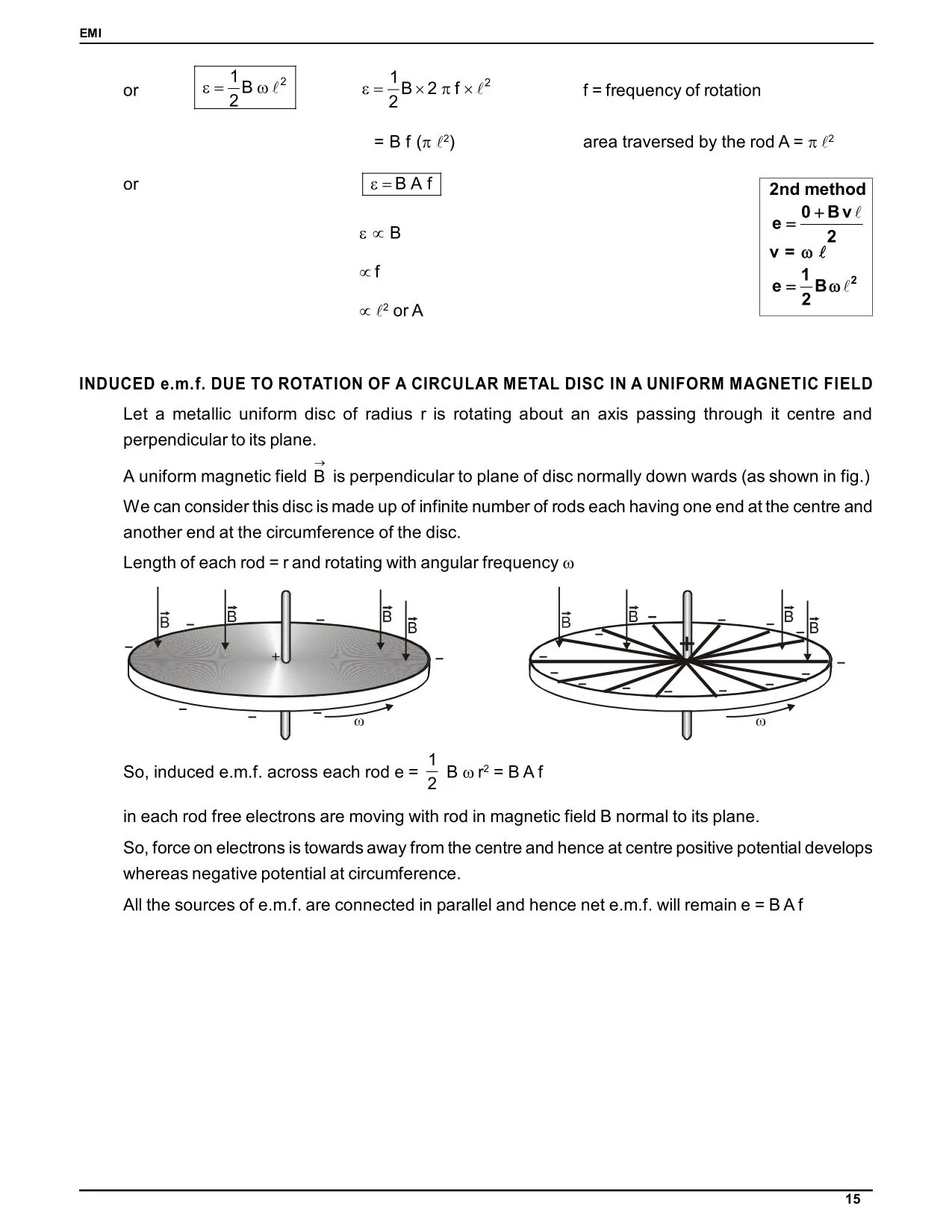
For a rod of length l rotating about one end with angular velocity ω in a field B perpendicular to the plane of rotation:
$$\varepsilon = \frac{1}{2}B\omega l^2$$
Power Dissipated in the Circuit
If the rod slides on rails with resistance R:
$$I = \frac{Blv}{R}, \quad P = \frac{B^2l^2v^2}{R}$$
This power equals the rate of work done by the external force maintaining the velocity — again confirming energy conservation.
Motional EMF problems in JEE Advanced frequently combine the sliding rod with a changing external circuit resistance. Always redraw the circuit at each stage and treat the rod as a battery of EMF = Blv with internal resistance = rod's resistance. This model solves 90% of such problems cleanly.
Self-Induction and Mutual Induction
What Is Self-Inductance?
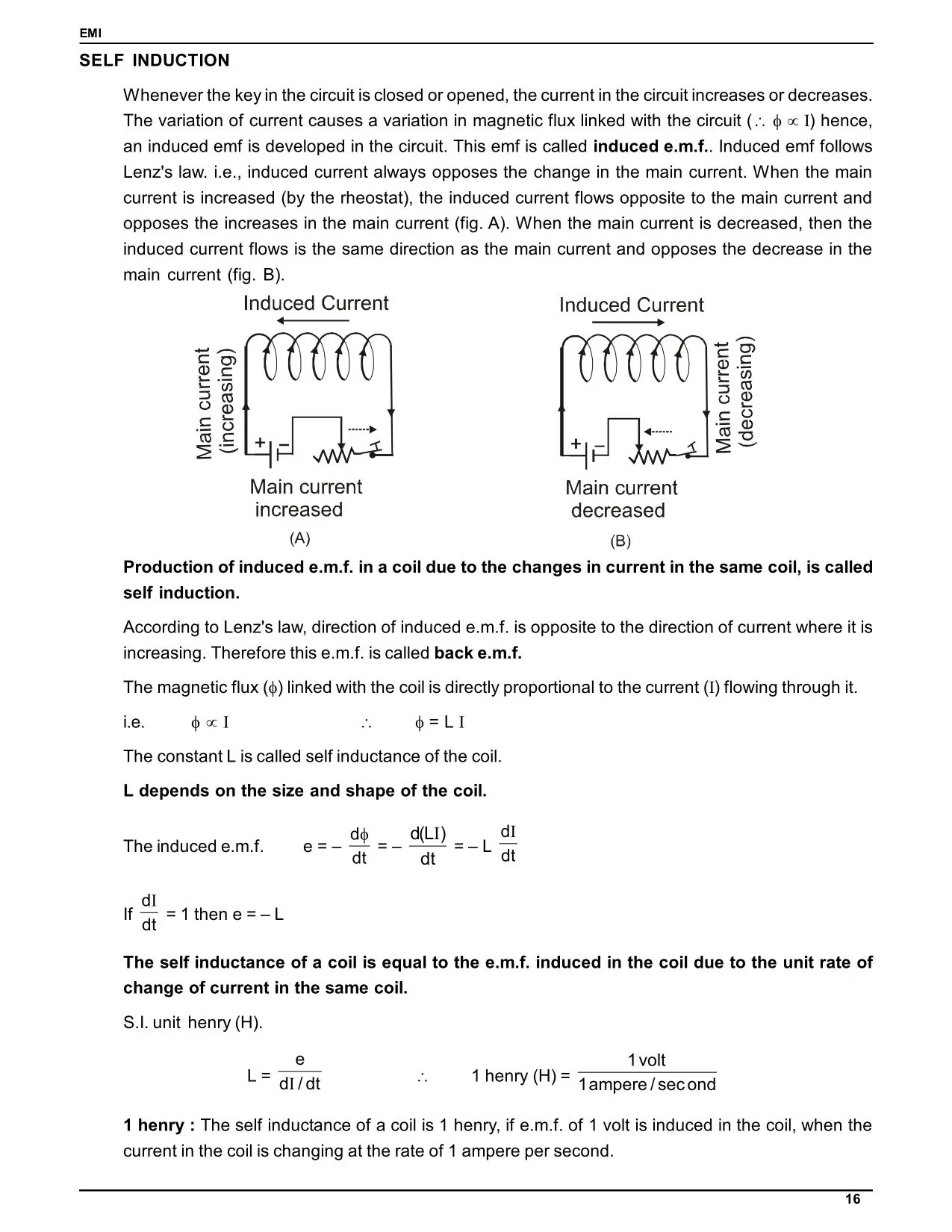
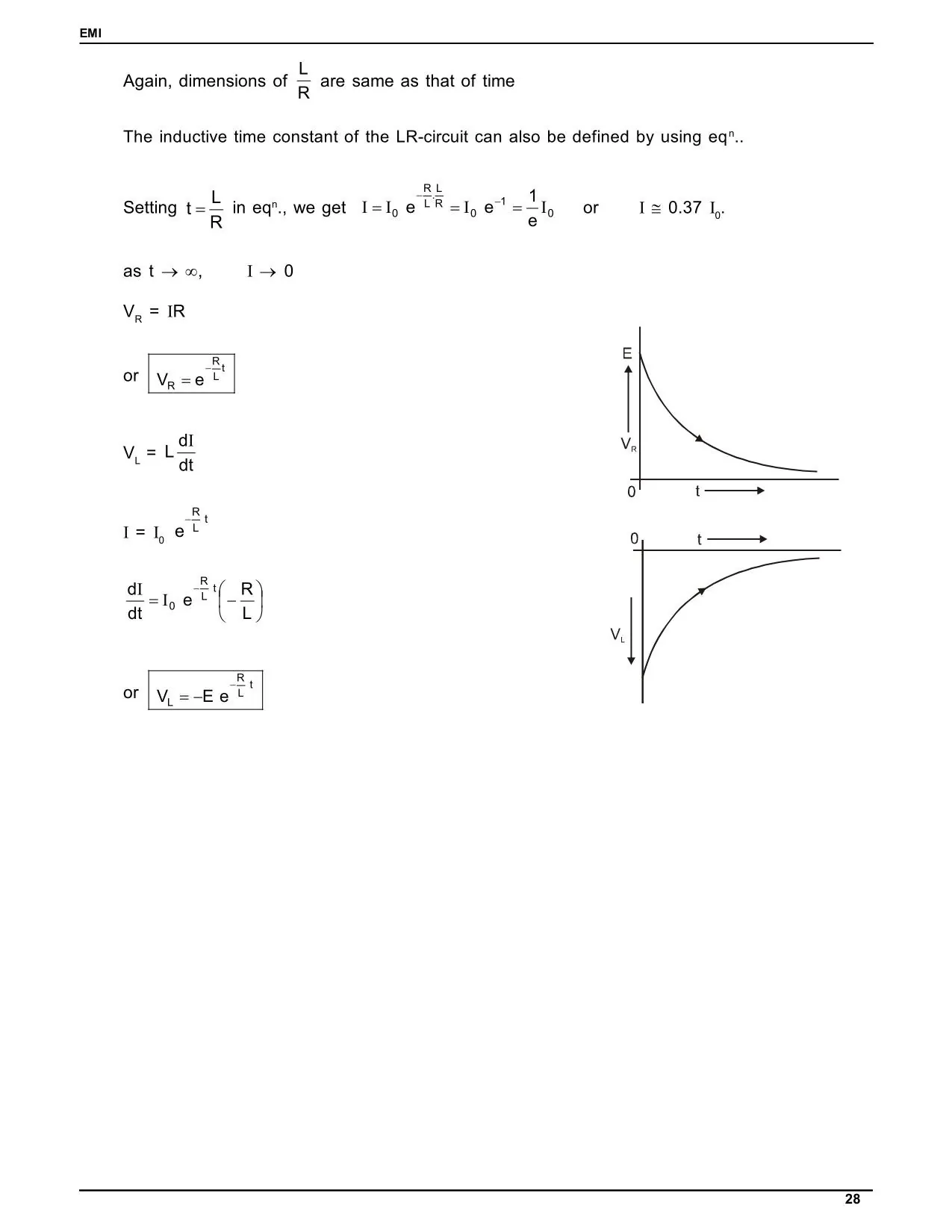
When the current in a coil changes, it changes the magnetic flux through the coil itself, inducing a back-EMF. This property is called self-induction.
$$\varepsilon = -L\frac{dI}{dt}$$
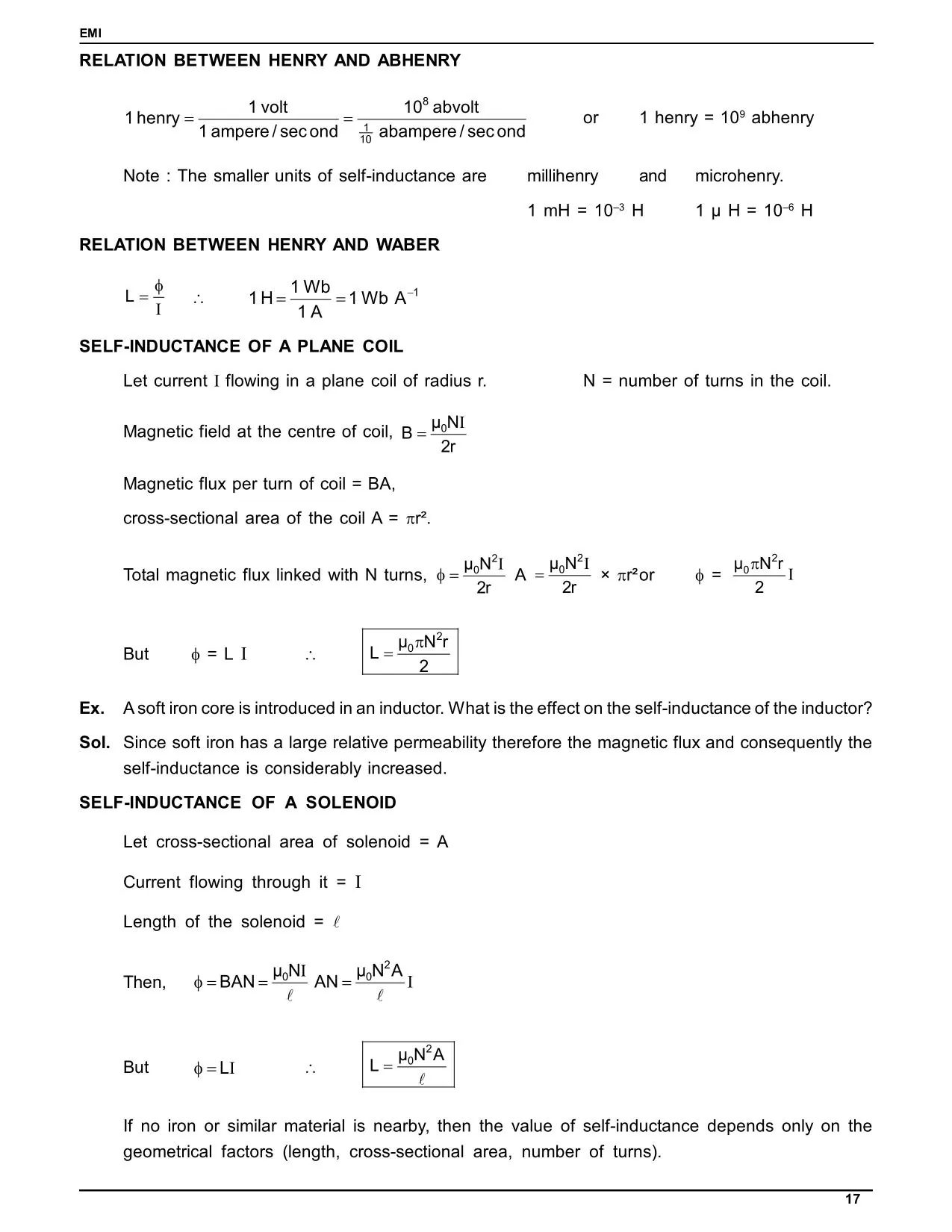
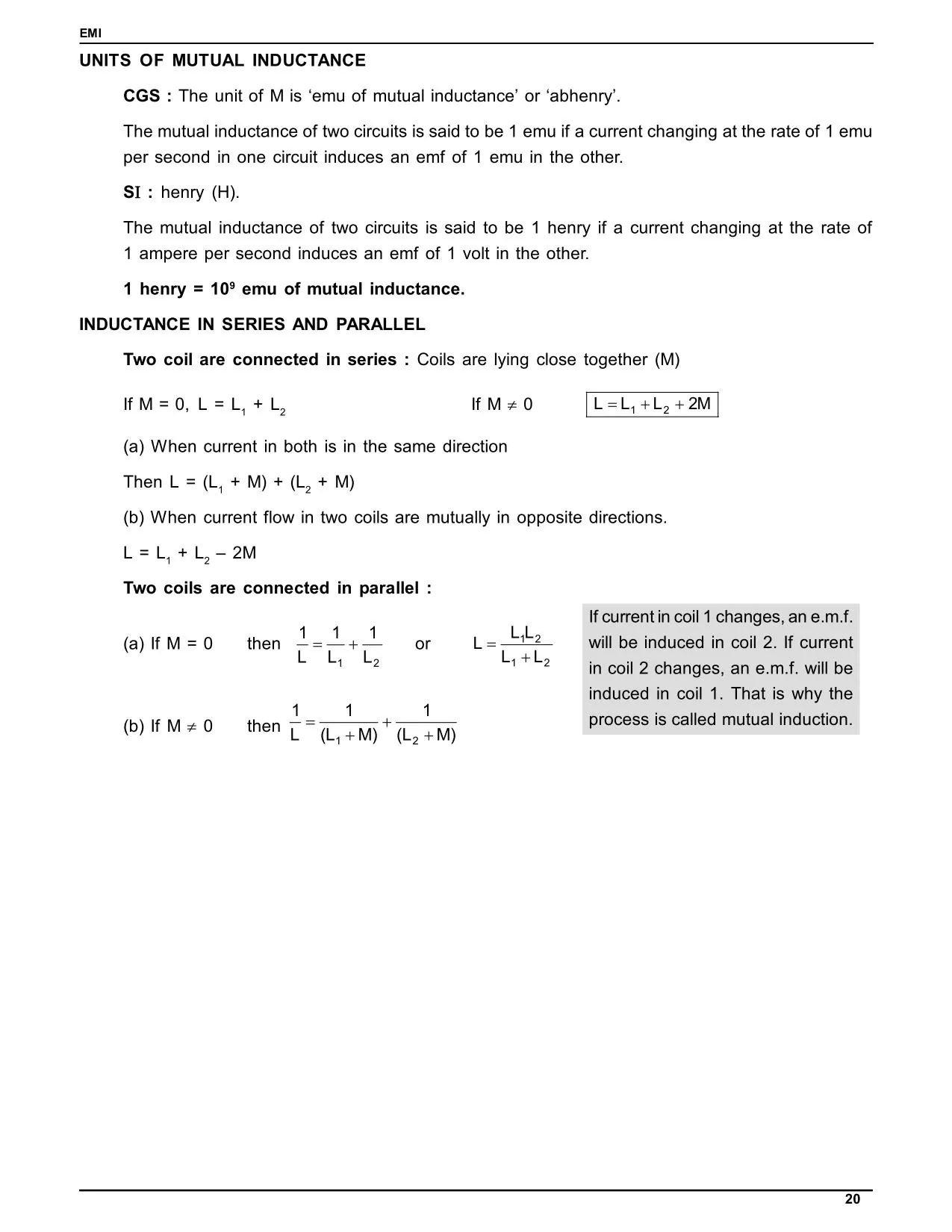
L is the self-inductance (measured in Henry, H). For a solenoid of n turns per unit length, cross-sectional area A, and length l:
$$L = \mu_0 n^2 Al = \frac{\mu_0 N^2 A}{l}$$
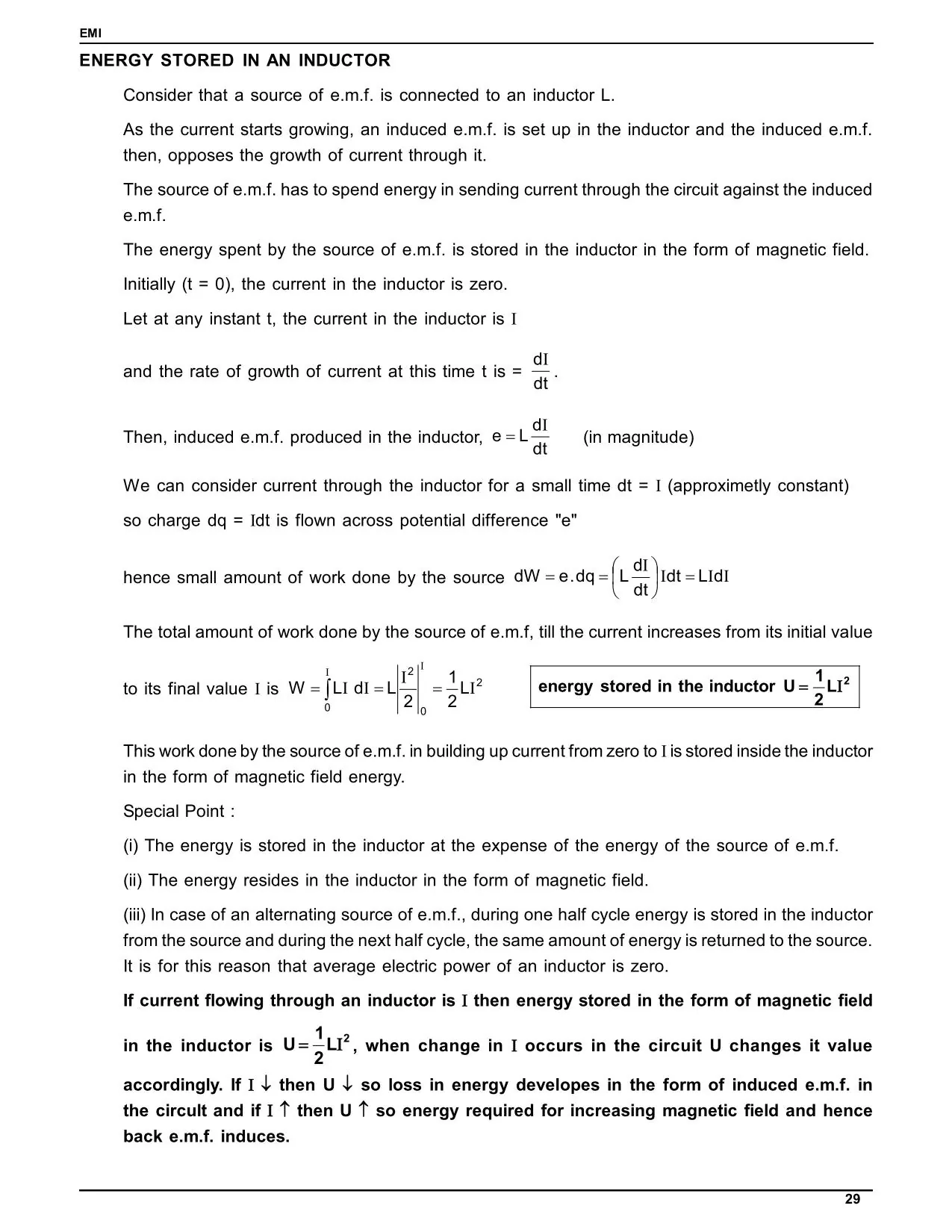
Energy stored in an inductor:
$$U = \frac{1}{2}LI^2$$
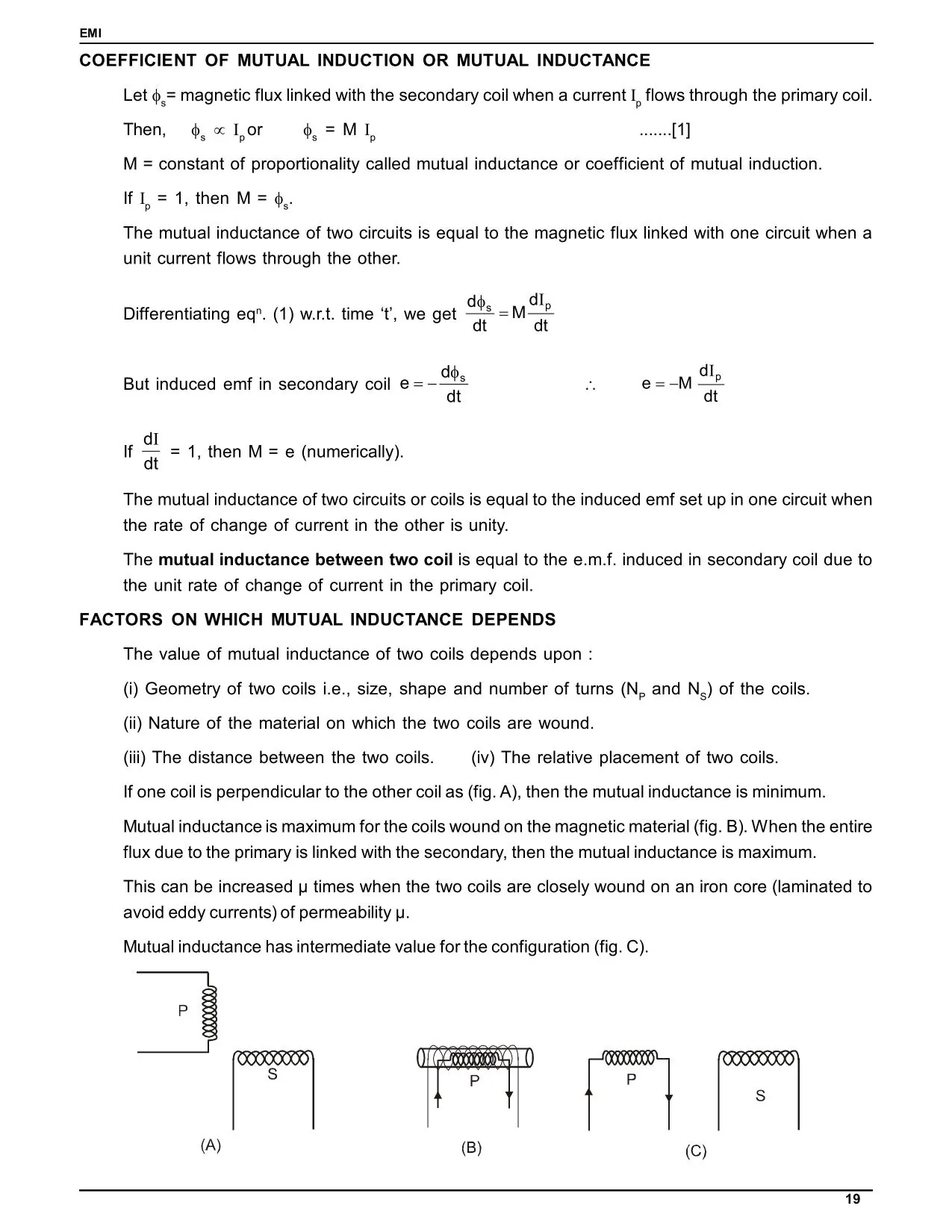
What Is Mutual Inductance?
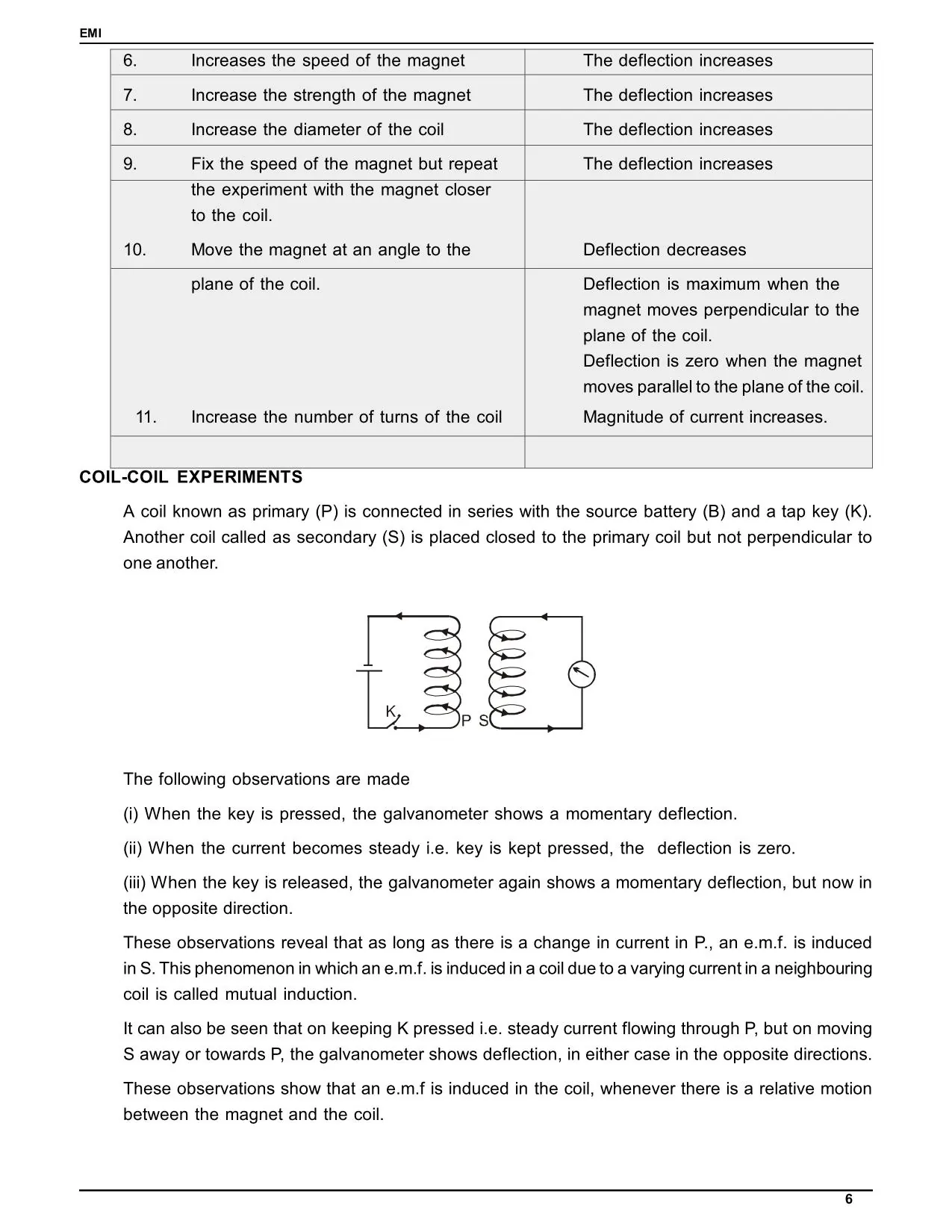
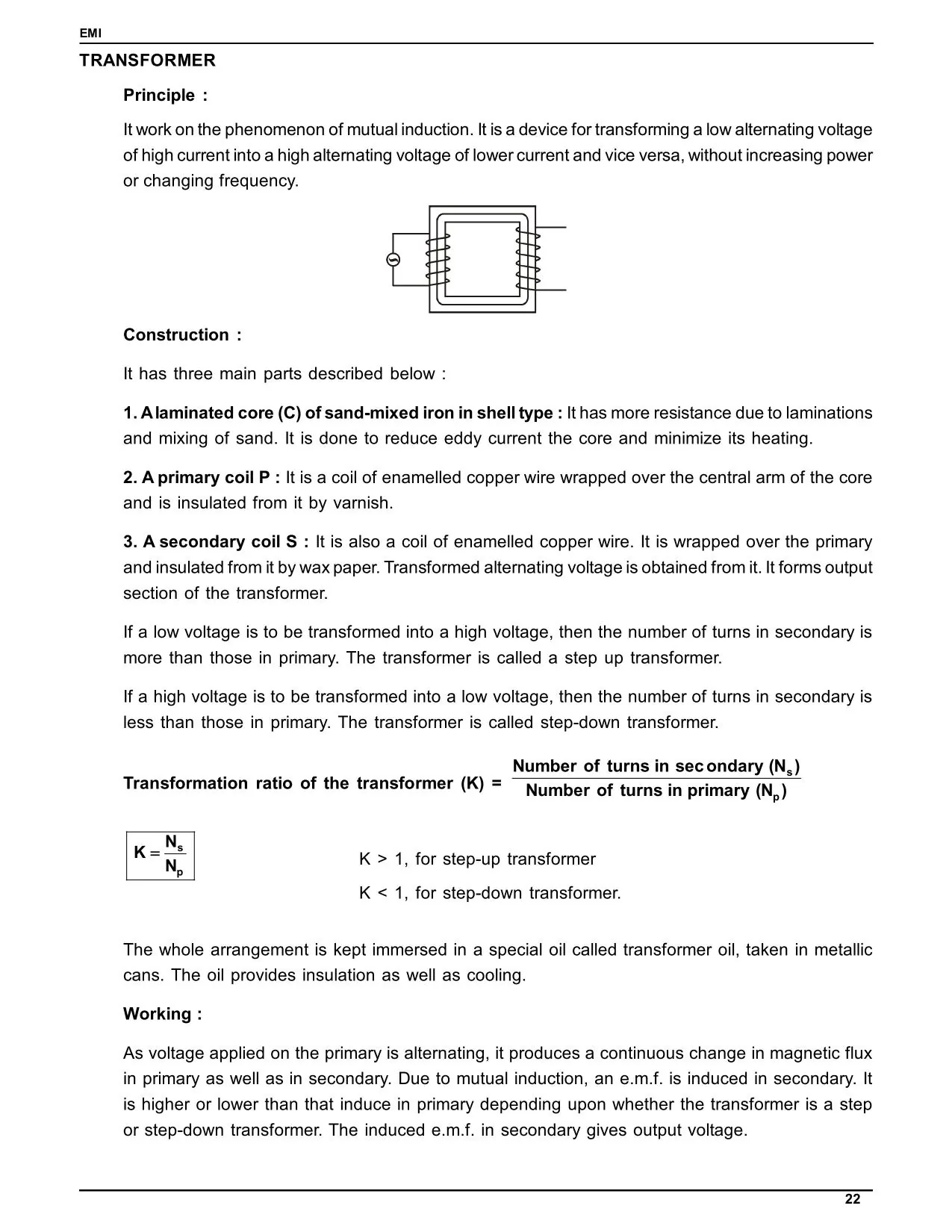
When two coils are placed near each other, a changing current in one (primary) coil induces an EMF in the other (secondary) coil. This is mutual induction.
$$\varepsilon_2 = -M\frac{dI_1}{dt}$$
M is the mutual inductance between the two coils. For two coaxial solenoids:
$$M = \mu_0 n_1 n_2 A l$$
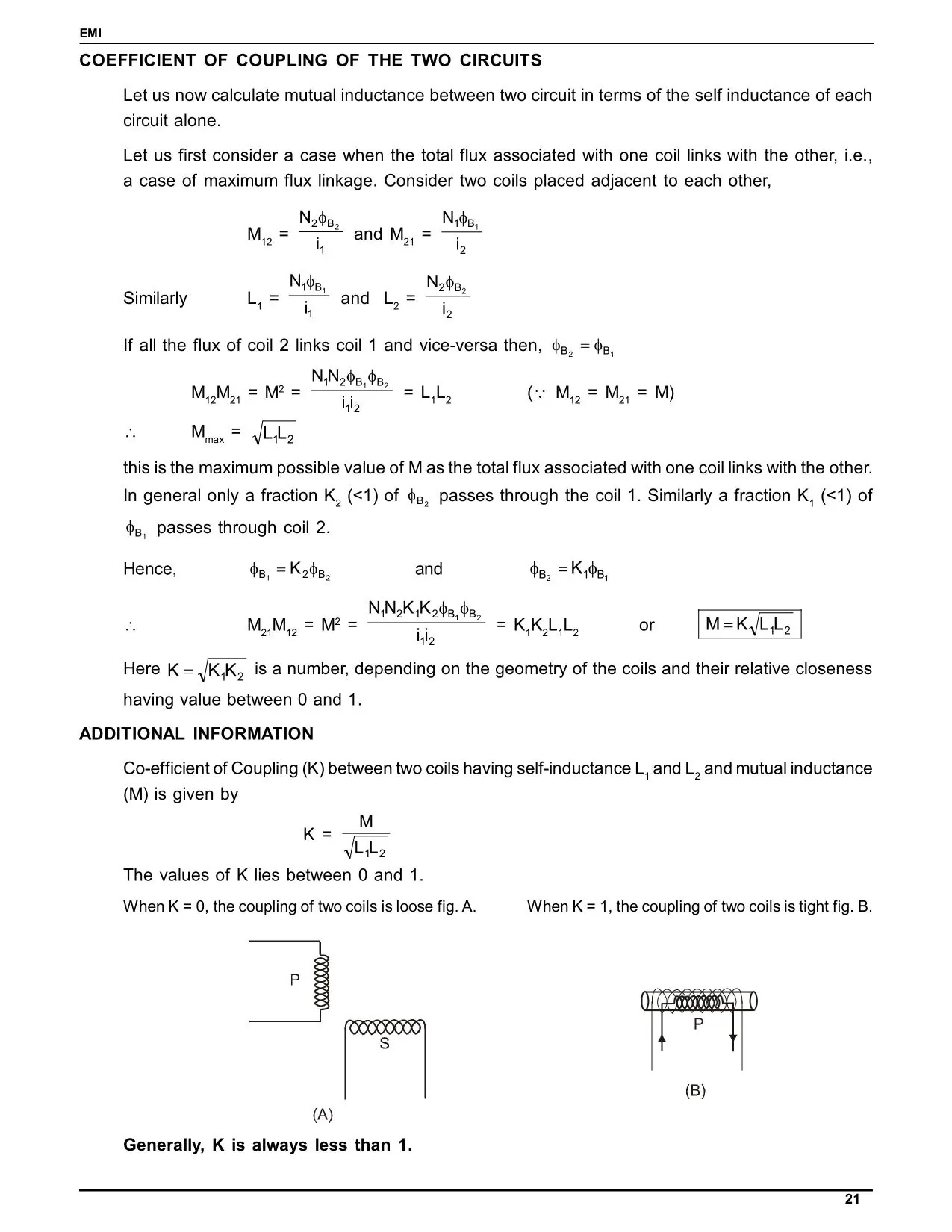
Relationship Between M and L
For two coupled coils with self-inductances L₁ and L₂ and coupling coefficient k:
$$M = k\sqrt{L_1 L_2}, \quad 0 \leq k \leq 1$$
| Property | Self-Inductance (L) | Mutual Inductance (M) |
|---|---|---|
| Cause | Change of own current | Change of current in the nearby coil |
| Formula (solenoid) | μ₀N²A/l | μ₀n₁n₂Al |
| Unit | Henry (H) | Henry (H) |
| Energy stored | ½LI² | — |
Eddy Currents — Causes and Applications
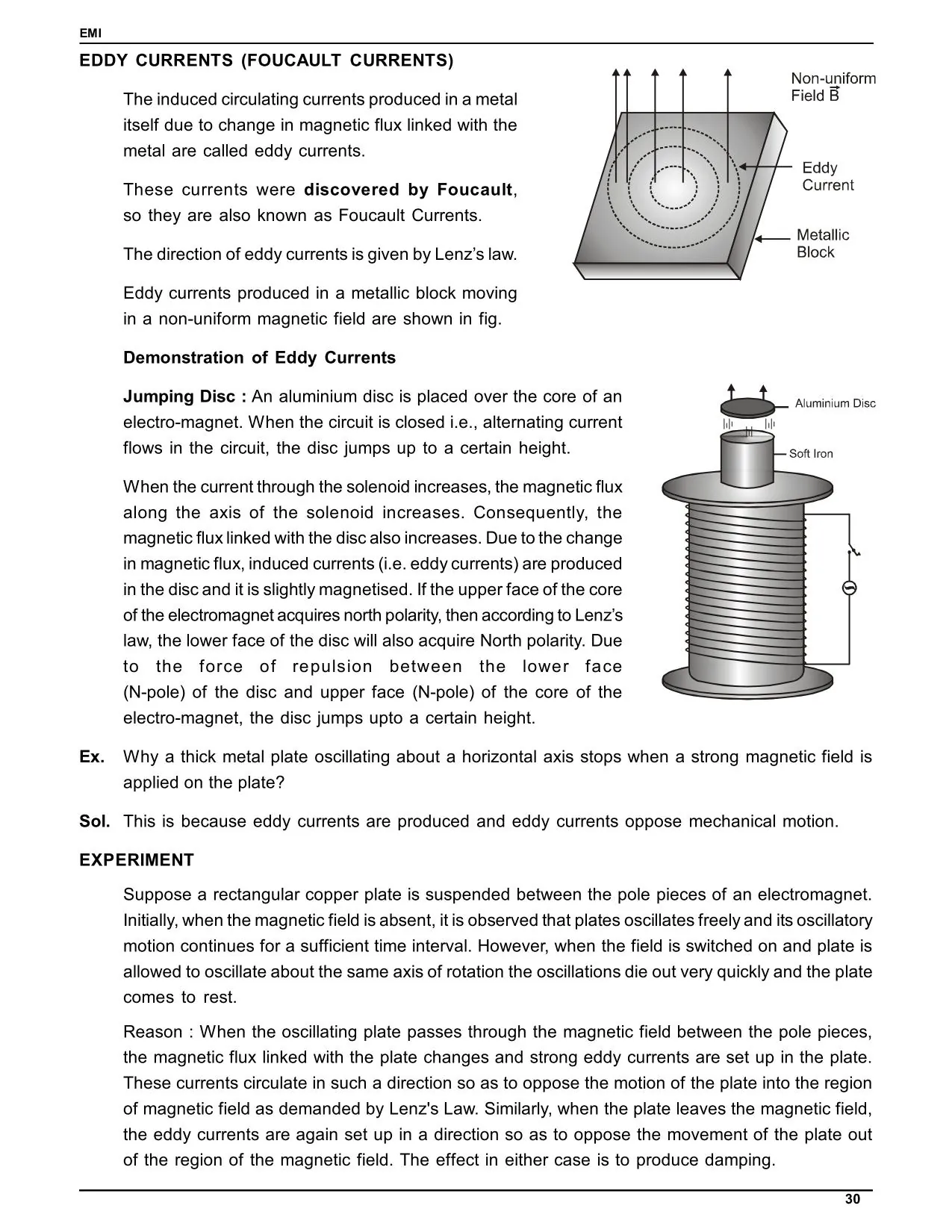
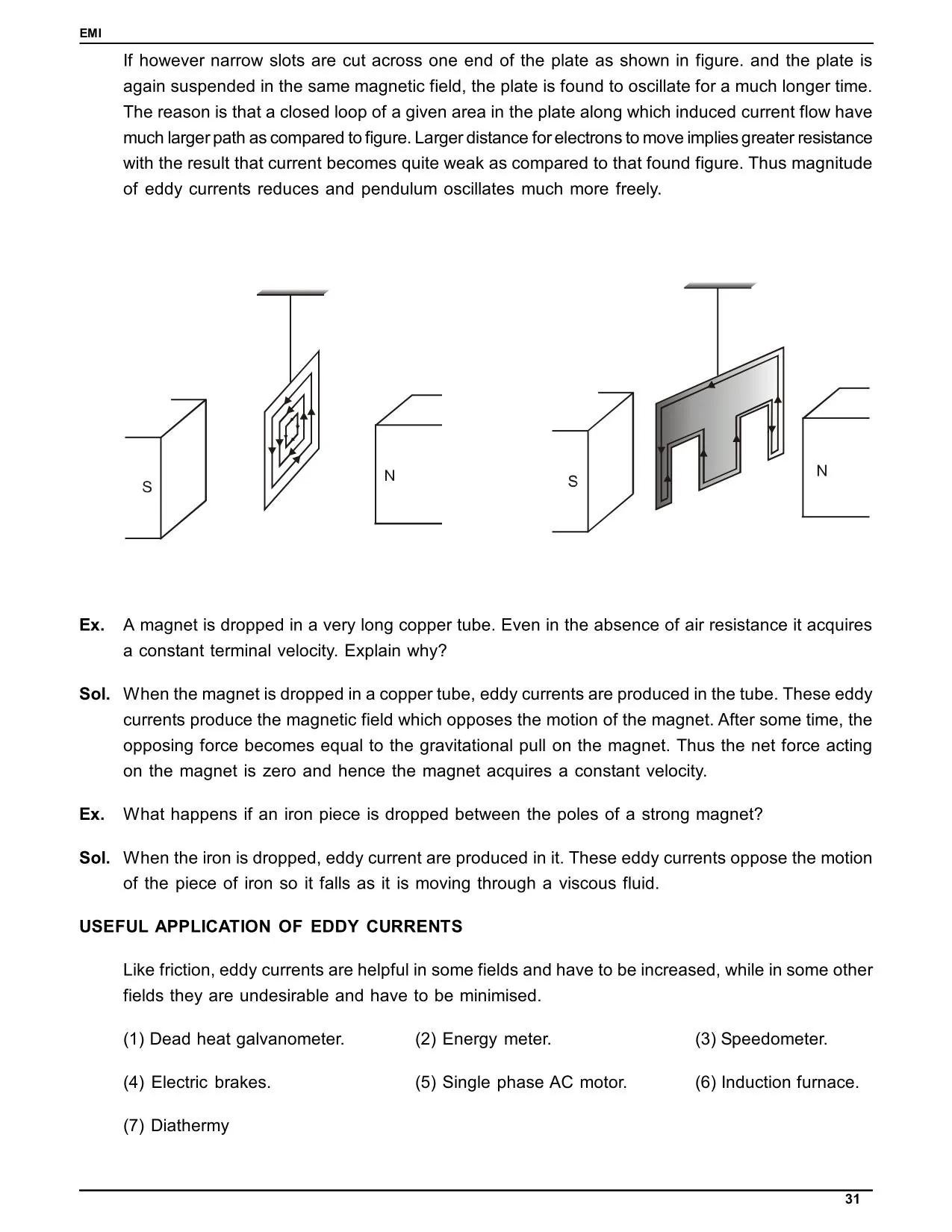
When a bulk conductor is placed in a changing magnetic field, currents are induced in the body of the conductor itself — not just along a defined path. These circulating currents are called eddy currents (or Foucault currents).
Causes of Eddy Currents
Eddy currents arise due to the same principle as Faraday's law — changing flux through the conductor body. Their magnitude depends on the rate of change of flux and the resistivity of the material.
Applications of Eddy Currents
- Magnetic braking in trains and roller coasters (contactless, smooth braking)
- Induction heating in industrial furnaces and induction cooktops
- Speedometers in vehicles (Weston eddy current type)
- Energy meters (electricity consumption measurement)
How Are Eddy Currents Minimised?
Eddy currents cause energy loss as heat. To minimise them, transformer cores and motor armatures are made of thin laminated sheets insulated from each other, reducing the effective area and hence the magnitude of eddy currents.
Topic-Wise Exam Weightage Table
| Sub-Topic | JEE Main (Expected Marks) | NEET (Questions) | Question Type |
|---|---|---|---|
| Faraday's Law & Lenz's Law | 4 marks | 1 MCQ | Conceptual + numerical |
| Motional EMF | 4 marks | 1 MCQ | Numerical |
| Self-Inductance | 4 marks | 0–1 MCQ | Formula-based |
| Mutual Inductance | 4 marks | 0–1 MCQ | Formula-based |
| Eddy Currents | 0–4 marks | 0–1 MCQ | Conceptual |
| Energy in Inductor | 0–4 marks | 1 MCQ | Numerical |
Based on NTA JEE Main question paper analysis and NEET official question papers. Always verify the latest syllabus at ntaexam.com.
For detailed solutions to past year problems on this chapter, explore the NCERT Solutions for Class 12 Physics prepared by eSaral faculty. You can also cross-reference with the NCERT Books Class 12 to align your notes with board exam requirements.
If you are simultaneously preparing for Class 11 concepts that feed into this chapter (like the Lorentz force and magnetic field due to current), the NCERT Solutions for Class 11 Physics will help you bridge those gaps quickly.
India's Best Exam Preparation for Class 12th - Download Now
India's Best Exam Preparation for Class 12th - Download Now
India's Best Exam Preparation for Class 12th - Download Now
India's Best Exam Preparation for Class 12th - Download Now
India's Best Exam Preparation for Class 12th - Download Now
https://play.google.com/store/apps/details?id=com.spayee.esaral.reader&referrer=utm_source%3Dwebsite_Blog_pageutm_medium%3Dwebsite_Blog_page
India's Best Exam Preparation for Class 12th - Download Now
eSaral have already come up with an amazing Revision Series of Physics where you can easily revise your chapter within minutes with all the important formulae and key points. This revision series is free for all. Click Here for Complete Physics Revision Series by Saransh Gupta Sir (AIR-41)
About Saransh Gupta Sir Computer Science Graduate from IIT Bombay. Cracked IIT-JEE with AIR-41 and AIEEE (JM) with AIR-71 in 2006. He is an author of JEE Mentorship Book “StrateJEE”. He taught Physics for 5 years at Allen and was loved immensely by all the students. Many of his students bagged success with flying colours in JEE & NEET Exams.
eSaral brings you detailed Class 11th Physics study material. eSaral provides a series of detailed chapter wise notes for all the Subjects of class 11th and 12th. These notes will also help you in your IIT JEE & NEET preparations. We hope these Physics Notes for Class 12 will help you understand the important topics and remember the key points for the exam point of view. Get Complete Physics Notes for Physics Class 12 for easy learning and understanding. For free video lectures and complete study material, Download eSaral APP.
At eSaral we are offering a complete platform for IIT-JEE & NEET preparation. The main mission behind eSaral is to provide education to each and every student in India by eliminating the Geographic and Economic factors, as a nation’s progress and development depends on the availability of quality education to each and every one. With the blend of education & technology, eSaral team made the learning personalized & adaptive for everyone.
Frequently Asked Questions
Find answers to common questions.
How do you apply Lenz's law to find the direction of induced current?
First, identify whether the magnetic flux through the loop is increasing or decreasing. If flux is increasing, the induced current creates a magnetic field to oppose the increase (opposing field). If flux is decreasing, the induced current creates a field to support the original flux. Use the right-hand thumb rule to find the actual current direction from that field direction.
What is the difference between Faraday's first and second law of electromagnetic induction?
Faraday's First Law says an EMF is induced whenever flux changes (qualitative). The Second Law gives the quantity — the induced EMF equals the rate of change of magnetic flux (ε = −dΦ/dt). For N turns, ε = −N(dΦ/dt). The second law is what you use in all numerical problems in JEE and NEET.
What is electromagnetic induction in simple terms?
Electromagnetic induction is the production of an electric current in a conductor whenever the magnetic flux through it changes. The faster the flux changes, the larger the induced EMF. Faraday discovered this in 1831, and it is the operating principle behind every generator and transformer used in power systems today.
How much weightage does Electromagnetic Induction carry in JEE Main?
Electromagnetic Induction and Alternating Currents together typically carry 6–8 marks (2 questions) per JEE Main session, based on NTA paper patterns from 2019 to 2024. Motional EMF and Faraday's law are the most frequently tested numerically, while Lenz's law and eddy currents appear as conceptual MCQs.
Are eddy currents always harmful?
No. While eddy currents cause unwanted energy loss as heat in transformer cores and motor armatures (which is why laminated cores are used), they have many useful applications — induction heating, magnetic braking in trains, induction cooktops, and electromagnetic damping in measuring instruments. In JEE MCQs, both aspects are tested.
What is the unit of self-inductance and how is it defined?
The unit of self-inductance is the Henry (H). One Henry is defined as the self-inductance of a coil in which an EMF of 1 Volt is induced when the current through it changes at the rate of 1 Ampere per second. Dimensionally, H = kg·m²·s⁻²·A⁻².