Complete Physics Notes for Class 12, IIT JEE and NEET Preparation
Class 12 Physics is one of the highest-weightage subjects for JEE Main, JEE Advanced, NEET, and Boards, where mastering high-priority chapters like Electrostatics, Current Electricity, Magnetism, Ray Optics, Alternating Current, and Modern Physics through structured notes, formulas, and regular revision can secure a major share of Physics marks across all exams.
Table of Contents

eSaral › Class 12› Complete Physics Notes for Class 12, IIT JEE and NEET Preparation

🚀 Checkout eSaral Courses
Why Class 12 Physics Notes Matter for JEE, NEET and Boards
Class 12 Physics is one of the most demanding and highest-weightage subjects across three major exams simultaneously — JEE Main, JEE Advanced, and NEET UG. On top of that, it contributes 70 marks in the CBSE Board exam. Getting the study material right is not optional.
The challenge most students face is not effort — it is scattered, unstructured resources. Reading 500 pages of NCERT, three reference books, and random YouTube videos for the same chapter wastes time and creates confusion. What you need is a single, reliable set of notes per chapter that covers:
- Complete theory with conceptual clarity
- All key formulas and derivations in one place
- Solved examples at the right difficulty level
- Exam-focused organisation (not just academic completeness)
eSaral's Class 12 Physics notes are built by IIT-faculty with exactly this in mind — covering all 17 NCERT chapters, designed for JEE Main, JEE Advanced, NEET, and Board preparation together.
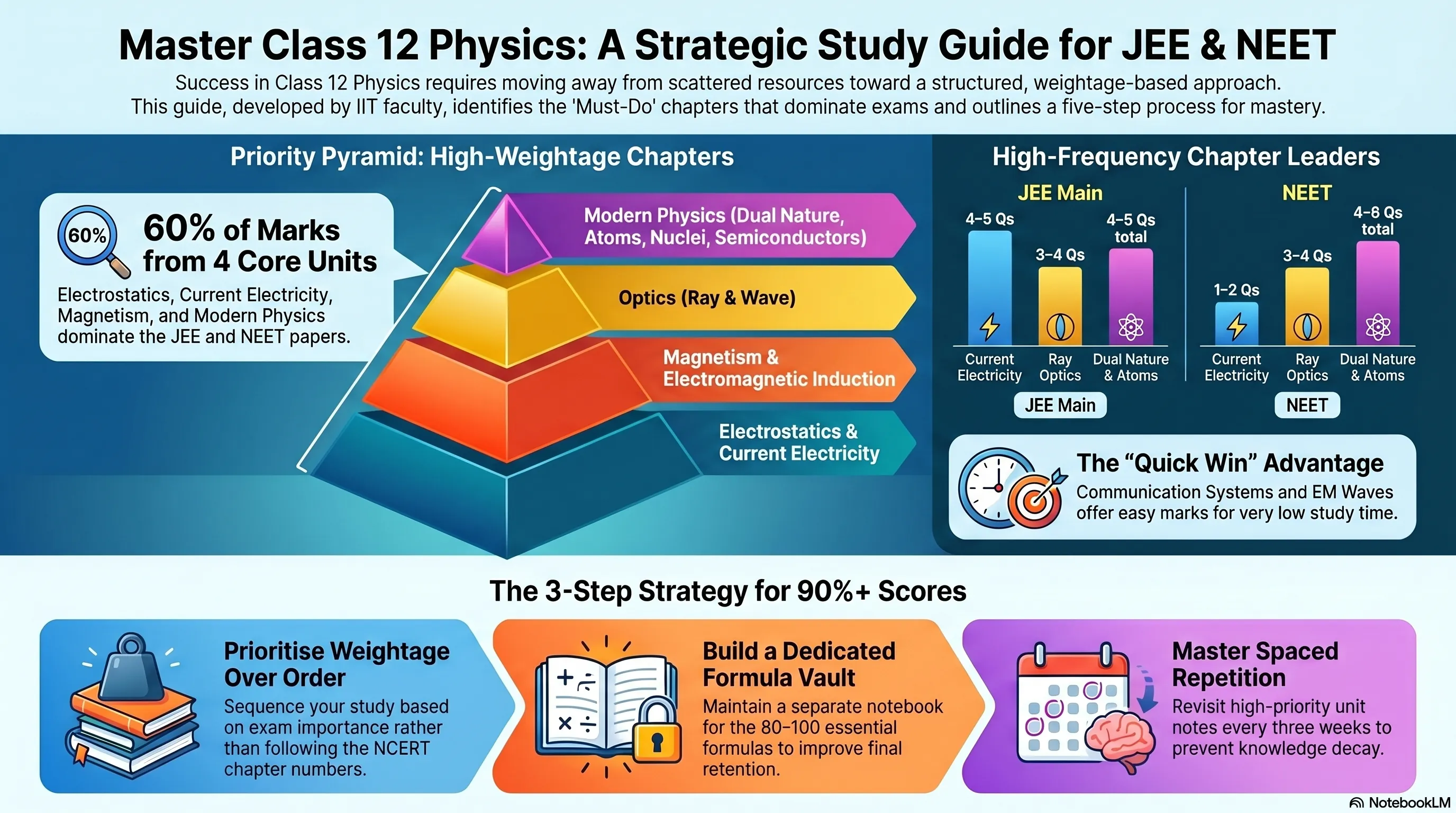
💡 Expert Tip by eSaral Physics Faculty, IIT Bombay: "The biggest mistake students make with Class 12 Physics is treating every chapter as equally important. Electrostatics, Current Electricity, Magnetism, and Modern Physics together contribute over 60% of Physics marks in JEE Main. Know your high-value chapters and go deeper there first."
Complete Chapter-Wise Class 12 Physics Notes — All Links
All 17 chapters of Class 12 Physics (NCERT) are covered below. Click any chapter to access the complete detailed notes.
Unit 1: Electrostatics
Chapter 1 — Electric Charges and Fields Coulomb's law, electric field, field lines, Gauss's law and its applications, continuous charge distributions. One of the highest-weightage chapters in both JEE and NEET.
Chapter 2 — Electrostatic Potential and Capacitance: Electric potential, equipotential surfaces, potential energy, capacitors, dielectrics, energy stored in a capacitor, combinations of capacitors. Deeply linked with Chapter 1 — study both together.
Unit 2: Current Electricity and Thermal Effects
Chapter 3 — Current Electricity: Ohm's law, drift velocity, resistivity, Kirchhoff's laws, Wheatstone bridge, potentiometer, meter bridge. Consistently one of the top-3 chapters in JEE Main by question frequency.
Chapter 3 (Extended) — Chemical Effects of Electric Current: Electrolysis, Faraday's laws of electrolysis, electrochemical cells. Important for both Physics and Chemistry overlap questions.
Chapter 4 — Thermoelectric Effects of Electric Current: Seebeck effect, Peltier effect, Thomson effect, thermocouple. Moderate weightage; useful for NEET and JEE Main.
Chapter 5 — Heating Effects of Electric Current Joule's law of heating, electric power, power dissipation in circuits. Short but high-return chapter — frequently tested in numerical form.
Unit 3: Magnetic Effects and Magnetism
Chapter 6 — Moving Charges and Magnetism: Biot-Savart law, Ampere's circuital law, magnetic field due to solenoid and toroid, force on current-carrying conductor, cyclotron, galvanometer. Very high JEE and NEET weightage.
Chapter 7 — Magnetism and Matter Bar magnet, magnetic field lines, Earth's magnetism, dia/para/ferromagnetism, hysteresis. Moderate weightage; NEET tests concept-based questions from this chapter regularly.
Unit 4: Electromagnetic Induction and Alternating Currents
Chapter 8 — Electromagnetic Induction: Faraday's laws, Lenz's law, motional EMF, eddy currents, inductance (self and mutual), transformers. Core chapter for JEE Advanced — expects deep numerical application.
Chapter 9 — Alternating Current AC generator, RMS values, phasors, LCR circuits, resonance, power factor, LC oscillations, transformers. Very high JEE Main weightage; tested numerically almost every year.
Unit 5: Electromagnetic Waves
Chapter 10 — Electromagnetic Waves: Displacement current, Maxwell's equations (conceptual), EM spectrum, properties of EM waves. Short chapter — mostly conceptual and fact-based. High return for low study time.
Unit 6: Optics
Chapter 11 — Ray Optics and Optical Instruments: Reflection, refraction, total internal reflection, lens and mirror formulas, optical instruments (microscope, telescope). One of the highest-weightage chapters in NEET. Critical for JEE as well.
Chapter 12 — Wave Optics Huygens' principle, interference (Young's double slit experiment), diffraction, polarisation. Moderate-to-high weightage in JEE; appears regularly in NEET in conceptual form.
Unit 7: Dual Nature of Matter and Radiation
Chapter 13 — Dual Nature of Radiation and Matter: Photoelectric effect, Einstein's equation, de Broglie wavelength, matter waves, Davisson-Germer experiment. Very high JEE and NEET weightage — photoelectric effect alone appears in almost every paper.
Unit 8: Atoms and Nuclei
Chapter 14 — Atoms: Rutherford model, Bohr model, hydrogen spectrum, energy levels, spectral series. Essential for both JEE and NEET — Bohr's model numericals appear almost every year.
Chapter 15 — Nuclei Nuclear binding energy, mass defect, radioactivity, decay laws, nuclear fission and fusion. High NEET weightage; JEE tests numericals on radioactive decay and binding energy.
Unit 9: Electronic Devices
Chapter 16 — Semiconductor Electronics: Materials, Devices and Simple Circuits Intrinsic and extrinsic semiconductors, p-n junction, diode characteristics, rectifiers, Zener diode, transistors, logic gates. Very high NEET weightage; appears consistently in JEE Main.
Chapter 17 — Communication Systems Modulation (AM, FM), bandwidth, propagation of EM waves. Mostly conceptual; low calculation burden. Good for quick marks in Board exams.
💡 Expert Tip by eSaral Physics Faculty, IIT Bombay: "Do not make the mistake of treating Chapter 17 (Communication Systems) as unimportant just because it is last. It is one of the easiest chapters in the entire syllabus and consistently appears in Board exams and sometimes JEE Main. 30 minutes of focused reading can secure full marks from this chapter."
Chapter-Wise Weightage: JEE Main and NEET
Use this table to prioritise which chapters to cover first and go deepest into.
| Chapter | JEE Main Weightage | NEET Weightage | Priority |
|---|---|---|---|
| Electric Charges and Fields | High (3–4 Q) | High (2–3 Q) | 🔴 Must-Do |
| Electrostatic Potential and Capacitance | High (3–4 Q) | Medium (1–2 Q) | 🔴 Must-Do |
| Current Electricity | Very High (4–5 Q) | Medium (1–2 Q) | 🔴 Must-Do |
| Moving Charges and Magnetism | High (3–4 Q) | High (2–3 Q) | 🔴 Must-Do |
| Electromagnetic Induction | High (2–3 Q) | Medium (1–2 Q) | 🔴 Must-Do |
| Alternating Current | High (3–4 Q) | Medium (1–2 Q) | 🔴 Must-Do |
| Ray Optics | High (3–4 Q) | Very High (3–4 Q) | 🔴 Must-Do |
| Dual Nature / Photoelectric Effect | High (2–3 Q) | High (2–3 Q) | 🔴 Must-Do |
| Atoms (Bohr Model) | Medium (2 Q) | High (2–3 Q) | 🟡 High |
| Nuclei | Medium (1–2 Q) | High (2–3 Q) | 🟡 High |
| Semiconductor Electronics | Medium (2 Q) | Very High (3–4 Q) | 🟡 High |
| Wave Optics | Medium (2 Q) | Medium (1–2 Q) | 🟡 High |
| Electromagnetic Waves | Low (1 Q) | Low (1 Q) | 🟢 Quick Win |
| Magnetism and Matter | Low (1 Q) | Medium (1–2 Q) | 🟢 Quick Win |
| Communication Systems | Low (1 Q) | Low (0–1 Q) | 🟢 Quick Win |
| Heating / Thermoelectric Effects | Low (1 Q) | Low (1 Q) | 🟢 Quick Win |
How to Use These Notes Effectively
Downloading notes and reading them once is not preparation. The difference between students who score 90%+ in Physics and those who score 60% comes down to how they use their study material.
Step 1 — Follow the Weightage Order, Not the NCERT Order
NCERT starts with Electrostatics — which is good, because it is also high-weightage. But do not mechanically follow Chapter 1 → 17 if your exam is approaching. Use the priority table above to sequence your chapters.
Step 2 — Read for Understanding, Not Completion
Rushing through notes to "finish the chapter" creates an illusion of progress. For every chapter, your benchmark should be: "Can I explain this concept to someone else without looking at the notes?" If the answer is no, re-read the relevant section.
Step 3 — Write Down Every Formula Separately
As you go through each chapter's notes, maintain a dedicated formula notebook. This becomes your revision sheet in the final weeks. Class 12 Physics has approximately 80–100 formulas that appear in JEE and NEET — writing them out once significantly improves retention.
Step 4 — Solve Examples Before Moving to Problems
Every chapter's notes include solved examples. Do not skip these. Work through them yourself before reading the solution. This bridges the gap between understanding theory and applying it under exam pressure.
Step 5 — Return to High-Priority Notes Every 3 Weeks
Spaced repetition is the reason some students remember everything and others forget everything before the exam. Revisit Electrostatics, Current Electricity, Magnetism, and Modern Physics notes every 3 weeks. One read of your formula sheet per week is enough for lower-priority chapters.
High-Priority Chapters You Must Not Skip
If you are short on time or starting late, these six chapters should receive your first and deepest attention. They collectively account for 50–60% of Physics marks in JEE Main and NEET:
1. Electrostatics (Chapters 1 + 2) Foundation for all of electricity and magnetism. The concepts here reappear in every subsequent chapter. Master Gauss's law, potential, and capacitors without shortcuts.
2. Current Electricity (Chapter 3) The single highest-frequency chapter in JEE Main Physics. Kirchhoff's laws, Wheatstone bridge, and potentiometer numericals appear almost every year.
3. Moving Charges and Magnetism (Chapter 6) Biot-Savart, Ampere's law, force on conductors, and cyclotron. High numerical difficulty — but the question types are predictable. Practise standard problems from these notes thoroughly.
4. Alternating Current (Chapter 9) LCR circuit resonance and power factor questions are JEE Main favourites. This chapter rewards students who understand phasor diagrams deeply.
5. Ray Optics (Chapter 11) The most heavily tested chapter in NEET Physics. Lens formula, mirror formula, TIR, and optical instruments — all appear regularly. eSaral's Ray Optics notes cover every derivation tested in the last 10 years.
6. Dual Nature and Modern Physics (Chapters 13–15) Photoelectric effect, Bohr's model, and radioactive decay together contribute 3–5 questions in every NEET paper. These are largely concept and formula-based — high return for the time invested.
🚀 Checkout eSaral Courses
Frequently Asked Questions
Find answers to common questions.
Where can I get chapter-wise Class 12 Physics notes for JEE and NEET for free?
eSaral provides free chapter-wise Class 12 Physics notes for all 17 NCERT chapters — covering JEE Main, JEE Advanced, NEET, and CBSE Board preparation. All chapter links are listed in this article. No sign-up is needed to access the notes pages.
Which are the most important chapters in Class 12 Physics for JEE Main?
The highest-weightage chapters for JEE Main Physics are Current Electricity, Electrostatics (Chapters 1 and 2), Alternating Current, Moving Charges and Magnetism, Ray Optics, and Dual Nature of Radiation. These chapters together account for 50–65% of Physics questions in JEE Main across years.
Which Class 12 Physics chapters are most important for NEET?
For NEET Physics, the highest-weightage chapters are Ray Optics, Semiconductor Electronics, Dual Nature of Radiation, Electric Charges and Fields, Moving Charges and Magnetism, and Nuclei. These chapters contribute the most questions in NEET UG Biology's Physics section.
Are eSaral Class 12 Physics notes enough for Board exams?
Yes. eSaral's Class 12 Physics notes are designed to cover CBSE Board, JEE Main, and NEET simultaneously. All derivations asked in CBSE Board exams are included. Students who use these notes for JEE/NEET preparation find that Board exam preparation requires minimal additional effort.
How many chapters are there in Class 12 Physics NCERT?
There are 17 chapters in Class 12 Physics NCERT — from Chapter 1 (Electric Charges and Fields) to Chapter 17 (Communication Systems). eSaral provides detailed notes for all 17 chapters, with each set of notes covering theory, formulas, derivations, and solved examples.