Electromagnetic Wave - NEET Previous Year Questions with Complete Solutions


eSaral › NEET Physics › Electromagnetic Waves NEET Previous Year Questions with Complete Solutions

Here you will get Complete Electromagnetic Wave NEET Previous Year Questions with complete and detailed solutions.
Get complete NEET previous year questions for Physics, Chemistry, and Biology.
You will find all the solutions at the end of this page:
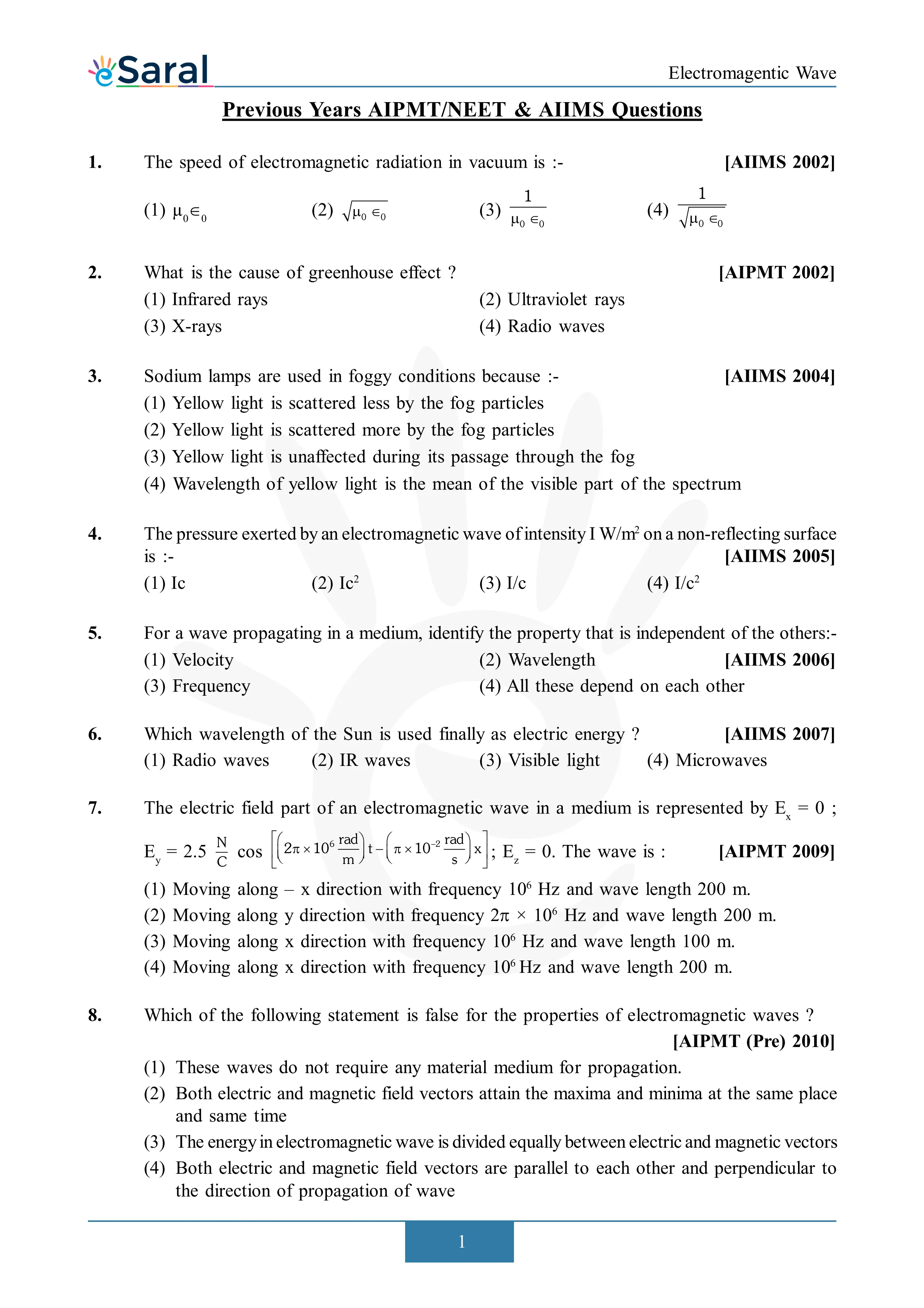
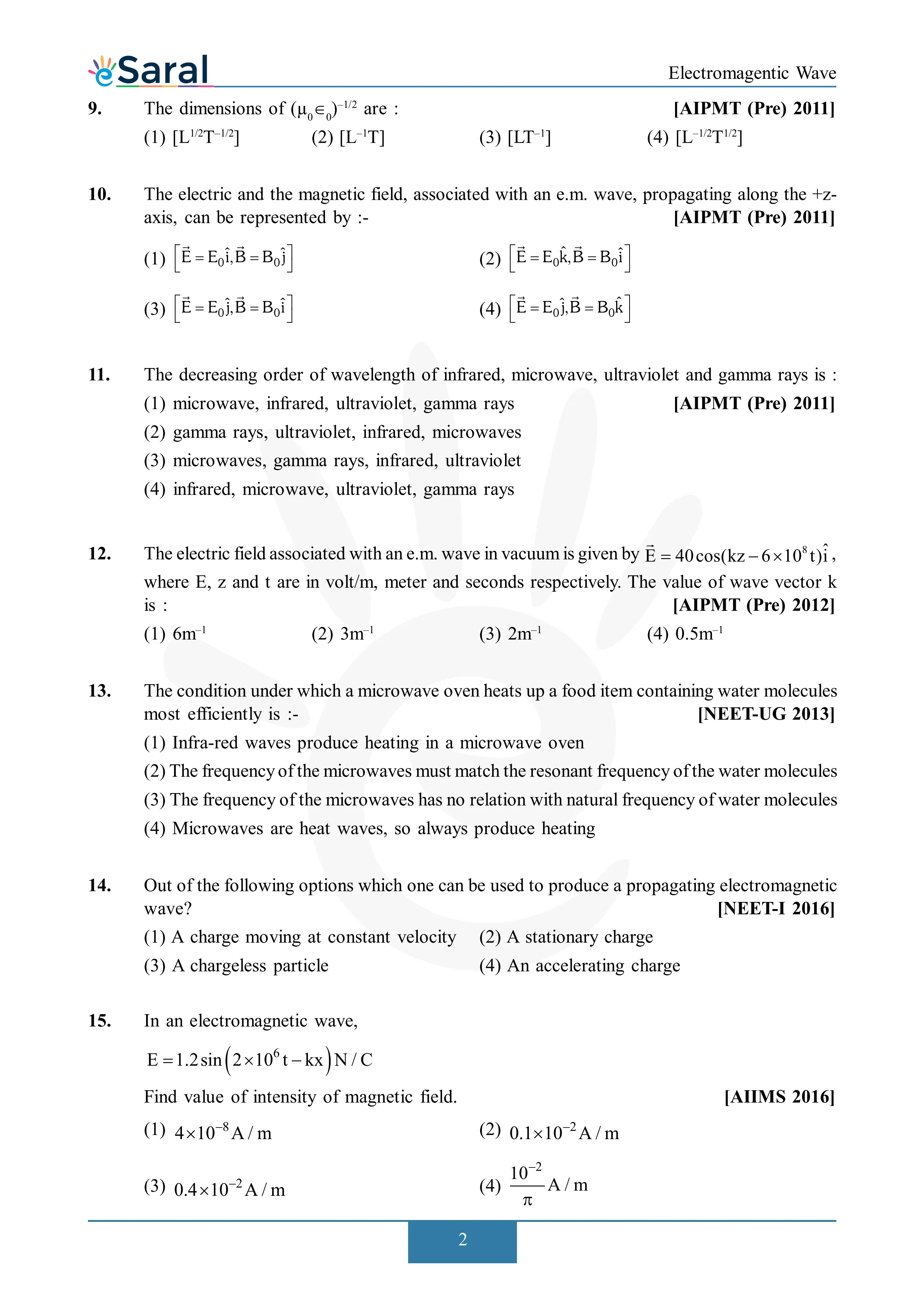
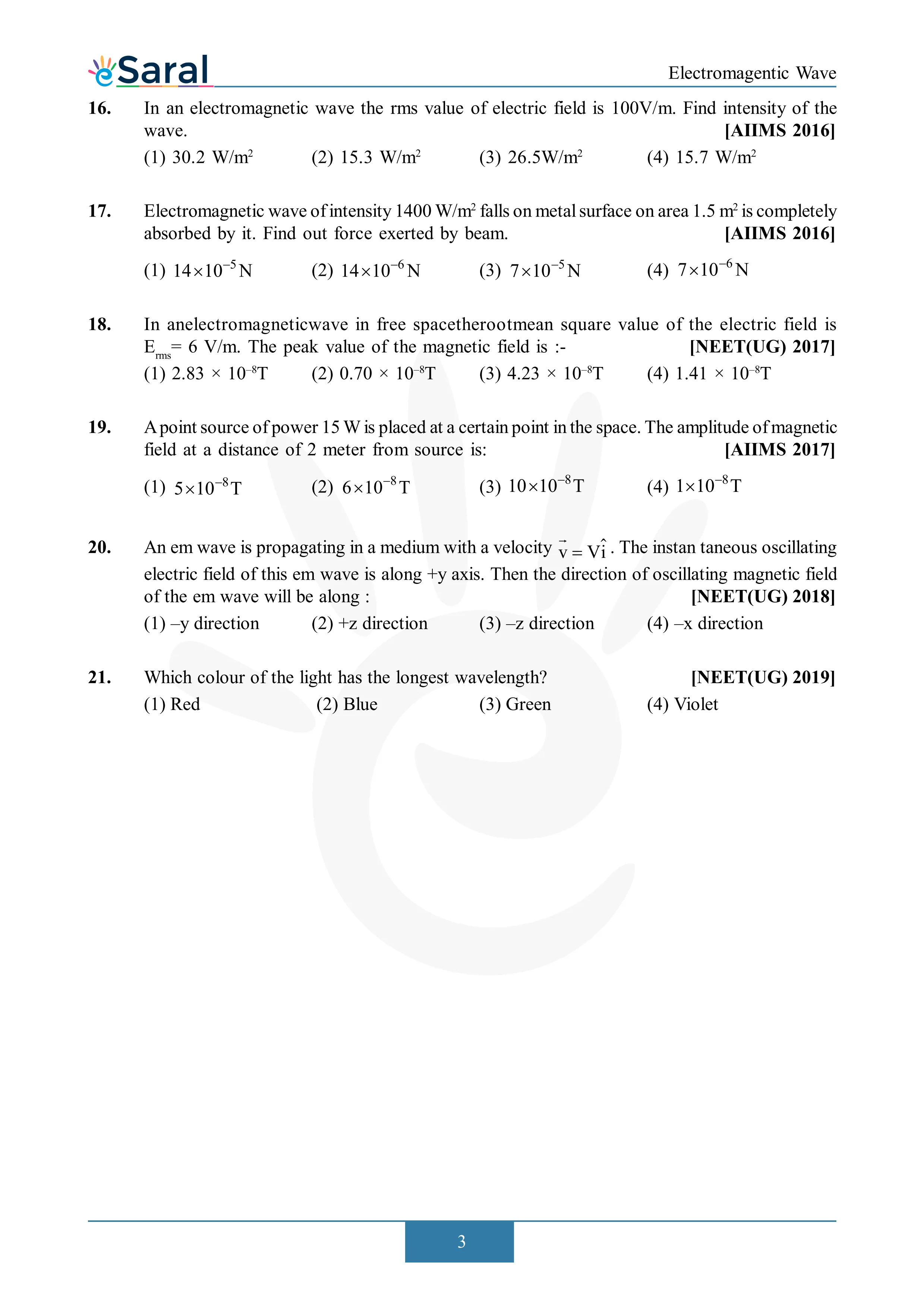

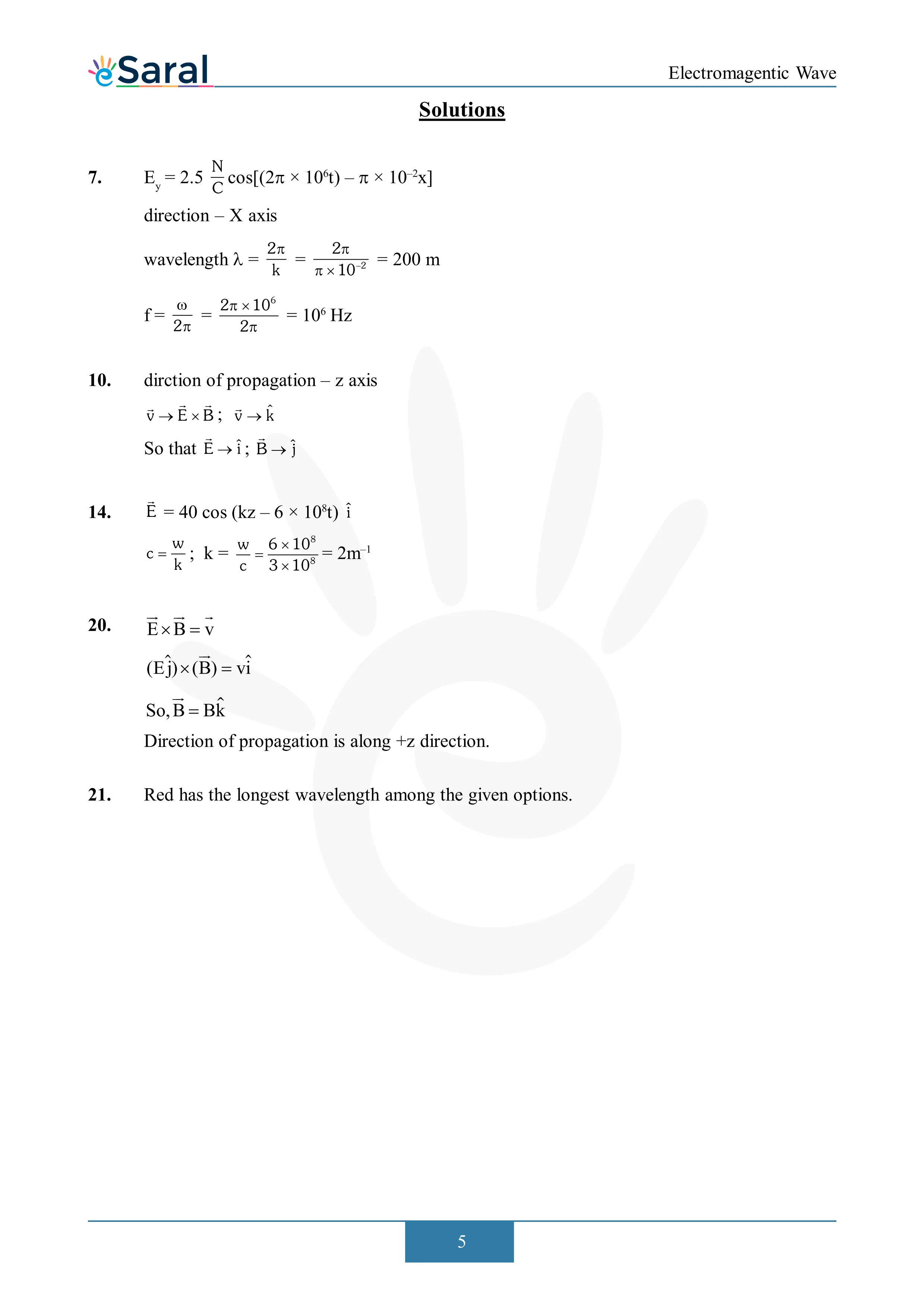
Frequently Asked Questions
Find answers to common questions.
Which EM wave has the highest frequency?
Gamma rays have the highest frequency (greater than 10¹⁸ Hz) and the shortest wavelength (less than 0.01 nm) in the electromagnetic spectrum. They are produced by radioactive nuclei and nuclear reactions. In NEET, gamma rays are associated with cancer treatment (radiotherapy) and the sterilisation of surgical instruments.
What is displacement current and why is it important for NEET?
Displacement current (I_d = ε₀ dΦ_E/dt) was introduced by Maxwell to resolve the inconsistency in Ampere's Circuital Law when applied to a charging capacitor. NEET asks about it almost every two years — either as a direct formula question or as a conceptual question about why Maxwell modified Ampere's law. Understanding the capacitor-charging scenario is enough to answer any NEET question on this topic
How many questions come from Electromagnetic Waves in NEET?
NTA typically asks 1 to 2 questions from Electromagnetic Waves in NEET-UG every year. Based on PYQ analysis from 2010–2024, the average is approximately 1.4 questions per year, contributing 4–8 marks. The chapter is short and high-scoring, making it one of the best chapters for last-minute revision before the exam.
What is the relationship between E and B in an electromagnetic wave?
In an electromagnetic wave, the amplitudes of the electric field (E₀) and magnetic field (B₀) are related by: E₀/B₀ = c, where c is the speed of light in vacuum (3 × 10⁸ m/s). Both fields are always in phase — they reach their maximum and minimum values at exactly the same points in space and time.
Are all electromagnetic waves transverse in nature?
Yes, all electromagnetic waves are transverse. The electric field (E) and magnetic field (B) vectors oscillate perpendicular to each other and to the direction of wave propagation. This transverse nature is a frequently tested fact in NEET. It also means EM waves can be polarised — unlike longitudinal waves such as sound.
What is the speed of electromagnetic waves in vacuum?
All electromagnetic waves — regardless of frequency or wavelength — travel at the speed of light in vacuum: c = 3 × 10⁸ m/s. This value is derived from Maxwell's equations as c = 1/√(μ₀ε₀). In a medium, the speed reduces to v = c/n, where n is the refractive index of the medium.