How Much of NEET Is From Class 11 NCERT?
Around 45% of NEET questions come from the Class 11 NCERT syllabus — roughly 80 out of 180 questions. This holds fairly steady across Physics (~46%), Chemistry, and Biology (~45–50%), based on recent years' NEET papers. Class 12 NCERT contributes the remaining 55%.
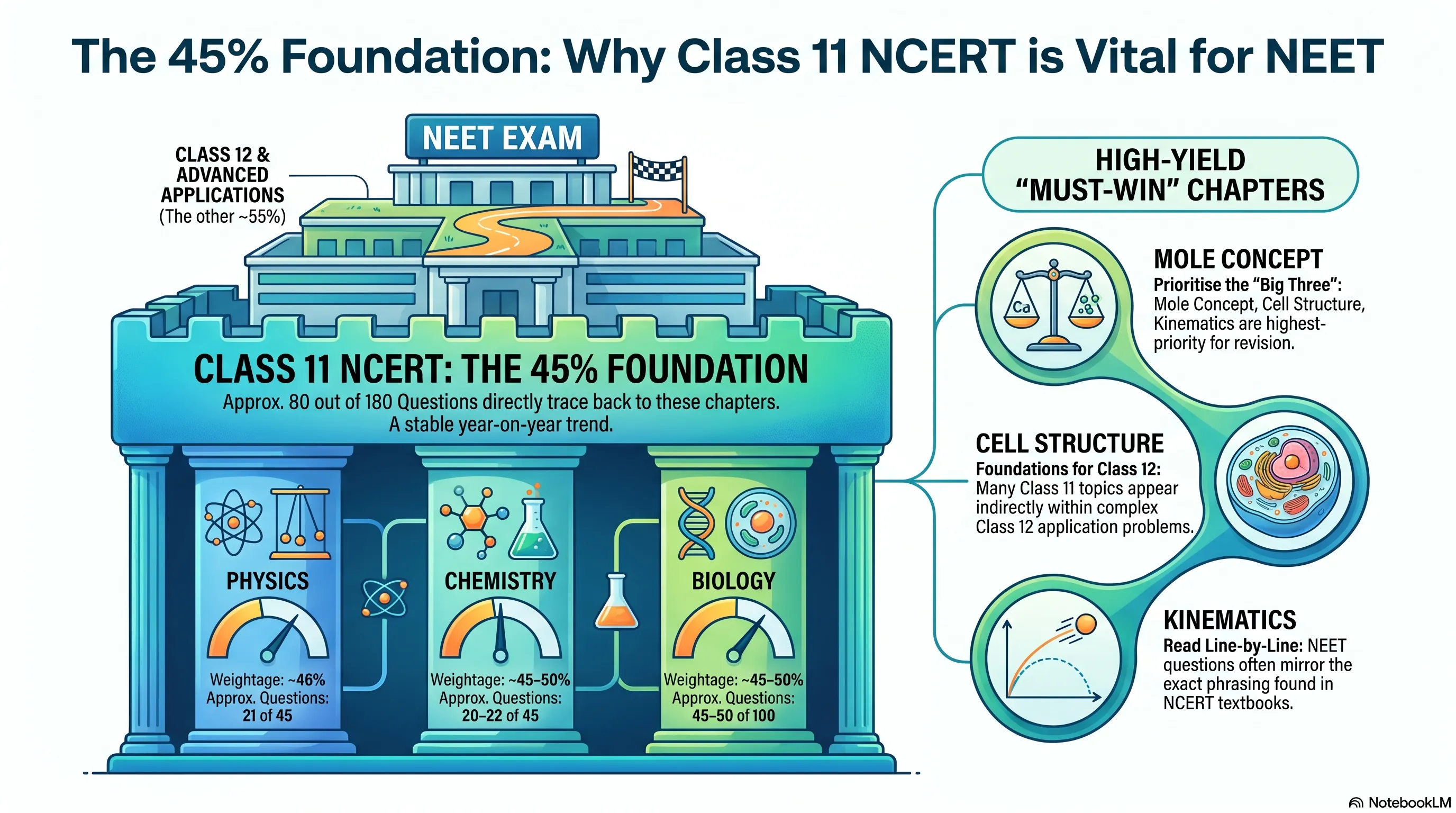
Table of Contents

eSaral › NEET › How Much of NEET Is From Class 11 NCERT?

What Percentage of NEET Comes From Class 11 NCERT?
Based on an analysis of NEET question papers from recent years, Class 11 NCERT contributes close to 45% of the total 180 questions, with Class 12 NCERT making up the remaining 55%. This pattern has stayed fairly stable year on year, which is why NEET educators treat it as a dependable planning benchmark rather than a one-time fluke.
That means that out of 180 questions, roughly 80 trace back to Class 11 NCERT chapters across Physics, Chemistry, and Biology. That's not a side topic — it's nearly half the paper.
💡 Expert Tip from eSaral's NEET Faculty Panel: Students often remember the "Class 12 has more weightage" headline and forget the actual number attached to Class 11. Anchor on the number — close to 80 questions — not just the comparison.
You can cross-check this against the exact chapter list on the official NEET syllabus page and see how these questions are spread across the paper on the NEET exam pattern page.
Class 11 NCERT Weightage by Subject
The Class 11 share isn't identical across subjects — it shifts slightly depending on how much of each subject's high-yield content sits in the Class 11 or Class 12 book.
| Subject | Class 11 NCERT Weightage | Approx. Questions (out of subject total) |
|---|---|---|
| Physics | ~46% | ~21 of 45 questions |
| Chemistry | ~45–50% | ~20–22 of 45 questions |
| Biology | ~45–50% | ~45–50 of 100 questions |
Physics leans very close to an even split, with Class 11 chapters like Mechanics and Units & Measurements carrying real weight alongside Class 12's Electrodynamics. Chemistry and Biology follow a similar pattern — close to half of each subject's questions come from the Class 11 book, even though the highest-yield individual chapters tend to sit in Class 12.
Does This Percentage Change Every Year?
The exact number moves slightly from one year's paper to the next, but it has stayed within a narrow 45–50% band for Class 11 across recent NEET exams. Treat the 45% figure as a strong planning estimate, not a fixed guarantee — always sanity-check it against the latest paper closer to your exam.
Which Class 11 Chapters Carry the Most Weightage?
Not every Class 11 chapter contributes equally. A handful of chapters account for a disproportionate share of the Class 11 questions, and these deserve priority if your revision time is limited.
- Physics: Kinematics, Laws of Motion, Thermodynamics, and Units & Measurements are consistently high-yield.
- Chemistry: Mole Concept, Chemical Bonding, Equilibrium, and Organic Chemistry Basics (including Hydrocarbons) show up repeatedly.
- Biology: Cell Structure & Function, Biological Classification, Plant Kingdom, Animal Kingdom, and Human Physiology basics (digestion, breathing, body fluids) carry strong weightage.
💡 Expert Tip from eSaral's NEET Faculty Panel: If you can only revise a handful of Class 11 chapters before the exam, prioritize Mole Concept, Cell Structure, and Kinematics — they show up directly in questions and indirectly inside Class 12 application problems too.
For a full chapter-wise breakdown by weightage, see the NEET Physics weightage page and NEET Chemistry weightage page.
Is Class 11 NCERT Alone Enough to Score Well in NEET?
No. Even though Class 11 NCERT accounts for close to 45% of the paper, scoring well in NEET requires covering both years — the remaining 55% from Class 12 is too large to skip, and several Class 12 chapters are among the single highest-weightage topics in the entire exam, such as Genetics, Human Reproduction, Current Electricity, and Semiconductors.
What Class 11 NCERT alone can do is get you close to half the paper right, provided you've read it thoroughly and not just skimmed it during Class 12 revision. Students who go back to the actual NCERT lines — not just notes or shortcuts — tend to catch details that directly match how NEET questions are phrased.
How to Use This Weightage in Your Study Plan
- Read the Class 11 NCERT book line by line, not just chapter summaries — NEET questions often mirror the exact textbook phrasing.
- Prioritize the high-weightage Class 11 chapters listed above before moving to lower-yield topics.
- Revisit Class 11 chapters periodically through Class 12, rather than treating Class 11 as "done" once the year ends.
- Verify your revision against real papers by going through past NEET papers and tagging each question by class — this turns a general 45% estimate into a concrete sense of what actually gets asked.
Frequently Asked Questions
Find answers to common questions.
How much of NEET is from Class 11 NCERT?
Around 45% of NEET questions come from the Class 11 NCERT syllabus, roughly 80 out of 180 questions. This holds fairly steady across Physics, Chemistry, and Biology, based on recent years' papers.
How many questions come from Class 11 NCERT in NEET Biology?
Class 11 NCERT typically contributes 45–50 of the 100 Biology questions in NEET. Key chapters include Cell Structure, Biological Classification, Plant Kingdom, and Animal Kingdom.
Is Class 11 NCERT enough to clear NEET?
No, Class 11 NCERT alone isn't enough since it covers only about 45% of the paper. Class 12 NCERT contributes the remaining 55%, including several of the highest-weightage chapters in the exam.
What percentage of NEET Physics is from class 11?
Class 11 contributes close to 46% of NEET Physics questions, with Class 12 making up the remaining 54%. High-weightage Class 11 Physics chapters include Kinematics and Laws of Motion.
Which Class 11 NCERT chapters are most important for NEET?
High-priority Class 11 chapters include Mole Concept, Cell Structure & Function, Kinematics, Chemical Bonding, and Human Physiology basics. These consistently appear in NEET papers and support many Class 12 topics as well.