How to Balance Class 11 School Exams and NEET Preparation: A Realistic Plan (2026)
Learn how to realistically balance Class 11 school exams and NEET preparation with a practical daily schedule, weekly study plan, common mistakes to avoid, and expert strategies for consistent success.
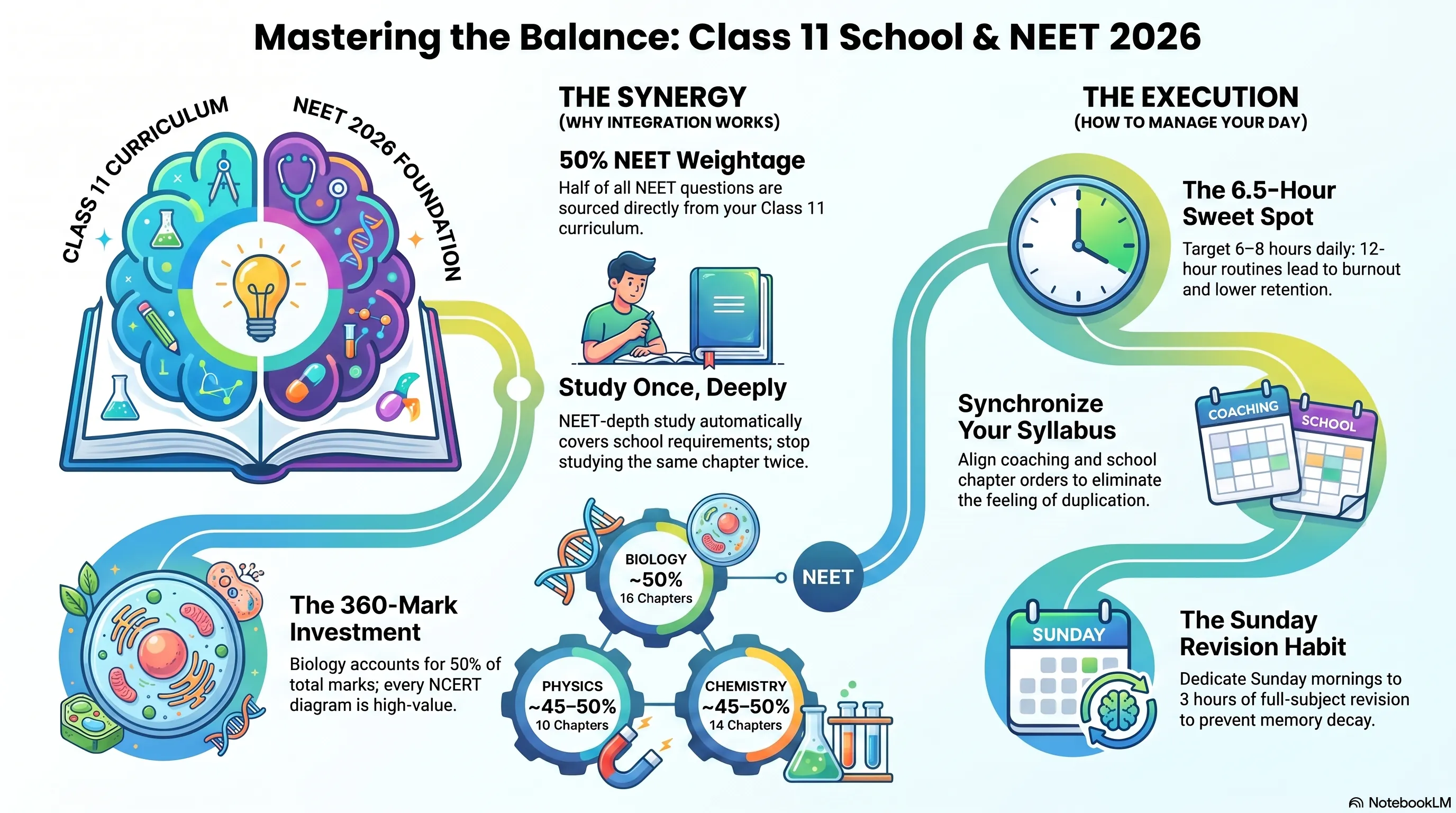
Table of Contents
- Why This Worry Is So Common Among NEET Aspirants
- The Overlap You Are Missing: School Syllabus vs. NEET Syllabus
- How Many Hours Should a Class 11 Student Study for NEET Daily?
- A Realistic Week-by-Week Roadmap to Balance Both
- Common Mistakes Students Make When Panicking About This
- Can I Prepare for NEET While Attending School in Class 11?

eSaral › NEET › How to Balance Class 11 School Exams and NEET Preparation: A Realistic Plan (2026)

Why This Worry Is So Common Among NEET Aspirants
Almost every serious NEET aspirant feels this anxiety in Class 11. There is a very specific reason for it.
When you join NEET coaching, you suddenly see a syllabus that looks enormous — three subjects, hundreds of chapters, five years of past papers. At the same time, your school gives you unit tests, practicals, attendance requirements, and project submissions. Your brain registers these as two separate mountains to climb.
The Real Source of Overwhelm
The overwhelm is not about the volume of work. It is about the perceived duplication of effort. Students believe they must study Physics twice — once for school and once for NEET. That belief is the root of the anxiety.
In reality, if you study your Class 11 Physics, Chemistry, and Biology at NEET-standard depth, your school exams become a by-product of that effort. According to NTA data, the NEET UG question paper draws approximately 50% of its questions directly from Class 11 topics every year.
💡 Expert Tip by eSaral Academic Team: "The student who studies the Class 11 NCERT chapter on Plant Kingdom at NEET depth will score in both the school test and the NEET exam. Study once, deeply. Stop studying the same chapter twice at two different levels."
The Overlap You Are Missing: School Syllabus vs. NEET Syllabus
Before you build any timetable, understand this data. It changes everything.
|
Subject |
Class 11 Chapters in [NEET Syllabus](https://www.esaral.com/neet/neet-syllabus/) |
Approximate NEET Weightage from Class 11 |
|
Biology |
16 chapters (Botany + Zoology) |
~50% of Biology questions |
|
Physics |
10 chapters |
~45–50% of Physics questions |
|
Chemistry |
14 chapters (Physical + Organic + Inorganic) |
~45–50% of Chemistry questions |
The NEET exam pattern has 200 questions (180 to attempt), carrying 720 marks. A significant portion of those marks comes from exactly what your school is already testing you on.
What NEET Actually Demands from Class 11 Topics
NEET does not ask you to memorise your textbook. It tests the application within NCERT boundaries. This means:
-
Every definition in your NCERT must be precise.
-
Every diagram (especially in Biology) must be reproducible from memory.
-
Numerical problems in Physics and Physical Chemistry must be solved without a calculator.
Study every school chapter as if NEET will test it — because it will. Check the NEET Physics weightage and NEET Chemistry weightage data to see exactly which Class 11 chapters carry the most marks.
How Many Hours Should a Class 11 Student Study for NEET Daily?
A Class 11 NEET aspirant attending school should target 6 to 8 hours of focused study per day — not 12, not 4.
This is not a soft recommendation. In eSaral's 2025 foundation batch, students who maintained a consistent 6.5-hour daily study routine (including coaching hours) showed an average improvement of 18 percentile points on internal NEET mock tests between June and November. The students who tried to study 10–12 hours burned out by September.
Sample Daily Time Distribution
|
Time Slot |
Activity |
Duration |
|
6:00 – 7:00 AM |
Self-study: Biology NCERT revision or previous night's notes |
1 hour |
|
7:30 – 1:30 PM |
School |
6 hours |
|
2:30 – 3:00 PM |
Rest (non-negotiable) |
30 min |
|
3:00 – 5:00 PM |
NEET coaching/self-study: Physics or Chemistry |
2 hours |
|
5:00 – 5:30 PM |
Short break |
30 min |
|
5:30 – 7:30 PM |
Self-study: weakest subject of the day |
2 hours |
|
8:30 – 9:30 PM |
NCERT reading + next day's preparation |
1 hour |
💡 Expert Tip by eSaral Academic Team: "Sleep 7–8 hours. Memory consolidation happens during sleep. A student who sleeps 5 hours and studies 10 hours retains far less than one who sleeps 8 hours and studies 7 hours with full focus."
A Realistic Week-by-Week Roadmap to Balance Both
Here is a structured, time-bound plan for the first three months of Class 11. This is not theoretical — it is what actually works.
Step 1: Map your school unit test dates in Week 1.
Sit down on Day 1 and write every school exam date for the next three months. Put them in a physical planner or phone calendar. Now you can see the real picture, not the imagined one.
Step 2: Align your NEET chapter order with your school chapter order (Weeks 1–2).
Wherever possible, study the same chapter in school and in NEET coaching simultaneously. Talk to your coaching faculty if the sequence does not match. Most NEET curricula are designed to roughly follow NCERT order.
Step 3: Set one "NEET-depth" study session per chapter (ongoing).
For every chapter your school covers, schedule one 2-hour self-study session that goes beyond the school level — solving NEET previous year questions from that chapter. Find practice questions in the NEET question papers archive.
Step 4: Reserve Sunday mornings for full-subject revision (weekly).
Every Sunday, spend 2–3 hours revising everything covered that week. This single habit prevents the "I studied it but forgot it" problem that derails most students by December.
Step 5: Solve at least 10 NEET previous year questions per chapter (chapter-end).
Do not wait until Class 12 to touch past papers. The moment you finish a chapter — in school or coaching — solve 10 NEET questions from that chapter. This tells you immediately where the gaps are.
Step 6: Run a monthly self-assessment in the last week of every month.
Attempt a 90-minute subject-wise mock test. Review every wrong answer. Identify patterns. Adjust the next month's plan based on data, not feelings.
Common Mistakes Students Make When Panicking About This
Panic produces predictable errors. Knowing them in advance helps you avoid them.
Mistake 1: Dropping school entirely to "focus on NEET."
This backfires badly. School attendance, practicals, and internal marks matter for your board percentage. More importantly, school provides a structured environment that keeps your routine stable. JEE ki taiyari aur school — dono saath chalte hain.
Mistake 2: Studying Chapter 1 of every subject repeatedly.
Many students feel safest revising what they already know. Chapter 1 of Biology gets studied five times; Chapter 18 never gets opened. Track your chapter completion honestly.
Mistake 3: Waiting for school exams to pass before starting NEET practice.
"I'll start solving NEET questions after my unit test" becomes "after my half-yearly" becomes "after boards." Integrate NEET practice from Day 1. Even 15 minutes of past questions per chapter is enough in the beginning.
Mistake 4: Comparing your pace to coaching-only students.
Students who attend only coaching (no school) have 3–4 extra hours daily. Do not benchmark your progress against theirs in the first six months. Your benchmark is your own progress week-on-week.
Mistake 5: Ignoring Biology in favour of Physics.
Biology carries 360 out of 720 marks in NEET UG. Many Class 11 students neglect it because it does not feel like "real science." That is a costly mistake. NCERT Biology — every line, every diagram — is your highest-return investment.
Can I Prepare for NEET While Attending School in Class 11?
Yes — and the data supports this clearly.
Many NEET toppers attended regular school through Class 11 and 12. The key is that they used school strategically. Classroom explanations became their first pass at a topic. Self-study became their NEET-depth second pass. They never studied the same chapter twice at two different levels.
The honest caveat: you must be disciplined about your evening and morning study hours. School will consume 6–7 hours of your day. The remaining hours must be protected and purposeful. Chaai breaks that stretch to 45 minutes, endless scrolling after dinner — these are where the hours disappear.
If you feel genuinely stretched, that is a signal to audit your time, not to panic. Most students who feel overwhelmed are not actually running out of time — they are running out of structure.
Frequently Asked Questions
Find answers to common questions.
How many hours should a class 11 student study for NEET daily while attending school?
A class 11 student attending school should aim for 6 to 8 hours of total focused study daily, including coaching hours. Consistency matters more than volume. A steady 6.5-hour routine maintained over 12 months outperforms sporadic 12-hour sessions that lead to burnout within weeks.
Can I prepare for NEET while attending school in class 11 without coaching?
Yes, self-study with strong NCERT reading, NEET previous year questions, and a structured timetable can work. However, coaching provides structured sequencing, doubt clearing, and test series that are hard to replicate alone. If coaching is not accessible, eSaral's online NEET foundation batch offers a structured alternative at a fraction of offline coaching costs.
How to manage school attendance and NEET coaching in class 11 without falling behind in either?
Align your NEET chapter order with your school chapter order wherever possible. Study each chapter at NEET depth from the start — this means one study session serves both school and NEET. Use Sunday mornings for weekly revision and attend school regularly to maintain routine and internal marks.
Which chapters from Class 11 are most important for NEET preparation?
For Biology: Cell Biology, Plant Kingdom, Animal Kingdom, and Human Physiology chapters. For Physics: Laws of Motion, Work-Energy-Theorem, and Thermodynamics carry high NEET weightage. For Chemistry: Basic Concepts, Equilibrium, and Organic Chemistry fundamentals. Review the official NEET syllabus for the complete chapter list.
Is it okay to skip school occasionally to study for NEET in class 11?
Occasional unavoidable absences are manageable, but making it a habit is a poor strategy. School attendance supports your board percentage, provides structured learning time, and keeps your social and mental health stable. Regular bunking in Class 11 tends to create long-term discipline problems that hurt NEET preparation itself.