Ionic Equilibrium - NEET Previous Year Questions with Complete Solutions


eSaral › NEET Chemistry › Ionic Equilibrium Previous Year Questions with Complete Solutions

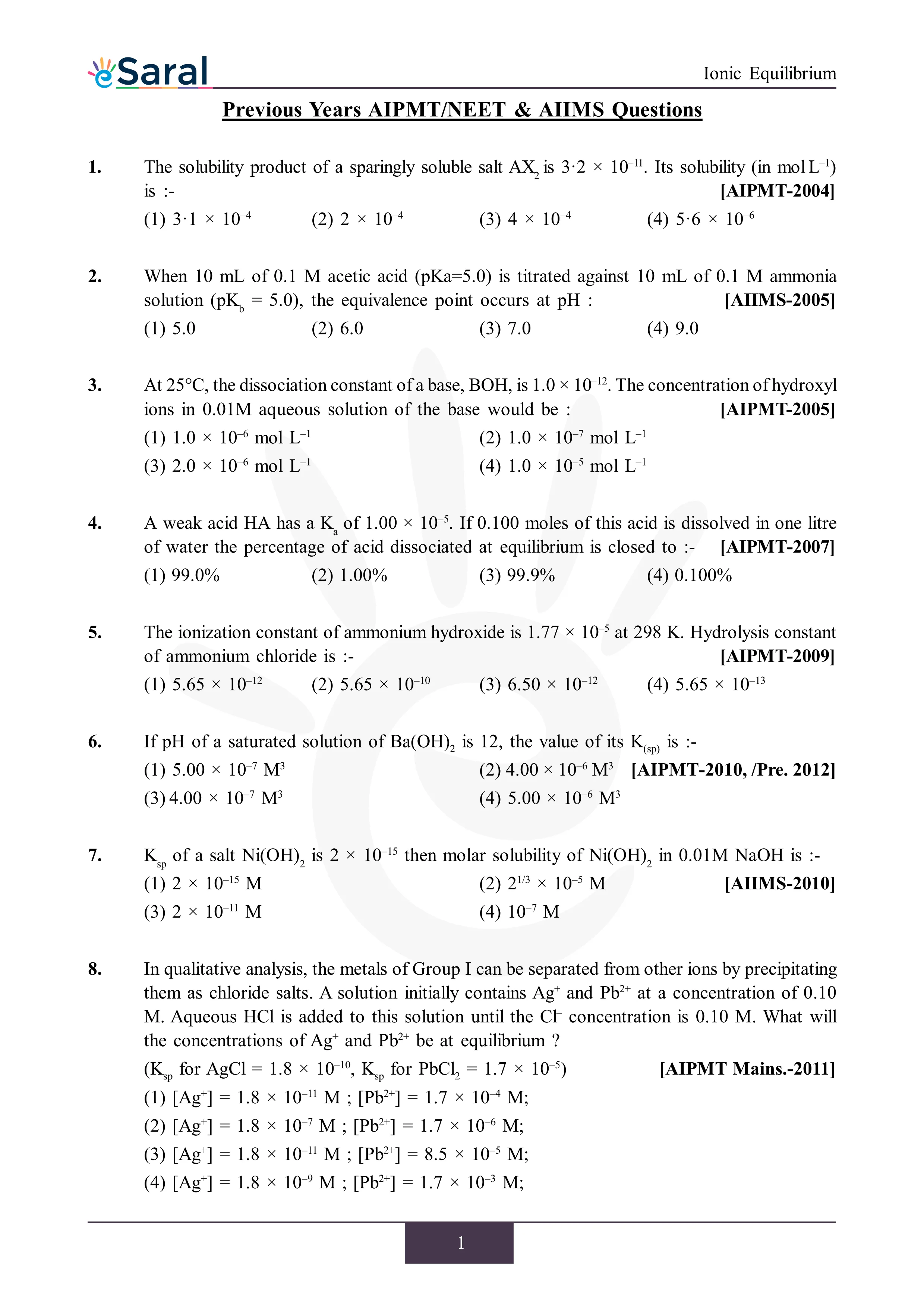
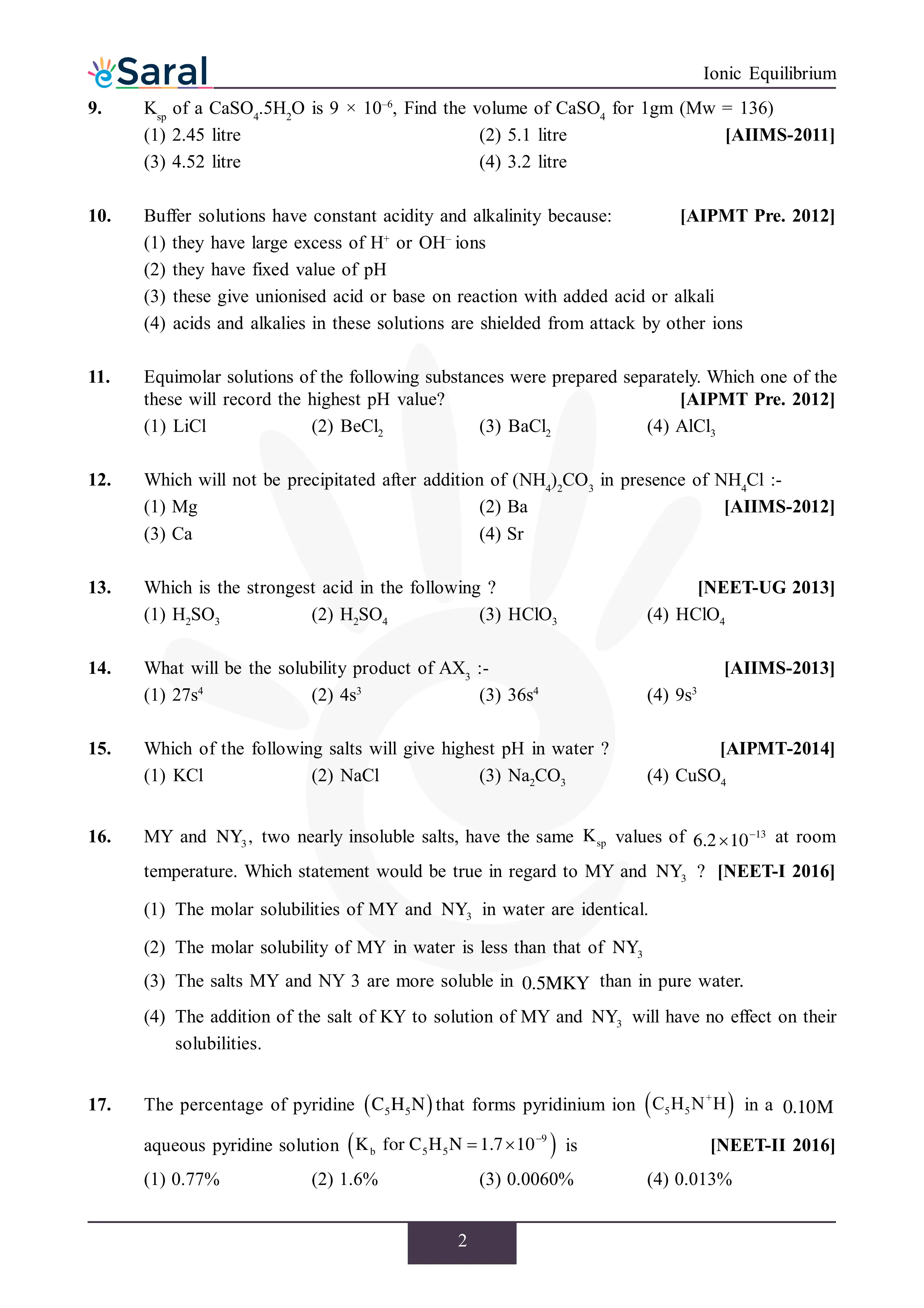
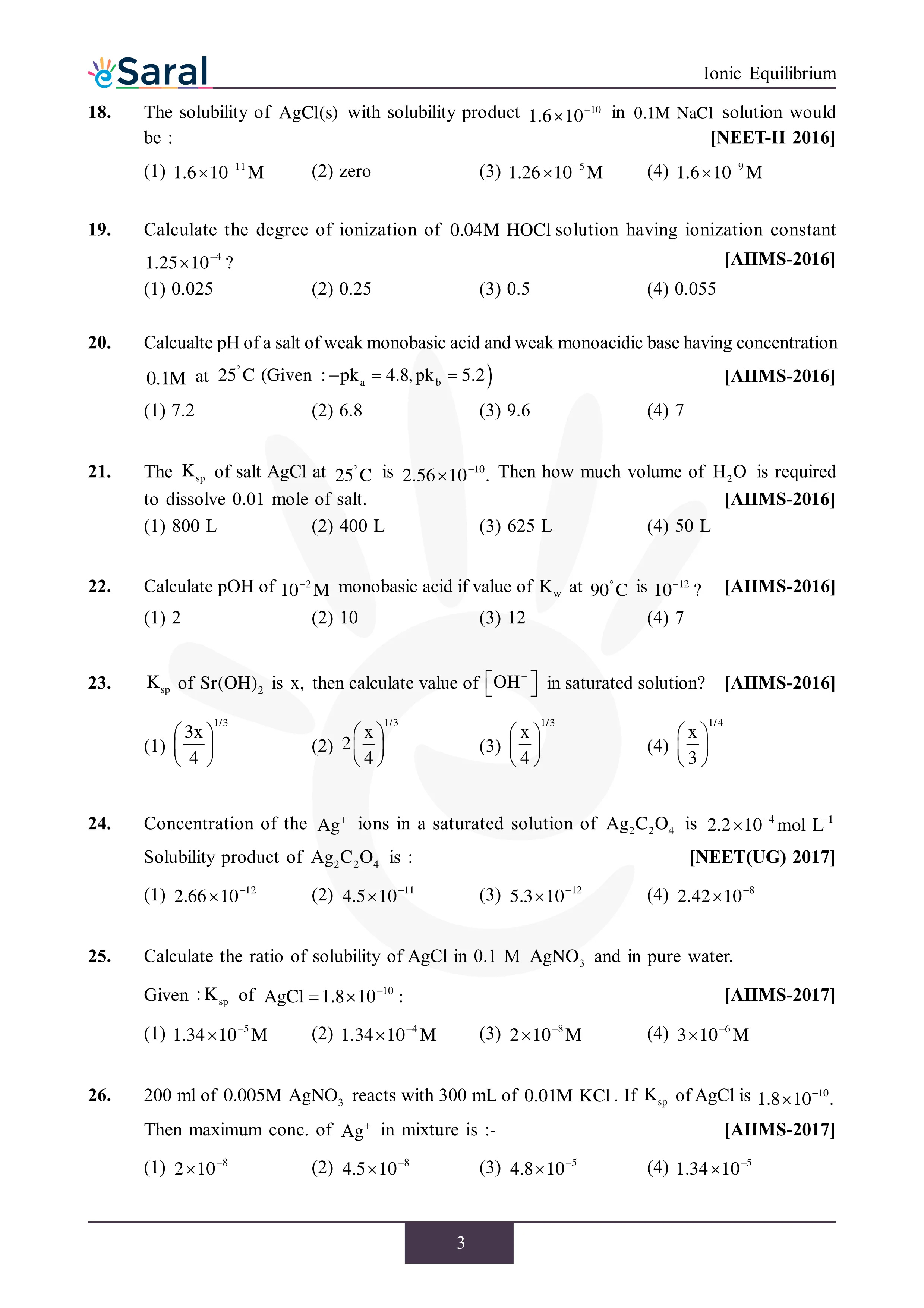
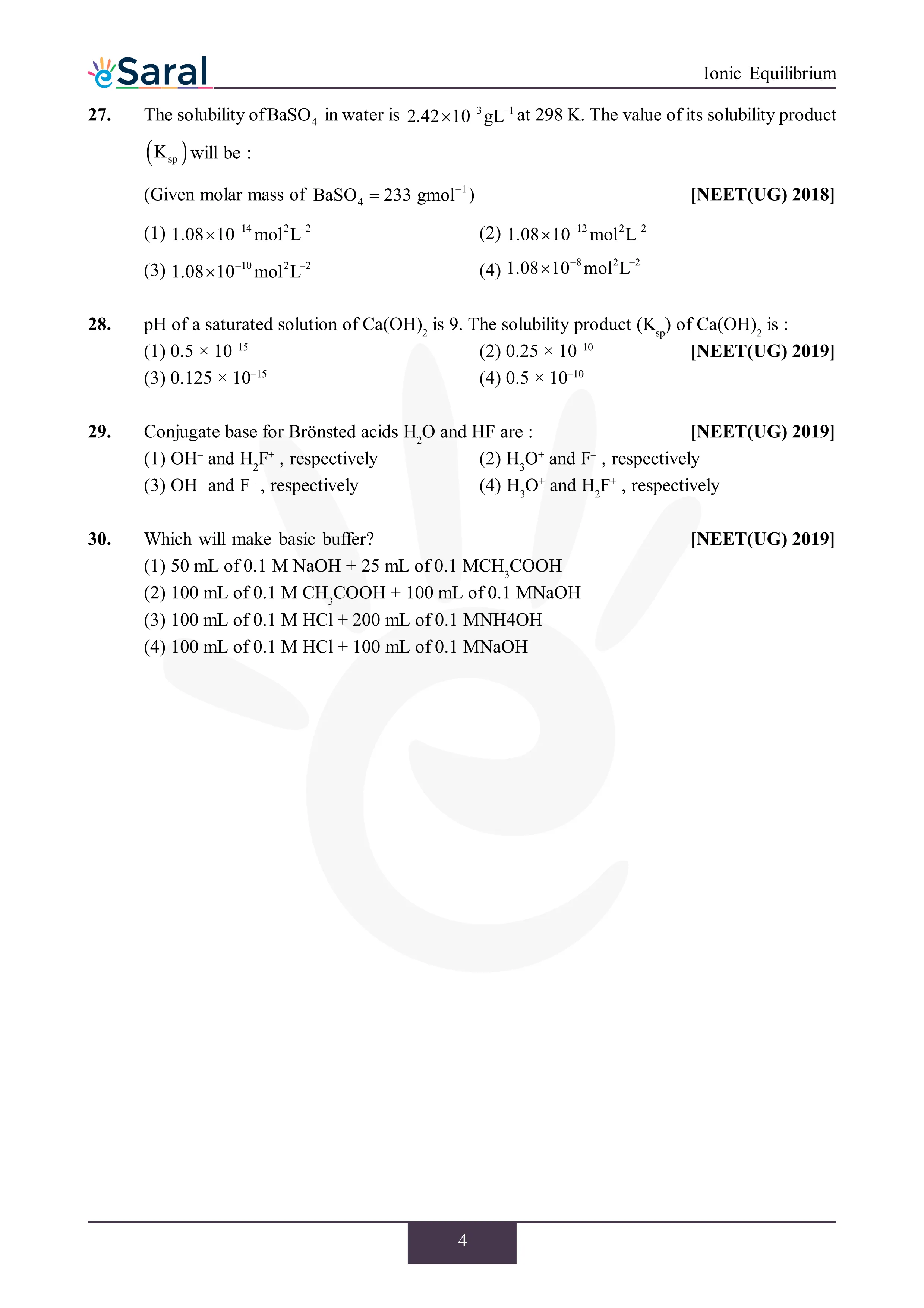
Here you will find Complete Ionic Equilibrium NEET Previous Year Questions with detailed solutions.
Get complete NEET previous-year questions for Physics, Chemistry, and Biology.
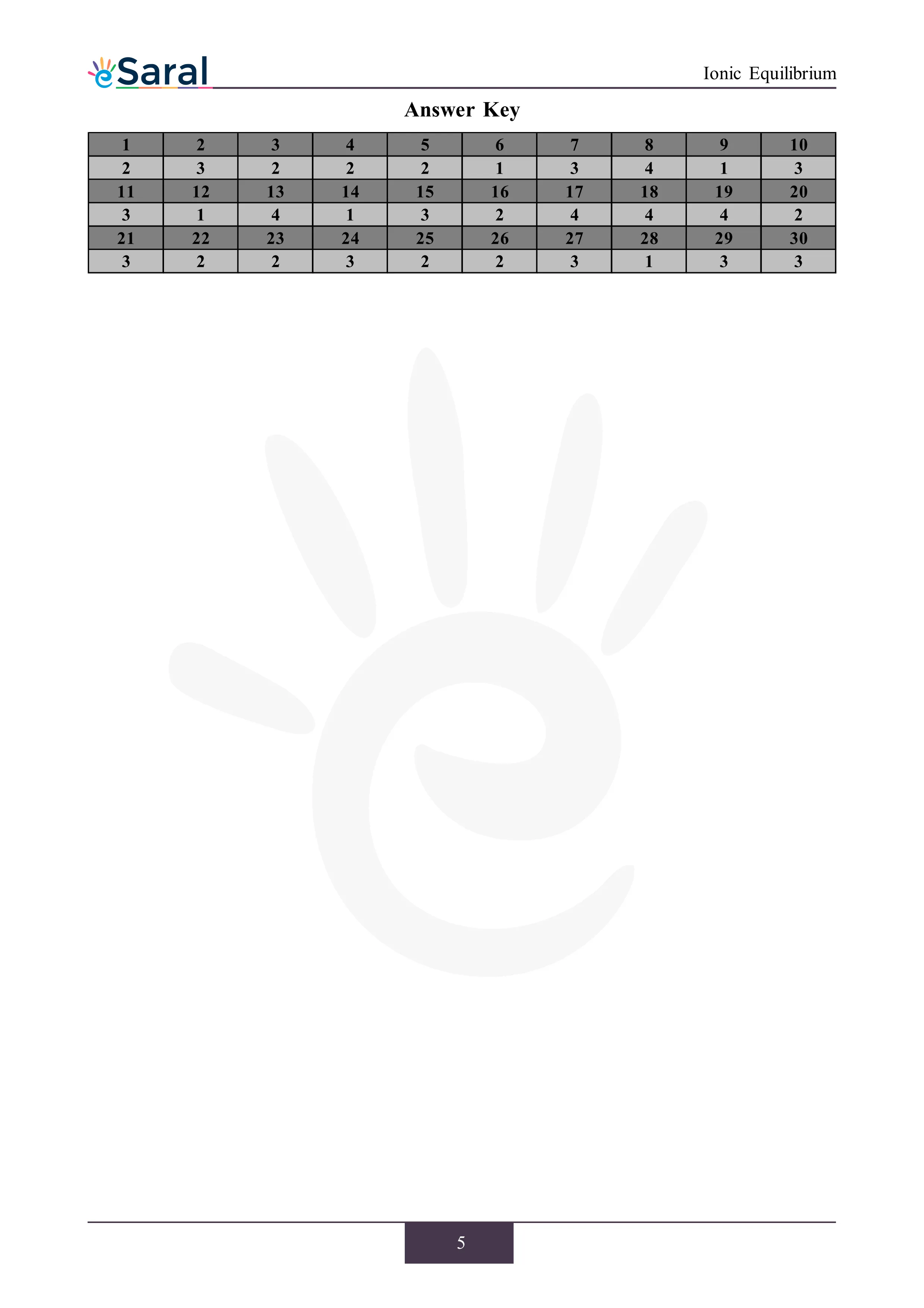
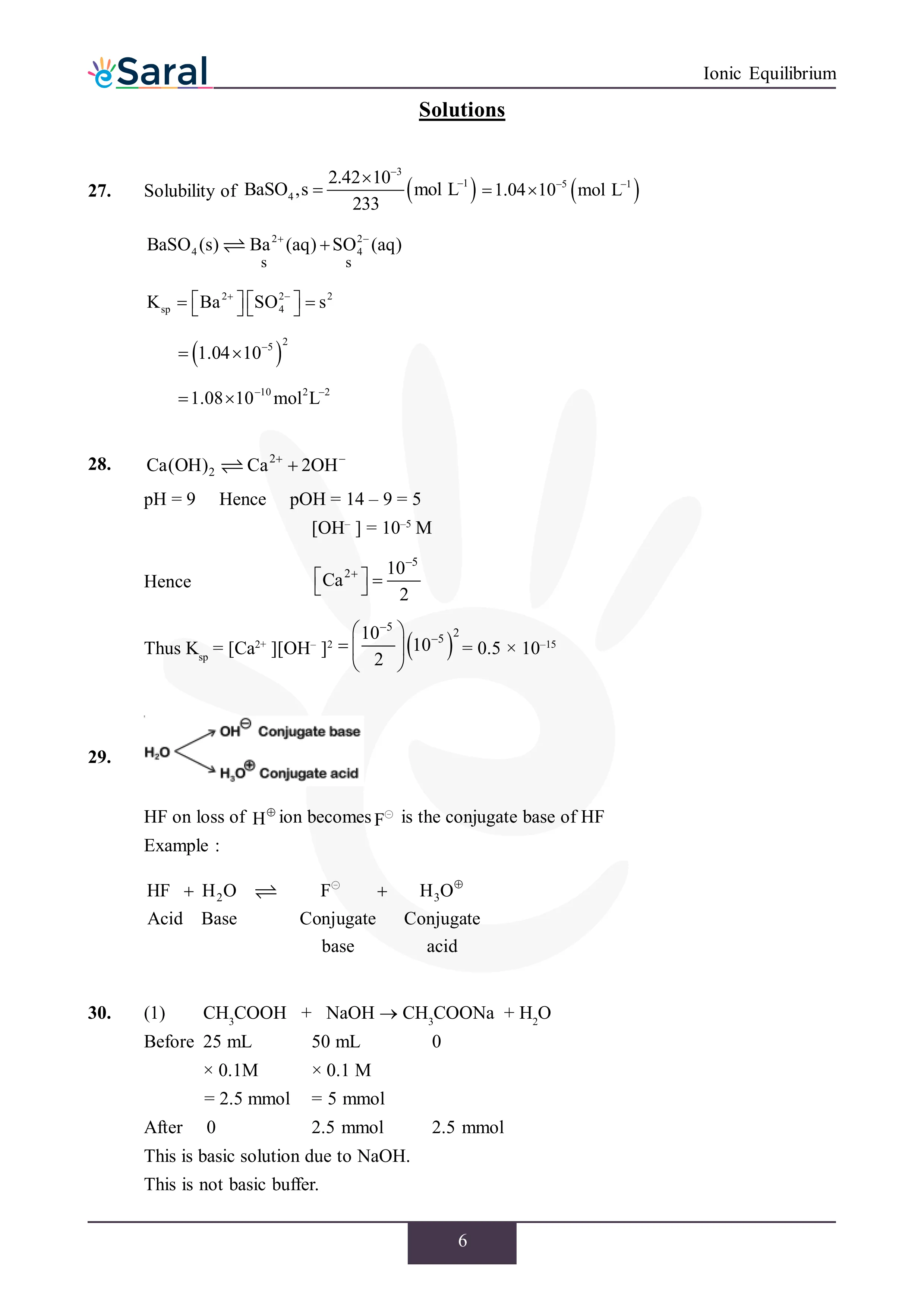
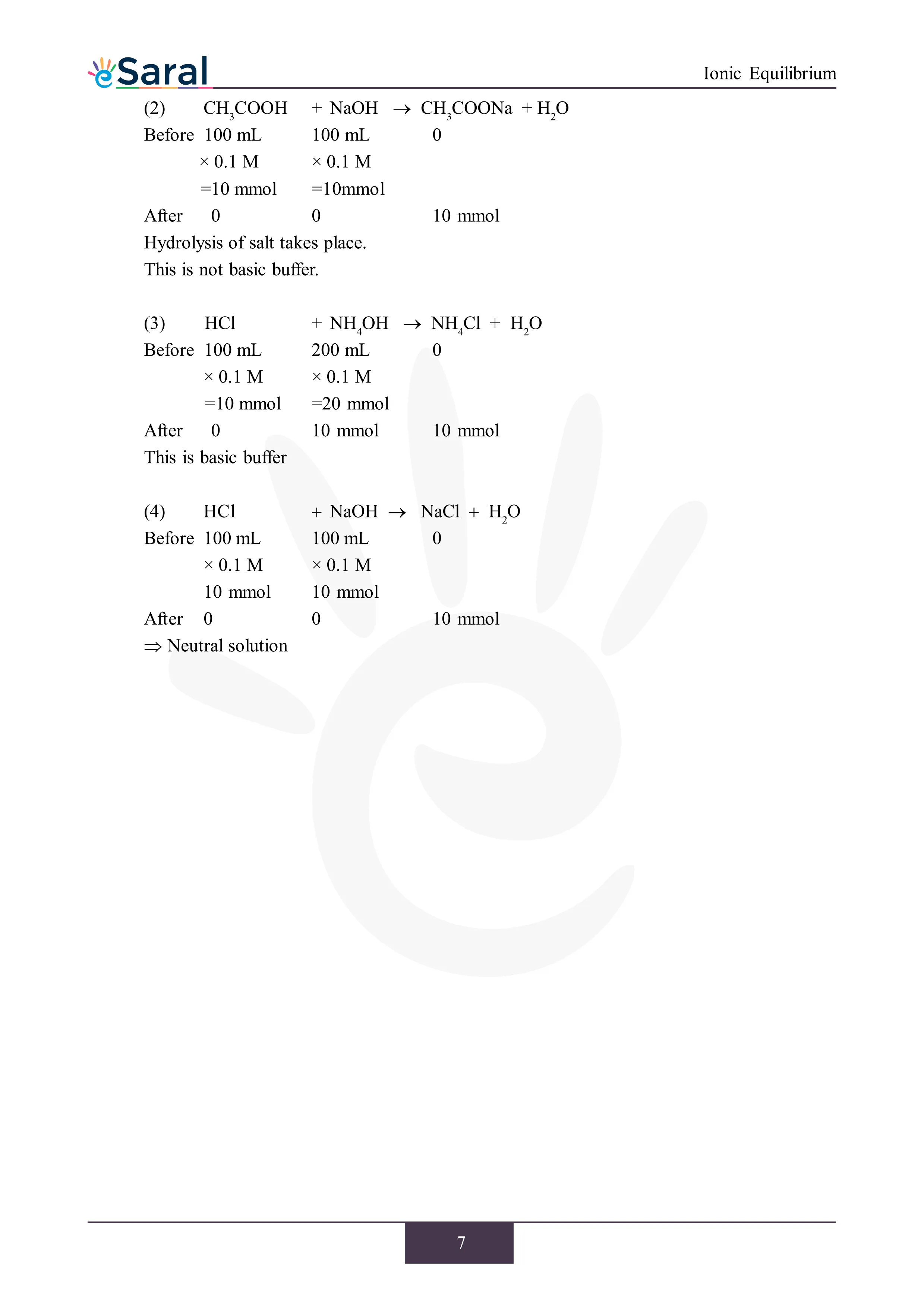
You will find all the solutions at the end of this page:
Frequently Asked Questions
Find answers to common questions.
Is Ionic Equilibrium from Class 11 or Class 12 for NEET?
Ionic Equilibrium is a Class 11 topic, covered in NCERT Chemistry Part 1, Chapter 7 ("Equilibrium"). However, it connects directly with Class 12 topics like electrochemistry (Kw temperature dependence) and coordination chemistry (complex ion equilibria). NEET questions draw entirely from the Class 11 NCERT scope for this chapter.
Which sub-topics of Ionic Equilibrium are most important for NEET?
The five highest-yield sub-topics are: pH and pOH calculations, dissociation constants (Ka, Kb, Kw), buffer solutions and the Henderson–Hasselbalch equation, hydrolysis of salts, and solubility product (Ksp) with common ion effect. Among these, pH calculations and Ksp-based problems appear most frequently in recent NEET papers.
How many questions come from Ionic Equilibrium in NEET every year?
NEET typically has 2 to 3 questions from Ionic Equilibrium each year, contributing 8–12 marks. The chapter has featured in every NEET paper since 2013 without exception. Given the predictable question types (pH, Ka/Kb, buffer, Ksp), it offers one of the best returns on study time in the entire Chemistry syllabus.
Can I skip Ionic Equilibrium and still score well in NEET Chemistry?
Skipping Ionic Equilibrium is not advisable. It contributes 8–12 marks annually and its questions are among the most formula-predictable in Chemistry. Missing it means surrendering easy marks that competitors — especially students trained by IIT Bombay faculty with structured PYQ practice — will pick up. The chapter takes roughly 10–15 hours of focused study to master fully.
How do I calculate the pH of a buffer solution for NEET?
Use the Henderson–Hasselbalch equation: pH = pKa + log([A⁻]/[HA]), where [A⁻] is the concentration of the conjugate base (salt) and [HA] is the concentration of the weak acid. For NEET, the ratio is usually a simple number (1:1, 1:10, 10:1), so the log term becomes 0, +1, or −1, making mental calculation fast.
What is the difference between Ka and Kb in Ionic Equilibrium?
Ka is the acid dissociation constant — a measure of how strongly a weak acid donates a proton. Kb is the base dissociation constant — a measure of how strongly a weak base accepts a proton. For a conjugate acid-base pair at 25°C, Ka × Kb = Kw = 1 × 10⁻¹⁴. A higher Ka means a stronger acid; a higher Kb means a stronger base.