Is Class 11 Syllabus More Important Than Class 12 for NEET?
Class 12 carries a slightly higher weightage in NEET — roughly 55% of questions — compared to Class 11's 45%. But this margin doesn't make Class 11 optional. Most Class 12 topics, from electrochemistry to genetics, are built directly on Class 11 foundations, so skipping Class 11 to "save time" for Class 12 usually backfires in the exam.
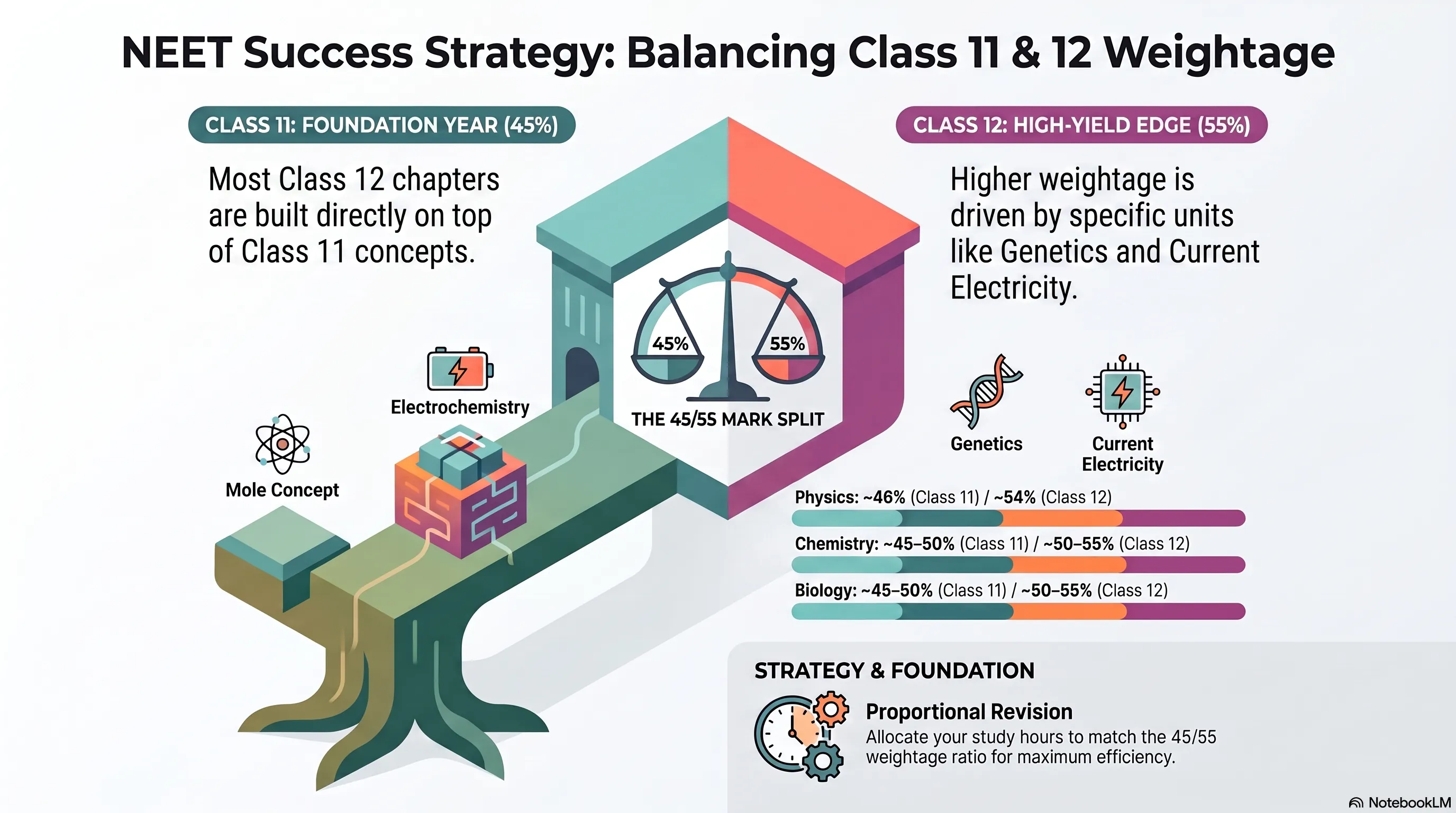
Table of Contents
- What Does the Actual NEET Weightage Data Show?
- Subject-Wise Class 11 vs Class 12 Weightage
- Why Class 11 Still Matters Even With Lower Weightage
- How Should You Split Your Study Time Between Class 11 and Class 12?
- What Should NEET Droppers Do Differently?
- Common Mistakes Students Make With This Weightage

eSaral › NEET › Is Class 11 Syllabus More Important Than Class 12 for NEET?

What Does the Actual NEET Weightage Data Show?
Based on an analysis of the last several years of NEET question papers, Class 12 topics contribute close to 55% of the total questions, while Class 11 topics contribute around 45%. This pattern has held steady year after year, which is why serious NEET educators treat it as a reliable planning input rather than a one-off trend.
That 10-point gap is real, but it's smaller than most students assume. A lot of aspirants hear "Class 12 has more weightage" and mentally round it up to "Class 12 is what matters" — which isn't what the data actually says.
💡 Expert Tip from eSaral's NEET Faculty Panel: Don't treat the 45–55 split as a reason to rush Class 11. Treat it as a reason to make sure Class 11 revision is efficient, not skipped — because you still need close to half your Biology, Physics, and Chemistry marks from it.
You can check the exact chapter list this weightage is calculated against on the official NEET syllabus page, and see how these questions are distributed across sections on the NEET exam pattern page.
Subject-Wise Class 11 vs Class 12 Weightage
The 45–55 split isn't identical across subjects. Each subject has its own internal balance, and knowing this helps you prioritize revision inside each subject rather than treating "Class 11" and "Class 12" as one giant block.
| Subject | Class 11 Weightage | Class 12 Weightage | High-Weightage Class 12 Chapters |
|---|---|---|---|
| Physics | ~46% | ~54% | Current Electricity, Semiconductors, Ray Optics, Magnetism |
| Chemistry | ~45–50% | ~50–55% | Electrochemistry, d- and f-Block Elements, Biomolecules, Coordination Compounds |
| Biology | ~45–50% | ~50–55% | Genetics & Evolution, Human Reproduction, Biotechnology, Ecology |
Which Chapters Actually Drive the Class 12 Edge?
The extra weightage in Class 12 doesn't come from every chapter equally — it's concentrated in a handful of high-yield units. In Physics, Current Electricity and Semiconductors alone account for a large share of Class 12's edge. In Biology, Genetics and Human Physiology topics dominate. This is why "Class 12 has more weightage" really means a specific set of chapters, not the entire year.
For subject-specific chapter breakdowns, eSaral's detailed pages cover this in full: see the NEET Physics weightage page and the NEET Chemistry weightage page.
Why Class 11 Still Matters Even With Lower Weightage
A 45% weightage is not a small number — it's still close to half the paper. But the bigger reason Class 11 can't be skipped is structural: most Class 12 chapters are built on top of Class 11 concepts.
- You cannot understand Electrochemistry (Class 12) without a solid grip on Mole Concept and Equilibrium (Class 11).
- You cannot answer application-based Genetics questions (Class 12) without first understanding Cell Structure and Biomolecules (Class 11).
- You cannot solve Electromagnetic Induction problems (Class 12) without being fluent in Laws of Motion and Units & Measurements (Class 11).
This is why NEET toppers consistently describe Class 11 as the "foundation year" — weaker on raw question count, but the layer everything else sits on. Students who rush through Class 11 to "save time" for Class 12 usually end up re-learning basics anyway, just later and under more pressure.
💡 Expert Tip from eSaral's NEET Faculty Panel: If a Class 12 topic feels confusing no matter how many times you revise it, the actual gap is usually in Class 11. Go back to the base chapter before repeating Class 12 revision — it's faster in the long run.
How Should You Split Your Study Time Between Class 11 and Class 12?
Given the roughly 45–55 weightage split, a proportional time allocation works well for most students who are covering both years together (Class 11 students starting early, or Class 12 students revising Class 11 alongside).
- Allocate time close to the weightage ratio — roughly 45% of revision hours to Class 11, 55% to Class 12, adjusted by subject.
- Prioritize high-weightage Class 12 chapters first in each subject, since they carry the most marks per hour invested.
- Never let Class 11 revision drop to zero — even light, periodic revision keeps foundational concepts sharp for Class 12 application questions.
- Use past papers to verify your own weak areas rather than relying only on general weightage data, since individual students often have specific Class 11 or Class 12 gaps.
Reviewing actual past papers is one of the most reliable ways to see this weightage in action. You can go through the NEET 2023 question paper, NEET 2022 question paper, and NEET 2021 question paper and tag each question by class — it's a fast way to internalize the pattern yourself instead of just trusting a table.
What Should NEET Droppers Do Differently?
Droppers are in a slightly different position — they've already completed both years once, so the question isn't "which year to study" but "where to focus limited revision time."
For droppers, the smarter approach is usually:
- Diagnostic first: Take a full-length mock and tag every wrong answer by class and chapter before deciding where to spend extra hours.
- Fix Class 11 gaps immediately: If mock analysis shows repeated errors on Class 12 application questions that trace back to a shaky Class 11 concept, that gets fixed before more Class 12 practice.
- Don't over-correct toward Class 12: Because Class 12 has slightly higher weightage, droppers sometimes swing too far and neglect Class 11 revision entirely — which shows up as careless errors on foundational questions they "already knew."
Common Mistakes Students Make With This Weightage
- Treating 55% as "most of the paper." It's a majority, not a dominant share — Class 11 is still close to half the exam.
- Ignoring low-weightage Class 11 chapters completely. Even a 1–2-question chapter adds up across three subjects.
- Studying Class 12 in isolation. Application-heavy Class 12 questions often fail simply because the Class 11 base concept wasn't clear.
- Not verifying weightage with real papers. General weightage tables are a guide, not a guarantee — cross-checking against actual past papers, including the NEET 2020 and NEET 2019 papers, keeps expectations realistic.
Frequently Asked Questions
Find answers to common questions.
Is the Class 11 syllabus more important than Class 12 for NEET?
No, Class 12 carries slightly more weightage in NEET, at around 55% of questions compared to Class 11's 45%. However, Class 11 remains essential because most Class 12 topics are built directly on Class 11 concepts.
What percentage of NEET comes from class 11?
Class 11 contributes around 45% of NEET questions on average, based on the last several years of question papers. This varies slightly by subject, with Physics around 46% and Biology and Chemistry close to 45–50%.
Should I skip class 11 and only focus on class 12 for NEET?
No, skipping Class 11 is a high-risk strategy. Many Class 12 chapters, like Electrochemistry and Genetics, require Class 11 concepts such as Mole Concept and Cell Biology to be understood at all.
Which class has tougher chapters in NEET, 11th or 12th?
Class 12 generally has more application-based and numerically intensive chapters, such as Electrodynamics and Organic Chemistry reactions. Class 11 chapters tend to be more conceptual and foundational, which makes them easier to underestimate.
How should NEET droppers split time between Class 11 and Class 12?
Droppers should start with a diagnostic mock test to identify weak chapters before deciding where to focus. Time should roughly follow the 45–55 weightage split, but any recurring Class 11 gaps should be fixed immediately since they affect Class 12 accuracy too.