JEE 2027 After a Wasted Class 11: Your Complete Comeback Plan (7-Month Roadmap by IIT Faculty)
Students who wasted Class 11 can still crack JEE 2027 by following a structured 7-month plan. The strategy involves covering Class 11 topics through recorded lectures while attending live Class 12 sessions, clearing backlogs chapter-by-chapter, and giving weekly tests with analysis. Hundreds of students have reached IIT with this exact approach.

Table of Contents
- Can You Still Crack JEE 2027 After a Bad Class 11?
- Why Did Class 11 Go Wrong — And Why It Doesn't Define You
- How to Cover Class 11 and Class 12 Together in 7 Months
- What Does the Week-by-Week Schedule Look Like?
- How to Manage Class 12 Boards Alongside JEE Prep
- The Backlog-Clearing Method That Actually Works

eSaral › JEE › JEE Main ›JEE 2027 After a Wasted Class 11

🚀 Checkout eSaral Courses
Can You Still Crack JEE 2027 After a Bad Class 11?
Yes — and the evidence is specific, not motivational.
Ayush had an average-to-wasted Class 11. He joined eSaral's structured program and scored 99.7 percentile in JEE Main. He is now at IIT Bombay.
Prachi was enrolled in a coaching institute that shut down mid-session. She joined eSaral's Prahar course after a wasted 11th. She is now at IIT Kanpur.
Manu started JEE preparation only in Class 12 — one year of prep, zero prior foundation. He cracked JEE Advanced and is now at IIT Roorkee.
Pankaj did it in 8 months: IIT Delhi.
Manthan did it in 7 months: IIT Bombay.
These are not outliers selected to sell you something. They are the documented outcomes of students who, at exactly this stage, made one decision: I will not give up.
💡 Expert Insight by Prateek Gupta, IIT Bombay: "Every year I see students who write off their chances in October and end up at IIT in July. The ones who make it are not always the smartest. They are the ones who build a system and stick to it. A wasted 11th is a disadvantage, not a disqualification."
The data from NTA's official JEE Main results consistently shows that a significant portion of top percentile scorers are students who improved dramatically in the second half of their Class 12 year. A compressed, high-intensity preparation with the right structure is not just possible — it is a proven model.
Why Did Class 11 Go Wrong — And Why It Doesn't Define You
Understanding the root cause of the backlog matters, because the fix must target the root, not the symptom.
The Doubt-Backlog Spiral
Most JEE 2027 students who are struggling right now hit the same pattern:
- A concept wasn't fully understood in class
- The doubt wasn't cleared in time
- The next chapter built on that concept — and was even more confusing
- Questions became unsolvable, so practice stopped
- Tests were skipped or bombed
- The student disengaged from that subject section entirely
This is the doubt-backlog spiral. It is not a motivation problem. It is a structural problem — specifically, the absence of a system that forces doubt resolution before moving on.
Why It Won't Repeat
A structured JEE 2027 preparation plan with two-way interactive classes, dedicated doubt sessions, and mentorship that monitors your progress chapter by chapter makes the spiral impossible to enter silently. Someone is watching. Someone checks your homework. Someone calls when you miss a class.
That structure, absent in most students' Class 11, is what this guide builds around.
How to Cover Class 11 and Class 12 Together in 7 Months
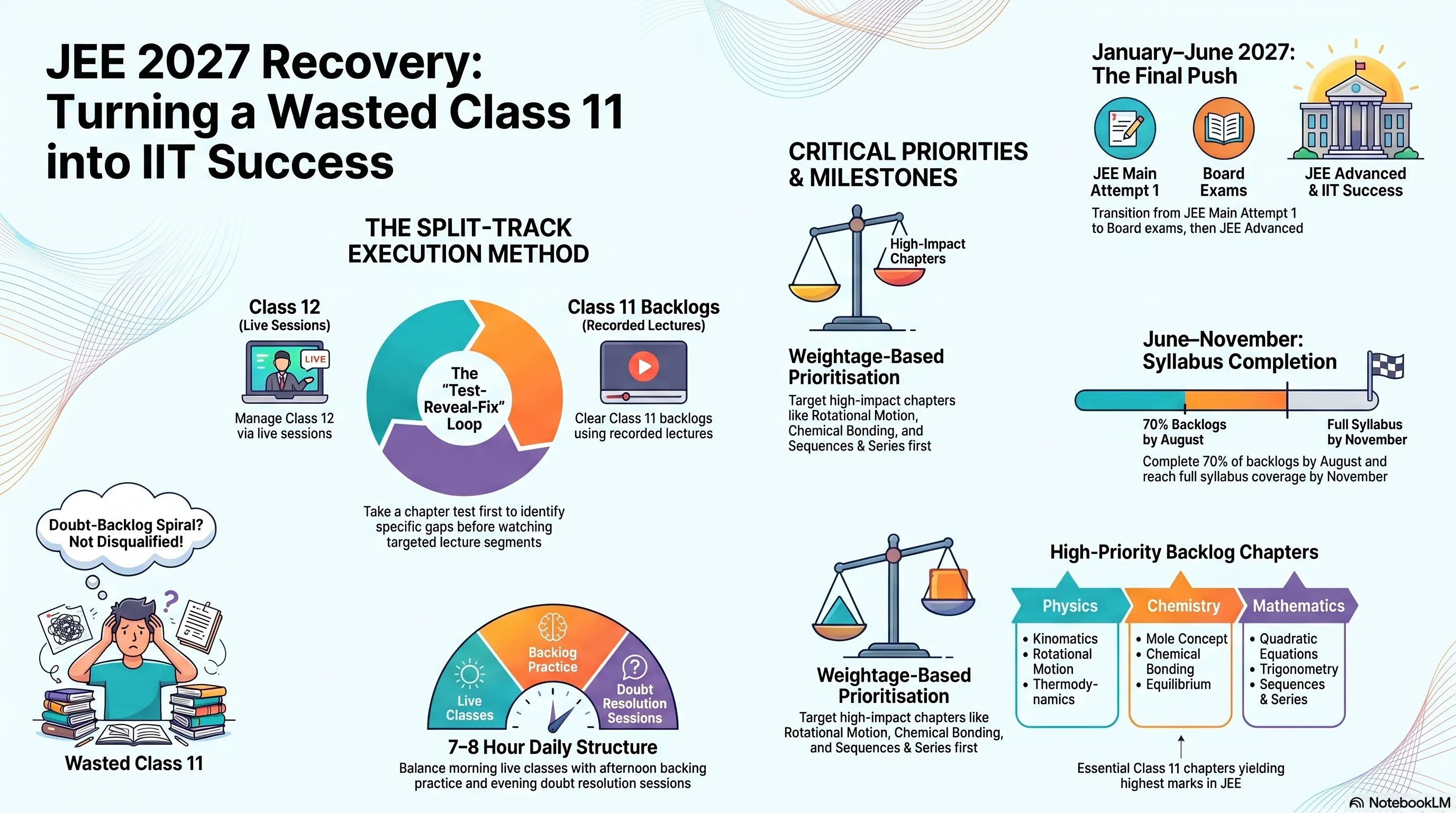
This is the core tactical question. The answer is a split-track model.
The Split-Track Model Explained
| Track | Content | Delivery Method | Pacing |
|---|---|---|---|
| Track A — Class 12 | Live syllabus (12th PCM chapters) | Live interactive classes | Synchronized with board calendar |
| Track B — Class 11 | Foundation and backlog topics | Recorded video lectures (self-paced) | Guided by mentor, 1–2 chapters/week |
You do not attempt to repeat all of Class 11 live. That would require two full years of time. Instead:
- Track A keeps you current. Your Class 12 live sessions build new knowledge you'll need for JEE Main January 2027.
- Track B systematically closes the gaps. Your mentor reviews your 11th topic priorities and assigns chapters in order of JEE weightage.
By December 2026, both tracks converge: your syllabus is complete, and you begin revision for JEE Main January 2027.
Subject-Wise Priority for Class 11 Backlog
Not all Class 11 topics are equally critical for JEE. Target these first:
Physics (Class 11 Priority)
- Kinematics and Laws of Motion
- Work, Energy and Power
- Rotational Motion
- Thermodynamics
Chemistry (Class 11 Priority)
- Mole Concept and Stoichiometry
- Chemical Bonding
- Atomic Structure
- Equilibrium
Mathematics (Class 11 Priority)
- Quadratic Equations and Complex Numbers
- Trigonometry
- Permutations and Combinations
- Sequences and Series
These chapters have the highest combined JEE Main + JEE Advanced weightage. Start here, regardless of where your emotional backlog feels worst.
What Does the Week-by-Week Schedule Look Like?
Sample Daily Study Structure (7-Month Plan)
| Time Block | Activity | Duration |
|---|---|---|
| Morning | Live Class 12 session (2-way interactive) | 2–2.5 hrs |
| Late Morning | Class 11 backlog (recorded lectures) | 1.5 hrs |
| Post-lunch | Module practice / homework (CPP → Exercise 1 → 2) | 1.5 hrs |
| Evening | Doubt resolution, test analysis, or mentor session | 1 hr |
| Night | Light revision, board notes, or short quiz | 45 min |
Total active study: approximately 7–8 hours per day.
This schedule is demanding. It is also finite. 7 months of this level of commitment ends with an exam. After that, the system resets entirely.
Monthly Milestones
| Month | Goal |
|---|---|
| June 2026 | Cover 3–4 priority Class 11 chapters per subject; begin Class 12 live track |
| July–August | Complete 70% of Class 11 backlog; all Class 12 live chapters current |
| September | First full-length JEE Main mock test; chapter-wise tests underway |
| October–November | Full syllabus coverage complete; first JEE Advanced level practice |
| December | Syllabus done; revision phase begins; Board prep parallel track active |
| January 2027 | JEE Main Attempt 1 |
| February–March | Board exams; JEE Main Attempt 2 revision |
| April 2027 | JEE Main Attempt 2 |
| May–June 2027 | JEE Advanced |
How to Manage Class 12 Boards Alongside JEE Prep
Boards require 90%+ in most IITs' eligibility criteria. They cannot be ignored. But they also do not require separate preparation if your JEE preparation is structured correctly.
The Overlap Strategy
Chemistry and Physics: JEE preparation covers the NCERT content deeply. Your board exam is largely a subset of your JEE preparation. Practice NCERT examples and back-exercise questions as part of your daily routine — this handles 80% of board preparation automatically.
Mathematics: JEE preparation goes significantly beyond NCERT. For boards, you only need NCERT-level fluency plus past board paper practice (3–4 papers in January 2027). This is a two-week exercise, not a parallel course.
English and other subjects: Set aside 30–45 minutes per day starting from September. Boards for non-PCM subjects require reading, not deep study. NCERT is sufficient.
Pre-Board and Board Exam Calendar
Students in eSaral's Prahar Batch receive:
- Board-specific test series starting October
- Live English classes from July
- Pre-board revision support in December–January
- Board paper walkthroughs before the exam
This integration means you never choose between boards and JEE. Both are managed inside the same system.
The Backlog-Clearing Method That Actually Works
Most students try to clear backlogs by re-reading theory. This is the slowest method. The fastest method is the Test-Reveal-Fix loop:
Step 1 — Take a Chapter-Wise Test First
Before revising any Class 11 chapter, take a short 15-question chapter test. This reveals exactly which concepts are genuinely weak versus which ones you think are weak.
Step 2 — Watch Targeted Lecture Segments
Based on test results, watch only the recorded lecture segments that address your actual gaps. Do not watch full 2-hour lectures for chapters where you are missing only one subtopic.
Step 3 — Solve in Sequence: CPP → Exercise 1 → Exercise 2
eSaral's module structure is designed for exactly this:
- CPP (Concept Practice Problems): Basic-level questions, JEE Main January easy-shift standard
- Exercise 1: JEE Main moderate, including advanced pattern questions
- Exercise 2 / 2A: JEE Main tough (Jan 2026 level) and JEE Advanced standard
Work through levels in sequence. Do not skip to hard questions to save time — partial understanding at the foundation level collapses under exam pressure.
Step 4 — Discuss Homework in Class
Every question from your module gets discussed in the class session. This is the difference between solo study (where you skip questions you can't solve) and structured classroom learning (where the teacher works through exactly the problems you couldn't do).
Step 5 — Repeat With the Next Chapter
One chapter cleared completely is worth more than four chapters half-covered. Depth over breadth, especially in the first two months.
🚀 Checkout eSaral Courses
Frequently Asked Questions
Find answers to common questions.
Can I crack JEE Main 2027 if my entire Class 11 was wasted?
Yes, it is possible. Students like Ayush (IIT Bombay, 99.7 percentile), Manu (IIT Roorkee, one year of prep), and Pankaj (IIT Delhi, 8 months) all started from similar or worse positions. The requirement is a structured plan, consistent execution, and mentorship — not a perfect Class 11 record.
How many hours per day should I study for JEE 2027 with Class 11 backlogs?
Aim for 7–8 focused hours per day. This breaks down into 2–2.5 hours of live Class 12 session, 1.5 hours on Class 11 backlog (recorded), 1.5 hours of practice, and 1 hour of doubt resolution or test analysis. Quality of focus matters more than raw hours — avoid phone distractions during these blocks entirely.
Should I focus on Class 11 or Class 12 topics first for JEE 2027?
Both simultaneously, using a split-track approach. Attend live Class 12 sessions every day to stay current with new syllabus. In parallel, use recorded lectures to cover high-priority Class 11 chapters based on JEE weightage — not textbook order. Your mentor should assign the chapter sequence.
How to cover JEE syllabus in 7 months from scratch?
Prioritize chapters by JEE Main weightage, use a split-track model (live for Class 12, recorded for Class 11), take chapter-wise tests after every topic, clear doubts immediately, and review test analysis reports every week. The key is completing one chapter fully before moving on, not skimming many chapters.
Is 90% in boards possible while preparing for JEE 2027?
Yes. JEE preparation covers the NCERT content deeply, so Physics and Chemistry boards require minimal extra effort. For Maths, add 3–4 past board papers in January 2027. Start English preparation from September. Students in structured JEE programs consistently score 90–95% in boards without a separate parallel study track.