JEE 2027 Dropper Batch: How Abhinav Warrior 2.0 Builds a Top 500 Rank Roadmap
A JEE 2027 dropper batch should rebuild concepts from the basics, provide guided mentorship to prevent backlogs, and include three revision cycles before JEE Main and JEE Advanced, alongside 300 daily practice questions and 200 full-length tests. eSaral's Abhinav Warrior 2.0 batch follows this structure, citing results like AIR 378 and 1,600 JEE Advanced selections from its dropper batches.

Table of Contents
- Why the Drop Year Feels Like Starting Over
- Students Who Cracked a Top 500 Rank After a Drop Year
- Who Should Join a JEE Dropper Batch?
- The 5-Point Preparation Roadmap
- How Test Analysis and Deep Analysis Work
- The Complete Teaching and Mentorship Structure
- How Homework, Quizzes and Tests Are Structured
- The 5 Ways Doubts Get Cleared

eSaral › JEE › JEE Main ›JEE 2027 Dropper Batch: How Abhinav Warrior 2.0 Builds a Top 500 Rank Roadmap

🚀 Checkout eSaral Courses
Why the Drop Year Feels Like Starting Over
Most droppers carry forward the same gaps that held them back in Class 11 and 12: backlogs that started building early, teachers who taught at a surface, JEE Main level rather than an Advanced level, and test scores that don't reflect the effort going in. Opening JEE Advanced previous year question papers and finding they can't be solved is a common, demoralizing moment.
This is the exact starting point a dropper batch needs to address — whether a student is beginning JEE Advanced preparation from zero or restarting after a weak first attempt.
Students Who Cracked a Top 500 Rank After a Drop Year
A top 500 rank in a drop year is achievable, and eSaral points to real outcomes to make the case. One student took zero serious study time until January, scored a 64 percentile (around AIR 5,400), then committed to 100 days of 15-hour daily effort and reached the 98th percentile by April — eventually securing an IIT Delhi seat with a strong JEE Advanced score.
Another student, Arya, secured an All India Rank of 378 — a top 500 rank from a drop year at eSaral — starting preparation around the same point in the year as most droppers do. Across the batch, eSaral reports 1,600 selections in JEE Advanced, with individual ranks of 79, 112, 175, 236 and 262, alongside additional results such as a rank in the 86,000s. These are described as the highest online-result ranks compared to other platforms teaching online, attributed to individualised attention pegged to each student's starting level.
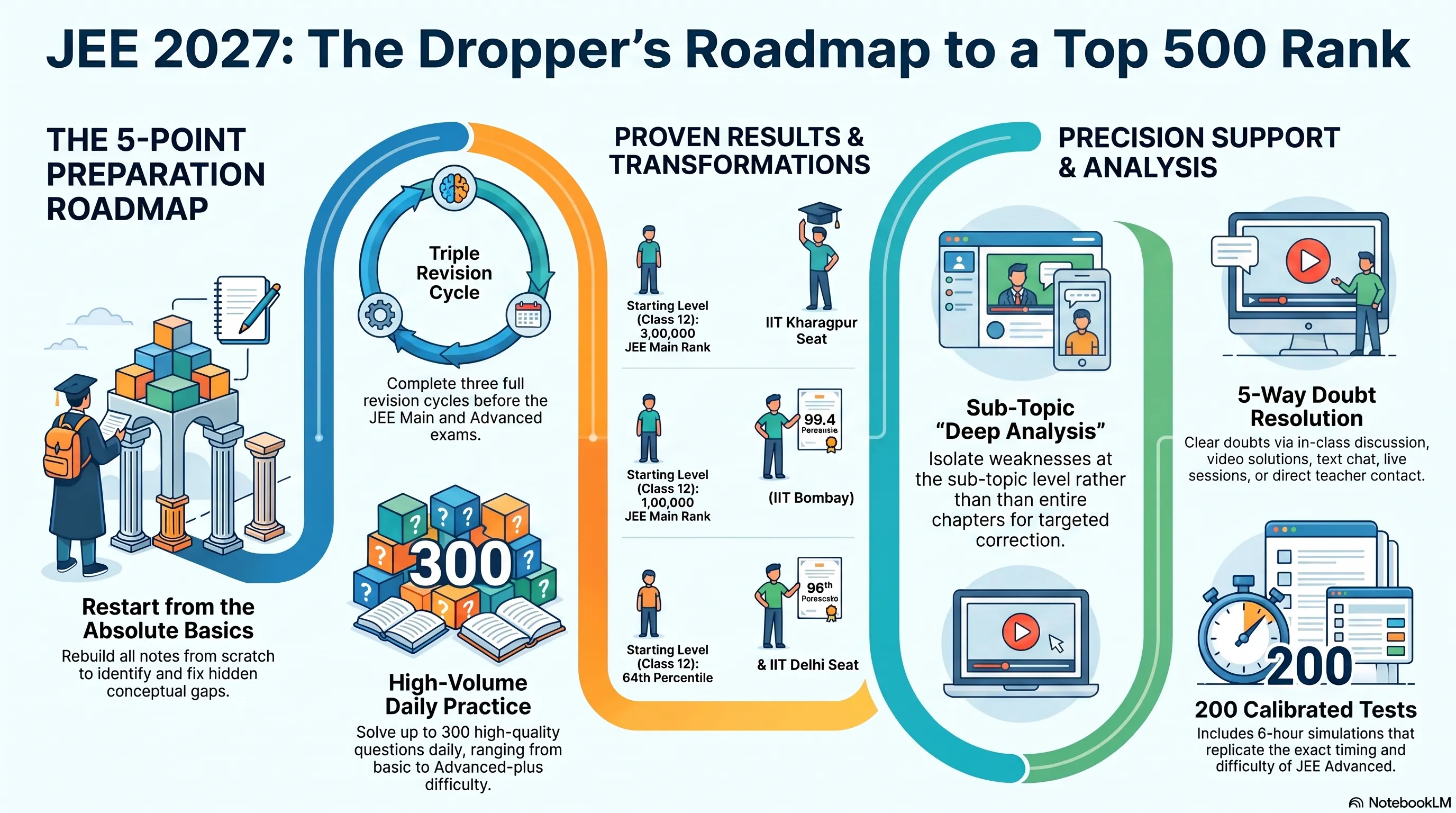
eSaral also cites students who moved from a 3,00,000-range JEE Main rank in Class 12 to IIT Kharagpur, and from a 1,00,000-range rank in Class 12 to a 99.4 percentile and an IIT Bombay seat. One student, Uday Shankar, lost his vision entirely but did not lose his dream — he scored a 97.5 percentile in his drop year and is headed to IIT Hyderabad.
The message behind these examples is consistent: a structured drop year with sustained daily effort can close a large gap in a relatively short window.
Who Should Join a JEE Dropper Batch?
Before the "how," eSaral defines what makes someone a serious JEE aspirant — and the Abhinav Warrior 2.0 batch is built specifically for this profile:
- Genuinely enjoys the subjects rather than treating study as a chore — someone who studies Physics, Chemistry and Maths because they like the subjects, not just to clear an exam.
- Studies a minimum of 10 to 12 hours daily.
- Doesn't get trapped in pure theory — practices questions continuously and takes regular tests instead of only reading.
If a student is ready to commit to this, the batch promises India's highest level of online teaching, material, testing and doubt-support, positioned above both other online platforms and offline "top-secret" batches. Scholarships of up to 100% are available, based on a student's JEE Main or JEE Advanced 2026 performance. An offline version of the Warrior batch is also starting soon at the eSaral Gurukul centre, with similarly performance-based discounts of up to 100%. Board exam support, including English classes, board-pattern tests and PTMs, is included for students who still have boards pending.
The 5-Point Preparation Roadmap
eSaral lays out five core actions every dropper in the Abhinav Warrior 2.0 batch follows for JEE 2027:
1. Restart from the basics. Even students scoring 99.6–99.8 percentile in the batch are rebuilding notes from scratch rather than reusing Class 11–12 material, because that's exactly how they reach that level. The batch identifies where a student's understanding fell short the first time around and rebuilds from there — at the highest difficulty level across Physics, Chemistry and Maths, across the full 10-month batch.
2. Study in a guided structure. A week of unaddressed backlog in the drop year can snowball into a backlog that never clears before JEE Main attempt one. eSaral assigns two mentors per student who call when a class is missed and are available for instant guidance — a structure credited as central to the batch's 1,600 JEE Advanced selections, including top ranks like 79 and 112.
3. Revise three times before the main exams. A full revision cycle happens before JEE Main attempt one, a second revision before JEE Main attempt two, and a third revision before JEE Advanced — meaning every topic is revised three times before the exams that matter most.
4. Practice 300 high-quality questions daily across the year, scaling from roughly 70–80 questions a day while the syllabus is still being taught, up to 120–130 a day later in the year when the focus shifts to pure practice, over the available ~300-day window. Questions span basic to two or three levels above JEE Advanced difficulty.
5. Attempt 200 tests through the batch. eSaral notes that for most students who finished in the top 1,000 JEE Advanced ranks, their eSaral test scores typically ran 20–30 marks below their eventual JEE Advanced score — meaning the test difficulty is calibrated above both JEE Advanced and the tougher JEE Main shifts.
💡 Tip from eSaral's directors: Directors personally call students who miss tests to follow up directly — a level of individual involvement eSaral says is uncommon at scale, framed around the idea that a drop year doesn't come back twice.
How Test Analysis and Deep Analysis Work
Every test in the batch comes with a 20-page analysis report covering strengths and areas to improve, with mentors guiding students through it directly. A newly added Deep Analysis feature goes down to the sub-topic level. For example, if a student appears weak in an entire chapter like Rotational Motion, Deep Analysis can isolate that the actual weakness is confined to a specific sub-topic — such as moment of inertia, or only the solubility portion of ionic equilibrium — rather than the whole chapter.
Once a weak sub-topic is identified, the system follows up with targeted PYQ practice, a concept revision, and a similar question on that exact sub-topic — closing the loop from diagnosis to correction.
One example shared by eSaral: a student scoring 140–150 marks across two tests crossed 200 marks for the first time after correcting three specific mistakes flagged through this process — forgetting formulas, mistaking incorrect methods for correct ones, and losing questions to slow speed. All three were corrected within a month through one-to-one mentor guidance.
The Complete Teaching and Mentorship Structure
The batch's full-year roadmap finishes the syllabus by December, followed by structured revision cycles ahead of JEE Main and JEE Advanced. Teaching is delivered by senior faculty with 24–37 years of experience, including teachers from IIT Bombay, IIT Delhi and IIT Roorkee, in two-way interactive live classes — both teacher and student keep audio and video on, enabling real-time back-and-forth during theory, question discussion and test discussion, so doubts get resolved in the same session rather than turning into backlog.s.
Additional mentorship elements include backlog recovery sessions, speed-practice sessions to improve attempt speed, and live test sessions that recreate an exam-hall environment — functioning as a live study room even for students preparing remotely.
How Homework, Quizzes and Tests Are Structured
After each class, homework is assigned first from CPP (Class Practice Problems), then from the module. The module contains four exercises:
| Exercise | Difficulty Level |
|---|---|
| Exercise 1 | Moderate |
| Exercise 1A | Moderate, pattern-based |
| Exercise 2 | Tough, JEE Main-aligned |
| Exercise 2 (Advanced) | Toughest JEE Advanced pattern (single correct, multiple correct, paragraph type, matching list, match-the-column, triple match) |
After homework, students unlock a quiz calibrated to recent tough JEE Advanced papers (cited years: 2016, 2022, 2025, 2026), then a Special Quiz one level above that, then Rank Booster 1, and finally Rank Booster 2 — pitched well above JEE Advanced difficulty.
On the testing side, students get a JEE Main-pattern chapter test and a JEE Advanced-pattern chapter test as soon as each chapter is completed, a 3-hour full JEE Main test, and a 6-hour test replicating the exact JEE Advanced timing (9:00–12:00 and 2:30–5:30) — each followed by the 20-page analysis report described earlier.
The 5 Ways Doubts Get Cleared
eSaral structures doubt resolution across five channels so unresolved doubts don't accumulate into backlogs:
- In-class discussion — homework is actively discussed and cross-questioned in class, not just handed back with a video solution.
- Textual and video solutions — available for any doubts missed during the live session.
- Text/chat support — students can resolve doubts by messaging directly.
- Live doubt-solving classes — dedicated sessions for doubts on any chapter from earlier in the syllabus, even months later (for example, raising a September chapter doubt in October).
- Direct teacher contact — students can also connect with the teacher directly for clarification.
Short notes are also provided for revision, alongside chapter-wise and full-length tests, rounding out an end-to-end preparation cycle for JEE Main and JEE Advanced.
🚀 Checkout eSaral Courses
Frequently Asked Questions
Find answers to common questions.
Is a top 500 rank realistic for a JEE dropper starting preparation now?
Yes — eSaral cites Arya, who secured AIR 378, a top 500 rank, starting preparation around the same point in the year as most droppers. With the months remaining before JEE Advanced, eSaral states this is sufficient time for a top 100 rank, provided a student doesn't give up.
What is the Abhinav Warrior 2.0 batch?
It is eSaral's JEE 2027 dropper batch, named after a student, Abhinav, who improved from a 64 percentile to a 98 percentile in 100 days. The batch combines basics-first teaching, guided mentorship, three revision cycles, 300 daily questions and 200 tests across the year.
How many tests and questions does the batch include?
Students get access to 300 high-quality questions per day on average across the year and 200 tests overall, each followed by a 20-page analysis report, including a sub-topic-level Deep Analysis feature.
How are doubts resolved in a JEE dropper batch?
Through five channels — in-class discussion, textual and video solutions, chat support, dedicated live doubt-solving classes for older chapters, and direct teacher contact — designed so unresolved doubts don't turn into backlogs.
Is a scholarship available for the JEE 2027 dropper batch?
Yes, up to 100% scholarship is available for both the online and offline (Gurukul) Warrior batches, based on a student's JEE Main or JEE Advanced 2026 performance.