JEE 2027 Preparation: How to Crack JEE When Class 11 Is Weak
Yes, you can absolutely crack JEE 2027 even if Class 11 was weak. The key is committing fully to the next 7 months, completing the entire syllabus by December, then revising intensively through January. With structured mentorship, 12-hour daily study discipline, and the right learning material progression, thousands of students with similar Class 11 struggles have cracked top IITs.

Table of Contents
- Why Weak Class 11 Doesn't Mean You Can't Crack JEE
- Real Stories: Students Who Cracked Top IITs Despite Poor Class 11
- The 7-Month Timeline: From Now to JEE Main January 2027
- The Four Pillars of Last-Minute JEE Preparation
- How to Build the Right Material Progression
- The 5-Layer Doubt Solving System
- Test Strategy: 250+ Tests and AI-Powered Analysis
- Simultaneous Board Preparation Without Losing Focus
- How Mentorship Changes Your Results

eSaral › JEE › JEE Main ›JEE 2027 Preparation: How to Crack JEE When Class 11 Is Weak

🚀 Checkout eSaral Courses
Why Weak Class 11 Doesn't Mean You Can't Crack JEE
A weak Class 11 is not your final assessment—it's your starting point.
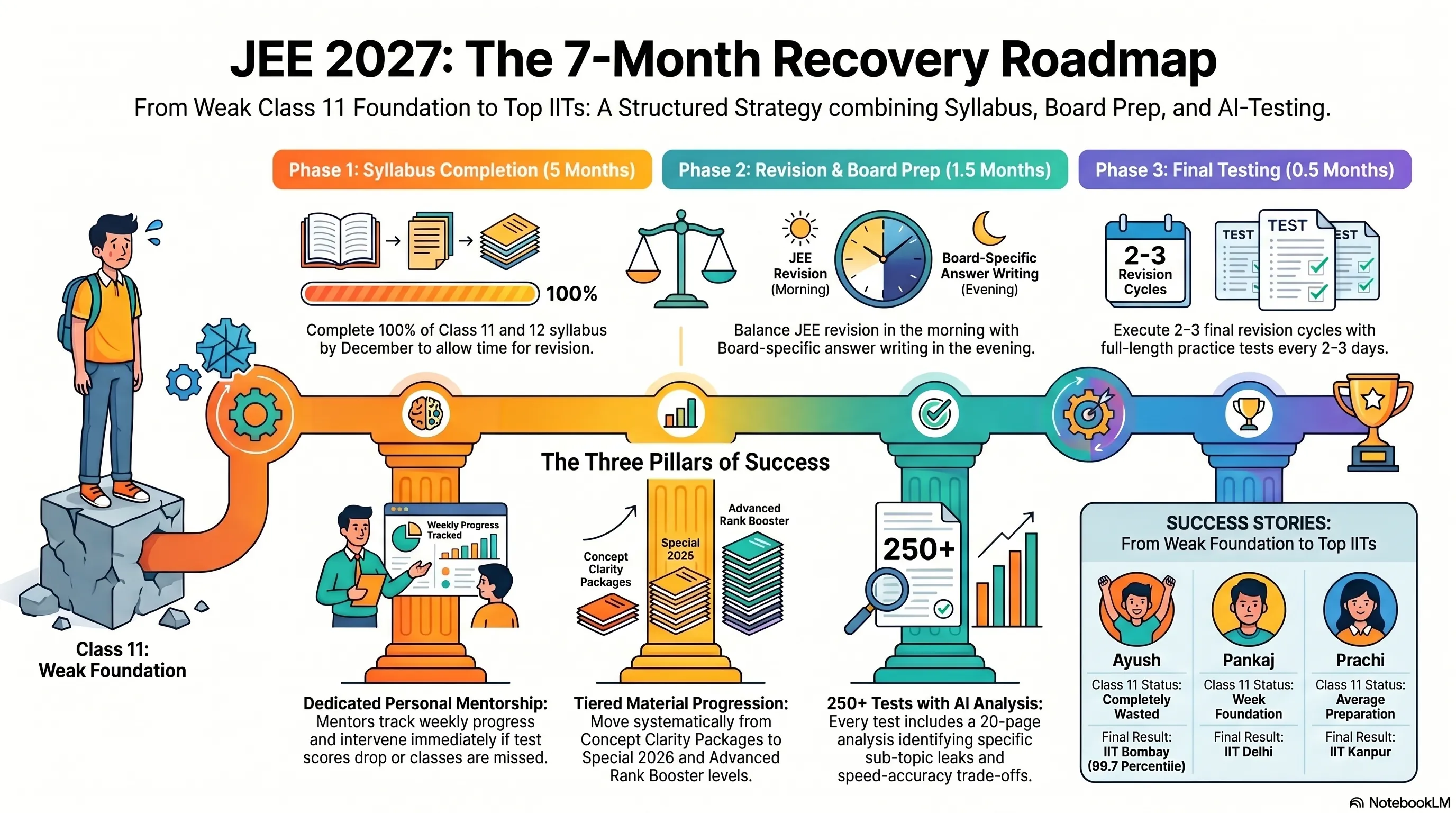
In the last 10 years, hundreds of eSaral students have proven this. Take Ayush: his entire Class 11 was wasted. Test scores were nowhere close to where they needed to be. By the time he committed fully in Class 12, confidence had shattered. Within 7 months of focused preparation, Ayush scored 99.7 percentile and cracked IIT Bombay. Or Prachi, whose Class 11 was average, but after structured preparation she secured admission to IIT Kanpur. Manu had similar struggles and got into IIT Roorkee.
Why does this happen? Because the Class 11 syllabus fundamentals keep repeating in Class 12 questions. Every chapter you struggled with in Class 11—mechanics, thermodynamics, organic chemistry, coordinate geometry—shows up again in Class 12. You get a second chance to master it. The students who leverage this second chance and simultaneously complete Class 12 properly are the ones who crack top ranks.
The fear you feel right now is normal. But the students above felt exactly that fear. The difference is they didn't give up.
Real Stories: Students Who Cracked Top IITs Despite Poor Class 11
Your situation is not unique. Here's what successful students with weak Class 11 have in common:
| Student | Class 11 Status | Final Result | Time to Crack |
|---|---|---|---|
| Ayush | Completely wasted | IIT Bombay (99.7 percentile) | 7 months |
| Prachi | Average preparation | IIT Kanpur | 7 months |
| Manu | Average preparation | IIT Roorkee | 7 months |
| Pankaj | Weak foundation | IIT Delhi | 8 months |
| Manthan | Average preparation | IIT Bombay | 7 months |
These aren't exceptions. This pattern repeats. Last year, eSaral had over 1,600 successful selections into top IITs. Many were students who started Class 12 with weak Class 11 preparation.
What they all had in common:
- Absolute commitment to the process (no half-measures)
- Structured material progression starting from basics
- Immediate doubt resolution (no backlog of confusion)
- Dedicated mentors tracking their progress weekly
- 250+ practice tests with detailed analysis
- 12-hour minimum daily study discipline
The question isn't "Can I crack JEE?" The question is: "Am I willing to commit fully for the next 7 months?"
🚀 11th Wasted? Start From Zero & Crack JEE 2027 with Prahaar!
The 7-Month Timeline: From Now to JEE Main January 2027
Your preparation has three clear phases. Understand them now, and execute them perfectly.
Phase 1: Syllabus Completion (Now through December) — 5 Months
Your target: Finish 100% of Class 11 and Class 12 syllabus by end of December.
This is non-negotiable. Why? Because revision—the component that transforms 60 percentile into 99+ percentile—requires your syllabus to be finished. You cannot revise what you haven't learned yet. Most students who fail are those still learning new chapters in December, leaving no time for revision.
What this phase includes:
- Class 11 fundamentals recovered through structured recorded lectures (visualisation-based, not generic video lectures)
- Class 12 chapters completed through live interactive classes with faculty
- Immediate doubt resolution within the class itself (no backlogs)
- Daily homework with discussion in the next class
- Chapter-wise JEE Main and JEE Advanced practice tests
Your first 5 months are speed + depth combined, not just one or the other.
Phase 2: First Revision & Board Prep (January until Board Exams) — 1.5 Months
January is revision month for JEE, but it's also Board exam study month.
How to handle both:
- Morning: JEE revision with live classes
- Afternoon/Evening: Board exam-specific preparation (answer writing, practical revision, theoretical depth for Board scoring)
- The same fundamentals you studied for JEE directly support 90%+ in Boards. There's minimal overlap conflict if managed properly.
eSaral's simultaneous prep strategy ensures you score high in both without sacrificing your JEE rank. Students from the last batch: 99.7 percentile in JEE AND 95%+ in Boards.
Phase 3: Final Revisions & Testing (After Boards until JEE Main January 2027) — 0.5 Months
By Board exams (February), your syllabus is 100% complete. You have 2–3 final revision cycles before JEE Main.
- Full-length practice tests every 2–3 days
- Topic-specific accuracy sessions to eliminate careless errors
- All-India competitive testing against lakhs of students
- Individual performance analysis and targeted remediation
🚀 11th Wasted? Start From Zero & Crack JEE 2027 with Prahaar!
🚀 11th Wasted? Start From Zero & Crack JEE 2027 with Prahaar!
The Four Pillars of Last-Minute JEE Preparation
Your preparation rests on four non-negotiable pillars. Miss anyone, and cracks form.
Pillar 1: Two-Way Interactive Live Classes (Not Recorded Lectures)
Generic online coaching = teacher talks, students watch, doubts pile up.
eSaral's approach is different. Live two-way interaction means:
- You raise your hand (via chat). You ask. The teacher answers in real-time.
- Physics concepts are explained by Saransh Gupta Sir or similar Kota-calibre faculty who have 20+ years teaching AIR 1, 2, 3 rankers.
- Your doubt clears in seconds. You move forward. No backlog of confusion accumulates.
This is critical for students with weak Class 11. The moment you don't understand something, clarity needs to come immediately. Otherwise, you build a castle of confusion on a shaky foundation.
💡 Expert Tip by Prateek Gupta, IIT Bombay : "The students who crack top IITs are not always the smartest. They are the ones who never let a doubt sit for more than a class or two. A resolved doubt today is learned knowledge. An unresolved doubt becomes a blocker for 10 future chapters."
Pillar 2: Dedicated Mentorship & Personal Care
You miss one class. In a typical batch, nobody notices. In the right program, two mentors call you within hours, asking why.
When your test scores drop, in a typical setup, you get a report. In a proper system, your mentor analyzes which exact subtopics are weak, creates a recovery plan, and tracks you weekly until you improve.
This is the difference. Not all students study 12 hours. But students with mentors who track whether they're studying 12 hours study 12 hours. Students with mentors who analyze test mistakes at the sub-topic level don't repeat those mistakes.
Example: One student from the last batch had weak Physics. Her cutoff wasn't clearing. Mentor identified that she was strong in mechanics but weak in waves and thermodynamics. Dedicated weekend sessions on those topics. Three months later: Physics improved by 50 marks. Same student went from borderline selection to top IIT.
This level of care is not the default. It's intentional infrastructure.
Pillar 3: Strategic Material Progression (From Easy to JEE Advanced Level)
You cannot go straight from "foundational confusion" to "JEE Advanced problems." You'll crash.
The right progression:
- Conceptual Clarity Packages (CCP): Super clear, easy-level questions. Concepts sink in.
- Module Exercises (4 progressions per chapter): Medium to hard. Builds confidence.
- Special 2026 Material: JEE 2026 was the toughest in history. All three subjects got harder. eSaral built special material matching that level.
- Advanced Quizzes & Rank Boosters: Two levels above JEE Advanced standard.
Most coaching doesn't tier like this. Most give everyone the same material. Some students finish the easy module and get stuck on advanced problems—they drop out mentally. Others breeze through and get bored.
Tiered material means every student is challenged at the right level. You always feel stretched but capable, never overwhelmed or underwhelmed.
Pillar 4: 250+ Tests With AI-Powered Analysis
You take a test. You get a score. Now what?
Most coaching: "Here's your score report."
eSaral approach: 20-page AI-powered analysis that tells you:
- Which subtopics are you weak in (not just "Physics is weak," but "In Rotation chapter, specifically Conservation of Angular Momentum is weak")
- Exactly which types of questions you get wrong (calculation-heavy vs. conceptual vs. logic-based)
- Your speed vs. accuracy trade-off
- How do you compare to your peer cohort and all-India toppers
You then meet your mentor with this analysis. Together, you plug the exact leaks. By next test, you avoid those mistakes.
This is how 50–60 marks improve in 2–3 months. Not by doing 1,000 random questions. But by identifying your exact weak point and fixing it systematically.
🚀 11th Wasted? Start From Zero & Crack JEE 2027 with Prahaar!
How to Build the Right Material Progression
Understanding the material progression is half the battle.
The Material Ladder (Easiest to Hardest)
Level 1 — Conceptual Clarity Packages (CCP)
- Super foundational questions
- Designed for students recovering from Class 11 backlogs
- You develop confidence and concept clarity
- Everyone starts here; nobody feels lost
Level 2 — Module Exercises (4 per chapter)
- Medium difficulty, then progressively harder
- Each module has different question types
- Builds problem-solving techniques
- The section where you learn "how to think" about JEE questions
Level 3 — Special 2026 Material
- When JEE 2026 happened, all three subjects got harder
- Maths toughened. Chemistry toughened. Physics shifted.
- eSaral built special material matching that difficulty
- This material is what top-scorers train on
Level 4 — Advanced Quizzes & Rank Boosters
- Two levels above the JEE Advanced standard
- Reserved for students targeting top 100 ranks
- Only attempt after mastering Level 3
- This is where 99.9 percentile comes from
How to Use This Progression Without Wasting Time
Don't jump levels. If you skip CCP and go straight to Special 2026, you'll crash. If you camp in Level 1 forever, you won't reach 99 percentile.
Here's the rule:
- Finish CCP for a chapter (2–3 days per chapter depending on difficulty)
- Complete all 4 Module exercises for that chapter (3–4 days)
- Take the chapter-wise JEE Main test and JEE Advanced test
- If you score 70%+ on both, move to next chapter
- If you score below 70%, spend 2 days in Level 3 and Level 4 material for that chapter only, then retest
This ensures you're always at the edge of your capability, neither bored nor overwhelmed.
The 5-Layer Doubt Solving System
Doubts are the silent killers of JEE preparation. A doubt ignored for a week becomes a blocker for 10 chapters. A doubt cleared in the same class becomes learned knowledge.
eSaral's system has 5 layers. Use them in this order:
Layer 1: Class Discussion
When you don't understand in the live class, you ask immediately. The teacher clarifies. Doubt done. Cost: 2 minutes.
Layer 2: Textual Solution + Video Solution
For homework questions, access both a written solution and a video walkthrough. Read or watch. Cost: 5 minutes.
Layer 3: Chat-Based Doubt Solving
Can't you explain by text? Snap a photo, upload it to the app, and describe the issue. A tutor responds with an explanation. Cost: 15–30 minutes.
Layer 4: Live Doubt Solving Sessions
Dedicated time slots (Physics, Chemistry, Maths tutors present). You join live, camera on, ask in real-time, get clarification. Exactly like going to a doubt counter in offline coaching. Cost: 10–20 minutes per session; 4–5 sessions per week available.
Layer 5: Mentor One-On-One
For persistent doubts on specific topics, your assigned mentor books a 1-on-1 session. Deep dive until cleared. Cost: 30–45 minutes; reserved for critical gaps.
The magic: Most students never hit Layer 5. Most doubts are cleared in Layers 1–3. But knowing Layer 5 exists removes anxiety.
🚀 11th Wasted? Start From Zero & Crack JEE 2027 with Prahaar!
Test Strategy: 250+ Tests and AI-Powered Analysis
You will take 250+ tests over 7 months. Sounds like a lot? It's not. Here's the breakdown:
Test Frequency Breakdown
| Test Type | Count | Timing | Purpose |
|---|---|---|---|
| Chapter-wise JEE Main tests | 90+ | After each chapter completion | Concept check + speed building |
| Chapter-wise JEE Advanced tests | 90+ | After each chapter in Modules 3–4 | Difficulty ramp-up |
| Full-length 3-hour JEE Main tests | 30+ | Every 5–7 days during the syllabus phase | Speed + stamina + sectional balance |
| Full-length 6-hour JEE Advanced tests | 20+ | Every 10–14 days during revision | Advanced difficulty + endurance |
| All-India test series (online + offline) | 20+ | Weekly during the revision phase (Jan–June 2027) | Competitive percentile tracking |
| Revision tests | 20+ | Every 3 weeks following the revision schedule | Retention check |
Total: 250+
Each test gets a 20-page AI analysis covering:
- Difficulty level distribution
- Your accuracy by topic and question type
- Time management (section-wise breakdown)
- Strong topics (maintain them)
- Weak topics (improvement targets)
- Percentile vs. peer group and all-India average
How to Use Test Analysis
Don't just look at the score. Use the analysis:
- Identify weak sub-topics (e.g., "Electrostatics, specifically Electric Potential and Capacitors")
- Identify weak question types (e.g., "Calculation-heavy questions in Thermodynamics")
- Identify speed leaks (e.g., "Spending too much time on easy questions; skipping harder ones")
- Meet your mentor with this analysis
- Create a targeted recovery plan (e.g., "5 sessions on Potential & Capacitors; then 20 calculation-based practice questions")
- Track progress on next test
This is not random practice. This is surgical precision in improvement.
Simultaneous Board Preparation Without Losing Focus
Question: "Sir, I have Boards in February. How do I prepare for Boards while crushing JEE?"
Answer: The foundations overlap by 90%. But execution differs.
What's the Same?
Physics concepts, Chemistry reactions, Maths proofs—these are identical in JEE and Board exams. A concept clear for JEE is a concept clear for Boards.
What's Different?
- JEE: Speed (1.2 min/question), conceptual application, multiple interpretations
- Boards: Depth (full solution writing), procedural correctness, standard answer format
How to Prepare for Both Simultaneously
Months 1–5 (Nov–Mar, overlapping):
- Morning/Forenoon: JEE preparation (chapters, concepts, tests)
- Afternoon/Evening: Board-specific work (answer writing practice, practicals, Board-standard solution format)
Timeline detail:
- After completing a chapter for JEE (with tests), spend 3–4 days on Board question practice for that chapter
- Practice writing answers in Board exam format (complete sentences, derivations, diagrams)
- Your mentor guides Board-specific focus areas
Result: When Boards arrive in February, you've already written Board-style answers 100+ times. Boards feel like a formality. Most eSaral students score 90%+ in Boards AND 99+ percentile in JEE simultaneously.
Example: Last year's student scored 99.7 percentile in JEE and 95% in Boards.
How Mentorship Changes Your Results
Mentorship is the invisible force that separates students who improve and students who don't.
Without Mentorship
- Miss a class → Nobody notices → 3 more classes missed → Backlog begins
- Test score drops 10 points → You see the score, assume you're weak → Confidence decreases → Study becomes inconsistent
- You get stuck on a concept → No one guides you → You try alone for 2 hours → Either force a wrong understanding or give up
- You spend 6 hours studying → Mentor doesn't know → Might actually be studying inefficiently, but nobody corrects
- Result: Potential 95 percentile becomes 70 percentile
With Dedicated Mentorship
- Miss a class → Mentor calls within hours → You give a reason → Mentor creates a recovery plan
- Test score drops 10 points → Mentor analyzes which sub-topics caused it → Specific sessions scheduled → Next test you've improved
- Stuck on a concept → Mentor clarifies in a session → You move forward with confidence
- Studying 12 hours → Mentor asks how it's spent → Gives feedback on efficiency → You shift from 12 hours of scattered work to 10 hours of focused work
- Result: 95 percentile becomes 99.5+ percentile
One last-minute intervention prevents 3 months of wasted effort. One strategic test analysis prevents 20 repeat mistakes.
🚀 Checkout eSaral Courses
Frequently Asked Questions
Find answers to common questions.
Can I really crack JEE 2027 if my Class 11 was very weak?
Yes, absolutely. The transcript shows multiple examples: Ayush (Class 11 completely wasted → IIT Bombay 99.7 percentile), Prachi (weak Class 11 → IIT Kanpur), Manu (weak foundation → IIT Roorkee). The key is committing fully now and using structured recovery methods starting immediately. Class 11 is your past; your next 7 months are your future.
How many hours should I study daily for JEE 2027?
Minimum 12 hours every single day. This includes live classes (3 hours), homework (2 hours), tests/practice (4 hours), revision/doubt solving (3 hours). This is not negotiable for reaching 99 percentile. Students targeting IIT Bombay or IIT Delhi consistently study 12 hours throughout the preparation phase.
What if I can't finish the entire syllabus by December?
You will not be able to revise thoroughly, and revision is what takes you from 60 to 99 percentile. Finishing by December is non-negotiable. The mentorship system ensures you stay on track and don't fall behind. If you start falling behind, mentors intervene with a recovery plan.
How do you prepare for Boards and JEE simultaneously?
Boards and JEE have 90% overlapping content. Morning/forenoon: JEE prep. Afternoon/evening: Board-specific answer writing and practicals. Once you've completed a chapter for JEE, dedicate 3–4 days to Board-format answers for that chapter. Most eSaral students score 90%+ in Boards while maintaining 99+ percentile prep.
What's the difference between 250+ tests and just studying harder?
Tests with AI analysis reveal your exact weak points (specific sub-topics, specific question types). Blind studying means you might spend 10 hours on topics you already know. Tests let you spend 1 hour on the 3 sub-topics actually holding you back. This is surgical precision vs. scattered effort. That difference is 30–50 marks on JEE Main.