JEE 2027 Preparation Strategy: How to Crack JEE with 3 Lakh Competitors (Based on JEE Advanced 2026 Analysis)
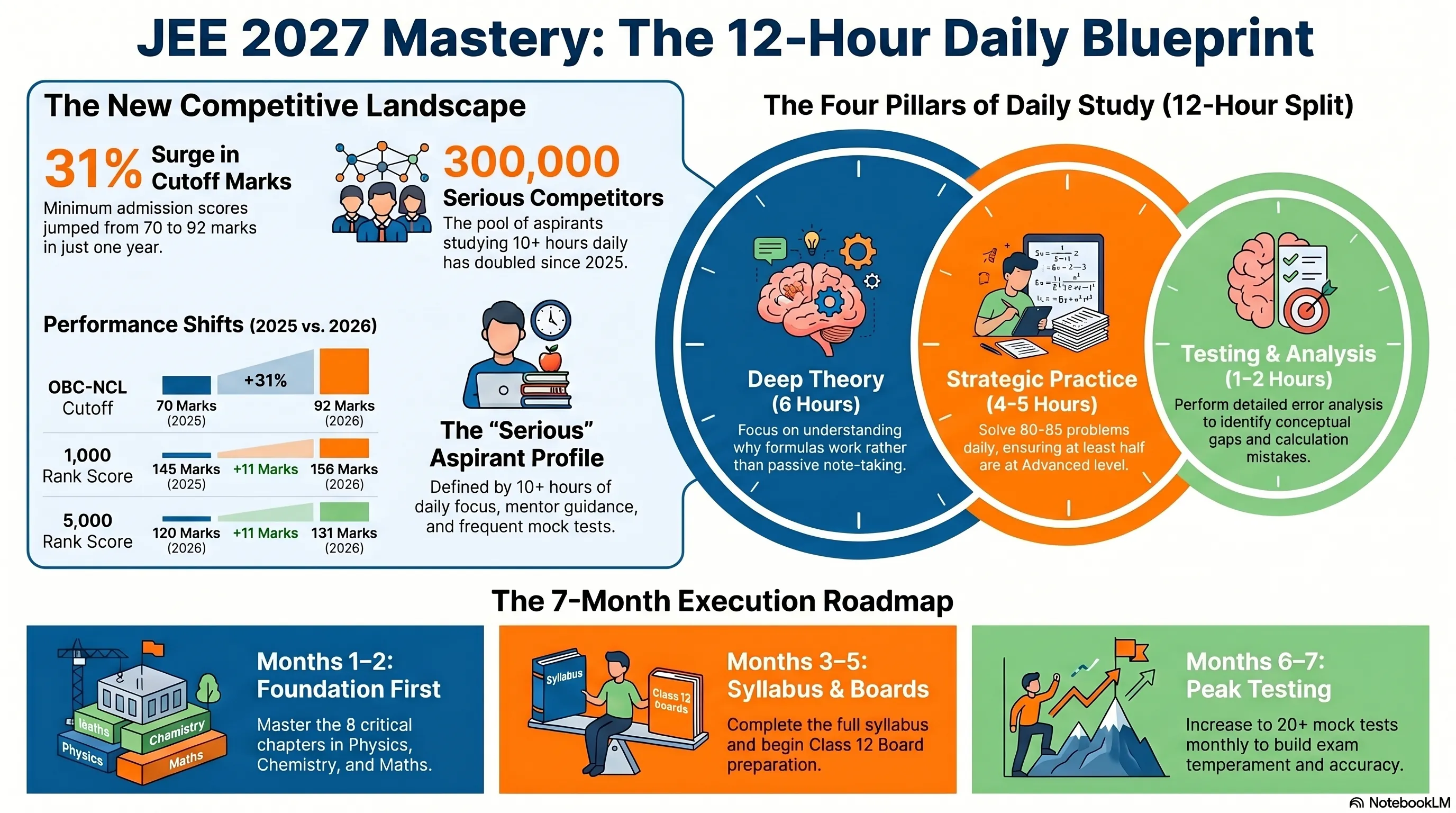
The JEE 2027 preparation strategy requires a fundamental shift due to dramatically increased competition. JEE Advanced 2026 revealed that cutoffs jumped from 70 to 92 marks—a 31% jump—because serious competitors increased from 2 lakh to 2.5 lakh. In 2027, expect 3 lakh competitors. To rank in the top 2000, you need 12 hours of daily study: 6 hours of deep conceptual theory, 80–85 daily practice questions (40–50 advanced-level), 6+ monthly mock tests, and rigorous test analysis.

Table of Contents
- The JEE Advanced 2026 Shock: Why the Cutoff Jumped to 92
- Competition Surge: From 2 Lakh to 3 Lakh Serious Aspirants
- Why JEE 2027 Will Be the Toughest Exam in JEE History
- The 12-Hour Daily Study Requirement: No Shortcuts
- Critical Chapters You Must Master First
- The Exact 7-Month Preparation Roadmap
- Theory, Practice, Testing, and Analysis: The Four Pillars
- The Mindset that Separates Toppers from Failures

eSaral › JEE › JEE Main ›JEE 2027 Preparation Strategy

🚀 Checkout eSaral Courses
The JEE Advanced 2026 Shock: Why the Cutoff Jumped to 92
When JEE Advanced 2026 results were announced, something unprecedented happened: the cutoff for admission jumped from 70 marks to 92 marks.
That's a 31% increase in one year.
What This Number Means
Let's break down what this reveals about the exam difficulty and competition:
| Metric | JEE Advanced 2025 | JEE Advanced 2026 | Change |
|---|---|---|---|
| Cutoff (OBC-NCL) | 70 marks | 92 marks | +22 marks (+31%) |
| Top 100 rank score | 278 marks | 274 marks | -4 marks |
| 1000 rank score | 145 marks | 156 marks | +11 marks |
| 5000 rank score | 120 marks | 131 marks | +11 marks |
Here's the crucial insight: The top 100 students actually scored slightly lower (278 → 274), which means the paper was slightly harder. But everywhere else down the ranking, students scored significantly higher marks to achieve the same rank.
This tells you one thing: the median competitor got significantly smarter.
💡 Insight by Prateek Gupta, IIT Bombay : "The top 100 students' performance is immune to competition changes—they always perform at their peak. But when everyone else's scores rise despite a harder paper, it means the quality of preparation has surged. That surge is what JEE 2027 aspirants must prepare for."
Why Did This Happen?
Two reasons:
- Better access to quality resources — Online coaching platforms (including eSaral) made IIT-level preparation accessible across India, not just in Kota.
- More serious aspirants — The number of students doing proper preparation (not just "attempting") doubled.
.webp)
Join eSaral's Droppers Batch – Available in both Online & Offline modes. Get expert guidance, structured preparation, and personalized mentorship to crack JEE/NEET with confidence!
Competition Surge: From 2 Lakh to 3 Lakh Serious Aspirants
Here's the raw truth: You're not competing against 15 lakh JEE aspirants. You're competing against 3 lakh serious aspirants.
The Numbers
| Year | Total JEE Candidates | Serious Competitors (Daily 10+ Hour Study) | Expected in 2027 |
|---|---|---|---|
| 2025 | ~15 lakh | ~2 lakh | — |
| 2026 | ~15.5 lakh | ~2.5 lakh | — |
| 2027 | ~16 lakh | ~3 lakh (projected) | Target for you |
What does "serious competitor" mean?
- Studies 10+ hours daily with genuine focus
- Has access to quality resources (IIT-faculty content, structured programs)
- Takes regular mock tests and analyzes them
- Follows a mentor-guided system, not random YouTube tutorials
The Psychological Impact
When you sit in the exam hall for JEE 2027, remember: The person sitting next to you has probably studied 10+ hours daily for months. They've solved 5,000+ problems. They've taken 30+ mock tests. They've discussed their doubts with mentors.
This is why the cutoff jumped. This is why you need a different strategy.
Why JEE 2027 Will Be the Toughest Exam in JEE History
It's not just about paper difficulty. It's about the aggregate competition level.
The Cricket Analogy
Prateek Gupta explains it best: You need 200 runs. In a 50-over match, you can play defensively. In a T20, you must average 10 runs per over.
JEE 2027 is a T20 with limited resources. You have 7 months (if you're in Class 12) or 12 months (if you're a dropper). The target is massive. The time is compressed.
You cannot afford to play slow.
What Makes 2027 Tougher Than Previous Years
- Syllabus Completion: You must finish Class 12 board syllabus + JEE Main + JEE Advanced syllabi in the same time frame
- Revision Time: Previous toppers had 3-4 months for revision. You'll have compressed revision
- Competition Quality: Every serious competitor now has access to IIT-faculty teaching and mentor guidance—something that was a Kota privilege 5 years ago
- Cutoff Inflation: To get into a top IIT, you need top 2000 rank, which now requires 92+ marks in Advanced (vs. 70 marks just last year)
💡 Expert Tip from eSaral Mentors: "The exam paper itself isn't exponentially harder. But the median aspirant is exponentially better prepared. That's the real difficulty."
The 12-Hour Daily Study Requirement: No Shortcuts
Let's address the elephant in the room: You need to study 12 hours daily to crack JEE 2027.
Why Not Less?
Many students ask: "Sir, can't I crack JEE with 8-10 hours daily?"
Short answer: No. Not in 2027. Not with 3 lakh competitors.
Here's why:
Syllabus Coverage: JEE Main + Advanced covers ~500 hours of lecture content across Physics, Chemistry, and Math. If you study 8 hours daily, and only 6 hours is fresh content (rest is revision), you'll need 83 days just to finish lectures. That leaves you 5 months for practice and tests. Not enough.
Practice Volume: You need to solve 80–85 practice questions daily, with 40–50 of them at advanced level. This takes time—research, problem-solving, cross-checking, noting mistakes.
Test Taking: 6+ monthly tests × 12 months = 72 tests. Each test takes 3 hours, analysis takes 2 hours. That's 5+ hours per month just for testing. Over a year, that's 60 hours.
Total: 500 hours theory + 300 hours practice + 60 hours testing + 100 hours revision = 960 hours minimum. Spread over 12 months, that's 2.3 hours per day. But add inefficiency, breaks, and a realistic day structure: you're at 12 hours daily.
But What About Toppers Who Study 14–15 Hours?
Yes, some toppers study 14–15 hours daily. Why? Because they started in Class 7 or 8. They have foundational comfort. You might not have that luxury.
The rule: Study as much as you can, but 12 hours is the bare minimum for a serious Top 2000 aspirant.
How to Track Your 12 Hours
Use one of these proven methods:
Method 1: Chit Method
- Carry 12 chits in your pocket
- Every hour of genuine study, tear one chit
- Aim to tear all 12 by end of day
Method 2: Diary Method
- Write numbers 1–12 in a diary each night
- Strike them off as each hour is completed
- Satisfaction from seeing progress builds momentum
Student Testimonial
"I was skeptical. But I committed to 12 hours using the chit method. Within a month, my problem-solving speed increased by 40%. By month 4, I had done 10,000+ problems. The cutoff didn't scare me because I'd already done the work." — Akshay, eSaral student, AIR 342 (2026)
Critical Chapters You Must Master First
Here's what data from JEE Advanced 2026 revealed: 95% of questions use concepts from just 8 critical chapters.
If your foundation in these chapters is weak, the remaining 80% of your syllabus won't help.
The Critical 8 Chapters
Physics:
- Mechanics (Newton's Laws, kinematics, energy, momentum)
- Waves and Sound
- Thermodynamics and Kinetic Theory
- MOL concept (Moles and molar relationships—appears in 70%+ of chemistry questions)
Chemistry:
- Atomic Structure and Periodicity (periodic table trends)
- Bonding and Molecular Structure
- Coordination Chemistry and Inorganic Compounds
- General Organic Chemistry (GOC) — Reaction mechanisms, functional groups, substitution
- Physical Chemistry calculations involving MOL
Math:
- Calculus (differentiation, integration, application problems)
- Algebra (quadratic equations, polynomials, inequalities)
- Coordinate Geometry
- Probability and Combinatorics
Why These Chapters Are Non-Negotiable
Every other chapter builds on these. If you're weak in:
- Calculus: You'll struggle with optimization problems in Physics (e.g., minimum distance, maximum power)
- MOL concept: You'll fail 40% of Chemistry questions that require stoichiometry
- GOC: You'll guess on organic synthesis questions instead of solving logically
eSaral's Approach for 2027 Batches
In all eSaral's new batches (Super Warrior 2.0, Prateek Gupta's program, offline Gurukul batches), these 8 chapters receive dedicated focus first—before any other topic. This ensures every student has a bulletproof foundation.
Join eSaral's Droppers Batch – Available in both Online & Offline modes. Get expert guidance, structured preparation, and personalized mentorship to crack JEE/NEET with confidence!
The Exact 7-Month Preparation Roadmap
You're reading this in June 2026. JEE Main is in January 2027 (7 months away). Here's your month-by-month strategy:
Month 1–2: June–July (Foundation + Critical Chapters)
Goal: Master the 8 critical chapters at a conceptual level
Daily Breakdown (12 hours):
- 5 hours: Deep theory lectures on critical chapters
- 4 hours: Practice 40–50 questions on those chapters
- 2 hours: Mentor discussion + doubt solving
- 1 hour: Revision of previous concepts
Outcomes by End of July:
- All 8 critical chapters should feel intuitive, not memorized
- You should solve foundation-level problems confidently
- Your mentor should identify your weak spots within these chapters
Month 3–4: August–September (Expand to Full Syllabus)
Goal: Finish all JEE Main and JEE Advanced syllabi
Daily Breakdown (12 hours):
- 4 hours: New theory lectures (moving beyond critical chapters)
- 5 hours: Practice 80–85 questions (mix of old chapters and new)
- 2 hours: Mock tests or test analysis
- 1 hour: Mentorship discussions
Outcomes by End of September:
- Full JEE Main syllabus covered
- 70% of JEE Advanced syllabus covered
- Monthly tests started (aim for 6–8 tests)
Month 5: October (Revision + Board Exam Prep for Class 12)
Goal: Revision cycle starts; complete JEE Advanced; board exam preparation begins (if Class 12)
Note for Class 12 Students: Start board exam preparation in October, not December. Exam pressure in January–February will make revision impossible. October–November is your window.
Daily Breakdown (12 hours):
- 2 hours: Board subjects (if Class 12)
- 3 hours: JEE Advanced completion + revision of Main syllabus
- 4 hours: Practice 80–85 questions (increasing difficulty)
- 2 hours: 2 full mock tests per week (12–15 tests this month)
- 1 hour: Test analysis and doubt resolution
Outcomes by End of October:
- All syllabi covered completely
- Board exams on track (Class 12)
- Monthly test count: 15+ (you should see improvement)
Month 6: November (Intensive Revision + Peak Testing)
Goal: Maximize accuracy; bring scores to 90%+ in your strong areas
Daily Breakdown (12 hours):
- 1 hour: Board exam prep (if applicable)
- 2 hours: Revision (concept review, formula sheets, key problem types)
- 4 hours: Advanced-level practice (targeting JEE Advanced level problems)
- 3 hours: Full-length mock tests (20–25 tests this month)
- 2 hours: Detailed test analysis (minimum 2 tests per week analyzed deeply)
Outcomes by End of November:
- Mock test scores stabilizing at 85%+ of target
- Error patterns identified and corrected
- Board exams completed (if Class 12)
Month 7: December (Final Precision + Mental Preparation)
Goal: Lock in your knowledge; build exam confidence
Daily Breakdown (12 hours):
- 5 hours: Targeted practice on weak areas (based on test analysis)
- 3 hours: Full-length tests under exam conditions (simulating January exam stress)
- 2 hours: Speed and accuracy drills (test-specific)
- 1 hour: Revision of critical chapters
- 1 hour: Mental conditioning + rest
Outcomes by End of December:
- You should be scoring 85%+ consistently
- You should know your weak spots and have a recovery plan
- You should feel ready
Theory, Practice, Testing, and Analysis: The Four Pillars
Here's what separates the 1,600 eSaral students who got into IITs from the rest:
Pillar 1: Deep Conceptual Theory (6 Hours Daily)
What NOT to do:
- Sit in class passively, listening to teacher explanations
- Copy large segments of notes without understanding
- Move forward without discussing concepts with mentors
What TO do:
- Watch lectures but pause every 2 minutes to connect the concept to problems
- Read the chapter, watch the lecture, then discuss it with your mentor or study group
- Understand WHY a formula works, not just how to apply it
- Work through detailed problems that show step-by-step logic
Why eSaral's approach works: Theory lectures are followed by module problems and mentor discussions. The module problems aren't homework—they're in-lecture problems that the mentor solves alongside you, discussing the logic. This interactive approach builds deeper understanding than passive lectures.
Time breakdown for theory (6 hours):
- 1 hour: Fresh theory lecture
- 1 hour: Detailed module problems + mentor walkthrough
- 0.5 hours: Mentor discussion on confusions
- 1.5 hours: Revision (practice problems from previous lectures)
- 1.5 hours: Board exam content (if Class 12) or advanced application
Pillar 2: Strategic Practice (4–5 Hours Daily)
The number: 80–85 problems per day
The breakdown:
- 30–35 problems: Easy to medium level (build speed and accuracy)
- 40–50 problems: Advanced level (these stretch your thinking)
Why advanced-level problems matter: An "advanced" problem doesn't mean harder for the sake of difficulty. It means a problem where multiple concepts connect. Example: A single problem might require calculus from Math, MOL concept from Chemistry, and energy conservation from Physics. Solving 40–50 such problems monthly builds the interconnectedness that JEE tests.
Real constraint: You can't solve 80–85 problems daily by yourself. You need:
- DPP (Daily Problem Practice) from eSaral curated with increasing difficulty
- Discussion of 5–10 problems daily with mentors (not all 85—focus on the tricky ones)
- Tracked error analysis (your mentor should know which types of problems you consistently miss)
Pillar 3: Regular Testing (6–25 Tests Per Month)
The Schedule:
| Month | Test Count | Type |
|---|---|---|
| Months 1–2 | 6 | Chapter tests |
| Months 3–4 | 12–15 | Mixed chapter + cumulative |
| Months 5–6 | 20 | Full JEE Main + Advanced length |
| Month 7 | 12 | Exam-condition simulations |
| Total | 60–70 | — |
What each test should cover:
- Chapter-wise tests: Single topic mastery
- Cumulative tests: Topics from months 1–2 combined
- Full-length tests: Entire JEE Main (3 hours) or JEE Advanced (6 hours) under exam conditions
Why 6+ monthly tests early, 20–25 later? Early tests identify what you know and don't know. Later tests build your exam temperament—your ability to maintain focus and make decisions under 3-hour pressure.
Pillar 4: Detailed Test Analysis (2 Tests Analyzed Per Month, Minimum)
This is where most students fail.
Students take 50 tests, review their score, see "85/120," and move on. That's useless.
What proper analysis looks like:
Step 1: Score Breakdown (15 minutes)
- Physics: 28/40
- Chemistry: 32/40
- Math: 25/40
- Insight: Chemistry is strong. Physics and Math need work.
Step 2: Error Type Breakdown (20 minutes)
- Conceptual mistakes: 5 (didn't understand the concept)
- Calculation errors: 3 (understood but made arithmetic errors)
- Time management: 2 (understood but ran out of time)
- Misread question: 2 (read carelessly)
- Insight: Conceptual gaps are the biggest issue.
Step 3: Chapter-wise Performance (15 minutes)
- Mechanics (Physics): 6/8 (weak in circular motion)
- Calculus (Math): 4/8 (weak in integration problems)
- Organic Chemistry (Chem): 10/12 (strong)
Step 4: Next Steps (10 minutes)
- Revise circular motion theory (1 hour)
- Practice 10 integration problems (1.5 hours)
- Maintain strength in organic chemistry
Time needed: 60 minutes of analysis per test
Minimum frequency: Analyze 2 tests per month in detail (this takes 2 hours total). eSaral's mentors do this with every student.
Join eSaral's Droppers Batch – Available in both Online & Offline modes. Get expert guidance, structured preparation, and personalized mentorship to crack JEE/NEET with confidence!
The Mindset that Separates Toppers from Failures
Preparation strategy is 60% of success. The remaining 40% is mindset.
Mindset 1: "It's You Versus You"
The trap: Comparing yourself with classmates, roommates, friends
The truth: The only comparison that matters is your progress. Ask yourself daily: "Am I better today than I was yesterday?"
If the answer is yes, you're winning. Doesn't matter if someone else is also improving faster. That's irrelevant.
Mindset 2: "Next 6 Months Will Determine Your Life"
This isn't dramatic. It's factual.
The decisions you make about how you spend your time in the next 6 months will cascade into:
- Which IIT you go to
- Which branch you get
- Which startup or company recruits you
- Your income trajectory for the next decade
Students who recognize this intensity disconnect from unnecessary things. They:
- Delete Instagram and Facebook
- Avoid WhatsApp groups (especially those with friends from other cities)
- Stop watching Netflix and YouTube entertainment
- Minimize phone usage to 30 minutes daily
This isn't punishment. It's prioritization.
Mindset 3: "Toughness is a Feature, Not a Bug"
You'll face:
- Moments where you feel your prep is wasting time
- Days when you're exhausted and want to quit
- Tests where you score lower than expected
- Concepts that refuse to stick
Topper mindset: This toughness is the experience that builds your resilience. Every other JEE aspirant faces the same. The ones who push through these moments are the ones who crack JEE.
eSaral students who cracked JEE reported this consistently: "I didn't enjoy the journey. But I learned that I can push through discomfort. That learning was worth more than the IIT admission itself."
Mindset 4: "Focus is a Weapon"
In an age of distraction, deep focus for 12 hours daily is a superpower.
Real toppers aren't smarter. They're just better at ignoring distractions.
How?
- Phone: Physically separate from your study area. Give it to a parent during study hours.
- Notifications: Turn off all app notifications. Check email/messages once daily.
- Social media: Delete apps entirely. Don't just mute them.
- Peers: Avoid study group gossip. Study together, but with focused purpose.
💡 From Prateek Gupta's experience: "Every topper I've met has one thing in common: social media amnesia. They genuinely forgot their Instagram password or deleted their account. When you eliminate distractions, you're not losing social life—you're gaining 2 extra hours of study daily. That's 60 hours per month, or 360 hours in 6 months. That's the difference between good and top ranks."
🚀 Checkout eSaral Courses
Frequently Asked Questions
Find answers to common questions.
Is 12 hours of daily study actually necessary, or is it just motivational talk?
It's mathematically necessary. With 3 lakh serious competitors, each doing 10+ hours daily, you need at least 12 hours to have a competitive edge. Don't take my word—take the data: eSaral's 1,600 successful students averaged 11.5 hours daily over 12 months. The dropouts averaged 6–7 hours daily.
I'm weak in Physics. Should I focus only on Physics or follow the balanced approach?
Follow the balanced approach for months 1–4 (covering all syllabi). From month 5 onward, allocate your 12 hours by weakness ratio. If Physics is 30% weaker than other subjects, spend 30% extra time on Physics within your total 12 hours. Don't abandon other subjects.
What if I don't have 7 months? It's already September.
You have 4 months. Realistic target: Top 5000 rank (AIR 5000 in 2027 will likely require 75–80 marks). The strategy remains same—12 hours daily, focus on critical chapters first, then expand. You'll compress Months 1–2 into 1 month and maintain the rest.
Can online coaching actually prepare me as well as offline Kota coaching?
Yes. eSaral's results prove it: Top 500 ranks, AIR 79, 1,600+ IIT selections from online-only students. The advantage of online: flexibility, personalized pacing, mentor access 24/7, no distraction from hostel life. The risk: self-discipline. If you can maintain 12-hour focus at home, online is equal to or better than offline.
How should I balance JEE preparation with board exams (Class 12)?
Start board prep in July, not October. Allocate 2 hours daily (months 1–3) to board subjects, increasing to 3 hours in months 4–5, and 4 hours in October–November. This way, board exams are done by February, leaving March–April for JEE Main revision. If you delay board prep to October, January board exam pressure will destroy your JEE Advanced prep.