JEE 2028 Preparation Guide for Class 11: 2-Year Roadmap to Top 100 IIT Rank
JEE 2028 preparation for Class 11 students begins with a structured 2-year plan: complete the full Class 11 syllabus by December of the first year, finish Class 12 by October of the second year, and complete five revision cycles before JEE Advanced. Students who study 10–12 hours daily with chapter-wise tests and personalised mentorship from Class 11 consistently achieve top 100 ranks — as proven by data from the last 20 years. Read the complete guide below for a detailed, step-by-step breakdown.

Table of Contents
- Is a Top 100 JEE Rank Possible Starting from Class 11
- The Brutal Truth: What 20 Years of JEE Data Actually Shows
- The Complete 2-Year JEE 2028 Study Plan — Month by
- How Many Hours Should You Study Daily for JEE 2028
- What Study Material Do You Actually Need for JEE 2028
- How Does the Homework and Test System Work for 2 Years
- Why Mentorship Is the Factor That Separates Toppers from the


Is a Top 100 JEE Rank Possible Starting from Class 11
Every year, thousands of Class 10 students make a decision that determines where they spend the next four years of their lives. Some start JEE preparation in Class 11 with a clear plan. Others delay, get distracted, or start without structure. The difference in outcomes is not about intelligence — it is about that decision and what follows it.
The good news: a top 100 JEE Advanced rank is absolutely achievable from a Class 11 start. This is not motivational talk. It is what the data from the last 20 years of JEE results shows consistently.
eSaral has produced 1,550+ IITians in 2025 alone, with 1,200+ crossing 99 percentile in JEE Main. Students who started from Class 11 with no prior coaching background, who had never touched JEE-level problems before May of their Class 11 year, went on to achieve AIR rankings in the top 100 and top 500. The mechanism that made this possible is teachable, structured, and repeatable.
💡 Expert Tip by Prateek Gupta, studied at IIT Mumbai: The students who crack IIT from Class 11 are not the ones who were already solving olympiad problems in Class 9. They are the ones who committed to a process — a fixed daily schedule, chapter-wise mastery, and accountability — and executed it for 24 months without deviation. That commitment is the only prerequisite.
The ambition is clear: IIT Bombay CS, IIT Delhi CS, JEE Advanced top 100, JEE Main 99.9 percentile, and 90%+ in boards. All of this from Class 11. The question is not whether it is possible. The question is: what exactly must you do for the next two years?
The Brutal Truth: What 20 Years of JEE Data Actually Shows
Before building a plan, you must understand what actually produces top JEE ranks. The data is unambiguous:
Where Top 100 JEE Rankers Come From
Over the last 20 years of JEE Advanced results:
| Category | % of Top 100 Rankers |
|---|---|
| 2-year preparation (Class 11 + 12) | ~70% or more |
| 1-year preparation (drop year or Class 12 only) | ~20–25% |
| 3+ year preparation (starting Class 9 or earlier) | ~5–10% |
The majority of the top 100 rankers were prepared for exactly two years — Class 11 and Class 12. Not three years. Not five years. Two focused, structured years.
This data has one important implication: starting early beyond Class 11 does not statistically improve your odds of a top 100 rank. What improves your odds is the quality and structure of the 2 years you have.
The Concern About Students Who Started Earlier
Many Class 11 students worry: "Log Class 8, 9, 10 se taiyari kar rahe hain. Main unse kaise compete karunga?" Here is the honest answer.
Students who start in Class 8 or 9 often spend their early years building a surface-level familiarity with topics — but rarely the deep problem-solving ability JEE Advanced demands. Many arrive in Class 11 with incorrect concepts that need to be re-learned. A fresh Class 11 start, done right, is not a disadvantage. It is often cleaner.
Your competition is not the student who started in Class 9. Your competition is the student who will study better, more consistently, and with more accountability than you in the next two years.
The Complete 2-Year JEE 2028 Study Plan — Month by
This is the exact timeline that produces top results. Every month has a specific role. Deviate from this and the revision cycles — which are the real differentiator — get compressed.
Year 1 (Class 11) — Timeline
| Period | Focus |
|---|---|
| April–August | Full Class 11 syllabus coverage — all three subjects in parallel |
| September–November | Chapter-wise tests + DPP practice + first revision of completed chapters |
| December | Class 11 syllabus complete. Begin first full revision. |
Year 2 (Class 12) — Timeline
| Period | Focus |
|---|---|
| January–July | Class 12 syllabus coverage — with Class 11 concepts revisited in parallel |
| July onwards | Board preparation begins (dedicated board classes, board test series) |
| October | Full Class 12 syllabus complete — with Class 11 revision embedded |
| November–December | Second and third revision cycles for JEE Main |
| January | JEE Main 1 — targeting 99.9 percentile |
| February–March | Fourth revision — JEE Main 2 + Board preparation |
| April | Fifth revision — JEE Advanced final preparation |
| May | JEE Advanced — targeting top 100 |
Five revision cycles total before JEE Advanced. This is what separates students who score 200+ in JEE Advanced from students who score 120–150. The content is the same. The number of times it has been revisited is not.
💡 Expert Tip by NK Gupta, 37 Years Kota Teaching Experience: The single biggest mistake I have seen in 37 years of teaching JEE is students who delay syllabus completion. If your Class 11 syllabus is not done by December, your revision cycles get eaten. You will walk into JEE Advanced having revised once instead of five times. One revision versus five revisions is the difference between top 100 and top 5000.
For a complete chapter-by-chapter breakdown of what needs to be covered, refer to the JEE Main syllabus and JEE Advanced syllabus with their full topic lists and weightages.
How Many Hours Should You Study Daily for JEE 2028
The honest answer is 10–12 hours per day on average — including live classes and self-study combined. But the number alone is misleading. What matters far more is the quality of those hours.
What "10–12 Hours" Actually Means
| Time Block | Activity | Hours |
|---|---|---|
| Morning | Live classes (Physics + Chemistry + Maths) | 4–5 hours |
| Afternoon | Revise the morning's class content | 1.5–2 hours |
| Evening | Question practice — all 3 subjects | 3–4 hours |
| Night | Chapter-wise test (when applicable) / formula revision | 1 hour |
Total: 10–12 hours.
What Destroys Effective Hours
Many students sit for 14–16 hours but achieve an output of 6. The culprits are predictable:
- Spending 45 minutes on one problem that should take 15 minutes (set a timer — 15 minutes per problem maximum)
- Social media breaks that stretch from 10 minutes to 2 hours
- Studying one subject heavily for 3 days and ignoring the other two
- No fixed sleep schedule — leading to grogginess during morning classes
How Many Questions Per Day?
In the first months of Class 11, the focus is on concept understanding — not question volume. As you progress:
- Class 11 (May–August): 40–60 questions per day across three subjects
- Class 11 (September–December): 60–80 questions per day, chapter-wise test days included
- Class 12: 70–90 questions per day, with increasing full-syllabus test frequency
The homework system in eSaral's Brahmos 2.0 batch provides 500 questions per subject across the module's four exercise levels — sufficient for all three subjects combined to hit 1,500 fresh questions through Year 1 alone.
What Study Material Do You Actually Need for JEE 2028
This is where most Class 11 students waste money and time. They buy 10–15 books, work through none of them fully, and end up with gaps everywhere.
The Only Material You Need
The entire JEE 2028 preparation — from Class 11 basics to AIR 1 level — requires exactly three sources:
- eSaral module — four exercise levels per chapter (Exercise 1 for JEE Main easy, Exercise 1A for JEE Advanced moderate, Exercise 2 for JEE Main tough, Exercise 2A for JEE Advanced toughest)
- NCERT — mandatory for Chemistry, especially in the organic and theory sections
- Irodov — for advanced Physics problems in Year 2
That is it. No additional books. No extra resources. The students who score in the top 100 ranks are not the ones with the most books — they are the ones who have done fewer books completely.
The Module's Unlock System
| Level | Material | What It Builds |
|---|---|---|
| Level 1 | CPP (Class Practice Problems) | Formula recall, basic concept application |
| Level 2 | Module Exercises 1 & 1A | JEE Main + JEE Advanced moderate level |
| Level 3 | Exercise 2 & 2A | JEE Main tough + JEE Advanced toughest |
| Level 4 | Quiz → Super Quiz | Speed and accuracy under pressure |
| Level 5 | Shaktiman Material + Rank Booster | AIR 1-level problems — Kota's secret material |
Students who complete all five levels unlock Kota's highest-level preparation material from home. The same material that was previously available only to the top 30–40 students, hand-picked from lakhs in Kota's elite batches
How Does the Homework and Test System Work for 2 Years
The Chapter-Wise Test Sequence
After every chapter is completed, the following test sequence runs:
- JEE Main chapter-wise test — 30 questions, JEE Main pattern, 1 hour
- JEE Advanced chapter-wise test — 17 questions, JEE Advanced pattern, 1 hour
- Part-syllabus test — every 21–28 days, covers 4–5 chapters together
- Full-syllabus test (3 hours) — JEE Main pattern, starts after the partial syllabus is done
- Full-syllabus test (6 hours) — JEE Advanced pattern, Paper 1 + Paper 2
Total across 2 years: 350+ tests. This is not a number chosen arbitrarily. It is the minimum test volume needed to build the test temperament, speed, and decision-making that JEE Advanced demands on exam day.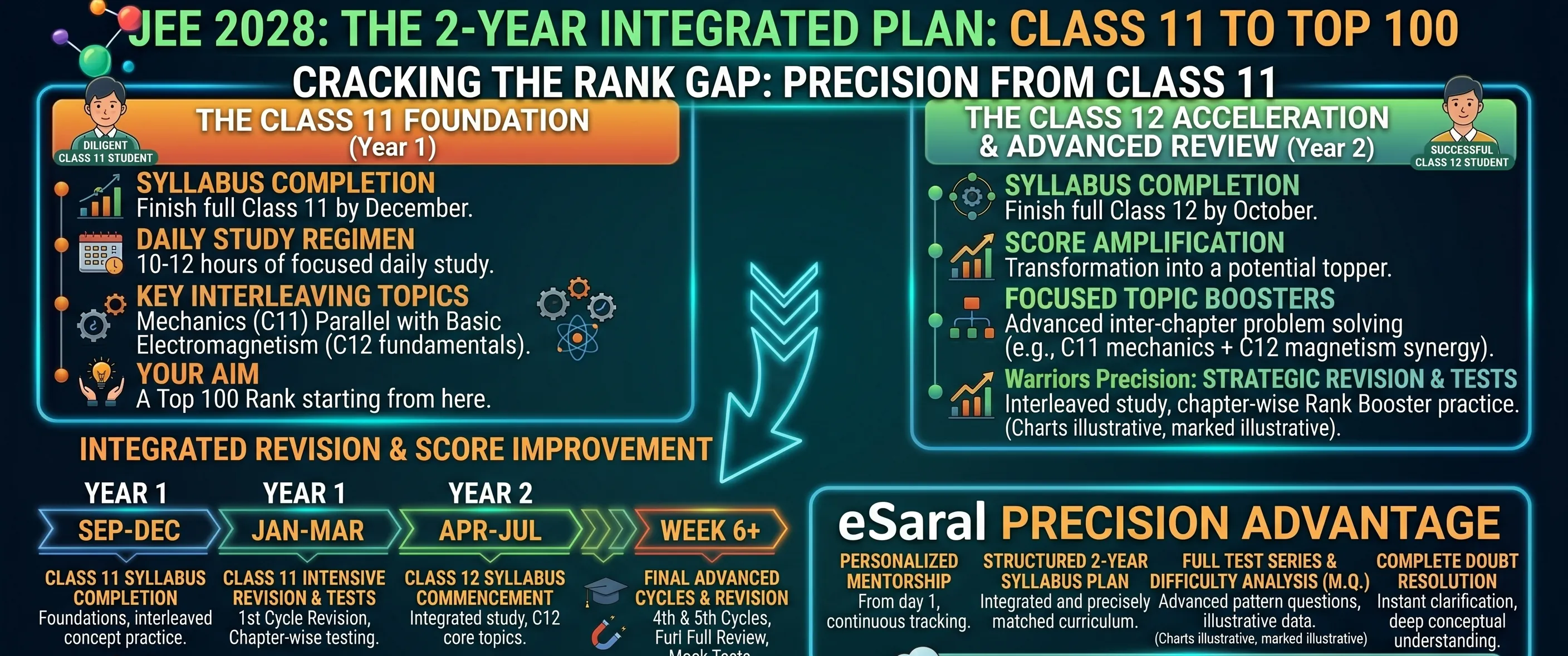
The 20-Page AI-Powered Test Analysis Report
After every test, students receive an AI-powered 20-page analysis report. This report shows:
- Overall accuracy and speed
- Chapter-wise accuracy breakdown
- Sub-topic level weaknesses (e.g., not just "Organic Chemistry weak" but "Cannizzaro reaction specifically incorrect")
- Peer comparison — what percentage of students solved each question, and in how much time
- Consolidated report across multiple tests — showing patterns across 3–5 papers
| Report Feature | What It Tells You |
|---|---|
| Chapter accuracy | Which chapters need immediate revision |
| Sub-topic breakdown | Exactly which concept within the chapter is failing |
| Time-per-question | Where you over-invest time on low-probability questions |
| Peer comparison | Which questions should you have got right that most students didn't |
The consolidated report feature — available after every 3 tests — shows cross-test patterns. This turns guesswork into precision. You do not revise the chapter that "feels weak." You revise the exact sub-topic the data says is weak.
Why Mentorship Is the Factor That Separates Toppers from the
Every student who has gone through Kota's top batches — the ones producing consistent top 100 ranks — has one thing in common that nobody talks about publicly: they had dedicated mentors tracking every single thing they did.
In Kota's elite batches, this was the exclusive privilege of the top 30–40 students selected from lakhs of applicants. eSaral has replicated this system for every student in the batch — regardless of their starting marks.
What Your Two Dedicated Mentors Actually Do
Each student in eSaral's Brahmos 2.0 batch gets two assigned mentors with personal phone numbers. Their responsibilities across the 2-year journey:
| Mentor Responsibility | Frequency |
|---|---|
| Attendance tracking — call if class missed | Every class |
| Homework checking | Daily |
| Notes verification | Weekly |
| Study hours tracking | Daily |
| Test analysis review | After every test |
| Distraction and time management counselling | As needed |
| Backlog recovery sessions | When backlogs detected |
| Board preparation guidance | From July, Year 2 |
| Overall AI analysis review — hours, efficiency, focus | Monthly |
The mentor system also tracks how many hours you study outside class (live + recorded), how many questions you attempt, and how many tests you complete. Every single thing is tracked.
What Happens When You Stop Attending
The moment class attendance drops, the mentor calls — not the next day, not the next week, but the same day. "Aaj class kyun nahi aaye? Kaise chalega aise?"
This is not punitive. It is protective. One missed class becomes two. Two becomes a week. A week becomes a backlog. A backlog becomes the reason a student's Class 11 gets wasted. The mentor's job is to catch this at step one — not step five.
In eSaral's 2025 batch, the highest-selection-ratio institution in India for JEE, every three students who enrolled — one reached their dream college. That is not a coincidence. That is what happens when mentorship is not optional.
Frequently Asked Questions
Find answers to common questions.
How should a Class 11 student start JEE 2028 preparation?
A Class 11 student starting JEE 2028 preparation should begin by covering all three subjects — Physics, Chemistry, and Maths — simultaneously from day one, following a structured module with four difficulty levels. The goal is to complete the full Class 11 JEE syllabus by December, then move into Class 12 coverage with parallel revision cycles. Daily study of 10–12 hours with chapter-wise tests is the baseline.
How many hours should a Class 11 student study for JEE 2028 daily?
A Class 11 student targeting JEE 2028 should study 10–12 hours daily on average — including live classes and self-study combined. This breaks down as 4–5 hours of classes, 1.5–2 hours of revision, 3–4 hours of question practice, and 1 hour of test or formula revision. Quality of those hours matters more than raw duration.
What is the best 2-year JEE preparation plan after Class 10?
The best 2-year JEE preparation plan after Class 10 completes Class 11 syllabus by December of Year 1, Class 12 syllabus by October of Year 2, and runs five revision cycles before JEE Advanced. Board preparation runs in parallel from July of Year 2. Chapter-wise tests follow every completed chapter, and full-syllabus 3-hour and 6-hour mock tests run monthly from Year 2.
Can I get a top 100 rank in JEE Advanced 2028, starting preparation from Class 11?
Yes, a top 100 rank in JEE Advanced 2028 is achievable starting from Class 11. Over 70% of the top 100 JEE Advanced rankers in the last 20 years prepared for exactly 2 years — Class 11 and Class 12. The key requirements are completing the syllabus on time, doing five revision cycles before JEE Advanced, studying 10–12 hours daily, and having a mentorship system that prevents backlogs.
How many questions should a Class 11 JEE 2028 student do per day?
A Class 11 JEE 2028 student should aim for 40–60 questions per day across all three subjects in the first months, increasing to 60–80 per day as more chapters are completed and tests begin. The total across Year 1 from eSaral's module alone exceeds 1,500 questions — enough to build the problem-solving depth JEE Advanced demands without needing additional books
What books are needed for JEE 2028 preparation from Class 11?
For JEE 2028 preparation from Class 11, only three sources are needed: a quality JEE module with four exercise difficulty levels, NCERT for Chemistry theory and Inorganic, and Irodov for advanced Physics in Year 2. No additional books are required. Students with top 100 ranks consistently report that doing fewer sources completely outperforms doing many sources partially.
Is online JEE preparation as effective as offline Kota coaching for JEE 2028?
Online JEE preparation is equally effective as offline Kota coaching for JEE 2028 — provided the online platform offers two-way interactive live classes (not recorded-only), dedicated mentors per student, chapter-wise and full-syllabus tests with detailed analysis, and module discussion in class. The key differentiator between Kota's top results and average results was always interactive teaching and mentorship — both of which can be delivered online.